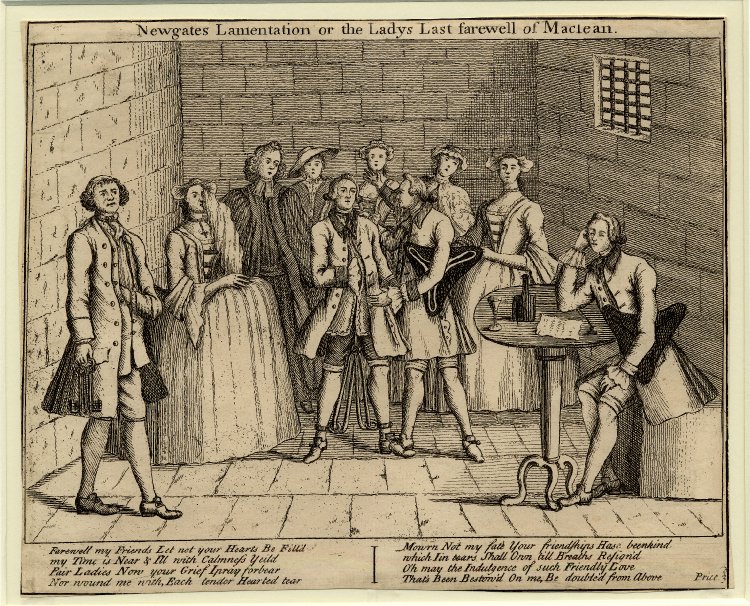
1750: James Maclaine

Gentleman highwayman James MacLaine hanged at Tyburn on this date in 1750.

The debauched son of a Presbyterian minister, MacLaine wasted first an inheritance and later a dowry on expensive clothes, gambling, and ladies of easy virtue; want, however, was his ticket to the immortality of the gallows when he joined fellow penniless gentleman William Plunkett to seek his revenue on the roads. (Inspiring the 1999 film Plunkett & Macleane — which uses one of several alternate spellings available for our man’s surname.)

For several months in 1749-1750 they prowled the environs of a lawless London, and notably Hyde Park, with the exaggerated courtesy demanded by romance of their profession. They found noteworthy prey: once, they stole a blunderbuss from the Earl of Eglington, though Eglington survived to suffer a noteworthy murder years later; in November 1749, they robbed M.P. Horace Walpole, even skimming his face with a pistol-ball that was inches wide from depriving posterity of the gothic novel.*

When caught** by mischance, the mannered† Maclaine became the object of public celebration, much to the bemusement of Walpole — who professed no ill will for his assailant but wondered that “there are as many prints and pamphlets about him as about the earthquake.”

Three thousand people are reported to have turned up on a sweltering summer Sunday to pay their admiration to the rogue, not excluding the very cream of society. Walpole teased his friends, court beauty Lady Caroline Fitzroy (wife of the Earl of Harrington) and her sidekick Miss Elizabeth Ashe, for presenting themselves among these masses to starfuck this latter-day Duval. “I call them Polly and Lucy,” he wrote, alluding to female conquests of the outlaw Macheath in The Beggar’s Opera, “and asked them if he did not sing,”

Thus I stand like the Turk with his doxies around.

Maclaine did not have to borrow Macheath’s ballads, for he was celebrated with verse dedicated all to him — like this “Jemmie Maclaine”, to the tune of Derry Down:

Ye Smarts and ye Jemmies, ye Ramillie Beaux,
With golden cocked hats, and with silver laced clothes,
Who by wit and invention your pockets maintain,
Come pity the fate of poor Jemmy Maclaine,

Derry down derry, etc.

He robb’d folks genteely, he robb’d with an air,
He robb’d them so well that he always took care
My lord was not hurt and my Lady not frighted,
And instead of being hanged he deserved to be knighted!

Derry down derry, etc.

William Hogarth‘s 1751 print cycle The Four Stages of Cruelty, one skeleton overseeing the operating theater where a hanged criminal is dissected is subtly labeled — Macleane.

* Walpole once remarked of the ubiquity of violent crime in London that “one is forced to travel, even at noon, as if one was going to battle.”

** Plunkett was never apprehended; it’s alleged that he ultimately escaped to North America.

† Although our man “has been called the gentleman highwayman,” the player-hating Ordinary of Newgate wrote, “and his dress and equipage very much affected the fine gentleman, yet to a man acquainted with good breeding, that can distinguish it from impudence and affectation, there was little in his address or behaviour, that could entitle him to that character.”

On this day..

1685: Krystof Alois Lautner, Witch Hammer victim

On this date in 1685, Catholic priest Kryštof* Alois Lautner was degraded from the clergy and burnt at the stake as a sorcer — but his real crime was standing athwart a witch hunt.

The term “witch craze” doesn’t quite seem the just one for the Northern Moravian witch trials since they spanned 18 terribly systematic years until the gouty main inquisitor mercifully retired in 1696, having put about 100 people to the sword and stake.

Generally understood in the context of Catholic hostility to reform denominations on the soil of the present-day Czech Republic, this dreadful affair started when a Vernirovice woman was caught sneaking the Host out of Easter Mass in 1678, intending to use it as a charm for a folk spell to enhance the fertility of her cows.

By 1679, that woman was burned at the stake — along with two others whom she was induced to accuse by the threat of torture.

These executions were the fruit of a witchcraft commission that had been empaneled to pursue the original desecration of the communion bread, but now that the witch team was an institution it began finding more and more necromancers, in a self-justifying spiral of accusations.

Lautner, a well-liked deacon of Sumperk, spoke against the witch hunt when it came to that city and for his pains he was arrested there in 1680 … then leisurely broken by torture over a period of four years until he was at last undone by accusations wrenched from the torture of the wealthy Sattler family. (Whose valuables the commission did not neglect to appropriate.) It was standard witchcraft fare: black sabbaths, incestuous orgies, pacts with Satan.

Milder tortures were used against him initially” the records say. “But those he admirably resisted, and remained obdurate. Then came harsher steps. Lautner began to confess, but when he was removed from the devices he recanted his admissions. So he was put to torture again and again, to defeat the devil’s secrecy. He was interrogated in June 1684 — twelve days in a row, except Sunday.” The case progressed so deliberately in part because the prosecution of a clergyman required the signoff of church heirarchy** … and in part because Lautner’s own friends intervened to try to free him. (One such ally, the priest Tomáš König, wrote a letter to the bishop on Lautner’s behalf and thereby became an object for investigation himself; it’s thought that he was about to be arrested by the witchsmellers when he fortuitously died in 1682.)

In the end the cleric could not hope to withstand the pressure. 20,000 people are reported to have swelled Sumperk for his execution by fire.

His case — which has latterly been commemorated by public monuments celebrating Lautner as a hero of conscience — was dramatized in the historical novel Witch Hammer by Vaclav Kaplicki. Otakar Vavry adapted the story for the silver screen; Kladivo na Carodejnice is available online in its entirety, but you’ll need to be up on your Czech.

* Hacek courtesy of Jan Hus!

** Pope Innocent XI ultimately signed off on proceedings, on the sententious grounds that clergy can’t be above the law when they traffic with devils.

On this day..

1824: Johann Christian Woyzeck, non compos mentis?

Johann Christian Woyzeck was publicly beheaded on this date in 1824 for fatally daggering his lover in a jealous wrath.

He was a rudderless orphan to whom the Napoleonic Wars gifted the stopgap profession of soldiering, but once the fighting stopped, Woyzeck wandered back to his native Leipzig and gave rein to his many vices.

Suicidal, drinking heavily, and unable to hold down steady work, Woyzeck frequently abused his special lady friend, the widow Johanna Christiane Woost. He would later say that he was often urged by voices in his mind to slay her — and on the night of June 21, 1821, after she canceled a rendezvous, he did so at last.

A pathetic exit from life turned out to be an entrance into judicial and literary history.

There was no question but that Woyzeck’s hand had taken Woost’s life, but proceedings against the killer dragged on for three years as courts vacillated on his mental competence. Woyzeck had been wildly depressed and owned to hallucinations and unbalanced moods that his contemporaries could readily recognize as falling near the pall of madness.

Nevertheless, Woyzeck had initially been slated for execution in November 1822 based on the evaluation of celebrated Leipzig physician Johann Christian August Clarus, but another doctor — academics will recognize the irksome intervention of reviewer no. 2 here — horned in with a missive questioning the conclusion.

That stay invited an 11th-hour stay and five more examinations worth of billable hours for Dr. Clarus, who studied up his man again and came to the same conclusion: that Woyzeck, though disturbed, was cogent enough to bear responsibility for his actions. It was in the end by this verdict that the executioner’s sword-arm swung.

The lost soul’s end on a Leipzig scaffold on this date would eventually inspire the writer Georg Buchner to pen the play Woyzeck. Though left unfinished when Buchner died young, the play has been frequently staged down to the present day, and even adapted for the silver screen by Werner Herzog:

On this day..

1990: Sam Cayhall in Grisham’s “The Chamber”

In John Grisham’s The Chamber, it is on August 8, 1990 that the titular enclosure receives its victim in a cloud of lethal gas.

In The Chamber, Sam Cayhall, a Ku Klux Klansman who had long avoided conviction for bombing a Jewish civil rights lawyer in 1967, has at last been condemned in Mississippi twenty years later.

The action centers around the futile and increasingly hopeless efforts of Cayhall’s grandson Adam Hall to save the old man working pro bono for a Chicago law firm.

Adam comes to learn that his grandfather has a long and bloody Klan history, even killing children. (We also find that the missing link in this generational drama, Adam’s father, committed suicide after Sam was sent to death row.)

But Sam is in no way a good guy: still an unreconstructed racist, he refuses to inform on any ex-confederates. As grandpa wends his way towards his date with the executioner, Adam’s torrent of judicial appeals go nowhere and the politically sensitive nature of the case makes executive clemency a non-starter. (When The Chamber was published in 1994, the death penalty was at an acme of popularity.) This is to be expected, of course; as Chekhov might observe, you can’t call the book The Chamber if someone isn’t going to go sit in said chamber by the end.

This bestseller was made into a 1996 film starring Gene Hackman as the grizzled Klansman. (In the film version’s execution scene, the date is changed to April 13, 1996.)

There’s an excerpt of the novel available on Grisham’s site here.

On this day..

1865: Okada Izo, barbarian-expeller

On this date in 1865, the Japanese samurai Okada Izo was dispatched by crucifixion.

He was one of* the “Four Hitokirimanslayers — whose legendary blades coruscated in the Bakumatsu era that marked Japan’s pivot from an isolationist feudal state, one where samurai were big men on prefectures, to a burgeoning modern power ruled by industry and mass conscription.

The irony was that dinosaurs like the Hitokiri helped bring the asteroid down on their own heads.

During the chaotic Bakumatsu period, triggered by Japan’s becoming involuntarily opened to the outside world, the emperor — long a figurehead marginalized by the shogun — entered the political fray under the xenophobic banner “revere the emperor, expel the barbarians.”

Warriors/assassins like the Hitokiri were wooed by the imperial camp and the promise of a policy that would maintain the purpose and privilege of elite swordsmen. But once power was conquered, the Meiji emperor repaid those knights’ exertions by doing the modernization thing that Hitokiri types had hoped to avoid.

Okada Izo was among the first barbarian-expellers to be caught up by the policy swing. After a couple of years running amok in Kyoto, the anti-foreigner movement was suppressed and its leader forced to commit seppuku, which was still more deference than Izo received.

The execution, usually conceived as the end, is the jumping-off point for the surreal time-and-space-hopping 2004 Takasha Miike bloodbath Izo, “one of the most difficult works of art to be made in recent times.”

* Along with fellow-execution victim Kawakami Gensai, and two other guys who met violent deaths that were not (more’s the pity for this site) executions.

On this day..

1963: Jorge del Carmen Valenzuela Torres, Chacal de Nahueltoro

On this date in 1963, Jorge del Carmen Valenzuela Torres — better known as Chacal de Nahueltoro — was shot at Chillan for murder.

Perhaps Chile’s most recognizable mass-murderer (in the nonpolitical category) the drink-addled young peasant one summer’s afternoon in 1960 took a scythe to his 38-year-old inamorata — and slaughtered all of her five children besides. (None of the children were Valenzuela’s own.)

The horrifying crime became grist for an acclaimed movie, but “the Jackal” was also noted for his dramatic personal turnaround during the two-plus years he spent awaiting his firing squad. In one of those paradoxes of the poor, Valenzuela was a man whose world cared for him only once he was condemned to death: he learned to read and write in prison and embraced spiritual counseling that made the fellow in front of the guns an altogether different creature from the homicidal brute.

While this rebirth made the execution itself controversial, it has also amazingly helped to elevate Valenzuela into the ranks of Latin America’s criminal folk saints. His tomb in San Carlos is crowded with votive offerings in thanksgiving for his intercessions.

(The actor who played Valenzuela in that film later collaborated on a 2005 documentary Bajo el Sur: Tras la Huella de un Asesino Milagroso — exploring the popular devotions that have arisen around his character’s real-life inspiration.)

For murderabilia that pairs with a juicy cut of meat, don’t miss out on Botalcura Winery’s blood-red Chacal de Nahueltoro merlot.

On this day..

1941: Twenty-one hostages for Igo Sym


Igo Sym tickles the ivories in Zona i nie zona (Wife and No Wife) … his last role.

On this date in 1941, the Germans occupying Poland took revenge for the loss of an artist.

Handsome Austrian-born silver screen luminary Igo Sym, whose silent film credits included roles opposite Marlene Dietrich and Lillian Harvey, had become a prominent fixture of the Warsaw stage when the Germans overran Poland in 1939.

Sym (English Wikipedia entry | Polish) collaborated with the German occupation: he worked manicured hand in glove with the Gestapo, even helping to entrap a former co-star.

This attracted the hostility of the Polish underground, which secretly condemned him to death — and executed that sentence on the morning of March 7, 1941, with a knock at Sym’s apartment door and a sudden 9 mm pistol.

In punishment for this gesture of national defiance, all of Warsaw was clapped under a harsh curfew and dozens of hostages seized as surety for the public’s promptly rendering the actor’s murderers for punishment. But the assassins were not so delivered: in revenge, the Germans executed 21 hostages at the nearby village of Palmiry.* Two University of Warsaw professors were among those hostages, biologist Stefan Kopec and historian Kazimierz Zakrzewski.

* Palmiry had the sorrow to host numerous similar mass-executions during the German occupation of Warsaw. Over 2,000 bodies have been recovered from the site.


Polish hostages (not necessarily those of March 11, 1941) being readied for execution at Palmiry. This photo (and others) via the Polish Wikipedia page on war crimes in Palmiry.

On this day..

1943: The last five Young Guards shot in Krasnodon

On this date in 1943, days before their city was liberated, five members of the anti-occupation resistance were shot in Krasnodon in the Donbass.

That eastern Ukrainian city* had fallen under German-Italian-Romanan occupation in July 1942.

In response, some 100 local teens banded together into an anti-fascist underground — the Molodaya Gvardiya, or Young Guard. (English Wikipedia entry | Russian) Most of their number would give their lives in resistance.

During the few months of occupation, the Young Guards managed an impressive record of sabotage operations and propaganda coups. It busted 90 people out of the Germans’ concentration camp, and got the hammer and sickle hung up on government buildings to mark the silver anniversary of Red October. In December, the Young Guards managed to destroy the labor bureau (and its list of intended conscripts) on the eve of a planned deportation, sparing 2,000 people that dreadful fate.

The Germans finally got their hooks into the Young Guards and started mass arrests at the start of January. They brought in most of the Young Guards for torture and execution — smashing up the organization in their very last weeks in town.

The five put to death this date were the last of those martyrs, and the more tragic in that the occupiers were even then gearing up to evacuate as the Red Army closed in. (The Soviets took the city on February 15.) They were:


Oleg Koshevoy’s interrogation. Image from MolodGuard.ru’s stupendous images collection.

In September 1943, three Soviet citizens were publicly executed in the liberated city on charges of having aided the Germans in suppressing the Young Guards.

The Young Guards’ youth and intrepidity made them extremely congenial to the Soviets’ wartime demand for martyrs. At the urging of his Ukrainian deputy Nikita Khrushchev — who himself hailed from the Donbass — Stalin approved a number of the Young Guards (including this date’s Koshevoy and Shevtsova) as Heroes of the Soviet Union.

The Guards valorized in a 1945 novel, and then a 1948 film based on that novel. (Russian links, both.)

They’ve featured in postage stamps, public artwork, and every manner of patriotic commemoration ever since. They’ve even come in for a bit of post-Soviet “ownership” conflict (over the Guards’ degree of Communist Party affiliation) between Ukraine’s Russian- and Soviet-leaning east and the nationalist-sympathizing west.

Today the “Molodaya Gvardiya” brand might be most immediately recognizable as a youth organ of Vladimir Putin’s party — no connection to the young partisans, of course.

* Not to be confused with the Russian city of Krasnodar.

On this day..

1792: Three of the H.M.S. Bounty mutineers

On this date in 1792, three men were hanged from the yardarms of the H.M.S. Brunswick in Portsmouth Harbor.

Their crime was participating in that famous or infamous act of seaborne resistance, the Mutiny on the H.M.S. Bounty.

There are so many excellent resources already for enthusiasts of this adventure that a generalist site such as this one can scarcely hope to contribute. Much of the commentary through the years has gravitated towards asserting (by implication at least) the ought between the allegedly oversensitive first mate Fletcher Christian and his allegedly tyrannous captain William Bligh.

Their confrontation is too well mythologized to require commentary here. We only wish to note that this workplace spat occurred in furtherance of a mission whose purpose was the application of the lash to other laborers than the Bounty‘s Able Seamen.

Lord Byron fictionalized Bligh’s and other mariners’ accounts to render “The Island”, a poem surprisingly sympathetic (given Byron’s radical proclivities) to the officers mutinied upon. In it, he depicts the Eden-like plenty of Otaheiti

The gentle island, and the genial soil,
The friendly hearts, the feasts without a toil,
The courteous manners but from nature caught,
The wealth unhoarded, and the love unbought;
Could these have charms for rudest sea-boys, driven
Before the mast by every wind of heaven?

The Bread-tree, which, without the ploughshare, yields
The unreaped harvest of unfurrowed fields,
And bakes its unadulterated loaves
Without a furnace in unpurchased groves,
And flings off famine from its fertile breast,
A priceless market for the gathering guest …

Those fertile-breasted breadtrees were the object of Bligh’s voyage: they were to be acquired, potted, and sailed onward to the Caribbean where they’d be transplanted in hopes of providing a cornucopia … of profits to sugar plantations whose slaves’ hands an “unreaped harvest of unfurrowed fields” would free for an added margin in the export economy.*

The Bounty bartered for and potted up over 1,000 specimens during a protracted five-week layover Tahiti, a literal Bounty that the crew would prove to prefer to the floating despotism under Capt. Bligh.

Those mutineers turned the breadfruit-ship ’round and settled themselves back on Tahiti or on Pitcairn Island,* burning the Bounty in hopes of simply disappearing from imperial Britain’s circuits of maritime accumulation.

Cast adrift in the Pacific, Bligh somehow guided the 7-meter open launch 6,700 kilometers to Timor, losing only one of his 18 loyal passengers along the way — a feat of seamanship Bligh himself told all about in a first-person account. From the East Indies, Bligh caught a ride back to England and reported the insurrection to the Admiralty in March 1790, more than two years after his ill-starred voyage had set sail from Spithead.

So in 1791, a 24-gun ship called Pandora set out carrying a box of evils for the mutineers. The latter had, in this time, found the comforts of the South Pacific at least somewhat less congenial now that they proposed to make themselves permanent residents and moreover anticipated native deference to their race despite having opted themselves out of the authority that underwrote said privilege. Fletcher Christian himself is thought to be among the mutineers who died in conflicts with the natives.†

Still, the Pandora found 14 of the Bounty‘s former crew to round up and return for British judgment. (The Pitcairn settlement escaped notice altogether; it was only chanced upon by an American ship in 1808 by which time nobody had any interest in persecuting the last remaining mutineer.)

The three featured today were, perhaps surprisingly, the only ones to pass through all the filters from detention to execution, filters that one might have thought would winnow only fleetingly in the case of such an impudent rebellion.

  • To begin with, the Pandora ran aground on the Great Barrier Reef on its return voyage. Only at the last moment did a boatswain unlock the cell where the prisoners were being held — and only 10 of the 14 managed to escape being swallowed up by the seas.
  • The ensuing court-martial acquitted outright four of those remaining ten — men whom Bligh himself described as innocent loyalists who had been forced to remain with the mutineers.

The Admiralty court-martial had a job to fix the six other sailors in their right spots along the spectrum from “enthusiastic mutineer” to “passive participant” to “had to go along with events outside of their control.” It took a good deal of testimony from Bligh’s loyalists about who was armed, who gave a sharp word, and so forth, during the critical moments of Fletcher Christian’s coup. (Legal proceedings in the Bounty case are collected in their entirety here, part of a rich trove of primary sources related to the incident.)

In the end, all six whom Bligh did not vouch for got the same sentence — death — but the court endorsed several for royal mercy. The three who eventually hanged on October 29, 1792 were:

  • Able Seaman Thomas Burkitt or Burkett. Multiple witnesses made him an armed and active member of the mutiny from its very first stroke, assisting Fletcher Christian’s nighttime seizure of the sleeping captain.
  • Able Seaman John Millward. He too was placed among the armed mutineers by witnesses; in fact, prior to the mutiny, he had attempted with two other crewmates to abscond from the Bounty and spent three weeks hiding out in Tahiti before recaptured.
  • Able Seaman Thomas Ellison. Just 16 or 17 years old at the time of the mutiny, Ellison was made to hand over his watch at the helm to a mutineer. His efforts at court to portray himself as loyal to Bligh and only unwillingly swept up in events were contradicted by one of the men set adrift with the ex-captain, but have been favorably received by many later interlocutors. The Charles Nordhoff-James Hall novelization Mutiny on the Bounty presents Ellison as an innocent.

Three others condemned with this trio at the same court-martial who might have shared their execution date were spared that fate.

  • Able Seaman William Muspratt copped a stay and eventually a commutation of sentence based on having been prevented from calling his desired witnesses. He returned to active duty at sea.
  • James Morrison, notable for having built a schooner on Tahiti with which he attempted unsuccessfully to sail for the East Indies, was recommended for mercy by the court which condemned him. While incarcerated, Morrison wrote a journal giving his account of the mutiny; he too returned to active service as a gunner.
  • Midshipman Peter Heywood, the only officer charged, was like Morrison pardoned at the court’s recommendation. He put in many years of respectable service at sea, eventually retiring with the rank of post-captain. Anticipating his being tongue-tied when the pardon was announced to him, he had a note ready-written to hand the angel of his deliverance: “when the sentence of the law was passed upon me, I received it, I trust, as became a man; and if it had been carried into execution, I should have met my fate, I hope, in a manner becoming a Christian … I receive with gratitude my Sovereign’s mercy; for which my future life shall be faithfully devoted to his service.” (London Times, Oct. 30, 1792)

* This breadfruit scheme was the brainchild of Joseph Banks, an empire-minded botanist who was also a leading advocate of diverting the convict labor formerly exported to America to Australia instead.

After all the mutiny business had been sorted out, Bligh commanded a second, do-over voyage to dump breadtrees on Jamaica. Slaves’ distaste for the delicacy caused the voyage’s immediate objectives to fail; however, the imported fruit would eventually become a Jamaican culinary staple.

** Descendants of the Bounty mutineers and native women still inhabit Pitcairn to this day. It’s the smallest self-governing national jurisdiction in the world.

† The last mutineer on Pitcairn gave vague and contradictory accounts of Christian’s death. It was long rumored that he might actually have escaped Pitcairn and secretly returned to England: if so, he was never exposed.

On this day..

1854: Aslak Hetta and Mons Somby, Sami rebels

On this date in 1854, two Sami men were beheaded for Norway’s Kautokeino Rebellion.

The indigenous Sami people — often known as Lapps, although this nomenclature is not preferred by the Sami themselves — had by this point become territorially assimilated to the states of the Scandinavian peninsula across which their ancestral homeland had once spanned.

The material benefits of this association for the Sami were much less apparent.

In Norway — our focus for this post — Sami shared little of the economic growth in the 19th century save for a startling proliferation of alcoholism.

In the 1840s a charismatic Sami preacher named Lars Levi Laestadius founded a Lutheran revival movement that went over like reindeer among his people. Religious enthusiasm and social critique went hand in hand: Laestadius’s hard anti-alcohol line and criticism of the comfortable state clergy touched deeply felt grievances, and Laestadius could deliver these messages in Sami dialects. Villages devastated by drink would go dry in response to his exhortations with pleasing results for the social fabric, further stoking adherents’ piety.

The most militant expression of this movement soon detached itself from any restraint Lars Levi Laestadius might hope to exercise upon it. Eventually it would move towards disruptive actions like interrupting services of the official clergy and protesting licensed alcohol merchants.

In a rising in November 1852, firebrand Laestadians attacked the trading post of Carl Johan Ruth, the liquor merchant in the Finnmark village of Kautokeino. Both Ruth and the local sheriff, responding to the disturbance, were slain in the ensuing fray and several other buildings in town torched. A counterattack managed to quell the disturbance — killing two rebels in turn — and eventually 17 men and 11 women were condemned to sentences ranging from short prison terms to lifelong prison terms to (our concern, of course) execution.

The two leaders of the mob, Aslak Hetta (English Wikipedia entry | Norwegian) and Mons Somby (English Wikipedia entry | Norwegian), were both beheaded at the Arctic Circle town of Alta.

After decapitation, the men’s bodies were buried at Alta’s Kafjorddalen Church, but their severed heads went off to the Royal Fredrik’s University (today the University of Oslo) for scientists to probe. The heads eventually went missing until a search turned them up at a cranium collection in Copenhagen in 1997, which returned them at the behest of the descendants for burial back with the trunks from which they parted ways 160 years ago today.

A 2008 Nils Gaup-directed feature film, The Kautokeino Rebellion, dramatizes these events. (Synopsis | review) Armas Launis, a Finnish composer with an interest in ethnography, also wrote a libretto (Finnish link) in honor of Aslak Hetta after residing among the Sami for some time.


As of this writing, the full movie is also available on YouTube provided you can understand Norwegian, or read Spanish subtitles.

* Laestadianism still exists today. According to Wikipedia, “Because of doctrinal opinion differences and personality conflicts, the movement split into 19 branches, of which about 15 are active today.” Said Wikipedia entry enumerates all 19 groups, ranging from the Conservative Laestadians (approximately 115,000 adherents) all the way down to the Sten group (15 adherents) and the Kontio group (5 adherents).

On this day..