2007: Daryl Holton, wanted dead

Daryl Holton went to the Tennessee electric chair.

Holton was an depressive Gulf War veteran with an acrid relationship with his ex-wife Crystle.

Bitter at being kept from his children for weeks on end, Holton picked up his three kids and their half-sister on November 30, 1997 and told them they’d be going Christmas shopping.

According to the confession that he gave when he turned himself in later that night, he instead drove them to an auto repair shop in Shelbyville, where he shot them in two pairs by having first Stephen and Brent (aged 12 and 10) and then Eric and Kayla (aged 6 and 4) stand front-to-back facing away from him, then efficiently shot them unawares through the back with an SKS. (Eric and Kayla played elsewhere while the older boys were murdered. Eric was hearing-impaired.)

“They didn’t suffer,” Holton would tell his shocked interrogators that night. “There was no enjoyment to it at all.”

The original plan was to complete a family hecatomb by proceeding to murder Crystle and her boyfriend, and then commit suicide. But on the drive over, Holton lost his zest for the enterprise, smoked a joint, and just went straight to the police where he announced that he was there to report “homicide times four.”

Holton had a light trial defense focused on disputing his rationality and competence at the time of the murders — a theme that appellate lawyers would attempt to return to, hindered significantly by Holton’s refusal to aid them or to participate in legal maneuvers that would prevent his execution. A spiritual advisor reported him at peace with his impending death: “He’s very clear, very focused.”

Holton is met in depth in the 2008 documentary Robert Blecker Wants Me Dead, detailing his remarkable relationship — even friendship — with vociferous death penalty proponent Robert Blecker.

Holton’s was Tennesee’s first electrocution in 47 years and, as of this writing, its last. The Volunteer State subsequently removed electrocution from its statutes altogether — but in 2014 it re-adopted the electric chair as a backup option in view of the nationwide shortage of lethal injection drugs.

On this day..

1971: Ishola Oyenusi, smiling to his death

On this date in 1971, the Nigerian robber Ishola Oyenusi — “smil[ing] to his death,” in the words of the next day’s paper — was publicly shot with his gang at Lagos Bar Beach.

Dubbed “the most dangerous criminal of this decade” even though the Seventies were barely underway, “Doctor” Oyenusi — as he liked to style himself — sprang out of the wreckage of the 1967-1970 Nigerian Civil War, a charismatic, cocksure gangster whose lordly disdain for the law cast the terrifying portent of social breakdown.

Beyond Oyenusi loomed a systematic collapse of order that long outlived him. In years to come, other celebrity crime lords would follow; eventually, armed robbery proliferated into a frightfully ubiquitous feature of life in Lagos. Maybe the Doctor smiled at the stake because he foresaw his legacy.

Disturbingly unable to combat the plague systematically, authorities would resort to occasional high-profile executions instead, provided, of course, that the culprit’s misappropriations were of the retail street-crime variety, rather than the fruits of wholesale corruption.

Oyenusi was never in the same universe with such exalted impunity as enjoyed by the masters of the state. He got into the robbery business back in 1959, boosting a car (and murdering its owner into the bargain) to make it rain for his broke girlfriend. While he eventually expanded his operations into a brutal syndicate, he was still just a hoodlum; the infamy that packed the Bar Beach with 30,000 fellow humans who booed and jeered Oyenusi to the stake was merely enough to make him worth the quashing. (He was condemned to death specifically for a raid on the WAHUM factory in March 1971 that also claimed the life of a police constable.)

Six members of Oyenusi’s crime ring went with him to the stake on the same occasion. An eighth man was also shot in the batch for an unrelated armed carjacking.

There is a 1977 film by Nigerian director Eddie Ugbomah based on this flamboyant gangster’s life, The Rise and Fall of Dr. Oyenusi.

On this day..

1979: Bill Stewart, ABC News reporter

On this date in 1979, the American Broadcasting Company journalist Bill Stewart was executed at a somocista checkpoint during Nicaragua’s bloody civil war.

And what is more, the deed was caught on film — pre-emptively balking the crumbling Nicaraguan dictatorship of the ability to, say, blame the killing on the Sandinista rebels.

Warning: This is the execution footage.

Stewart was stopped in a marked press vehicle in Managua, ordered to lie down, and then kicked and shot through the head while colleagues looked on. Though his summary execution by national guardsmen was taped by fellow journos in the convoy, the reasons for it are well into the fog of war: even the identity of the guardsman who pulled the trigger isn’t known. (The commander of the roadblock would claim that it was a “Private Gonzalez” who conveniently died in combat later the very same day.) The immediate “investigation” promised by dictator Anastasio Somoza didn’t really have much chance to get off the ground before Somoza himself had to take to the skies fleeing, on July 17, the collapse of his own regime. Whether the executioner also escaped the revolution, fled into exile, became a Contra guerrilla, or actually did die in the fighting, only God can say.

“The murder of American newsman Bill Stewart in Nicaragua was an act of barbarism that all civilized people condemn,” said U.S. President Jimmy Carter, who of course was backing Somoza.* “Journalists seeking to report the news and inform the public are soldiers in no nation’s army. When. they are made innocent victims of violence and war, all people who cherish the truth and believe in free debate pay a terrible price.”

Stewart’s career and murder are a principal inspiration for the 1983 film Under Fire.

* Or more precisely by this point, backing Somocismo sin Somoza — ease out the unpopular Somoza but keep the same system.

On this day..

1902: Hirsh Lekert, Jewish assassin

On this date in 1902, the Jewish socialist Hirsh Lekert was hanged in Vilna (Vilnius) for his attempt on that city’s governor.

The 22-year-old shoemaker, active in the Bund since childhood, was aggrieved along with many others by repressive measures taken against that leftist council by Vilna governor Victor von Wahl — culminating with the calculated humiliation he inflicted by personally overseeing the flogging of 20 Jews and 6 Poles arrested at a May Day demonstration.

As was the style at the time, Lekert took some retaliatory potshots at the municipal dictator on May 18, 1902. He scored a couple of flesh wounds before the police on hand beat him all to hell.

And that was pretty well that. Lekert got sent to face a military tribunal with a foreordained result. But he made his bones with posterity by refusing to apologize and instead fearlessly vindicating his action as a defense of the Jewish worker’s dignity.

This carried his legend in the early 20th century Jewish community much further than one might assume.

For Jewish Workers Bund, “the first great attempt at the organization of the Jewish masses for secular and independent political activity,”* Lekert’s uncompromising embrace of revolutionary violence created an internal controversy: radical workers saw a martyred hero; elites, and the Bund officially, were much more wary of terrorism provoking official backlash in an empire where Jewish communities were still liable to be targeted by pogroms at any time. All this during a renaissance of cultural and political thought among Eastern European Jewry.

Even decades later, the esteem remaining Lekert from his sacrifice gave his name power. Another generation of Jewish terrorists — in Mandate Palestine — was incensed at the British for flogging some Irgun members, leading Menachem Begin to invoke Lekert as his justification for kidnapping several British soldiers and flogging them. (Source) The British had no stomach for this, and desisted with floggings.

Artistic tributes followed as well — folk songs; plays by Arn Kushnirov and H. Leyvik; the bust that illustrates this post; a monument in Soviet Minsk; even this appearance in a 1927 silent film called His Excellency:

And from the hellish Vilna Ghetto under Nazi occupation, the great poet of the Holocaust Abraham Sutzkever depicted his “Teacher Mira” trying to keep her students’ heads up by reminding them of the Vilna cobbler who fought back.

Her skin, a windowpane in stains of dusk,
Mira must not reveal the darkness thus.
She bites her lip, of courage she will tell:
About Hirsh Lekert, how he fought and fell.

* Koppel Pinson, “Arkady Kremer, Vladimir Medem, and the Ideology of the Jewish ‘Bund'”, Jewish Social Studies July 1945.

On this day..

1942: Vladislav Vancura, “Marketa Lazarova” author

On this date in 1942, leftist Czech novelist Vladislav Vancura was executed at Prague’s Kobylisy shooting range.

An “unsung giant” of European letters, the Bohemian doctor burst onto the literary scene in the 1920s with Pekar Jan Marhoul (Baker Jan Marhoul) and Pole orná a válecná (Fields to Plough, Fields of War). But he was notable for a remarkable perspicacity in style, genre, and artistic perspective throughout his career. He’s often referred to as a poet in prose, and maybe for this reason was equally keen on writing for and directing cinema.

Milan Kundera credited Vancura with “probably the richest vocabulary that any Czech writer has ever had; a vocabulary in which the language of every era is preserved, in which words from the Bible of Kralice [the first complete translation of the Bible into Czech] stand humbly side by side with modern argot.”

His greatest commercial success and possibly his crowning achievement was Marketa Lazarova, a short novel (120 pages in the original Czech) set amid a feud of nobles in he Middle Ages. Only tranlated into English in 2013, it “does for Czech literature something akin to what James Joyce did for English-language literature with Ulysses: breaking with the realism that previously dominated to open up a new frontier in the realm of style.”

Here’s an excerpt (via):

Folly scatters without rhyme or reason. Lend an ear to this tale of a place in the county of Mladá Boleslav, in the time of the disturbances, when the king strove for the safety of the highways, having cruel troubles with the nobles, who conducted themselves downright thievishly, and what is worse, who shed blood practically laughing out loud. You have become truly too sensitive from musing upon our nation’s nobility and fair manners, and when you drink, you waste the cook’s water, spilling it ‘cross the table, but the men of whom I speak were an unruly and devilish lot. A rabble which I cannot compare to anything else than stallions. Precious little cared they of that which you account as important. Comb and soap! Why, they did not heed even the Lord’s commandments.

‘Tis said that there were countless such ruffians, but this story concerns itself with none save the family whose name most surely calls to mind Václav unjustly. Shifty nobles they were! The eldest amidst this bloody time was baptized with a graceful name, but forgot it and called himself Kozlík till the time of his beastly death.

Vancura’s death was plenty beastly too, albeit not particularly surprising: Communist avant-garde artists in German-occupied Slavic countries didn’t usually fare the best during the war years, and Vancura compounded his risk by taking active part in the resistance. He was among hundreds of Czechs arrested, tortured, and executed in the bloody German crackdown that followed the May 27, 1942 assassination of Reinhard Heydrich.

On this day..

1574: Joseph Boniface de La Mole, La Reine Margot’s lover

On this date in 1574, nobleman Joseph Boniface de La Mole was beheaded in Paris for a supposed plot against the king.

As the year would imply, La Mole was a casualty of France’s decades-long Wars of Religion.

Two years prior, in an attempt to cement an unsteady peace, the king’s sister Marguerite de Valois had been married off to the Protestant Henri of Navarre. As Paris teemed with Huguenots in town to celebrate the nuptials, the Catholic party sprang the infamous St. Bartholomew’s Day Massacre.

As if things weren’t awkward enough with the in-laws, Henri was now made to live at the royal court, feigning conversion to Catholicism. His relationship with Marguerite went off to a rocky start; both took other lovers.

Joseph Boniface de La Mole (English Wikipedia entry | French) was one of Marguerite’s. You’ll find this adulterous couple steaming up the screen in the 1994 film La Reine Margot, which is based on a Dumas novel of the same title.


In real life, La Mole was 27 years Marguerite’s senior.

Meanwhile, civil strife ebbed and flowed.

Desperate to escape his gilded cage, Henri in 1574 was part of a Protestant coup attempt that boldly aimed to seize the sickly King Charles IX and his mother Catherine de’ Medici at Saint-Germain.

The conspiracy failed, but its principals — including not only our Henri, but also the King’s Protestant-friendly brother the Duke of Alencon, and the Duke of Montmorency* — were too august for severe punishment. Catherine de’ Medici, whose children kept dying on her (Charles IX would do likewise in May of 1574), was desperately trying to navigate the civil war with a Valois heir in place who had enough political support to rule; going all-in with the realm’s Catholic ultras (most characteristically represented by the House of Guise, which wanted Henri beheaded for this treason) would have permanently alienated all the Huguenots.

The likes of La Mole, however, were not so safe.

He and one Annibal de Coconnas, members of the court’s Huguenot circle who “had nothing of the divinity that hedged the princes of the blood,” were seized on April 8 and interrogated for an alleged scheme to murder the sovereign — possibly at the instigation of the Guises, trying to implicate through this pair the more powerful Huguenot lords.

After the inevitable blade fell on them, Marguerite supposedly kept her former lover’s severed head in a jeweled box. But the nobleman had at least the consolation of a rich literary afterlife. Besides the Dumas novel aforementioned, the La Mole family — our man’s supposed descendants — feature prominently in Stendhal’s The Red and the Black.

‘Let us take a turn in the garden,’ said the Academician, delighted to see this chance of delivering a long and formal speech. ‘What! Is it really possible that you do not know what happened on the 30th of April, 1574?’ ‘Where?’ asked Julien, in surprise. ‘On the Place de Greve.’ Julien was so surprised that this name did not enlighten him. His curiosity, the prospect of a tragic interest, so attuned to his nature, gave him those sparkling eyes which a story-teller so loves to see in his audience. The Academician, delighted to find a virgin ear, related at full length to Julien how, on the 30th of April, 1574, the handsomest young man of his age, Boniface de La Mole, and Annibal de Coconasso, a Piedmontese gentleman, his friend, had been beheaded on the Place de Greve. ‘La Mole was the adored lover of Queen Marguerite of Navarre; and observe,’ the Academician added, ‘that Mademoiselle de La Mole is named Mathilde-Marguerite. La Mole was at the same time the favourite of the Duc d’Alencon and an intimate friend of the King of Navarre, afterwards Henri IV, the husband of his mistress. On Shrove Tuesday in this year, 1574, the Court happened to be at Saint-Germain, with the unfortunate King Charles IX, who was on his deathbed. La Mole wished to carry off the Princes, his friends, whom Queen Catherine de’ Medici was keeping as prisoners with the Court. He brought up two hundred horsemen under the walls of Saint-Germain, the Due d’Alencon took fright, and La Mole was sent to the scaffold.

In Stendhal’s novel, it is Julien’s sexual conquest of the pretty young Mathilde de La Mole that sets in motion Julien’s ruin and execution.

Joseph Boniface de La Mole’s lover fared far better than that of his fictional descendant. Henri would eventually make his escape after all, and through fortune and intrepidity made Marguerite the Queen of all France** when he decided at last that Paris was worth a Mass.

* The man in our story was the second Duke of Montmorency; his nephew, the fourth duke, was beheaded in 1632.

** The marriage was never comfortable, and Henri and Marguerite continued to live and love separately until they finally annulled the union in 1599.

On this day..

1713: Juraj Janosik, Slovakian social bandit

On this date (most likely) in 1713, Slovakian “Robin Hood” figure Juraj Janosik was hung on a hook in Liptov County for his outlawry.

Janosik was a flesh-and-blood man, but much of what is known or believed about him lies squarely in the realm of folklore.

He hailed from the village of Terchova. You’ll find Terchova today just on the Slovakian side of the Polish border; in Janosik’s time, this was the Habsburg Kingdom of Hungary.


In Janosik’s native Terchova, a walking path leads to a monumental statue of the famed outlaw. (cc) image from Andre Skibinski.

Janosik is said to have fought with the anti-Habsburg Kuruc guerrillas in his youth, then joined the imperial army when that rebellion fizzled, then found his short life’s calling when detailed to guard a brigand named Tomáš Uhorcík. The two went into (Uhorcík’s) business together in about 1711, and Janosik’s natural aptitude soon made him the leader of their robber band.

From pine-forest lairs the merry bandits preyed on aristocrats and rich merchants throughout their mountainous home territories and into Moravia, Silesia, and Slovakia and are supposed to have taken chivalrous care not to injure their prey other than financially. They’re inevitably also credited with sharing the fruits of their heists with the poor.

When Janosik became celebrated in later centuries his virtues both moral and martial would multiply by each astonishing retelling. In this Polish verse, for example, Janosik is less Robin Hood and more Terminator as he boldly presents himself at a royal tourney and avenges the honor of Slovakian maids raped by some of the contending knights.

“O king, an accusation I bring thee!” he proclaimed.
“Our women are dishonored, our village maidens shamed!
Twelve of our maidens ravished — on these twelve knights the guilt! —
Twelve of our village maidens! Let blood for blood be spilt!

“Twelve cottages dishonored — twelve homes lament today …
Sire, throned on gold, be gracious — give ear to me, I pray!
Blood must be shed, and bloody must be the foeman’s face;
I come, I come avenging our Slovak maids’ disgrace!”

Then all men stood astounded, and silent fell the ring.
“What word is this? How durst thou? Who art thou?” asked the king.
“A hill-born outlaw, hetman Janosik, that am I.”
Then marvelled all the courtiers, and king enthroned on high.

And the king’s visage slowly with rising wrath was lit,
And his moustache was bristling, his grizzled brows were knit.
Upon that band of Magyars, twelve gentlemen, he glowered.
Beneath the crested headgear twelve heads were earthward lowered.

“What, willest thou to fight them, all twelve, and brow to brow?”
— “With all, O king,” Janosik made answer; “all, and now!
O king, twelve fields of harvest a single gust will clear;
Thus let me, single-handed, meet these twelve warriors here.”

Then the king’s sceptre signalled; the trumpets gave one blast.
Janosik fixed his girdle, and off his mantle cast.
The king and all the courtiers, they marvelled to behold
The shirt that came from Juhasz, the trousers looped with gold.

There from his cap a bundle of discs, all golden, rayed,
And moved he ever so little, the cap a tinkling made.
A row upon his axe-haft of brazen rings he had;
At every step he swung it. His shoes in steel were clad.

His hand had gripped the hatchet, and there he took his stand.
Heralds struck up; then signalled the king, with sceptred hand;
Twelve lances, like a forest thick-timbered, took their aim,
And at Janosik’s bosom twelve lances flying came.

Hola! in golden Budzyn, hola! how went it, tell!
And in the king’s chief city what thing that day befell?
Upon that day what pastime might there the king await
In his dear daughter’s honor, by his town’s golden gate?

Now on the sand, all shattered, twelve lances fell and crashed,
And off the polished helmplates twelve glittering sabres flashed.
For see! up sprang Janosik, and raised his arm to strike,
Whistled the tune of Juhasz, and whirled around his pike.

How like a flame of lightning that hatchet circled round!
Erdoedy, count, with vizor hewn through, was on the ground;
Pallavicini, margrave, had rent his horse’s rein;
His riven skull was soiling the sand with bloody stain.

And now Prince Bathyani on his left side had dropt;
Right hand and sword were severed. Count Palffy’s brows were chopt.
And soon Prince Esterhazy upon the sand lay low,
Scrabbling the ground; and straightway his face was white as snow.

Not long did Count Festetics smile in the light of day,
But by the brothers Toskoel fell dead — and dead were they.
And then, before Janosik, the remnant lay in death.
When the twelfth corpse had fallen, he drew a mighty breath,

And leaned upon his weapon; like some rich beechtree then
He stood; there lay before him twelve haughty gentlemen;
Twelve golden suits of armor and twelve sharp sabres lay;
And dumbly gazed the people upon that mortal fray.

And no man spoke, and all men a tomblike silence kept.
To the king bowed Janosik, and low his cap he swept.
Then in their blood were carried twelve corpses from that place
And thus avenged Janosik those Slovak maids’ disgrace.

But the actual Janosik was quite vincible.

His career only really lasted a year or so; he was captured in 1712, escaped, and was soon re-taken. It seems that despite the marauders’ usual care for the safety of their victims, they managed to kill a Father Juraja Vertíka.

March 17, 1713 was the date of Juraj Janosik’s conviction and death sentence; though not explicitly recorded of Janosik, the usual practice would have been to carry out such a sentence without delay. Many of his comrades met similar fates: Uhorcík, for instance, was put to death a month after Janosik.


Janosik Hanged, by Miloš Jiránek (1906). (Via)

The bandit’s legend has survived and thrived after his death in literally hundreds (per Hobsbawm) of poems, legends, and folk ballads, like Jan Botto’s epic “The Death of Janosik”.

Oddly, Martin Votruba argues,** there is no indication that anyone in 1713 or the years following celebrated Janosik with anything like the fervor he eventually attained.

Janosik is all but invisible as a literary figure until the late 18th century, according to Votruba. Pesumably his name attached to miscellaneous anecdotes and exploits — enough to keep it in the conversation of bandits.

Around the turn to the 19th century Janosik’s person seems to have become gradually conjoined to stories and songs about other brigands, both real and fictional, just as these characters were booming in literary popularity. Juraj Janosik went from being just a guy who’d be mentioned in passing in a list of bandits, to the bandit. (Votruba guesses that the linguistic similarity our fellow’s surname had with with generic male name Jan, Janik, or Janko — variations on “John” that were commonly used for entirely legendary outlaws in folk songs — helped to form the connection)

Only in the 1830s and 1840s did the long-dead outlaw, who by then dominated lowbrow bandit-legend folklore, begin to take on the form familiar today — that of “a benevolent, rebellious, tragic, quasi-folkloric freedom-fighter” called “Janosik.” And “since this happened in a period of mounting ethnic activism in central Europe, Janosik could not become merely a romantic hero. The Slovak literary and social discourse highlighted his ethnicity, which then appeared in implicit contrast to the ethnicity of the now politically overpowering Hungarians.” The rich guys Janosik robbed — not ethnically specified in the earliest sources — now became oppressive foreign lords. Janosik’s growing corpus of attributed exploits now earned elite artistic attention.

He’s never looked back since.

In the 20th and 21st centuries, he’s been the subject of many film treatments, most recently in 2009.

* Translation by Oliver Elton from the Slavonic and East European Review. American Series, Vol. 2, No. 2 (November 1943)

** Martin Votruba, “Hang Him High: The Elevation of Janosik to an Ethnic Icon”, Slavic Review, Vol 65, No. 1 (Spring 2006).

On this day..

1933: Thomas Thurmond and John Holmes lynched in St. James Park


This still-notorious lynching — America’s seminal lynching for the broadcast media era — has been portrayed several times on the silver screen.

On this day..

1940: Hans Vollenweider, the last guillotined in Switzerland

On this date in 1940, Hans Vollenweider became the last person executed in Switzerland.

The Swiss had long experience with executions by beheading and, of course, with mechanical refinements, so adoption of the guillotine was a natural fit … especially after Napoleon overran Switzerland.

Actually, Switzerland had experimented with guillotine-like machines centuries before the French introduced the device, but in the 19th century its Jacobin associations led to a running tug-of-war that saw some cantons abolish the guillotine (German link) in favor of a return to public beheading with a sword. At the same time, the pan-European move away from capital punishment saw a precipitous decline in actual executions, culminating with outright abolition in Switzerland’s 1874 constitution.

Although the death penalty was narrowly reinstated by referendum* (more German) in 1879, its use thereafter was sparing and often contested. In 1938, Switzerland adopted by referendum a new, federal criminal code abolishing the death penalty.

But that code did not take legal effect until January 1, 1942 … and in the intervening years, two people would be controversially guillotined under the outgoing statutes.

Hans Vollenweider (German link) “enjoys” the distinction of being the last of these.

He was a triple murderer, although formally condemned only for one of these homicides — and condemned by an Obwalden court not even a month before, on September 19. Vollenweider’s last legal appeal and his application mercy were disposed of in the week before he lost his head.

There’s a 2004 German-language documentary film about this milestone execution, Vollenweider – Die Geschichte eines Mörders (Vollenweider – The Story of a Murderer).

Vollenweider was the last person executed in Switzerland for an “ordinary” crime, but the death penalty did remain on the books for treason until 1992. Seventeen additional people were executed for that crime during World War II — executed by shooting, not beheading.

Switzerland today has abolished the death penalty at the constitutional level for all crimes. It does retain one single guillotine left in a warehouse somewhere as its last keepsake from an increasingly distant era.

* More precisely, the individual cantons were granted the right to introduce the death penalty in their own territories.

On this day..

1931: Omar Mukhtar, Libyan revolutionary

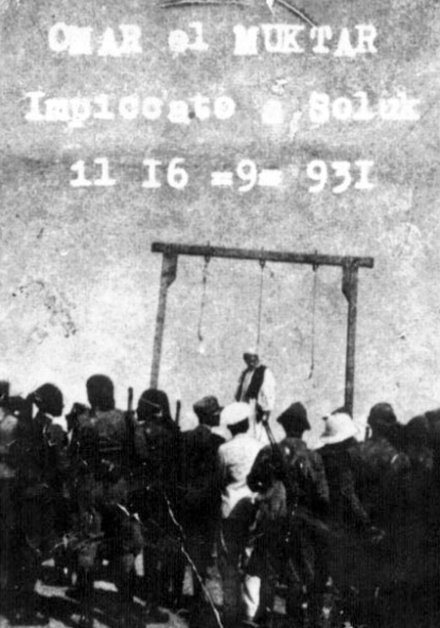
On this date in 1931, Libyan independence martyr Omar [al-]Mukhtar was publicly hanged by the Italians at their concentration camp in Suluq.

Mukhtar (English Wikipedia entry | Italian) was born an Ottoman subject back in 1858 and had lived long enough to see his native Libya seized in the 1911-12 Italo-Turkish War.

Mukhtar, a religious teacher and follower of the Senussi movement, became the leader of the Libyan resistance that dogged the Italian occupation. Mukhtar proved an energetic and successful desert guerrilla fighter, and he had to be given the Italians’ mechanized military.

The Italians executed an estimated 4,000 Libyans in the 1920s, and drove hundreds of thousands into concentration camps, and gradually, only gradually, gained the upper hand on their adversaries.

Captured in battle after he abandoned a 1929 truce, Mukhtar was denied prisoner-of-war status and subjected to a snap military tribunal in one of the small coastal enclaves actually controlled by Italy — “a regular trial and consequent sentence, which will surely be death,” as the Italian general directed. It surely was.

He’s played by Anthony Quinn in the 1981 film Lion of the Desert — a better movie than you might think given that it was bankrolled by Muammar Gaddafi.

A national hero for contemporary Libyans across any social divide you’d care to name, Omar Mukhtar was valorized by the rebels who recently overthrew the aforementioned Gaddafi (here’s Mukhtar on a billboard in rebel-held Benghazi). “The whole world knows what Omar al-Mukhtar did,” Mukhtar’s 90-year-old son told media during the civil war. “That’s where they get their energy from. Ask the youth, they’ll tell you they are all the grandsons of Omar al-Mukhtar.”

His steely profile can be seen on Libya’s 10 10 dinar note.

On this day..