1964: Nguyen Van Troi, Viet Cong urban guerrilla

On this date in 1964, South Vietnam executed a 17-year-old Communist for a plot to assassinate American Secretary of Defense Robert McNamara.

The young electrical worker and Viet Cong urban guerrilla Nguyen Van Troi was nabbed in the spring of 1963 trying to off both McNamara, famous for the megatonnage he would bestow on Southeast Asia, and U.S. ambassador Henry Cabot Lodge, Jr.

(Later, when the South Vietnamese client president whose guests these men ostensibly were was being shot in an armored personnel carrier with the Americans’ blessing, Ngo Dinh Diem might have had cause to wish this youth’s inhospitable gesture had not been undone by his men. Lodge was a particularly vocal advocate in the Kennedy administration for overthrowing Diem.)

For the months leading up to his public shooting, he became an international cause celebre; North Vietnam would later milk his martyrdom with a postage stamp, an award, and numerous public streets.

The international reach of his case was underscored when a Venezuelan revolutionary cell kidnapped an American officer shortly before Troi’s execution, and threatened to shoot him in retaliation. (They didn’t.)

Against this, South Vietnam counterposed the unedifying spectacle of a 17-year-old patriot put to death, energetically declaiming at the stake while cameras rolled,

It is the Americans who have committed aggression on our country, it is they who have been killing our people with planes and bombs…. I have never acted against the will of my people. It is against the Americans that I have taken action.

Naturally, he became a worldwide leftist martyr. There’s an Estadio Nguyen Van Troi in Cuba; American actor Troy Garity, son of Jane Fonda from her “Hanoi Jane” days, is also named for Nguyen Van Troi.

Robert McNamara, meanwhile, had many, many years yet to live, and many, many more Vietnamese deaths to burden his conscience.Troi’s widow wrote a 1965 book about him, out of print but still available on the used book market.

On this day..

1941: Nguyen Thi Minh Khai, Indochina Communist cadre

On this date in 1941, Vietnamese Communist cadre Nguyen Thi Minh Khai was shot as an anti-France insurrectionary.*

Khai (Vietnamese Wikipedia page | English) surely fit the description: she was a leader of the Indochinese Communist Party in the 1930’s, working directly with Ho Chi Minh in his Hong Kong exile. She would return in 1936 to the city later named for that redoubtable revolutionary as its ranking agitator.

Khai, the most famous of the Indochinese Wars’ vast ranks of women fighters, would marry fellow revolutionary Le Hong Phong, the chairman of the party, who died in prison in 1942. Khai’s sister’s marriage made Khai sister-in-law to the revolution’s military lion Vo Nguyen Giap.**

But her prominent position also made her a target.

Arrested by the French late in 1940, she was tortured and condemned to death. She was shot with other cadres, shouting last words that the decades yet to come would pretty well vindicate.

Long live the Communist party of Indochina. Long live the victorious Vietnamese revolution. (Source)

Readers whose Vietnamese is stronger than mine — i.e., extant in any form whatsoever — might get something out of this video:

As a national heroine, Nguyen Thi Minh Khai is the namesake of any number of public spaces in Vietnam, like schools and roads.


Paradoxical historiography: the street address visible to the right of the photo brands a revolutionary name onto an upscale coffee shop in Ho Chi Minh City. (cc) image from Lawrence Sinclair.

* Some sources give an April 1941 execution date, particularly April 25. I believe this may actually be the date Khai was condemned. There are also some sources indicating a guillotine execution; though the guillotine was certainly available, the bulk of the sources seem to say that Khai was shot.

** Giap is still going strong after all these years; he just turned 100 a few days ago. Khai’s sister was not as lucky; she died in French custody at the prison American pilots would later refer to as the “Hanoi Hilton”.

On this day..

1936: Grigory Zinoviev and Lev Kamenev, Old Bolsheviks

During the purges of the 1930s, Josef Stalin showed a particular relish for eliminating the Old Bolsheviks whose red credentials predated the revolution. (And potentially, outshone his own.)

Zinoviev

On this date in 1936, one of the oldest of them, Grigory Zinoviev, was shot with his longtime ally Lev Kamenev.

These guys had been major movers and shakers among the early Bolsheviki, adherents of Lenin during the first decade of the century when the aspiration for a Communist Russia seemed hopelessly far-fetched. Zinoviev rode with Lenin from Switzerland to Petrograd in the famous sealed train after the February Revolution toppled the tsar. (Not so Kamenev: he was serving time in Siberia, but was freed by the revolution.)

In the years that followed, both played leading roles in the Soviet government despite their impolitic opposition to the Bolshevik coup in October.

Kamenev was briefly head of state in 1917, and he married Leon Trotsky’s sister. Zinoviev was the longtime head of the Communist International, in which capacity he showed Moscow’s public face for communist movements in other countries. Bela Kun was another ally of Zinoviev’s.)

In this capacity, he’s known in British history for the “Zinoviev letter”, a purported summons to Anglo agitation that was actually a dirty trick dropped before an election to help the Tories sweep to power.*

Those were the good old days — when Lenin was fading away and Zinoviev, Kamenev, and Stalin were the “troika” running things. They should have checked with the Romans how triumvirates work out.

Because of their alliance, Zinoviev and Kamenev provided the decisive support that enabled Stalin to remain General Secretary of the party after the public airing of Lenin’s Testament warning against him. Without Zinoviev and Kamenev at this crucial moment, Stalin probably could not have survived politically; the name Koba might have gone into history books as little more than a terror to the paperwork of some forgotten bureau. (And the pre-revolutionary Caucasus!)

Talk about hoisted by your own petard.

Having been helpfully maintained in his position against Lenin’s dying wish, Stalin soon marginalized these formerly useful creatures. Their last decade was doomed to a spiral of failing power struggles, sinking rank, furtive dissension, and craven submission to party discipline.

Stalin at length destroyed them at the first great Moscow show trial, the Trial of the Sixteen — which hyped a “Trotskyite-Zinovievite” plot in a nicely Orwellian twist. (Despite Kamenev’s marital connection, Trotsky was actually a political rival.) The charge sheet must have reminded the defendants on every one of their dwindling days of the alliance with Trotsky they could have made back when they mattered.

The Trial of the 16 defendants would help to write the script for succeeding acts of this awful theater: after fighting the allegations, Zinoviev and Kamenev agreed to plead guilty on private assurances that their lives would be spared.

But once he had their “admissions” on the record, Stalin altered the deal.

Not only Zinoviev and Kamenev, but all 16 from the trial of the 16 were shot shortly after midnight this date.

From exile, their “conspirator” Trotsky called it the “end of an epoch”.

His obituary for Zinoviev and Kamenev minces no words about the men’s personal shortcomings (“they lacked sufficient character”), but still achieves a certain elegaic sympathy for these former fellow-travelers and their shared movement, now swallowed by Stalinism.

I have had the occasion to hear tranquil petty bourgeois tell me in the days between the beginnings of the trial and my internment: “It’s impossible to understand Zinoviev … He is so lacking in character!” And I would reply: “Have you yourselves experienced the full weight of the pressure to which he has been subjected for a number of years?” Unintelligent in the extreme are the comparisons, so widespread in intellectual circles, of the conduct in court of Danton, Robespierre and others. These were the instances of revolutionary tribunes who found the knife of justice suspended over them, directly in the midst of the arena of struggle; at a time when they were in the full flower of their strength, with their nervous system almost untouched and, at the same time, when they despaired of all hope of salvation.

[By contrast] For ten years they [Zinoviev and Kamenev] had been enveloped by clouds of slander paid for in heavy gold. For ten years they had swayed between life and death, first in a political sense, then in a moral sense, and lastly in a physical sense. Can one find in all past history examples of such systematic, refined and fiendish destruction of spines, nerves and all the fibers of the soul? Zinoviev or Kamenev would have had more than ample character for a tranquil period. But the epoch of grandiose social and political convulsions demanded an extraordinary firmness of these men, whose abilities secured them a leading place in the revolution. The disproportion between their abilities and their wills led to tragic results.

* There are numerous theories of the Zinoviev Letter’s origin; one has it that spy Sidney Reilly had a hand in it.

On this day..

1949: Koci Xoxe, Titoist

On this date in 1949, Albania’s former defense minister was purged.

One of the first purge victims in the Soviet satellites — though scarcely the last — Xoxe was induced to admit having labored “against the Party and the people.”

The ethnic Macedonian’s real offense had been a pro-Yugoslav orientation.

That put Xoxe on the wrong side of the emerging rift in the Communist bloc, between Soviet dictator Joseph Stalin and independent-minded Yugoslav strongman Josip Tito.

After Tito broke with Stalin in 1948, Moscow froze the naughty Yugoslavs out of the international communist club and began suppressing “Titoist” elements whose national political or economic orientation augured potential annoyance for Soviet supremacy.

Albanian chief Enver Hoxha in later years would become somewhat notorious as the last unabashed Stalinist leader in Europe. (Hoxha took an “anti-revisionist” stance on Khrushchev’s later denunciation of Stalin.) So you can see the bind Koci Xoxe was about to be in.

Hoxha’s own pro-Soviet orientation was akin in its way to Tito’s anti-Soviet orientation: for Tito, Moscow meant domination, but for Hoxha, Yugoslavia was the resented aspiring regional hegemon. Albanian economic ministers complained that trade links disproportionately benefited Belgrade, and Yugoslavia once high-handedly marched troops into Albania to contain a conflict in neighboring Greece.

At any rate, Hoxha went energetically along with Uncle Joe on the Tito question … whose answer, on this date, was a bullet for Hoxha’s former Defense Minister.

On this day..

1972: Deniz Gezmis, Yusuf Aslan, and Huseyin Inan, Turkish revolutionaries

On this date in 1972, three Turkish youths hanged at Ankara Central Prison for attempting to “overthrow the constitutional order.”

Deniz Gezmis

“The three urban guerrillas,” reported the New York Times the next day, “stood on chairs placed on a platform as the nooses were placed around their necks. They asked for and were given the right to kick the chairs out from under themselves.”

Deniz Gezmis, the best-known of them, was a 1960s student radical who eventually helped found the People’s Liberation Army of Turkey (THKO) and received guerrilla training in Syria from Palestinian terrorists.

As Turkey made the turn into the 1970s, left-right violence made the country all but ungovernable.

Gezmis and his comrades got in on the action by kidnapping four U.S. radar technicians for ransom in March 1971, leading Turkish journalist Abdi Ipekci to declare that “it is necessary to halt this anarchy which is pushing our country to a dark and bloody future.”*

The Turkish armed forces were right on the case, and just days later intervened with a bloodless military coup.

The servicemen were released unharmed … but there was a bloodbath waiting for others on account of THKO.

An army-backed conservative government started shuttering left-wing papers, banning left-wing organizations, and eventually imposed outright martial law.

Our principals became the first hanged under that regime, but scores of others** were also tried for their lives for revolutionary activities. Since the young socialists had robbed banks and taken hostages but never actually killed anyone, their actual executions were controversial within the government itself … and ultimately undertaken on the unseemly “three for three” body count equivalence to the Prime Minister and two aides who had hanged when Turkey last had a leftist coup government.

In the streets, paramilitary violence continued.

During the trials of Gezmis and other radicals, Israeli ambassador Efraim Elrom, a Polish emigre who had interrogated Adolf Eichmann, was kidnapped and murdered in Istanbul by THKO activists. (The kidnapping in turn prompted an intensified crackdown — arbitrary detention, torture, the usual stuff.) Years later, another communist cell assassinated the man who had presided as Prime Minister when Gezmis hanged, Nihat Erim, allegedly in revenge for this date’s executions.


London Times, May 8, 1972.

Conversely, for Gezmis, the handsome young Che Guevara of Turkish insurrectionary Marxism — this date was only the beginning of a rich afterlife as iconic martyr.


Graffiti of Gezmis and Che Guevara, with a sentiment common to both. (cc) image from somebody_

Also imprisoned in the roundup of radical activists was Turkish writer Erdal Oz, who turned the conversations he had with this date’s doomed into a notable book.

* Quoted in the March 8, 1971 London Times. Ipekci was eventually murdered by the Turkish assassin who subsequently tried to kill Pope John Paul II — Mehmet Ali Agca.

** e.g., Irfan Solmazer, a Senator who had been involved in Turkey’s left-wing coup a decade before. (He wasn’t executed.)

On this day..

1938: Yakov Peters, Siege of Sidney Street survivor

On this date in 1938, a Soviet purge claimed (among others*) Yakov (Jacob) Peters, former Cheka executioner and once the subject of a headline-grabbing trial in England.

Peters was a trusted (and ruthless) operator in the Soviet internal police from the start of the Revolution: he helped interrogate Lenin‘s would-be assassin Fanya Kaplan in 1918.

And he was the guy Trotsky had on speed-dial when Cheka founder Felix Dzerzhinsky was arrested by the Left SRs during their abortive 1918 uprising against their erstwhile revolutionary allies, the Bolsheviks.**

Dzerzhinsky was disarmed and locked in a room. his assistant, M.I. Latsis, was captured in the Cheka Lubianka headquarters. “No point in taking him anywhere, put this scum against the wall!” shouted a sailor, but one of the leaders, Alexandrovich, intervened, saying, “There is no need to kill, comrades; arrest him, but do not kill.” Dzerzhinsky’s assistant Yakov Peters was urgently summoned by Trotsky, who ordered him to crush the uprising by attacking the Left Eser headquarters. Alexandrovich was caught at a railway station, and Latsis, whom he had saved from execution, personally shot him. Mass executions in Cheka prisons followed. (Source)

Like a lot of old Bolsheviks, Peters’s early service to the cause didn’t age too well. He ran afoul of some bureaucratic intrigue or point of party discipline or other and caught a bullet in 1938. (Khrushchev rehabilitated him.)

For anyone in England watching the fate of this distant apparatchik, the proximity to bloodbaths would have had a familiar hue.

Peters was one of a gang of Latvian revolutionaries who came to cinematic public attention in London when, in the course of being rounded up for a December 1910 murder, they engaged the police in a stupendous East End firefight on January 2, 1911 — the Siege of Sidney Street. (It’s also known as the Battle of Stepney.)

Armed like soldiery, the Latvians easily outgunned the bobbies who had them hemmed into a cul-de-sac, and they fired on John Law with ruthless effect. This necessitated a call to the Scots Guard — whose deployment was okayed by Home Secretary Winston Churchill, the latter captured on film that day awkwardly milling about the scene of the urban combat.


(Translated directly to the city’s cinemas as soon as that same evening, Churchill’s image came in for public catcalls owing to his support for a relatively open immigration policy for eastern Europeans.)

This incident was a landmark in crime, policing, media — recognizably modern in its trappings of nefarious immigrant terrorists, politicized state funerals for policemen, and of course, the live-on-the-scenes camera work.

Since Britain was a ready hand with the noose at this time, one might think an execution would have been just the denouement.

However, responsibility for the policememen slain in the affray had been officially assigned to a different gang member, George Gardstein — who was killed when the besieged house burned down — and there was little usable evidence against those who were finally put on trial for the gang’s various crimes. Most of the witnesses were dead, fled, or completely unreliable, so the surviving Latvians all walked.

(Since the identity of one of the first guys to start shooting when the police rang always remained murky, there are some theories — such as in this out-of-print book — that Peters himself had been one of the gunmen on-site, and/or that he could be identified with the absconded and never-captured gang leader “Peter the Painter”.)

Whatever the exact measure of blood on Yakov Peters’s hands from Sidney Street, there would be a lot more where it came from.

While Peters went off to his different fate in revolutionary Russia, the dramatic scene he left behind has naturally attracted continuing retrospective attention in England. The testimony of witnesses, who also recollect the shootout’s anti-immigrant fallout, is preserved in this BBC Witness radio program:

[audio:http://downloads.bbc.co.uk/podcasts/worldservice/witness/witness_20110127-0950a.mp3]

And, on this BBC Four television special:

* e.g., Russian Civil War officer Nikolay Gikalo and Romanian Jewish revolutionary Leon Lichtblau.

** And in favor of resuming Russia’s ruinous involvement in World War I!

On this day..

1940: Robert Indrikovich Eikhe, “believing in the truth of Party policy as I have believed in it during my whole life”

On this date in 1940, the former Soviet People’s Commissar for Agriculture was shot for treason.

The 1930’s were a scary time in the USSR, but the agricultural posts — forced collectivizations, production quotas, and screw-ups that starved thousands — were particularly fraught.

R.I. Eikhe inherited the job from a fellow purged in the trial of the 21. And, unsurprisingly, he went the same way.

It was another former agricultural commissar (of Ukraine), Nikita Khrushchev, who managed to succeed Stalin.

When, in 1956, Khrushchev made his “secret speech” denouncing the savagery of his predecessor, the fate of his old comrade Eikhe was lamented in detail.

Excerpted below is the relevant portion of Khrushchev’s report, as cited here.


The great modesty of the genius of the revolution, Vladimir Ilyich Lenin, is known. Lenin had always stressed the role of the people as the creator of history, the directing and organizational role of the party as a living and creative organism, and also the role of the central committee.

Lenin never imposed by force his views upon his coworkers. He tried to convince; he patiently explained his opinions to others. Lenin always diligently observed that the norms of party life were realized, that the party statute was enforced, that the party congresses and the plenary sessions of the central committee took place at the proper intervals.

In addition to the great accomplishments of V. I. Lenin for the victory of the working class and of the working peasants, for the victory of our party and for the application of the ideas of scientific communism to life, his acute mind expressed itself also in this that lie detected in Stalin in time those negative characteristics which resulted later in grave consequences. Fearing the future fate of the party and of the Soviet nation, V.I. Lenin made a completely correct characterization of Stalin, pointing out that it was necessary to consider the question of transferring Stalin from the position of Secretary General because of the fact that Stalin is excessively rude, that he does not have a proper attitude toward his comrades, that lie is capricious, and abuses his power. . . .

Vladimir Ilyich said:

“Stalin is excessively rude, and this defect, which can be freely tolerated in our midst and in contacts among us Communists, becomes a defect which cannot be tolerated in one holding the position of the Secretary General. Because of this, I propose that the comrades consider the method by which Stalin would be removed from this position and by which another man would be selected for it, a man, who above all , would differ from Stalin in only one quality, namely, greater tolerance, greater loyalty, greater kindness, and more considerate attitude toward the comrades, a less capricious temper, etc.”

As later events have proven, Lenin’s anxiety was justified …

Stalin originated the concept enemy of the people. This term automatically rendered it unnecessary that the ideological errors of a man or men engaged in a controversy be proven; this term made possible the usage of the most cruel repression, violating all norms of revolutionary legality, against anyone who in any way disagreed with Stalin, against those who were only suspected of hostile intent, against those who had bad reputations. This concept, enemy of the people, actually eliminated the possibility of any kind of ideological fight or the making of one’s views known on this or that issue, even those of a practical character. In the main, and in actuality, the only proof of guilt used, against all norms of current legal science, was the confession of the accused himself, and, as subsequent probing proved, confessions were acquired through physical pressures against the accused. . . .

Lenin used severe methods only in the most necessary cases, when the exploiting classes were still in existence and were vigorously opposing the revolution, when the struggle for survival was decidedly assuming the sharpest forms, even including a civil war.

Stalin, on the other hand, used extreme methods and mass repressions at a time when the revolution was already victorious, when the Soviet state was strengthened, when the exploiting classes were already liquidated, and Socialist relations were rooted solidly in all phases of national economy, when our party was politically consolidated and had strengthened itself both numerically and ideologically. It is clear that here Stalin showed in a whole series of cases his intolerance, his brutality, and his abuse of power.

Stalin’s willfulness vis-a-vis the party and its central committee became fully evident after the 17th party congress, which took place in 1934. . . .

It was determined that of the 139 members and candidates of the party’s Central Committee who were elected at the 17th congress, 98 persons, that is, 70 percent, were arrested and shot (mostly in 1937-38). [Indignation in the hall.] . . .

The majority of the Central Committee members and candidates elected at the 17th congress and arrested in 1937-38 were expelled from the party illegally through the brutal abuse of the party statute, because the question of their expulsion was never studied at the Central Committee plenum.

Now when the cases of some of these so-called spies and saboteurs were examined it was found that all their cases were fabricated. Confessions of guilt of many- arrested and charged with enemy activity were gained with the help of cruel and inhuman tortures. . . .

An example of vile provocation of odious falsification and of criminal violation of revolutionary legality is the case of the former candidate for the central committee political bureau, one of the most eminent workers of the party and of the Soviet Government, Comrade Eikhe, who was a party member since 1905. [Commotion in the hall.]

Comrade Eikhe was arrested on April 29, 1938, on the basis of slanderous materials, without the sanction of the prosecutor of the USSR, which was finally received 15 months after the arrest.

Investigation of Eikhe’s case was made in a manner which most brutally violated Soviet legality and was accompanied by willfulness and falsification.

Eikhe was forced under torture to sign ahead of time a protocol of his confession prepared by the investigative judges, in which he and several other eminent party workers were accused of anti-Soviet activity.

On October 1, 1939, Eikhe sent his declaration to Stalin in which be categorically denied his guilt and asked for an examination of his case. In the declaration he wrote:

“There is no more bitter misery than to sit In the jail of a government for which I have always fought.”

On February 2, 1940, Eikhe was brought before the court. Here he did not confess any guilt and said as follows:

“In all the so-called confessions of mine there is not one letter written by me with the exception of my signatures under the protocols which were forced from me. I have made my confession under pressure from the investigative judge who from the time of my arrest tormented me. After that I began to write all this nonsense. The most important thing for me is to tell the court, the party and Stalin that I am not guilty. I have never been guilty of any conspiracy. I will die believing in the truth of party policy as I have believed in it during my whole life.”

On February 4 Eikhe was shot. [Indignation in the hall.] It has been definitely established now that Eikhe’s case was fabricated; he has been posthumously rehabilitated.

On this day..

1983: Maurice Bishop, Prime Minister of Grenada

On this date in 1983, Grenadian Prime Minister Maurice Bishop was shot with seven supporters during the chaotic struggle of power that precipitated a U.S. invasion.

The charismatic Bishop grew up on the small British Commonwealth island in the south Caribbean, attended the London School of Economics, and became the leader of the Marxist New Jewel Movement.

In 1979, Bishop and the NJM overthrew the paranormal government of Eric Gairy (he’s famous for his controversial judging in the wild 1970 Miss World pageant).

Leftist governments in the hemisphere were just the sort of thing to irk the Yankee hegemon. Collaboration with Cuba and Nicaragua to build an airstrip on Grenada … could that open the door for Soviet air support when the Sandinistas invaded Harlingen, Texas?

Ironically, it would be an intra-party Communist coup against the fellow-Communist Bishop that provided the pretext for said hegemon to stanch this existential threat.

A deputy, one Bernard Coard, ousted Bishop in October 1983, apparently a factional dispute in the NJM along ideological lines. Bishop broke out of house arrest and led a march on Coard’s position on this date, contesting his control of the government; the march was broken up and its leadership collared — and, later that day, disposed of.

The Reagan administration didn’t care two figs about Maurice Bishop, but a scene of general chaos offered it all the pretext necessary* to invade on Oct. 25. To save from the red menace, oh, let’s say, a few American med students, plus a little thing called the free world.

Whew!

Years later, that provocative airstrip bears Maurice Bishop’s name.

Audio of several Bishop speeches can be had here; others can be found on YouTube.

* Another possible precipitating factor: a U.S. Marines barracks in Lebanon was spectacularly bombed by terrorists on Oct. 23, 1983, forcing (eventually) American withdrawal. The New Jewel Movement turned out to be an opponent more in Washington’s wheelhouse.

On this day..

1938: Bela Kun, Hungarian Communist leader

On this date in 1938 — so the Soviet government finally announced in 1989, after decades of opacity — the Hungarian Communist leader Bela Kun was secretly shot by firing squad in the gulag.

The pudgy and pugnacious* onetime journalist whose capture by the Russians during World War I enabled him to get in on the ground floor with the Bolshevik Revolution became the de facto leader of the short-lived Hungarian Soviet Republic. For a few months in 1919, it was the world’s second Soviet state after Russia itself.

Bela Kun’s moment in the sun was particularly notorious for his advocacy late in the Soviet Republic’s brief life of a Red Terror against internal opposition. Several hundred people were killed over the last few weeks of the state’s existence, until a Romanian invasion toppled the reds and sent Bela Kun fleeing back to the Soviets. There, he’s supposed to have brought his gift for wholesale murder to surrendered White prisoners in the Crimea.

Still, Hungary was an insurrectionary success next to most everywhere else, and Bela Kun was detailed to Germany to revive the flagging fortunes of a revolution that the Bolsheviks thought would be critical to sustaining their own. Modeling on Lenin’s own coup d’etat in 1917, Kun pushed the Germans to go all-in on an aggressive 1921 “March Action” offensive to capture state power — which backfired catastrophically, essentially marking the end of the post-World War I revolutionary window. Vladimir Ilyich gave his Magyar counterpart a dressing-down for that gambit at that summer’s Comintern summit.

He’d become associated in this time with Zinoviev, an Old Bolshevik whose comradeship would blow an ill wind come the killing time of the 1930s. Kun himself was long past his sell-by date at this stage, knocking around Moscow feuding with other Hungarian exiles.

Stalin eventually had him arrested for “Trotskyism”, and he disappeared into the Gulag never to be seen again.

Like many purge victims, Bela Kun was rehabilitated under Khrushchev, which also made him fitting source material for statuary congenial to the post-World War II Hungary, situated (however unhappily) within Moscow’s sphere. Some of the detritus of this age can be found at Budapest’s Mememto Park outdoor fairgrounds of discarded Communist kitsch.


Bela Kun, marshaling the Magyar masses. The streetlamp behind him (a literary symbol of hanging) alludes to his martyrdom. Wider views of the entire monument: 1 | 2

* He had a rep in his youth for fighting duels.

On this day..

1797: Gracchus Babeuf, for the Conspiracy of Equals

If the “revolutionary extremist” exists at all as an identifiable type, he exists in purest incarnation in Gracchus Babeuf. No revolutionary better fits the description “narrowminded to the point of genius”; few have defined their heaven more clearly or crusaded so fanatically, ascetically, so religiously to bring it to earth.

Gracchus Babeuf: The First Revolutionary Communist

On this date in 1797, Francois-Noel Babeuf lost his head for the Conspiracy of Equals — the last Jacobin upheaval of the French Revolution, or the first Communist upheaval of post-Revolution modernity.

Francois-Noel — he styled himself “Gracchus” after the populist Roman tribunes — was a young man of Desmoulins‘ generation but from a considerably more hardscrabble background. Like the starry-eyed Dantonist scribbler, Babeuf discovered himself a brilliant journalist and pamphleteer with the onset of the Revolution; he did several prison stints during various revolutionary phases of the early 1790s for his too-radical-for-school opinions.

He did another in 1795 under the French Directory for his firebreathing rag Le Tribun du Peuple, which was particularly unfashionable stuff during the post-Robespierre Thermidorian regime.

Nothing daunted, Babeuf emerged from prison the leading apostle of the Parisian proletariat which had by then been decisively separated from power.

The order of the day was class consolidation with the spoils of the aristocracy apportioned among a new oligarchy of wealth. As France rushed headlong towards Bonaparte and Bourbon restoration, Babeuf was the man left to rally “the party which desires the reign of pure equality.”

The French Revolution was nothing but a precursor of another revolution, one that will be bigger, more solemn, and which will be the last.

The people marched over the bodies of kings and priests who were in league against it: it will do the same to the new tyrants, the new political Tartuffes seated in the place of the old.

Manifesto of the Equals, 1796

One can see why later revolutionaries — Marx included; Babeuf makes a cameo in the Communist Manifesto — would adopt this sort of thing as a harbinger of the next century’s revolutions.

And if the Directory had known who Nicholas II would be, it would have had no intention of going the way of his family.

Instead, it shut him down in February, 1796: Napoleon Bonaparte personally carried out the operation, just days before he wed Josephine.


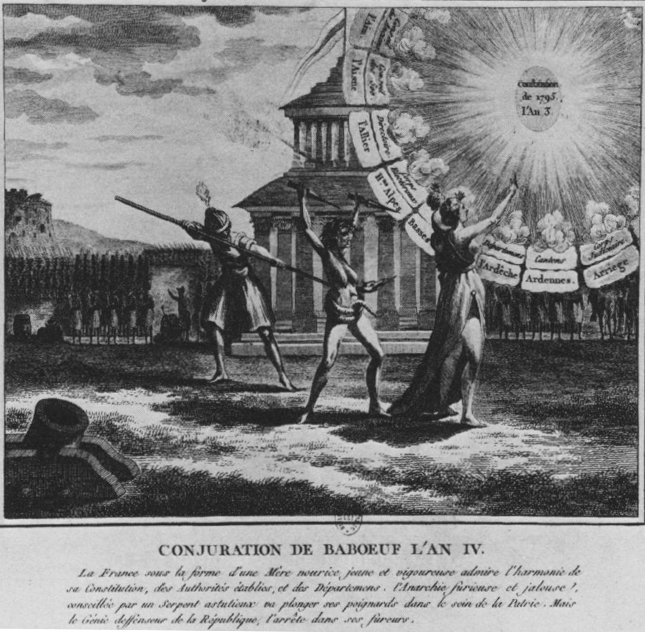
The Babeuf Conspiracy. Anonymous French print.

Babeuf’s party comes down to us as a “conspiracy,” under which word the state would charge him and which his follower Philippe Buonarroti would later rebrand the “Conspiracy of Equals”. It was not so much a grassy-knoll type of conspiracy as it was an underground organization.

When its adherents placarded Paris with the seditious “Analysis of the Doctrine of Babeuf” as the city endured a potentially dangerous economic crisis in April 1796, the government was put to a test of its strength.

It passed.

Having infiltrated Babeuf’s network, it arrested the principals on the eve of the Conspiracy’s intended insurrection. They were hailed out of Paris (a safeguard against sympathetic risings) to the commune of Vendome and there put on trial.* Babeuf and his associate Augustin Alexandre Darthe were condemned to death on May 26th and guillotined the very next day.

The last gasp of the French Revolution dropped with their heads into the basket.

Revolutionary Babeuvism, however, had scarcely just begun.

I don’t know what will become of the republicans, their families, and even the babies still at their mothers’ breasts, in the midst of the royalist fury that the counter-revolution will bring. O my friends! How heart-rending these thoughts are in my final moments! … To die for the fatherland, to leave a family, children, a beloved wife, all would be bearable if at the end of this I didn’t see liberty lost and all that belongs to sincere republicans wrapped in a horrible proscription.

-Babeuf’s last letter to his family

* The trial of Babeuf was itself a jurisprudential milestone: it was the first French trial to be transcribed verbatim.

What might look today like a nifty little advance for efficient judicature was bitterly controversial in 1797. The French Revolution had overturned an ancien regime practice of professional magistrates accepting legal testimony by written deposition and deciding matters behind closed doors. The liberte, egalite, fraternite way would instead demand that testimony be given live in the courtroom where citizen jurors could weigh its credibility.

Babeuf’s lawyer, Pierre-Francois Real, protested against the court stenographers, arguing that “The law insists that the system of written depositions not be restored in any way. That system will undoubtedly return if any means are used to save testimony given orally.”

There’s a fascinating disquisition on the curious and contradictory development of this issue and the way it “violates … common assumptions about the advance of textuality in the West” during the French Revolution in Laura Mason, “The ‘Bosom of Proof’: Criminal Justice and the Renewal of Oral Culture during the French Revolution” The Journal of Modern History, March 2004.

On this day..