On this date in 1931, the Chinese nationalists executed 23 Communists at Longhua, including five members of the League of Left-Wing Writers.
Early in what would prove to be the very long Chinese Civil War, the Koumintang government in 1930 mounted a suppression* of Communist outposts. That included military campaigns attempting to encircle communist-held regions, as well as an internal crackdown. It’s the latter that concerns us here.
A Communist-founded League of Left-Wing Writers operating in Shanghai was formally banned by the Koumintang in September 1930. Threatened with arrest, the writers struggled to stay underground but at a January 17 meeting in the British concession area,** British police arrested Li Weisen, Hu Yepin, Rou Shi, Yin Fu, and Feng Keng. They were handed over to the Chinese authorities.
The Five Martyrs: From left: Hu Yepin, Rou Shi, Feng Keng, Yin Fu, Li Weisen (Li Qiushi)
They became the Five Martyrs of the League when they were shot this date in 1931 along with 18 other Communist prisoners, one of them a pregnant woman.
Among the five martyrs, Rou Shi† was particularly close to the great writer Lu Xun, who was heartbroken when he received word of his young protege’s untimely end — “one of China’s best youths,” in his estimation. In hiding himself, Lu Xun composed a “Lament for Rou Shi”:
To long and sleepless nights I’ve grown
accustomed in the spring;
Fled with a wife and babe in arms,
my temples are graying.
‘Mid dream there comes an image faint —
a loving mother’s tear;
On city walls the overlords’
e’er-changing banners rear.
I can but stand by looking on
as friends become new ghosts,
In anger face bayonet thickets
and search for verse ripostes.
The poem intoned, my gaze turns low —
one cannot write such down.
Moonlight shimmers with watery sheen
upon my jet-black gown.
After a decade of bloody left-right civil strife, the Turkish generals toppled the civilian government on that date. Hundreds of thousands of arrests with rampant torture marked the period, but it did quell the endemic street fighting and terrorism of the 1970s.
Erdal Eren was actually arrested during the chaotic pre-coup period. February 1980 student protests after the murder of Sinan Suner, an activist of the communist Patriotic Revolutionary Youth Association, turned into a melee that resulted in an officer shot dead under confused circumstances. Eren was among 24 students rounded up.
Despite his youth, Eren was sentenced to die in a March 19 trial — but his appeals had legs until the post-coup military junta abruptly sent him to the gallows on December 13.
Eren went to his death with a brave step, gamely writing his family that he had witnessed so much torture in prison that death was a relief and not a terror.
He’s very warmly remembered today. A number of cultural artifacts pay tribute to the young martyr, including two different songs (“Two Children”, “Seventeen”) by Teoman, a relative of Erdal Eren’s.
JOHANNESBURG, Oct. 28. The Rand Daily Mail, in an article dealing with the economic situation of the Union, gives striking figures illustrating the steady advance of the gold industry on the march towards prosperity.
Profits for the July-September quarter show an increase of £1,136,000 over the previous quarter. This has been accomplihed not only by lowering wages, but by all-round improvement in efficiency per unit, mining costs having fallen from 25s. 8d. in 1921 to 20s. 5d. in September, 1922 …
[T]he Rand Daily Mail says that these facts “represent unmistakable omens of coming prosperity which should steel the downhearted farmer to greater effort and encourage the suffering industrialist throughout the Union, and transform the pessimism of the merchant into healthy confident and hope.” (London Times, Oct. 30, 1922)
THREE RAND EXECUTIONS.
ANTI-GOVERNMENT RIOT.
(From our correspondent.)
JOHANNESBURG, Nov. 17. The bitterest feeling prevails among the workers over the refusal to reprieve the three men, Long, Hull, and Lewis, who were condemned to death for murder in connexion with the Rand revolt, and were executed at Pretoria to-day.
Appeals for mercy poured in till almost the last moment, and an open-air mass meeting was held, in which prominent Communists took part. At this meeting angry and threatening speeches were made; the names of General Smuts and Sir Lionel Phillips were boohed, and the crowd attempted to break into the Town Hall, severely injured a detective, and was finally dispersed by armed police. The public generally approves the Government’s firmness. The condemned men sang the Red Flag on the scaffold. (London Times, Nov. 18, 1922)
“Come dungeons dark or gallows grim the sun will be our parting hymn.”
FUNERAL OF RAND MURDERERS.
COMMUNIST APPEAL TO CHILDREN.
(From our correspondent.)
JOHANNESBURG, Nov. 19. Remarkable scenes recalling the funeral of the victims of the great strike of 1913 were witnessed at the burial of the remains of Long, Lewis, and Hull, who were executed on Friday. The coffins, in separate hearses, were followed by thousands of workers, with banners and regalia, representing every trade union. “The Red Flag” was sung at the graveside and addresses were delivered, in which members of Parliament, of the Provincial Council, and Town Councils participated.
…
The latest development of Communist propaganda in Johannesburg is the distribution broadcast among children and students as they are leaving their schools and colleges of a pamphlet denouncing as “legalized murder and a blot on history” the execution of the men convicted of murder at special treason courts. (London Times, Nov. 20, 1922)
The young man striking the dramatic pose is Stjepan Filipovic, an anti-fascist partisan hanged in the city of Valjevo by the Serbian State Guard, a collaborationist force working with the Axis occupation of Yugoslavia.
Filipovic is shouting “Death to fascism, freedom to the people!” — a pre-existing Communist slogan that Filipovic’s martyrdom would help to popularize. Smrt fašizmu, sloboda narodu! … or you can just abbreviate it SFSN!
In the city where Filipovic died, which is in present-day Serbia, there’s a monumental statue in his honor replicating that Y-shaped pose — an artistically classic look just like our favorite Goya painting, poised between death and victory.
Filipovic was a Communist so we’re guessing that he would not have had a lot of truck with the ethnic particularism that’s latterly consumed the Balkans. Times being what they are, however, the national hero to Tito’s Yugoslavia has become a post-Communist nationalist football.
That Valjevo monument — it’s in Serbia, remember — calls him Stevan Filipovic, which is the Serbian variant of his given name. But as Serbia is the heir to Yugoslavia, he at least remains there a legitimate subject for a public memorial. Filipovic himself was Croatian, but his legacy in that present-day state is a bit more problematic: in his native town outside Dubrovnik, a statue that once commemorated Filipovic was torn down in 1991 by Croat nationalists; its vacant plinth still stands sadly in Opuzen. (Opuzen’s film festival, however, awards its honorees a statuette replicating the destroyed monument.)
Set against the background of the Soviet moderisation process, the development of sport in the two decades from the early 1930s to the early 1950s not only established the world-recognised pattern of sport in the Soviet Union and, later, in many other communistcountries (like China, Cuba and the GDR), it also resulted in a phenomenon unprecedentedin world sports history: the arrest and execution of a host of sports personalities. No one knows the exact numberof victims; but the purges carried off five sports ministers, Olympic Committee members for the Baltic states, heads of the major physical education colleges, eminent sports scientists and medics4 and probably thousands of leading athletes.
-Jim Riordan*
Sports and the physical body emerged early in Soviet history as a major doctrinal focus. A 1925 party resolution (quoted in this pdf) declared it
“essential to consider physical culture not only from the standpoint of physical education and health, and as one aspect of our youth’s cultural-industrial and military training, but also as a method of educating the masses.”
Dziga Vertov’s Soviet silent masterpiece Man With A Movie Camera (1929). This clip should cue up at the sports bit (45:26), but the entire film is a must-watch.
In the Stalin years, Soviet athletics took on the institutional patterns that continue to structure Russian sport to this day.
Given his position during the time of purges, Alexander Kosarev might have been bound for a bad end regardless. At least he had the consolation of leaving his fingerprints on a sporting institution that still thrives to this day.
We get to Kosarev by way of another man, Nikolai Starostin, an elite athlete of the 1920s and 1930s.**
A hockey star as well as a footballer, Starostin supported his family with his athletic gifts in the 1920s, and in 1922 helped found the local sports club that eventually developed into one of Europe’s most storied champions.
After juggling sponsorships and team names for a decade, Starostin approached Kosarev about bringing the club under the patronage of the Communist Party’s youth organ Komsomol, which Kosarev headed. He also suggested the name by which the team is still known, Spartak Moscow — paying tribute to the ancient rebel Spartacus.†
Komsomol support was not Komsomol control, however: Spartak remained basically independent, and this set it starkly apart from the other top Soviet teams, each controlled by a state ministry and its associated industry. (e.g., Lokomotiv Moscow, or the Red Army team CSKA.‡)
The football bully on the block at the time was Dynamo Moscow, a club dating to the tsarist age that was in the ambit of the internal security services. Dynamo won the first Soviet championship in 1936.
But Spartak quickly stepped over the Lokomotivs and established itself as Dynamo’s top rival.
Football matches, like everything else in Stalinist Moscow, were about politics, bureaucratic infighting, and the characteristic through-the-looking-glass rules of the dictatorship. Spartak used a controversial goal to beat Dynamo Tblisi (there were six Dynamo teams in the top division) in a Soviet Cup semifinals in 1939, the last before World War II. After Spartak went on to win the final, the Dynamo teams’ scary patron, NKVD boss Lavrenty Beria, ordered the semifinal match replayed. Spartak, already the tournament champion, then proceeded to win its semifinal a second time, compounding Beria’s fury. The referee from the first match was later arrested.
Beria was a passionate fan of the beautiful game — the ultimate football hooligan, you might say. He frequently attended Dynamo matches.
The secret police chief had even played for a Georgian club in his youth; in fact, he had played against (and lost to) a Starostin team. (Starostin thought Beria was a dirty player. Truly the Georgian was a man who tackled life studs-up.)
In contrast to Dynamo’s establishment backing, independent Spartak didn’t even have a home stadium until 1956. Nevertheless, it soon began attracting a sizable popular following. Its tactics were less stodgy; its persona less institutionally leaden; its star, Starostin, was a legend. And Spartak won, a lot.
“The people’s team” became a pole for — not resistance, exactly. But something a little bit alienated. A little bit defiant. Sport might not be your thing, but you have to appreciate any team that can embarrass the national torturer-in-chief. You have to appreciate the opportunity to hiss the secret police under cover of innocent fandom.
Unfortunately, Spartak’s Komsomol patron Kosarev fell. There’s an apocryphal story that Kosarev’s fate was football-related; surely the rivalry did him no favors when his life was hanging in the balance.
But it was actually just the routine infighting that did Soviet bureaucrats in throughout the late 1930s. His power eroded; a Komsomol official whom Kosarev had previously booted went over his head to Stalin himself, and Uncle Joe’s apparatchiks brought him down at a November 1938 Komsomol plenum with accusations of favoritism and alcoholism. (Stalin popped in briefly to see if “maybe this is a system and not a mistake?”)
Kosarev spent November 19-22 desperately fending off accusations at the rostrum, was removed from his post by the end of the session, and resided in a Lubyanka dungeon before the month was out. And you thought your committee meetings were awful.§
Kosarev got the bullet. Spartak lived on.
So did Starostin, who was not executed but sent to the Gulag. In 1948, Stalin’s son Vasily extracted Starostin to use as a coach for the Soviet Air Force’s football team, leading to a bizarre saga as a, well, human football between Vasily and Beria. (Beria’s security services kept trying to arrest Starostin, leaving the coach shuttled from city to city as the political winds shifted — and sometimes even bunking with his young protector and the revolver Vasily kept under his pillow. All for football!)
Kosarev was rehabilitated shortly after Stalin died. Khrushchev mentioned him by name in his “secret speech” denouncing the previous years’ terror.
And since Stalin’s death precipitated Beria’s own execution, Starostin was rehabilitated as well. “It was like the sun rising in the Far North after the long Polar night,” Starostin remembered of 1953.
The exiled football legend returned to coach and manage Spartak Moscow — from 1955 until 1992, when he retired at age 90. Nikolai Starostin was associated with the club he helped create in 1922 almost as long as the Soviet Union was associated with Russia: 70 years … minus those lost to the Arctic labor camps.
“Camp bosses, arbiters of the life and death of thousands upon thousands of human beings, personifications of the GULAG brutalities and horrors, were so benevolent to anything concerning soccer,” said Starostin in his memoirs of the starstruck commandants who treated their special prisoner with kid gloves and invariably recruited Starostin to coach local clubs. (Dynamo clubs, ironically.) “Their unbridled power over human lives was nothing compared to the power of soccer over them.”
“The soccer ball was always out of Beria’s reach.”
* “The Strange Story of Nikolai Starostin, Football and Lavrentii Beria,” Europe-Asia Studies, Vol. 46, No. 4 (1994). Riordan, a Briton, played for Spartak in the 1960s. (He wote an autobiography about it.)
** Nikolai was the oldest of four Kosarev brothers, all four of whom played for Spartak. All four were also arrested and tortured in 1942. Nikolai was the only one of them to remain involved in football after his release.
‡ In the 1930s, the Red Army team was known as CDKA. The reason its name changed was because a CDKA-based national team lost to Tito’s Yugoslavia in the 1952 World Cup, and Stalin in a huff ordered the CDKA club dissolved.
§ Information on Kosarev’s fall and the November 1938 Komsomol plenum from Seth Bernstein’s 2011 University of Toronto graduate paper “‘Lifestyle Cannot Be Separate from Politics’: Degeneracy and Promotion in the Purge of the Soviet Komsomol Leadership, 1934-1938”. This paper no longer appears to be available online.
On this date in 1978, peripatetic Communist intellectual Hu Nim vanished into Khmer Rouge Cambodia’s charnel house along with 126 others at Tuol Seng.
The child of a poor peasant’s family, Nim was a gifted young state worker who studied in Paris in the 1950s, where he met several future Khmer Rouge leaders.
Nim charted an independent — some might say hypocritical — course over the next two decades, serving uneasily as a leftist parliamentarian in Prince Sihanouk‘s nationalist coalition government, fleeing ahead of a conservative purge into the bush to join Communist guerrillas, then returning once more to Sihanouk’s now-leftist Chinese-backed government-in-exile. It’s a period whose interests and alliances don’t map straightforwardly onto the familiar Cold War axis.
Hu Nim’s stature as Minister of Information in the government-in-exile transitioned directly to that same portfolio when the Khmer Rouge came to power.
Maybe those old ties to the ancien regime did him in — Vietnam, after invading Cambodia, would seize on the late minister’s reputation for independence to damn the Khmer Rouge for purging a moderate socialist — but there was no ideological talisman for safety during those terrible years. Hu Nim’s longstanding pro-Chinese position was also a dangerous association come 1977, and Phouk Chhay, a fellow officer of the Khmer-Chinese Friendship Association, was among the batch of prisoners shot along with Hu Nim this date.
Early in 1977, a massive internal purge shook the regime; as many people (some 1,500) went to Tuol Sleng from mid-February to mid-April of that year as had gone in all of 1976.* Almost every one of these humans would be, in the terrible bureaucrat-ese of the security apparatus, “smashed.”
Hu Nim was one of these, a denunciation wrung from a local commander leading to his April 10, 1977 arrest. Under repeated torture over the ensuing three months, the ex-Minister of Information would write and re-write his confession, fashioning himself “a counterfeit revolutionary, in fact … an agent of the enemy … the cheapest reactionary intellectual disguised as a revolutionary,” a stooge of the CIA since the high school, and a skeptic of the disastrous forced agricultural collectivization who had swallowed his doubts lest “I would have had my faced smashed in like Prom Sam Ar.” The confession ultimately tallied 200-plus pages. (Here’s some of it.)
Four days after his arrest, Hu Nim submitted the first of seven draft “confessions” to his interrogator, who appended a note to Deuch, saying: “We whipped him four or five times to break his stand, before taking him to be stuffed with water.” On April 22, the interrogator reported: “I have tortured him to write it again.” Five weeks later, Hu Nim was abject: “I am not a human being, I am an animal.” (Source
* Official count for all of 1977: 6,330 “anti-party” types tortured and executed at Tuol Sleng, as against “only” 2,404 in 1975-1976 combined.
Thousands were arrested, and brutally tortured into betraying their comrades. While most weren’t put to death, Roozbeh was both a true militant — he opposed moderates’ attempt to make common cause with the liberal Mossadegh government that the Shah had deposed — and the organizer of a network of military infiltrators. The British embassy called him the “Red Pimpernel” for his uncanny talent for slipping traps and getting about in disguise. But that act never has a long shelf-life.
Roozbeh was finally winged in a 1957 shootout and taken into custody, where he was tortured into his own confessions (e.g., that he had assassinated Tudeh members who were too willing about their police collaboration). After spending his last night on this planet putting NaNoWriMo to shame by cranking out a 70-page political manifesto, he’s supposed to have met his executioners defiant to the last, refusing a blindfold and crying “Long Live the Tudeh Party of Iran! Long Live Communism! Fire!”
But the volley that silenced Roozbeh’s cry can be seen in retrospect to mark the definitive elimination of communism from Iran’s political stage, the piece de resistance for SAVAK’s campaign of suppression.
After Roozbeh, Tudeh slipped into irrelevancy (Spanish link) … leaving little but the outsized myth of its most renowned martyr.
On this date in 1937, Martemyan Ryutin was condemned to death and immediately executed in Stalinist USSR.
Ryutin (English Wikipedia entry | Russian | another Russian bio) was a revolutionary from the Far East who by the late 1920s was in the Bolsheviks’ heretical right wing; his affiliation with Bukharin and Rykov got him temporarily booted out of the Communist party in 1930.
Not content to keep his head safely down as Stalin’s star ascended, Ryutin typed out an anti-Stalin pamphlet and the 200-page “Ryutin Platform” denouncing Josef Djugashvili as “the gravedigger of the Revolution” and urging that he be removed — even by force.*
Weeks after Ryutin began circulating this incendiary samizdat the secret police busted him.
Though open discussion of the so-called Ryutin Affair was nonexistent in the Soviet Union until the Gorbachev era, it was a matter of dire importance for the Politburo in 1932; indeed, fleeting as it was, it’s one of the few organized elite attempts to thwart Stalin discernible during the 1930s. Stalin wanted Ryutin executed, but he was outvoted; this is a small milepost on the way to the Yezhovschina indicating that Stalin’s power still had its limits … and Bolsheviks still recoiled at the prospect of killing other party members.** These constraints were not very long for the scene.
Even so, Ryutin got a 10-year prison sentence and anyone else who had read the Ryutin platform without informing on it to the Party was in seriously hot water. Twenty-four were expelled from the party in October 1932 for this reason, including once-proud and soon-doomed Old Bolsheviks Zinoviev and Kamenev.
Ryutin, for his part, had only a few years to wait before the deteriorating political climate dispensed with those taboos about internecine bloodletting. The Supreme Court signed off on his execution this day with just a few minutes’ hearing, and it was immediately carried out.
Ryutin’s two sons were also executed in 1937, and his wife died in a labor camp. Only his daughter Lyubov survived the Ryutin Affair — which convictions were posthumously reversed in 1988.
* Bukharin’s widow later wrote that Stalin’s agents later added the most inflammatory material — like that violent overthrow stuff.
A journalist and agitator from way back, Kostov was a casualty of the postwar political chasm between east and west.
He’d been the number three man in Bulgaria’s communist hierarchy at the time of his fall in January of 1949, but had also been considered close to Yugoslavia’s independent socialist leader Josip Broz Tito. Like Tito, Kostov was a little too into his own country’s national economic sovereignty as against the purported greater good of a Soviet-dominated eastern bloc.
So a propagandist could write, comparing Kostov to the Hungarian minister who had swung for Titoism just weeks before, that
[i]f Laszlo Rajk could be regarded as the right arm of Tito’s plans for Eastern Europe, Traicho Kostov, member of the Bulgarian Politburo and Deputy Premier, was certainly his left arm. I sat in a crowded court in Sofia in December, 1949, heard and watched Traicho Kostov and ten other accused and dozens of witnesses testify to a Yugoslav plan for Bulgaria every whit as diabolical and bloodthirsty as that for Hungary. In reality there was only one overall strategic plan with “Operation Rajk” and “Operation Kostov” as tactical moves.
Specifically, “Operation Kostov” entailed spying for western (plus Yugoslavian) powers and plotting to overthrow the People’s Republic.
Although his enemies had browbeaten Kostov into political self-denunciation at party summits, the man stoutly repudiated guilt at trial — which was not necessarily the norm in the show trial genre.
Kostov’s ten fellow defendants received prison terms rather than the rope, and some of them were alive to enjoy the official rehabilitation that followed Stalin’s death.
On “a beautiful autumn day” this date in 1941, four dozen French leftists were executed by that country’s occupiers as punishment for the murder of a German officer.
On October 20, 1941 — sixteen months into the German occupation — a pair of Communist commandos assassinated the Feldkommandant of Nantes, Lt. Col. Karl Hotz (French link).
News of this crime went straight to Adolf Hitler himself, who personally ordered a fearful reprisal.
The list of the executed hostages as published Oct. 23 in L’oeuvre
Accordingly, the collaborationist Petain government was induced to select 50 persons from among the ranks of detained German political prisoners. Pierre Pucheu, who would later be executed himself,* intentionally selected Communist types in an effort to confine the retaliation to fellow-travelers.
On this date, those 50 — well, 48, but who’s counting?; the numbering can get dodgy in these mass-execution scenarios — were put to death at three different locations: five at Fort Mont-Valerien; sixteen at Nantes; and most notoriously, 27 internees of Choisel (French link) at Chateaubriant.**
In three different batches of nine, the 27 reds and trade unionists were fusilladed into the ranks of Gallic martyrdom. They remain among the most emblematic French martyrs of the occupation; there’s a cours des 50-Otages named for them in Nantes, and various streets that bear individual victims’ names — such as Rue Jean-Pierre Timbaud in Paris. (Timbaud was a Communist steelworker.)
Monument to the martyrs of Chateaubriant. Image (c) Renaud Camus and used with permission.
He made headlines in 2009 when current French President Nicolas Sarkozy had added to the educational curriculum the reading of Moquet’s brave-but-sad last letter to his family: the decision drew some rather mean-tempered fire because of Moquet’s political persuasion. In the end, the text bore a fairly universal reading that could play inoffensively to posterity — like its postscript injunction,
“You who remain, be worthy of the 27 of us who are going to die!”
There’s a thorough roundup of the Oct. 22 executions (including poetic tribute) here.
* Vindicating Winston Churchill’s prophecy to the Times upon receiving news that “These cold-blooded executions of inocent people will only recoil upon the savages who order and execute them.” (Oct. 25, 1941, as cited in the The Churchill War Papers, vol. 3)
** Fifty more were supposed to be executed if the assassins weren’t promptly turned in, but that second batch never took place. (There was, however, a different batch of 50 executed on October 24 in retaliation for a different political assassination. Maybe they just all ran together.)


 Eren (


 The child of a poor peasant’s family, Nim was a gifted young state worker who studied in Paris in the 1950s, where he met several future Khmer Rouge leaders.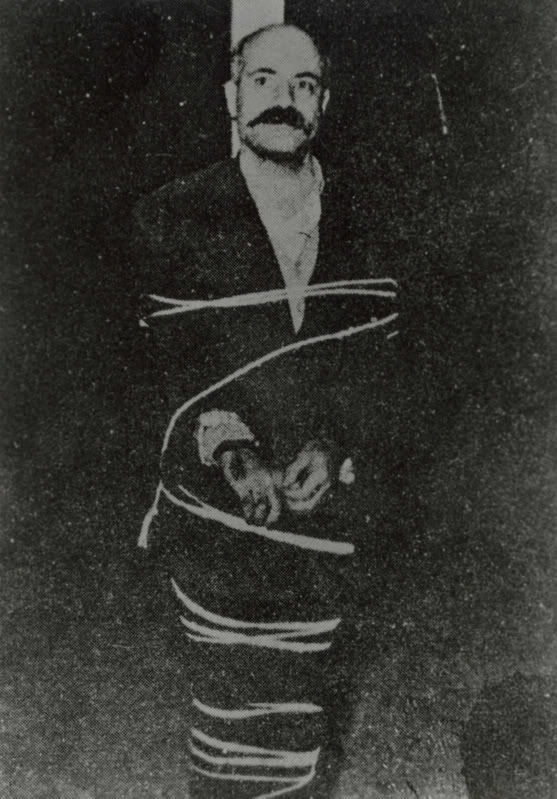
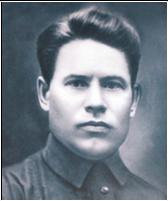 Ryutin (
 A journalist and agitator from way back, Kostov was a casualty of the postwar political chasm between east and west.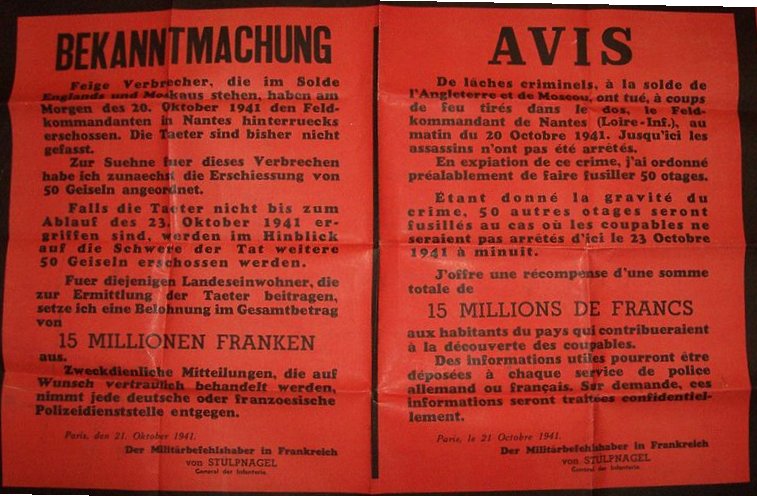


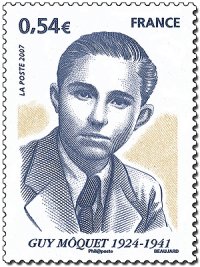 The youngest, 17-year-old