1944: Galeazzo Ciano and four other Italian Fascists

On this date in 1944, Benito Mussolini had his son-in-law, the politician Galeazzo Ciano, shot for treason outside the gates of Verona along with four other fascists who had abandoned Mussolini.

A glamorous playboy in public life, Ciano was the scion of a wealthy fascist founder. The youth wed Mussolini’s eldest daughter in 1930 and quickly ascended the party’s ranks, becoming Foreign Minister at the tender age of 33.

Ciano’s treachery, and that of the others seated in chairs and shot from behind on this day, was to have voted with the majority of the Fascist Grand Council for deposing Mussolini as Allied attacks thrust Italy into a desperate position. This confused affair lacked the character of a coup d’etat, but Mussolini was indeed placed under arrest the next day and a separate peace concluded with the Allies in early September.

Soon after, an audacious German glider raid freed Mussolini, who was quickly re-installed as head of a Nazi puppet state in northern Italy.

Ciano’s capture by this body set in motion a final personal drama with implications for later students of the Second World War. Edda Ciano escaped to Switzerland with her husband’s diaries — potentially damaging notes on the machinations of the Axis.

These scribblings she took hostage for the life of her husband. The blackmail was not accepted — to the grief of Edda, who never spoke to her father again.

One final quixotic rescue attempt cooked up by a female SS administrator on Ciano’s guard detail — the last of many women drawn to this charismatic man — foundered; the preordained death sentence came down on January 10th, and the men were shot the next morning.* Mussolini reportedly fretted in the small hours of the night over whether his standing in Hitler’s eyes would suffer should he intervene.

Edda had the diaries published as she threatened, and if they exposed scant novel evidence against his German and Italian compatriots, they offer a window upon diplomatic intrigue and personal relationships within the Pact of Steel.

The last entries were written from prison just three weeks before his execution, and (allowing that by that time the author had reason to lay blame for policy missteps explicitly at Mussolini’s door) the protracted effort they describe to steer the impulsive Duce towards some sane foreign policy — something that might have spared Italy the devastation of war and maintained a fascist government, as Spain managed to do — reads almost farcically in retrospect. Italy could make little material contribution to the war, and probably had as much to fear from Hitler in victory as from the Allies in defeat … but at every turn, Hitler’s inspiring star pulled the Italian dictator away from realpolitik and towards romantic catastrophe.

As the invasion of Poland approached, for instance, Ciano watched Mussolini vacillate on whether to cast his lot irrevocably with Hitler.

The Duce’s reactions are varied. At first he agrees with me [not to commit to war]. Then he says that honor compels him to march with Germany. Finally, he states that he wants his part of the booty in Croatia and Dalmatia.

Like World War II’s every nook and cranny, the Italian experience bestrode by Ciano has received eager literary coverage.

Edda and Galeazzo Ciano’s son Fabrizio also wrote a personal memoir entitled Quando il nonno fece fucilare papa (“When Grandpa had Daddy Shot”).

* Four of the five were only wounded by the initial volley, and the fifth was missed altogether; all were dispatched with a coup de grace.

On this day..

1945: Josefa Llanes Escoda

On this day in 1945, Filipina suffragist Josefa Llanes Escoda was last seen before her presumed execution by the Japanese occupying troops holding her at Manila’s Far Eastern University.

Escoda came of age with her native archipelago under American colonization. An energetic and brilliant woman, Escoda lectured in sociology at the University of the Philippines, held several civil service posts, founded the Girl Scouts of the Philippines and helped win female suffrage.

During the Japanese occupation, her efforts to aid POWs — including those on the Bataan Death March — made her the “Florence Nightingale of the Philippines”.

But she declined to do so in the capacity of Japanese collaborator and she and her husband Antonio were arrested in 1944 and executed in the weeks following MacArthur’s return and push towards Manila.

Escoda is pictured on the Philippines’ current 1000-peso bill.


Escoda is in the center of the three figures on this banknote. Jose Abad Santos, also executed by the Japanese, is in the top left.

On this day..

1944: Lilo Gloeden, Erich Gloeden and Elisabeth Kuznitzky

On this date in 1944, Berlin housewife Elisabeth “Lilo” Gloeden was beheaded with an axe in Plotzensee Prison, along with her husband and mother.

They had been sentenced — and intentionally made an example of — just three days before for hiding a fugitive from the July 20 Plot to assassinate Hitler.

As Martin Gilbert observes in The Second World War: A Complete History, the fury of Hitler’s domestic crackdown came in inverse proportion to Germany’s fortunes in war.

[The family’s] fate was then publicized, as a warning to anyone else who might try to shelter the enemies of the Third Reich.

The fate of that Reich could not, however, be seriously in doubt. On the day of Lilo Gloeden’s execution, American troops drove the Germans from Mackwiller, in the Saar, inside Germany’s pre-war frontier. In Hungary, the Red Army entered Eger, less than twenty-five miles from the central Slovak frontier.

Part of the Themed Set: Women Against Fascism.

On this day..

1941: Zoya Kosmodemyanskaya

On this date in 1941, Soviet partisan Zoya Kosmodemyanskaya was hanged by the Wehrmacht for sabotaging buildings behind German lines near Moscow.

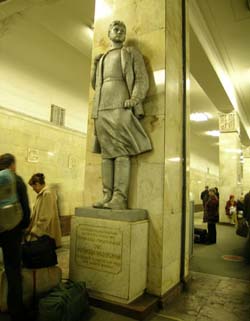
A statue of Zoya Kosmodemyanskaya stands vigil over Moscow’s World War II-era Partizanskaya metro station. Image used with permission.

One of the most famous Soviet war heroines and the first woman decorated as Hero of the Soviet Union during World War II, the 18-year-old had quit school to volunteer for a partisan unit only a few weeks before her hanging as Russia mobilized against Hitler’s race towards Moscow.

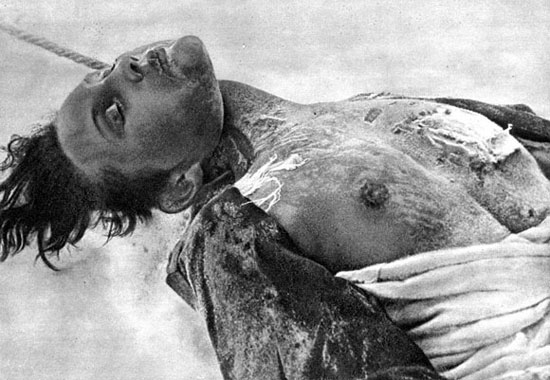
Known simply as “Tanya”, the nom de guerre which was the only information she volunteered during two days of torture, the power of the press offered her apotheosis into a propaganda coup for the Kremlin, and a symbol of courage that would long outlive Stalin. Before the public execution, the Nazis paused to photograph the scene; Kosmodemyanskaya availed the lull to harangue the Germans — “you can’t hang all 190 million of us!” — and call on the Russian villagers present to resist occupation.

Her bayoneted, mutilated body hung on the gibbet until the Red Army recaptured the village; witnesses related the tale of her dying heroism to a newsman.

It was only after the story of “Tanya” hit the press in January 1942 that her identity was established … and then promulgated widely. Anonymous and obscure in death, Zoya Kosmodemyanskaya would inspire millions and become the heroic emblem of other women partisans.


Soviet propaganda poster unabashedly modeled on the already-iconic image of Zoya Kosmodemyanskaya’s abused corpse.

Zoya, a 1944 Soviet film, was scored by Dmitri Shostakovich.

Part of the Themed Set: Women Against Fascism.

On this day..

1944: An unknown Allied airman

On this date in 1944, in the midst of a worldwide conflagration that would claim 70 million lives, one unknown crew member of an Allied bomber was shot by Nazi SS/SD troops in the woods around Enschede, Netherlands.

From late 1942, the Allies’ massive industrial capacity had sapped the vaunted Luftwaffe, bleeding down the German air force in desperate airborne combat in the Mediterranean and the Eastern front. Crippling losses in July and August 1943 lay Germany’s industrial heart open to devastating bombing and would within a year spell the end of the Luftwaffe as an effective fighting force.

The contest’s stakes were high. This hour-long compilation of contemporaneous U.S. propaganda footage celebrates the decisive effect of air supremacy in western Europe:

With hostile planes darkening Europe’s skies, the Germans called upon ruthlessness to stand in for materiel. Nazi SS chief Heinrich Himmler issued, according to Robin O’Neil, an August 1943 order to show no quarter to captured enemy pilots.

The young man shot this day suffered its effects:

The airman (estimated age 26 years), who was apparently unhurt, was taken by the SS to the cellar of the villa [serving as SS headquarters], where he was kept under guard while arrangements were made for his disposal. These arrangements consisted of the removal of his flying kit, and the substitution of a civilian light-coloured shirt, a pair of dark trousers, and a pair of socks.

In this dress he was put into a security vehicle, his hands handcuffed behind his back, and taken some distance in the grounds of the SS HQ to a spot within the compound where a grave had already been prepared. The airman was marched from the car by an escort of two SS men, one of whom dropped back and shot the airman in the back of the neck. He was buried and the grave was carefully camouflaged.

To this day, the airman’s identity has not been established. It was assumed that he was British or American, most probably American, as the trousers he was wearing were of a dark shade of khaki, and the fact that when he was informed in the car, in English, that he was to be executed, he made an indistinct reply in which the word “America” was uttered.

Countless such executions undoubtedly took place and were lost, forgotten or concealed in the charnel house of war. Thanks to the witness of Dutch prisoners who survived the war, this single act of routine brutality endured not only historically but juridically: little more than a year later, its author, Dr. Karl Eberhard Schongarth — an SS officer who participated in the Wannsee Conference and slaughtered thousands in occupied Poland and Holland — faced a war crimes prosecution for the execution of the anonymous airman.

His actions this date may have been small by the gauge of a bloodthirsty career, but since pre-war treaties explicitly regulated treatment of war prisoners, they also constituted a conveniently plain transgression of the far-from-bright line demarcating “war crimes.” For this one killing, Schongarth was himself hanged as a war criminal in Hamelin, Germany on May 16, 1946.

On this day..

1944: Richard Sorge and Hotsumi Ozaki

On the day of the USSR’s October Revolution holiday in 1944, Stalin’s greatest spies were hanged in Japan.

Renowned among espionage aficionados for supposedly forewarning Moscow of the exact date of Germany’s planned surprise attack in 1941, Richard Sorge‘s work in the pregnant years leading up to World War II produced multiple intelligence coups and could lay claim to the uncommon distinction of having materially affected the course of the war.

His signal achievement was establishing, as a foreigner in a highly xenophobic Japan, a spy ring that for years penetrated the highest levels of the Japanese government and the German embassy, giving Moscow an inside look at Axis planning.

Working under the cover of journalism in the German expat community — he had grown up in a mixed German-Russian household in Berlin and won the Iron Cross for his service in the Kaiser’s army in World War I before embracing communism — Sorge struck Hitler from half a world away. His access to the German embassy was untrammeled — indeed, he had an affair with the ambassador’s wife. His lead Japanese collaborator Hotsumi Ozaki was a major public intellectual similarly privy to sensitive information through his contacts.

The two, along with several other Japanese and foreign collaborators, produced a steady diet of top-shelf intelligence, including the (ignored) forecast of Operation Barbarossa. But the ring’s most important coup — arguably a decisive one in the history of the war as a whole — was to inform Moscow in September 1941 that Japan did not intend to attack the Russian Far East. Relieved of the nightmare prospect of a two-front war, Stalin transfered desperately needed Siberian divisions to help throw back the German advance on Moscow.

Japan by 1941 was a dangerous place to operate, however, and the nerve-rattling work — and the alcoholism to which it contributed — were taking its toll on the master spy just as the authorities were closing in. Sorge and his ring were arrested in October 1941.

Sorge’s decisive communique regarding Japanese intentions in the East had not yet borne its fruit. The war had nearly four years yet to run, and Sorge would languish in prison for most of them — long enough to leave fellow detainees with recollections of the captured operative jubilant at Red Army victories. Soviet tanks were at Germany’s doorstep by the time the two went to the gallows, one after the other, with the few minutes’ notice still customary for Japanese hangings to this day.

The spies in history who can say from their graves, the infomation I supplied to my masters, for better or worse, altered the history of our planet, can be counted on the fingers of one hand. Richard Sorge was in that group.

Spy novelist Frederick Forsythe

Sorge’s personal role in the crucible of world-shaping politics have proven a compelling topic for biographers. Among the notable works:

The Soviet government did not officially acknowledge Sorge until 1964, but the case had immediate and widespread interest in Japan. Ozaki inspired an early Kurosawa film, No Regrets for Our Youth:

The espionage ring’s operations were also the subject of a recent multilingual Japanese epic, Spy Sorge:

Part of the Themed Set: Spies.

On this day..

1936: Edgar André

On this date in 1936, communist politician Edgar Andre was beheaded in Fuhlsbüttel Prison for treasonous complicity in the Reichstag Fire.

This 1936 German pamphlet denouncing Andre’s execution concludes: “Edgar André lives. In his spirit, we march: Despite all.”

A politician raised in Belgium, Andre had bolted the Socialist Party of Germany for the Communist Party in the early 1920’s, becoming a major labor leader in Hamburg. Andre was arrested within days of the 1933 Reichstag Fire as Adolf Hitler crushed official leftist opposition.

But Andre was not brought to trial for over three years — by which time torture had crippled and deafened him, and the political climate made the doubtful nature of the evidence against him scant protection in the courts. His conviction and sentence were a foregone conclusion.

The Spanish Civil War, which erupted over the summer of 1936 between Andre’s trial and execution, saw the service of a battalion in the International Brigades named for Edgar Andre.

Just days after Andre was beheaded, that battalion entered its first action — with German volunteers helping stave off fascist capture of Madrid. The unit’s hymn commemorated their namesake:

[audio:Das_Batallion_Edgar_Andre.mp3]

On this day..