1253: P. Morret, poor guesser

Henry Charles Lea‘s A History of the Inquisition of the Middle Ages brings us the following anecdote of the Kafkaesque legal trap in which those denounced to the Inquisition found themselves.

In reality no advocate could be of material service to the accused, save in the most exceptional cases. The men who organized the Holy Office knew too well what they wanted to leave open any possibilities of which even the shrewdest advocate could take advantage, and it was admitted on all hands as a recognized fact that there was no method of defence save disabling the witnesses for the prosecution. It has been seen that enmity was the only source of disability in a witness, and this had to be mortal — there must have been bloodshed between the parties, or other cause sufficient to induce one to seek the life of the other. If, therefore, the case rested on witnesses of this kind, their testimony had to be rejected and the prosecution fell. As this was the only possible mode of escape, the cruelty of withholding from the prisoner the names of the adverse witnesses becomes doubly conspicuous. He was forced to grope around in the dark and blindly name such persons as he imagined might have a hand in his misfortunes. If he failed to hit upon any who appeared in the case, the evidence against him was conclusive, as far as it went. If he chanced to name some of the witnesses, he was interrogated as to the causes of enmity; the inquisitor examined into the facts of the alleged quarrel, and decided as he saw fit as to the retention or the rejection of their testimony. Conscientious jurists like Gui Foucoix and inquisitors like Eymerich warned their brethren that as the accused had so slender a chance of guessing the sources of evidence, the judge ought to investigate for himself and discard any that seemed to be the product of malice; but there were others who sought rather to deprive the poor wretch of every straw that might postpone his sinking. One device was to ask him, as though casually, at the end of his examination, whether he had any enemies who would so disregard the fear of God as to accuse him falsely, and if, thus taken unawares, he replied in the negative, he debarred himself from any subsequent defence; or the most damaging witness would be selected and the prisoner be asked if he knew him, when a denial would estop him from claiming enmity. It is easy to imagine other tricks by which shrewd and experienced inquisitors could save themselves the trouble of admitting the accused to even the nugatory form of defence to which alone he was entitled. As to allowing him to call witnesses in his favor, except to prove enmity of the accusers, it was never thought of in ordinary cases. By a legal fiction, the inquisitor was supposed to look at both sides of the case, and to take care of the defence as well as of the prosecution. If the accused failed to guess the names of enemies among the witnesses and to disable their testimony, he was condemned.

In England, under the barbarous custom of the peine forte et dure, a prisoner who refused to plead either guilty or not guilty was pressed to death, because the trial could not go on without either confession or defence. Cruel as was this expedient, it was the outcome of a manly sense of justice, which based its procedure on the rule that the worst felon should have a fair opportunity to prove his innocence. Far worse was the system of the Inquisition, which was equally resolved that its culprits should have no such easy method of escape as a refusal to plead. It had no scruples as to proceeding in such cases, and the obstinacy of the accused only simplified matters. The refusal was an act of contumacy, equivalent to disobeying a summons to appear, or it was held to be tantamount to a confession, and the obdurate prisoner was forthwith handed over to the secular arm as an impenitent heretic, fit only for the stake. The use of torture, however, rendered such cases rare.

The enviable simplicity which the inquisitorial process thus assumed in the absence of counsel and of all practical opportunities for defence can perhaps best be illustrated by one or two cases. Thus in the Inquisition of Carcassonne, June 19, 1252, P. Morret is called up and asked if he wishes to defend himself against the matters found in the instructio or indictment against him. He has nothing to allege except that he has enemies, of whom he names five. Apparently he did not happen to guess any of the witnesses, for the case proceeded by reading the evidence to him, after which he is again asked thrice if he has anything further to say. To this he replies in the negative, and the case ends by assigning January 29 for the rendering of sentence. Two years later, in 1254, at Carcassonne, a certain Bernard Pons was more lucky, for he happened to guess aright in naming his wife as an inimical witness, and we have the proceedings of the inquest held to determine whether the enmity was mortal. Three witnesses are examined, all of whom swear that she is a woman of loose character; one deposes that she had been taken in adultery by her husband; another that he had beaten her for it, and the third that he had recently heard her say that she wished her husband dead that she might marry a certain Pug Oler, and that she would willingly become a leper if that would bring it about. This would certainly seem sufficient, but Pons appears nevertheless not to have escaped. So thoroughly hopeless, indeed, was the prospect of any effort at defence, that it frequently was not even attempted, and the accused, like Arnaud Fabri at Carcassonne, August 26, 1252, when asked if he wished a copy of the evidence against him, would despairingly decline it. It was a customary formula in a sentence to state that the convict had been offered opportunity for defence and had not availed himself of it, showing how frequently this was the case.

On this day..

1567: Pietro Carnesecchi, Florentine humanist and heretic

On this date* in 1567, Florentine humanist Pietro Carnesecchi was burned after beheading at the Ponte Sant’Angelo in Rome.

Carnesecchi (English Wikipedia entry | Italian) was born to a wealthy Florentine merchant family allied with the Medici; as a child, Carnesecchi probably dandled the infant Cosimo, the future ruler of the city. His education was patronized by the Medici cardinal who went on to become Pope Clement VII.

All these friends in high places would prove in time to be a poisoned chalice.

But the young man was in his glory in his twenties at Clement’s papal court, as notary and protonotary, excelling in his lucrative sinecures on the curial cursus honorum.

To his grief and/or glory, he met along the way the Spanish reformer Juan de Valdes, who had taken refuge in Naples from the Spanish Inquisition, and the spellbinding pulpit orator Bernardino Ochino, who was by the late 1530s to trend towards outright apostasy.

Intellectual curiosity was a quality dangerous to its owners during the Reformation. Carnesecchi had his own insider’s view of the Church’s warts to add to the influences of these brilliant associates, and by the 1540s was obliged by his affinities to seek his safety in the more liberal religious environment of Venice … and later, after a close first brush with the Roman Inquisition, to leave Italy altogether.

He wasn’t on the run per se, but his was a contingent life: a few years in a place, with the ever-present peril that a shift in the political winds could see him or his friends to the scaffold. He returned from France to Venice in 1552, spurned a summons to justify himself once more to the Inquisition under the furiously anti-Protestant Pope Paul IV, and was even able to move back to the Eternal City with the accession to St. Peter’s Throne of another Medici cardinal as Pope Pius IV. The Inquisition, nevertheless, drug its feet when it came to acquitting Carnesecchi once again.

“Nothing progresses!” he cries in one of his letters, for the Inquisitors “will not judge as right and duty dictate, for they suggest scrupulous hesitancy where there is no ground for it, and interpret that prejudicially which, rightly apprehended, is good and praiseworthy.” In other words: prosecutors.

As Popes are said to alternate fat with thin, and old with young, here they traded zealot of the faith with mellow humanist. When Pius IV died, the pendulum swung back against Pietro and the relentlessly orthodox** Pius V took charge.

Carnesecchi took refuge in his native Florence, governed by that baby Cosimo de’ Medici, all grown up now into an authoritarian state-builder. Cosimo had welcomed him before, and interceded on his behalf in the last go-round with the Inquisition; Florence, moreover, had a long-running rivalry with Rome in peninsular politics. Carnesecchi would have supposed himself as safe there as ever he had been in his peregrinations.

“But how did Ghislieri’s [Pope Pius V’s given name] reckless energy paralyse others!” as this book puts it. “Cosimo, too, was destined to feel its influence.”

Carnesecchi was a guest at his sovereign’s table when the friar Tomaso Manrique, the Master of the Papal Palace, was announced, as sent on a special mission to Florence, and desiring an interview with the Duke. The Pope had furnished his messenger with a letter bearing date June 20th, 1566, in which, after greeting Cosimo with the Apostolic Benediction, ‘he was called upon, in an affair which nearly affected obedience to the Divine Majesty and to the Catholic Church, and which the Pope had greatly at heart, as being of the highest importance, to give to the bearer of this letter the same faith as though His Holiness were present conversing with him.” Manrique claimed in the Pope’s name the delivering over of Carnesecchi into the hands of the Inquisition. The Duke made his friend and guest rise from the table and surrender himself on the spot to the Papal messenger. And he abjectly added, that, “had His Holiness — which God forfend — called upon him to surrender his own son for the same motive, he would not have hesitated one moment to have him bound and surrendered.”

Thanks, buddy.

Hauled immediately to a Vatican dungeon, Carnesecchi spent his last 15 months in prison, under interrogation, and sometimes on the rack.

“They would fain have me say of the living and of the dead things which I do not know, and which they would so fain hear,” Carnesecchi pleaded in (futile, intercepted) letters to old associates from the Curia. He admirably refused to incriminate anyone, but was convicted in September 1567 on 34 counts of obstinate heresy. They can all be read here — headlined by that hallmark of rank Protestantism, justification by faith alone.

Carnesecchi was stripped of his ecclesiastical ranks and his property, and turned over to the secular arm — the latter hypocritically “beseech[ed] … to mitigate the severity of your sentence with respect to his body, that there may be no anger of death or of shedding of blood,” which was, of course, the very intent and the effect of turning him over. Carnesecchi met his fate sturdily; his Catholic confessor complained that he was more interested in bantering ideas than penitence for his wrong opinions, and showed no proper fear of death.

In 1569, Pius V bestowed the title of Grand Duke of Tuscany on Cosimo.

Carnesecchi, long obscure to posterity, was exhumed almost literally when the Napoleonic Wars gave anti-clerical factions the opportunity to ransack secret Roman Inquisition archives. His meter-long file passed into a succession of private hands and was finally published in the mid-19th century, and as a result there are several public-domain volumes about the heretic in addition to the one we have already cited. Some of the original documents, with English translation, can be read in this volume; Italian speakers might give this one a go.

* There are a few citations out there for October 3. I can’t find a definitive primary source, and it may be that the original records are themselves ambiguous, so I’m going with the bulk of the modern and academic citations in favor of October 1.

** Anglos may recognize Pius V as the pope whose bull explicitly releasing Catholics from their allegiance to Queen Elizabeth put English followers of the Old Faith in an untenable position, much to the grisly profit of this here blog.

On this day..

1815: José María Morelos, Mexican revolutionary

On this date in 1815, the Catholic priest turned revolutionary leader Jose Maria Morelos was shot for rebellion.

Morelos was born in New Spain — the town of his nativity was posthumously named in his honor — and entered adulthood a humble agricultural laborer* before engaging the career in letters necessary to undertake Holy Orders.

Designated to save his countrymen’s souls, he proposed instead to save their liberties and ungratefully joined up with fellow-priest Miguel Hidalgo when the latter sounded the tocsin for the Mexican War of Independence.

Morelos distinguished himself rapidly in the revolutionary army, and upon Hidalgo’s capture attained its leadership, complete with Generalissimo status.

Upon capture, he was handled first — and rather meticulously — by the Inquisition, which defrocked him in an auto de fe before relaxing him to the secular authority for the inevitable punishment.

Without a dissentient voice it [was] agreed that … [Morelos] be declared guilty of malicious and pertinacious imperfect confession, a formal heretic who denied his guilt, a disturber and persecutor of the hierarchy and a profaner of the sacraments; that he was guilty of high treason, divine and human, pontifical and royal … his property should be confiscated to the king … His three children were declared subject to infamy and the legal disabilities of descendants of heretics.

Source

Nobody said being a national hero was easy.

* “His morals were those of his class,” remarks our source on the Inquisition. “He admitted to having three children, born of different mothers during his priesthood, but he added that his habits, though not edifying, had not been scandalous, and the tribunal seemed to think so, for little attention was paid to this during his trial.”

On this day..

1539: Don Carlos Ometochtzin, Aztec heretic

On this date in 1539, the Spanish Inquisition had Aztec noble Don Carlos Ometochtzin (or Don Carlos Chichimecatecuhi, or Don Carlos Ahuachpitzactzin) burned at the stake for reverting to the pre-Columbian indigenous religion.

Just another Mesoamerican depredation?

Surprisingly, this execution stands out as an exception in the first generations of its conquest. It even cost the first bishop of Mexico, Juan de Zumarraga, a reprimand for his excess severity. Why?

Certainly any European Christian would have had trouble with the Inquisition if, like Don Carlos (Spanish Wikipedia entry | English), he had been caught with idols of Xipe Totec in his place.

But it was precisely the point that these weren’t Europeans. In 16th century “New Spain,” syncretisms of Christianity and the native Mexican cults still in living memory were the norm, a scenario recalling early Christianity co-opting the pagan rites it supplanted.*


Respect Xipe Totec’s authoritah!

And that created for the Spanish a problem: how stringently to insist upon an alien orthodoxy for its new subjects? The problem was pragmatic at least as much as it was theological, because the business of winning converts for Christ had to coexist with the business of running an empire. No sense provoking civil war just because the newest souls in the fold don’t have the Te Deum down; Cortes himself, in his initial conquest, had prohibited human sacrifice but not risked closing native temples.* That wasn’t done until 1525.

Over the 1530’s, a campaign unfolded to pare down the many holdover native behaviors — polygamy, idolatry — and cement Christianity. Of particular concern were the “converted” elites who had both means (their social position) and motive (privileges lost to the Spanish) to use nostalgia for the old ways to make trouble.

So, a powerful indigenous priest who “converted” and then went about preaching heretically was investigated by Zumarraga, wielding the Inquisitorial authority, in 1536.

But even that didn’t draw a death sentence.

In Zumarraga’s 19 Inquisitorial trials involving at least 75 suspects, the one and only instance of an Indian being “relaxed” to the secular authorities for execution came in 1539, when Zumarraga was tipped that the hereditary ruler of one of the Aztec Triple Alliance‘s principal city-states was a secret idolator, and a public declaimer of treasonable utterances like this:

Who are those that undo us and disturb us and live on us and we have them on our backs and they subjugate us? … no one shall equal us, that this is our land, and our treasure and our jewel, and our possession, and the Dominion is ours and belongs to us.

Don Carlos was ultimately acquitted of the idolatry stuff, but convicted of heretical dogmatizing.

So far, so good, right? Executions for heresy might be horrible in general, but if you live in a world where they’re routine, surely having your colonial satrap out there calling the empire parasitical, and telling the unwashed masses to go ahead and take multiple wives (Aztec elites seem to have been especially piqued by the lifestyle austerity preached by Franciscan missionaries) is the sort of thing that’ll get you burned at the stake.** And there were plenty more like him out there.

But though the Christianizing campaign of the 1530’s would continue in many forms for decades still to come, the bloodletting which Don Carlos figured to presage was abruptly canceled.

According to Patricia Lopes Don’s “Franciscans, Indian Sorcerers, and the Inquisition in New Spain, 1536–1543,” in Journal of World History, Vol. 17, No. 1,

[a] holocaust was most probably at hand in the spring of 1540. However, when the Council of the Indies in Spain learned of Don Carlos’s execution, they reprimanded Zumárraga, sent a visitador, an inspector-auditor, to New Spain to take away the bishop’s inquisitorial powers, and left him in a state of some humiliation until his death in 1548. All indications were that they feared further such executions would lead to widespread indigenous rebellion in New Spain. As was the case with the Muslims in the Old World, although orthodox Christianity was central to the concept of Spain and the monarchy, when the imperial Spanish needed to choose between religious orthodoxy and the security of the state, they could learn very quickly to be flexible and politique, yet express their concerns in judicious language. In a letter of 22 November 1540, Francisco de Nava, bishop of Seville, explained to Zumárraga that while he understood that he had executed Don Carlos “in the belief that burning would put fear into others and make an example of him,” the Indians, he suggested, “might be more persuaded with love than with rigor.”

When the Inquisition was formally instituted in New Spain in 1571, the native populace was explicitly outside its jurisdiction: its job was to monitor the European population for covert Protestants, Muslims, and Jews.

Although this development has to count as a break for the locals, it’s interesting to note that the theological superstructure of the Spanish policy tension between religious conformity and practical colonialism turned at least in part on a condescending dispute over the “capacity” of Indians to truly become Christian. In that dispute, Zumarraga and his Franciscan order were the ones who thought more highly of the indigenous “capacity”, as against the more skeptical Dominicans; the logical consequence of the Franciscan position was to impose upon those capacious natives the fullest severity of God’s law.

* Though not to be underestimated is the persistence within the citadel of Christendom of everyday folk beliefs, and occasional social movements, at odds with ecclesiastical dogma.

** Treasonous quote and details about the investigation and trial from Richard E. Greenleaf, “Persistence of Native Values: The Inquisition and the Indians of Colonial Mexico”, The Americas, Vol. 50, No. 3 (Jan., 1994)

On this day..

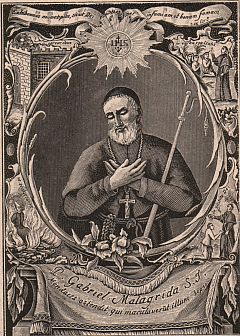
1761: Gabriel Malagrida, Jesuit nutter

On this date in 1761,* the Jesuit Gabriel Malagrida became a late casualty of the Tavora Affair and the Lisbon earthquake when he was garroted for heresy.

Malagrida (English Wikipedia entry | Portuguese) was a 72-year-old Italian with decades of missionary service to the Portuguese New World colonies under his belt.

He had, in his time, been a prominent exponent of the Jesuits missions’ policy in the Amazon, which amounted to asserting their own jurisdiction against the secular government’s attempt to order its overseas territories. (There’s more on that conflict here.)

And this only exacerbated his principal sin of being a Jesuit — an order whose diminution was eagerly sought by the rising statesman of Enlightenment Portugal, the Marquis of Pombal.

The shock of the 1755 Lisbon earthquake would deal Pombal the trump hand he needed to start reshaping both city and society to his liking.

Malagrida, meanwhile, carped that the earthquake’s causes

“are not comets, are not stars, are not vapors or exhalations,** are not phenomena, they are not natural contingencies or causes; but they are solely our intolerable sins … I do not know how a Catholic subject dares to attribute the present calamity of this tragic earthquake to causes and natural contingencies. Do not these Catholics understand this world is not a house without an owner?”

This published pamphlet merely echoed what many of the order were saying in the pulpits, and Pombal was not about to let the backwards, superstitious crowd** own the catastrophe.

Malagrida was banished from Lisbon: and, when the Tavora family was implicated in an attempt to assassinate the Portuguese king, Malagrida, their confessor, found himself clapped in prison.

Though the now-septuagenarian priest did not share the Tavoras’ grisly public butchery, he was left to molder. A couple years in a dungeon saw him go a bit strange, and supposedly he published treatises with such eccentric features as God’s personal instructions to Malagrida, and Malagrida’s fascination with St. Anne’s uterus. Catholic sources, which consider Malagrida a martyr, doubt that he ever published any such thing; if he did, it seems apparent that it was dementia rather than heresy that afflicted the old man.

But Pombal had installed his own brother as judge of the tribunal, so the matter was prearranged. The execution itself was

staged in a dramatic way, even to the point of Malagrida’s appearing on the scaffold in Jesuit habit, to impress upon the Portuguese and the world at large that an old order had come to an end and a new one was to be established … one might say that … symbolism at the cost of one human life was a relatively humane procedure in comparison with the symbolic elimination of whole classes of society in the twentieth century.


Detail view (click for the full image) of Malagrida executed at a Lisbon auto de fe. CC image from Ricardo Mealha, original provenance unknown.

Pitying the superstitious Jesuit at the stake, Enlightenment secularist Voltaire inveighed against Enlightenment secularist Pombal for conducting the execution … just part of Voltaire’s queer ideas about not killing people over their religious beliefs.

“It is all pity and horror,” Voltaire wrote in a private correspondence. “The Inquisition has found the secret to inspire compassion for the Jesuits.”

Voltaire’s appraisal in Candide (already published by this time) of a country in the grip of religious superstition unjustly stands as one of the lasting literary monuments to an event that actually rolled back clerical influence: “the sages of [Portugal] could think of no means more effectual to prevent utter ruin than to give the people a beautiful auto-da-fé; for … the burning of a few people alive by a slow fire, and with great ceremony, is an infallible secret to hinder the earth from quaking.” That the philosophe who penned those words waxed so immoderately outraged at the demonstrative chastisement of a man who preached precisely all that hocus-pocus — that Voltaire ascribed his execution to “the Inquisition” — plants the cherry on the irony sundae.‡

But Pombal’s expedient use of the Inquisition’s medieval machinery to make an example of Father Malagrida would not be the start of a pattern; the Pombaline reforms of the years to come brought the Inquisition sharply to heel, and it was Malagrida himself who was its last victim (pdf) in Portugal in its classical ecclesiastic form.


The house where Malagrida was born in Menaggio, Italy is marked with a plaque. Image (c) kallipyg and used with permission.

* Some sources give September 20 as the date.

** The “God is pissed” hypothesis was posited against theories of earth’s vapors promulgated by the Pombal-sponsored scientist Ribeiro Sanches.

† Anti-Jesuit sentiment was widely abroad in Europe at this time; increasingly resented as political manipulators, the Society would be suppressed by papal order in 1773, only to revive during the post-Napoleonic reaction.

‡ Malagrida was well-known to contemporaries in Europe, but that does not mean sympathy for him was universal. The British pol Lord Shelburne was satirized as “Malagrida” for his putative duplicity.

On this day..

1603: Not Tommaso Campanella

The wise were forced to live as the mad were accustomed, in order to shun death, such that the greatest lunatic now possesses the royal burdens. The wise now lived alone with their wisdom, behind closed doors, applauding only in public the others’ mad and twisted caprices.

-Tommaso Campanella

On this date in 1603, freaky-deaky Dominican philosopher Tommaso Campanella drew a life sentence — avoiding execution by dint of a painfully convincing performance of insanity.

Campanella had some problematically heterodox notions about the sun (namely, that it was going to consume the earth) and everything under it, and had had a recent scrape with the Inquisition.

What really got him in trouble was trucking with a Calabrian conspiracy to overthrow Spanish domination, apparently a product of the monk’s millenarian anticipation of a sort of proto-communist revolution.

Campanella was a strange guy, but this was quite a far-out plot.

As Joan Kelly-Gadol writes in this fine tome,

This took place, let it be noted, after he had written two works advocating a Papal monarchy for Italy and the world and two works promoting the interests of the Spanish Empire also in Italy and throughout the world.

Past performance is no guarantee of future returns. Once the conspiracy was betrayed,

Campanella was imprisoned … in the Castel Nuovo, one of the principal fortresses in which the Spaniards maintained a military garrison. He was arraigned before the civil tribunal for rebellion and before the ecclesiastical tribunal for heresy. His “examination” which began in January 1600 was gruesome. He claimed innocence in his first interrogation before the civil tribunal, was thrown into a dungeon, actually a cleft in the bedrock of the Castle, to remain there for seven days. Then followed torture. He “confessed,” admitting that he preached about the coming political upheaval but denying that he was part of a conspiracy to bring it about …

His desperation at this point can be gauged by the fact that by April of 1600 he began to feign madness. The ecclesiastical action against him began now, and he persisted in this attitude of insanity through three interrogations, including an hour of torture … On the fourth and fifth of June 1601, he was subjected to the cruel torture of “the vigil” to test whether his insanity was genuine. This was the usual torture of the rope, suspending the body of the victim by his tied hands over a blade which cut into his flesh whenever he yielded to the strain of holding himself in the air; but the vigil refined this cruelty by continuing it for forty hours. Campanella endured the ordeal without breaking.

And it wasn’t just a feat of toughness to beat the torturer at his own game, impressive as it is on those terms alone: Campanella pulled off a genius gambit exploiting the Inquisition’s own legal machinery to duck the separate capital charges he faced in civil and ecclesiastical court.

Joseph Scalzo’s “Campanella, Foucault, and Madness in Late-Sixteenth Century Italy”,* an academic paper that reads like a thriller, narrates Campanella’s “dangerous competition” with his persecutors.

In fine: on Easter Sunday 1600,** as he was approaching conviction and condemnation in his state trial for treason, Campanella began his insanity ploy, successfully forcing a delay in that case and initiating his separate church trial for heresy.

Then, by remaining stubbornly committed to what most of his examiners believed was a charade, Campanella won … by forcing them to inflict that juridically determinative 40-hour “vigil” torture.

the jurisprudence of the time accorded torture so much force, such as to annul all other proofs and “to purge circumstantial evidence”; if the torture had been vigorous and unusual. The accused came, all the more to avail himself of the result obtained, according to the scholarship of the criminologists most in vogue. Thus, Campanella had judicially to be regarded as insane, although everyone was persuaded that he probably simulated insanity. The consequence, in the tribunal of the Holy Office, was not indifferent: He was a “relapsed heretic,” and even if repentant, he would have been disgraced and consigned to the secular court of justice, which would have executed him; being mad, he could no longer suffer condemnation, and in the circumstance in which he might already have been condemned, he would have been spared the death penalty, to reason and repent.

(this is Scalzo’s quotation of Luigi Amabile, an Italian who wrote the book on Campanella; I have been unable to find the Amabile original online.)

Home free.

Having reached this judicial safe haven, Campanella soon — in fact, according to the man who tortured him, literally on the walk from the vigil back to his cell — resumed a recognizable rationality.

He’d languish in prison until 1626 (a few years after he got out, he had to flee to France), but he made the most of it. Campanella wrote his magnum opus, the utopian City of the Sun, while awaiting his sentence in 1602. A number of other works on a wide array of subjects — science, philosophy, theology, political governance (he returned to giving the Spanish empire supportive advice), a vigorous defense of Galileo — were also composed during his 27 years under lock and key.

Campanella’s visionary anticipation of radical egalitarianism would, like Thomas More‘s, help shape the utopian literary genre. But Campanella’s take, while still a theocratic one, lent itself to distinctly more subversive interpretation.†

For example, this Brezhnev-era Soviet essay‡ (unearthed and translated by Executed Today friend and sometime guest-blogger Sonechka) decants the Dominican’s heretical notions into Marxist orthodoxy.

How many times were the communists denounced by their enemies for this “commonality of wives”! Scientific communism, certainly, is not responsible for the figments of a monk like Campanella. But it is instructive to penetrate his logic. It is not commodification or dehumanization that hides behind Campanella’s “commonality of wives”. The women of the “City of Sun” have the same rights as men … The “commonality of women” is equivalent to the “commonality of men” on the basis of mutual equality. That is why, though [we are] decisively rejecting this type of family-free communism, it is necessary to consider who stands on the higher moral grounds — Campanella’s woman, alien to deceit and pretense, or a false bourgeois woman, whose lot in life is adultery and legalized prostitution.

Ultimately, this wild man not only got the high moral ground: he got to die in bed. Once in a while, we get a happy(ish) ending.

So although it actually has nothing to do with Tommaso, “La Campanella”“Little Bell”, a Paganini violin concerto — allows us here at this blog (in common with our day’s hero) an atypically soothing* denouement.

* Joseph Scalzo, “Campanella, Foucault, and Madness in Late-Sixteenth Century Italy”, The Sixteenth Century Journal, Vol. 21, No. 3 (Autumn, 1990)

** Campanella’s Easter 1600 madness was initiated only a few weeks after fellow intellectual omnivore Giordano Bruno was burned for heresy up the road in Rome. Strictly coincidence.

† Since so much of Campanella’s work was produced while the author was under duress — fighting capital charges, applying for clemency and release — it remains disputable just which parts of it can be taken to represent his real beliefs.

‡ L. Vorob’ev. “Utopija i dejstvitelnost”. (“Utopia and Reality”) in Utopicheskij roman XVI-XVII vekov (Utopian Novel of XVI-XVII century); Series “Biblioteka vsemirnoj literatury”, Khudozhestevnnaja literature, Moscow, 1971, p. 19.

On this day..

1532: Solomon Molcho

(Thanks to Jonathan Shipley of A Writer’s Desk for the guest post. -ed.)

Solomon Molcho, a Portuguese mystic, burned at the stake on this date in 1532 for apostasy.

Solomon Molcho’s Shel Silverstein-esque stylized signature. You can see his robe in Prague, or here.

He was in Regensberg, Germany with Jewish messianic adventurer David Reubeni meeting with Emperor Charles V hoping to persuade the ruler of the Holy Roman Empire to arm Marranos (Sephardic Jews forced to adopt Christianity) against the Turkish onslaught.

Charles imprisoned them both, turning them over to the Inquisition in Mantau, Italy. Reubeni died in prison, possibly poisoned. Molcho, who chose at the stake not to return to Christianity, burned.

Molcho’s life ended in flame but started in the warm bosom of the high echelons of Portuguese society. Born Christian to Marrano parents around 1500, Molcho held the post of royal secretary in the high court of Portuguese justice.

That is, until Reubeni visited Portugal on a political mission.

Enamored with Reubeni, who claimed to be a prince descended from the tribe of Reuben, and who had gained favor with Pope Clement VII, Molcho wanted to join Reubeni in the adventurer’s travels. Reubeni refused. Molcho circumcised himself in hopes of gaining Reubeni’s favor. It was all for naught, and so Reubeni emigrated to Turkey.

Soon Molcho was wandering through the Land of Israel, a preacher who predicted the Messianic Kingdom would come in 1540. He, too, gained favor with Pope Clement VII and, after studying the Kabbalah, predicted natural disasters like a flood in Rome in 1530 and an earthquake in Portugal in 1531. After those predictions, and dabbling in strange experiments, Molcho claimed himself to be a precursor to the coming Messiah, if not the Messiah himself.

This troubled many. Now traveling with Reubeni — one a Kabbalist mystical messianic preacher, the other a peripatetic Jewish dwarf — they sermonized, and allied themselves, where they could.

But not with the emperor.

Molcho, in the provincial capital of Mantua, south of Lake Garda in the Po plain, was given one last opportunity to convert back to Catholicism. Asking instead for a martyr’s death, Molcho got it.

On this day..

1570: Aonio Paleario, Italian religious reformer

On this date, Antonio della Pagliara was hanged across the Tiber from the Castel Sant’Angelo in Rome for heresy.

The present-day view from the square where Paleario is thought to have been put to death, over the Ponte Sant’Angelo’s span across the Tiber to the Vatican’s imposing citadel.

Better known as Aonio Paleario (English Wikipedia entry | the considerably deeper Italian), the humanist scholar grew into his intellectual career just as Martin Luther’s doctrine was shaking Christendom.

Paleario’s positions were dangerously — and at length, fatally — close to Protestantism. He counted himself a humanist, a great admirer of Erasmus, who from the Low Countries managed to hold his critical positions without running afoul of the Catholic Church.

This would prove an increasingly difficult trick as the century unfolded … especially in the pope’s back yard.

Paleario’s most particular offenses were to take what amounts to the Lutheran side on the primacy of scriptural text over ecclesiastical tradition, and of salvation through Christ alone without the Church’s intermediation. (He also denied Purgatory.)

Since the Italian academic also cottoned to the Protestant-humanist critique of clerical corruption, he pitched Martin Luther and John Calvin on the notion of convening a Christendom-wide ecclesiastical council to reconcile competing sects. He seems to have wanted to reconcile the reformist current of humanism still within the Catholic tradition, and that of those critics who had broken, perhaps not yet irrevocably, with Rome.

The effort ultimately foundered. Instead, the curia-approved Council of Trent formulated a Roman Catholic doctrine that insured the permanent schism with Protestantism.

The Counter-Reformation was on. Still, with contending theologies — and contending polities — afoot in the Italian quiltwork plus his own towering reputation as the greatest orator in Italy, Paleario was able to find protectors and carry on. He taught in Siena, Lucca and Milan for more than three decades, surviving two bouts with the Inquisition before a Rome in crackdown mode finally pinned a heresy rap on him.

By that time, the septuagenarian didn’t much bother to fight it.

If your Eminences have so many credible witnesses against me, there is no need to give yourselves or me any further trouble … Judge, therefore, and condemn Aonio; satisfy my adversaries, and fulfil your office.

The office was fulfilled consuming the old man in flames, but they did extend the favor of hanging him (and apparently exposing the corpse for several days) first.

A book uncertainly attributed to Paleario, Beneficio di Criso (The Benefit of Christ’s Death) is available free at Google Books.

On this day..

1568: The Counts of Egmont and Hoorn, insufficiently Inquisitorial

On this date in 1568, two Flemish nobles were beheaded at Brussels’ Grand Place for treason to the Spanish crown that then ruled the Low Countries.

Lamoral, Count of Egmont and Philip de Montmorency, Count of Hoorn had a beef with the introduction of the Inquisition into the Netherlands by Egmont’s cousin, King Philip II, and got to hanging around with dubious characters like William of Orange.

Unluckily for this day’s duo, William didn’t teach them to read the writing on the wall.

After the Counts went easy on an outbreak of Protestant Iconoclasm, the Catholic king sent the hammer in the person of the Duke of Alba (or Alva).

Let this long-expired generation counsel posterity to find itself elsewhere when one’s door is darkened by a man known as “the Iron Duke”. William had the wit to get out of town. Egmont and Hoorn hung around, depending on their (professedly) clean consciences.

Oops.

Count Egmont Before His Death, by Louis Gallait

The beheadings were widely protested both locally and abroad, and festered as a grievance against the empire — a grievance that, as the nascent conflict evolved into a revolution that would detach the Netherlands from Spain, elevated these distinctly non-revolutionary wealthy nobles into freethinking martyrs of independence.

Two centuries later, Goethe put the story on the stage with his play Egmont (original German | English translation), a production for which Beethoven subsequently composed gorgeous orchestral companion pieces.

Here’s the lovely, lovely Ludwig Van’s beloved (including by Goethe himself) Overture to Egmont, Op. 84:

On this day..

1596: Francisca Nunez de Carvajal, her children, and four other crypto-Jews of her family

On this date in 1596, the Inquisition sent nine Jewish converts to Christianity to the stake in Mexico City for Judaizing — a cruel fate offering a window into a secret history of New World settlement.

When Spain expelled its Jews (and subsequently its Muslims), those who did not flee had to convert. Conversions at swordpoint being of suspect sincerity, the Inquisition spent much of the following centuries hunting Conversos — so-called “New Christians” — who secretly preserved their outlawed faiths.

For some crypto-Jews, the New World held an appeal akin to that which would draw later generations of northern Europe’s religious minorities.

Latin America in particular attracted considerable numbers of New Christians. The advantage of these territories was that they offered the New Christians a familiar culture and the possiblity of direct — even if infrequent — contact with the mother countries … These factors also helped permit [crypto-Jews] to practice Judaism.

The Carvajals (or Carabajals) were just such a family, settling in Monterrey under the aegis of their kinsman, Spanish governor Luis de Carvajal y Cueva.

But in 1590, the governor’s sister Francisa was tortured by the Inquisition into implicating her entire family in Judaism.

They got off with a humiliating public recantation, but evidence of a relapse a few years later resulted in Francisca being burned at the stake at an auto de fe — along with her children Isabel, Catalina, Leonor and Luis, and four of their in-laws. The 30-year-old Luis left a testimonial to his faith and his tortures.

A headstone in New Mexico, USA, suggests crypto-Jewish descent. Image used with permission.

Despite the grisly doings of this day, however, the Inquisition never could extirpate Jews from its American territory.

These hidden communities filtered into Mexico and north to the present-day United States, keeping adapted versions of Jewish traditions secretly alive.

Still, crypto-Jews produced scant potentially self-incriminating documentary evidence. Although DNA testing has latterly entered the scene, the true extent and nature of these populations has been the subject of lively scholarly controversy.

But the Carvajals and others like them, seemingly lost to the Inquisition’s depredations, are coming alive again. This day’s executions are the subject of a modern opera and a spring 2008 Texas A&M symposium.

And the wider community of crypto-Jews have their own umbrella organization and a burgeoning body of historical literature.

Books about crypto-Jews

On this day..