2004: Enzo Baldoni

On this day four years ago, an Islamic militants in Iraq executed* hostage Enzo Baldoni, an Italian freelance journalist and Red Cross volunteer.
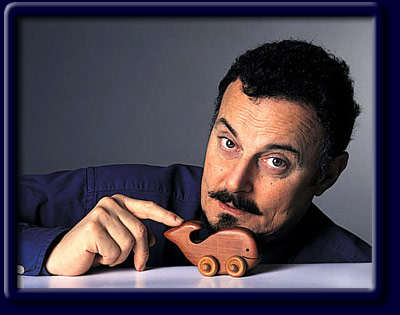

Baldoni had a variegated copyriting career, often working through his company Le Balene Colpiscono Ancora (“The Whales Strike Again”)

Baldoni (English Wikipedia page | Italian) made his writing chops with advertising copy, but also translated (notably the American comic strip Doonesbury, whose creator saluted him “Enzo the miraculous” in this FAQ) and segued into journalism. He was an early adopter of blogging and made a habit of traveling to the world’s hot spots; he had interviews with Subcomandante Marcos and Xanana Gusmao under his belt … but he was no scavenger of human misery.

Some people think I am some sort of a Rambo who loves strong emotions and seeing people die. I am miles away from that mentality. I am a convinced pacifist and for that reason I am curious to understand what make normal people brandish a gun.

Baldoni reported from Iraq for the Italian weekly Diario and kept a blog from the ground as well. On August 21, he was kidnapped after being caught in a firefight between Baghdad and Najaf.** Three days later, Al Jazeera aired his captors’ demand for Italian withdrawal within 48 hours; Baldoni was killed when that demand was ignored.

The day after Baldoni’s death, the black armband-clad Azzurri defeated the upstart Iraqi soccer team for the Olympic bronze medal.

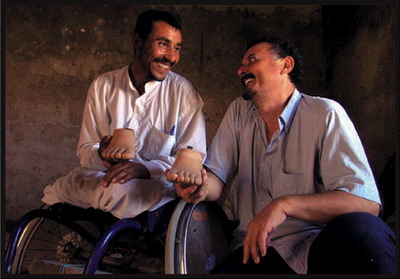
The final legacies of Baldoni’s work well reflected his generous principles. The last entry on his blog Bloghdad (now defunct; here’s how it looked four years ago) was this picture:
And his (translated, obviously) “last testament” as released by a fellow journalist described a man who would not want this blog post to linger on mawkishly.

[At my funeral] I want people to smile — did you notice? Funerals always end up with someone smiling: it’s natural, it’s Life taking over Death. And let people smoke freely anything they like; I’d also be pleased if new love stories would come out, and I’d even consider some casual sex an offer to Life rather than an offense to Death.

At about eight or nine o’clock, with little or no ceremony, bring my coffin quietly to the crematorium, while the party and the music should last until late night.

About my ashes … throw them into the sea. Or do as you want, who fucking cares? Just nothing phony like in The Big Lebowski.

Ciao, Enzo.

* Obviously, this is a case of a borderline execution, owing to the Islamic Army in Iraq’s non-state credentials — in a legal sense, Enzo Baldoni was murdered. But it was precisely the point of his killing to contest legitimate state authority, and according to a later interview with an alleged spokesman of the faction, there was even a juridical proceeding “convicting” Baldoni of espionage.

** According to Reporters Without Borders, a stupefying 142 journalists — Baldoni among them — were killed in Iraq from 2004 through 2007, nearly half the worldwide total of 299 reporters who died in their line of work during that span.

On this day..

1191: Muslim prisoners at Acre

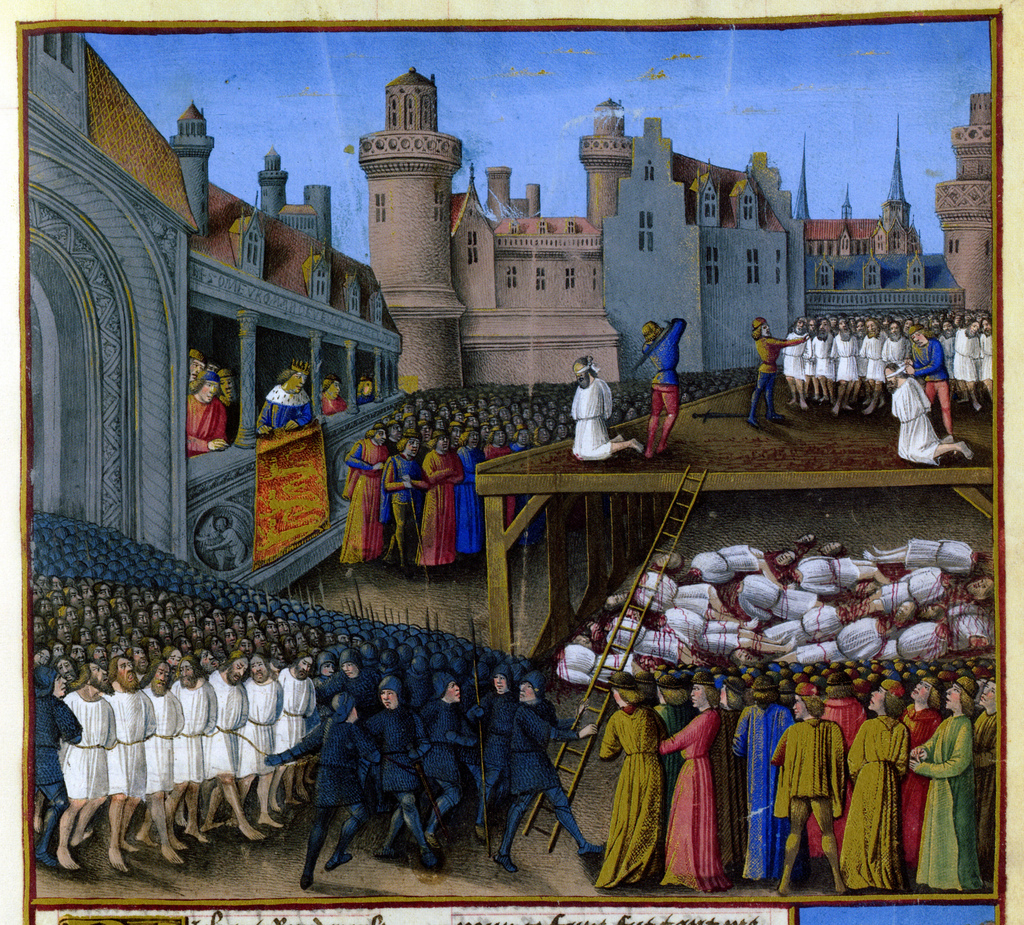
On this date in 1191, Richard the Lionheart had 2,700 Muslim prisoners of Acre demonstratively executed before his opposite number Saladin, when ransom arrangements dilated.

Courtesy of Project Gutenberg, here is Guizot on this ugly prod to action from the Third Crusade

From the 1st of August, 1191, to the 9th of October, 1192, King Richard remained alone in the East as chief of the crusade and defender of Christendom. He pertains, during that period, to the history of England, and no longer to that of France. We will, however, recall a few facts to show how fruitless, for the cause of Christendom in the East, was the prolongation of his stay and what strange deeds—at one time of savage barbarism, and at another of mad pride or fantastic knight-errantry—were united in him with noble instincts and the most heroic courage. On the 20th of August, 1191, five weeks after the surrender of St. Jean d’Acre, he found that Saladin was not fulfilling with sufficient promptitude the conditions of capitulation, and, to bring him up to time, he ordered the decapitation, before the walls of the place, of, according to some, twenty-five hundred, and, according to others, five thousand, Mussulman prisoners remaining in his hands.

The only effect of this massacre was, that during Richard’s first campaign after Philip’s departure for France, Saladin put to the sword all the Christians taken in battle or caught straggling, and ordered their bodies to be left without burial, as those of the garrison of St. Jean d’Acre had been. Some months afterwards Richard conceived the idea of putting an end to the struggle between Christendom and Islamry, which he was not succeeding in terminating by war, by a marriage. He had a sister, Joan of England, widow of William II., king of Sicily; and Saladin had a brother, Malek-Adhel, a valiant warrior, respected by the Christians. Richard had proposals made to Saladin to unite them in marriage and set them to reign together over the Christians and Mussulmans in the kingdom of Jerusalem. The only result of the negotiation was to give Saladin time for repairing the fortifications of Jerusalem, and to bring down upon King Richard and his sister, on the part of the Christian bishops, the fiercest threats of the fulminations of the Church. With the exception of this ridiculous incident, Richard’s life, during the whole course of this year, was nothing but a series of great or small battles, desperately contested, against Saladin. When Richard had obtained a success, he pursued it in a haughty, passionate spirit; when he suffered a check, he offered Saladin peace, but always on condition of surrendering Jerusalem to the Christians, and Saladin always answered, “Jerusalem never was yours, and we may not without sin give it up to you; for it is the place where the mysteries of our religion were accomplished, and the last one of my soldiers will perish before the Mussulmans renounce conquests made in the name of Mahomet.”

Good thing that Jerusalem issue has since been cleared up.

The BBC treated the scenario — complete with the resultant loss of the last chunk of the supposed True Cross — in a chunk of its 90-minute documentary on the Third Crusade:

On this day..

2006: Mohamed Amin Mohamed Razali, mystical Malaysian militant

Two years ago today, the strange leader of a mystical Islamic fight club was hanged at Malaysia’s Sungai Buloh prison for waging war on the king.

Caption Contest?: The Headsman could be mistaken, but based on an altogether amateur comparison to the Razali shot on this BBC story, I believe that’s him in the white. Photo from the sect website.

The heretofore obscure Al Ma’unah — just a couple dozen guys — had descended on an army camp in July 2000 and made off with a handsome cache of weapons and a few hostages, apparently the opening gambit in a bid to launch an Islamic fundamentalist revolution in Malaysia.

What actually happened was the army hunted them down and engulfed them a couple of days later.

You’d never know the ambitious designs of this clique from its web site (still online as of this writing), whose English “about us” page rings harmlessly loopy (all grammatical manglings [sic]):

Al-Ma’unah … is a Non-Govermental Organisation (NGO) … involved in the teaching of martial arts particularly the development of one’s inner power and the practice of Islamic traditional medicine.

Literary, the term “Ma’unah” is an Arabic word which means, something extraordinary that happens to an ordinary Muslim individual, for example extra sensory perception or the ability to see “things” in another dimension (paranormal).

“Al-Ma’unah Inner Power” can be defined as “something extraordinary bestowed to a righteous Muslim (in the form of assistance from Allah) in accordance with specific adherence to tradition and proper sequence emphasising on the Islamic principles and Allah’s commandments as stipulated in the holy Quran”.

In teaching the martial art and traditional medicine, the brotherhood placed more emphasis on spiritual development and enlightenment of its members or “ikhwan” as it is known in Al-Maunah, in order to achieve the highest level of proficiency in the art and to attain great healing powers.

… although a section entitled “The Usage of the Inner Power” suggests the training achieves the sorts of useful martial superpowers more commonly found on a Dungeons & Dragons treasure table:

Among the benefit of Al-Ma’unah Inner Power can be listed as follows:

o For health and vitality, both physically and spiritually.
o Making an enemy/attacker to freeze on the spot and to be hurled sprawling backwards without being touch.
o Invincible from sharp objects, weapons, boiling water, fire etc.
o To transfer temporarily the inner energy to another object.
o Able to attain healing powers.
o Able to tie enemies without using rope.
o Able to hypnotise a violent aggressor to sleep or forget his intention.
o Able to pull back a fleeing snatch thief or robber from great distance (without physical body contact).
o Able to make attackers to drop to their knees or fall down with the blink of an eye.
o For marital bliss.
o Able to increase influence over others.

Too bad it didn’t protect against hemp.

Most of the 19 who survived the manhunt and went on trial eagerly cut deals, groveled (“Please don’t send us to the gallows!” one said during the hearing), and pointed the finger at the former army private. Razali didn’t say boo at trial and died stoically at about 6 a.m. this morning.

Although there were 359 executions in Malaysia from 1970 to 2001, the practice has dropped into disuse in this decade; Razali appears to be the last person executed in Malaysia as of this post’s publication. Amnesty International has suggested that Malaysia’s zero figure might conceal some secret (presumably extrajudicial) executions. While the government angrily denied that suggestion, the death penalty has come under growing scrutiny in Malaysia.

On this day..

1850: The Bab, Prophet of Baha’i

On this date in 1850, a Persian merchant who claimed to be the Islamic messiah was shot in Tabriz for apostasy.

The Bab — the handle means “Gate”; he was born Siyyid `Alí Muhammad — started preaching as a young man in 1844 and attracted a following unwelcome to the orthodox Shi’a clergy and the powers that were.

The Bab would claim to be “that person you have been awaiting for one thousand years”: the Mahdi. And in a John the Baptist-like pose, he would also pledge to be preparing the way for another, “He whom God shall make manifest,” to follow his footsteps.

Authorities cracked down on this subversive faith and its heretical claim to have a divine messenger, hailing the Bab before a clerical tribunal that found him a blasphemer and an apostate. After dawdling a couple of years, the government finally ordered him shot … to which punishment a young disciplie submitted himself voluntarily as well.

Reputedly, the public execution by firing squad was quite a fiasco for the government, and/or a miracle for the Bab. It is said that the entire sizable regiment deployed to volley at the Bab and his devotee managed to miss everything, but to shoot through the rope that was holding the prophet suspended a few meters above the ground. In the Baha’i version, he miraculously disappears from the first execution attempt and is found later calmly conversing with a secretary in his prison cell, at which point he’s (successfully) executed a second time.

A less pious version of the story commencing from the same starting point of unmarksmanlike executioners has the Bab shot out of his rope and availing the smoke of the discharge to scramble out of the courtyard, only to be detained before he could make good an escape.

Inevitable disputes about the succession to this charismatic figure ensued his death, and several claimed to be the Bab’s Promised One. The main current of the tradition evolved into the Baha’i faith, accepting the claim of Baha’u’llah to this position. (A tiny remnant of Babism still persists who dispute Baha’u’llah’s legitimacy and still await the Promised One.)

July 9 is a major holiday for Baha’i, for whom the Bab is a revered figure.

On this day..

1985: Mahmoud Mohamed Taha, progressive Islamic theologian

On this date in 1985 progressive Islamic theologian Mahmoud Mohamed Taha was publicly hanged at a prison in Khartoum North, Sudan.

Seventy-five years old at his death, Taha spent his youth in the nationalist movement against British control of Sudan where he emerged as the standard-bearer of the liberal/secular Republican Party.

After Sudan won independence in 1956, both Taha and his party maintained — in the face of official hostility that waxed and waned with the changing regimes — nonviolent support for political openness, national unity between Muslims and non-Muslims, and a theology pointing to reform within Islam. Specifically, Taha embraced a women’s movement and opposed the imposition of sharia, at least in the absence of a radical modernization of the Islamic religious law.

The introduction of sharia in 1983 brought matters to a head, and not only with Taha: civil war broke out — the conflict between the Muslim north and the Christian and animist south only recently and imperfectly abated.

Taha and four other Republicans were tried for their intransigence in a two-hour trial under a seemingly muddled mixture of secular and religious law.

Among the hundreds of attendees of Taha’s hanging this day were his four “co-conspirators.” They were themselves under sentence of death to be carried out January 20th, unless they should recant. All four recanted. Hundreds of other Republicans were held around the country on lesser charges until they did likewise.

The next year, with a new government in place, the Sudanese Supreme Court declared the proceedings against the Republicans to have been in error.

Little of Taha’s work has been translated, but his Second Message of Islam is available in English and presents a conception of the faith so unfamiliar in the west that one reviewer mitigates his praise with the regret that “it is nonsensical to talk of reforming Islam, a religion which is doctrinally irreformable.”

Taha’s thought also has a scholarly evaluation in Quest for Divinity: A Critical Examination of the Thought of Mahmud Muhammad Taha. More information by and about Taha and the Republicans is here.

On this day..

2007: 23 Shia hostages

On this date in 2007, during Iraq’s sectarian civil war, Sunni gunmen avenged the execution of Saddam Hussein by hanging 23 Shia hostages in Baghdad’s Haifa Street.

It was but one instance of retaliatory violence ensuing upon the former dictator’s hanging Dec. 30, with scores killed around the country — many in a similar fashion.

London’s Telegraph reports:

The residents of the city’s Haifa Street will long remember the events of Sunday morning. As shop owners raised their shutters and stall holders set out their stock, three minibuses roared to a halt.

Gunmen jumped out and pulled blindfolded prisoners on to the street. Ropes were tied to lampposts and electricity poles. Those hostages who resisted were shot. Others who were still alive had nooses tied around their necks and were then suspended in mid air to choke to death.

All were left hanging, and the victims received little sympathy from those who witnessed the events.

“We watched as all these blindfolded men were hung up and some were shot in the head,” Imad Atwan, a supermarket worker said.

“Altogether there were 23 bodies. We are all Sunni people here so we supported the gunmen. Some of them are the guards of our neighbourhood.”

The discoveries were not limited to Haifa Street. People murdered in the same way had been found in Al Doura district and Amriya, in western Baghdad.

The interior ministry estimates that 200 Iraqis were taken hostage after Saddam was sentenced to death.

On this day..

838: Babak Khorramdin

On this date in 838, Babak Khorramdin was chopped to pieces for his 20-year rebellion against the Abbasid Caliphate.

A Zoroastrian son of northwest Iran’s Azerbaijan region, Babak rose to head a movement at once political and religious rooted in cultural preservation against the Arab-dominated caliphate.

Captured at last — he had spurned a guarantee of safety with that timeless insurrectionary sentiment, “Better to live for just a single day as a ruler than to live for forty years as an abject slave” — he had his hands and legs struck off in the presence of the caliph. It is said that Babak washed his face in the blood of these wounds to deprive his royal observer the pleasure of seeing his face fall pallid.

Babak remains an iconic figure in his homeland for his resistance to Arab domination, as evidenced by this Farsi-language vignette …

… and this performance of the Persian Ballet.

But he is not an unproblematic character for contemporary Iran, and not so much because of the anti-Islamic character of his revolt. Babak, whose personal ethnic composition seems to be a bone of historical contention, is also hailed an Azeri nationalist hero vis-a-vis Iran. His fortress is mountainous northern Iran still stands … and has latterly become a meeting-ground for advocates of “greater Azerbaijan” on the occasion of Babak’s birthday in July, much to the displeasure of Iranian authorities.

On this day..

2002: Sani Yakubu

On this date in 2002, a young murderer from the northern Nigerian state of Katsina became the first person executed under that country’s controversial introduction of sharia law two years before.

Yakubu was convicted of stabbing to death a woman and her children, and according to the BBC was initially to be stabbed to death using the same knife. The sentence was moderated to hanging, perhaps to avoid inflaming sectarian sensibilities.

The introduction in 2000 of sharia in several northern majority-Muslim states of the oil-rich nation has pitted those states against majority-Christian territories to the south in a complex duel of identity politics under the klieg lighting of international human rights pressure.

Yakubu went from a guilty plea to death within three months, apparently because he failed to pursue any form of appeal, which might well have availed him: Nigeria’s federal government has pledged to stay sharia executions. Yakubu is in fact believed to not only be the first Nigerian executed under sharia — but also the last.

(It should be noted that just last month, Amnesty International charged Nigeria with carrying out executions in secret over a period of years. Although there was no explicit sharia connection documented in that expose, such behavior counsels caution with any assertion about recent death penalty activities in Nigeria.)

On this day..

1949: Nathuram Godse, Gandhi’s assassin

On this date in 1949, Mahatma Gandhi’s assassin was hanged at India’s Ambala Jail, together with one of his co-conspirators.

Often spoken of posthumously as little less than a saint, Gandhi was deeply immersed in the controversial rough-and-tumble politics of his time — India’s independence movement, and the shape of the nascent state. Winston Churchill, for instance, scorned him as “a seditious middle temple lawyer, now posing as a fakir of a type well known in the east, striding half-naked up the steps of the viceregal palace.”

The hatred of a Tory M.P. at the twilight of the empire might be expected, but it was a Hindu nationalist who struck Gandhi down after the partition into a Hindu India and a Muslim Pakistan. Gandhi had vocally opposed partition on the grounds of interreligious tolerance — but he eventually assented to Pakistan’s separation when he became convinced that the alternative was civil war.

Distrusted by Hindu partisans for his “appeasement” of minority groups within India, Gandhi survived numerous attempts on his life. But he sealed his fate by fasting to compel Delhi to make its agreed-upon partition payments to Islamabad even in the midst of war. Nathuram Godse, a Hindu nationalist, gunned him down during evening prayers on January 30, 1948.

(For a less Hollywood take on Gandhi, a five-hour documentary available online surveys his life.)

Godse never betrayed doubt or regret. On the contrary, he cogently justified the murder at trial:

I thought to myself and foresaw I shall be totally ruined, and the only thing I could expect from the people would be nothing but hatred and that I shall have lost all my honour, even more valuable than my life, if I were to kill Gandhiji. But at the same time I felt that the Indian politics in the absence of Gandhiji would surely be proved practical, able to retaliate, and would be powerful with armed forces. No doubt, my own future would be totally ruined, but the nation would be saved from the inroads of Pakistan. People may even call me and dub me as devoid of any sense or foolish, but the nation would be free to follow the course founded on the reason which I consider to be necessary for sound nation-building.

I do say that my shots were fired at the person whose policy and action had brought rack and ruin and destruction to millions of Hindus. There was no legal machinery by which such an offender could be brought to book and for this reason I fired those fatal shots.

Sixty years later, the subcontinent and the world at large seem more strained than ever by the collision between these men’s visions — the secular and egalitarian as against violent religious animosity.

Godse’s old party, the RSS, has become a substantial far-right bloc in the modern political scene. And while the party has always disavowed responsibility for the murder, some still consider Godse a hero. Pakistan, for whose birth Gandhi was slain, totters on the brink of an abyss.

Gandhi, meanwhile, is not only the official “father of his country” but has become the very watchword for nonviolence, his tactics and ideas inspiring such luminaries as Nelson Mandela and Martin Luther King, Jr. But his life and legacy remain live topics of research and dispute.

On this day..