On this date in 1435, the Duke of Bavaria-Munich had his son’s commoner mistress drowned.
Agnes Bernauer (English Wikipedia link | German) was supposed to have been the daughter of an Augsburg barber, though hard details about her life are hard to come by owing to her social class.
By 1432, she’s demonstrably a part of the Munich court; it’s thought that the prince Albert (the future Duke Albert III) must have met her at an Augsburg tournament in 1428.
The nature of her relationship to the Bavarian heir, too, must largely be guessed at. It’s been widely hypothesized that they might have married secretly.
Such a marriage might explain the shocking end to the Agnes-Albert relationship by situating it as a threat to dynastic succession: Albert was Ernst’s only legitimate son, and the Bavarian patrimony had been subdivided and fought over among Wittelsbach kin over the preceding decades.
Whatever the reason, Ernst took the disapproving (maybe) in-law act quite a lot farther than most. While Albert was out on a hunt, Ernst had Agnes seized, condemned for witchcraft, and executed by drowning in the Danube River on Oct. 12, 1435.
Upon hearing of the death of his beloved, Albert bitterly deserted his father for Ernst’s cousin and rival Louis VII, Duke of Bavaria-Ingolstadt. The prospect of capping domestic homicide with civil war loomed for several months until father and son were reconciled — and one must guess, once again, at how that conversation went. Albert endowed a perpetual mass for Agnes which is still said annually. A Bernauer chapel containing a tomb relief of Agnes, erected as an apology by Duke Ernst, remains a tourist draw in Straubing.
The star-crossed love of Agnes and Albert has proven irresistible to the arts over the centuries, with a special boom in the Romantic era.
King Ludwig I of Bavaria composed a poem in her honor; several 19th century stage tragedies (most notably that of Friedrich Hebbel) explore the story; and Carl Orff made it into an opera, Die Bernauerin.
On this date in history, the French spy Francois Henri de la Motte was hanged at Tyburn — and, only after hanging, his head was cut off and his heart carved out. Old Blighty was going a bit soft: it didn’t do actual drawings and quarterings at this late enlightened date. (Well, just one.)
Those old enemies Britain and France had renewed hostilities over the American Revolution, which France backed to twist the neighboring lion’s tail.
De la Motte was a French expat living in England, in which capacity he supported the statecraft of his native realm by coyly picking up British army and naval dispositions and sending word home of who was going where, when. His intelligence allegedly enabled the French navy to turn an unusually aggressive gambit against the British in an engagement in the East Indies, with the loss of 207 souls.
“In the whole history of mankind, an instance was not to be produced of a more ingenious, able, and industrious spy than Mr. De La Motte,” his prosecutors charged. (There’s an account of the trial here.)
Perhaps this was flattery, since the operation was not defeated by counterintelligence except de la Motte’s own counter-intelligence. The guy dropped a bunch of incriminating notes he had taken on naval movements in a staircase, and they were there snatched up by King George’s true subjects and forthwith sent their owner to Newgate. His English accomplice quickly turned Crown’s evidence
Days after the spy’s ignominious end, General Cornwallis’s army in the American south arrived from Charleston at Yorktown, Va., a deep-water port from which he meant to command the Chesapeake. There, Cornwallis was surrounded by an overwhelming force of both American rebels and their French armies. The British defeat at Yorktown that October clinched independence for the colonies.
De la Motte’s trial — accused perfidious Frenchman in danger of barbaric old-timey punishment — appears to be the model for the London trial against Charles Darnay depicted at the start of A Tale of Two Cities. See if this sketch by noted death penalty skeptic (but also death penalty obsessive) Charles Dickens doesn’t essentially depict Francois de la Motte’s situation:
“What’s coming on?”
“The Treason case.”
“The quartering one, eh?”
“Ah!” returned the man, with a relish; “he’ll be drawn on a hurdle to be half hanged, and then he’ll be taken down and sliced before his own face, and then his inside will be taken out and burnt while he looks on, and then his head will be chopped off, and he’ll be cut into quarters. That’s the sentence.”
“If he’s found Guilty, you mean to say?” Jerry added, by way of proviso.
“Oh! they’ll find him guilty,” said the other.
…
Charles Darnay had yesterday pleaded Not Guilty to an indictment denouncing him (with infinite jingle and jangle) for that he was a false traitor to our serene, illustrious, excellent, and so forth, prince, our Lord the King, by reason of his having, on divers occasions, and by divers means and ways, assisted Lewis, the French King, in his wars against our said serene, illustrious, excellent, and so forth; that was to say, by coming and going, between the dominions of our said serene, illustrious, excellent, and so forth, and those of the said French Lewis, and wickedly, falsely, traitorously, and otherwise evil-adverbiously, revealing to the said French Lewis what forces our said serene, illustrious, excellent, and so forth, had in preparation to send to Canada and North America.
Darnay is acquitted, obviously, as Dickens was only three chapters in and being paid for a novel-length serial.
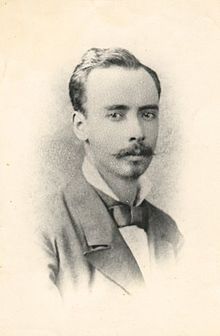
Prado’s father, Manuel Ignacio Prado, was twice the president of Peru (1865-1868,* 1876-1879).
As a military man (Prado’s first presidency was as outright dictator), the old man naturally had his son on a soldierly track as well. Leoncio was all of 12 years old when he took part in the Battle of Callao in 1866, defending that city against a Spanish bombardment during the Chincha Islands War.
That war saw Peru and Chile cooperating against Spain, after the latter seized a lucrative cluster of guano islands.
But different resource rivalries put the two former allies at loggerheads in 1879. When Peru nationalized saltpeter mining in the border province of Tarapaca — dispossessing Chilean interests — and Bolivia took similar measures, the countries fought the three-way War of the Pacific, also known as the Saltpeter War.
Chile would win the war decisively, dramatically reshaping Latin America in the process. Peru lost most of Tarapaca to Chile, devastating Peru’s saltpeter industry and provoking a generation of instability and social crisis. Bolivia fared even worse, losing its only littoral province to Chile: Bolivia remains landlocked to this day.
So it’s safe to say that there was something at stake worth fighting for as hostilities commenced.
As the Saltpeter War got underway, Prado returned from the United States where he was preparing an expedition to help Philippines separatists, and formed a guerrilla force. Though this corps had its highlight moments, it was overwhelmed in a scrap with Chilean regulars in July 1880 and Prado taken prisoner.
Considering his lineage and his exploits, he was an honored captive for the Chileans who repeatedly offered to release him on his honor not to take up arms again.
Prado refused these offers for some time, but he finally accepted his parole at the start of 1882 — a low ebb for Peruvian fortunes, for his father had been deposed by a coup and 1881-82 saw leadership of the country violently contested. Prado’s only thought, notwithstanding his pledge to Chile, was for the defense of his country and he rallied another party of guerrillas to his banner. “The enemy’s bullets do not kill,” he cried. “For to die for the fatherland is to live in immortal glory!”
That has proved to be the case for Prado, who certainly stood out from the politicians of his time for his patriotic heroism.
Captured during the decisive Chilean victory at the Battle of Huamachuco where a grenade shattered his thigh, the crippled Prado was regretfully executed in his bed for having broken his previous parole by resuming arms in the fight.
“We were all crying — all but Pradito,” recalled the Chilean captain tasked with overseeing the nasty business.
The Aug. 28, 1955 lynching of Emmett Till and the subsequent acquittal of his murderers by an all-white Mississippi jury were among the American civil rights movement’s pivotal events.
For a certain indecent number of people, however, the passion of the 14-year-old youth — alleged to have flirted with a white woman — was to be mourned only insofar as it confirmed the menace that insatiable Negro libidos posed to southern way of life.
Further to that end, the months following Emmett Till’s death brought to the headlines the formerly obscure* July 2, 1945 hanging of an American G.I. in Italy: Emmett’s father, Louis Till.
The violent Louis Till ruined his marriage to Emmett’s mother Mamie shortly after his son’s birth. Repeatedly violating her restraining order eventually landed Till pere before a judge, who gave him a choice between hard time and enlistment. Till joined the U.S. Army.
In 1945, he was court-martialed for murdering an Italian woman and raping two others. His execution near Pisa — he’s buried in Europe in the Oise-Aisne American Cemetery, the same final resting place as Eddie Slovik — was the no-account end of a no-account man for many years thereafter. Mamie Till said that she wasn’t even told what happened to her ex-husband, and was stonewalled when she sought information.
By the end of 1955, everyone knew.
In Jim Crow’s backlash against nationwide condemnation of the Till lynching, Louis Till came back to life in newsprint all that autumn to visit the sins of the father upon his late son: here was the mirror of the young predator all grown up, violating Italian women. Mississippi’s white supremacistsenators used their rank to obtain his army file, and leaked it to reporters.
According to Davis Houck and Matthew Grindy’s study of the Mississippi media’s conflicting reactions to the events of 1955, “Louis Till became a most important rhetorical pawn in the high-stakes game of north versus south, black versus white, NAACP versus White Citizens’ Councils.”
The pawn’s sacrifice did not figure in the endgame.
Crude attempts to impose blood guilt for Louis Till’s crimes aside, Clenora Hudson-Weems argues in her Emmett Till: The Sacrificial Lamb of the Civil Rights Movement that it was Emmett Till’s shocking death that catalyzed the civil rights movement — that the horrifyingly mutilated face at his open-casket funeral and the insouciant confession of his killers once they had been acquitted shook southern blacks and northern whites alike so profoundly as to dispel any confidence that legal briefs or political incrementalism could grapple with America’s race problem. Civil rights lion Joyce Ladner was an 11-year-old Mississippi girl when Emmett Till was lynched; she would tell Hudson-Weems of the shock it delivered in her world coming on the heels of the Brown v. Board of Education ruling desegregating schools.
A very important thing is that it followed the Supreme Court decision in 1954. It’s like the Whites said that they don’t care what rights we were given … So when the spark came in Mississippi to sit in the public library, for example, people who participated had been incensed by the Till incident and were just waiting for the spark to come. The Till incident was the catalyst.
Emmett Till’s body was exhumed for autopsy and DNA testing in 2005, in part to dispel the old story first promulgated by the attorneys who defended Till’s murderers — that the body wasn’t Emmett Till’s at all. On the corpse’s finger was a ring inscribed with the initials of his father: L.T.
* Louis Till did have one small claim to fame prior to his son’s murder: the fascist poet Ezra Pound chanced to be imprisoned with Till; he mentions the later-famous execution in his Pisan Cantos:
Till was hung yesterday
for murder and rape with trimmings
He cut his teeth — and a holy beard — as a surgeon and barber in the court of Saint Louis. When Louis died on crusade in 1270, Philip the Bold succeeded to the throne. Philip was tight with Pierre, so this seemed like great news for the chamberlain — and indeed, de La Brosse advanced rapidly with the new king’s patronage in wealth and influence.
The power of this Touraine arriviste did not fail to attract the enmity of the realm’s hereditary lords. As their grandchildren would do in Enguerrand de Marigny‘s time, they nursed their resentments and awaited only their chance.
King Philip’s marriage in 1274 to Marie of Brabant* gave them that chance.
His influence eclipsed by the new bride, de La Brosse developed a dangerous rivalry with the royal consort. When Philip’s firstborn son by his previous marriage and the heir to the French throne died suspiciously in 1276, Pierre de La Brosse allegedly made bold to suggest that the new queen herself might have poisoned the youth off.**
Philip “investigated” this by sending emissaries to consult a clairvoyant who, knowing she was speaking to representatives of the royal family, gave a judiciously positive appraisal of the queen, leaving de La Brosse on very tenuous footing indeed. The barons cut that footing out from under their foe a few months later when they produced documents, likely forged, implicating de La Brosse in a treasonable arrangement with the Spanish crown. De La Brosse was imprisoned for six months and condemned without a regular judicial proceeding: he has the unenviable distinction of being the first victim of an extraordinary royal commission in France. That commission destroyed the evidence (or “evidence”) in the case, but to judge from the positive appraisal de La Brosse enjoyed from chroniclers the popular sentiment for his innocence was widespread.
Pierre de La Brosse is among the several French royal counselors who are sometimes apocryphally said to have built the Montfaucon gallows only to hang upon them. The last word on him (and the more interesting trivia) belongs to Dante, who stationed the man in Purgatory as one who was unjustly slain but without opportunity to cleanse his soul with a last repentance.
I saw the soul
cleft from its body out of spite and envy —
not, so it said, because it had been guilty —
I mean Pier de la Brosse,
and may the Lady of Brabant
while she’s still in this world, watch
her ways—or end among a sadder flock
December 21 was an execution date at Tyburn in 1692, with eleven men and women put to death.
They were, as usual, physically escorted on the 21st — and spiritually escorted in the days leading up to that black date — by the Ordinary of Newgate.
We have often referred to this character and, in the present series, cited him repeatedly.
This clergyman was appointed to London’s stinking prison to tend to the souls of its inmates, particularly those condemned to die.
Under the tenure of Samuel Smith, the Ordinary of Newgate began in about 1684* to put out a regular broadsheet published the day after London’s eight or so annual hanging-days. Laboriously titled The Ordinary of Newgate, His Account of the Behaviour, Confession, and Dying Words of the Malefactors who were Executed at Tyburn, it was sold by street-peddlers for (at first) a penny.
A typical Ordinary’s account by Smith had a three-act arc:
An account of the honored clergyman’s own sermonizing, even the literal day-by-day exhortations and their progress (or not) in bringing the condemned round to a satisfactory spiritual state. The Account for December 21, 1692, for instance, begins:
THE Ordinary preacht several Sermons to the Condemed Criminals being Twenty One. The first was on the Lord’s-Day immediately before their Condemnation on the Monday following, from this Text, viz. The 19th. Psalm, the 12th. Verse. Who can understand the Errors of his Life? Cleanse thon me from my secret Faults. The Observation from the Words was this, That the smallest Sins even Errors in Opinion and Infirmities in our Obedience to God’s Laws, ought to be repented of, as needing pardoning Mercy.
Biographical thumbnails of the condemned, of no regular format but often remarking the person’s age, profession, birthplace, and life circumstances … and always attentive to whether s/he had come by repentance. This is Samuel Smith’s take on one of the 11 hanged today:
Robert Marshal: Condemned for Murthering William Curtys, in White-Chappel. He pretended now, as formerly, that he is blind, and Begged under that Disguise. But being denied Relief by Curtys, Marshal, with his Begging-staff, in both his Hands, struck him on the Head, and made a Fracture in his Skull, of which he died; and he immediately attempted to run away. He confessed on Tuesday, that though his Sight was not strong enough for Labour, yet he could see his Way, in Walking, so as to go safely. He was born in Jamaica, bred up a Sea-man . He was unwilling to give any Account of his Life, being very obstinate.
The scene at Tyburn itself, with the Ordinary’s prayers and the public behavior and confessions of the doomed.
They were fervently exhorted to Confess their Faults, the Effects of which had brought them to such disgrace: After which the Ordinary took great pains with them in Prayer, and other suitable Applications, to bring them to a sense of the near approaches of Death; to which they adher’d, and joined in the Prayers; and singing of a penitential Psalm in as fervent a manner as could be reasonably expected from Persons of so mean Education, as were the most of them. They lamented their dismal Fall, desiring all Spectators of such a Tragedy to be warn’d by them, &c.
As to the Particulars of their Confessions. they did not much enlarge themselves; only the Blind Man was penitent, and desired all Persons to take warning by him; owning that he could see; hoping God would forgive him all his Offences, &c.
In the 18th century these hang-day reports would expand even further.
For historians these records, formulaic as they are, remain “a unique and inestimable source of knowledge of the poor people who were hanged.” (Linebaugh).
For the Ordinary’s contemporaries, they were something else besides: the voice of authority on “the Malefactors,” their usual submission, the facts of their lives and the expected public lessons of the crimes and punishments.** Certainly the Ordinary was at pains to assert his “official” status; in the Account at issue for this date’s hanging, he appends the notice,
Whereas there formerly have been, and still are, several False Accounts in Print, in relation to the Condemned Prisoners; and particularly, this very Session, that Robert Marshal, the Blind Beggar, was Executed two Days since; which is utterly false: The Ordinary thinks it necessary to acquaint the World, (to prevent the like for the future,) that no true Account can be given of the Condemned Prisoners Behaviour, Confessions, and Last Dying Speeches, which is not Attested under his own Hand.
Accept no substitutes!
The Ordinary had good reason to defend his position, for the Ordinary’s own livelihood depended upon his marketing his black-bordered pamphlets. This was naked entrepreneurship, direct to Smith’s pocket, and his product stood in competition with every other scandal-sheet hawker crowding the gallows.
Nor was the printed word the only way to monetize the office of Ordinary. In an environment when many people were condemned to death and many were pardoned, Smith was accused of shaking down prisoners to intervene for more lenient treatment.
For instance, in this wonderfully vicious send-off to the cleric after he died in 1698, satirist Thomas Brown accuses Smith (in the bolded passage) of taking payola to help illiterate prisoners claim benefit of clergy — an anachronistic legal mechanism wherein a condemned first-time offender could escape the noose by showing that he could read. (The loophole was reformed in 1706 to eliminate the reading test entirely, although this also came with making many offenses no longer “clergyable” at all.)
An Elegy on that most Orthodox and Pains-taking Divine, Mr. Samuel Smith, Ordinary of Newgate, who died of a Quinsey, on St. Bartholomew’s Day, the 24th of August, 1698.
Tyburn, lament, in pensive sable mourn,
For from the world thy ancient priest is torn.
Death, cruel death, thy learn’d divine has ended,
And by a quinsey from his place suspended.
Thus he expir’d in his old occupation,
And as he liv’d, he dy’d by suffocation.
Thou rev’rend pillar of the triple-tree,
I would say post, for it was prop’d by thee;
Thou penny-chronicler of hasty fate,
Death’s annalist, reformer of the state;
Cut-throat of texts, and chaplain of the halter,
In whose sage presence vice itself did faulter:
How many criminals, by thee assisted,
Old Smith, have been most orthodoxly twisted?
And when they labour’d with a dying qualm,
Were decently suspended to a psalm?
How oft hast thou set harden’d rogues a squeaking,
By urging the great sin of Sabbath-breaking;
And sav’d delinquents from Old Nick’s embraces,
By flashing fire and brimstone in their faces?
Thou wast a Gospel Smith, and after sentence
Brought’st sinners to the anvil of repentance;
And tho’ they prov’d obdurate at the sessions,
Couldst hammer out of them most strange confessions,
When plate was stray’d, and silver spoons were missing,
And chamber-maid betray’d by Judas kissing. Thy christian bowels chearfully extended
Towards such, as by their Mammon were befriended.
Tho’ Culprit in enormous acts was taken,
Thou would’st devise a way to save his bacon;
And if his purse could bleed a half pistole,
Legit, my lord, he reads, upon my soul.
Spite of thy charity to dying wretches,
Some fools would live to bilk thy gallows speeches.
But who’d refuse, that has a taste of writing,
To hang, for one learn’d speech of thy inditing?
Thou always hadst a conscientious itching,
To rescue penitents from Pluto’s kitchen;
And hast committed upon many a soul
A pious theft, but so St. Austin stole:
And shoals of robbers, purg’d of sinful leaven,
By thee were set in the high road to heaven.
With sev’ral mayors hast thou eat beef and mustard,
And frail mince-pies, and transitory custard.
But now that learned head in dust is laid,
Which has so sweetly sung, and sweetly pray’d:
Yet, tho’ thy outward man is gone and rotten,
Thy better part shall never be forgotten.
While Newgate is a mansion for good fellows,
And Sternhold‘s rhimes are murder’d at the gallows;
While Holborn cits at execution gape,
And cut-purse follow’d is by man of crape;
While Grub-street Muse, in garrets so sublime,
Trafficks in doggrel, and aspires to rhime;
Thy deathless name and memory shall reign,
From fam’d St. Giles’s, to Smithfield, and Duck-lane.
But since thy death does general sorrow give,
We hope thou in thy successor will live.
Newgate and Tyburn jointly give their votes,
Thou may’st succeeded be by Dr. Oates.
* There are irregular Smith accounts from the late 1670s (he took over the position in 1675) as he felt out the genre, but he only institutionalized the periodical in the mid-1680s.
** Smith and all the Ordinaries harp endlessly on what amount to “gateway crimes”: idleness, drunkenness, bad company, and especially (as our satirist observes) breaking the Sabbath. They’re constantly inveigling prisoners to warn the execution crowd against these vices.
On this date in 1835, John Smith and James Pratt (sometimes reported as John Pratt) were hanged outside Newgate Prison for (in the exhausting fulminations of the Old Bailey trial records) “feloniously, wickedly, diabolically, and against the order of nature, carnally … commit[ted] and perpetrate[d] the detestable, horrid, and abominable crime (among Christians not to be named) called buggery.”
These men were the last put to death anywhere in the realm under the ghastly Tudor-era Buggery Act,* and indeed among the last to die at Newgate for any crime other than murder or attempted murder.
“The grave will soon close over me,” Smith allegedly wrote to a friend before his hanging, “and my name [be] entirely forgotten.”
But that’s not altogether true.
Unbeknownst to the sufferers, they were destined for literary preservation by a young writer on the make, one Charles Dickens: Smith and Pratt make an appearance in Dickens’ Sketches by Boz, an 1836 compilation of London scenes of which “A Visit to Newgate” is perhaps the best-known.
This piece narrates a visit Dickens paid, according to William Carlton’s “The Third Man at Newgate” (The Review of English Studies, Nov., 1957), on November 5, 1835. Dickens would write in subsequent correspondence that the experience left him “intensely interested in everything I saw.”
Prisons and the threat or reality of execution would loom large in that redoubtable author’s canon. “You cannot throw the interest over a year’s imprisonment, however severe, that you can cast around the punishment of death,” the perspicacious 23-year-old told his publisher.
So too did the still-living apparitions of the condemned Smith and Pratt occupy Dickens’s reflections in “A Visit to Newgate”; they comprise a good third of the essay.
In the press-room below, were three men, the nature of whose offence rendered it necessary to separate them, even from their companions in guilt. It is a long, sombre room, with two windows sunk into the stone wall, and here the wretched men are pinioned on the morning of their execution, before moving towards the scaffold. The fate of one of these prisoners was uncertain; some mitigatory circumstances having come to light since his trial, which had been humanely represented in the proper quarter. The other two had nothing to expect from the mercy of the crown; their doom was sealed; no plea could be urged in extenuation of their crime, and they well knew that for them there was no hope in this world. ‘The two short ones,’ the turnkey whispered, ‘were dead men.’
Smith and Pratt, of course, were the “dead men.”
Their third companion, otherwise unconnected with them, was a soldier named Robert Swan, convicted of robbery. Swan was indeed reprieved, a few days before the execution. “Boz” sketched the aspect of these men as he observed them:
The man to whom we have alluded as entertaining some hopes of escape, was lounging, at the greatest distance he could place between himself and his companions, in the window nearest to the door. He was probably aware of our approach, and had assumed an air of courageous indifference; his face was purposely averted towards the window, and he stirred not an inch while we were present. The other two men were at the upper end of the room. One of them, who was imperfectly seen in the dim light, had his back towards us, and was stooping over the fire, with his right arm on the mantel-piece, and his head sunk upon it. The other was leaning on the sill of the farthest window. The light fell full upon him, and communicated to his pale, haggard face, and disordered hair, an appearance which, at that distance, was ghastly. His cheek rested upon his hand; and, with his face a little raised, and his eyes wildly staring before him, he seemed to be unconsciously intent on counting the chinks in the opposite wall. We passed this room again afterwards. The first man was pacing up and down the court with a firm military step – he had been a soldier in the foot-guards – and a cloth cap jauntily thrown on one side of his head. He bowed respectfully to our conductor, and the salute was returned. The other two still remained in the positions we have described, and were as motionless as statues.
If we have Dickens to thank in part for this unexpected glimpse of these poor fellows in the shadow of death, we also can hardly help but notice that — and this is in keeping with Smith’s forecast of posthumous anonymity — he does not name them, nor breathe a word about their scandalous crime. Only the man destined for the reprieve has animation; Smith and Pratt, immobile and affectless, are … but are little else besides. “Dead men,” like that turnkey said. This is not necessarily implausible, but it is also very pat for the literary construction of “A Visit to Newgate,” and we might be entitled to wonder how close to journalistic accuracy the writer has really come here, or regret the details Dickens has discarded that might have salvaged their humanity for a later readership.
Dickens’ party proceeded from these characters to a tour of the physical cells in which these doomed “statues” passed their last sleepless nights.
A few paces up the yard, and forming a continuation of the building, in which are the two rooms we have just quitted, lie the condemned cells. The entrance is by a narrow and obscure stair-case leading to a dark passage, in which a charcoal stove casts a lurid tint over the objects in its immediate vicinity, and diffuses something like warmth around. From the left-hand side of this passage, the massive door of every cell on the story opens; and from it alone can they be approached. There are three of these passages, and three of these ranges of cells, one above the other; but in size, furniture and appearance, they are all precisely alike. Prior to the recorder’s report being made, all the prisoners under sentence of death are removed from the day-room at five o’clock in the afternoon, and locked up in these cells, where they are allowed a candle until ten o’clock; and here they remain until seven next morning. When the warrant for a prisoner’s execution arrives, he is removed to the cells and confined in one of them until he leaves it for the scaffold. He is at liberty to walk in the yard; but, both in his walks and in his cell, he is constantly attended by a turnkey who never leaves him on any pretence.
We entered the first cell. It was a stone dungeon, eight feet long by six wide, with a bench at the upper end, under which were a common rug, a bible, and prayer-book. An iron candlestick was fixed into the wall at the side; and a small high window in the back admitted as much air and light as could struggle in between a double row of heavy, crossed iron bars. It contained no other furniture of any description.
A year after Sketches‘ February 1836 publication, Dickens’ serialized novel of the London underclass Oliver Twist began its run. That story’s heart-wrenching denouement of the thief Fagin awaiting execution in Newgate seems to owe a debt to Dickens’ meditation in Sketches on the dolorous condition of Smith, Pratt, or any doomed prisoner facing death in these awful cells.
“A Visit to Newgate” concludes:
Conceive the situation of a man, spending his last night on earth in this cell. Buoyed up with some vague and undefined hope of reprieve, he knew not why – indulging in some wild and visionary idea of escaping, he knew not how – hour after hour of the three preceding days allowed him for preparation, has fled with a speed which no man living would deem possible, for none but this dying man can know. He has wearied his friends with entreaties, exhausted the attendants with importunities, neglected in his feverish restlessness the timely warnings of his spiritual Fagin in Newgate – Cruikshank consoler; and, now that the illusion is at last dispelled, now that eternity is before him and guilt behind, now that his fears of death amount almost to madness, and an overwhelming sense of his helpless, hopeless state rushes upon him, he is lost and stupefied, and has neither thoughts to turn to, nor power to call upon, the Almighty Being, from whom alone he can seek mercy and forgiveness, and before whom his repentance can alone avail.
Hours have glided by, and still he sits upon the same stone bench with folded arms, heedless alike of the fast decreasing time before him, and the urgent entreaties of the good man at his side. The feeble light is wasting gradually, and the deathlike stillness of the street without, broken only by the rumbling of some passing vehicle which echoes mournfully through the empty yards, warns him that the night is waning fast away. The deep bell of St. Paul’s strikes – one! He heard it; it has roused him. Seven hours left! He paces the narrow limits of his cell with rapid strides, cold drops of terror starting on his forehead, and every muscle of his frame quivering with agony. Seven hours! He suffers himself to be led to his seat, mechanically takes the bible which is placed in his hand, and tries to read and listen. No: his thoughts will wander. The book is torn and soiled by use – and like the book he read his lessons in, at school, just forty years ago! He has never bestowed a thought upon it, perhaps, since he left it as a child: and yet the place, the time, the room – nay, the very boys he played with, crowd as vividly before him as if they were scenes of yesterday; and some forgotten phrase, some childish word, rings in his ears like the echo of one uttered but a minute since. The voice of the clergyman recalls him to himself. He is reading from the sacred book its solemn promises of pardon for repentance, and its awful denunciation of obdurate men. He falls upon his knees and clasps his hands to pray. Hush! what sound was that? He starts upon his feet. It cannot be two yet. Hark! Two quarters have struck; – the third – the fourth. It is! Six hours left. Tell him not of repentance! Six hours’ repentance for eight times six years of guilt and sin! He buries his face in his hands, and throws himself on the bench.
Worn with watching and excitement, he sleeps, and the same unsettled state of mind pursues him in his dreams. An insupportable load is taken from his breast; he is walking with his wife in a pleasant field, with the bright sky above them, and a fresh and boundless prospect on every side – how different from the stone walls of Newgate! She is looking – not as she did when he saw her for the last time in that dreadful place, but as she used when he loved her – long, long ago, before misery and ill-treatment had altered her looks, and vice had changed his nature, and she is leaning upon his arm, and looking up into his face with tenderness and affection – and he does NOT strike her now, nor rudely shake her from him. And oh! how glad he is to tell her all he had forgotten in that last hurried interview, and to fall on his knees before her and fervently beseech her pardon for all the unkindness and cruelty that wasted her form and broke her heart! The scene suddenly changes. He is on his trial again: there are the judge and jury, and prosecutors, and witnesses, just as they were before. How full the court is – what a sea of heads – with a gallows, too, and a scaffold – and how all those people stare at HIM! Verdict, ‘Guilty.’ No matter; he will escape.
The night is dark and cold, the gates have been left open, and in an instant he is in the street, flying from the scene of his imprisonment like the wind. The streets are cleared, the open fields are gained and the broad, wide country lies before him. Onward he dashes in the midst of darkness, over hedge and ditch, through mud and pool, bounding from spot to spot with a speed and lightness, astonishing even to himself. At length he pauses; he must be safe from pursuit now; he will stretch himself on that bank and sleep till sunrise.
A period of unconsciousness succeeds. He wakes, cold and wretched. The dull, gray light of morning is stealing into the cell, and falls upon the form of the attendant turnkey. Confused by his dreams, he starts from his uneasy bed in momentary uncertainty. It is but momentary. Every object in the narrow cell is too frightfully real to admit of doubt or mistake. He is the condemned felon again, guilty and despairing; and in two hours more will be dead.
Lotta books about Dickens
A magistrate with the Dickensian name of Hesney Wedg(e)wood appealed vigorously for clemency for Smith and Pratt — pointing out that the only reason these two had been doomed among the rather many enthusiasts** for this victimless offense was that they were penurious enough to have to pursue their desires in a lodging-house rented by a friend where they were easily spied-upon.
(The testimony lodged against them in court came from the nosy landlord who got suspicious, and with his wife peeped through the keyhole on “Pratt laying on his back with his trowsers below his knees, and with his body curled up—his knees were up—Smith was upon him—Pratt’s knees were nearly up to Smith’s shoulders—Smith’s clothes were below his knees … and a great deal of fondness and kissing.” The landlord burst in on the sodomites and put a stop to the fondness right away.)
“There is a shocking inequality in this law in its operation upon the rich and the poor,” wrote Wedgwood.
It is the only crime where there is no injury done to any individual and in consequence it requires a very small expense to commit it in so private a manner and to take such precautions as shall render conviction impossible. It is also the only capital crime that is committed by rich men but owing to the circumstances I have mentioned they are never convicted. The detection of these degraded creatures was owing entirely to their poverty, they were unable to pay for privacy, and the room was so poor that what was going on inside was easily visible from without. (Quoted here)
* The first executed under the Buggery Act shared his scaffold with Thomas Cromwell almost 300 years before. Although there were no further executions for sodomy after Smith and Pratt in 1835, that penalty remained theoretically available for the “crime” until 1861.
On this date in 1642, with the last words “Mon Dieu! Qu’est-ce que ce monde?”, 22-year-old former royal favorite Cinq-Mars was beheaded at Lyon’s Place des Terreaux.
Henri Coiffier de Ruze (English Wikipedia page | French) had been under Cardinal Richelieu’s protection since the boy’s father died in 1632; in 1639, the Red Eminence introduced the then-19-year-old whippersnapper to Louis XIII as a prospective royal favorite (read: lover).
Though the king did indeed take to the youth, Cinq-Mars, in the age-old custom of sullen teenagers everywhere, soon found the luxurious profligacy of the favorite’s life rather overbalanced by irritation at both of his sickly, aging patrons.
Tart talk to intimates graduated to something more serious after Richelieu rudely put the kibosh on Cinq-Mars’s (unrealistic) designs on a wealthy noblewoman — which was also a bid to parlay his tenuous favorite gig into some lasting power.
Now considering himself personally begrudged of the Cardinal, Cinq-Mars fell into the conspiracies (French link) to depose, assassinate, or otherwise replace him.
Eventually Cinq-Mars would go so far as a real blockbuster (French again): he signed a secret pact with the Spanish king to support a noble revolt in exchange for handing over French possessions, a seditious plan also backed by perennialplotter Gaston d’Orleans, the king’s scheming brother.
Our angry moppet had more than met his match in Richelieu, however: the cardinal’s agents intercepted (more French) the treasonable correspondence and had Cinq-Mars dispatched this date along with his confederate de Thou.
Execution of Cinq-Mars and De Thou in Paris (1642), engraving by Johann Luyken, Paris, Bibliothèque nationale de France (via)
Richelieu himself was already dying as he undid this last conspiracy against him. The cardinal succumbed on December 4, 1642 … with Louis following him into the grave the next May.
On this date* in French-occupied Moscow of the War of 1812, many alleged arsonists — unnamed and unnumbered — were shot by Napoleon’s army in the ashes of Moscow.
Although real, flesh-and-blood Muscovites died, they are best known via their bespectacled fictional companion, Pierre Bezukhov, whose miraculous escape is one of the pivotal episodes of Tolstoy’s War and Peace.
Merely the greatest novel in history by some reckonings — we’ll just let Tolstoy fight it out with Dostoyevsky for top of table in the competitive 19th Century Russia literary scene — the epic War and Peace tracks that country’s transformation under the revolutionary pressures of the Napoleonic age.
In Russian director Sergey Bondarchuk’s sprawling cinematic adaptation of War and Peace, the part of Pierre Bezukhov is played by Bondarchuk himself.
Pierre Bezukhov (“without ears”) is one of the book’s central figures, the illegitimate son of a count who unexpectedly inherits, forever consumed with his next impulsive, passionate quest for meaning (boozing around, freemasonry, religion …).
Pierre finds himself present in Moscow when the Grande Armeerolls in following its Pyrrhic victory at the Battle of Borodino. His fancy of the moment is to assassinate Napoleon: “he suddenly felt that what before had seemed to him merely a possibility had now become absolutely necessary and inevitable. He must remain in Moscow, concealing his name, and must meet Napoleon and kill him, and either perish or put an end to the misery of all Europe.” And to think, a younger Pierre actually used to admire Napoleon.
Historically, the city of Moscow started burning as soon as the French occupied it. The reasons for this conflagration have been widely disputed; Tolstoy detours in War and Peace to characterize it as nothing more than the natural consequence of the occupation, when the city’s civil infrastructure has broken down and the everyday fires that spark in wooden buildings are more liable to grow out of control.
The French blamed terrorists.
A bulletin of the Grande Armee dated September 20 (Gregorian date; this corresponds to the Julian date September 8) reports on the successful efforts to bring arsonists to heel through the expedient of mass executions.
Three hundred incendiaries have been arrested and shot; they were provided with fuse six inches long, which they had between two pieces of wood: they had also squibs, which they threw upon the roofs of the houses. The wretch Rastapchin had these prepared, on the pretence that he wished to send a balloon, full of combustible matter, amidst the French army …
The fires subsided on the 19th and 20th; three quarters of the city are burned; among other palaces that beautiful one of Catherine, which had been newly furnished: not above a quarter of the houses remain. …
Manufactures were beginning to flourish at Moscow: they are destroyed. The conflagration of this capital will throw Russia one hundred years back. The weather is becoming rainy: the greatest part of the army is in barracks in Moscow.
In this paranoid occupation, the fictional Pierre, wandering Moscow armed without a good excuse, gets himself picked up by French troops.
The travail of his resulting drumhead trial offers the anti-authoritarian (and anti-death penalty) Tolstoy the opportunity to reflect on the “legal” arrangements, a passage Tolstoy dates September 8 on the Julian calendar — the same day that army bulletin above was penned.
[Pierre] learned that all these prisoners (he, probably, among them) were to be tried for incendiarism. On the third day he was taken with the others to a house where a French general with a white mustache sat with two colonels and other Frenchmen with scarves on their arms. With the precision and definiteness customary in addressing prisoners, and which is supposed to preclude human frailty, Pierre like the others was questioned as to who he was, where he had been, with what object, and so on.
These questions, like questions put at trials generally, left the essence of the matter aside, shut out the possibility of that essence’s being revealed, and were designed only to form a channel through which the judges wished the answers of the accused to flow so as to lead to the desired result, namely a conviction. As soon as Pierre began to say anything that did not fit in with that aim, the channel was removed and the water could flow to waste. Pierre felt, moreover, what the accused always feel at their trial, perplexity as to why these questions were put to him. He had a feeling that it was only out of condescension or a kind of civility that this device of placing a channel was employed. He knew he was in these men’s power, that only by force had they brought him there, that force alone gave them the right to demand answers to their questions, and that the sole object of that assembly was to inculpate him. And so, as they had the power and wish to inculpate him, this expedient of an inquiry and trial seemed unnecessary. It was evident that any answer would lead to conviction.
It’s only by Pierre’s chance ability to forge a human connection with the officer detailed to condemn him that he’s mysteriously, and arbitrarily, not sentenced to death — a fact that Pierre doesn’t even realize until he’s led out with the rest of the prisoners only to see that it’s “only” the others who are being shot. This is the narration at length from Book XII, Chapters 10-11.
On the eighth of September an officer- a very important one judging by the respect the guards showed him- entered the coach house where the prisoners were. This officer, probably someone on the staff, was holding a paper in his hand, and called over all the Russians there, naming Pierre as “the man who does not give his name.” Glancing indolently and indifferently at all the prisoners, he ordered the officer in charge to have them decently dressed and tidied up before taking them to the marshal. An hour later a squad of soldiers arrived and Pierre with thirteen others was led to the Virgin’s Field. It was a fine day, sunny after rain, and the air was unusually pure. The smoke did not hang low as on the day when Pierre had been taken from the guardhouse on the Zubovski rampart, but rose through the pure air in columns. No flames were seen, but columns of smoke rose on all sides, and all Moscow as far as Pierre could see was one vast charred ruin. On all sides there were waste spaces with only stoves and chimney stacks still standing, and here and there the blackened walls of some brick houses. Pierre gazed at the ruins and did not recognize districts he had known well. Here and there he could see churches that had not been burned. The Kremlin, which was not destroyed, gleamed white in the distance with its towers and the belfry of Ivan the Great. The domes of the New Convent of the Virgin glittered brightly and its bells were ringing particularly clearly. These bells reminded Pierre that it was Sunday and the feast of the Nativity of the Virgin. But there seemed to be no one to celebrate this holiday: everywhere were blackened ruins, and the few Russians to be seen were tattered and frightened people who tried to hide when they saw the French.
…
Pierre had been taken by one set of soldiers and led first to one and then to another place with dozens of other men, and it seemed that they might have forgotten him, or confused him with the others. But no: the answers he had given when questioned had come back to him in his designation as “the man who does not give his name,” and under that appellation, which to Pierre seemed terrible, they were now leading him somewhere with unhesitating assurance on their faces that he and all the other prisoners were exactly the ones they wanted and that they were being taken to the proper place. Pierre felt himself to be an insignificant chip fallen among the wheels of a machine whose action he did not understand but which was working well.
He and the other prisoners were taken to the right side of the Virgin’s Field, to a large white house with an immense garden not far from the convent. This was Prince Shcherbatov‘s house, where Pierre had often been in other days, and which, as he learned from the talk of the soldiers, was now occupied by the marshal, the Duke of Eckmuhl (Davout).
They were taken to the entrance and led into the house one by one. Pierre was the sixth to enter. He was conducted through a glass gallery, an anteroom, and a hall, which were familiar to him, into a long low study at the door of which stood an adjutant.
Davout, spectacles on nose, sat bent over a table at the further end of the room. Pierre went close up to him, but Davout, evidently consulting a paper that lay before him, did not look up. Without raising his eyes, he said in a low voice:
“Who are you?”
Pierre was silent because he was incapable of uttering a word. To him Davout was not merely a French general, but a man notorious for his cruelty. Looking at his cold face, as he sat like a stern schoolmaster who was prepared to wait awhile for an answer, Pierre felt that every instant of delay might cost him his life; but he did not know what to say. He did not venture to repeat what he had said at his first examination, yet to disclose his rank and position was dangerous and embarrassing. So he was silent. But before he had decided what to do, Davout raised his head, pushed his spectacles back on his forehead, screwed up his eyes, and looked intently at him.
“I know that man,” he said in a cold, measured tone, evidently calculated to frighten Pierre.
The chill that had been running down Pierre’s back now seized his head as in a vise.
“You cannot know me, General, I have never seen you…”
“He is a Russian spy,” Davout interrupted, addressing another general who was present, but whom Pierre had not noticed.
Davout turned away. With an unexpected reverberation in his voice Pierre rapidly began:
“No, monseigneur,” he said, suddenly remembering that Davout was a duke. “No, monseigneur, you cannot have known me. I am a militia officer and have not quitted Moscow.”
“Your name?” asked Davout.
“Bezukhov.”
“What proof have I that you are not lying?”
“Monseigneur!” exclaimed Pierre, not in an offended but in a pleading voice.
Davout looked up and gazed intently at him. For some seconds they looked at one another, and that look saved Pierre. Apart from conditions of war and law, that look established human relations between the two men. At that moment an immense number of things passed dimly through both their minds, and they realized that they were both children of humanity and were brothers.
At the first glance, when Davout had only raised his head from the papers where human affairs and lives were indicated by numbers, Pierre was merely a circumstance, and Davout could have shot him without burdening his conscience with an evil deed, but now he saw in him a human being. He reflected for a moment.
“How can you show me that you are telling the truth?” said Davout coldly.
Pierre remembered Ramballe, and named him and his regiment and the street where the house was.
“You are not what you say,” returned Davout.
In a trembling, faltering voice Pierre began adducing proofs of the truth of his statements.
But at that moment an adjutant entered and reported something to Davout.
Davout brightened up at the news the adjutant brought, and began buttoning up his uniform. It seemed that he had quite forgotten Pierre.
When the adjutant reminded him of the prisoner, he jerked his head in Pierre’s direction with a frown and ordered him to be led away. But where they were to take him Pierre did not know: back to the coach house or to the place of execution his companions had pointed out to him as they crossed the Virgin’s Field.
He turned his head and saw that the adjutant was putting another question to Davout.
“Yes, of course!” replied Davout, but what this “yes” meant, Pierre did not know.
Pierre could not afterwards remember how he went, whether it was far, or in which direction. His faculties were quite numbed, he was stupefied, and noticing nothing around him went on moving his legs as the others did till they all stopped and he stopped too. The only thought in his mind at that time was: who was it that had really sentenced him to death? Not the men on the commission that had first examined him — not one of them wished to or, evidently, could have done it. It was not Davout, who had looked at him in so human a way. In another moment Davout would have realized that he was doing wrong, but just then the adjutant had come in and interrupted him. The adjutant, also, had evidently had no evil intent though he might have refrained from coming in. Then who was executing him, killing him, depriving him of life — him, Pierre, with all his memories, aspirations, hopes, and thoughts? Who was doing this? And Pierre felt that it was no one.
It was a system — a concurrence of circumstances.
A system of some sort was killing him — Pierre — depriving him of life, of everything, annihilating him.
From Prince Shcherbatov’s house the prisoners were led straight down the Virgin’s Field, to the left of the nunnery, as far as a kitchen garden in which a post had been set up. Beyond that post a fresh pit had been dug in the ground, and near the post and the pit a large crowd stood in a semicircle. The crowd consisted of a few Russians and many of Napoleon’s soldiers who were not on duty- Germans, Italians, and Frenchmen, in a variety of uniforms. To the right and left of the post stood rows of French troops in blue uniforms with red epaulets and high boots and shakos.
The prisoners were placed in a certain order, according to the list (Pierre was sixth), and were led to the post. Several drums suddenly began to beat on both sides of them, and at that sound Pierre felt as if part of his soul had been torn away. He lost the power of thinking or understanding. He could only hear and see. And he had only one wish- that the frightful thing that had to happen should happen quickly. Pierre looked round at his fellow prisoners and scrutinized them.
The two first were convicts with shaven heads. One was tall and thin, the other dark, shaggy, and sinewy, with a flat nose. The third was a domestic serf, about forty-five years old, with grizzled hair and a plump, well-nourished body. The fourth was a peasant, a very handsome man with a broad, light-brown beard and black eyes. The fifth was a factory hand, a thin, sallow-faced lad of eighteen in a loose coat.
Pierre heard the French consulting whether to shoot them separately or two at a time. “In couples,” replied the officer in command in a calm voice. There was a stir in the ranks of the soldiers and it was evident that they were all hurrying — not as men hurry to do something they understand, but as people hurry to finish a necessary but unpleasant and incomprehensible task.
A French official wearing a scarf came up to the right of the row of prisoners and read out the sentence in Russian and in French.
Then two pairs of Frenchmen approached the criminals and at the officer’s command took the two convicts who stood first in the row. The convicts stopped when they reached the post and, while sacks were being brought, looked dumbly around as a wounded beast looks at an approaching huntsman. One crossed himself continually, the other scratched his back and made a movement of the lips resembling a smile. With hurried hands the soldiers blindfolded them, drawing the sacks over their heads, and bound them to the post.
Twelve sharpshooters with muskets stepped out of the ranks with a firm regular tread and halted eight paces from the post. Pierre turned away to avoid seeing what was going to happen. Suddenly a crackling, rolling noise was heard which seemed to him louder than the most terrific thunder, and he looked round. There was some smoke, and the Frenchmen were doing something near the pit, with pale faces and trembling hands. Two more prisoners were led up. In the same way and with similar looks, these two glanced vainly at the onlookers with only a silent appeal for protection in their eyes, evidently unable to understand or believe what was going to happen to them. They could not believe it because they alone knew what their life meant to them, and so they neither understood nor believed that it could be taken from them.
Again Pierre did not wish to look and again turned away; but again the sound as of a frightful explosion struck his ear, and at the same moment he saw smoke, blood, and the pale, scared faces of the Frenchmen who were again doing something by the post, their trembling hands impeding one another. Pierre, breathing heavily, looked around as if asking what it meant. The same question was expressed in all the looks that met his.
On the faces of all the Russians and of the French soldiers and officers without exception, he read the same dismay, horror, and conflict that were in his own heart. “But who, after all, is doing this? They are all suffering as I am. Who then is it? Who?” flashed for an instant through his mind.
“Sharpshooters of the 86th, forward!” shouted someone. The fifth prisoner, the one next to Pierre, was led away- alone. Pierre did not understand that he was saved, that he and the rest had been brought there only to witness the execution. With ever-growing horror, and no sense of joy or relief, he gazed at what was taking place. The fifth man was the factory lad in the loose cloak. The moment they laid hands on him he sprang aside in terror and clutched at Pierre. (Pierre shuddered and shook himself free.) The lad was unable to walk. They dragged him along, holding him up under the arms, and he screamed. When they got him to the post he grew quiet, as if he suddenly understood something. Whether he understood that screaming was useless or whether he thought it incredible that men should kill him, at any rate he took his stand at the post, waiting to be blindfolded like the others, and like a wounded animal looked around him with glittering eyes.
Pierre was no longer able to turn away and close his eyes. His curiosity and agitation, like that of the whole crowd, reached the highest pitch at this fifth murder. Like the others this fifth man seemed calm; he wrapped his loose cloak closer and rubbed one bare foot with the other.
When they began to blindfold him he himself adjusted the knot which hurt the back of his head; then when they propped him against the bloodstained post, he leaned back and, not being comfortable in that position, straightened himself, adjusted his feet, and leaned back again more comfortably. Pierre did not take his eyes from him and did not miss his slightest movement.
Probably a word of command was given and was followed by the reports of eight muskets; but try as he would Pierre could not afterwards remember having heard the slightest sound of the shots. He only saw how the workman suddenly sank down on the cords that held him, how blood showed itself in two places, how the ropes slackened under the weight of the hanging body, and how the workman sat down, his head hanging unnaturally and one leg bent under him. Pierre ran up to the post. No one hindered him. Pale, frightened people were doing something around the workman. The lower jaw of an old Frenchman with a thick mustache trembled as he untied the ropes. The body collapsed. The soldiers dragged it awkwardly from the post and began pushing it into the pit.
They all plainly and certainly knew that they were criminals who must hide the traces of their guilt as quickly as possible.
Pierre glanced into the pit and saw that the factory lad was lying with his knees close up to his head and one shoulder higher than the other. That shoulder rose and fell rhythmically and convulsively, but spadefuls of earth were already being thrown over the whole body. One of the soldiers, evidently suffering, shouted gruffly and angrily at Pierre to go back. But Pierre did not understand him and remained near the post, and no one drove him away.
When the pit had been filled up a command was given. Pierre was taken back to his place, and the rows of troops on both sides of the post made a half turn and went past it at a measured pace. The twenty-four sharpshooters with discharged muskets, standing in the center of the circle, ran back to their places as the companies passed by.
Pierre gazed now with dazed eyes at these sharpshooters who ran in couples out of the circle. All but one rejoined their companies. This one, a young soldier, his face deadly pale, his shako pushed back, and his musket resting on the ground, still stood near the pit at the spot from which he had fired. He swayed like a drunken man, taking some steps forward and back to save himself from falling. An old, noncommissioned officer ran out of the ranks and taking him by the elbow dragged him to his company. The crowd of Russians and Frenchmen began to disperse. They all went away silently and with drooping heads.
“That will teach them to start fires,” said one of the Frenchmen.
Pierre glanced round at the speaker and saw that it was a soldier who was trying to find some relief after what had been done, but was not able to do so. Without finishing what he had begun to say he made a hopeless movement with his arm and went away.
* It’s our practice (although we’re sure it’s been violated here and there) to utilize Gregorian dates universally after the mid-18th century, even for executions in Orthodox Christendom where the Julian calendar prevailed into the 20th century. For this post, seeing as it’s straight from the text of Tolstoy himself, in his magnum opus, channeling the soul of the Russian rodina, we’re making an exception: the 12-day-slower, local-to-Russia Julian calendar prevails … just like the Russians themselves did.
Late this night* in 1628 was the fictional execution of The Three Musketeers antagonist Milady de Winter.
Milady de Winter, as the heroine of Agnes Maupre’s revisionist French graphic novel series (Author interview | Another (Both in French)).
This conniving minx bears the fleur-de-lis brand of a teenage crime upon her shoulder — a very naughty beauty-mark indeed — but becomes a secret agent of Cardinal Richelieu. (Richelieu is a point of friction for the Musketeers right from the start.)
This novel — which has long been in the public domain (Text at Gutenberg.org or ClassicReader.com | Free audio book at Librivox.org) — features Milady continually bedeviling the protagonist d’Artagnan. He loves her; she keeps trying to kill him. Pretty typical for these grim annals. (She also used to be Athos’s wife, years ago, until he tried to murder her. Long story.)
To skip to the end of things, Milady is portrayed as having orchestrated at Richelieu’s behest the (actual, historical) assassination of the Musketeers’ buddy the (actual, historical) Duke of Buckingham, which Milady accomplishes by seducing and manipulating his (actual, historical) assassin, John Felton. In reality, Felton was motivated by the stirring Republican sentiment that would soon generate a revolution; in Dumas, he’s a horny dupe who beholds his seductress escaping by sea even as he’s placed under arrest.
Buckingham was (actually, historically) murdered on August 23.
The fictional narrative picks up on August 25, when the escaped Milady writes to Cardinal Richelieu from the safety of Boulogne. Unbeknownst to her, her hours are numbered.
Milady proceeds the next morning to a convent in Bethune where she chances to encounter the mistress of her old foe d’Artagnan … and, by that night, to slay said mistress with poison just ahead of the arrival of the Musketeers.** But the Musketeers are able to track the escaping murderess down by the next evening. There, they subject her to a snap “trial”:
“We wish to judge you according to your crime,” said Athos; “you shall be free to defend yourself. Justify yourself if you can. M. d’Artagnan, it is for you to accuse her first.”
D’Artagnan advanced.
“Before God and before men,” said he, “I accuse this woman of having poisoned Constance Bonacieux, who died yesterday evening.”
He turned towards Porthos and Aramis.
“We bear witness to this,” said the two Musketeers, with one voice.
D’Artagnan continued: “Before God and before men, I accuse this woman of having attempted to poison me, in wine which she sent me from Villeroy, with a forged letter, as if that wine came from my friends. God preserved me, but a man named Brisemont died in my place.”
“We bear witness to this,” said Porthos and Aramis, in the same manner as before.
“Before God and before men, I accuse this woman of having urged me to the murder of the Baron de Wardes; but as no one else can attest the truth of this accusation, I attest it myself. I have done.” And d’Artagnan passed to the other side of the room with Porthos and Aramis.
“Your turn, my Lord,” said Athos.
The baron came forward.
“Before God and before men,” said he, “I accuse this woman of having caused the assassination of the Duke of Buckingham.”
“The Duke of Buckingham assassinated!” cried all present, with one voice.
“Yes,” said the baron, “assassinated. On receiving the warning letter you wrote to me, I had this woman arrested, and gave her in charge to a loyal servant. She corrupted this man; she placed the poniard in his hand; she made him kill the duke. And at this moment, perhaps, Felton is paying with his head for the crime of this fury!”
And so forth.
Then these obviously impartial judges judge her guilty, and have the executioner of Lille — whom they have thoughtfully procured in advance — chop off her head and dump her in a river.
“The executioner may kill, without being on that account an assassin,” said the man in the red cloak [i.e., the executioner himself], rapping upon his immense sword. “This is the last judge; that is all. Nachrichter, as say our neighbors, the Germans.”
Extrajudicial is as extrajudicial does. And in this case, Richelieu is just as happy to be rid of his duplicitous agent and, admiring the protagonist’s moxie, commissions d’Artagnan a lieutenant in the Musketeers. D’Artagnan is the fourth of the titular “three Musketeers”, so this denouement means that he’s finally made it … and he should stand by for duty in sequels continuing to mix-and-match Dumas’s fictional characters with actual, historical events.
Indeed, in the next volume of the series, Twenty Years After, it’s Milady’s vengeful son Mordaunt who acts as Charles I‘s executioner.
This date’s captivating femme fatale has appropriately been portrayed by a ravishing host of silver screen sirens including Lana Turner, Mylene Demongeot, Antonella Lualdi, Faye Dunaway, Rebecca de Mornay, Emmanuelle Beart, and (most recently as of this writing), Milla Jovovich.
* August 27-28, right around midnight. Dumas isn’t specific as to pre- or post-midnight.
** In the novel, it’s Madame de Chevreuse who has arranged this rendezvous of d’Artagnan with his lover — another actual, historical person whom we have met elsewhere in these pages.

 Agnes Bernauer (English Wikipedia link | German) was supposed to have been the daughter of an Augsburg barber, though hard details about her life are hard to come by owing to her social class.
 Those old enemies Britain and France had renewed hostilities over the American Revolution, which France backed to twist the neighboring lion’s tail.
 Prado’s father,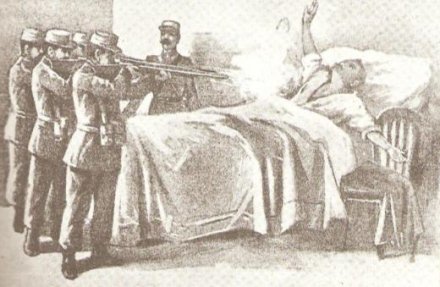
 De La Brosse (
 A few paces up the yard, and forming a continuation of the building, in which are the two rooms we have just quitted, lie the condemned cells. The entrance is by a narrow and obscure stair-case leading to a dark passage, in which a charcoal stove casts a lurid tint over the objects in its immediate vicinity, and diffuses something like warmth around. From the left-hand side of this passage, the massive door of every cell on the story opens; and from it alone can they be approached. There are three of these passages, and three of these ranges of cells, one above the other; but in size, furniture and appearance, they are all precisely alike. Prior to the recorder’s report being made, all the prisoners under sentence of death are removed from the day-room at five o’clock in the afternoon, and locked up in these cells, where they are allowed a candle until ten o’clock; and here they remain until seven next morning. When the warrant for a prisoner’s execution arrives, he is removed to the cells and confined in one of them until he leaves it for the scaffold. He is at liberty to walk in the yard; but, both in his walks and in his cell, he is constantly attended by a turnkey who never leaves him on any pretence.
 Henri Coiffier de Ruze (


