According to Michel Crouzet,* literary scholar of Stendhal, it was on this date in 1831 that the protagonist of said French author’s magnum opus was guillotined.
“Everything passed simply, decorously, and without affectation on his part,” is the entirety of Stendhal’s death scene for his man.
Julien Sorel, the flawed (or anti-) hero of The Red and the Black (Le Rouge et le Noir), is the intelligent son of a provincial carpenter who puts his wits to use trying to climb Restoration France’s treacherous social ladder.
Ambition, says Stendhal, is “the very essence of his existence,” much as it is for his milieu, and through Julien’s exertions — brilliant and resourceful at times; infuriatingly handicapped by social prejudice against the protagonist’s low birth at others — the author sets down one of the most psychologically forceful works in the canon.
Julien Sorel’s ambition also powers his youthful passion, and his fall: to conquer the mother of the children he tutors, and to likewise conquer the daughter of a nobleman.** This latter conquest has him a made man, married into the aristocracy and set with a plum military assignment that has Julien dreaming of Napoleon … so when the spurned former conquest denounces Julien to the father of that latter conquest as an upstart seducer cynically shagging his way into decent society, the incensed Julien hauls off and shoots that previous conquest. (As she kneels at Mass, no less.)
Is it a mere jealous fit? Even though his victim survives the attack, and forgives her lover, Julien obstinately pleads guilty, and insists on his own maximum culpability. It’s not only an individual criminal culpability, but a culpability of class aspiration.
‘I ask you for no mercy,’ Julien went on, his voice growing stronger. ‘I am under no illusion; death is in store for me; it will be a just punishment. I have been guilty of attempting the life of the woman most worthy of all respect, of all devotion. Madame de Renal had been like a mother to me. My crime is atrocious, and it was premeditated. I have, therefore, deserved death, Gentlemen of the Jury. But, even were I less guilty, I see before me men who, without pausing to consider what pity may be due to my youth, will seek to punish in me and to discourage forever that class of young men who, born in an inferior station and in a sense burdened with poverty, have the good fortune to secure a sound education, and the audacity to mingle with what the pride of rich people calls society.
‘That is my crime, Gentlemen, and it will be punished with all the more severity inasmuch as actually I am not being tried by my peers. I do not see, anywhere among the jury, a peasant who has grown rich, but only indignant bourgeois …’
The Red and the Black is available in its French original here; in English translation here; and as a free French audio book here. And here’s some literary analysis
* The date is not explicit in the text. The Red and the Black was subtitled Chronique de 1830, but several past-tense allusions to the event show that the main action takes place after the July Revolution of 1830 that toppled Charles X and raised Louis-Philippe to the throne. There is, however, a late and seemingly anachronistic allusion to Julien’s lover/victim intending to “throw herself at the feet of Charles X” to appeal for his life. Oh well: ambiguity is the novel’s stock in trade.
On this date in 1627, the Comte de Bouteville plus his cousin Des Chapelles lost their heads for fighting a duel — ultimately (because of the execution) one of the most notorious duels in French history.
Though this is the duel that everyone knows, Francois de Montmorency-Bouteville (English Wikipedia entry | French) had engaged in 22 such affairs of honor between the tender ages of 15 and 28. Like as not, he was the duellist par excellence in an age where demanding lethal satisfaction was all the rage among devil-may-care aristocratic straplings.
And this, of course, is why he was nominated for condign punishment in Louis XIII’s struggling anti-dueling campaign. One might say he nominated himself.
Dueling, a mano-a-mano vindication of feuds between fops, was an archaic holdover of Burgundian clan violence turned preposterous baroque ritual of conspicuous consociation.
It was also incredibly epidemic in France at this period.
During the reign of Louis’s predecessor Henri IV, 7,000 to 8,000 people are reported to have died in duels, which works out to the suspect rate of one per day for the entire period. Then again, France did have an excess supply of noble progeny whose violent impulses were no longer preoccupied by fratricidal religious warfare.*
Henri IV had tried to ban dueling, even in 1610 executing for lese majeste a couple members of his own guard who defied the ban. Just weeks later, and for no reason connected to dueling, Henri was assassinated. Then-nine-year-old heir Louis XIII was in no position at the time to follow up his father’s policy, and the naughty sport continued to flourish.
“Duels had become so common among the French nobility that the streets of Paris usually served as the field of combat,” according to the Mercure Francois. And as Richard Herr described in his “Honor versus Absolutism: Richelieu’s Fight against Dueling” (The Journal of Modern History, September 1955; this is also the source of all other quotes in this post), they often arose over utterly trivial “slights.”**
Typical was a duel in Lent of 1626 in which Bouteville [i.e., the subject of our post] with two seconds engaged the Comte de Thorigny and his two seconds. The fight was over a dispute between Thorigny and the Marquis de Chalais, who was in prison accused of treason. Bouteville was merely defending the honor of a friend. All six spent the night before the engagement in an inn outside Paris, and in the course of a fairly amicable conversation, they expressed regret that being good friends, they were going to kill each other over another gentleman’s quarrel. But they agreed that they had gone too far to be able to abandon the project without loss of honor. The next day Bouteville killed Thorigny after the latter’s sword broke.
By the 1620s, Louis was old enough to make another run at this intractable elite-on-elite crime wave, and did so with the full encouragement of his famous consigliere Cardinal Richelieu. Depriving the aristocracy of this weird extra-judicial prerogative fit right into the latter’s going campaign to centralize the French state and bring its quarrelsome lords to heel.
What with all those duels he liked to fight, Francois de Montmorency-Bouteville was a great test case. Fighting a public duel in January 1627 — at which his second was slain — made Bouteville a target, and he fled to the Netherlands for safety.
Our fugitive figured he’d send word that a pardon would be appreciated, and everything would blow over like it always did. But Louis was determined to disabuse this type of any privilege to commit public mayhem, and refused to grant Bouteville his absolution.
Honor offended — his default state, to judge by his career — Bouteville vowed angrily to “fight in Paris and in the Place Royale!” This he did on May 12, 1627, slipping back into France for the express purpose of dueling Guy Harcourt, the Marquis de Beuvron. And Bouteville disdained a private fight for the occasion, insisting, as he had declared, on a daytime melee where everyone could see it at the grand new Place Royale (today, Places des Vosges).
Bouteville and Beuvron fought to a bloodless stalemate and agreed to call it a draw. But Bouteville’s second Des Chapelles mortally wounded Beuvron’s second.
Everyone fled, and while Beuvron made it out of the country, Montmorency and Des Chapelles were nabbed, and condemned to death by the Parlement of Paris for violating Louis’s royal edict against duels.
From the king’s standpoint, this was just about the most egregious possible arrangement of factors.
The guy was a serial offender, and he was already a fugitive for his last duel.
The fight had produced a fatality.
Worst, the whole scene — sneaking back into Paris, fighting openly within the potential view of the sovereign — had been overtly staged to scorn the royal ban.
If Louis intended his decree to mean anything at all, he had to come down hard on this one. “It is a question of cutting the throat of duels or of your majesty’s edicts,” Richelieu summarized.
But as clear-cut as were the case indicia, this was still a hard one for Louis, and even for the usually-ruthless Richelieu. Bouteville was a well-born noble, with powerful friends and family who were also close to the king, and they besieged the royal person with petitions for mercy. A sorrowing but firm Louis had to personally refuse mercy to Bouteville’s tearful wife. “Their loss affects me as much as it does you,” he said. “But my conscience prevents my pardoning them.”
Although the poor wife couldn’t make any headway for clemency, she had the better of Bouteville’s swordsmanship off the field of honor. The doomed duke bequeathed one last rapier thrust to posterity by leaving his widow-to-be pregnant with a posthumous son who eventually generalled French armies to any number of routs of the Dutch in the late 17th century.
And while Richelieu’s memoirs would depict this instance of executive implacability as a decisive turn, Herr argues that it was nothing but a brief interruption. The pernicious hobby was back in all its glory within a couple of years, an evil that even Richelieu could never master. France’s aspired-to absolutism could not reach that ancient and intimate noble right save in the very most exemplary case.
In Dumas’s Three Musketeers, set in 1620s France, D’Artagnan is charged by his father in the opening pages to “[n]ever fear quarrels … Fight on all occasions. Fight the more for duels being forbidden, since consequently there is twice as much courage in fighting.” And indeed, it is by blundering into silly duels (e.g., the “offense” caused by bumping into Porthos while hurrying down the stairs, the latter of whom considers D’Artagnan’s apology discourteously perfunctory) that D’Artagnan becomes the fourth of their cadre … because Richelieu’s men arrive to break up the illegal D’Artagnan-vs.-Musketeer melees, and D’Artagnan joins with his “foes” to defend, all for one and one for all, their privilege as gentlemen to slaughter one another.
The dueling phenomenon faded significantly under Louis XIV, but still not completely: Voltaire almost fought a duel in 1726; the artist Manet dueled a critic in 1870; and YouTube will favor the viewer with a number of 20th century professors and litterateurs settling long-forgotten affairs of honor — like disputes over wartime collaboration after World War II — in ceremonial swordfights. Dueling pistol shooting (at human silhouettes) was even an event at the 1906 Olympics.†
* Also worth noting relative to the casualty numbers: at this time, each side’s seconds also fought in addition to the principals. A move for taking seconds out of the fight eventually prevailed, long before the end (if there has been a real end) of dueling, but in 1627 that time was not yet come.
† This event was an “Intercalated Games” falling between the natural 1904 and 1908 Olympiads. It’s an outlier historical experiment during the modern Olympics’ uncertain early years, and though it was officially sanctioned at the time and winners walked away with proper medals, the International Olympic Committee no longer recognizes the Intercalated Games as an official Olympics.
On this date in 1484, the onetime royal barber turned noble scoundrel was hanged at the terrifying Montfaucon gibbet.
Jolly grotesque “Olivier le Necker” (“Olivier the Devil”) statue in Tielt, Belgium. (cc) image from Zeisterre.
The scheming Olivier le Daim (English Wikipedia page | French), who ought to be patron saint of networking, got himself a gig as the sovereign’s coiffeur and glad-handed his way from straight razors all the way to the aristocracy. A presumably smooth-shaved Louis XI created him comte de Meulant.
Louis was an inveterate schemer known as the “Universal Spider”, and Olivier — excuse me, the comte — from his sprawling fortified manor proved an eager confederate. As Louis had a gift for infuriating the realm’s noble houses, he liked to elevate commoners into his entourage, men like our “Meulant” and Cardinal Balue whose loyalty could be relied upon since they owed their positions to the crown.
“That terrible Figaro whom Providence, the great maker of dramas, mingled so artistically in the long and bloody comedy of the reign of Louis XI,” Victor Hugowrote of our man in The Hunchback of Notre Dame. “This barber of the king had three names. At court he was politely called Olivier le Daim (the Deer); among the people Olivier the Devil. His real name was Olivier le Mauvais.” [Meaning “the bad”, as with “Charles le Mauvais”, the king Charles the Bad — a real bastard.]
With the disintegration of Burgundy following the death of Charles the Bold, le Daim was sent to that duchy’s Belgian reaches to connive them into French hands.
And if, according to everyone else, Oliver the Bad was a swaggering, nasty villain, he still remained loyal to Louis all the way to the latter’s deathbed. Louis recommended him to his successors’ favor, but once the Spider King was gone the put-upon lords of the realm vented their blueblooded spleens upon Olivier. (A servant of Olivier’s named Daniel also suffered the same fate.)
It’s not clear to me that history records the exact charge furnishing the pretext for his execution this date — this suggests abuse of his power to order executions — but it does certainly bequeath us this epitaph:
Cii gist le Diable
Baptisé le Dain
Jugé pendable
Barbier suzerain
On this date in 1917, Romanian Lieutenant Emil Rebreanu was hanged for attempted desertion by the Austro-Hungarian army.
Here’s Rebreanu’s entry at the Enciclopedia Romaniei, which says in brief that he was one of 14 (!) brothers born in the part of present-day Romania that was then attached to the Kingdom of Hungary.
Upon the outbreak of World War I, Rebreanu was drafted into the Austro-Hungarian forces and fought on several fronts. But his removal to the lines to fight against the independent Romanian state was a front too far: he attempted to cross the lines to the Romanians on the night of May 10-11, but was captured, court-martialed, and sentenced to hang.
However, tragedy for the sizable Rebreanu family was a boon to world literature.
One of Emil’s many brothers was author Liviu Rebreanu, one of the greats of Romanian letters.
The latter’s 1922 novel Forest of the Hanged clearly draws upon his brother’s fate: in Forest, a Romanian officer uneasily serving in the Habsburg army first condemns a Czech deserter to death as part of a tribunal, then attempts himself to desert to Romania.
On this date in 1857, a robber-murderer named Francis Richeux was publicly guillotined in Paris before a crowd of 12,000 to 15,000 people.
One of those onlookers was a 28-year-old Russian noble, fresh from the Crimean War and abroad on his first European trip: Leo Tolstoy.*
Overcome with curiosity, Tolstoy (as he recorded in his diary; here it is in Russian)
rose at seven o’clock and drove to see an execution. A stout, white, healthy neck and breast: he kissed the Gospels, and then — Death. How senseless … I have not received this strong impression for naught. I am not a man of politics. Morals and art I know, love, and [understand]. The guillotine long prevented my sleeping and obliged me to reflect.
The spectacle made such an impression on me that it will be long before I get over it. I have seen many horrors in war and in the Caucasus, but if a man were torn to pieces in my presence it would not have been so repulsive as this ingenious and elegant machine by means of which they killed a strong, hale, healthy man in an instant. There [in war] it is not a question of the rational [will], but the human feeling of passion, while here it is a question of calm and convenient murder finely worked out, and there’s nothing grand about it. The insolent, arrogant desire to carry out justice, the law of God. Justice, which is determined by lawyers every one of whom, basing himself on honor, religion, and truth, contradicts each other. With these same formalities they have murdered both the king and Chenier, both republicans and aristocrats.† . . Then the repulsive crowd, the father explaining to his daughter what a convenient and ingenious mechanism it is, and so forth. The law of man — rubbish! The truth is that the state is a conspiracy not only for exploitation, but chiefly to corrupt its citizens. But all the same states exist, and moreover in this imperfect form. And they cannot pass from this system into socialism . . . For my part, I can only see in all this repulsive lie what is loathsome, evil, and I do not want to, and cannot, sort out where there is more and where there is less. I understand moral laws, the laws of morality and religion, binding on no one, that lead people forward and promise a harmonious future; I feel the laws of art which always bring happiness; but the laws of politics constitute for me such an awful lie that I cannot see in them a better or worse. All this is what I felt, understood, and recognized today. And this recognition at least to some extent relieves the burden of the impression for me . . . From this day forward I will not only never go to see such a thing again, but I will never serve any government anywhere.**
He wasn’t kidding about that long insomnia, either: the impression startled him, permanently. Recalling the effect years later in his Confessions, Tolstoy still attributed to it an important confirmation of his egalitarian philosophy.
When I saw the head separate from the body, and how they both thumped into the box at the same moment, I understood, not with my mind but with my whole being, that no theory of the reasonableness of our present progress can justify this deed; and that though everybody from the creation of the world, on whatever theory, had held it to be necessary, I know it to be unnecessary and bad; and therefore the arbiter of what is good and evil is not what people say and do, and is not progress, but is my heart and I.
Tolstoy developed the same theme further a few years later in What Is to Be Done? … the shade of the long-forgotten Francis Richeux still haunting the great man of letters.
Thirty years ago in Paris I once saw how, in the presence of thousands of spectators, they cut a man’s head off with a guillotine. I knew that the man was a dreadful criminal; I knew all the arguments that have been written in defence of that kind of action, and I knew it was done deliberately and intentionally, but at the moment the head and body separated and fell into the box I gasped, and realized not with my mind nor with my heart but with my whole being, that all the arguments in defence of capital punishment are wicked nonsense, and that however many people may combine to commit murder — the worst of all crimes — and whatever they may call themselves, murder remains murder, and that this crime had been committed before my eyes, and I by my presence and nonintervention had approved and shared in it. In the same way now, at the sight of the hunger, cold, and degradation of thousands of people, I understood not with my mind or my heart but with my whole being; that the existence of tens of thousands of such people in Moscow — while I and thousands of others over-eat ourselves with beef-steaks and sturgeon and cover our horses and floors with cloth or carpets — no matter what all the learned men in the world may say about its necessity — is a crime, not committed once but constantly; and that I with my luxury not merely tolerate it but share in it. (PDF source | Original Russian)
* Among Tolstoy’s other activities in Paris was hanging around Turgenev … but the two mostly irritated one another. Nevertheless, they shared a distaste for the guillotine, at least to judge by Turgenev’s repulsion at seeing it in action years later.
** Two days after the execution, Tolstoy left Paris for Geneva. Execution-disgust is a suggestive speculation, although Henri Troyat argues that it merely gave him a “dramatic excuse” to stop putting off travel plans he had already made.
On this date in 1719, Mary (Marie) Hamilton, lady-in-waiting upon the tsaritsa Catherine I, was beheaded in St. Petersburg for infanticide.
A frightened Mary Hamilton contemplates her imminent execution in this 1904 painting by Pavel Svedomsky.
Lady Hamilton — her Scottish family had emigrated generations earlier — did not like to wait on her libido.
She could tell you if Peter the Great deserved his nickname, and dish on any number of other courtiers, nobles, and hangers-on.
This pleasing sport, of course, assumes with it the risks imposed by an equally impatient biology. Hamilton’s gallantries two or three times quickened her womb.
Her decision to dispose of these unwanted descendants in the expedient way — once by abortion, and again by infanticide — was done on the sly (voluminous court gowns helped) but surely also with no expectation of such a severe sanction in the unlikely event of detection.
But according to Eve Levin,* Russia’s longtime slap-on-the-wrist policy for infanticide was changing, and beginning “to distinguish between a woman who killed her child to hide illicit sexual conduct, and a woman who killed her child because she was too poor to care for it. In the first instance, the killing of the child reflected selfish behavior and was considered to be murder.”
Mary Hamilton was obviously not too poor to raise children.
In 1717, an unrelated investigation of another of Hamilton’s lovers led him to accuse the libertine lady-in-waiting of practicing post-natal birth control, which Mary admitted to,** certainly expecting her mistress the queen and her paramour the king to look forward, not back.
Peter, the towering and intense “learned druzhina” with his eye fixed on the West and a modernity that Russia lagged behind, was a liberal man in many respects. But he remained eminently capable of ruthlessness in service of an idea. This affair played out, after all, in his brand-new capital St. Petersburg, built on the bones of thousands peasants who threw up the city over swampland at Peter’s command. In 1718, he’d had his own son knouted to death.
On the day of the execution, the prisoner appeared on the scaffold in a white silk gown trimmed with black ribbons. Peter climbed the structure to stand beside her and spoke quietly into her ear. The condemned woman and most of the spectators assumed that this would be her last-minute reprieve. Instead, the Tsar gave her a kiss and said sadly, “I cannot violate the laws to save your life. Support your punishment with courage, and, in the hope that God may forgive you your sins, address your prayers to him with a heart full of faith and contrition.” Miss Hamilton knelt and prayed, the Tsar turned away and the headsman struck.
Then, the bystanding tsar picked up the severed head that had once shared his pillow and discoursed to the multitude on its anatomical features — another idea imported from the West. That strange tsar afterward had the disembodied dome preserved in a jar until Catherine the Great ran across it and (after remarking that the woman’s youthful beauty had been preserved this half-century) had it decently buried.
Something else of Mary Hamilton outlasted her pickled cranium, however.
In one of those unaccountable twists of history, Hamilton maybe became conflated with the “four Marys”, Ladies-in-Waiting of Mary, Queen of Scots — and the story seemingly became translated backwards into this altogether different time and place. This is a much-disputed hypothesis† but for purposes of a blog post is well worth the noticing, while resigning to wiser heads the literary forensics at stake.
There was no “Mary Hamilton” among the Queen of Scots’s attendants, but in at least some of the many different versions of this ballad that survive, a person of this name is held to have become the lover of the king (“the highest Stuart,” in this case) and been put to death for killing her illegitimate child.‡ It is, at the very least, rather difficult to miss the parallel.
O little did my mother ken,
The day she cradled me,
The lands I was to travel in,
Or the dog’s death I wad d’ee!
Variants of this ballad remain popular to this day.
* “Infanticide in Pre-Petrine Russia,” Jahrbücher für Geschichte Osteuropas, Neue Folge, Bd. 34, H. 2 (1986).
** She had also pilfered some effects from the Queen.
† Dissenting opinions on identifying the “Mary Hamilton” of the ballad with our Mary Hamilton can be read here and here.
400th death-day congratulations go to John Selman, a brass-balled nimblefingers who was hanged on this date in 1612 for stealing … at Whitehall … on Christmas … in the presence of the king. And, Selman himself added in his scaffold confessional, “in the time of divine Service, and the celebration of the Sacred Communion.” That’s like hitting for Stuart England’s malefaction cycle.
This common thief had tried to blend among the ermine-clad set at church with a black-velvet cloak getup, but drawn enough suspicion to be nabbed with a 40-shilling purse he’d brazenly boosted from a nobleman‘s retainer.
Francis Bacon, one of Selman’s judges, affected a suitably hyperbolic indignation at the effrontery of it all: “The first and greatest sinne that ever was committed was done in Heaven. The second was done in Paadise, being Heaven upon Earth, and truly I cannot chuse but place this in the third ranke.” Tens of thousands of human beings in the judge’s immediate ambit — England, Europe — had been slaughtering one another to the glory of God for the past century when Bacon said that. He’d surely give Nancy Grace a run for her money.
Then as now crime moved copy, and if the realm’s lord magistrates were ready to measure this guy up against Beelzebub, one can readily imagine the woodblock tweets he sent a-flying among the hoi polloi. Selman’s audacious escapade relieved his last days’ dread with the gift of celebrity. Writers scrambled to churn out Selman-tinged copy, like these inevitable ballads.
With hands and eyes to heaven,
all did in reverence stand:
While I in mischife used mine eye,
and my accursed hand,
Now was my mischiefe ripe.
my villanyes full growne,
And now the God in secret knew it.
did make it open knowne.
Hopefully God got a cut of the action from these writers. Talk about a Christmas gift for a scribe.
No less a personage than Ben Jonson hastily wrote Selman into his Twelfth Night masque Love Restored as “the Christmas Cutpurse”: this debuted the same night the real Selman made his last peace with God and man awaiting the next day’s hanging on the road to Charing Cross. (After all this Christmas reverence, they piously held off on the hanging until the full twelve days of Christmas had elapsed.)
At playes and at sermons and at the Sessions,
‘Tis daily their practice such booty to make;
Yea under the gallows, at executions,
They stick not the stare-abouts’ purses to take;
Nay, one without grace, at a better place,
At Court, and in Christmas, before the Kings face.
Alack then for pitty! must I bear the curse,
That only belongs to the cunning Cut-purse?
Youth, youth you hadst better been starv’d by thy nurse,
Than live to be hang’d for cutting as purse.
Jonson sure got that right: under Selman’s own gallows-tree this day, “one of his quality (a picke-pocket I meane) even at his execution, grew master of a true mans purse, who being presently taken, was imprisoned, and is like the next sessions to wander the long voiage after his grand Captaine Mounsier Iohn Selman.”
“Yes sir, I am The Sheppard, and all the gaolers in the town are my flocks, and I cannot stir into the country but they are at my heels baaing after me.”
On this date in 1724, the hangman finally got Jack Sheppard.
Sheppard was a thief, a romantic hero, a highwayman of the urban proletariat, a Houdini whom no prison could hold.
It had become possible in his time to ride criminal notoriety into celebrity: Jack Sheppard, a mere 22 at his death, proved as adept with that quicksilver element during his personal annus mirabilis of 1724 as he was with a lockpick.
Sheppard’s world had him fitted to wield a hammer better than thieves’ tools — but at about age 20, a young man awash in the illicit liberty of London’s underbelly, he ditched the square carpenter to whom he was apprenticed to live free by his wits.
Peter Linebaug’s The London Hanged finds in Jack Sheppard’s career and his runaway popularity an important marker of the capital city’s “refusal of subordination: — contra Foucaultian discipline, which “makes the rulers of government and society seem all-powerful.”
An important meaning of liberation … [consisted of] the growing propensity, skill and success of London working people in escaping from the newly created institutions that were designed to discipline people by closing them in. This tendency I have dubbed ‘excarceration’ because I wish to draw attention to the activity of freedom in contrast to its ideological or theoretical expressions…
This lithe youth is most famous for his literal talent for freedom: four times in 1724 he escaped from custody in ever more dramatic fashion.
He busted out through the ceiling of St. Giles Roundhouse. He rappelled with a bedsheet rope down the 20-foot wall of Clerkenwell Prison with his lover.
This sort of thing won the enterprising rogue growing folk hero status. The vaunted Sheppard “made such a noise in the town, that it was thought the common people would have gone mad about him, there being not a porter to be had for love nor money, nor getting into an ale-house, for butchers, shoemakers and barbers, all engaged in controversies and wagers about Sheppard.”*
It also drew the unwanted attention of 1720s London’s Jabba the Hutt: “thief-taker” Jonathan Wild, who managed a vast thieving cartel enforced by Wild’s willingness to turn in non-participants in his ingenious cover role as the city’ preeminent lawman. That’s some protection racket.
Sheppard, to the fame of his memory, scorned obeisance to the crime lord as much as to any guild carpenter and worked for no man but himself. A vengeful Wild shopped him to the authorities.
This time, Sheppard was actually condemned to death for burglary but broke prison again, using yet another classic ruse: the “disguised in smuggled women’s clothes.”
Back on the lam, he posted a cocky letter to his executioner “Jack Ketch” giving his regrets at not having joined two fellow-sufferers on the scheduled hanging date. (September 4.)
I thank you for the favour you intended me this day: I am a Gentleman, and allow you to be the same, and I hope can forgive injuries; fond Nature pointed, I follow’d, Oh, propitious minute! and to show that I am in charity, I am now drinking your health, and a Bon Repo to poor Joseph and Anthony. I am gone a few days for the air, but design speedily to embark, and this night I am going upon a mansion for a supply; its a stout fortification, but what difficulties can’t I encounter, when, dear Jack, you find that bars and chains are but trifling obstacles in the way of your Friend and Servant
JOHN SHEPPARD
London’s finest were determined to put an end to this character’s preposterous run of prison breaks, so when they caught him the fourth time Sheppard found himself loaded with manacles and chained to the floor of a special strongroom in Newgate Prison. Get out of that, Jack.
Somehow, Jack got out of it.
On the night of Oct. 14, Sheppard authored the sublimest breakout in Newgate’s voluminous annals. Picking the locks of his fetters with a small nail, our acrobat scurried up a chimney, picked, prised, or otherwise passed a succession of locked doors in the dead of night, paused to rest on the condemned pew of the gaol chapel, forced a grille, reached the roof, and threw another homemade rope over the wall to scamper down to safety.
And then “he promptly went forth and robbed a pawnbroker’s shop in Drury Lane of a sword, a suit of apparel, snuff boxes, rings, &c., and suddenly made a startling appearance among his friends, rigged out as a gentleman from top to toe.”
There’s no doubt but that Jack had showmanship, but at a certain point he could have done with just the tiniest measure of discretion. But then, this was a man writing his own legend. Sure, he could have put his head down and tried to disappear into some nameless Puritan settlement in the New World. (His distraught mother kept telling him to get out of the country.) He traded those dull and toilsome years for the fame of generations: his candle burned at both ends.
When next Sheppard was detained, it was towards his apotheosis. It was the only time he would be arrested and fail to escape.
A throng of thousands mobbed London’s route to execution this date, almost universally supporting the ace escapologist. And Sheppard very nearly had for them the piece de resistance in his career of magical disappearances: it was only at the last moment before boarding the fatal tumbril that Sheppard’s executioners found the penknife their prey had secreted on his person, evidently intending to cut his cords and spring from the cart into the safety of the surging crowd. What an exploit that would have been.
This indomitable soul has enjoyed a long afterlife as a subversive hero.
A celebrity in his own time, his execution-eve portrait was taken by the Hanover court painter himself, James Thornhill. Sheppard is a very likely candidate as an inspiration for the criminal Macheath in The Beggar’s Opera completed just a few years after his death; likewise, his abandoned apprenticeship makes him the most apparent model for Hogarth‘s “idle prentice” plates.
A century later, prolific historical novelist William Ainsworth** claimed the convict-martyr for an 1839 retelling. This popular potboiler — read it free online here — came in for a spate of 19th century social panic when it was learned that a notorious servant-on-master murder had been carried out by a young man who had recently read it. A two-decade ban on public plays based on the Jack Sheppard novel ensued.
For as much as Jack Sheppard is romanticized in his remarkable individual characteristics, his story has always had a class undertow that raises the hackles of the powerful — and is celebrated by the people who menace that power. Linebaugh, again:
Jack Sheppard, housebreaker and gaol-breaker, was once the single most well-known name from eighteenth-century England. His fame spread across oceans and the centuries. When the bandit Ned Kelly was alive, the Australian press was full of comparisons between him and Sheppard. At the same time on the other side of the globe in Missouri, Frank and Jesse James wrote letters to the Kansas City Star signed ‘Jack Sheppard’. In England his name cut deep into the landscape of popular consciousness. Henry Mayhew noted that Cambridgeshire gypsies accepted Sheppard stories as the archetype of ‘blackguard tales’. Among English sailors anyone with the surname of ‘Sheppard’ was automatically called ‘Jack’. Within the Manchester proletariat of the 1840s his name was more widely known than that of the Queen herself. One of these lads said, ‘I was employed in a warehouse at 6s. 6d. a week, and was allowed 6d. of it for myself, and with that I went regularly to the play. I saw Jack Sheppard four times in one week.’
The oral history of Sheppard has maintained his memory within human contexts where books were scarce and working-class resources for an independent historiography were non-existent. Moreover, that memory was kept in contexts of social struggle in which a continuity, if not a development, with earlier moral and political conflicts was suggested.
* cited in Andrea McKenzie, “The Real Macheath: Social Satire, Appropriation, and Eighteenth-Century Criminal Biography,” Huntington Library Quarterly, December 2006
** Ainsworth is also known for a novel about Sheppard’s near-contemporary, highwayman Dick Turpin.
On this date in 1778, Revolutionary War-era bandit James Fitzpatrick was hanged — very badly — at Chester, Pennsylvania.
Fitzpatrick was then, and still is now, a legendary character in Chester County. He’s better known as “Captain Fitz” or, with a bit more flair, “Sandy Flash”.
Born to Irish immigrants in Chester, Fitzpatrick joined up with the Continental Army when the Revolutionary War broke out.
But after being subject to the commonplace but brutal punishment of flogging for some failure of military discipline, Fitzpatrick deserted, swimming off Long Island in the dead of night and eventually returning home. There, he was recognized as a deserter and clapped in jail until he agreed to fight again.
All this built up a terrific grudge in the young man’s heart, and he “agreed” just long enough to get out from behind bars and abscond again. After warding off yet another press gang sent to retrieve him, Fitzpatrick vengefully took to the road.
This was not necessarily out of bounds for Fitzpatrick’s milieu. As detailed by Rosemary Warden (“‘The Infamous Fitch’: The Tory Bandit, James Fitzpatrick of Chester County,” Pennsylvania History Summer 1995):
Fitzpatrick’s bold outlawry must be seen against the background of many Chester Countians’ lack ofsupport for the Revolution, ranging from passive neutrality to outright loyalism. Forty percent were Quaker, settled most heavily in the eastern township. Only a small number actively supported the Revolution or the British cause … Fitzpatrick’s two favorite targets, militia recruiters and tax collectors, often met violent opposition in Chester County during this period, and not always from loyalists …
It is not surprising that revolutionary General Anthony Wayne wrote to Council President Thomas Wharton in the spring of 1778, to suggest that he stop recruiting troops in Chester County, a wasted effort, and concentrate on raising men in Berks, Lancaster, York, or Cumberland Counties. Nor is it surprising that a loyalist bandit who particularly targeted militia officers would find clandestine support and safe hideouts in Cheser County.
Playing to the hilt the part of “Tory highwayman,” Captain Fitz targeted Chester County Whigs, and especially agents of the revolutionary government. And he did not neglect the opportunity to inflict with the flog the suffering he had once endured himself. Still,
Despite his many crimes, there was a rough chivalry in the character of the man which exhibited itself in his marked gallantry towards women, in his open, generous disposition to aid them on when ill fortune bore heavily; indeed, he was never known to rob a poor man or ill-treat a female. Many are the instances related when he bestowed upon the destitute that which he had taken from those in good circumstances, and the weak or defenseless never suffered at his hands. On one occasion an old woman, who made a meagre living by peddling from house to house odds and ends of female apparel, encountered Fitzpatrick in the neighborhood of Caln Friends’ meeting-house. She was at the time on her way to Philadelphia to buy goods, and all the money she possessed was on her person. She had never seen Capt. Fitzpatrick, and she informed, the tall, handsome stranger that she was told that the outlaw had made some demonstrations in that neighborhood a short time before, and she was afraid that she might fall in with him and be robbed of all her money. Fitzpatrick, by a few questions, drew from her the particulars of her business, and her difficulty in winning an honest livelihood. He then good naturedly told her she need be under no apprehension, Fitzpatrick never warred upon the weak or defenseless, that she was talking to that personage; and taking a purse from his pocket containing several gold pieces, he gave it to her to aid her in increasing her scanty stock of goods. Then, wishing her a safe journey, he turned into the woods and disappeared.
What a guy.
His prey among the Whig well-to-do not being constrained to treat Fitz with any similar measure of gallantry, the bandit was at length captured when, in the course of raiding a household, he briefly set down his weapons — and his hostages jumped him. (The hostages in question had an argument with each other afterwards over who should get the reward.)
“Sandy Flash” is a prominent character in Bayard Taylor‘s portrait of revolutionary Pennsylvania, The Story of Kennett, where, Turpin-like, he’s “transformed” (the author’s own words) “from a living terror into a romantic name.” Here, Bayard dramatizes an allegedly real exploit, in which Fitzpatrick boldly presents himself at a public inn* where a posse hunting him has holed up.
All eyes, turned towards the crossing of the roads, beheld, just rounding the corner-house, fifty paces distant, a short, broad-shouldered, determined figure, making directly for the tavern. His face was red and freckled, his thin lips half-parted with a grin which showed the flash of white teeth between them, and his eyes sparkled with the light of a cold, fierce courage. He had a double-barrelled musket on his shoulder, and there were four pistols in the tight leathern belt about his waist.
Barton turned deadly pale as he beheld this man. An astonished silence fell upon the group, but, the next moment, some voice exclaimed, in an undertone, which, nevertheless, every one heard,—
“By the living Lord! Sandy Flash himself!”
There was a general confused movement, of which Alfred Barton took advantage to partly cover his heavy body by one of the porch-pillars. Some of the volunteers started back, others pressed closer together. The pert youth, alone, who was to form the third party, brought his musket to his shoulder.
Quick as lightning Sandy Flash drew a pistol from his belt and levelled it at the young man’s breast.
“Ground arms!” he cried, “or you are a dead man.”
He was obeyed, although slowly and with grinding teeth.
“Stand aside!” he then commanded. “You have pluck, and I should hate to shoot you. Make way, the rest o’ ye! I’ve saved ye the trouble o’ ridin’ far to find me. Whoever puts finger to trigger, falls. Back, back, I say, and open the door for me!”
Still advancing as he spoke, and shifting his pistol so as to cover now one, now another of the group, he reached the tavern-porch. Some one opened the door of the barroom, which swung inwards. The highwayman strode directly to the bar, and there stood, facing the open door, while he cried to the trembling bar-keeper,—
“A glass o’ Rye, good and strong!”
It was set before him. Holding the musket in his arm, he took the glass, drank, wiped his mouth with the back of his hand, and then, spinning a silver dollar into the air, said, as it rang upon the floor,—
“I stand treat to-day; let the rest o’ the gentlemen drink at my expense!”
He then walked out, and slowly retreated backwards towards the corner-house, covering his retreat with the levelled pistol, and the flash of his dauntless eye.
* Specifically, the Unicorn, a patriotic tavern. Filed under “small world”: this pub was owned by Joseph Shippen, the uncle of the woman who would marry soon-to-be–turncoat Benedict Arnold.
I have ever had the single aim of justice in view … ‘Do equal and exact justice,’ is my motto, and I have often said to the grand jury, ‘Permit no innocent man to be punished, but let no guilty man escape.’
On this date in 1875, the most famous — or infamous, depending on your perspective — “hanging judge” of the American West dropped the trap on his noosing career with his first six hangings at Fort Smith, Arkansas.
Isaac Parker, around the time he arrived at Fort Smith
No problem: his co-partisan president, Ulysses S. Grant, appointed Parker to a federal judgeship in neighboring Arkansas. It’s upon that renowned tenure that the man’s reputation, uh, hangs.
This expanse of land, the final destination of the Trail of Tears, had once been preserved for tribes forcibly “removed” from eastern North America.
But by the post-Civil War years, the frontier was sweeping past on iron wheels … and as long as Indian Territory remained (mostly) protected from white settlement, it remained a sparsely-populated refuge for outlaws.
Pandemonium in the Territory was only exacerbated by the Fort Smith court’s reputation for corruption and inefficiency; the office was open for Parker’s appointment because his predecessor had resigned to avoid impeachment.
Judge Isaac Parker came to clean up the place.
Fort Smith was an unusual portfolio for a federal judge. While most of Parker’s colleagues were confined to the tedium of interstate civil litigation, Parker was the court of first call for many regular criminal cases in the Indian Territory which in other jurisdictions would have been a state matter. He estimated in 1885 Congressional testimony that seven-eighths of his caseload came from Indian Territory.*
And in those cases he quickly established himself a reputation for severity.
“I never hanged a man,” Parker said of himself later in life. “The law hanged him. I was only its instrument.”
But make yourself the law’s instrument to the tune of 79 hangings, and folks are bound to sit up and take notice.
“they nearly hung me for stealin’ a horse
in Fort Smith Arkansas.
Judge Parker said guilty and the gavel came down
just like a cannon shot …”
At his court’s very first sitting in May 1875, Parker death-sentenced a murderer — Daniel Evans, who came straight from frontier central casting and had murdered a man for his boots.
As that year unfolded, he added enough condemned men to the bowels of the miserable jail nicknamed “Hell on the Border” — for an eight-strong hanging date to christen September.
One of the eight had his sentence commuted due to youth.
One was shot trying to escape.
And the other six were the debut crop for the mass-occupancy gallows that Parker ordered constructed at Fort Smith. (Its capacity was a full dozen.)
The clientele was six unconnected murderers, committing various atrocities for various motives and aptly embodying the region’s ethnic diversity.
Evans, white
James Moore, white
Samuel Fooy, quarter Cherokee
Smoker Mankiller, Cherokee
Edmond Campbell, black
John Whittington, white
And the audience? Five thousand or so reportedly on hand in Fort Smith this date, plus a national media audience … and posterity deep into the second century since this sturdy magistrate donned his first black cap and set about putting chaos into order with a rope in his hand.
New York Tmes, September 4, 1875.
Whatever one might have to say about his methods, Parker presents a magnetic personality, a figure so truly of his own time and place that he obligingly died just weeks after his court was finally relieved of its Oklahoman jurisdiction in 1896. He’d never hang around to jolt our anachronism meter by weighing in on trench warfare or cubism.
Parker is undoubtedly a more layered figure than his “hanging judge” reputation would suggest, and even his life’s project to bring his unruly jurisdiction to heel was more complicated than just being a hardass. (He had a significant administrative challenge to manage his chronically underfunded court, and he needed to foster the sense of communal reciprocity and legal integrity that would encourage fellow-citizens to turn up for jury duty and witness testimony that make the law’s everyday business possible.) The judge was famous for the long hours he kept, and capital cases were never more than a tiny fraction of his work.
Parker was notorious (slash-beloved, again depending on perspective) for his prosecution-friendly courtrooms, but even the tough sentences he handed down came in his mind from a place of tough love. He wrote late in life that
not one of [those he suffered to long prison terms for violent crimes], no matter how depraved, had entirely lost that better part of human nature …
The object of punishment is to revive, that in some cases, almost extinct spark, to lift the man up, to stamp out his bad nature and wicked disposition, that his better and God given traits may assert themselves.*
Still, whether you prefer him as the stern avatar of law on an outlaw plain or bloodthirsty yahoo, Parker’s ready amenability to latter-day Hollywood tropes will surely maintain his popularity in the cultural rookery of wild west cutouts.
Among numerous other reference points, the novel True Grit, and the 1969 and 2010 films based on it, use Judge Parker’s Fort Smith as the heroine’s embarkation point — with her dangerous journey carrying her into the untamed Indian Territory on his doorstep.
Pat Hingle’s “Judge Fenton” (from “Fort Grant”) in the Clint Eastwood western Hang ‘Em High also shows an unmistakable debt to the Judge Parker persona.
A few books about Judge Parker
Spare a thought, too, for the man operating the ropes and levers this date.
George Maledon, named Fort Smith’s official hangman just a couple of years before Isaac Parker’s appointment, would enforce the Hanging Judge’s hanging sentences into the 1890s: 60-plus executions in all, plus five other escaping prisoners he gunned down, all in a day’s work for an Arkansas lawman.
Maledon has a sad coda to this story, which wasn’t so upbeat to begin with.
The year after the veteran hangman hung up his hood and opened a grocery store, Maledon’s daughter was murdered. The bereaved father’s friend Judge Parker, still on the bench at that time, condemned the killer to die in a case we’ll suggest might have warranted a recusal by present-day standards. Nevertheless, a successful appeal balked Maledon’s successor of the malefactor, and the disgusted ex-executioner got his species of payback by taking the accoutrement of his late profession on the road as a traveling act.
There, under the billing of “the Prince of Hangmen,” Maledon lectured and exhibited old hanging ropes and pictures of the outlaws they had choked.
People of all classes flocked to the show grounds, crowded about the lecturer and filled the tent, viewing the gruesome relics and listening to the old hangman’s recital of soul-stirring events as he pointed out the…instruments of his vocation. (Source)
* See Mary Stolerg, “Politician, Populist, Reformer: A Reesamination of ‘Hanging Judge’ Isaac C. Parker”, The Arkansas Historical Quarterly, Spring 1988

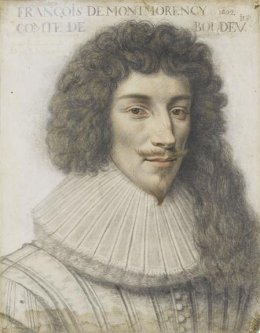 Though this is the duel that everyone knows, Francois de Montmorency-Bouteville (

 However, tragedy for the sizable Rebreanu family was a boon to world literature.