1897: The Bicol martyrs of Philippines independence

On this date in 1897, eleven pro-independence Filipinos were shot at Manila’s Bagumbayan execution grounds.

These eleven,* together with one who was tortured to death on a prison brig and three others who died exiled to prisons elsewhere in the Spanish empire, comprise the Fifteen Bicol (or Bikol) Martyrs.

Spanish suppression of the unfolding Philippine Revolution was in full martyr-making; just days before, the same site had seen the execution of Dr. Jose Rizal. (A few days after this, it made still another batch of martyrs.)

“They died bravely,” a Filipino newspaper reported. “They died like those who are sustained by a sacred ideal.”

They were.

This date’s victims had been rounded up on September 16 at Naga City in the Bicol Region. It was the aftermath of Spain’s discovery of the anti-colonial Katipunan secret society, and mass arrests followed by torture-aided interrogation were the order of the day.

These would not, in the end, avail.

As a result, the “Quince Martires” are still commemorated in independent Philippines every January 4, which is a public holiday in Naga City … and commemorated throughout the year at that city’s Plaza Quince Martires, and its monument.


(c) image courtesy of Wally Ocampo.

* Rev. Fr. Gabriel Prieto; Gabriel’s brother, Thomas Prieto; Rev. P. Severino Diaz; Rev. P. Inocencio Herrera; Manuel P. Abella; Manuel’s son, Domingo I. Abella; Camilo Jacob; Florencio Lerma; Macario Valentin; Cornelio Mercado; and Mariano Melgarejo.

On this day..

1868: Giuseppe Monti and Gaetano Tognetti, by the Papal guillotine

On this date in 1868, Italian revolutionaries Giuseppe Monti and Gaetano Tognetti were guillotined in Rome.

Theirs was a passion of the Risorgimento, the 19th century drive to unify as a single nation the peninsula’s quiltwork of minor kingdoms, duchies, and city-states.

Following the Third Italian War of Independence, this had largely been accomplished … with the notable exception of the Papal States surrounding Rome. You can hardly have Italy without the Eternal City.

So national liberator Giuseppe Garibaldi gathered a force under the slogan Roma o morte and prepared to march … while Pope Pius IX began receiving reinforcements from the sympathetic French emperor Napoleon III.

Inside Rome, Monti and Tognetti prepared a little morte of their own. Intending to mount a fifth-column uprising to coincide with the arrival of Garibaldi’s army, the two detonated a couple barrels of gunpowder under the Serristori barracks, killing 23 French zouaves and four Roman civilians. (All links in this paragraph are Italian.)

Unfortunately for the bombers, no general rising ensued, and the Papal and French armies subsequently repulsed Garibaldi at the Battle of Mentana on Nov. 3, 1867 — extending the papal enclave’s lease on life only slightly, but just enough to deal with Monti and Tognetti.

Their fate at the hands of the civil and religious authorities (one and the same, at this time), is dramatized in the 1977 Italian film In Nome Del Pap Re. (This Google books freebie purports to relate their final days.)

The triumph, such as it was, was short-lived for the Papal States: these were the very last executions by guillotine in Rome; the Papal States polity as a whole had time for only two more executions in its history before the Italian nationalist army completed the risorgimento by capturing Rome in 1870.

The two are memorialized in a celebratory ode by Giosue Carducci.

PER GIUSEPPE MONTI E GAETANO TOGNETTI
MARTIRI DEL DIRITTO ITALIANO

I
Torpido fra la nebbia ed increscioso
Esce su Roma il giorno:
Fiochi i suon de la vita, un pauroso
Silenzio è d’ogn’intorno.

Novembre sta del Vatican su gli orti
Come di piombo un velo:
Senza canti gli augei da’ tronchi morti
Fuggon pe ‘l morto cielo.

Fioccano d’un cader lento le fronde
Gialle, cineree, bianche;
E sotto il fioccar tristo che le asconde
Paion di vita stanche

Fin quelle, che d’etadi e genti sparte
Mirar tanta ruina
In calma gioventù, forme de l’arte
Argolica e latina.

Il gran prete quel dì svegliossi allegro,
Guardò pe’ vaticani
Vetri dorati il cielo umido e negro,
E si fregò le mani.

Natura par che di deforme orrore
Tremi innanzi a la morte:
Ei sente de le piume anco il tepore
E dice – Ecco, io son forte.

Antecessor mio santo, anni parecchi
Corser da la tua gesta:
A te, Piero, bastarono gli orecchi;
Io taglierò la testa.

A questa volta son con noi le squadre,
Né Gesù ci scompiglia:
Egli è in collegio al Sacro Cuore, e il padre
Curci lo tiene in briglia.

Un forte vecchio io son; l’ardor de i belli
Anni in cuor mi ritrovo:
La scure che aprì ‘l cielo al Locatelli
Arrotatela a novo.

Sottil, lucida, acuta, in alto splenda
Ella come un’idea:
Bello il patibol sia: l’oro si spenda
Che mandò Il Menabrea.

I francesi, posato il Maometto
Del Voltèr da l’un canto,
Diano una man, per compiere il gibetto,
Al tribunal mio santo.

Si esponga il sacramento a San Niccola
Con le indulgenze usate,
Ed in faccia a l’Italia mia figliuola
Due teste insanguinate. –

II
E pur tu sei canuto: e pur la vita
Ti rifugge dal corpo inerte al cuor,
E dal cuore al cervel, come smarrita
Nube per l’alpi solvesi in vapor.

Deh, perdona a la vita! A l’un vent’anni
Schiudon, superbi araldi, l’avvenir;
E in sen, del carcer tuo pur tra gli affanni.
La speme gli fiorisce et il desir.

Crescean tre fanciulletti a l’altro intorno,
Come novelli del castagno al piè;
Or giaccion tristi, e nel morente giorno
La madre lor pensa tremando a te.

Oh, allor che del Giordano a i freschi rivi
Traea le turbe una gentil virtù
E ascese a le città liete d’ulivi
Giovin messia del popolo Gesù,

Non tremavan le madri; e Naim in festa
Vide la morte a un suo cenno fuggir
E la piangente vedovella onesta
Tra il figlio e Cristo i baci suoi partir.

Sorridean da i cilestri occhi profondi
I pargoletti al bel profeta umìl;
Ei lacrimando entro i lor ricci biondi
La mano ravvolgea pura e sottil.

Ma tu co ‘l pugno di peccati onusto
Calchi a terra quei capi, empio signor,
E sotto al sangue del paterno busto
De le tenere vite affoghi il fior.

Tu su gli occhi de i miseri parenti
(E son tremuli vegli al par di te)
Scavi le fosse a i figli ancor viventi,
Chierico sanguinoso e imbelle re.

Deh, prete, non sia ver che dal tuo nero
Antro niun salvo a l’aure pure uscì;
Polifemo cristian, deh non sia vero
Che tu nudri la morte in trenta dì.

Stringili al petto, grida – Io del ciel messo
Sono a portar la pace, a benedir –
E sentirai dal giovanile amplesso
Nuovo sangue a le tue vene fluir…

In sua mente crudel (volgonsi inani
Le lacrime ed i prieghi) egli si sta:
Come un fallo gittò gli affetti umani
Ei solitario ne l’antica età.

III
Meglio così! Sangue dei morti, affretta
I rivi tuoi vermigli
E i fati; al ciel vapora, e di vendetta
Inebria i nostri figli.

Essi, nati a l’amore, a cui l’aurora
De l’avvenir sorride
Ne le limpide fronti, odiino ancora,
Come chi molto vide.

Mirate, udite, o avversi continenti.
O monti al ciel ribelli,
Isole e voi ne l’oceàn fiorenti
Di boschi e di vascelli;

E tu che inciampi, faticosa ancella,
Europa, in su la via;
E tu che segui pe’ i gran mar la stella
Che al Penn si discovria;

E voi che sotto i furiosi raggi
Serpenti e re nutrite,
Africa ed Asia, immani, e voi selvaggi,
Voi, pelli colorite;

E tu, sole divino: ecco l’onesto
Veglio, rosso le mani
Di sangue e ‘l viso di salute: è questo
L’angel de gli Sciuani.

Ei, prima che il fatale esecutore
Lo spazzo abbia lavato,
Esce raggiante a delibar l’orrore
Del popolo indignato.

Ei, di demenza orribile percosso,
Com’ebbro il capo scuote,
E vorria pur vedere un po’ di rosso
Ne l’òr de le sue ruote.

Veglio! son pompe di ferocie vane
In che il tuo cor si esala,
E in van t’afforza a troncar teste umane
Quei che salvò i La Gala.

Due tu spegnesti; e a la chiamata pronti
Son mille, ancor più mille.
I nostri padiglion splendon su i monti,
Ne’ piani e per le ville,

Dovunque s’apre un’alta vita umana
A la luce a l’amore:
Noi siam la sacra legion tebana,
Veglio, che mai non muore.

Sparsa è la via di tombe, ma com’ara
Ogni tomba si mostra:
La memoria de i morti arde e rischiara
La grande opera nostra.

Savi, guerrier, poeti ed operai,
Tutti ci diam la mano:
Duro lavor ne gli anni, e lieve omai
Minammo il Vaticano.

Splende la face, e il sangue pio l’avviva;
Splende siccome un sole:
Sospiri il vento, e su l’antica riva
Cadrà l’orrenda mole.

E tra i ruderi in fior la tiberina
Vergin di nere chiome
Al peregrin dirà: Son la ruina
D’un’onta senza nome.

On this day..

1895: The Vegetarian perpetrators of the Kucheng Massacre

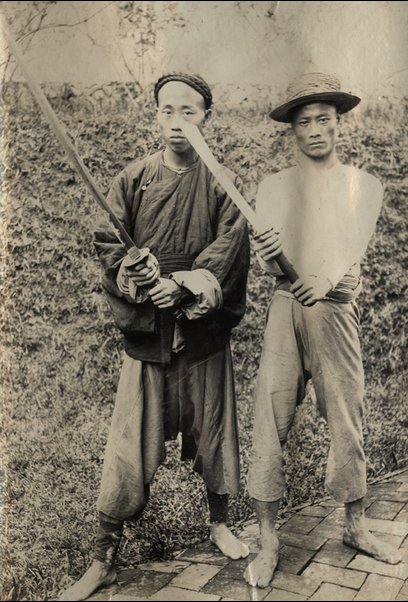
On the morning of September 17, 1895, in the presence of the British and American consuls, seven perpetrators of a Chinese massacre of western Christian missionaries were beheaded at Foochow.

Anticipating the better-known Boxer Rebellion by four years, the Kucheng Massacre (there are many other transliterations of “Kucheng”) was likewise a response to the Celestial Empire’s frustrating second-class status as against European interlopers.

Christian missionaries had been a point of friction in China for decades. Though their rights to proselytize had been guaranteed in a hated treaty dictated to China by force of arms, they often met resentment or worse on the ground.

“You bring incense in one hand, a spear in the other;” one evangelist reported being told: that is, however honorable the immediate intentions of many individual missionaries, their presence looked like a stalking horse for less reputable western interventions like the opium trade. (That’s how it looked to many Chinese. Professional western diplomats themselves found the impolitic preachers a hindrance to their statecraft, according to Ian Welch’s 2006 paper “Missionaries, Murder and Diplomacy in Late 19th Century China: A Case Study” (pdf).*)

On August 1, 1895, these frustrations unleashed a river of blood at the village of Huashan in Gutian County, where a Buddhist secret society — known as “Vegetarians” in the western press for their characteristic dietary vow — fell upon a group of vacationing British Anglican missionaries still abed at dawn and ruthlessly slaughtered eleven of them. (There are some 1890s books paying tribute to the fallen available online: Robert and Louisa Stewart: In Life and in Death, and The sister martyrs of Ku Cheng : Memoir and Letters of Eleanor and Elizabeth Saunders (“Nellie” and “Topsie”) of Melbourne.)

“The attack came,” said a physician from a nearby town who was summoned to the bloody scene, “like a thunderbolt from a clear sky, not one of the victims having received the slightest intimation of the intended assault.”

Word of the carnage struck western powers with similar force.

Incensed newspaper-readers literally demanded** gunboat diplomacy, and literally got it, especially when Chinese authorities drug their feet on the condign punishment the missionaries’ countrymen were clamoring for.

All this put British diplomacy on a sticky wicket, which Welch (pdf) deals with in detail. To satisfy the domestic audience, the government had to be seen to be taking a hard line on avenging the outrages; at the same time, London was wise to the Chinese state’s shakiness and wary that a “barbarous holocaust” perpetrated against the Vegetarians would trigger a mass backlash and bring the whole thing down.

An obdurate Chinese viceroy impeded the quick resolution everyone was after by making inflammatory public proclamations against Christians, and releasing without explanation six of the thirteen men who had initially been condemned to death in the month of August. The seven who were executed on this date were therefore only the vanguard of 26 humans ultimately put to death for their involvement in the atrocity.

Some of the execution photographs that follow are Mature Content. They’re obtained via Visual Cultures in East Asia; some also available at USC Digital Library.


Raids and investigations to bring the Vegetarian movement to heel continued for several months thereafter, and the whole affair ultimately was quelled without doing any of the wider damage that might have been feared — not even to missionaries who continued pouring into China.

And that, effectively, kicked the can down the road on the anti-foreigner sentiments afoot in the land … sentiments that would find much costlier expression a few years later when another secret society kicked off the Boxer Rebellion.

* I’ve relied heavily on Welch for this post. He’s also collected a massive trove (over 1,200 pages) of primary documents from this incident available in a series of pdfs (some quite large) from the Australian National University website:

** This was not universally so. The wife of missionary Stephen Livingston Baldwin, who knew some of the victims of the attack, urged a “charitable” response and sensitivity that “the Chinese feel that all the world is against them, and they are not far from right.” (New York Times, Aug. 10, 1895) In letters responding to intemperate coverage elsewhere, she acidly compared (pdf) western editorialists’ high dudgeon to their look-forward-not-back dismissal of recent stateside anti-Chinese violence.

It was ten years yesterday since more Chinese were killed, and burned alive and left to die wounded, in one hour, at Rock Springs, Wyoming (the very same Territory in which the recent massacre occurred) than have been Americans and English in China in the thirty-four years I have personally known that land, being a resident there twenty years and closely connected with it ever since. Ten years yesterday since that awful Rock Springs massacre, and up to date no one arrested, much less punished! The anti-Chinese papers of the town and neighbourhood gloating over the awful details and assuring all that there would be “no Congressional investigation,” and no waste of “enterprising newspaper eloquence” over the woes of the Chinese, “though their blood flow like rivers, as they had no votes and no friends.” In less than four weeks after the Ku-Cheng massacre, arrest, investigation and execution have all taken place for the Ku-Cheng massacre. Would that our colored, red and yellow brethren, so helpless in our so-called civilized and Christian land, had some power behind them to bestir Ministers Plenipotentiary, wave flags, and run gunboats to the front, to bully, if necessary, our pusillanimous Government into some sort of civilization — I will not say Christian justice!

On this day..

1946: Chu Minyi, collaborationist Foreign Minister

On this date in 1946, China executed Chu Minyi for serving as the Foreign Minister of the wartime Japanese puppet government.

Chu was a nationalist dating back to the Qing dynasty, though he spent most of the first decade after the revolution at European universities.

He returned to China as a Koumintang supporter in the 1920s.

The guy had the bad luck to be the brother-in-law of notorious quisling figure Wang Jingwei, who enjoyed the title of President of China under the Japanese aegis.

For what’s generally interpreted as reasons of personal more than political loyalty, Chu accordingly agreed to serve in Wang’s cabinet as Foreign Minister. “Chen Gongbo‘s mouth, Zhou Fuohai‘s pen and Chu Minyi’s legs” was the government’s tagline. (Chu was also a noted martial artist.)

But it was Hirohito’s guns they relied upon, and none of them would much outlive Japan’s surrender. Chu was tried as a traitor in April 1946.

On this day..

1908: Khudiram Bose, teenage martyr

The investigations following upon the recent raids on Anarchist dens here prove the existence of a revolutionary plot on a vast scale and show that there was a systematically organized “college” … where bombs were manufactured and instruction in explosives was given … The prisoners talk freely of their “heroic conduct” and “noble design,” while refusing to impart any informaton incriminating those working behind the scenes and furnishing the funds. They all confess, however, that their minds have been fired by writings in the Press and speeches on platforms.

London Times

It’s a timeless story, really; with a tweak here or there, the excerpt above could do for reportage on seditious movements by the hundredfold. As it happens, its dateline is May 11, 1908 — Calcutta.

Separatist stirrings on the subcontinent were then manifesting themselves in the explosive revolutionary language of the day, and the chief magistrate of that ancient city of Calcutta — Kingsford by name, as in charcoal — was a character notorious for his harshness toward the movement. The year before, he’d had a 15-year-old flogged for trying to stop a British soldier beating Indian activists.

Among the more militant types excited to wrath against Kingsford was an 18-year-old Bengali who would have the privilege of martyrdom for the cause of national self-determination.

Khudiram Bose sought the judge out in Muzaffarpur and, with another young revolutionary, attempted to assassinate him in April 1908 by tossing a couple of bombs into Kingsford’s carriage.

Minor problem: it was the wrong carriage.

Instead of popping the nefarious judge, the bombs killed the wife and daughter of a barrister.

The other assassin committed suicide when cornered by police, but Bose would meet his end via the judiciary.

Bose played his patriotic martyr’s role to the hilt in the few brief weeks before his hanging, and found himself on the leading edge of a growing movement of anti-British bombers. “People are prepared to do anything for the sake of swarajya [home rule] and they no longer sing the glories of British rule,” one contemporary newspaper (quoted here) put it. “They have no dread of British power. It is simply a question of sheer brute force.” The editor was convicted of seditious libel.

One can now find plentiful Khudiram Bose hagiographies celebrating the youthful freedom fighter … regardless of his target selection.

On this day..

1849: Ugo Bassi, nationalist priest

Measure thy life by loss instead of gain;
Not by the wine drunk, but the wine poured forth
For love’s strength standeth in love’s sacrifice;
And whoso suffers most hath most to give.

-From Harriet King‘s poem “Ugo Bassi’s Sermon in the Hospital”

On this date in 1849, the Garibaldian priest Ugo Bassi was shot in Bologna along with fellow-nationalist Count Livraghi.


Statue of Ugo Bassi at Bologna’s via Ugo Bassi.(cc) image from Biblioteca Salaborsa.

Detail view (click for full image) of Bassi and Livraghi being escorted to execution.

Bassi was a penniless Barnabite priest famous for his powerful oratory* and his national enthusiasms. He signed right up for Garibaldi‘s national movement in the heady liberal revolutions of 1848-49.

“Italy is here in our camp,” he would say of the Garibaldian forces readying their (ultimately unsuccessful) defense of the Roman Republic.** “Italy is Garibaldi; and so are we.”

Alas, in this engagement, Italy had a lot fewer guns than the French.

The new French ruler Napoleon III, who had himself been in youth a revolutionary carbonaro in Rome, saw foreign policy advantage in backing the exiled Papacy and overthrew the Republic.†

Garibaldi escaped to exile, but many of his subalterns did not. Bassi was captured unarmed — he didn’t even bear arms in battle — and Pius IX, once thought a fellow-traveler by the liberals, did not hesitate to hand him to the Austrians for punishment. The Habsburgs stood equally to lose from any gains of the Risorgimento, and accordingly gave Bassi a perfunctory military trial, then had him shot immediately in Bologna.

For crowning his open-hearted life with this sacrifice, Ugo Bassi instantly became, from that day to this, one of the best-honored Italian patriots.

He possessed at once the simplicity of a child, the faith of a martyr, the knowledge of a scholar, and the calm courage of a hero … If ever Italy comes to be united may God restore her the Voice of Ugo Bassi … The name of Ugo Bassi will be the watchword of the Italians on the day of vengeance!

Garibaldi

* Anecdote associated with Bassi once he came to firing up the Bolognese for Garibaldi: a poor girl who could give nothing to the cause spontaneously chopped off her own hair and handed it to him. This is the event depicted by Bassi’s fellow-Bolognese Napoleone Angiolini, Ugo Bassi sui gradini di San Petronio.

** Topical incidental: the Roman Republic lasted only a few months, but its constitution abolished the death penalty … so it can count as the first nation to abolish capital punishment in constitutional law.

† Earning Napoleon III the permanent wrath of Italian nationalists.

On this day..

1917: Emil Rebreanu, Forest of the Hanged inspiration

On this date in 1917, Romanian Lieutenant Emil Rebreanu was hanged for attempted desertion by the Austro-Hungarian army.

Here’s Rebreanu’s entry at the Enciclopedia Romaniei, which says in brief that he was one of 14 (!) brothers born in the part of present-day Romania that was then attached to the Kingdom of Hungary.

Upon the outbreak of World War I, Rebreanu was drafted into the Austro-Hungarian forces and fought on several fronts. But his removal to the lines to fight against the independent Romanian state was a front too far: he attempted to cross the lines to the Romanians on the night of May 10-11, but was captured, court-martialed, and sentenced to hang.

However, tragedy for the sizable Rebreanu family was a boon to world literature.

One of Emil’s many brothers was author Liviu Rebreanu, one of the greats of Romanian letters.

The latter’s 1922 novel Forest of the Hanged clearly draws upon his brother’s fate: in Forest, a Romanian officer uneasily serving in the Habsburg army first condemns a Czech deserter to death as part of a tribunal, then attempts himself to desert to Romania.

For his trouble, the character suffers the exact same fate as Emil Rebreanu.

A 1965 Romanian film, also called Forest of the Hanged, adapts this novel for the silver screen.

On this day..

1956: Andreas Dimitriou and Michalis Karaolis, the first EOKA men hanged

On this date in 1956, the British hanged two members of Cyprus’s nationalist resistance underground, the EOKA


Andreas Dimitriou (left) and Michalis Karaolis.

Michalis Karaolis murdered a local constable; Andreas Dimitriou (or Demetriou) hadn’t managed to kill his target, and only injured the British intelligence agent he shot. This, however, occurred two days after the enactment of draconian emergency regulations to counteract EOKA terrorism, under which merely possessing a firearm could be a hanging offense, never mind discharging it into someone.

The two of them weren’t connected to one another save in their common support for expelling the British from the Mediterranean island and reuniting it to the Greek mainland. It was a longtime, long-frustrated Hellenic dream.

Great Britain, even while the death penalty was eroding domestically, spurned international appeals for clemency — the Greek government made history by filing the first state-vs.-state petition to the European Commission of Human Rights a few days before the execution — reckoning that its credibility as a hard line against terrorism was at stake.

In Nicosia, where the hangings took place, schools were shuttered, armed paratroopers patrolled streets barred to traffic, and newspapers operated under a censor’s requirement not to inflame the populace.

In Athens, beyond the reach of the crown, the soundness of this policy was unpleasantly confirmed. Seven deaths and hundreds of injuries resulted from the ensuing brickbats with police. (The mayor of Athens personally smashed up a tributary plaque to Queen Elizabeth II.) And in retaliation, the EOKA subsequently executed two British soldiers it had captured, Gordon Hill and Ronnie Shilton … although British skepticism over this claim required an additional statement clarifying the matter.

On this day..

1671: Zrinski and Frankopan, Croatian conspirators

He who dies honorably lives forever.

-Fran Frankopan

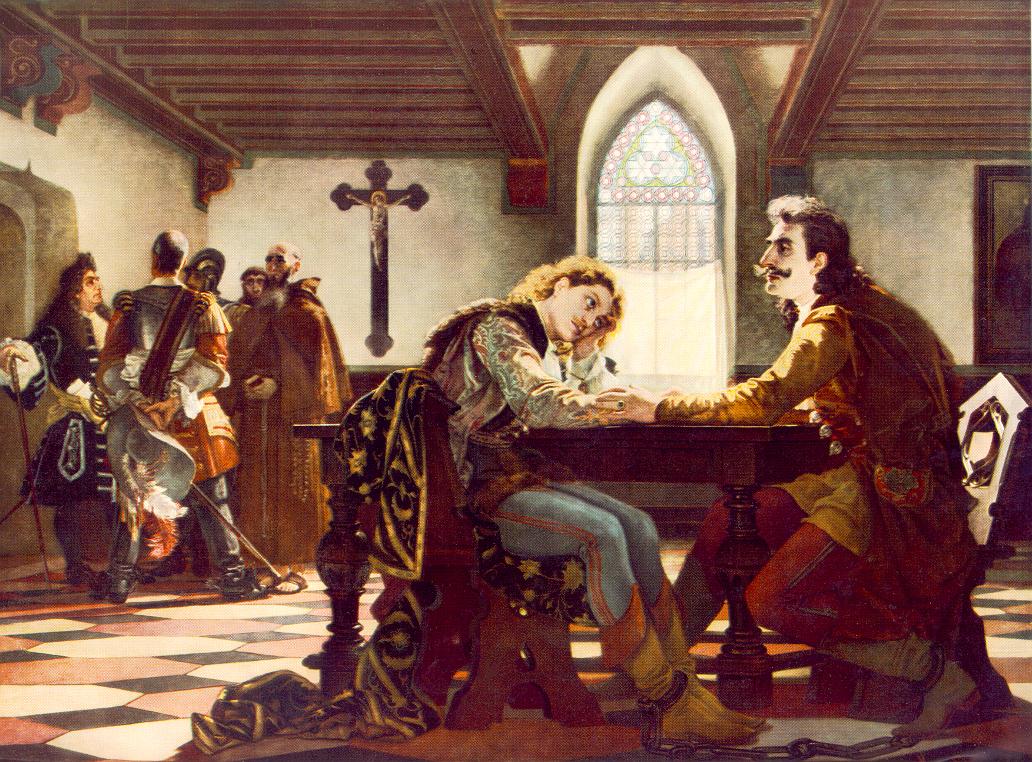
On this date in 1671, Croatian noble Fran Krsto Frankopan and his brother-in-law Petar Zrinski were beheaded by the Austrian empire at Wiener-Neustadt Prison.

The Zrinski-Frankopan Conspiracy — or Magnate Conspiracy — was the product of great powers chess in central Europe … and specifically, of the frustration of these lords in the frontier zone between the Austrian and the Ottoman Empires at being a sacrificial pawn.

Instead, they’d take control of their own destiny and be a self-sacrificial pawn.

Croatia and Hungary had been on the perimeter of Hapsburg authority for generations, and seen the rising Ottomans push well into Europe.

In the latest of innumerable wars, the Austrians had trounced the Ottomans, potentially (so the Croats and Hungarians thought) opening the door for reconquest of lost territory. Croatia in particular had been nibbled away by Ottoman incursions into a “remnant of a remnant.” Emperor Leopold I thought otherwise: he had Great Games to play in western Europe as well and didn’t find this an auspicious moment to go all in in the east.

Rather than following up his victory by trying to run the Turks out of their half of divided Hungary, or out of Transylvania, Leopold just cut an expedient peace on status quo ante terms quite a bit more favorable to Istanbul than the latter’s military position could demand.

The aggrieved nobles started looking around for foreign support to help Hungary break away.

This scheme never came to anything all that palpable, perhaps because the operation’s leading spirit Nikola Zrinski got himself killed by a wild boar on a hunt, and definitely because no other great powers wanted to get involved in the mess.

Zrinski (or Zrinyi) was also a noteworthy Croatian-Hungarian poet, as were the remaining conspirators.

The boar-slain’s younger brother Petar, his wife Katarina, and Katarina’s half-brother Fran Frankopan, also better litterateurs than conspirators, inherited the scheme’s leadership, and its penalty.


Zrinski and Frankopan in the Wiener-Neustadt Prison, by Viktor Madarasz (1864)

Royal vengeance against the plot shattered two mighty noble houses: the Zrinskis were all but destroyed by the seizure of their estates. The Frankopans — an ancient and far-flung family whose Italian Frangipani branch was even then about to yield a pope — were done as major players.

After these executions, anti-Hapsburg sentiment metastasized in Hungary into outright rebellion.

But in what was left of Croatia, the loss of the two largest landholders spelled the end of effective resistance until the era of 19th century romantic nationalism — when our day’s unfortunates were recovered as honored national heroes.

Zrinski and Frankopan are pictured on modern Croatia’s five-kuna bill, and were both reburied in Zagreb Cathedral after World War I finally claimed the Austrian Empire. (They also got memorial plaques in Wiener-Neustadt) Their mutual relation Katarina Zrinski, who avoided execution but was shut up in a convent, was a writer as well, and has ascended to the stars of founding patriotess, seemingly the go-to namesake for most any Croatian women’s civic organization. (Dudes honor the House of Zrinski by slapping the name onto sports clubs.)

On this day..

1916: Joseph Hani, abandoned

“Mr Joseph Hani was hanged for treason in the Burj at 5 a.m. At 8 a.m. 40 families deported.

-Diary of Mrs. Harry Dorman, April 5, 1916*

The unfortunate Joseph Hani — Yusuf al-Hani — was among the worthies of Beirut’s Maronite Christian community to petition the French consulate for western aid in detaching Lebanon from the Ottoman Empire.

With the development of World War I, the French ambassador Francois Georges-Picot abandoned the embassy … without removing or destroying this sort of incriminating correspondence. As a result, the Turks ransacked the embassy and identified several dozen of reproachable loyalty to the Porte to put to death.

May 6 — Martyrs’ Day — honors these victims, but Hani was among the very first of them.

While most of the other Maronite signers were able to fly, Hani stuck around to face the music. A British agent was able to contact the implicated characters in Aley Prison, and received the plaintive answer,

‘Where are the English? Where are the French? Why are we left like this?’

* I believe an ancestor of the current president of the American University of Beirut, Peter Dorman. The source of the diary citation is Nicholas Z. Ajay Jr.’s “Political Intrigue and Suppression in Lebanon during World War I” in International Journal of Middle East Studies, Apr., 1974.

On this day..