1931: Bhagat Singh

I am full of ambition and hope and of full charm of life. But I can renounce all at the time of need, and that is the real sacrifice. These things can never be hinderance in the way of man, provided he be a man. You will have the practical proof in the near future.

Bhagat Singh

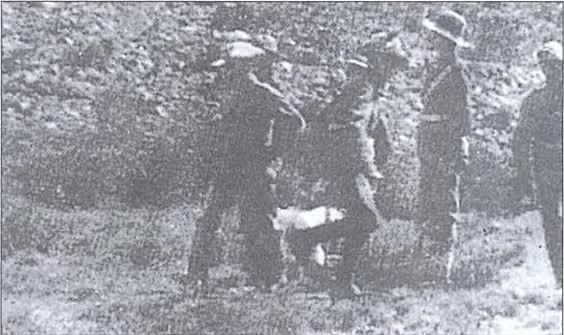
On this date in 1931,* India revolutionary Bhagat Singh was hanged by the British in Lahore, together with Shivaram Rajguru and Sukhdev Thapar. The hanging was surreptitiously done, on the evening before it was officially scheduled, with the men’s cremated ashes scattered into the nearby Satluj River.


Statue of the three March 23 martyrs near Amritsar, Punjab, close to the Pakistani border. (cc) image from Alicia Nijdam.

Though only 23 years of age when he hanged, Singh’s renown as a nationalist freedom-fighter was already considerable. It has not lessened in the intervening decades.

The teenage Singh had participated in Gandhi‘s nonviolent Non-Cooperation Movement, but violent British suppression of independence demonstrations soon had Singh looking for a more energetic response.

Till that time I was only a romantic revolutionary, just a follower of our leaders. Then came the time to shoulder the whole responsibility. … I began to study in a serious manner. My previous beliefs and convictions underwent a radical change. The romance of militancy dominated our predecessors; now serious ideas ousted this way of thinking. No more mysticism! No more blind faith! Now realism was our mode of thinking.

-Singh, from “Why I am an atheist”

Singh issued his definitive reply to British violence in 1929 by exploding a couple of bombs in the subcontinent’s legislative building.**

“It takes a loud noise to make the deaf hear,” read their leaflet, vindicating the (non-lethal) ordnance.

Singh’s arrest, along with a fellow bomb-tosser, was an intended consequence, but the official pursuit of the case against him also led back to Singh’s fellow-revolutionaries and bomb-manufacturers. Some of these were induced to inculpate Singh, Rajguru, and Thapar to the theretofore-unsolved murder of Lahore policeman John Saunders in December 28.

Saunders had been mistakenly assassinated: Singh et al took him for John Scott, a police superintendent who ordered a baton charge against protesters and personally helped beat to death one of the independence movement’s revered fathers.

While the law wrapped its coils about him, Singh led a successful hunger strike for better prison conditions, and kept churning out writing.

His example of sacrificial revolutionary ardor — not to mention his leftist politics — kept him a popular martyr figure for years after his death, all the way down to the present day.


Climactic execution scene from the 2002 Hindi flm The Legend of Bhagat Singh — one of many different cinematic adaptations of his story.

The Shaheedi Mela (Martyrdom Fair) is observed across Punjab each March 23 in honor of these men.

* Not on Valentine’s Day, as a 2011 Twitter hoax claimed.

** Shades of Auguste Vaillant.

On this day..

1902: Gideon Scheepers, Boer guerrilla

Scheepers lives because they shot him.”

-Hermi Baartman, Graaf-Reinet Museum

On this date in 1902, Kommandant Gideon Jacobus Scheepers was shot by the British for his exploits in the Boer War.

The young Dutch-descended Scheepers (here’s his Afrikaans Wikipedia page) was a soldier from the still-independent Boer states which were being reduced in this war to British dependencies.

In 1901, late in the proceedings, Scheepers took a column of irregulars into the British Eastern Cape Province and wrought havoc behind the lines. Some exploits are the stuff of legend, like the time he rode into a town, released all the Boer prisoners, locked up the British magistrate, and hauled down the Union Jack — to the delight of the Boer locals.

He would spend that year giving the British much better than he got, but the war was also infamously dirty.

According to David Harrison’s The White Tribe of Africa: South Africa in Perspective, “Scheeepers’ men also flogged and shot natives who helped the British, looted as well as burned farms, and executed Boer ‘traitors’.”

Was any of that criminal?

Since Scheepers was over enemy lines, the Boers who joined him could be held liable for treason … but that didn’t hold for Scheepers himself. His execution turned on holding these unsavory acts as war crimes: his 30-count charge sheet included seven arsons, seven murders, and various and sundry abuses of prisoners and blacks. Scheepers was really sore about the last; natives were supposed to be kept out of the fighting, but the prisoner very credibly insisted that the ones he “murdered” were under arms as scouts for the British.

“We Afrikaners will never find justice under the English,” Scheepers wrote as a prisoner. “Everything is for the kaffirs.”

(There’s a vociferous defense of Scheepers from a pro-Boer history here, and a more sober one by a London press correspondent here.)


Scheepers is read the death warrant on January 17, 1902 — before Graaf-Reinet townspeople assembled by British orders.

For non-Loyalist Boers and for many throughout the world — the U.S. House of Representatives even moved a resolution calling for Scheepers to be accorded POW status according to the Geneva Convention — it smacked of a setup.


Gideon Scheepers (mostly obscured by his guards) tied to a chair for execution.


Just shot, Gideon Scheepers slumps backward in his chair.

While martyrdom guaranteed Scheepers a lasting legacy, bizarre posthumous turns helped elevate it into legend. When the dead man’s family turned up after hostilities to retrieve his bones, the grave turned out empty, leading to a years-long saga with colorful frauds presenting bogus remains, a mentally ill man doing the Grand Duchess Anastasia act and claiming to be Scheepers, and the actual corpse remaining stubbornly elusive.

The bereaved mother’s ultimately fruitless search for her son’s final resting place inspired the poem “Gebed om die Gebeente”(“Prayer for the Bones”), by D.J. Opperman. (Here’s a translated version.) That verse was recently set to music as a cantata by composer Hendrik Hofmeyr.

Scheepers’ allies, however, had simply been beaten in the field. On May 31, 1902 they capitulated to the British.

If we are asked why in 1978 a memorial should be erected for a man who died in 1902, then the answer is simple. The life and work of this man was such that history placed him in the heroes’ gallery and nothing and no one can deprive him of that place.

-Nationalist Prime Minister John Vorster upon the unveiling of a Scheepers monument

This interesting “On the Trail of Gideon Scheepers” series has a detailed and richly illustrated narrative of the man’s final year.

On this day..

1999: Recak Massacre

(Thanks to Meaghan Good of the Charley Project for the guest post. -ed.)

On this day in 1999, Serbian militants killed approximately 40 to 45 Kosovo Albanians near the village of Reçak in Kosovo. The victims allegedly included a twelve-year-old boy and at least one woman.

Depending on who you listened to, it was either a massacre against innocent civilians, or a military action against guerillas.

The New Kosova Report, adopting the former point of view, summarizes in a 2008 article:

In the early morning of 15 January, 1999, forces from Serbian Interior Ministry (MUP) and Yugoslav Army (VJ) moved into the village with tanks and began to shoot at houses sheltering civilians. After ransacking all the houses, they gathered 28 Albanian men and boys and ordered them to head towards a hill outside the village for questioning. There they were sprayed with machine guns and 23 of them died. Only five survived by pretending they were dead. Another 22 people were shot and/or decapitated at different places in the village. Some in a ravine behind the village, while others in front of their houses.

A local villager named Shefqet Avida gave photographer and BBC Radio reporter Melanie Friend an account which was later quoted in Friend’s book No Place Like Home: Echoes from Kosovo.

Policemen — Serbs — were hiding here, expecting them. I heard the Serbs saying, “Anyone under fifteen years old, don’t touch, but upwards of sixteen or seventeen years old, just kill them …” The people, when they were captured here, were made to stay in line, and every one of them was shot, and after that with a … very nice knife … they took eyes from the faces and hearts from the chest, and the Serbs later said, “That’s not true, we didn’t do that,” the mice, they’d eaten them. […]

Serbian police were shooting until four or five in the afternoon. When the observers arrived in the morning, we went with them to see the place where the people were murdered. Three of us stayed here all night to guard the bodies. […] Thirteen members of my family were killed there.

The Serbs denied having murdered civilians and claimed all those killed were all Kosovo Liberation Army fighters, shot during a skirmish with Serbian forces. To this day, many maintain the entire thing was staged, a hoax set up by the KLA in order to get support for their side.

Trying to sort the matter out, the European Union dispatched forensic experts to the scene from Finland. Helena Ranta, one of the experts, concluded that “There were no indications of the people being other than unarmed civilians.” When her opinion was broadcast in a press release, many mistook it for being the opinion of the entire group of scientists.

The Finns’ official report, however, has never been released. Dr. Ranta, a forensic dentist, later accused officials from the Ministry for Foreign Affairs of pressuring her to go against the Serbs.

Yugoslav and Belarusian scientists also examined the bodies and said they believed all the dead were KLA combatants. In response, critics blasted them for using allegedly out-of-date and unscientific testing methods.

News of the killings made headlines all over the world and incited NATO to finally get involved in the war. A couple of years later, Yugoslav dictator Slobodan Miloševic was brought up on war crimes charges; ordering the Reçak killings was one of them. It was later removed from the indictment for lack of evidence, however. (Miloševic died before his trial was concluded.)

In 2001, a Kosovo Serb police officer was sentenced to fifteen years in prison for participating in the killings. Outside observers, including the United Nations and Amnesty International, criticized the trial proceedings, accusing the Kosovo war crimes tribunal of ethnic bias and politically motivated decision-making. As of this writing, no one else has been called to account for what happened in Reçak.

On this day..

1872: Du Wenxiu, Panthay rebellion leader

On this date in 1872, China’s Panthay Rebellion came to an end with the surrender, suicide, and execution — in that order — of Du Wenxiu.

The Panthay Rebellion (also known as the Du Wenxiu Rebellion) was one of several cataclysmic revolts to shake foundering imperial China in the 19th century.

This one was centered in the city of Dali (also known as Talifoo) in the southeastern Yunnan Province, near the Burmese border.* The rebels in question were the Hui people, a predominantly Muslim ethnic group who had been pushed around for years by Qing officials and by the ethnic Han.

The backstory of Han-on-Hui ethnic cleansing in the 1840s makes for harrowing reading, lowlighted by the 1845 massacre of 8,000 Hui in Baoshan.

An even more ambitious operation in May 1856 went down in Kunming, where a massacre — Qing officials publicly posted a directive to “kill [the Hui] one and all”** — claimed several thousand more and razed the city’s mosques. This outburst spawned an attempt at wholesale ethnic cleansing throughout the province … but that attempt blew back on its perpetrators by triggering a rebellion that would require a generation to tame.

The unexpected tenacity of Hui resistance was multiplied by the disadvantages for the Chinese state of operating in a distant and mountainous territory, and its preoccupation with the much larger simultaneous Taiping Rebellion. Though these considerations were not sufficient to dissuade local officials from picking the fight in the first place, they would help them come to regret it.

Hui resistance quickly coalesced into an organized rebellion, and that rebellion overran Dali by the end of the year, establishing itself as the seat of an independent kingdom called Pingnan Guo. Meanwhile, the onset of the Second Opium War left China incapable of contemplating a reconquest.

Du Wenxiu, the half-Han Islamic convert rebel leader acclaimed Sultan Sulaiman of Dali, was therefore left with some operating room to establish a Hui state. He led a pluralistic nation (for the Hui themselves were and are a pluralistic identity) in the western half of Yunnan, stretching from the Tibetan frontier almost to Kunming. (They came close but never quite managed to take this city).

Alas, in due time and with sufficient stability elsewhere in China the Pingnan state came under withering attack from the late 1860s. It sought help from the British as a potential foil against Chinese power, but the aid was not forthcoming and probably would have been too little and much too late. The Pingnan / Panthay / Hui state

ended much as it had begun — in a bloody massacre of the Hui populace. On 26 December 1872, imperial troops surrounded Dali, the Pingnan capital. Du Wenxiu, in a move that he hoped would spare the lives of the city’s residents, made the decision to hand himself over to the Qing general. Swallowing a fatal dose of opium as his palanquin carried him to the Qing encampment, Du was already dead by the time that he was delivered to the Qing commander. Not to be robbed of the gratification of killing him themselves, Qing officials hastily dragged Du before the Qing troops to be decapitated.† According to Emile Rocher, a French adviser to the provincial officials in Yunnan at the time, Du’s head was encased in honey and sent to the emperor.

Du’s sacrifice, however, was in vain. Three days later, imperial troops began a massacre that, according to the government’s own conservative estimates, took ten thousand lives by the time it was concluded — four thousand of the victims were women, children, and the elderly. Hundreds drowned trying to escape from Dali by swimming across Erhai Lake. Others attempted to flee through the narrow passes at either end of the valley. All were chased down and slain by the Qing troops. The imperial soldiers were ordered to cut an ear from each of the dead. These grisly trophies filled twenty-four massive baskets and, together with Du’s severed head, were sent to Beijing, where they served as a silent and unequivocal corroboration of the Pingnan regime’s bloody demise.**

Du Wenxiu was within living memory when the Qing themselves fell; shortly after that happened, an honorary tomb was constructed for the martyred rebel outside Dali.

* “Panthay” is a Burmese word for Chinese Muslims.

** David Atwill, “Blinkered Visions: Islamic Identity, Hui Ethnicity, and the Panthay Rebellion in Southwest China, 1856-1873,” The Journal of Asian Studies, Nov. 2003. This article and/or Atwill’s book (review) on the same subject appear to be the ultimate source of nearly every accessible English resource on the Panthay Rebellion.

† According to the London Times (Aug. 27, 1873) the aides and litter-bearers who accompanied the dying Du to the Qin camp were also beheaded for their troubles. It ballparks the ensuing butchery at 40,000 to 50,000 souls.

On this day..

1932: Yoon Bong-Gil, nationalist assassin

On this date in 1932, the Japanese shot Korean Yoon (or Yun) Bong-Gil for bombing a parade dais in Shanghai.

A parade to celebrate the emperor’s birthday may be standard enough fare on the home front, but in a China being swallowed by said emperor’s empire it was a provocative act.

In the first months of 1932, Japan had merrily exploited — or incited — anti-Japanese incidents in Shanghai as pretext for an imperialist mini-war, won handily by Japan.

When the aggressors presented their celebratory pageant of arms in the city’s Hongkou Park (today, Lu Xun Park), our young Korean terrorist* “threw a narrow tin box high in the air. In an ear-splitting roar, the grandstand flew apart like a mechanical toy.” (Time magazine, excerpted in this useful Axis History Forum thread.) All seven of the Japanese VIPs on the dais were casualties, and two of them died: one instantly and another succumbing to his injuries a month later.

“A young Korean patriot has accomplished something tens of thousands of Chinese soldiers could not do,” remarked an admiring Chiang Kai-shek. Coming just months after another Korean activist had taken a whack at Hirohito in Tokyo, the generalissimo couldn’t help but appreciate his brothers in resisting colonization.

For this accomplishment Chiang would later go to bat for postwar Korean independence. But for his part, the patriotic Yoon got only a free trip to Japan for military trial and execution.

When calling in Seoul, drop by a well-appointed memorial hall dedicated to Yoon’s memory … or, at the national cemetery where Yoon’s remains were repatriated in 1946.

You’ll find another subtle memorial to this incident in pictures from the decks of the USS Missouri, where a Japanese delegation surrendered to end World War II on September 2, 1945. Leading the delegation is a distinguished gentleman with a top hat and a cane: it is Mamoru Shigemitsu, walking with an artificial leg thanks to Yoon Bong-Gil’s bomb 13 years before.**


Mamoru Shigemitsu aboard the USS Missouri.

* Note: calling Yoon Bong-Gil a “terrorist” is controversial in Korea. We use the word without moral censure.

** Mamoru Shigemitsu had been Japan’s ambassador to China at the time of the assassination bid.

On this day..

1715: Four Jacobites including George Lockhart’s brother

On this date in 1715, four Jacobites who had participated in the 1715 Jacobite rising were shot together at Preston.

These executions came in the aftermath of the Battle of Preston, with the Jacobite cause in full collapse. It was an affecting scene, the first of many among the Preston captives.

After [Major John Nairn] was shot, Captain Lockhart would not suffer any of the common soldiers to touch his friend’s body, but, with his own hands and the help of the other two gentlemen [about to be executed], laid Major Nairn in his coffin, and, with the greatest composure of mind, performed the last offices to his dear companion: After which, he was shot, and the other two performed the like to his body.

Then the others [John Shaftoe and John Erskine] were shot, and laid together, without a coffin, in a pit digged for that purpose. Which tragical scene being thus finished, Mr. Nairn and Mr. Lockhart were decently buried. (Source)

False Equivalent

The “Captain Lockhart” named here was Philip Lockhart, brother to anti-unionist politician George Lockhart.* George Lockhart, years before, somehow ended up on the committee whose job it was to hammer out the terms on which that union would take place.

As a result, Lockhart’s memoirs record an inside look at the tawdry payoffs that roped Scottish elites into the union arrangement — beginning first of all with “the Equivalent”, a massive British inducement to Scottish lords who had lately gone comprehensively bust gambling on the dot-com scam of New World colonization, the Darien scheme.

the Equivalent was the mighty Bait; here was the Sum of 398,085 Pound Sterling to be remitted in Cash to Scotland (tho’ the Scots were to pay it and much more back again in a few Years, by engaging to bear a Share of the Burthens impos’d on England, and appropriated for Paymnt of England’s Debts.) … here was a swinging Bribe to buy off the Scots Members of Parliament from their Duty to their Country, as it accordingly prov’d: For to it we may chiefly ascribe, that so many of them agreed to this Union. The Hopes of recovering what they had expended on the African Company, and obtaining Payment of Debts and Arrears due to them by the Scots Government (it being articled in the Treaty, that it should be expended this Way) prevail’d upon many to overlook the general Interest of their Country.

Just Deserts

This, however, was not the reason that Philip et al were first in line for punishment after Preston. Instead, they were in trouble because they were British officers who had deserted.

At least, that was the crown’s position. As a legal matter, it wasn’t quite that simple: the “deserters” weren’t on active duty, but rather, were half-pay officers.

This ambiguous category had been introduced as a sort of reserve system to keep idled officers available to the army, but developed into a general dumping-ground of incompetents, invalids, and retirees (half-pay could be used as an ad hoc pension) in an army still only semi-professionalized. Moreover, according to Margaret Sankey, the system

was thoroughly corrupt by 1715. Much of the half-pay list was made up of men who were unfit to be called back into active service, while many of the commissions had been sold to brokers for an immediate cash settlement … [some officers] saw half-pay as a well-deserved personal gift from Queen Anne for … service under Marlborough, and one that carried no obligations to the current monarch whatsoever ‘as no more than a gratuity and a reward for the hazards they had run and the fidelity they had shewn their late mistress.’

It was also a period of dynastic turnover: six different monarchs representing three different houses had ruled England/Great Britain in the preceding 30 years, each man or woman coming to the throne under contestable circumstances. Various gentlemen-officers had sworn various oaths to various entities and they in good faith did not necessarily consider those blanket oaths transferable to the new “British” state and to every Tom, Dick, and German elector who styled himself king of it.

Martial Prowess

These neither-fish-nor-fowl soldiers, then, presented a delicate jurisprudential question. No less a personage than the Lord High Chancellor suggested back in Privy Council that, since half-pay officers would not be eligible to sit on a court-martial jury, they must likewise not be eligible to be court-martialed.

The plurality of the government, and certainly the military, saw it otherwise.

Nevertheless, all concerned were constrained not to be entirely indiscriminate. Of six men prosecuted, the one who was able to prove that he had “thrown up” his half-pay commission walked altogether: he’d been in rebellion, but he hadn’t deserted to do it. Another defendant, who threw himself on the court’s mercy rather than trying to parse a half-reason why half-pay licensed his revolt, received that mercy. (It didn’t hurt that that one was also the child of a (loyal) duke.)

The rest of the lot was abandoned to its fate, leading the correspondent who recorded the particulars of their execution concluded to conclude,

this is a swatch of the usage people may expect that fall into some men’s clutches, from whom all good Christians and true Scotsmen should fervently pray, that God, out of his infinite goodness and mercy, would deliver every honest man!

* These Lockharts were sons of the Scottish judge George Lockhart whose senseless 1689 murder we have previously noticed.

On this day..

1938: Corneliu Codreanu, Romanian fascist martyr

“In place of the weak and beaten man who bends with every breeze, a man who is all too common in politics and other fields, we must create for this nation a man who does not bend, who is inflexible.”

-Corneliu Codreanu

On this date in 1938, 14 political prisoners of the Romanian Legionary movement were extrajudicially executed — including Corneliu Codreanu, one of the Romanian right’s leading spirits.

The son of a Bukovina schoolteacher in what was then Austria-Hungary, Codreanu came to political maturity in the interwar heyday of Greater Romania. It was a moment of national aspiration — the Romanian state had never before grown so large — but it was abutted by the great threats of Germany and Russia, and haunted by nationalism, economic crisis, shaken political authority, and all the other spooks conjured by the first World War.

For Codreanu as for many at that time it was the stage for a blood-and-soil death struggle against Communist agitators and sinister Jewish financiers.

But his vision was an intensely positive one as well: a valiant new Romania founded by a courageous new man, honorable and true to the virtues of the nation’s noble peasant stock. “We shall create,” Codreanu declared, “a spiritual atmosphere, a moral atmosphere, in which the heroic man may be born and on which he can thrive.”

Codreanu’s vehicle for stamping out these heroic countrymen was the Legion of the Archangel Michael* which our principal founded in 1927. Named for God’s ass-kickingest enforcer, this movement/militia was not above creating its spiritual atmosphere with political assassinations by adherents widely noted for a willingness to die for the cause.

Later known as the Iron Guard, the Legion, in the view of German historian Ernst Nolte, “plainly appears to be the most interesting and the most complex fascist movement, because like geological formations of superimposed layers it presents at once both prefascist and radically fascist characteristics.” (Qutoed here.)

As his Legion’s name suggested, Codreanu was intently religious — virtually a mystic, and a messianic Romanian Orthodox Christianity was essential to his new Romania. His movement took root in a peasant society, not an industrial state with a revolutionary working class to crush or co-opt. Rather, it organized in opposition to a mediocre king and a feckless, heavily non-Romanian oligarchy which maintained its enervating grip on the nation with “endless appeals to the Fatherland which it does not love, to God in whom it does not believe, to the Church where it never sets foot, to the Army which it sends to war with empty hands.”*

And also to the police, which clapped Codreanu and his confederates in prison after the revolutionaries declined the elite incumbents’ offer of political collaboration.

In 1938, Codreanu was hit with a long prison sentence for sedition. Uncowed, the Legion grew ever more overtly aggressive when Nazi Germany successfully dismembered Czechoslovakia; Berlin made the Legions plainly aware that it saw their movement as Romania’s future, German-allied government. Futilely maneuvering for his own scope of action, Carol attempted to decapitate the Iron Guard by having its imprisoned leadership “shot while trying to escape” on this date.

This did not turn out to help the king. Codreanu’s movement traded stripe for stripe with its foes; within two years, Carol had been forced to abdicate and the Iron Guard helped govern (albeit with tension) a fascist state.

The contemporary Romanian right aggressively reclaimed Capitanul, “the Captain”, after the fall of communism. Codreanu is now revered among not only among Romanian nationalists but in fascism’s wider populist Strasserite tradition. (Gregor Strasser, who liked the socialist part of national socialism too much for Hitler’s taste, was among those murdered on Nazi Germany’s Night of the Long Knives.)

* Eugen Weber in Varieties of Fascism, quoted by Anthony James Joes in “Fascism: The Past and the Future,” Comparative Political Studies, April 1974

On this day..

1867: The Manchester Martyrs

On this date in 1867, three Fenians hanged for the murder of a Manchester policeman.

They were the Manchester Martyrs — Michael O’Brien, William Philip Allen and Michael Larkin.

“Who were they?” an admiring James Connolly later asked, rhetorically.*

Two members of the Fenian organisation -– Kelly and Deasy –- were trapped in Manchester, and lay awaiting trial in an English prison. The Fenians in that city resolved to rescue them. [Manchester was a hotbed of Irish radicalism -ed.] This they did by stopping the prison van upon the road between Manchester and Salford, breaking open the van, shooting a policeman in the act, and carrying off their comrades under the very eyes of the English authorities.


Marker on the spot of the ambush that started all the trouble. (cc) image from Tom Jeffs.

Out of a number of men arrested for complicity in the deed, three were hanged. These three were ALLEN, LARKIN and O’BRIEN –- the three Manchester Martyrs whose memory we honour today.

There were actually five in all selected to stand trial for their lives for what the British dubbed the “Manchester Outrage”; although all five were condemned to swing, one received clemency and a second was pardoned outright since the evidence against him was soon proven to have been entirely perjured.

Indeed, all five of the men asserted their innocence in the shooting even when they acknowledged joining the crowd attempting to free their brethren.

But they, and especially their partisans, were still more energetic asserting the Fenian cause from the platform afforded by the legal antechambers to the scaffold. “God save Ireland!” they cried at several dramatic points in the trial — and these words titled a beloved patriotic tune in the martyrs’ honor.

The British, basically, freaked at the effrontery of an Irish mob hijacking a police wagon, making Fenian as dirty a word among the Anglo respectable as terrorist is today, and stampeded the case to judgment without dithering overmuch about fine points like meticulous investigation. While respectable liberals could (and did) make the clemency case on grounds of actual innocence, the right-thinking were scandalized by Irish marches in overt support of Fenianism.

“These Irish are really shocking, abominable people,” Queen Victoria wrote privately to one of the government’s Tory cabinet members. “Not like any other civilized nation.”

So it was a bloodthirsty rabble, baying and not a little drunk, that gathered outside the walls of Manchester’s New Bailey Prison to see Allen, Larkin, and O’Brien hang** for their abominableness. This lot also happened to witness the last public hanging in Manchester; England shifted to private executions the next year.

But these by no means represented everyone in Manchester.

The very week of the Fenian ambush, a philosopher had dropped in to Manchester to visit a local industrialist. These were, granted, not Englishmen but Germans. Still, Karl Marx and Friedrich Engels were keenly interested in the Fenian cause.

Marx exhorted English workers, now and over the years ahead, to make common cause with Fenianism; he apparently authored this clemency appeal for the Manchester Martyrs sent by the First International. The very day after the execution, Engels — our Manchester industrialist — compared the martyrs to John Brown and prophesied that the hangings “accomplished the final act of separation between England and Ireland.” (See Marx at the Margins: On Nationalism, Ethnicity, and Non-Western Societies)

These martyrs have stood the test of time, in part because Engels’ prediction (more or less) came to pass. But we think it’s their countryman Connolly whose epitaph rings truest — the summons three men in Manchester issued posterity to stand against monstrous edifices as “unyielding foes even to the dungeon and the scaffold.”

We honour them because of their heroic souls. Let us remember that by every test by which parties in Ireland to-day measure political wisdom, or personal prudence, the act of these men ought to be condemned. They were in a hostile city, surrounded by a hostile population; they were playing into the hands of the Government by bringing all the Fenians out in broad daylight to be spotted and remembered; they were discouraging the Irish people by giving them another failure to record; they had no hopes of foreign help even if their brothers in Ireland took the field spurred by their action; at the most their action would only be an Irish riot in an English city; and finally, they were imperilling the whole organisation for the sake of two men. These were all the sound sensible arguments of the prudent, practical politicians and theoretical revolutionists. But “how beggarly appear words before a defiant deed!”

* Connolly was observing the anniversary of the men’s death in 1915, which was the same anniversary a 13-year-old Kevin Barry began his own path to future martyrdom by attending a Manchester Martyrs memorial.

** Hanged badly. Notoriously erratic hangman William Calcraft only killed Allen on the drop; descended the gallows to help Larkin along; and was denied access by O’Brien’s confessor, who said he held that strangling man’s hand full 45 minutes until he finally succumbed.

On this day..

1802: Jacques Maurepas and his entire family

On this date in 1802, a Haitian general, his family, and his men, were butchered by French forces fighting to retain control of Saint-Domingue.

Haing recently mastered the French Revolution, Napoleon Bonaparte — ever one for keeping it in the family — late in 1801 dispatched his brother-in-law* and brother-in-arms Leclerc to suppress the Haitian Revolution.

Over the course of 1802, Leclerc made headway towards accomplishing just that, as much with carrots as with sticks.

Maurepas was one of the Haitian commanders tasked by Toussaint L’Ouverture with defending Saint-Domingue, in his case, Port-de-Paix. Faced with a French landing, Maurepas burned the town to the ground and withdrew for an effective guerrilla resistance in the mountains.

But he eventually came to terms with the French, as did other Haitian officers, L’Ouverture included — reintegrating forces back with the French on the understanding that all that liberte, egalite, fraternite stuff would at least extend as far as not reintroducing slavery.

The French had other plans for their lucrative once-and-future colony, and when the Haitians caught wind of them, trouble resumed — now under the leadership (since the French had sagely deported L’Ouverture) of Jean-Jacques Dessalines.**

Leclerc had the, er, “fortune” of succumbing to yellow fever shortly after Dessalines’ promising revolt got underway; he was succeeded by the brutal Rochambeau, who threw away the carrots and relied on naked violence to control the island. (Again, not uncharacteristic of Napoleonic conquests.)

Maurepas had not actually gone over to Dessalines, but the fact that he was a black Haitian general was reason enough for his white French superior officer to arrest him preventively. Immediately upon assuming command, Rochambeau made an example of Maurepas.

The sea off the Cape was chosen to be the theatre of an execution, unparalleled in what is called civilized life. For fear that Maurepas, who had gained distinction under Toussaint L’Ouverture, after having embraced the side of France, should join the insurgents, Leclerc had written to him to come by sea, with his family and his troop, to take the command of the Cape, which he destined for him as a reward for his services. No sooner had he arrived than he and his soldiers were seized and disarmed. Rochambeau ordered preparations to be made for a barbarous punishment in order to put the negro general to death, with his troop, consisting of 400 blacks. It was also put in deliberation whether death should be inflicted on his children, in order to prevent them from rising up to avenge their father.

After having been bound to the mast of a vessel, Maurepas was frightfully insulted. His wife, his children, and his soldiers were brought to be drowned under his eyes. The executioners were astounded when they beheld a father fix his dying eyes by turns on his children, his wife, and his companions in arms, undergoing a violent death; while they, on their part, turned their eyes away from a father, a husband, a general, whose countenance was disfigured by the tortures he was enduring. After being made to contemplate each other’s sufferings, they were all tossed into the ocean. They died without complaining in a manner worthy the champions of liberty. With a reversal of the order of nature, the father died last; he also suffered most.

Thus died Maurepas, whose character was a compound of frankness and severity. Thrice had he repulsed the French at the gorge of Trois-Rivières; he had at once the glory and the misfortune to go over to the French with victorious arms. The elevation of his soul equalled his valor. He preserved a tender feeling for the master whose slave he had been; he caused funeral honors to be paid to that master, and when his grave had been negligently prepared, he threw off his upper garment in order to perform the pious office properly. Among men of his own blood he was a powerful chief. A spirit of order and justice prevailed in his life. His riches, which were considerable, were given up to pillage. It would almost seem as if so much excellence were subjected to so much ignominy, expressly to show that while black men are capable of any virtue, white men are capable of any crime. Certainly, my narrative is replete with instances which, beyond a question, prove that moral as well as mental excellence is independent of the varieties of color.

This brutal punishment, preceded by vile perfidy, filled the camps of the insurgents with horror. That horror was augmented when Rochambeau, at the Cape, put to death five hundred prisoners. On the place of execution, and under the eyes of the victims, they dug a large hole for their grave, so that the poor wretches may be said to have been present at their own funeral.

Far from cowing the rebels into submission, this savagery fired more ferocious resistance from men, women, and children who now perceived that their race subjected them to wholesale and arbitrary cruelty that no display of loyalty could overcome.

A terrible retribution was determined upon. Dessalines erected 500 gibbets, and hanged half a regiment of French that he had captured by a bold countermarch. A war of extermination followed, and in December, 1803, aided by an English squadron, the French were compelled to evacuate the island.

January 1, 1804 is Haiti’s Independence Day.

* By way of marriage to Napoleon’s sister Pauline. Pauline enjoyed the Saint-Domingue adventure more than did her spouse; she sported with lovers and balked at returning to France. “Here,” she noted, “I reign like Josephine; I hold first place.”

This character is the subject of a recent biography.

** After expelling the French and becoming the first ruler of independent Haiti, Dessalines took a page from Napoleon’s own playbook and crowned himself Emperor.

On this day..

1803: Thomas Russell, the man from God knows where

On this date in 1803, Irish revolutionary Thomas Russell was hanged at Ireland’s Downpatrick Gaol.

Russell was such a republican original gangster that as a young junior officer in the British army in the late 1780s, he refused to eat sugar because it was the product of the empire’s slave plantations. (Hardly a bygone issue.) And while his own family was Anglican, Russell was also a staunch supporter of the then-radical (to Anglicans) position of Catholic equality.

For Russell, this personal stuff was all most intently political. And his politics in no way ended with the dumbwaiter.

After leaving the army, he fell in with Irish separatists and in 1795 co-founded the United Irishmen movement, along with a lot of other guys who would wind up in these executioners’ annals. He joined Henry Joy McCracken, Wolfe Tone, and Samuel Neilson in a convocation of Celtic martyrs atop Belfast’s Cave Hill to pledge one another “never to desist in our effort until we had subverted the authority of England over our country and asserted her independence.”

Subversion was Russell’s game for the remaining years of his life; his Letter to the People of Ireland unveils a Tom Paine-like vision of a revolutionary world — a world that the ancien regime would remain violently vigilant against in the wake of the recent French example. Like many of the most dazzling egalitarian dreams of that insurrectionary moment at the end of the 18th century, it’s still never been realized.

Great pains have been taken to prevent the mass of mankind from interfering in political pursuits; force, and argument, and wit, and ridicule, and invective, have been used by the governing party, and with such success, that any of the lower, or even middle rank of society who engage in politics, have been, and are, considered not only as ridiculous but in some degree culpable … Those insolent enslavers of the human race, who wish to fetter the minds as well as the body, exclaim to the poor, ‘mind your looms, and your spades and ploughs; have you not the means of subsistence; can you not earn your bread … leave the government to wiser heads and to people who understand it, and interfere no more!’

-Russell, Letter to the People of Ireland

Russell actually spent most of his final decade imprisoned without trial while tragic Irish insurrections came and went. England finally released him to Hamburg in 1802, and as might be expected, Russell was so itchy by then to get back in the scrap that he immediately broke his parole to return to Ireland for the next available rising.

And as also might be expected, he showed more haste than discrimination in his project. Hey, he did vow “never to desist.”

He joined up with Robert Emmet‘s rebellion — another doomed patriot; Russell was his designated organizer of the north — but found little success canvassing for potential rebels and took the field on July 23, 1803 in a gesture of little more than hopeless romanticism. His band fell apart and fled without a shot fired.


Memorial plaque in Downpatrick commemorating Russell’s execution. (cc) image from Ardfern.

The British did what the British always did and hunted down the Irish rebel, while the Irish did what the Irish always did and stuffed his remains in a ballad.* It’s called “The Man from God Knows Where” — and God knows, two centuries later, where that man has gone.

Whiles I said “Please God” to his dying hope
And “Amen” to his dying prayer,
That the Wrong would cease and the Right prevail.
For the man that they hanged at Downpatrick Jail
Was the Man from God-knows-where!

Peter Linebaugh, author of the indispensable scaffold social history The London Hanged, surveyed Russell’s life and times on the occasion of his 200th death-day here

* Russell tried his own hand at verse, and some Jacobin lines in his hand helped to hang him, e.g.

Proud Bishops next we will translate
Among priest-crafted martyrs;
The guillotine on Peers shall wait,
And Knights we’ll hang in garters;
These Despots long have trod us down,
And Judges are their engines;
These wretched minions of a crown
Demand a people’s vengeance.

Part of the Themed Set: Illegitimate Power.

On this day..