1816: Camilo Torres, Manuel Rodriguez, and other leaders of independent New Granada

On this date in 1816, Spain hanged the leaders of a breakaway former New World possession in a vain effort to maintain control of what is now Colombia.

The United Provinces of New Granada was la Patria Boba, the “foolish fatherland” of Colombia: a welter of rival provinces and municipalities which capitalized on the mother country’s fall to Napoleon to declare independence and immediately commence fratricidal civil war.

The United Provinces had leave of several years for this foolishness before the Peninsular War ended with the restoration of Ferdinand VII, who promptly dispatched a massive expedition under the notorious command of Pablo Morillo to bring these disobedient satellites to heel … and to hemp.

The gentlemen whose death-day we commemorate today were the ones at the seat of government when the music stopped playing. Those positions, and even the forms of government itself, had been regularly reshuffled in the Patria Boba as federalist and anti-federalist, republican and royalist, threw their respective weights (and armies) around.

Morillo, who is still infamous in Colombia for his cruelty, had the most weight of all.

As Morillo’s reconquista invaded the Provinces, Camilo Torres (English Wikipedia page | the much more detailed Spanish) resigned the presidency. Torres is best-remembered now as the author of the Memorial de Agravios (Spanish link; it translates as “Memorial of Grievances” or, more Office Space-ishly, “Memorandum of Grievances”).

This incendiary document prophetically insisted that

the union between America and Spain [rest on] the just and competent representation of its people, without any difference among its subjects that they do not have because of their laws, their customs, their origins, and their rights. Equality! The sacred right of equality. Justice is founded upon that principle and upon granting every one that which is his.

-Memorial de Agravios, as translated in The Independence of Spanish America, by Jaime Rodriguez

Stuff like this was liable to get you on Morillo’s enemies list political office or no; cowing — or killing — seditious intellectuals was part of his whole project.

Torres, his predecessor and vice president (same guy) Manuel Rodriguez, and several other ministers of state were nabbed together trying to make an escape to sea.

Morillo had them subjected to a snap trial, and Torres and Rodriguez were executed this date along with Pedro Felipe Valencia (Spanish link) and Jose Maria Davila; simultaneous property confiscation left the men’s survivors penniless. (Later, Simon Bolivar would personally support the widow Torres.)

Once hemp got through with the necks this day, old-fashioned blades did their redundant work: Torres’s head was hewed off and mounted in Bogota for public viewing.

It’s noteworthy that the author of this sort of nasty warning to the public would later sign his name opposite his New World antagonist Simon Bolivar in a Treaty of Armistice and Regularization of War (more Spanish) undertaking to stop murdering prisoners and non-combatants and fight only “as do civilized peoples” — one of the seminal documents in the development of human rights and the law of war.

Spanish speakers may appreciate this timeline site on the life and times of Camilo Torres.

* Torres, that Colombian Tom Paine, took some overt inspiration from the recent American Revolution, arguing that “to exclude the Americas from such representation … would forever alienate their desires for such a union.” After all,

If the English government had taken such an important step, perhaps today it would not rue the separation of its colonies. But a feeling of pride and a spirit of vanity and superiority led to the loss of those rich possessions.

On this day..

1941: Nguyen Thi Minh Khai, Indochina Communist cadre

On this date in 1941, Vietnamese Communist cadre Nguyen Thi Minh Khai was shot as an anti-France insurrectionary.*

Khai (Vietnamese Wikipedia page | English) surely fit the description: she was a leader of the Indochinese Communist Party in the 1930’s, working directly with Ho Chi Minh in his Hong Kong exile. She would return in 1936 to the city later named for that redoubtable revolutionary as its ranking agitator.

Khai, the most famous of the Indochinese Wars’ vast ranks of women fighters, would marry fellow revolutionary Le Hong Phong, the chairman of the party, who died in prison in 1942. Khai’s sister’s marriage made Khai sister-in-law to the revolution’s military lion Vo Nguyen Giap.**

But her prominent position also made her a target.

Arrested by the French late in 1940, she was tortured and condemned to death. She was shot with other cadres, shouting last words that the decades yet to come would pretty well vindicate.

Long live the Communist party of Indochina. Long live the victorious Vietnamese revolution. (Source)

Readers whose Vietnamese is stronger than mine — i.e., extant in any form whatsoever — might get something out of this video:

As a national heroine, Nguyen Thi Minh Khai is the namesake of any number of public spaces in Vietnam, like schools and roads.


Paradoxical historiography: the street address visible to the right of the photo brands a revolutionary name onto an upscale coffee shop in Ho Chi Minh City. (cc) image from Lawrence Sinclair.

* Some sources give an April 1941 execution date, particularly April 25. I believe this may actually be the date Khai was condemned. There are also some sources indicating a guillotine execution; though the guillotine was certainly available, the bulk of the sources seem to say that Khai was shot.

** Giap is still going strong after all these years; he just turned 100 a few days ago. Khai’s sister was not as lucky; she died in French custody at the prison American pilots would later refer to as the “Hanoi Hilton”.

On this day..

1947: Three Jewish terrorists and two British hostages

On this date in 1947, three members of an Irgun commando team who had engineered a massive prison break of Zionist terrorists were hanged for the affair.

The Acre Prison Break was a meticulously coordinated operation by the Zionist underground in British Mandate Palestine that, a Conservative MP later charged, “reduced British prestige to a nadir.”

A team of guerrillas attacked the prison from the outside, coordinating with imprisoned Irgun and Stern Gang operatives who had explosives smuggled into their cells to help detonate their way through the walls. Hundreds of prisoners — most of them Arabs availing the opportunity — escaped.

According to the London Times (May 6, 1947), 16 escaping prisoners were slain in the affray, with eight British guards and police wounded.

More crucially for our purposes, five of the guerrillas who assailed the prison were captured. Three — Haviv Avshalom, Yaakov Weiss, and Meir Nakar — were taken armed, and sentenced to death by the British.

To browse the contemporaneous western press coverage is to visit a Holy Land very familiar to the present-day reader, filled with “terrorists” and “extremists” and “fanatics” and “murderers” abetted by “those who incite them from a safe distance and supply the funds and the weapons which they put to such deadly use.”* Except that this discourse was directed at Jews, not Arabs.

One good way to earn such an imprecation would be to kidnap two British soldiers and hold them hostage against the execution of the sentence. That’s exactly what the Irgun did.

The British searched for their men, but disdained to stoop the majesty of the law at the pleasure of some seditious blackmailer. So, early this morning at that same Acre Prison they had lately helped to liberate, Avshalom, Weiss, and Nakar went to the gallows.


Left to right: Avshalom, Weiss, and Nakar.

Palestine awaited with anxiety the expected discovery of two kidnaped British sergeants whom the Irgunists have vowed to kill in retaliation. The Mosaic law of vengeance applies and any show of clemency would be regarded by the extremists as evidence of cowardly submission.

New York Times, July 30, 1947

The Irgun had already applied that Mosaic law of vengeance.

On the evening of that same July 29, it hanged its two hostages, intelligence corps sergeants Clifford Martin and Marvin Paice. The bodies were moved and strung up in a Eucalyptus grove near Netanya, to be discovered the next day, booby-trapped with a land mine. A scornful note announced their condemnation for “criminal anti-Hebrew activities.”


The bodies of Sgts. Clifford Martin and Marvin Paice, as discovered on July 31, 1947, hanging from Eucalyptus trees.

Moderate, mainline Zionists were horrified.

Of all the crimes that took place till this day on this land, this is the most grievous and disgusting one and will stain the purity of our peoples struggle for freedom. May this act of hanging remain as a sign of Cain on the doers of this disgraceful deed! The heavens and the earth are my witnesses that most of our population took desperate measures to free the hostages and prevent this shame.

-Netanya Mayor Oved Ben Ami

Said disgraceful deed-doers were far from apologetic.

And you could say they had a point, since although the threat did not prevent the death sentences at hand from being carried into execution, its example proved to be a lively deterrent: Avshalom, Weiss, and Nakar were the last Zionists executed by the British. Then-Irgun leader, and later Israeli Prime Minister, Menachem Begin made no bones about the trade.

The Brits were a little less sanguine about “the sergeants affair”.

A Times editorial for Friday, Aug. 1 fulminated against “the violent deeds of the Palestine terrorists [that] will not readily be effaced,” comparing them to “the bestialities practised by the Nazis themselves.”**

Over the ensuing long weekend’s summer bank holiday, racist riots against Jews shook Britain. Jewish businesses, cemeteries, and synagogues were smashed up and vandalized all over the island, to the horror this time of milquetoast liberals like the Manchester Guardian, with again-familiar lines like: “to answer terrorism in Palestine with terrorism in England is sheer Hitlerism. We must be desperately careful to see that we do not let ourselves be infected with the poison of the disease we had thought to eradicate.”

Fine points for debate in Britain, which within months was bugging out of the Levant as open war engulfed Palestine — the violent birth pangs of modern Israel and its embrace of its own subject populace with its own frustrated national ambitions pursued by its own violent extremists.

* London Times editorial, May 21, 1947.

** Irgun propaganda’s riposte: “We recognize no one-sided laws of war. If the British are determined that their way out of the country should be lined by an avenue of gallows and of weeping fathers, mothers, wives, and sweethearts, we shall see to it that in this there is no racial discrimination.”

On this day..

1844: The Bandiera brothers

On this date* in 1844, the Italian nationalists Attilio and Emilio Bandiera were shot with seven companions at Cosenza, Italy.

The Bandieras (English Wikipedia page | Italian) were Venetian officers in the Austrian navy — sons, indeed, of an admiral in that service.

Having been caught out in a mutinous agitation, the patriotic lads had been obliged to flee to Corfu (then under British administration)

But whispers soon reached them of a nascent rising in the Kingdom of the Two Sicilies, and they took a small party to the toe of the Italian boot looking to get in on the glory.

They didn’t find the rumored revolutionaries — just martyrdom.

Reprieves preserved eight of the seventeen death-sentenced for the escapade; shot along with the renowned national martyrs together crying “Viva l’Italia!” were Nicola Riccioti, Domenico Moro, Anarcharsis Narde, Giovanni Verenui, Giacomo Rocca, Francesco Berti, and Domenico Lapatelli. (London Times, Aug. 12, 1844)

Venice visitors can pay their respects to the two at the Church of San Giovanni e Paolo, where they’re buried.

* There are some citations for July 23 out there, but the numerical bulk of the sources, and those closest to the event itself, clearly prefer July 25. e.g., the London Times of Aug. 12, 1844 cites the Journal of the Two Sicilies in reporting July 25; as noted by Mazzini and Marx, then-exiled Italian risorgimento figure Giuseppe Mazzini, who corresponded ineffectually with the martyrs, published a poem for this anniversary date in the July 25, 1846 edition of the Northern Star:

And in distant years the story
Still shall our children tell
Of those who sleep in glory
At Cosenza where they fell.

On this day..

1934: Night of the Long Knives

In the dark hours this date in 1934, a bargain with the devil was sealed in blood.

Months before, even mere hours before, it was still possible for longstanding adherents of the National Socialist Workers’ Party to demand the “Socialist” part of the program.

The SA and the SS will not tolerate the German revolution going to sleep and being betrayed at the half-way stage by non-combatants. … It is in fact high time the national revolution stopped and became the National Socialist one. Whether [the bourgeoisie] like it or not, we will continue our struggle — if they understand at last what it is about — with them; if they are unwilling — without them; and if necessary — against them.

Populist, not Bolshevik. (In fact, stridently anti-communist.) Nevertheless, a distinct menace by the have-nots against the haves.*

Especially so because they were the words not of some impotent scribbler but of Ernst Roehm, commander of the the Nazis’ paramilitary brownshirts. And threatening, too, for Adolf Hitler for this same reason: his ascension the previous year to the Chancellorship had entailed terms with a German elite who needed but mistrusted the man’s mass party. Something was going to have to give.

The Communist exile Leon Trotsky’s 1933 analysis of the infant Nazi Germany’s dynamics proved prescient.

The banner of National Socialism was raised by upstarts from the lower and middle commanding ranks of the old army. Decorated with medals for distinguished service, commissioned and noncommissioned officers could not believe that their heroism and sufferings for the Fatherland had not only come to naught, but also gave them no special claims to gratitude. Hence their hatred of the revolution and the proletariat. At the same time, they did not want to reconcile themselves to being sent by the bankers, industrialists, and ministers back to the modest posts of bookkeepers, engineers, postal clerks, and schoolteachers. Hence their “socialism.”

German fascism, like Italian fascism, raised itself to power on the backs of the petty bourgeoisie, which it turned into a battering ram against the organizations of the working class and the institutions of democracy. But fascism in power is least of all the rule of the petty bourgeoisie. On the contrary, it is the most ruthless dictatorship of monopoly capital. … The “socialist” revolution pictured by the petty-bourgeois masses as a necessary supplement to the national revolution is officially liquidated and condemned.

The Night of the Long Knives this date took those blades to the “socialists”, to the men like Roehm whose dreams of redistribution were reckless enough to picture his working-class militia supplanting the German army proper.

As its price of power, the Nazi leadership purged these dangerous elements.

At 2 a.m. this date, Hitler flew to Munich to personally arrest Roehm on the pretext of averting an imminent coup by Roehm’s SA.** Elsewhere in the Reich, coordinated arrests and summary executions destroyed the Nazi party’s “left”, and throughout this date, and continuing into the next, did not scruple to sweep up whatever other conservative elements Hitler considered unreliable.

It was a dangerous but ultimately decisive move. Albert Speer saw Hitler on July 1, and remembered him ebullient at the triumph.

Hitler was extremely excited and, as I believe to this day, inwardly convinced that he had come through a great danger. … Evidently he believed that his personal action had averted a disaster at the last minute: “I alone was able to solve this problem. No one else!”

The final death toll is uncertain. Hitler copped to 77 in a speech to the Reichstag two weeks later which chillingly claimed that “in this hour I was responsible for the fate of the German people, and thereby I became the supreme judge”; it is likely that the true number is much higher. But its effect went far beyond those immediately killed: it tamed the SA’s independence, and permanently subordinated it to the military; and, it brought Adolf Hitler the dictatorial power that would make the succeeding years so fruitful for this blog.

Among those known to have been seized and executed and/or murdered this date:

Roehm himself died on July 2, initially spared for his many good offices for the Nazi cause before Hitler realized he could not leave him alive.

The armed forces, apparently the day’s big winner, would pay a price of their own for the arrangement.

“In making common cause with” the murderous purge, observed William Shirer in The Rise and Fall of the Third Reich, “the generals were putting themselves in a position in which they could never oppose future acts of Nazi terrorism.” As the quid for the quo, soldiers were soon required to swear “unconditional obedience” to Adolf Hitler, and this oath would give countless Wehrmacht officers sufficient reason or excuse to eschew resistance to their leader until much too late.

Barely a month after the Night of the Long Knives, the ancient German President Hindenburg died in office. Hitler, who now commanded the clear allegiance of his nation’s elites and had savagely mastered his own party besides, succeeded the powers of Hindenburg’s vacant office along with those of his own Chancellorship and became the German Fuehrer.

* When the Nazis were knee high to the Weimar Republic, their party program sought such radical stuff as abolition of rentier income, generous old-age pensions, and nationalizing trusts.

** The historicity of any actual coup plot is generally dismissed, although the event is still known in German by the expedient sobriquet the Nazi leadership gave it, Roehm-putsch.

On this day..

1925: Sheikh Said Piran, Kurdish rebel

Early this morning this date in 1925, just hours after his condemnation for an eponymous rebellion against the newborn Turkish Republic, Sheikh Said Piran was publicly hanged.

This founding member of the Kurdish anti-Ankara martyrology had sparked a momentarily-successful rising against Turkey, fired by grievances that have not ceased to resonate since.

The secular nationalist Kemal Ataturk‘s intent to “Turkify” its peoples. The Kurdish populace’s frustrated national ambitions, indifferently bartered away by distant great powers dismembering the Ottoman Empire.* Ataturk’s abolition of the Caliphate.

“Oppressive and vile towards the Kurds,” Sheikh Said declared. (pdf)

For several years we have been able to read in the newspapers and official documents about the oppression, insults, hatred, and enmity that the Turk Republic [sic] accords to the Kurdish notables and dynasties. There is a lot of evidence available from authentic sources that they want to subject the Kurdish elite to the same treatment to which they subjected the Armenians

The February revolt quickly made him master of the majority-Kurdish eastern province of Diyarbakir, but a massive Turkish counterattack drove him east, encircled him, and had the Sheikh in irons by mid-April.

The government arrogated martial law powers to itself and appointed Orwellian courts called Independence Tribunals to prosecute Kurdish elites, rebels or no. (Some Kurdish intelligentsia were hailed to Diyarbakir from Istanbul.) Hundreds hanged, without even counting wholesale extrajudicial retribution against Kurdish civilians.

the repression of the 1925 rising was accomplished with a brutality which was not exceeded in any Armenian massacres. Whole villages were burnt or razed to the ground, and men, women and children killed.


Mass hanging of Kurds at Diyarbakir, May or June 1925 (Source)

Despite prosecutors’ avowed intention to extirpate the separatist sentiment “root and branch,” it hasn’t exactly put the whole Kurdish issue to bed.

Just ask Kurdish guerrilla Abdullah Ocalan, who received on this very same date 74 years later his own Turkish death sentence (since commuted).

* A past-is-prologue artifact from the time: the “Issue of Mosul“, a prickly international relations dispute over control of the historic city, accurately suspected to be sitting on a lot of oil.

Turkey claimed it as part of its historic heartland, but Great Britain had seized it just before World War I ended and wound up hanging onto it for the embryonic Iraqi state. Kurds who also considered it part of their homeland got short shrift altogether. It’s still disputed today among Iraqis, situated as it is just on the edge of Kurdish Iraq.

On this day..

1951: Ospan Batyr, Kazakh freedom fighter

On this date in 1951, Kazakh national hero Ospan Batyr was executed in Urumqi.

Ospan — the second name is an honorific, not a family name — hailed from an ethnic Kazakh region in China’s eastern Xinjian region, noted today for its still-robust Uighur separatist movement.

Executed Today does not envy any ethnic group attempting to sort out its national aspirations on the frontiers of great powers, and this was the dangerous matter to which our day’s principal applied himself.

The powers in question here are the Soviet Union and China; their degree of sway over Xinjiang (or “East Turkestan”) shapes the parameters of the struggle.

During the early 1940’s, the Soviets’ dire wartime position gave them less weight to throw around; accordingly, the formerly Soviet-allied local warlord Sheng Shicai — an ethnic cleanser of Kazakhs from way back — made nice with the Koumintang.

As Moscow gained the upper hand over Berlin, however, it had leave to tend its eastern ambitions as well.

Since Sheng’s attempt to sell out to Stalin failed, he left Xinjiang with 50 trucks full of loot, and retired to Taiwan to write this 1958 volume on his erstwhile demesne.

When Sheng got bounced from his post trying to re-defect to the victorious Soviets, Ospan Batyr (alternatively, Osman or Uthman Batur) led Kazakh forces in a multi-ethnic Muslim rebellion that established a short-lived East Turkestan Republic, allied with the Soviet Union.

But what the political expediency of great powers giveth, it also taketh away.

The postwar partition of the globe left Xinjiang in China’s sphere of influence, drawing down the East Turkestan Republic’s Soviet support. When that state-like entity became involved in a border conflict with Soviet-backed Mongolia, Osman and the Kazakhs lined up with the Koumintang — not Russia.

As a matter of straight realpolitik, this was an inauspicious moment to get with Chiang Kai-shek since he was on the verge of finally losing China’s long civil war. But it’s a move that would be subsequently vindicated by the way Kazakhs voted with their feet under Mao.

Ospan Batyr had to settle for the judgment of history when the People’s Liberation Army absorbed Xinjiang, and in 1950 finally corralled the remnants of his Kazakh resistance. He repelled demands under torture that he sign on with the Reds and make an appeal to his people in their name: “I can give a life. My nation will continue the struggle.”


Ospan Batyr awaits execution.

Most of the information readily available online about this Kazakh martyr is not in English, and a good deal of it tends to the hagiographical — like this Turkish-language page, lavishly illustrated.

On this day..

Feast Day of St. George

This is the feast date, and the traditionally-ascribed execution date in 303, of St. George — legendary dragon-slayer and patron saint of half the world and darn near everything that the original apostles didn’t nail down.

Saint George is supposed to have been a well-favored officer in Diocletian‘s army who suicidally announced his Christian faith during the latter’s persecutions, and refused every sop and entreaty to renounce it. He was martyred at Nicomedia.

Pretty standard persecution fare — and there’s next to nothing that can be reliably verified about his life — but George did well by his future cult to get into the martyr’s game right before Christianity’s official triumph. Still, at the end of the day, it’s one of those unaccountable accidents of history that this particular fellow ended up as perhaps Christendom’s most widely venerated champion.

He’s most immediately recognizable for the story of having slain a dragon, a plain metaphor for paganism (and usable metaphor for anything and everything else) that’s been depicted in all its scaly corporeality by innumerable artists.

England has liked him jolly well ever since his suitability to the chivalric ethos positioned him to supplant Edmund the Martyr as that realm’s patron saint during the Middle Ages. The red cross on the English flag is a St. George’s cross.

And so there he is, too, in one of Shakespeare’s most rousing patriotic monologues:

I see you stand like greyhounds in the slips,
Straining upon the start. The game’s afoot:
Follow your spirit, and upon this charge
Cry ‘God for Harry, England, and Saint George!’

But George gets around, and England has to share him.

That St. George’s Cross also adorns the flag of Georgia (the country, that is: it’s so hard core that it’s named for the guy), and he’s claimed as a sponsor throughout Orthodox Christendom: Serbia (which celebrates a major holiday when April 23 hits on the Julian calendar); Bulgaria; Greece; Ethiopia; the city of Constantinople and its heir, the city of Moscow, and Russia generally. There were two George’s [Yuri’s] Days on Old Russia’s calendar, and the autumn one was marked as the one time in the year that serfs were permitted to change their landlords, at least until Boris Godunov canceled the privilege and left Russian with the idiom “so much for Yuri’s day!” to mark an expectation disappointed.

George is big in Spain, and even bigger in Portugal; through its Portuguese heritage, he’s also venerated in Brazil, where he’s the patron saint of the Corinthians football club. He’s the sponsor (via that dragon connection) of the snaky Hungarian military order that gave Vlad the Impaler the immortal sobriquet of Dracula.

There are other countries and any number of cities who also trust the dragon-slayer’s patronage; George accepts the further devotions of saddle-makers, lepers, animal husbandmen, shepherds, Crusader knights, butchers, the Maltese, gypsies, farmers, archers, syphilis-sufferers, cavalrymen and therefore also armored tankmen, Palestinian Christians, and the Boy Scouts of America. He’s generally got a stupendous worldwide collection of churches, art, legends, and devotional rites dedicated to his name.

On this day..

1705: Captain Thomas Green and two of his crew on the Worcester

On this date in 1705, another century’s supposed terrorist was hanged on Leith Sands with two of his “pirate” crew by a Scottish court “drunk with patriotic prejudice.”*

This execution took place in the feverish run-up to England and Scotland’s Acts of Union welding the neighboring realms into Great Britain in 1707.

Arising as it did from the same causes that animated that national marriage of convenience, Green’s execution also endangered it: Daniel Defoe, who was at this time a pro-Unionist mole (and prolific pamphleteer) for English pol Robert Harley, described this hanging as one of the six crises that had to be overcome en route to the Union.

A Man, A Plan, A Calamity

Panama.

That’s where it all started, for Green and Union alike.

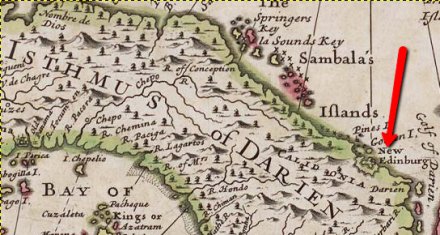
Mired in economic backwardness as neighboring European states carved up the world, Scotland made a bold, doomed bid for a chit in the empire game: the Darien scheme. One part visionary and (at least) two parts daft, this venture attempted to establish a Scottish colony on the Isthmus of Panama (aka the Isthmus of Darien) with a view to porting freight across the narrow strip of land separating Atlantic and Pacific, and dominating the dramatically more efficient east-west trade route that would result.


The intended Scottish colony in Panama; map from this University of Glasgow exhibit.

Students of the Panama Canal project will be aware that this malarial tropic would not be described as especially hospitable; to the natural disadvantages of the climate were added the political interpositions of England herself, whose hostility to the advent of her Caledonian neighbor as a New World rival was expressed in legislation choking the Darien adventure of foreign aid.

(Also a problem: Spain. The colony was abandoned at last under Spanish siege.)

So Scotland went it intrepidly, injudiciously alone in this last bid for real independent muscle in Europe. The hyperbole of the Isthmus’s publicists eventually sucked in 20 percent or more of the capital circulating in Scotland. And when Darien-dot-com went bust by 1700 at the cost of a couple thousand lives, it cratered the Scottish economy too. That set the stage for Edinburgh’s partnership in a different scheme: Great Britain.

Green with Envy

In the years following the Darien catastrophe, the Scottish corporation chartered to undertake it was still throwing stuff against the wall in the world trade game, trying to get something to stick to at least take the edge off the losses.

This company (theoretically a potential rival of England’s own East India Company) had suffered the further national indignity of having one of its ships, the Annandale, seized in the Thames for infringing the East India Company’s royal monopoly. Its appeals for redress falling on deaf ears, the Darien company apparently induced Scottish authorities to undertake the retaliatory seizure of an English merchant ship, the Worcester, that had the ill luck to weather a storm at the Firth of Forth.

Rumor soon connected this ship to another vanished Darien company vessel overdue from its return trip from the East Indies … and, as it quickly became understood by all right-thinking Scots, overtaken in the Indian Ocean by this same Worcester and its crew butchered.

Captain Thomas Green and his English crew were hailed before an Admiralty court** on piracy charges on this extremely fantastical connection in a virtual mob atmosphere.

It never was clearly established that an act of piracy had been committed as a distinct fact, but by putting certain circumstances together it was inferred that Green was guilty of piracy. The very shape in which the accusation is set forth, shows that the accusers could not point to the specific act of piracy which had been committed …

[There] was no specification as to the vessel taken, which might enable the accused to prove that it had not been taken; no names of parties murdered, who might be shown still to be alive; no ownership of cargo, which might admit of proof that the owner’s goods had arrived safe. As Green himself is made justly to say in the document published as his dying speech, “We are condemned as pirates and murderers on a coast far distant from this place — is there any of you who wants either a friend whom we have murdered, or whose goods we have taken?”

Worcester Sauce

The Worcester‘s Malabari cook provided a highly dubious charge — dubious, for he was not yet among the crew when it last called at the location he claimed the crime took place — of Green and crew hatchet-murdering approximately ten English-speaking mariners on an unnamed vessel off the Indian coast.

Upon this evidence, 14 or more members (the ready sources are a little loose on the total number) of the Worcester crew were condemned for piracy, and initially slated for three batches of hangings. Queen Anne‘s personal intervention managed a stay,

The Scottish Privy Council unto the very last hours debated what to do with the diplomatic appeals, with evidence forwarded from London to the effect that the crew these Worcester men had supposedly slaughtered were alive, their vessel having been hijacked in another place, by another man.

But a surging Scottish mob aggrieved by the preceding years’ misadventures and the impending shotgun marriage to Westminster rather than anything Green himself had really done was already engorged on the blood of the supposed English corsairs. Most of the Council thought better than to deny them their sacrifice.†

The Streets fill’d with Incredible Numbers of Men, Women and Children, calling for Justice upon those ENGLISH Murtherers. The Lord Chancellor Seafield‘s Coach happening to pass by, they stop’d it, broket he Sashes, haul’d him out, and oblig’d him to promise Execution should speedily be done before he could get from ’em … According to the Chancellors promise, soon after, on the same Day, being Wednesday, Captain Green, Madder [the mate], and Sympson [the gunner] were brought out, and convey’d to Execution, which was at Leith Road upon the Sands, and all the way was Huzza’d in Triumph as it were, and insulted with the sharpest and most bitter Invectives. Being come to the place of Execution, Good God! what a moving sight was it to see those Men stand upon the very Varge of Life, just launching in to Eternity, and at the same time see the whole Multitudet ransported with Joy!”

-From an anonymous Letter From Scotland To a Friend in London, quoted by James Kelly, “The Worcester Affair,” The Review of English Studies, Feb. 2000

In the event, these three were the only ones actually hanged; passions cooled enough for the other “pirates” to be quietly released.

But the wider, national passions unleashed by this date’s executions would long provide fodder for intemperate patriotic recrimination, and specifically anti-Unionist propaganda — on both sides of the border.

Competing propagandistic broadsides framed and re-framed the events, as the affair of unscrupulous English buccaneers or perfidious highland barbarians. (Defoe, maneuvering for Union, wrote to chill such bad-for-business hostility: “Nothing could be more horrid, than that the Scots should Execute these Men on a meer Pique at the English Nation. Nothing can be more like it, than to conclude rashly, that it is so, and improve it on purpose to Exasperate our People against the Scots.” (Kelly))

And that, of course, is precisely the viewpoint that prevailed.

While the hemp neckties issued to Green et al this date threatened to (ahem) scotch the Union project, that very danger might have ultimately hastened its completion — as elites recognized, in Defoe’s words, that Union represented “the only way to preserve the publick Tranquillity, and prevent the certain Mischiefs that threatened the whole Body,” (Kelly, again) and rammed it through with dispatch.‡

* English historian G.M. Trevelyan.

** A lengthy account of the trial can be found in this Google books freebie

† In their very scanty defense, the Scottish magistrates had reason to fear Scottish citizens.

‡ The ebb and flow of national resentment continued long after the Acts of Union, of course; continuing Scottish support for the restoration of the Stuart monarchy was one expression of Scottish nationalism and anti-Union sentiment.

On this day..

1393: John of Nepomuk, Bohemian rhapsody

This is the date in 1393 when the Catholic patron saint of Bohemia, John of Nepomuk (or John Nepomucene) was tossed from Prague’s Charles Bridge into the Vltava River to drown at the order of the Holy Roman Emperor Wenceslaus.

Baroque statue of John Nepomuk on the Charles Bridge from which he was hurled. (cc) image from Jaguar Julie

A relief detail ((cc) image from Charles Hoffman) on this statue depicts the moment of Nepomuk’s martyrdom.

This Wenceslaus — not be confused with the good King Wenceslaus of song — had a tetchy relationship with powers ecclesiastical and temporal.

But although Wenceslaus did martyr a fellow by the handle of John of Pomuk or Nepomuk, the latter makes this blog because of political tension centuries afterward. Despite the date of his corporeal death, John of Nepomuk is really a counter-reformation saint.

Between the late 14th century and Catholic Austria’s bloody 17th century triumph over Czech nationalism the historical Nepomucene parted company pretty definitively.

The real John of Nepomuk was the General Vicar of the local archbishop, John of Jenstein (or Jenzenstein), whose skirmishes with Wenceslaus over the boundaries of royal authority caused historian Albert Wratislaw to draw a Thomas a Becket comparison.*

In the event, the latest manifestation of that disputatious relationship — the king’s attempt to seize some monastic revenues — caused Wenceslaus to completely fly off the handle and arrest several of the archbishop’s advisors, among whom was our sainted martyr.

Wenceslaus personally oversaw their torture and ordered their drowning, but someone talked him out of the execution part. The king at that point had a sort of mini-Guantanamo Bay situation: he had in hand several people whom he had arrested arbitrarily and tortured, whose release would only further embarrass his own royal self. He therefore prevailed upon them to trade their silence for their liberty.

The other arrestees counted their blessings and accepted this expedient exchange. John of Nepomuk, perhaps because he was already tortured near to the point of death, refused. He was consequently “dragged through the streets to the bridge, there his hands were tied behind him, a piece of wood was thrust into his mouth, his feet were tied to his head in the form of a wheel, and he was thrown into the river.”*

The Nepomucene’s legend really grew after his death: in its most splendidly devotional form, as the proto-martyr for the seal of the confessional, which he supposedly kept as the queen’s confessor when Wenceslaus suspected her of infidelity. (An ironic inversion to say the least, since it was actually John’s more timorous co-accused who distinguished themselves with their silence.)

This is a much more edifying martyrdom altogether, so little wonder that the sourcing on John of Pomuk over the succeeding centuries is a hot mess; later scholars would actually speculate as to whether there might not have been two priests of this name who were both martyred by Wenceslaus, so dissimilar were the legends.

Nepomuk’s elevation to legend, and thereafter to the patron saint of Bohemia, would come in part thanks to a great Czech religious reformer who arose at the end of Wenceslaus’s reign — Jan Hus.

This other, heretical John became woven into the emerging Bohemian national sense; he still remains there today. When the Catholic authorities beat back a Protestant and nationalist revolt in 1620 and imposed Catholicism from above,** Saint John of Nepomuk, martyr, was ready at hand for propagandists of the new order. At least, the legendary, confessional-keeping Nepomuk was ready … because this was not a job for the random cleric-bureaucrat who’d been done to death in some forgotten dispute over rent.

For three hundred years two holy men have been rivals for the reverence of the Cech people. One of them, Saint John Nepomuk, was exalted by the Jesuits, who after the battle of the White Hill in 1620 sought to win back the Cechs to the Roman obedience. … His rival for the position of national hero has been Jan Hus, who, during the reign and under the favour of that same king Wenceslas, led the revolt of the Cechs against the ecclesiastical domination of Rome and the secular domination of Germany, and was martyred as a heretic and rebel at the council of Constance in 1415. From that date until the extinction of the independent Bohemian state by the forces of the Empire and the Counter-Reformation in 1620, Hus was publicly honoured by his fellow-countrymen as the champion of national and religious liberty. From 1620 to 1918 his rival was exalted in his place …†

John of Nepomuk today is depicted in statuary on the Charles Bridge (the spot on the bridge where he was thrown over is also marked with a plaque) and is well-represented throughout Catholic central and eastern Europe. Owing to his patronage portfolios of bridges and flood victims, you might also find the Nepomucene in many a topical posting throughout the world — like the very spot of Christianity’s European triumph, Rome’s Milvian Bridge.

(Somewhat less gloriously, the promulgation of this saint’s name and fame mean it also attaches to John Nepomuk Schrank, a Bavarian immigrant to the U.S. who attempted in 1912 to assassinate former president cum presidential candidate yet again Theodore Roosevelt.)

* Wratislaw, “John of Jenstein, Archbishop of Prague, 1378-1397,” Transactions of the Royal Historical Society, Vol. 7 (1878), pp. 30-57. Wratislaw wrote a now-public-domain book about St. John available here.

** Bohemia’s Catholicization is perhaps the classic case in early modern Europe of the Reformation being rolled back from above and from afar. The recent (and none too affordable) book Converting Bohemia: Force and Persuasion in the Catholic Reformation takes a nuanced survey of Bohemia’s transformation from a Protestant to a Catholic bastion … and as the title suggests, finds many of the Catholic components home-grown.

† R.R. Betts, “Jan Hus,” History, Volume 24, Issue 94 (September 1939), pp. 97–112.

On this day..