1913: Bonnot Gang members, anarchist illegalists

A century ago today, Raymond Caillemin, Elie Monnier and André Soudy were guillotined in Paris for their exploits with Third Republic France’s most celebrated band of anarchist bank-robbers, the Bonnot Gang.

It was actually not Bonnot but Octave Garnier who was the original moving spirit for the gang, which took shape in 1911 around a core of anarchist adherents to the philosophy of illegalism — criminality as resistance. The outlaws were revolutionaries, vegetarians, working-class. Though respectable anarchist communists fled from them, the philosophy bit wasn’t a pose.

“It’s because I didn’t want to live this life of present-day society, because I didn’t want to wait and maybe die before I’d lived, that I defended myself against the oppressors with all the means at my disposal,” Garnier wrote in a memoir discovered after he was killed in a police shootout.

To Garnier the gang owed its signature innovation of using automobiles: they were the first ever to use this novel machine to flee the scene of a crime after knocking over a Paris bank in December 1911. Between their internal combustion engine and their repeating rifles, they had a decided technological advantage on the police who pursued them.

For obvious reasons they were initially dubbed the “Auto Bandits.” But Jules Bonnot stole the marquee by marching into the office of La Petit Parisien in January 1912 to indignantly correct some of its reporting. The newspaper gave him an interview, and started branding the outlaws the “Bonnot Gang” (La bande a Bonnot), a name which has stuck for posterity and titles a 1968 film about them.

And the “Bonnot Gang” moved plenty of papers.

For the next three months, they would repeatedly crash the headlines on either side of the French-Belgian border by stealing cars to perpetrate new robberies, often shooting policemen and bank tellers into the bargain.

Meanwhile, they magnetized admirers and enemies alike with their Gallic intrepidity and self-confessedly impossible struggle. Garnier mailed his fingerprints to the police chief. Ground-down proletarians fell into their orbit, cracking bitter fatalistic jokes. Under the pen name La Retif, a young writer extolled the masculine, doomed outlaws: he was the Russian expatriate Victor Serge, at the start of a long revolutionary career.*

To shoot, in full daylight, a miserable bank clerk proved that some men have at least understood the virtues of audacity.

I am not afraid to own up to it: I am with the bandits. I find their role a fine one; I see the Men in them. Besides them I see only fools and nonentities.

Whatever may result, I like those who struggle. Perhaps it will make you die younger, or force you to experience the man-hunt and the penal colony; perhaps you will end up beneath the foul kiss of the guillotine. That may be! I like those who accept the risk of a great struggle. It is manly.

Besides, one’s destiny, whether as victor or vanquished, isn’t it preferable to sullen resignation and the slow interminable agony of the proletarian who will die in retirement, a fool who has gained nothing out of life?

The bandit, he gambles. He has therefore a few chances of winning. And that is enough.

The bandits show strength.

The bandits show audacity.

The bandits show their firm desire to live.

By April and May the authorities were finally overcoming the audacious bandits, though desires to live showed firm to the last: both Bonnot and Garnier were overcome and killed only after holding off protracted sieges against overwhelming numbers.

Although the headline attractions were gone, the ensuing massive trial soon fitted four for death:

  • Raymond Callemin, Serge’s own friend and reading-companion since childhood
  • Elie Monier (or Monnier), the onetime refugee draft-dodger whose will grandiloquently bequeathed to the Paris library his copy of Darwin, and to the Paris museum the pistol he was arrested with, provided it be engraved with the phrase “Thou Shalt Not Kill”
  • The sickly Andre Soudy, reckless in his outlaw adventure since tuberculosis that he was too poor to fend off already had him coughing his way to an earl grave
  • The joiner Eugene Dieudonne, a friend and compatriot of the gang members but not an actual bank-robber himself. Dieudonne was reprieved on April 20th and dispatched instead to the French penal colony at Devil’s Island

Other prison sentences from a few years up to a lifetime at hard labor were meted out to various other Bonnot gang members and fellow-travelers, several of whom showed themselves dedicated enough to their heroic fatalism to take their own lives. One who attempted an escape only to find himself stymied when he attained the roof of the prison worked fellow-inmates into a frenzied chant of Viva l’anarchie as he hurled slate shingles at the guards who treed him, then wrapped up the performance by hurling himself off the roof, too.

“I would have liked to eat black bread with black hands,” that man’s last testament read. “But I was forced to eat white bread with red hands.”

* Serge got himself in some hot water as an anti-Stalinist in the Soviet Union. Serge’s mature (1945) appraisal of his youthful infatuation with the Bonnot gang, as well as his first-person recollections of the Bonnot gang trial (which got Serge himself a five-year sentence) can be read here

On this day..

1944: Joseph Epstein, Polish Communist French Resistance hero

On this date in 1944, Joseph Epstein* was shot with 18 others at Mont-Valerien outside Paris for their parts in the World War II French Resistance.

Joseph — “Jurek”, really — was born in Poland, but his communist politics got him harried out of Poland and Czechoslovakia and onward to France in the early 1930s.

There he completed his law studies, but was unable practice since he wasn’t a Frenchman.

But he was a perfect recruit for the international republican brigades of the imminent Spanish Civil War (he commanded an artillery battery named in honor of Tudor Vladimirescu).

War would drive Joseph Epstein hither and yon for his remaining years. After a spell in a French POW camp for Spanish Civil War refugees, Epstein signed up for the Foreign Legion, got captured and sent to a German POW camp, escaped to Switzerland, and returned to France.

There as “Colonel Gilles” of the communist resistance organization Francs-Tireurs et Partisans, he became the commissionaire of military operations for the capital and pioneered a shift in tactics towards guerrilla strikes using larger teams. Resistance fighter (and later, historian of the Resistance) Henri Nogueres explained:

Most of the comrades adopted the three comrades system. But in Paris there were policemen and German soldiers everywhere: Joseph Epstein preferred to engage fifteen to twenty fighters per operation … [because] if in Paris during daylight, three persons only had to attack a military unit, there will always be a danger to be arrested that could lead to a partial or complete failure. By contrast, with a larger group, it was possible to gain a superiority if adopting a discrete strategy. The operations in Paris conducted in 1943 were placed under Colonel Gilles’ authority.

Epstein was arrested in the autumn of 1943 at a meeting with Missak Manouchian, and withstood months of brutal torture without so much as revealing his real name or national origin.

While this is a standard accomplishment in a Resistance martyrology, the proof of it in this case was that the ensuing “Manouchian Group” show trial, and the resulting famed “Affiche Rouge” poster, took great pains to depict Resistance members as foreigners and criminals.

As a Polish Jew who regularly ordered assassinations, Epstein would have made a fine exhibit … if the Nazis had known who he was. Instead, he’s conspicuous only by his absence.

The ironic consequence, according to another Resistance veteran, was that “The man who, by far, was the greatest officer in all of France, the greatest tactician of the People’s War, is unknown to the general public. Of all military leaders, he was the most audacious, the most capable, the one who gave the French Resistance its originality compared to other European countries.”

* Not to be confused with the writer of the same name.

On this day..

1430: Seven Parisian conspirators, during the Hundred Years War

In the early 15th century, France had stacked upon the woes of the Hundred Years War those of a civil war — between Armagnacs and Burgundians.

Burgundy, doughty duchy of Nibelungenlied renown, stretched to the Low Countries and was a gestating wealthy merchant state that perhaps had more in common with the English than with feudal, agrarian France. What Burgundy and England demonstrably had in common from 1419 was an alliance. Together, they bossed the northern half of what is now France during the endless Hundred Years War.

Thanks to this timely arrangement, the English came to occupy Paris — in Burgundian possession since 1418, when said party had bloodily ejected the French royalist Armagnacs.

Into this very low ebb of Valois fortunes entered Joan of Arc.

It is true that the king has made a truce with the duke of Burgundy for fifteen days and that the duke is to turn over the city of Paris at the end of fifteen days. Yet you should not marvel if I do not enter that city so quickly. I am not content with these truces and do not know if I will keep them.

-Joan of Arc, in a letter to Reims

Late in the 1420s, the illiterate farm girl somehow reversed the failing fortunes of the southerly French court. Joan, of course, will die at an English stake … but it is the Burgundians who will capture her.

At any rate, in 1429, Joan showed up and the French suddenly began going from victory to victory, knocking English and Burgundian heads in north-central France and culminating with having Charles VII crowned at Reims … which is actually north (well, northeast) of Paris.

Although Joan’s attack on Paris failed, advancing French arms put the fear of Holy Maid in the city and also cut off quite a lot of its rural food supply. “The capital itself was in a frightful state. As a result of interrupted communication and exposed supply routes, together with harassment by brigands and peasants, many Parisians were starving.”

Good times.

This naturally led some of the Armagnac-inclined citizens of Paris to think about ways to give the city back up to the French. We take up the narration of Anatole France, on a plot revolving around the “Seigneur de l’Ours,” or Jaquet Guillaume. (From here (HTML), or here (PDF).)

He was not of gentle birth and his arms were the sign of his hostelry. It was the custom in those days to give the title of Seigneur to the masters of the great Paris inns. Thus Colin, who kept the inn at the Temple Gate, was known as Seigneur du Boisseau. The hôtel de l’Ours stood in the Rue Saint-Antoine, near the Gate properly called La Porte Baudoyer, but commonly known as Porte Baudet, Baudet possessing the double advantage over Baudoyer of being shorter and more comprehensible. It was an ancient and famous inn, equal in renown to the most famous, to the inn of L’Arbre Sec, in the street of that name, to the Fleur de Lis near the Pont Neuf, to the Epée in the Rue Saint-Denis, and to the Chapeau Fétu of the Rue Croix-du-Tirouer. As early as King Charles V’s reign the inn was much frequented. Before huge fires the spits were turning all day long, and there were hot bread, fresh herrings, and wine of Auxerre in plenty. But since then the plunderings of men-at-arms had laid waste the countryside, and travellers no longer ventured forth for fear of being robbed and slain. Knights and pilgrims had ceased coming into the town. Only wolves came by night and devoured little children in the streets. There were no fagots in the grate, no dough in the kneading-trough. Armagnacs and Burgundians had drunk all the wine, laid waste all the vineyards, and nought was left in the cellar save a poor piquette of apples and of plums.

The Seigneur de l’Ours … was the proprietor of the house with the sign of the Bear (l’Ours). He held it by right of his wife Jeannette, and had come into possession of it in the following manner.

Fourteen years before, when King Henry with his knighthood had not yet landed in France, the host of the Bear Inn had been the King’s sergeant-at-arms, one Jean Roche, a man of wealth and fair fame. He was a devoted follower of the Duke of Burgundy, and that was what ruined him. Paris was then occupied by the Armagnacs. In the year 1416, in order to turn them out of the city, Jean Roche concerted with divers burgesses. The plot was to be carried out on Easter Day, which that year fell on the 29th of April. But the Armagnacs discovered it. They threw the conspirators into prison and brought them to trial. On the first Saturday in May the Seigneur de l’Ours was carried to the market place in a tumbrel with Durand de Brie, a dyer, master of the sixty cross-bowmen of Paris, and Jean Perquin, pin-maker and brasier. All three were beheaded, and the body of the Seigneur de l’Ours was hanged at Montfaucon where it remained until the entrance of the Burgundians. Six weeks after their coming, in July, 1418, his body was taken down from gibbet and buried in consecrated ground.

Now the widow of Jean Roche had a daughter by a first marriage. Her name was Jeannette; she took for her first husband a certain Bernard le Breton; for her second, Jaquet Guillaume, who was not rich. He owed money to Maître Jean Fleury, a clerk at law and the King’s secretary. His wife’s affairs were not more prosperous; her father’s goods had been confiscated and she had been obliged to redeem a part of her maternal inheritance. In 1424, the couple were short of money, and they sold a house, concealing the fact that it was mortgaged. Being charged by the purchaser, they were thrown into prison, where they aggravated their offence by suborning two witnesses, one a priest, the other a chambermaid. Fortunately for them, they procured a pardon.

The Jaquet Guillaume couple, therefore, were in a sorry plight. There remained to them, however, the inheritance of Jean Roche, the inn near the Place Baudet, at the sign of the Bear, the title of which Jaquet Guillaume bore. This second Seigneur de l’Ours was to be as strongly Armagnac as the other had been Burgundian, and was to pay the same price for his opinions.

Six years had passed since his release from prison, when, in the March of 1430, there was plotted by the Carmelites of Melun and certain burgesses of Paris that conspiracy which we mentioned on the occasion of Jeanne’s departure for l’Île de France. It was not the first plot into which the Carmelites had entered; they had plotted that rising which had been on the point of breaking out on the Day of the Nativity, when the Maid was leading the attack near La Porte Saint-Honoré; but never before had so many burgesses and so many notables entered into a conspiracy. A clerk of the Treasury, Maître Jean de la Chapelle, two magistrates of the Châtelet, Maître Renaud Savin and Maître Pierre Morant, a very wealthy man, named Jean de Calais, burgesses, merchants, artisans, more than one hundred and fifty persons, held the threads of this vast web, and among them, Jaquet Guillaume, Seigneur de l’Ours.

The Carmelites of Melun directed the whole. Clad as artisans, they went from King to burgesses, from burgesses to King; they kept up the communications between those within and those without, and regulated all the details of the enterprise. One of them asked the conspirators for a written undertaking to bring the King’s men into the city. Such a demand looks as if the majority of the conspirators were in the pay of the Royal Council.

In exchange for this undertaking these monks brought acts of oblivion signed by the King. For the people of Paris to be induced to receive the Prince, whom they still called Dauphin, they must needs be assured of a full and complete amnesty. For more than ten years, while the English and Burgundians had been holding the town, no one had felt altogether free from the reproach of their lawful sovereign and the men of his party. And all the more desirous were they for Charles of Valois to forget the past when they recalled the cruel vengeance taken by the Armagnacs after the suppression of the Butchers.

One of the conspirators, Jaquet Perdriel, advocated the sounding of a trumpet and the reading of the acts of oblivion on Sunday at the Porte Baudet.

“I have no doubt,” he said, “but that we shall be joined by the craftsmen, who, in great numbers will flock to hear the reading.”

He intended leading them to the Saint Antoine Gate and opening it to the King’s men who were lying in ambush close by.

Some eighty or a hundred Scotchmen, dressed as Englishmen, wearing the Saint Andrew’s cross, were then to enter the town, bringing in fish and cattle.

“They will enter boldly by the Saint-Denys Gate,” said Perdriel, “and take possession of it. Whereupon the King’s men will enter in force by the Porte Saint Antoine.”

The plan was deemed good, except that it was considered better for the King’s men to come in by the Saint-Denys Gate.

On Sunday, the 12th of March, the second Sunday in Lent, Maître Jean de la Chapelle invited the magistrate Renaud Savin to come to the tavern of La Pomme de Pin and meet divers other conspirators in order to arrive at an understanding touching what was best to be done. They decided that on a certain day, under pretext of going to see his vines at Chapelle-Saint-Denys, Jean de Calais should join the King’s men outside the walls, make himself known to them by unfurling a white standard and bring them into the town. It was further determined that Maître Morant and a goodly company of citizens with him, should hold themselves in readiness in the taverns of the Rue Saint-Denys to support the French when they came in. In one of the taverns of this street must have been the Seigneur de l’Ours, who, dwelling near by, had undertaken to bring together divers folk of the neighbourhood.

The conspirators were acting in perfect agreement. All they now awaited was to be informed of the day chosen by the Royal Council; and they believed the attempt was to be made on the following Sunday. But on the 21st of March Brother Pierre d’Allée, Prior of the Carmelites of Melun, was taken by the English. Put to the torture, he confessed the plot and named his accomplices. On the information he gave, more than one hundred and fifty persons were arrested and tried. On the 8th of April, the Eve of Palm Sunday, seven of the most important were taken to the market-place on a tumbrel. They were: Jean de la Chapelle, clerk of the Treasury; Renaud Savin and Pierre Morant, magistrates at the Châtelet; Guillaume Perdriau; Jean le François, called Baudrin; Jean le Rigueur, baker, and Jaquet Guillaume, Seigneur de l’Ours. All seven were beheaded by the executioner, who afterwards quartered the bodies of Jean de la Chapelle and of Baudrin.

Jaquet Perdriel was merely deprived of his possessions. Jean de Calais soon procured a pardon. Jeannette, the wife of Jaquet Guillaume, was banished from the kingdom and her goods confiscated.

Joan, for her part, had taken a noble prisoner named Franquet d’Arras. Anatole France says that after the plot was discovered, she attempted to exchange that hostage for Jaquet Guillaume. Having no affirmative reply, Joan proceeded to execute Arras shortly before her capture in May 1430 — a fact that was used against her at her trial.

Burgundy lost her political independence a few decades later.

On this day..

1535: Six Protestants for the Affair of the Placards

The Affair of the Placards was the September 11 of the early French Reformation when the overnight posting of anti-Catholic placards sent the polity off the rails, claimed six victims on this date in 1535.

The formerly indulgent Renaissance-king Francis I was obliged by this late-1534 effusion of propagandizing to dissociate violently from heretical tolerance.

And maybe that would have been that. But the first placard incident was repeated by a follow-up posting on the night of Jan. 12-13 of an anti-sacramental pamphlet by Antoine Marcourt — the anthrax mailings to the hijacked planes, as it were — charging (French) that the Catholic “Mass has plunged half the world into an abyss of public idolatry.”

Francis flipped out. He closed bookstores and suppressed publishing. “One does not argue with heretics,” the Sorbonne agreed. What, do you want the terrorists to win?

So on this date in 1535, a grand Catholic procession — representing all the city’s guilds, all its religious orders, all its holy relics, and all its princes of the blood, with Francis himself modestly carrying a penitential taper to absolve his capital — wound through the city, punctuated by the torching of six accused Protestants.

At the ensuing feast, the king announced his intention to destroy heresy.

The procession of January 1535, with the inclusion of the sacrament, the number of holy objects transported, and the involvement of so many notables, was unprecedented. The elaborate character of the ritual is a good indication of the seriousness with which the authorities viewed this most recent evidence of the inclusion of heresy into French territory. The posting of the placards was regarded as a pollution of the king’s realm, the perceived danger being that the disease contaminating and “infecting some of his subjects” would multiply, undermining the very constitution of the social body … An attack upon the holy sacrament, according to the logic of the symbolism employed in the procession, presents a direct threat to the sacral character of the community, to the nation’s well-being, and hence amounts to an oblique attack on the person of the sovereign. Given the close association established between the sacrament and the monarch, it is no wonder that those implicated in the affair of the placards were regarded as being guilty not only of heresy but also of lese-majeste. (Source)

And maybe early modern France had a point with that weird old sacred-monarch stuff. The very same date two and a half centuries later saw a Parisian mob which had clearly lost any sense of the sacral sovereign behead the king himself.

On this day..

1721: Jean-Pierre Balagny, Cartouche lieutenant

On this day in 1721, Jean-Pierre Balagny, alias Capuchin, was broken on the wheel in Paris. He was one of the lieutenants and boon companions of legendary French outlaws Cartouche.

We have noted that that renowned bandit crowned his fame at the last by enduring all tortures, only to voluntarily give up the names of his companions as he approached the scaffold and perceived that they had failed to arrange a rescue.

“Capuchin”, who was with Cartouche when he was captured and subject to much the same interrogation, proved as good as his captain. He, too, endured the boot without breaking. And he, with two companions, likewise reached the scaffold and only there coughed it up.

They gave information as to their accomplices, and made, at the foot of the scaffold, confessions which torture had failed to elicit from them.

They implicated so many persons, that another series of trials began, which lasted as long as the declarations of convicted prisoners compromised other persons, and threw new light on the immense ramifications of an association of miscreants which had for many years defied the police. More than sixty persons were under lock and key at the time of the execution of Cartouche and Balagny. This number increased every day in consequence of the confession of those who hoped to save their lives by denouncing their accomplices, and in June of the following year it rose to one hundred and fifty … all this blood, instead of washing the affair away, seemed rather to make it more serious. Every day brought to light some new discovery; and this shows how profoundly mistaken were those who denied that Cartouche, the centre and wire-puller of this horrible association, possessed the organising spirit without which he could not have extended this immense net over the Parisian society.

One is left to infer from this entry in the memoirs of the Parisian hereditary executioner-family Sanson that Balagny likewise did in his friends over some ornate notion of honor … although if the anecdote is true, one could as easily suppose any number of less “creditable” reasons.

At any rate, Balagny’s evidence added to that of Cartouche’s snowballed into a bloody cycle of tortures and executions and fresh denunciations over the year to come.

Of course, getting rid of all the criminals did not get rid of crime.

“In spite of the executions at La Greve, there are more thieves than ever in Paris,” lamented one observer (quoted here). “Cartouche has died on the wheel; but his name and memory engender robbers.”

On this day..

1812: Claude-Francois de Malet and his conspirators

Two centuries ago today,* the author of one of the weirdest attempted coups in history was shot with his co-conspirators.

Picture Valkyrie in Napoleonic Europe.

Claude-Francois de Malet (English Wikipedia entry | French) had spent the years of his confinement for republican sensibilities painstakingly readying bogus orders and decrees for the eventual rollout of the most audacious putsch you’d ever want to putsch.

While Bonaparte was off on campaign trashing Russia, Malet broke out of his sanitarium and went to work.

Donning a general’s uniform, Malet on Oct. 23, 1812 presented a forged announcement of the Emperor’s recent demise … and started issuing orders. He bluffed the release of imprisoned allies, and got a legitimate general to order the arrest of Napoleon’s most prominent deputies in Paris. (It’s a good job that general obeyed Malet, because when one officer asked to kindly see the arrest warrant Malet was using on him, Malet responded by shooting him in the face.)

For a few hours that morning the Malet conspirators almost put themselves in control, almost normalized their sudden rearrangement of authority with its reassuringly familiar official paperwork. Later, when interrogated for the identities of his accomplices, Malet would retort, “You, yourself, Sir, and all of France — if I had succeeded!”

But the attempted coup which aimed so high ultimately made for little but tantalizing counterfactual history. Officers with clearer heads soon realized that they had received communiques from the Emperor dated after his purported October 7 death; one of those officers arrested Malet.

A tribunal was constituted later that same date. It had little difficulty condemning 14 (French link) during the small hours of the morning on Oct. 29. They were shot later that same day (at least, most of them were; there are oddly conflicting accounts on this point). This public-domain French text preserves a first-person narration of the scene, in which Malet himself — usurping authority to the very last — commands the firing platoon that’s lined up to shoot his comrades.

120 bullets riddled these unfortunates, who fell all except Malet. He stood on his hands and knees and raised his hands to his chest as he was only wounded, and retreated to the wall on which he leaned:

“And me, my friends!” cried he, “You forgot me!”

(One of the executed fellow-officers was Gen. Victor Lahorie. Lahorie’s lover was Sophie Trebuchet, and his lover’s son, Victor Hugo, was about to catapult himself to literary fame.)

While the Malet plot failed on its own terms, it got quite a lot farther than it had any right to expect — and this fact rightly alarmed the Corsican.

“Bad News From France”, by Vasily Vereshchagin, depicts a retreating Napoleon — bunking in an Orthodox church — finding out about Malet.

Was his position that precarious? And why, if some officers genuinely believed him dead, did nobody hail as emperor his infant son and designated heir?

Napoleon had already begun his catastrophic retreat from Russia when he got word of Malet’s attempted coup d’etat; the struggling Grande Armee was dwindling daily under the battering of cold, desertion, and Russian snipers. Now this?

Upon discovering his late narrow escape from a homefront conspiracy, Napoleon left his miserable troops under the command of Murat* and raced ahead of them back to Paris to secure his own position.

This new confluence of domestic vulnerability and foreign defeat marks the beginning of the end for Napoleon. Europe ganged up on the weakened French, and less than 18 months after Malet faced his executioners, France’s own generals forced Napoleon to abdicate.

* Murat soon ditched the army himself to try to preserve himself as King of Naples. (That didn’t end well.) The once-gigantic army’s remnants finally straggled home under the third-string leadership of Eugene de Beauharnais — the capable son of Josephine’s guillotined first husband.

On this day..

1887: Henri Pranzini, repentant?

On this date 125 years ago, a notorious French triple murderer was guillotined outside La Roquette Prison.

This condemned murderer, so infamous that anarchist bomber Ravachol planned to invoke his name as an emblem of crime in a suppressed courtroom speech, slaughtered a prostitute, her maid, and the maid’s child so that he could plunder the apartment’s jewelry.

Your basic sensational common butchery, given added legs by comparison to the next year’s apparition across the channel of the Whitechapel murderer.*

That’s just one of several more famous (or infamous) contemporaries for whom Pranzini was a sort of subplot character.

The artist Paul Gauguin — though he couldn’t quite remember the name right — suspected that this particular killer plotted his crime at the cafe that both he and Vincent Van Gogh frequented. (Van Gogh painted the proprietress, who was also possibly his lover.)

According to Van Gogh, the whole Pansini [Pranzini] affair, as well as many others, was hatched in this place … From this Pansini case sprang another case, also, according to Van Gogh, hatched in this famous cafe, the Prado case

We’ve noticed in these pages Gauguin’s disturbing severed-head jug, and its seeming inspiration from that other guillotinee, Prado.

While Gauguin’s meditations on the guillotine veered to the grotesque, a Norman teenager fresh off an apparition of Jesus Christ found spiritual sublimity in this villain. The woman eventually known as St. Therese of Lisieux later recollected

I heard talk of a great criminal just condemned to death for some horrible crimes; everything pointed to the fact that he would die impenitent…. I felt in the depths of my heart certain that our desires would be granted, but to obtain courage to pray for sinners I told God I was sure He would pardon the poor, unfortunate Pranzini; that I’d believe this even if he went to his death without any signs of repentance or without having gone to confession. I was absolutely confident in the mercy of Jesus. But I was begging Him for a “sign” of repentance only for my own simple consolation.

My prayer was answered to the letter! In spite of Papa’s prohibition that we read no papers, I didn’t think I was disobeying when reading passages pertaining to Pranzini. The day after the execution I found the newspaper “La Croix.” I opened it quickly and what did I see? Ah! my tears betrayed my emotion and I was obliged to hide. Pranzini had not gone to confession. He had mounted the scaffold and was preparing to place his head in the formidable opening, when suddenly, seized by an inspiration, he turned, took hold of the crucifix the priest was holding out to him and kissed the sacred wounds three times! Then his soul went to receive the merciful sentence of Him who declares that in heaven there will be more joy over one sinner who does penance than over ninety-nine just who have no need of repentance.

I had obtained the sign I requested.

Nameless citizens on the square when the blade fell settled for less exalted signs, like the ancient superstition of dipping into the spattered blood. (“Such scenes would disgust the black savages of Dahomey and the Gold Coast,” the London Times sniffed (September 1, 1887), and in vain urged the French government to take up legislation for private executions.)

* Pranzini found himself in Madame Tussaud’s for a spell.

On this day..

1722: Cartouche’s brother, hanged by the armpits

On this date in 1722, the younger brother of the great French outlaw Cartouche was punished with a bizarre non-fatal hanging in Paris’s Place de Greve.

At least, it was supposed to be non-fatal.

Little Louison was a whelp of 15 years and already condemned to hard labor in the months-long smashing-up of the gang that followed the ringleader’s 1721 execution. “Nothing but hangings and breakings on the wheel!” one diarist scribbled in July 1722. “Every day some Cartouchian executed.”

As a sort of piece de resistance for the month, a judge named Arnould de Boueix, sore about the murder of a gendarme in his family, ordered the young Louison “hanged” under the armpits (the rope about his chest) for two hours as an additional punishment/humiliation. Judge de Boueix apparently devised this thing without any sort of precedent or anatomical expertise that would actually confirm the safety of the procedure.

[Louison] cried out very loudly at first, and begged that he might be put out of pain at once, as the weight of his body seemed to force every drop of blood down to his feet. “Ce-qui” (adds Barbier) “est la souffrance des pendus.” [“Such is the suffering of the hanged” -ed.]

Later, his tongue protruded, and he spoke no more. Without waiting for the ordained two hours to expire, the lad was taken down and placed in medical care; but it was too late. He was already dead. “He was very wicked for his years,” says Barbier, “and had been an accomplice of his brother from a very early age.”

On this day..

1804: Georges Cadoudal, Chouan

On this date in 1804, royalist counterrevolutionary Georges Cadoudal was guillotined in Paris with eleven of his chouan brothers-in-arms.

Cadoudal (English Wikipedia entry | the much more detailed French) was the French Revolution’s ultimate antagonist, a Breton notary (and commoner, obviously) who obstinately resisted the bloody progress of those years to the last of his strength.

His decade of royalist adventures (French) reads* like an adventure novel, a mind-bogglingly perilous series of revolts, captures, escapes, rappelling, martial exploits, diplomatic intrigue, terrorist plotting, high principles, low politics … a desperately heroic (or anti-heroic) struggle using every resource of a changing world to claw back the lost age of Bourbons.

After that dynasty’s last (up until then) king was guillotined in 1793, the intrepid Cadoudal staked his life to the 1793 Vendee rising, mounted an insurrection at Brest, and became one of the principal leaders of the anti-revolutionary Chouannerie fighting les bleus around northwest France through the 1790s.

Beaten but not bowed, Cadoudal took refuge in England when those campaigns came to grief following the royalist debacle at Quiberon, but he was never one to retire to the exile social circuit. Cadoudal remained an active schemer against the France of a rising Napoleon Bonaparte, and he was backed now by Britain’s statecraft … and her gold.

Spurning a proffered arrangement with the Corsican — who, say what one will, could recognize ability when he saw it — Cadoudal instead oversaw a dramatic 1800 assassination attempt on Napoleon that didn’t get the dictator but blew a bunch of Parisian bystanders to smithereens.

This effort having failed, our persistent intriguer slipped back into France to attempt an even bolder venture to kidnap Napoleon and elevate the Duke of Enghien — the going Bourbon candidate, who lurked on the French frontier to rush into the power vacuum.

This didn’t work either. As outlandish as the idea seems with benefit of hindsight, it was hardly a crackpot plan — as attested by the credentials of its participants.

“All Europe laughs at the conspiracy in Paris; it was, however, a well-built machine. Men, money, everything was ready. Bonaparte was to be taken alive and carried out like lightning from one post to the sea and the English fleet … I am inconsolable that it missed its mark. Those who criticize the French princes that they do not risk themselves while others fight for them, they will be the first to cry: What madness! How childish! [that d’Enghien risked himself] That is how men are made.”

–Joseph de Maistre (Source)

Which is a long way of saying that it still comes down to wins and losses.

Having lost, the Bourbon pretender (he’s a pretender because he lost, of course) d’Enghien was arrested and immediately shot for his trouble; Cadoudal, taken on the streets of Paris,** was around long enough to see the hated Bonaparte take sufficient warning from the conspiracies against him to vest his governance in the imperial dignity. That was proclaimed on May 18. (The famous coronation wasn’t until December.)


Happy now, Georges? Napoleon on his Imperial throne, by Jean-Auguste-Dominique Ingres.

“We have done better than we hoped,” the doomed Cadoudal remarked caustically from his dungeon. “We intended to give France a king, and we have given her an emperor.”

He was rock-ribbed in his royalism to the very last.

He’d met Napoleon face to face years before in an abortive parley — when Cadoudal was offered, and rejected, the bribe of a lucrative Republican military commission — and now Cadoudal’s proposed victim let it be known to him that mercy was his for the asking. The indignant Breton scorned as dishonorable the very idea of supplicating Napoleon, even when the invitation was refreshed as he underwent the fatal toilette on his final day. His dozen-strong party went to their deaths this date taking heart from following the very footsteps of their martyred king.


The Execution of Georges Cadoudal, by Armand de Polignac … who portrayed several scenes of the conspirators.

A very lovely mausoleum in his native village of Kerleano preserves Cadoudal’s remains (reburied honorably there after his Bourbon Restoration finally came to pass), and his memory.

* A descendant wrote this now-public-domain book about our man.

** Reproached for orphaning a policeman’s family as he resisted capture, Cadoudal sneered, “then you should have sent a bachelor.”

On this day..

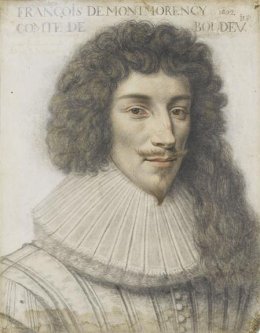
1627: Francois de Montmorency and his second, for dueling

On this date in 1627, the Comte de Bouteville plus his cousin Des Chapelles lost their heads for fighting a duel — ultimately (because of the execution) one of the most notorious duels in French history.

Though this is the duel that everyone knows, Francois de Montmorency-Bouteville (English Wikipedia entry | French) had engaged in 22 such affairs of honor between the tender ages of 15 and 28. Like as not, he was the duellist par excellence in an age where demanding lethal satisfaction was all the rage among devil-may-care aristocratic straplings.

And this, of course, is why he was nominated for condign punishment in Louis XIII’s struggling anti-dueling campaign. One might say he nominated himself.

Dueling, a mano-a-mano vindication of feuds between fops, was an archaic holdover of Burgundian clan violence turned preposterous baroque ritual of conspicuous consociation.

It was also incredibly epidemic in France at this period.

During the reign of Louis’s predecessor Henri IV, 7,000 to 8,000 people are reported to have died in duels, which works out to the suspect rate of one per day for the entire period. Then again, France did have an excess supply of noble progeny whose violent impulses were no longer preoccupied by fratricidal religious warfare.*

Henri IV had tried to ban dueling, even in 1610 executing for lese majeste a couple members of his own guard who defied the ban. Just weeks later, and for no reason connected to dueling, Henri was assassinated. Then-nine-year-old heir Louis XIII was in no position at the time to follow up his father’s policy, and the naughty sport continued to flourish.

“Duels had become so common among the French nobility that the streets of Paris usually served as the field of combat,” according to the Mercure Francois. And as Richard Herr described in his “Honor versus Absolutism: Richelieu’s Fight against Dueling” (The Journal of Modern History, September 1955; this is also the source of all other quotes in this post), they often arose over utterly trivial “slights.”**

Typical was a duel in Lent of 1626 in which Bouteville [i.e., the subject of our post] with two seconds engaged the Comte de Thorigny and his two seconds. The fight was over a dispute between Thorigny and the Marquis de Chalais, who was in prison accused of treason. Bouteville was merely defending the honor of a friend. All six spent the night before the engagement in an inn outside Paris, and in the course of a fairly amicable conversation, they expressed regret that being good friends, they were going to kill each other over another gentleman’s quarrel. But they agreed that they had gone too far to be able to abandon the project without loss of honor. The next day Bouteville killed Thorigny after the latter’s sword broke.

By the 1620s, Louis was old enough to make another run at this intractable elite-on-elite crime wave, and did so with the full encouragement of his famous consigliere Cardinal Richelieu. Depriving the aristocracy of this weird extra-judicial prerogative fit right into the latter’s going campaign to centralize the French state and bring its quarrelsome lords to heel.

What with all those duels he liked to fight, Francois de Montmorency-Bouteville was a great test case. Fighting a public duel in January 1627 — at which his second was slain — made Bouteville a target, and he fled to the Netherlands for safety.

Our fugitive figured he’d send word that a pardon would be appreciated, and everything would blow over like it always did. But Louis was determined to disabuse this type of any privilege to commit public mayhem, and refused to grant Bouteville his absolution.

Honor offended — his default state, to judge by his career — Bouteville vowed angrily to “fight in Paris and in the Place Royale!” This he did on May 12, 1627, slipping back into France for the express purpose of dueling Guy Harcourt, the Marquis de Beuvron. And Bouteville disdained a private fight for the occasion, insisting, as he had declared, on a daytime melee where everyone could see it at the grand new Place Royale (today, Places des Vosges).


At least the setting was operatic. (cc) image from Christophe Alary.

Bouteville and Beuvron fought to a bloodless stalemate and agreed to call it a draw. But Bouteville’s second Des Chapelles mortally wounded Beuvron’s second.

Everyone fled, and while Beuvron made it out of the country, Montmorency and Des Chapelles were nabbed, and condemned to death by the Parlement of Paris for violating Louis’s royal edict against duels.

From the king’s standpoint, this was just about the most egregious possible arrangement of factors.

  • The guy was a serial offender, and he was already a fugitive for his last duel.
  • The fight had produced a fatality.
  • Worst, the whole scene — sneaking back into Paris, fighting openly within the potential view of the sovereign — had been overtly staged to scorn the royal ban.

If Louis intended his decree to mean anything at all, he had to come down hard on this one. “It is a question of cutting the throat of duels or of your majesty’s edicts,” Richelieu summarized.

But as clear-cut as were the case indicia, this was still a hard one for Louis, and even for the usually-ruthless Richelieu. Bouteville was a well-born noble, with powerful friends and family who were also close to the king, and they besieged the royal person with petitions for mercy. A sorrowing but firm Louis had to personally refuse mercy to Bouteville’s tearful wife. “Their loss affects me as much as it does you,” he said. “But my conscience prevents my pardoning them.”

Although the poor wife couldn’t make any headway for clemency, she had the better of Bouteville’s swordsmanship off the field of honor. The doomed duke bequeathed one last rapier thrust to posterity by leaving his widow-to-be pregnant with a posthumous son who eventually generalled French armies to any number of routs of the Dutch in the late 17th century.

And while Richelieu’s memoirs would depict this instance of executive implacability as a decisive turn, Herr argues that it was nothing but a brief interruption. The pernicious hobby was back in all its glory within a couple of years, an evil that even Richelieu could never master. France’s aspired-to absolutism could not reach that ancient and intimate noble right save in the very most exemplary case.

In Dumas’s Three Musketeers, set in 1620s France, D’Artagnan is charged by his father in the opening pages to “[n]ever fear quarrels … Fight on all occasions. Fight the more for duels being forbidden, since consequently there is twice as much courage in fighting.” And indeed, it is by blundering into silly duels (e.g., the “offense” caused by bumping into Porthos while hurrying down the stairs, the latter of whom considers D’Artagnan’s apology discourteously perfunctory) that D’Artagnan becomes the fourth of their cadre … because Richelieu’s men arrive to break up the illegal D’Artagnan-vs.-Musketeer melees, and D’Artagnan joins with his “foes” to defend, all for one and one for all, their privilege as gentlemen to slaughter one another.

The dueling phenomenon faded significantly under Louis XIV, but still not completely: Voltaire almost fought a duel in 1726; the artist Manet dueled a critic in 1870; and YouTube will favor the viewer with a number of 20th century professors and litterateurs settling long-forgotten affairs of honor — like disputes over wartime collaboration after World War II — in ceremonial swordfights. Dueling pistol shooting (at human silhouettes) was even an event at the 1906 Olympics.†

And elsewhere in Germany, Russia, and everywhere Europe touched, duelling persisted with new practitioners into the 19th and even the 20th and even the 21st centuries.

* Also worth noting relative to the casualty numbers: at this time, each side’s seconds also fought in addition to the principals. A move for taking seconds out of the fight eventually prevailed, long before the end (if there has been a real end) of dueling, but in 1627 that time was not yet come.

** Across the Channel at this time, Francis Bacon was making much the same complaint against English duels.

† This event was an “Intercalated Games” falling between the natural 1904 and 1908 Olympiads. It’s an outlier historical experiment during the modern Olympics’ uncertain early years, and though it was officially sanctioned at the time and winners walked away with proper medals, the International Olympic Committee no longer recognizes the Intercalated Games as an official Olympics.

On this day..