2008: Behnam Zare, pleading for his life

On this date in 2008, Behnam Zare (or Zareh) was hanged in Shiraz for murdering, at the age of 15, another youth during a fight about a bird.

Evidently about 19 when he was finally put to death, Zare was hanged without any prior notice to his lawyer or his family.

A recording of Zare’s voice in what turned out to be his last call with his lawyer, pleading “I want to stay alive. Please, please I want to stay alive,” was used to open a 2008 documentary against executing juvenile offenders.

That attorney who represented Zare (and created the documentary) was Mohamad Mostafaei — an activist lawyer who described various forms of official harassment for his unwelcome work. Mostafaei has recently been in the news for his representation of Sakineh Mohammadi Ashtiani, the woman who made international headlines for receiving a sentence of stoning to death. (Mostafaei also represented cause celebre Delara Darabi, hanged in 2009.)

Just a few weeks ago, Mostafaei fled Iran ahead of an arrest warrant (several members of his family were also arrested as virtual hostages).

He was interviewed by the BBC in exile in Oslo. (Read on to the comments for a transcript.)

(Also of interest: Mostafaei’s gut-wrenching description of another child offender’s hanging in October 2009, and the desperate attempts to beg for mercy from the victim’s parents. StopChildExecutions.com has regular coverage of the juvenile death penalty in the Islamic Republic.)

On this day..

1460: The residents of Amlas, impaled by Vlad Dracula

This date is the 550th anniversary of (in)famous Wallachian dictator/vampire prototype Vlad III Tepes‘s destruction of the town of Amlas, impaling all its surviving citizens.

The signature execution form of “Vlad the Impaler” was as nasty as it sounds: still-living victim mounted on a long, oiled stake driven through the rectum and emerging through the mouth to expire agonizingly over a period of hours or days. Or, alternatively, stuck through the midsection, leaving the subject horizontally mounted like a flopping fish.

And he had frequent recourse to it during his long struggle for power in the treacherous 1450s and 1460s, the period* when Vlad III became famous for the iron-willed cruelty required to exercise power in a Wallachia squeezed between the expanding Ottoman Empire and Hungary.

It was this terrifying period from the late 1450s that made Vlad Dracula — the titular second name inherited from his father‘s investment into the Order of the Dragon, Draco in Latin — the namesake for Bram Stoker‘s famous bloodthirsty Transylvanian noble, and the granddaddy of all its lucrative latter-day offspring.

(Bram Stoker didn’t invent the vampire myth, and the notion that Vlad Dracula “is” Count Dracula is one of those bits of popular folklore that’s become academically unfashionable. But still.)

The historical Vlad has his latter-day defenders, who see him as a nation-builder. Certainly, both the man himself and his vulnerable frontier principality were menaced by innumerable threats both foreign and domestic.

This date’s massacre was to deal with one such, Germans in the territory of Transylvania, which lay to the north of Vlad’s own Wallachia. Both realms are part of present-day Romania, and they were closely connected in Vlad’s time as well; the young Dracula himself was born in Transylvania, and Transylvanian towns had helped him take the Wallachian throne with the support of Hungary.

So far, everyone was on the same page. But when a power struggle erupted for the Hungarian throne in 1457, the “Saxon” emigres who formed the upper crust of merchants in Transylvania (supported by a vast sea of Romanian peasants) backed the Holy Roman Emperor while Vlad supported the usurping Hunyadi family that had so ably patronized him.** It’s quite a bit more dizzyingly complex than that, but the bottom line is that commercial and political conflicts soon saw Vlad Dracula mounting a campaign of Transylvanian terror from 1458 onward.

During the summer of 1460 Dracula organized his final raid on Transylvania. This time he attacked townships and villages in the district of Amlas known as the “Land of the Forest” or Unterwald … The meistersinger Beheim gives the exact date of the attack as falling on the feast day of Saint Bartholomew in the year 1460: August 24. Dracula struck in the early morning after “passing through the great forest” with his cavalry force. He burned the town of Amlas and impaled all the citizens, a priest having led the procession to the burial scene …

Dracula’s raid on Amlas was aimed at eliminating any remaining dissident resistance and at killing rival contenders to his throne … Dracula knew, for instance, that … the boyar Bogdan Doboca, was hiding in the village of Sercaia, in the Fagaras district. So he had the entire village razed to the ground; it had to be completely repopulated in the following century. Similar was the fat of the village of Mica. The narrator Beheim tells us that Dracula burned or destroyed half the communities in the Amlas district, including the capital city by that name. He “assembled all the citizens and all those he could find” from other villages and hanged them on hooks and pitchforks, after having had his men hack them to pieces with knives, swords, and sabers. Amlas was reduced to a ghost town, as it still is today, and other villages such as Saliste, Apodul de Sus, and Tilisca were similarly destroyed. Beheim claims that altogether some 30,000 Germans were killed during this Dracula raid on the district of Amlas.

Impressive as this date’s butchery would have been — although we know it from German propagandists who figure to have made the most of it — it was simply of a piece with Vlad’s Transylvanian campaign. To this campaign, Florescu and McNally attribute an impressive catalogue of atrocities, such as:

  • Slaughtering all the inhabitants of a village named Bod
  • Impaling one of his own captains who reported an inability to take an enemy position “for the inhabitants are brave and well fortified”
  • Boiling alive 600 Saxon merchants
  • Impaling as spies 41 Saxons who came to Wallachia to learn the Romanian language
  • Forcing one captured rival claimant with Saxon support to go through a Mass for the dead clothed in funerary vestments before personally beheading him

Fleeing Germans carrying spine-tingling eyewitness accounts and rumors of even worse made a happy match with that new media technology, the printing press, giving Dracula continental infamy and a purchase on future literary immortality.

“The horror genre conformed to the tastes of the fifteenth-century reading public as much as it does today,” observe those same authors Florescu and McNally in another volume. “No fewer than thirteen different fiteenth- and sixteenth-century Dracula stories have been discovered thus far in the various German states.”

The St. Bartholomew’s Day 1460 events are seemingly sometimes conflated† with a more famous bloodbath during the spring of 1459, when Vlad arranged a demonstrative mass impaling on the outskirts of Brasov.‡

All those whom he had taken captive, men and women, young and old, chlidren, he had impaled on the hill by the chapel and all around the hill, and under them he proceeded to eat at table and enjoyed himself in that way.

It’s this 1459 event that provides us the most horribly recognizable images of Dracula’s reign, with the insouciant Wallachian prince enjoying his repast amid a thicket of impaled wretches.

* 1456 to 1462, specifically, which was the second (and most consequential) of the three different periods Vlad III was Prince of Wallachia. The Ottomans drove him out in 1462, and he took refuge in Hungary before a return bid in 1476, which ended in his own death in battle.

** And specifically, Mihaly Szilagy (Hungarian link), the uncle of the ascendant king Matthias Corvinus. The latter would seek to woo Saxon support, and he had an on-again, off-again relationship with Vlad Dracula. Wallachia was a small buffer state from the standpoint of a greater power like Hungary, and Wallachia’s ruler a political instrument no matter how much impaling he might do.

† Perhaps because Brasov’s Church of St. Bartholomew was among the targets ravaged by Dracula’s force?

‡ Attack staged from picturesquely vampiric Castle Bran.

On this day..

1860: John Moyse, the Private of the Buffs

“Our readers,” intoned the London Times on Nov. 5 of 1860, “will not have overlooked the behavior and fate of Private Moyse, of the Buffs, whose resolution, indeed, was not proof against the allurements of the grog-cart, but who actually faced death in cold blood rather than demean himself by prostration before ‘any Chinaman alive.'”

It was on this date that said Private Moyse, John to call him by his Christian name, died in captivity — allegedly because he refused to kowtow to a Chinese mandarin. “The Sikhs obeyed” this Asiatic command, goes the account. “But Moyse, the English soldier, declaring that he would not prostrate himself before any Chinaman alive, was immediately knocked upon the head and his body thrown on a dunghill.”

Kowtowing — Chinese insistence upon; British rejection of — was a touchy symbolic issue between the rising European hegemon and the ancient Chinese empire. It’s said (likely with more color than accuracy) that the British envoy Earl Macartney‘s 1790s trade mission to the east failed for want of a kowtow.

For the same reasons this legend became current, the Moyse tale made sensational propaganda during Britain’s Second Opium War intervention in China, valorized in this jingoistic tear-jerker.

The Private of the Buffs
by Sir Francis Doyle

Last night, among his fellow roughs,
He jested, quaffed and swore,
A drunken private of the Buffs,
Who never looked before.
Today, beneath the foeman’s frown
He stands in Elgin‘s place,
Ambassador from Britain’s Crown
And type of all her race.

Poor, reckless, rude, low-born, untaught,
Bewildered and alone.
A heart, with English instinct fraught,
He yet can call his own.
Aye, tear his body limb from limb,
Bring cord, or axe, or flame;
He only knows that not through him
Shall England come to shame.

Far Kentish hop fields round him seem’d
Like dreams, to come and go;
Bright leagues of cherry blossom gleam’d,
One sheet of living snow;
The smoke above his father’s door
In grey soft eddyings hung.
Must he then watch it rise no more,
Doomed by himself so young?

Yes, honour calls! With strength like steel
He puts the vision by.
Let dusky Indians whine and kneel;
An English lad must die.
And thus, with eyes that would not shrink,
With knee to man unbent,
Unfaltering on its dreadful brink
To his red grave he went.

Vain, mightiest fleets of iron framed;
Vain, those all-shattering guns;
Unless proud England keep, untamed
The strong heart of her sons.
So, let his name through England ring –
A man of mean estate,
Who died, as firm as Sparta’s King
Because his soul was great.

Moyse’s defiance and death make an appearance in this Flashman novel.

Aye, Moyse liked to get into the drink and had a discipline problem, but no matter. This fact was easily appropriated further to his bluff and earnest character in national martyrdom.

Getting a bit carried away with itself, the Times editorialized on Nov. 16,

We have no such visions of human perfectibility as to believe that all the young men of this country will be “respectable youth” looking for “honourable service.” … The English are a people endowed with superabundant energy, and energy must sometimes take an irregular and even a criminal form. The best use that can be made of a young man who will settle down to nothing is to get him to enlist as a soldier. He is kept under strict discipline at the same time that his love of activity and adventure is gratified. He becomes a first-rate fighting man, and fulfils splendidly the only duty which society can ever hope to obtain from him. There is no reason to wonder, with Colonel McMurdo, that acts of heroism have been performed by such men, for they have performed them in all ages and all countries. The “obstinate intemperate hero” is of all time, whether in the shape of Alexander or Lord Clive, or Private Moyse of the Buffs. There are two kinds of valour, belonging to two different classes of men, and a citizen-force may very usefully be employed side by side with the wildest lads who ever rioted in Tipperary or gambled in a London pothouse.

Basically forgotten now, this story can be fleetingly encountered among Anglophiles as an arcane indicator that the national character of Britain, or the West, or what have you, is not now what it once was, given all the kowtowing to mandarins going on in these debased times.

(Although this post amusingly juxtaposes the “commonsense prudence and practicality” of Wellington taking an expedient knee so that a military strategem would not be lost on account of bullheaded pride. Maybe it helped that Wellington was kneeling to a European.)

On this day..

1936: The Sacred Heart, by Spanish leftists

On this date in 1936, anticlerical leftists in the Spanish Civil War allegedly subjected a monumental statue of Christ to a ritual “execution”.


“This picture, taken by a Paramount News-reel representative and received by air from Madrid yesterday, illustrates an outrage which has no parallel in the photographs published by “The Daily Mail” of the Spanish Reds’ war on religion. It shows a Communist firing squad aiming at the colossal Monument of the Sacred Heart on the Cerro de los Angeles, a hill a few miles south of Madrid which is regarded as the exact centre of Spain.” (Source)

This outstandingly incendiary image made for great recruiting for the Francoist enemies of the “firing squad” and gave credence to a “crusade” lexicology that insured the devout would break overwhelmingly against the Republic. (Nearly 7,000 men and women in religious orders whose deaths during the war are charged to the Republican account also helped.)

Maybe that was inevitable, anyway.

George Orwell, the English leftist who volunteered for the Spanish Republicans, noted in his Homage to Catalonia that

the people in this part of Spain must be genuinely without religious feeling — religious feeling, I mean, in the orthodox sense. It is curious that all the time I was in Spain I never once saw a person cross himself; yet you would think such a movement would become instinctive, revolution or no revolution. Obviously the Spanish Church will come back (as the saying goes, night and the Jesuits always return), but there is no doubt that at the outbreak of the revolution it collapsed and was smashed up to an extent that would be unthinkable even for the moribund C. of E. in like circumstances. To the Spanish people, at any rate in Catalonia and Aragon, the Church was a racket pure and simple. And possibly Christian belief was replaced to some extent by Anarchism, whose influence is widely spread and which undoubtedly has a religious tinge.

Be that as it may, Republican types suspected photographic fakery.

Just like its inspiration is reported to have done, this statue survived its “execution” in fine shapewas resurrected by public subscription, and can still be seen at Cerro de los Angeles outside Madrid.


The “executed” statue today. (cc) image from bigchus.

On this day..

1942: Duncan Scott-Ford, because loose lips sink ships

On this date in 1942, British merchant sailor Duncan Scott-Ford was hanged at London’s Wandsworth Prison for giving German agents sensitive information about ship movements.

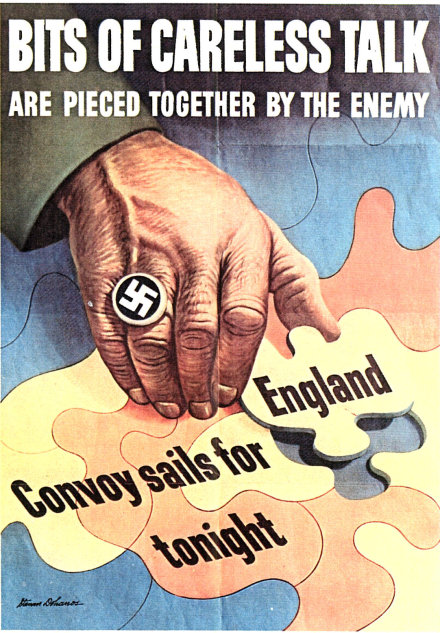
This, of course, was just the sort of thing everyone was trying to discourage.

… and a version to keep young soldiers on the pull Mata Hari-conscious:

For a case that so handily underscored the posters, the Scott-Ford affair made great copy … but not until a day after the hanging itself. Having kept everything secret, the papers were finally allowed on Nov. 4 to announce

that a British subject was executed for treachery at Wandsworth Prison yesterday morning.

Scott-Ford was paid 1,800 escudos by the enemy. This sum, which in English currency is equivalent only to about £18, was all that Scott-Ford in fact received from the enemy, though promises were held out to him which lured him deeper and deeper into the blackmailing clutches of the enemy. Thus when Scott-Ford returned on his second visit to Lisbon with the information which he had collected the Germans, instead of honouring their promises, threatened that they would expose him to the British authorities unless he continued to perform further services, to collect more valuable information and to undergo greater risks in their interest.

Some of the information which Scott-Ford gave to the enemy related to his own ship, and thus imperilled the lives of his own shipmates.

The moral to be drawn from this case is that British and allied seamen when visiting neutral ports should be constantly on their guard against strangers who may frequently approach them for apparently innocent purposes. Such strangers are apt to be enemy agents … (London Times, Nov. 4, 1942)

Shhhhh!

On this day..

1944: Ernst Thälmann, German Communist

On this date in 1944, German Communist Ernst Thälmann was shot at the Buchenwald concentration camp.

A true proletarian turned proletarian leader (and reliable adherent to Moscow’s line), Thalmann stood for election to the German presidency no the Communist Party ticket against Hindenburg and Hitler in 1932 (he’d also run in 1925).

Hitler wasn’t a very good winner.*

The Gestapo nabbed Thalmann in its sweep for leftists following the Reichstag Fire. Eleven years he waited in prison — being tortured, naturally — for his turn on the stage of a show trial. Or any trial at all.

It never took place.

Instead, the Weimar Communist leader languished in detention as the horror of Naziism swallowed Germany, with nothing to give the anti-fascist cause but his name — here adopted by a Spanish Civil War battalion.

We have such cinematic treatment of the man because after the war, the legitimately proletarian, demonstrably antifascist, ideologically unsullied, and conveniently dead Thalmann made ideal material for the Communist East German state’s national pantheon.

The myth employed all of the media available to a modern industrialized state. In addition to the scholarship produced by professional historians, popular works with a similar agenda also appeared. Irma, the slain party leader’s daughter, wrote a biography of her father intended for children. Max Zimmering wrote one of several children’s novels about Thalmann, and East German poets lionized the martyred communist leader. … Thalmann memorials were built, and membership in the SED’s youth organization, the Free German Youth (FDJ), began with the Thalmann Pioneers. Finally, Thalmann’s life was the topic of several films and television movies, the most important being the two features, Ernst Thalmann – Sohn seiner Klasse (Ernst Thalmann – Son of His Class, 1954) and Ernst Thalmann – Fuhrer seiner Klasse (Ernst Thalmann – Leader of His Class, 1955).

And something else, too: a barely-there Caribbean island ceremonially gifted to East Germany by Cuba in 1972. Is it the last outpost of the German Democratic Republic?

* Yes, this is glib; Hindenburg, not Hitler, won the 1932 election. However, the Nazis’ plurality victory in that year’s Reichstag election also gave Hitler the juice to demand the Chancellorship and set himself up to wield total power in Germany. Whatever the ballot boxes on any particular day had to say, Hitler obviously won the early 1930’s.

On this day..

1859: Ormond Chase, casus belli not quite

Every foreign policy adventure needs its pretexts, even adventures that never happen.

Quite marvelously, this illustration appeared in the same issue of Harper’s as Sydney Carton’s beheading in the last installment of Dickens’ Tale of Two Cities serial.

On this date in 1859, forces of Mexican General Miguel Miramon provided the United States such a pretext by executing American Ormond Chase in Tepic during the Mexican War of Reform.

This incident, said to have ensnared the luckless Portland (Me.)-born sawyer “for reasons entirely unknown,”* became elevated into the foreign policy calculation of U.S. President James Buchanan.

Buchanan rates as one of America’s worst chief executives for fiddling as the conflagration of Civil War began, but he kept himself busy eyeballing other dark-skinned folk in the hemisphere over whom America ought to claim suzerainty.**

So, in December of 1859, Ormond Chase was name-checked in a State of the Union address further to pressing Buchanan’s case for Mexico as a (to use a modern coinage) failed state — “a wreck upon the ocean, drifting about as she is impelled by different factions.”

“Little less shocking,” the Chief Executive intoned, crowning a litany of injuries “upon persons and property,” “was the recent fate of Ormond Chase, who was shot in Tepic, on the 7th August … not only without a trial, but without any conjecture by his friends of the cause of his arrest.”

And, of course, we know what happens to failed states.

Mexico ought to be a rich and prosperous and powerful Republic. She possesses an extensive territory, a fertile soil, and an incalculable store of mineral wealth. She occupies an important position between the Gulf and the ocean for transit routes and for commerce. … Can the United States especially, which ought to share most largely in its commercial intercourse, allow their immediate neighbor thus to destroy itself and injure them? Yet without support from some quarter it is impossible to perceive how Mexico can resume her position among nations and enter upon a career which promises any good results. The aid which she requires, and which the interests of all commercial countries require that she should have, it belongs to this Government to render, not only by virtue of our neighborhood to Mexico, along whose territory we have a continuous frontier of nearly a thousand miles, but by virtue also of our established policy, which is inconsistent with the intervention of any European power in the domestic concerns of that Republic.

The wrongs which we have suffered from Mexico are before the world and must deeply impress every American citizen. A government which is either unable or unwilling to redress such wrongs is derelict to its highest duties.

I recommend to Congress to pass a law authorizing the President under such conditions as they may deem expedient, to employ a sufficient military force to enter Mexico for the purpose of obtaining indemnity for the past and security for the future.

“The meaning of all this is clear enough,” observed the London Times, an ocean away and correspondingly less euphemistic.†

Before long another Mexican war will sever new provinces from the unhappy Spanish Republic, and give them to the Anglo-Saxon race. In one sense this is a gain to humanity. Beautiful and fertile regions, now desert, will pass under the hands of the cultivator, mines will be worked, harbours will be filled with shipping, and a new life will animate that vast region. It is not likely, however, that the Americans will seek to annex the whole Republic. The Mexicans are not the stuff to make citizens of, and another generation of discord and decay must elapse before their time comes to be improved off the face of the earth. Although we have not the slightest wish to interfere with the Americans, it is but right that an adequate force should be at hand to protect British interests in those quarters.

In the event, Congress actually turned down Buchanan’s use-of-force request — that actually used to happen! — and with Abraham Lincoln’s election the next year, poor Ormond Chase’s purchase on historical significance was dashed by the fierce urgency of the Civil War. His death was a wasted root of an intervention that never was.

As it happens, and as the London Times article’s closing allusion suggests, Buchanan’s suspicion of European interference in the New World was not without foundation. The Mexican Civil War that Buchanan here proposed to join evolved — while the Yankees were busy shooting one another — into a badly botched French‡ attempt to establish a foothold in Mexico.

We have met the most famous casualty of that affair in these pages before: imported Habsburg Emperor Maximilian I.

Shot along with him were two of his loyal generals: one of them was Miguel Miramon, whose men had put Ormond Chase to death eight years before.

* Per a deposition in the U.S. Consul’s investigation.

** More on Buchanan’s Mexican project in this 1883 biography.

† January 11, 1860

‡ Spain and Britain had made the initial foray with France to collect their own debts as well, but soon thought better of the project.

On this day..

859: St. Eulogius of Cordoba

On this date 1,150 years ago, Eulogius of Cordoba was beheaded for blasphemy in Muslim Spain.

Islamic rule in Spain was a century and a half old at this time; a period of relative comity among the Abrahamic faiths, it was nevertheless far from painless for Christians.

Islamic law exerted some (usually) non-lethal pressure on subject Christians by tolerating them as second-class citizens, subject to restricted civic privileges and additional taxes. With apostasy from Islam to Christianity punishable by death, it engineered a steadily increasing Muslim proportion of the populace.

Around 850, and continuing for the ensuing century, some Christians’ resistance to this arrangement would provoke periodoc repressions and a regular supply of martyrs.

Eulogius, a priest renowned for his eloquence and education, became a prominent exponent of the emerging trend of missionary martyrdom — Christians intentionally blaspheming Mohammad to a Muslim judge for purposes of drawing an exemplary death sentence.

We can readily infer that Eulogius’s support for such behavior was controversial; surely missionary martyrdom escalated tensions between the comingling communities in ways potentially troublesome for the go-along, get-along crowd. And Christians had good reasons to go along and get along: they could enjoy positions of wealth, influence and comfort, along with unencumbered worship.

Bishop Reccafred of Cordoba attempted to squelch any appearance of official support for these fire eaters, and threw Eulogius and other priests in prison after promulgating a decree against the martyrdoms in 852. Naturally, this made him a sellout in the eyes of the militants; Eulogius took a firm line against any attempt to derogate the martyrs of a fellow monotheism as unequal to the ancient martyrs of pagan Rome.

Those who assert that these [martyrs] of our own day were killed by men who worship God and have a law, are distinguished by no prudence … because if such a cult or law is said to be valid, indeed the strength of the Christian religion must necessarily be impaired. (Cited here)

The Cordoban martyrs’ movement claimed a few dozen lives over the 850’s — a hagiography records 48 — some taking inspiration from Eulogius’ Exhortation to Martyrdom. The author of that tract eventually followed his own advice.

Caught sheltering an apostate Muslim (she was executed a few days after Eulogius), the priest got into it with the Islamic judge, denounced the Prophet, and earned himself a death sentence. The story says he even literally “turned the other cheek” when struck by a guard en route to his decapitation.

In all the time since, Eulogius’s words have had a resonance for at least some segment of Christendom: when martyrdom has waxed popular, or confrontation with Islam loomed large. As his entry in Medieval Iberia: An Encyclopedia puts it,

Eulogius’s apologetic treatises are important, then, not only as evidence of the wide spectrum of Christian responses to life under Muslim rule — from outright rejection to almost complete assimilation — but also as one of the earliest extant sources for Western views on Islam.

St. Eulogius’s life gets a somewhat more detailed treatment (from an apologetic perspective) in The Lives of the Fathers, Martyrs, and other Principal Saints, a Google books freebie.

Part of the Themed Set: The Church confronts its competition.

On this day..

1836: The defenders of the Alamo, much remembered

On this date in 1836, Mexican forces commanded by President Antonio Lopez de Santa Anna overran the Alamo — and executed those few of its defenders who survived the day’s battle.

“Remember the Alamo!”

This most memorable battle of the Texas Revolution has since retained its place in the founding mythology of Texas and its draw as a tourist destination in San Antonio, no matter the complexities on the ground. (You can watch the earliest surviving film treatment, The Martyrs of the Alamo, free online. D.W. Griffith made it the same year he made Birth of a Nation.)

That Alamo of blood and legend, and the countervailing interpretations it eclipses, are much beyond our scope here, but we are attracted to notice the reputed summary execution of five to seven defenders who had surrendered or otherwise been captured during the fight. (A few dozen mostly civilian noncombatants in the former mission also survived, and were not executed.)

According to Robert Scott, Santa Anna was empowered by a Mexican resolution holding (not without cause) that

“foreigners landing on the coast of the Republic or invading its territory by land, armed, and with the intent of attacking our country, will be deemed pirates.”

Who counted, at this moment, as “foreigners” among the Anglo settlers trying to break away from Mexico and their supporters among from the United States to which Texas would eventually attach poses a historiographical riddle. But then, Santa Anna wasn’t there to write a dissertation, but to win a war — and he was said to be sorely annoyed at the defenders having tied him down for a week and a half.

King of the Wild Frontier

Covered by most any definition of “foreigner” would have been the Alamo’s most famous defender, Tennessee frontiersman and former U.S. Congressman Davy Crockett. He had arrived in Texas just a few months before, on a rendezvous with destiny.*

It’s a matter of dispute whether Crockett was among those last few executed; in an event this emotionally remembered, every version of the Crockett death scene — from “found dead of injuries amid a heap of Mexican casualties” to “cravenly bargained for his life” — gores someone’s ox.

Even if the account of Crockett’s presence among the executed derives from a disputed source — well, this blog has not scrupled to highlight the fictional and the mythological, those executions whose resonance transcends factual accuracy.

And even if Davy Crockett was not among those anonymous souls put to death this day, it is by his name that they have their tribute, as in the 2004 film** The Alamo:

* Destiny by way of Walt Disney.

** This Disney film diddles with the Crockett legend that Disney helped to inflate in the 1950’s — to the annoyance, of course, of traditional-minded Alamo partisans.

On this day..

1613: Ivan Susanin, a life for the tsar

On an uncertain date in February (perhaps) 1613 — so says a cherished Russian national legend — a villager met a Polish army intent on deposing the Russian tsar, offered to guide it on a “shortcut,” and proceeded to lead it into a forest or fen where it succumbed to the elements.

A monument to Ivan Susanin in Kostroma. Image courtesy of Barbara Partee (Barbara adds: to help prevent future executions of the wrongly convicted, check out the Innocence Project.)

That peasant, Ivan Susanin, is supposed to have been put to death as the army realized its folly and imminent doom — the fate one would expect, although also not the sort that would leave a lot of corroborating witnesses.

Though the particulars are of doubtful veracity, Susanin’s son-in-law was awarded estates for the man’s tortures by enemy armies seeking the tsar — so the story is not completely baseless.

It was tsarist public relations, however, that gave us Susanin in his dramatic, familiar* form with the trackless wilderness.

This Susanin embodies the Russian people’s sacrificial love for their autocrat … and more specifically, since this was the Time of Troubles when the Russian crown’s succession was contested, for the Romanov dynasty whose first scion chosen in February 1613 would have been the Poles’ target.**

Thus, Glinka’s 19th century opera A Life for the Tsar.

But Glinka and Ivan proved up to the shifting needs of authority as the tsar gave way to the Politburo, and that to the post-Soviet state.

In a fascinating 2006 academic disquisition,† Marina Frolova-Walker dissects A Life for the Tsar‘s transmutation into Ivan Susanin, a Stalin-era opera with the same score but a libretto altered to expunge the tsar — and the success this adaptation of a national classic enjoyed vis-a-vis Soviet artists’ original creations under the impossible aesthetic and political restrictions of official censorship.

Not only did this now-nationalist composition thrive in the USSR, it has been successfully re-staged in its Soviet form, or as a fresh amalgamation of Stalin and Glinka, in the Putin era.‡

From the days of serfdom via the days of the gulag past the fall of the Iron Curtain, here’s Ivan Susanin‘s stirring finale performed by the Russian army at the Vatican, and broadcast on Russian television.

* Familiar to Russians, certainly, and you can call one who gets you lost “susanin”.

** And we all know how they left the throne.

† Marina Frolova-Walker, ‘The Soviet opera project: Ivan Dzerzhinsky vs. Ivan Susanin’, Cambridge Opera Journal (2006), 18:2:181-216

‡ In the Yeltsin era, the opera was staged in its pre-Soviet form. Frolova-Walker argues that the version incorporating Stalinist edits actually speaks to contemporary Russia more aptly than the original, an operatic mirror of the state’s re-adopting the Stalinist national anthem after having used a tsarist piece (written by Glinka!) during the 1990’s.

The reappearance of these cultural tokens is occurring because high Stalinism provides the most easily assimilable model for Russian nationalism today: it is less remote than its nineteenth-century counterpart … The eclectic and confident nationalist of the new Susanin contains the appropriate message for those Russian citizens wealthy enough to attend the Bolshoi today.

On this day..