1867: Emperor Maximilian I of Mexico, “Archdupe”

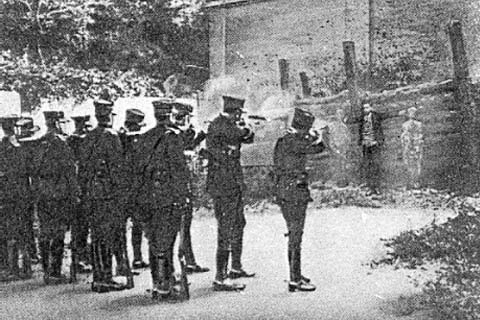
On this date in 1867, a firing squad disabused a Habsburg heir of his pretensions to the throne of Mexico.

A little bit loopy, a little bit liberal, and fatally short of common sense, Ferdinand Maximilian Joseph* decamped from the easy life at his still-under-construction dream palace outside Trieste for an exalted title that really meant playing catspaw for Napoleon III‘s Mexican land grab.

(To assuage the pangs of imperial adventurism upon our tender-headed hero, Maximilian had been “invited” to assume the Mexican throne by a convention handpicked to do just that.)

There the puppet emperor with the silver spoon in his mouth found himself pitted in civil war against the Amerindian peasant from the school of hard knocks: Benito Juarez, one of Mexico’s great liberal statesmen.

As the tide turned in favor of Juarez and the liberals, and Napoleon’s attention increasingly fixated on problems closer to home, the French threw in the towel.

But Maximilian had too much honor or too little sense to heed his patron’s advice to get out while the getting was good; sticking it out with “his people,” he was captured in May, 1867.

Juarez desiring to give any future bored European nobles second thoughts about New World filibustering, Maximilian got no quarter.**

While Louis Napoleon emceed a world’s fair on the other side of the planet, Maximilian was shot with two of his generals, Miguel Miramon and Tomas Mejia.


Manet’s The Execution of Maximilian, showing an obvious compositional debt to Goya’s Executions of the Third of May. Further analysis: written English; video Spanish.

Maximilian’s widow Charlotte — “Carlota”, when trying to blend with her adoptive subjects — descended into a long-lived madness back in the Old World, but was rumored to have borne with one of Maximilian’s French officers an illegitimate child who would go on to become an infamous Vichy collaborator.

Books about Emperor Maximilian

This sensational affair attracted plenty of coverage in the ensuing years; as a result, there is a good deal of topical material from near-contemporaries now in the public domain. Maximilian in Mexico: A Woman’s Reminisces of the French Intervention 1862-1867 (Gutenberg | Google Books) is a zippy read.

* Brother to Austrian Emperor Franz Joseph.

** Spanish trial records are here. European appeals for clemency poured in, but Maximilian had doomed himself with the “Black Decree” of 1865, ordering summary executions of captured Republicans.

The time for indulgence has gone by: it would only encourage the despotism of bands of incendiaries, of thieves, of highwaymen, and of murderers of old men and defenseless women.

The government, strong in its power, will henceforth be inflexible in meting out punishment when the laws of civilization, humanity, or morality demand it.

Juarez answered the clemency appeal of Princess Salm-Salm with solemn words:

If all the Kings and Queens in Europe [pled for Maximilian] I could not spare that life. It is not I who take it; it is the people and the law, and if I should not do their will the people would take it and mine also.

On this day..

1836: Goliad Massacre

On this date in 1836 — Palm Sunday, as it happened — over 300 Anglo POWs fighting to separate Texas from Mexico were executed en masse outside Goliad’s fortress

Less widely celebrated than the Battle of the Alamo preceding it by a fortnight, the Battle of Coleto on March 19-20 had seen Mexican troops surround and capture another force of Texians at Goliad.

Unaware of a Mexican order issued the previous December to execute foreign prisoners,* the men under Col. J.W. Fannin — a dithering commander whose military competence didn’t quite equal his romantic aspirations — expected to be released in a matter of weeks. They were marched out this morning on some innocuous pretext and had bare moments to apprehend their impending fate before their guards mowed them down. (Fannin was individually shot apart from his troops.)

Nineteenth-century musketry was a mediocre tool for mass slaughter, especially when the targets were nearly as many as their executioners. A number of prisoners survived the volley and managed to escape the subsequent cavalry charge and bayoneting by leaping into a nearby river. A fortunate few others were intentionally preserved. This thorough site on the massacre** preserves several survivor accounts.

These memoirs also detail life in the unit and troop maneuvers that are certainly of interest; in these pages, of course, we are most drawn to the accounts of those who stared death in the face — like this (understandably melodramatic) description by Herman Ehrenberg:

Either life or death! Behind were the bayonets of the murderers, and before me was the sword of a coward that crossed my way to the saving stream. Determinedly I rushed upon him. Forward I must go, and — the coward took flight in characteristic Mexican gallantry. Now the path was open, near was the point of my escape.

Arriving at the other bank of the river, I looked around once more to where my comrades were dying, while the bullets of the still firing enemies whistled about me. The hellish exaltations of the enemy mixed with the cries of pain of my dying brothers sounded over to me. What feelings took possession of me here! I cast another look and a farewell greeting to my dead companions and turned to flee. I had to hasten if I did not wish to fall into the hands of the lancers who were now on this side of the river less than a half a mile below me.

Which makes an interesting stylistic contrast with the story of John C. Duval, similar in its events but strikingly low-key, even ironic:

Some one near me exclaimed “Boys! they are going to shoot us!” and at the same instant I heard the clicking of a musket locks all along the Mexican line. I turned to look, and as I did so, the Mexicans fired upon us, killing probably one hundred out of the one hundred and fifty men in the division. We were in the double file and I was in the rear rank. The man in front of me was shot dead, and in falling he knocked me down. I didn’t get up for a minute, and when I rose to my feet, I found that the whole Mexican line had charged over me, and were in hot pursuit of those who had not been shot and who were fleeing towards the river about five hundred yards distant. I followed on after them, for I knew that escape in any direction (all open prairie) would be impossible, and I had nearly reached the river before it became necessary to make my way through the Mexican line ahead. As I did so, one of the soldiers charged upon me with his bayonet (his gun I suppose being empty). As he drew his musket back to make a lunge at me, one of our men coming from another direction, ran between us, and the bayonet was driven through his body. The blow was given with such force, that in falling, the man probably wrenched or twisted the bayonet in such a way as to prevent the Mexican from withdrawing it immediately. I saw him put his foot upon the man, and make an ineffectual attempt to extricate the bayonet from his body, but one look satisfied me, as I was somewhat in a hurry just then, and I hastened to the bank of the river and plunged in. The river at that point was deep and swift, but not wide, and being a good swimmer, I soon gained the opposite bank, untouched by any of the bullets that were pattering in the water around my head.


The Texas state flower — the bluebonnet — blooms in front of the monument put up to the Goliad Massacre on its centennial. Creative Commons image from Matthew Lee High.

History buffs in the Goliad environs this weekend can catch the annual re-enactment of the Goliad Massacre this weekend at Presidio La Bahia.

* The order came from the top, but the general who captured Goliad had no stomach to carry it out. He asked for leniency … but received an emphatic confirmation of the execution order.

** Also see its unit rosters tracking the particular fates of most of Fannin’s men, and these biographies of the unit.

On this day..

1836: The defenders of the Alamo, much remembered

On this date in 1836, Mexican forces commanded by President Antonio Lopez de Santa Anna overran the Alamo — and executed those few of its defenders who survived the day’s battle.

“Remember the Alamo!”

This most memorable battle of the Texas Revolution has since retained its place in the founding mythology of Texas and its draw as a tourist destination in San Antonio, no matter the complexities on the ground. (You can watch the earliest surviving film treatment, The Martyrs of the Alamo, free online. D.W. Griffith made it the same year he made Birth of a Nation.)

That Alamo of blood and legend, and the countervailing interpretations it eclipses, are much beyond our scope here, but we are attracted to notice the reputed summary execution of five to seven defenders who had surrendered or otherwise been captured during the fight. (A few dozen mostly civilian noncombatants in the former mission also survived, and were not executed.)

According to Robert Scott, Santa Anna was empowered by a Mexican resolution holding (not without cause) that

“foreigners landing on the coast of the Republic or invading its territory by land, armed, and with the intent of attacking our country, will be deemed pirates.”

Who counted, at this moment, as “foreigners” among the Anglo settlers trying to break away from Mexico and their supporters among from the United States to which Texas would eventually attach poses a historiographical riddle. But then, Santa Anna wasn’t there to write a dissertation, but to win a war — and he was said to be sorely annoyed at the defenders having tied him down for a week and a half.

King of the Wild Frontier

Covered by most any definition of “foreigner” would have been the Alamo’s most famous defender, Tennessee frontiersman and former U.S. Congressman Davy Crockett. He had arrived in Texas just a few months before, on a rendezvous with destiny.*

It’s a matter of dispute whether Crockett was among those last few executed; in an event this emotionally remembered, every version of the Crockett death scene — from “found dead of injuries amid a heap of Mexican casualties” to “cravenly bargained for his life” — gores someone’s ox.

Even if the account of Crockett’s presence among the executed derives from a disputed source — well, this blog has not scrupled to highlight the fictional and the mythological, those executions whose resonance transcends factual accuracy.

And even if Davy Crockett was not among those anonymous souls put to death this day, it is by his name that they have their tribute, as in the 2004 film** The Alamo:

* Destiny by way of Walt Disney.

** This Disney film diddles with the Crockett legend that Disney helped to inflate in the 1950’s — to the annoyance, of course, of traditional-minded Alamo partisans.

On this day..

1530: Tangaxuan II, the last Tarasco ruler

This date in 1530 marked the end of the pre-Columbian Tarasco Empire, when the Spaniard Nuño Beltrán de Guzmán lashed its last independent king (Spanish link) to a tree and burned him to death.

Legendary even by conquistador standards for his cruelty, Beltran de Guzman eliminated the Tarascan state in western Mexico — a onetime Aztec rival which had got off relatively easy during Cortes’s 1520s incursion by cooperating with the Spanish.

Beltran de Guzman had set out from Spanish holdings on the hunt for gold, butchering the many natives on his westward jag unable or unwilling to comply with his demand for more and better treasure.

Tangaxuan — or Tangaxoan, or Tanganxoan, or Tangaxhuan, and other such variants — met his foreign-born visitor peacefully with some gifts of gold and silver. This only whetted Nuno Beltran de Guzman’s appetite, and he promptly had the king detained and tortured for more pelf before dispatching him by dragging by horses and burning alive at the confluence of the Río Lerma and the Río Angulo. (Spanish, again.)


The monumental Juan O’Gorman mural in Michoacan, the present-day Mexican state occupying what was once Tarascan land, depicts this day’s execution above the inscription, “Tangaxhuán, the last monarch of the Purhépecha Indians was tortured and assassinated by the ferocious hordes led by the sadistic, vile, Nuño de Guzmán.”

Although even other Spanish officials viewed our bloodthirsty conquistador with distaste, his depredations were ultimately rooted in the logic of imperial expansion, and the conquest of Tarasco consolidated (Spanish link) the colonial power’s grip on “New Spain”.

On this day..

1929: José de León Toral, assassin of Álvaro Obregón

On this date in 1929, a Catholic militant who had gunned down the president of Mexico was shot for his trouble.

In the midst of the dirty Cristero War pitting Catholics against a secular, development-minded state, adroit former president Alvaro Obregon had just won election to a new term.

On July 17, 1928, as the president-elect banqueted in Mexico City, starving artist and father of three Jose de Leon Toral (English Wikipedia entry | Spanish) gained admittance as an itinerant caricaturist … then shot dead his putative subject square in the face.

En route to his inevitable Calvary, which he met like Father Miguel Pro with the insurgents’ cry of “Viva Cristo Rey!”, Toral had occasion to stand in a sensational trial where he described to a live radio audience his tortures at the hands of the police. (There’s an illustration at this Spanish-language biography.)

And of course, he’s got his own corrido.

On this day..

1927: Father Miguel Pro, “Viva Cristo Rey!”

On this date in 1927, the anti-clerical Mexican government made the emblematic martyr of the Cristero War.

This video is in Spanish, but the storyline is pretty easy to follow — young man finds faith, lives faith, dies faith.

Miguel Pro‘s dying cry, “Viva Cristo Rey!” — “Long live Christ the King!” — was a refrain of Cristeros, anti-government guerrillas who in the late 1920’s fought the revolutionary Mexican government’s attempts to forcibly restrict the power of the Catholic Church.

That conflict had been brewing for years, an outgrowth of Mexico’s own complex history of colonization and development — measures to restrict the church’s size, wealth, and social reach had been mooted and sometimes implemented well back to the middle of the 19th century.

Early in the 20th, the confrontation was merely a twist on its classic form: liberal state-builders and the Catholic hierarchy were (or increasingly saw themselves as) diametrically opposed in their vision for Mexico.

That conflict came to a head under president Plutarco Elias Calles, an irreligious northerner with a project of national capital development for whom the church’s intransigence from its agrarian strongholds was most unwelcome … and who seemed to delight in provoking Rome with sport like mandatory physicals for priests, not neglecting to publicize the incidence of venereal disease thereby revealed.

Liberals had already brought about drastically reduced clerical privileges in the Mexican Constitution of 1917; its somewhat draconian measures were neither fully enforced nor fully resisted, but initiated a period where the two hostile institutions rudely grappled for their respective spheres of influence on the ground.

Calles was the rudest grappler of all, and his 1926 Calles Law pushed for anti-clericalism stricter than the letter of the constitution … and sparked armed resistance.

It was an exceptionally dirty war with routine summary executions on both sides and thousands of Catholic refugees — a dangerous environment for any priest with legal sanctions against basically every practice of the vocation. (Photos of Cristeros, some in heroic resistance and others in grisly martyrdom, can be eyeballed here.)

Pro, a Jesuit who like many was forced underground, was under state surveillance and got picked up in the aftermath of an assassination attempt against a prominent politician. He was chosen to make an example of — without an actual trial, possibly because there’s no actual reason to think he was involved in the bombing.

Looking at these pictures of Pro’s last moments, it’s hard to believe that they were taken and circulated at government direction to cow the Cristero movement. Fail.


Led out to execution in a police courtyard. The place of his death today is (bizarrely) Calle Loteria Nacional.


Calmly at prayer before his death, under the eye of the firing squad commander.


Pro himself refused a blindfold. But why state authorities carrying out the execution with an eye towards public relations would allow him to die in this pose is anyone’s guess.


He blessed and forgave the firing squad, of course.


Just beginning to topple at the moment the bullets struck him.


Like many firing squad executions, this one failed to kill its victim with the ceremonial volley. Pro was finished off with a coup de grace.

Calles was simultaneously — the key measures were also enacted in 1926 — involved in a confrontation with the United States over oil rights, a situation that came to the brink of war, with Washington saber-rattling about “Soviet Mexico”. It’s tempting to wonder whether the two situations weren’t related, especially since the new American ambassador* who had arrived only the month before Pro’s execution would ultimately negotiate both situations’ resolutions.

While the natural resource politics went their separate way, the Mexican Revolution’s anti-clerical strain didn’t so much disappear by negotiation as fade away over decades, with regular new outbreaks.

One thinks of Mexico today as such so staunch a Catholic country that it’s hard to imagine that some of these provisions were only officially repealed in 1998.

As for Pro, he’s welcome in Mexico by now — celebrated by Pope John Paul II who ultimately beatified him, and the inspirational source of this hymn whose refrain is his famous last cry.

There’s a faithful site in his honor here, and apparently a shrine to him in Houston, Texas run by a group pushing for his canonization.

* The American ambassador in question, Dwight Morrow, invited Charles Lindbergh on a goodwill tour to Mexico, where the aviator would meet the diplomat’s daughter not long after Miguel Pro’s martyrdom. Little could Lindbergh and Anne Morrow suspect that their love match would set them on the path to their own famous encounter with capital punishment.

On this day..

1811: Miguel Hidalgo y Costilla, for Mexican independence

On this date in 1811, Mexican independence icon Miguel Hidalgo was shot for treason at the government palace in Chihuahua.

The subversive priest had set the spark to the Mexican War of Independence in the hours before sunrise of September 16, 1810. There, he rang the parish bell in the small town of Dolores and issued his “Grito de Dolores” — “Cry of Dolores” — summoning native Amerindians and mestizos to throw off the Spanish.

The movement got added juice from the fact that the Spanish jackboot was then being worn by Napoleon, who had installed his brother as king.*

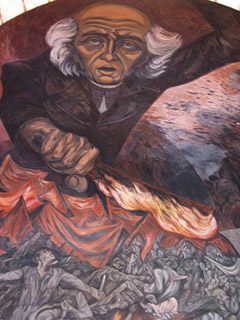
Hidalgo tributes are a mainstay of every Mexican town. This Orozco mural is in a government building in Guadalajara.

Hidalgo’s fired-up downtrodden mob slaughtered the local garrison and gathered numbers on a march towards Mexico City before the professional Spanish soldiery rallied to stop it. But the priest wouldn’t make his father-of-the-country credentials in generalship: he’d been relieved of command after repeated combat debacles by the time the insurrection’s leaders were betrayed in March.**

While his comrades Ignacio Allende, Jose Mariano Jimenez and Juan Aldama were shot on June 26, Hidalgo got an old-school detour through the ecclesiastical arm for defrocking (and a highly suspect alleged retraction).

When he was shot this day, he directed the firing squad to aim for the hand he placed over his heart.

Then, his head was cut off and stuck on a pike as a warning.

The struggle lived on, long past Hidalgo’s execution and Bonaparte’s fall, and finally resulted in Mexican independence in 1820. Today, the padre whose call to action not only started the revolt but made it a mass movement is the face on the 1,000-peso note, and his Grito de Dolores is repeated every Diez y Seis de Septiembre as an independence day tribute by Mexican authorities — as in this from 2006:

* Inspiring this blog’s banner in the process.

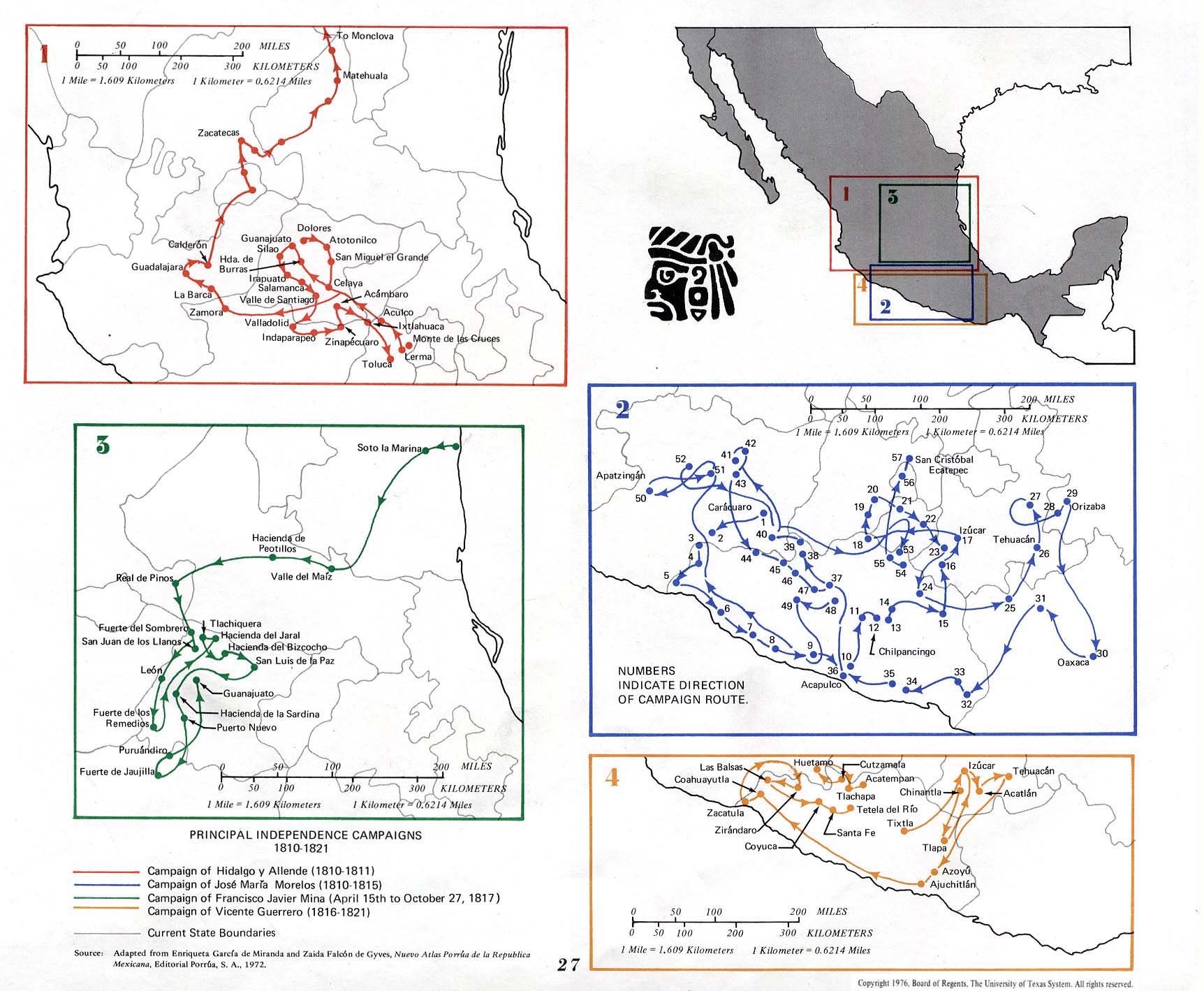
** There’s a map of Hidalgo and Allende’s army’s movements — and subsequent campaigns in the war — here.

On this day..

1913: Antonio Echazarreta, defending Matamoros

On this date in 1913, constitutionalist troops in the Mexican Revolution consolidating control over the border town of Matamoros shot a 23-year-old colonel who helped lead the city’s volunteer resistance.

Garrisoned by fewer than 50 regular soldiers, Matamoros put up only brief resistance to Gen. Lucio Blanco‘s June 3-4 attack, many of its government officials and wealthy denizens bolting over the Rio Grande to adjacent Brownsville, Texas.*

But some of the young guns in town had an overdeveloped sense of heroic machismo and sold their lives dearly to postpone the inevitable.

Groups of young Matamoros men, some of them fourteen and fifteen years old, volunteered for service under irregular huertista officers. They fought stubbornly until early in the morning of June 4. A number of them were captured and executed by Blanco’s men. (Source.)

Echazarreta’s leadership of these ill-fated guerrillas saw him up against the wall this day, but also saw him into the revolution folk song about the city’s conquest, “Corrido de la toma de Matamoros”. Nor was the revolution yet finished with Matamoros, or its martial prowess.

In 1915, as the rival revolutionary factions openly broke with one another, carrancistas loyal to President (and Villa rival) Venustiano Carranza inflicted a signal defeat on Villa at Matamoros that began Villa’s march into political and literal wilderness. It’s commemorated in yet another revolutionary corrido, here sung by Jose Suarez (via the U.S. Library of Congress):

[audio:Corrido_villesta_de_la_toma_de_Matamoros.mp3]

* An interesting photo album covering this battle is available here.

On this day..

1596: Francisca Nunez de Carvajal, her children, and four other crypto-Jews of her family

On this date in 1596, the Inquisition sent nine Jewish converts to Christianity to the stake in Mexico City for Judaizing — a cruel fate offering a window into a secret history of New World settlement.

When Spain expelled its Jews (and subsequently its Muslims), those who did not flee had to convert. Conversions at swordpoint being of suspect sincerity, the Inquisition spent much of the following centuries hunting Conversos — so-called “New Christians” — who secretly preserved their outlawed faiths.

For some crypto-Jews, the New World held an appeal akin to that which would draw later generations of northern Europe’s religious minorities.

Latin America in particular attracted considerable numbers of New Christians. The advantage of these territories was that they offered the New Christians a familiar culture and the possiblity of direct — even if infrequent — contact with the mother countries … These factors also helped permit [crypto-Jews] to practice Judaism.

The Carvajals (or Carabajals) were just such a family, settling in Monterrey under the aegis of their kinsman, Spanish governor Luis de Carvajal y Cueva.

But in 1590, the governor’s sister Francisa was tortured by the Inquisition into implicating her entire family in Judaism.

They got off with a humiliating public recantation, but evidence of a relapse a few years later resulted in Francisca being burned at the stake at an auto de fe — along with her children Isabel, Catalina, Leonor and Luis, and four of their in-laws. The 30-year-old Luis left a testimonial to his faith and his tortures.

A headstone in New Mexico, USA, suggests crypto-Jewish descent. Image used with permission.

Despite the grisly doings of this day, however, the Inquisition never could extirpate Jews from its American territory.

These hidden communities filtered into Mexico and north to the present-day United States, keeping adapted versions of Jewish traditions secretly alive.

Still, crypto-Jews produced scant potentially self-incriminating documentary evidence. Although DNA testing has latterly entered the scene, the true extent and nature of these populations has been the subject of lively scholarly controversy.

But the Carvajals and others like them, seemingly lost to the Inquisition’s depredations, are coming alive again. This day’s executions are the subject of a modern opera and a spring 2008 Texas A&M symposium.

And the wider community of crypto-Jews have their own umbrella organization and a burgeoning body of historical literature.

Books about crypto-Jews

On this day..

1919: Felipe Angeles

On this date in 1919, Mexican hero General Felipe Angeles was shot at dawn in Chihuahua, hours after a military tribunal condemned him for rebellion.

Angeles, a humane and cosmopolitan socialist, had tacked a unique course through the dangerous Mexican Revolution. The career artillerist’s military counsel was a high card in the hands of the revolutionaries, and helped to make the coruscating career of Pancho Villa. Crucially, Angeles advised Villa to seize the mines of Zacatecas, dealing a mortal blow to the putschist Huerta government by throttling its currency at the source.

But that brilliant maneuver countermanded an order of the Revolution’s moderate political face, Venustiano Carranza, and both personality conflicts and support for more radically redistributionist measures soon sundered the Villa factions’ alliance with Carranza.

Angeles hitched his destiny to Pancho Villa and is historically recalled as the “angelic” opposite number to the famed guerrilla’s other top military henchman, the murderous Roberto Fierro. The three lend themselves almost implausibly to allegorical literature — “the decisive biographical proof of Villa’s duality … found in the two men closest to him, equidistant and extreme extensions of his nature.” (Enrique Krauze)

Angeles aimed, perhaps, at a statesmanship that might have remembered him the father of his country.

‘It was the recurrent dream of the impotent revolutionary intellectual: to play Plato to some powerful but pliant popular caudillo.’ This may well be an accurate analysis of Angeles, who probably had ambitions to be president of Mexico, with Villa as the power behind the throne but based in Chihuahua, allowing Angeles free rein to implement radical reforms in the capital

… Angeles probably saw Villa as a tabula rasa on which he could imprint his ideology. The problem was that Villa had no taste for abstract thought; as [John] Reed remarked ironically: ‘You had to be a philosopher to explain anything to Villa.’

To the grief of both, Villa neglected Angeles’ expertise when the Villists faced Carranzo at arms. Against advice, Villa abandoned Mexico City, failed to attack when the constitutionalists were tenuous, then spurned guerrilla operations for a frontal assault into the teeth of a foe with numerical superiority and lethal tactical advances culled from the slaughterhouse of World War I.

All was postscript after the Battle of Celaya — Villa maintaining for a few years as a bandit force and famously raiding New Mexico while his strategist drifted into exile in Texas before returning to Mexico on a quixotic peacemaking mission that led him instead to a show trial.

Angeles’ end came with the all the dignity of his romantic age. Before his judges — before all the world — he gave “full and clear expositions of his history and his ideas about everything from politics to ontology. It was clear that he knew this was his end, and he seems to have written a kind of intellectual memoir in the protracted answers … he was not defeated morally so much as physically.”

Angeles himself arranged particulars of his own execution with the Carranza men detailed to shoot him. He enjoys posthumous esteem commensurate with his qualities in life:

On this day..