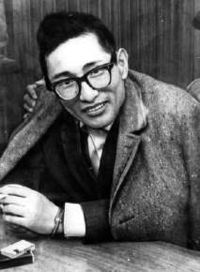
1970: Akira Nishiguchi, Vengeance Is Mine inspiration

On this date in 1970, Japanese serial killer Akira Nishiguchi was hanged for murder.

Born in 1925, Nishiguchi (English Wikipedia entry | Japanese) spent the war years in juvenile detention but emerged in time to work as an interpreter for the U.S. occupation.

He was arrested repeatedly (Japanese link) as a con man during the 1950s. Police had him pegged as a nonviolent serial fraud artist, but in 1963 he killed two drivers to steal from them, then went on the run in Tokyo.

For 78 terrifying days, his face — those fraud convictions came with fingerprints that identified him as the killer — gazed out of wanted posters as Nishiguchi scraped by in cheap hotels and desperate disguises, committing three more murders in the process. Finally, an 11-year-old girl recognized him, posing as a lawyer.

Nishiguchi is the subject of the 1979 Shohei Imamura film Vengeance Is Mine. (Review | Another)

On this day..

1852: Jose Forni, the first legal hanging in California

Detail view (click for the full image) of the hanging of Jose Forni (Forner)

“My friends! You have come to see an innocent man die. I die for having killed an assassin. He attempted to rob me; I resisted; he stabbed me and fled. Maddened and smarting from my wounds, I pursued, overtook, and killed him. I am a native of Valencia, Spain. I have but few friends in San Francisco.

I have resided in Cuba, where I have many friends. I was tried by a judge and jury who were utter strangers to me. I could produce no witnesses in my favor. What led to my killing my assailant is known only to God and myself. What I have said is true. After I have spoken these few words I shall never speak more. No doubt those who tried me acted justly according to the testimony. They could not have known the truth. The Americans are good people; they have ever treated me well and kindly; I thank them for it. I have nothing but love and kindly feelings for all. Farewell, people of San Francisco! World, farewell.”

Jose Forni’s last words (translated from Spanish)

Having so declaimed, Jose Forni (or Forner) dropped through a trap on San Francisco’s Russian Hill and into the history books as the first hanging under color of law in the state of California.

Forni was pretty small potatoes for such a milestone, a Spanish immigrant caught stabbing to death a Mexican in broad daylight a mere three months before.

Despite Forni’s mysterious last statement, everyone was in fact pretty sure they knew what led to the killing.

Forni was found with a sash containing $350. This sash, a Mexican style not popular with Spaniards, had been observed in the possession of the victim Jose Rodriguez earlier that evening, by a gambling-hall dealer who saw Forni follow Rodriguez out the door. (Source)

Forni stuck to the story that it was his, and that Rodriguez had tried to jump him and take it when Forni set the sash down to relieve himself. And that then, after he’d been stabbed in the leg, he chased down the assailant.

Yeah, right.

“It was a proud day for the law,” wrote (doc) historian Hubert Howe Bancroft. “It was a happy sight, I say, this hanging of the moneyless, friendless Spanish stranger.”

If this doesn’t seem like the sort of thing hippy-dippy San Francisco would ordinarily strut about, bear in mind that the previous year, a standing Committee of Vigilance had formed itself and meted out extrajudicial lynchings without waiting on “the quibbles of the law, the insecurity of prisons, the carelessness or corruption of the police, or a laxity of those who pretend to administer justice.” Similar committees operated elsewhere in the state.

So the fact that Forni was suffered to wait on the quibbles of the law was a sort of progress. And it does sound, from the report in the next week’s (December 16) Alta California, as if the populace were jolly pleased to see it.

A continuous line of human beings was pressing up the hill all the morning, until a crowd numbering three thousand at least had gathered together [n.b. – nearly a tenth of San Francisco’s population at this time -ed.] … the assemblage was indeed a singular one — there being at least one-fourth of the number composed of youths, women and children. Women elbowed their way as near as possible to have a full view of the gallows, whilst others were on horseback and in carriages, riding around with as much gaiety as if on a pleasure drive.

But what was most shocking was to see respectable looking parents taking their little sons and daughters into such a heterogenous crowd, to witness such a terrible spectacle. Despite the slight rain, they stood it out with heroical fortitude and patience worthy of a better occasion. Before the prisoner had arrived, the small boys amused themselves with playing marbles, the bigger ones with dog fights, whilst others whiled away the time recounting their experience in such matters.

Reflecting on the homicide that had occasioned all this festivity, the Alta prayed that “our criminal records never be stained again with the history of such a dark and bloody transaction.”

Yeah, right.

On this day..

1999: James Beathard, on the word of a known liar

(Thanks to Mary O’Grady for the guest post. -ed.)

Murder is not a common occurrence in Trinity County, Texas. The shotgunning of three members of the Hathorn family in their trailer home on the evening of October 9, 1984 remains notorious, even among locals who were not yet born on the date of the crime.

Clues scattered at the crime scene, African-American human hairs and Kool cigarette butts, were supposed to convince authorities that a certain sort of suspect had killed Gene Hathorn, Sr., his wife Linda Hathorn, and their teenaged son Marcus Hathorn. Mr. Hathorn’s recent receipt of a $150,000 property settlement and his recent disputes with his elder son, Gene Hathorn, Jr., led law enforcement in a different direction. Less than one month after the bodies were found, Gene Hathorn, Jr., and his running buddy James Lee Beathard faced charges of capital murder.

Prosecutors developed evidence that Gene Hathorn, Jr., hatched the plot to kill his family in order to inherit his father’s new wealth. It seems he was unaware that his father had formally disinherited him three weeks before he was murdered.

James Beathard was first to stand trial.

Called to the witness stand by District Attorney Joe Price, Gene Hathorn, Jr., testified against Beathard, to devastating effect. Hathorn claimed that Beathard entered the trailer, killed all three victims, and planted the false clues, while he himself fired only one shot through a window. Beathard was sent to death row.

When the younger Hathorn was brought to trial, District Attorney Price reversed his theory from Beathard’s trial, depicting Hathorn as the “inside man” and the strategist who believed he had concocted the perfect crime. Gene Hathorn, Jr., joined James Lee Beathard on Texas’s death row. Hathorn recanted his testimony against Beathard. No appeals court took notice.

In the mid-1980s, Texas’s male death row occupied part of the aging, red brick and steel Ellis I prison unit outside Huntsville. For prisoners such as James Beathard and Gene Hathorn who conformed themselves to the rules, a considerable amount of communication with other prisoners and with the outside world remained possible. Each of these sons of East Texas soon found himself editor of a death row periodical, the Lamp of Hope in Hathorn’s case and the Texas Death Row Journal for Beathard. Over the years, Beathard emerged as a prolific letter-writer and essayist, publishing a brief nonfiction piece describing life on death row in the British Guardian Weekly in August, 1996.

Beathard’s talent as a correspondent won him considerable sympathy during his fourteen years on death row. As they exchanged letters, American playwright Bruce Graham fictionalized Beathard in his short play, Coyote on a Fence.

James Beathard’s intelligence and powers of articulation were unusual among death row prisoners. Since he could be trusted to exit and re-enter his cell with no fuss and to refrain from blithering forth psychotic delusions, he was sometimes trotted out when prison authorities needed a condemned man to meet the press.

James Beathard’s appeals ran out at last in 1999. He was executed, still protesting his innocence, on December 9th of that year.

His partner in crime, Gene Hathorn, Jr., won an appeal in 2009 based on his trial attorney’s failure to introduce evidence of his father’s abuse of him in childhood. He is now serving consecutive life sentences, reportedly working as a prison cook in general population.

On this day..

Hand of Glory: 1,500 days and counting

(cc) image from Chris Chan.

Today’s post marks the 1,500th consecutive day of death-blogging for Executed Today.

False modesty aside, we consider it a rather glorious achievement of the pen-hand to have hit this milestone. (Previous end zone celebrations: 500 | 1000 (and 1))

And in the spirit of marking the digital feat denoted by this sort-of round number, we thought a bonus post was in order on capital punishment’s own glorious hand — the legendary Hand of Glory.

Like that dread artifact itself, today’s entry comes from someone else’s hand. Thanks to Carroll University historian Scott Hendrix (co-editor of Rational Magic) for lighting the way to some forbidden gallows-lore…


In J.K. Rowling’s The Half Blood Prince, Draco Malfoy employs a particularly grisly tool to escape from the Room of Requirement under the cover provided by a Peruvian Instant Darkness Powder: a Hand of Glory.

In the Harry Potter mythos this device provides light that is only visible to the holder, making it the perfect instrument of young Malfoy’s escape. That is, assuming that he doesn’t mind carrying a mummified hand equipped with fingers that burn with a gruesome light. Many people might balk at going to such lengths, and the reader could be forgiven for assuming that Ms. Rowling was exercising a bit of literary license in order to titillate and provoke her young (and sometimes not so young!) readers’ imaginations.

However, should one wish to take a trip to the charming Whitby Museum* in Whitby, North Yorkshire, England, a Hand of Glory is prominently displayed — perhaps (this is a perhaps to which I shall return later). According to the accompanying placard — though I admit I had to investigate the museum’s website to refresh my memory, as I’d not seen it in almost a decade — Joseph Ford, a local stonemason and art historian found the hand hidden in the wall of a thatched cottage in nearby Castleton in 1935.

He “immediately identified it as a ‘Hand of Glory.'” In a way, it makes sense that he would do so, as it seems that stories of such hands had become quite popular in England beginning in the nineteenth century. Several books, such as Thomas and Katharine Macquoid’s 1883 About Yorkshire and Sabine Baring-Gould’s 1873 Curious Myths of the Middle Ages, described such hands.

According to the authors these were instruments of the blackest magic, wrought by witches working in the darkest night. Through invocation of demons and the enactment of foul rituals, these witches created a magical burglar’s tool from the severed hand of an executed thief.

It seems that such tales found the Victorian imagination of English readers to be fertile ground, as the tales were told and retold. No doubt readers found themselves deliciously chilled at the idea of burglars employing such a device of black magic, guaranteed not only to open locked doors but also to keep sleepers asleep and off their guard as those with dark designs crept into their homes.

But as the title of Baring-Gould’s book would indicate, the story of the Hand of Glory had real legs. It persisted over the course of centuries and made its way across the European continent.

It was not, though, quite as old as Baring-Gould would have his readers believe.

The earliest known description of the Hand of Glory can be found in the work of the Jesuit canon lawyer and theologian, Martin del Rio. His Six Books of Magical Essays, published between 1599 and 1600, is a veritable smorgasbord of lore relating to black magic and witchcraft. One should not get the idea that del Rio approved of the things he wrote about, however. Rather, he wrote in order to educate Inquisitors about the tools employed by their foes, the witches he assumed to prowl the continent preying on the good Christians who relied on the priesthood for protection. Announcing his intent in the introduction his Six Books, del Rio wrote that

magic follows heresy, as plague follows famine. We have seen heresy flourishing in Belgium and we see swarms of witches laying waste the whole of the North, like locusts. The heretics are strongly opposed by the Jesuits. This book is a weapon in that war.

Therefore, descriptions of the tools used by practitioners of black magic were intended to combat the “swarms of witches” that so concerned him. These witches found instruments such as the Hand of Glory, which he describes in book two of his study, to be ideal for carrying out their plots.

Del Rio’s Six Books of Magical Essays proved to be a runaway best seller, going through twenty editions between 1599 and 1755. Among the many stories it spread were those of the Hand of Glory, and soon we see stories arising of thieves making use of these devices in order to rob and plunder the inhabitants of Germany, France, and eventually, England.

Sometimes there were local variations relating to their manufacture, as in German tales in which witches made the Hand from the fingers of unborn children. Nevertheless, in all the stories the Hand of Glory is demonic and its use damns to hell those unfortunates desperate or foolish enough to manufacture it.

But what was the source of these tales? Isn’t it reasonable to assume that del Rio was relating stories of actual practices and that many of these practices had an ancient pedigree?

Perhaps we shouldn’t be so fast to leap to such conclusions, for del Rio was an enthusiastic purveyor of many tales that had no objective basis in fact, such as his stories of the Witches’ Sabbat. He described these events as dark versions of the Catholic mass, when Satan came forth in the form of a goat or a dog and “witches came forward to worship him … [offering] candles made of pitch or a child’s umbilical cord, and kiss him on the anal orifice in a sign of homage.”

Such tales were lurid and memorable … and absolutely lacking any basis in fact. (We think -ed.) Historians have given different rationales for why writers such as del Rio told and retold such stories and a full consideration of that topic would take us very far afield from our subject.

Let’s just say for now that exhaustive research by the best minds in the field have shown that there is no evidence that anything like a Witches’ Sabbat ever happened, anywhere.

Similarly, many of the stories del Rio told are likely the result of his willingness to pass along hearsay accounts. In fact, pretty much any tell he relates should be taken with many grains of salt — including stories of the Hand of Glory. There’s no doubt that it was a good story, but a story was all it was. Therefore, efforts such as those undertaken by the early twentieth-century philologist W.W. Skeats to explain the name as coming from the French, main de gloire, which he assumed to be a corruption of mandrake, are unnecessary exercises in verbal gymnastics. The entire reason he even made the effort was so that he could provide a “scientific” explanation for the powers of the Hand by explaining away the stories as nothing more than descriptions of hallucinations induced by ingestion of the mandrake root. But since stories of the Hand of Glory were nothing more than stories, rather than descriptions of something that black magicians had once manufactured, there’s little need for “scientific” explanations of the Hand’s powers.

This brings us back to the Hand of Glory displayed so prominently in the Whitby Museum.

According to the museum this is the only example of a Hand of Glory in existence** … yet it is singularly missing any sign of having been subjected to flames, used as a candle, or otherwise employed as a magical burglary tool.

Why is that? Did someone make it, then hide it, then never use it? Perhaps (there’s that “perhaps” again!). Or perhaps Joseph Ford was a little too quick in his identification of the hand he found in the wall of the thatched cottage as a Hand of Glory. Perhaps instead it’s nothing more than what it appears to be: a withered hand that could have been severed in some sort of accident, coming to be mummified in the many untold years before it was discovered. However, that would hardly make a good story for the charming museum in Whitby. After all, del Rio’s tale of a mummified hand taken from an executed thief and given magical powers through demonic invocation — that certainly makes for a better story both for the Whitby Museum, as well as for J. K. Rowling.†

On the lone bleak moor,
At the midnight hour,
Beneath the Gallows Tree,
Hand in hand
The Murderers stand
By one, by two, by three!
And the Moon that night
With a grey, cold light
Each baleful object tips;
One half of her form
Is seen through the storm,
The other half ‘s hid in Eclipse!
And the cold Wind howls,
And the Thunder growls,
And the Lightning is broad and bright;
And altogether
It ‘s very bad weather,
And an unpleasant sort of a night!
‘Now mount who list,
And close by the wrist
Sever me quickly the Dead Man’s fist!—
Now climb who dare
Where he swings in air,
And pluck me five locks of the Dead Man’s hair!’

And now, with care,
The five locks of hair
From the skull of the Gentleman dangling up there,
With the grease and the fat
Of a black Tom Cat
She hastens to mix,
And to twist into wicks,
And one on the thumb, and each finger to fix.—
(For another receipt the same charm to prepare,
Consult Mr Ainsworth and Petit Albert.)

‘Now open lock
To the Dead Man’s knock!
Fly bolt, and bar, and band!
— Nor move, nor swerve
Joint, muscle, or nerve,
At the spell of the Dead Man’s hand!
Sleep all who sleep!— Wake all who wake!—
But be as the Dead for the Dead Man’s sake!!’

The Hand of Glory: The Nurse’s Story, Richard Harris Barham

* The Whitby Museum is full of necrophernalia.

** The Walsall Museum claims to have an entire arm of glory.

† As well as for bloggers.

Scott E. Hendrix is an historian of medieval and early-modern intellectual history. He’s written a number of books and articles on subjects ranging from astrology to witchcraft, from riots to the history of science. He is an assistant professor of history at Carroll University and the co-editor of Rational Magic.

On this day..

2009: Yang Yanming, hedge fund manager

On this date in 2009, China executed a rogue securities trader for disappearing around $10 million.

The first person executed for securities corruption in China, Yang used his position as a trader for Galaxy Securities to embezzle some 65 million yuan for personal gain.

He never disclosed the money’s whereabouts, presumably taking the secret with him to the grave. (Or to the organ donor market.)

As gangster capitalists go, Yang could hardly be considered exemplary either by scale or by ruthlessness. His peculation undoubtedly harmed many people, but there’s no known whiff of violence about him; he was caught after attempting suicide.

But by the same token, the occasional sacrifice of such middling malefactors potentially helps discharge some of the tension generated by the structural inequality accompanying China’s new oligarchy. What to do in such a world?

“Preserve your moral integrity and don’t set too much store by business results,” Yang told a newspaper prior to his execution. You said it, brother.

On this day..

1869: Nicholas Melady, the last public hanging in Canada

Thanks to John Melady, author of Double Trap, for the guest post about his kinsman. -ed.

I was standing with my father, looking at the ruins of an old house. I thought what remained of the brickwork was interesting, until Dad said, rather offhandedly: “And this is where the murder happened.” I was rather shocked, and asked what he meant.

His answer led me to write Double Trap, the story of the last public hanging in Canada.

Briefly, the tale goes something like this.

A man named Nicholas Melady Senior, my great-grandfather’s half brother, amassed substantial landholdings in Huron County, Ontario Canada, prior to 1868. In the years just before that, he played various family members off against each other, and depending on his whim, one or other of them would be promised his inheritance. His son Nicholas Junior was used worst of all. He worked without pay for his father, was promised all or at least some of the lands, but then was told he would get nothing — several times.

One night, Nicholas Senior, who was commonly called The Old Man, was in bed with his new wife, when Nicholas Junior and two of his friends, all of whom were drunk, broke into the Old Man’s house. A terrible fight ensued, and it included a hand gun and an axe, but at the end of the thing, the Old Man and his bride were dead.

After some very shoddy detective work, Nicholas Junior and his two friends were rounded up and lodged in a basement cell of an old house in nearby Seaforth, Ontario. (The local magistrate owned the place.) Part of that cell still exists, including the barred window the culprits would have looked through — at the rest of the cellar. It is rather creepy to visit, and while I researched Double Trap, I did not want to be there for long, and never at night.

In due course, the three desperadoes were sent to an even more chilling old jail in Goderich, Ontario. (It is now a Canadian historic site, and is visited by throngs of people every year.) There, Nicholas Junior’s friends ultimately turned against him.

However, before that happened, local detectives used a unique stratagem to gain evidence against Nicholas. I could never be sure where they got the idea. They hired a beautiful young woman who was born in Michigan, (who was likely a prostitute) and talked her into spending time in a cell in the jail. She was paid to gain the trust of Nicholas, and hopefully a confession.

In that sense, she was the first part of the “double trap,” in the book’s title.

The woman was given the name “Jenny,” and in time, by dropping notes where he would find them, and ultimately putting herself in a position where she could whisper to him through his cell window, (she positioned herself in the women’s exercise yard; he was inside his cell), she caused him to fall in love with her. All of her notes, and his as well, were used in the trial that followed. The two never actually touched each other.

When she walked into the courtroom during the trial and took the stand to describe her job and show the letters Nicholas had written, he was utterly speechless with shock. He had completely trusted her, and to him, her betrayal was total.

The execution of Nicholas Melady was a macabre affair, as were events leading up to it. His death cell was positioned quite close to where he was hanged. He could hear workers building his scaffold, and while I cannot prove it, I believe he would have been able to witness the construction of the thing. The death cell still exists, and in researching this book, I visited it several times. Now that is creepy.

So is the ground where he took his final few steps, out to the scaffold. It was built on top of the prison wall. He went up the steps on the inside, then lurched to his death, down the outside of the wall — where all the spectators waited to see the spectacle. His fall, through the trapdoor in the gallows floor was the second trap of the book’s title.

The execution was the last public one in Canada. Three weeks later the government of the country abolished public executions because they were regarded as too barbaric. There was controversy however, around the one for Nicholas. Many people felt he had been betrayed, by his accomplices, and by “Jenny,” and so lots of talk in the community made the public officials fear that there would be demonstrations the day of the death.

For that reason, they moved the execution time up by about three hours. “Only” about 300 people witnessed it. Several thousand came to see the spectacle later in the day, but by the time they reached the site, the show was over. His body was cut down, and for reasons I could never fathom, was actually waked for two days in the same house where the killings took place. Lots of the curious came to see the corpse of the killer, laid out for display.

The day after the execution, the New York Times was the first newspaper on the street with the story. I could find no trace of “Jenny,” or what became of her after her jailhouse job. Her testimony in court was never really challenged.

I was able to position myself in the cell where Nicholas was when he whispered to “Jenny.” I then went into the women’s exercise yard and by leaning against the jail wall easily understood how the conversations between the two transpired.

The book is Double Trap, by John Melady. Published by Dundurn, and available in the United States at Dundurn Publishing, 2250 Military Road, Tonawanda, New York 14150. In Canada, the pub address is: Dundurn Publishing, 3 Church Street, Suite 500, Toronto, Ontario M5E 1M2 In Britain, the address is: Gazelle Book Services Limited, White Cross Mills, High Town, Lancaster, England LA1 4XS.

On this day..

1769: Two weavers, for the Spitalfield riots

On this date in 1769, two weavers hanged in East London in a bitter fight over wages and labor power.

Spitalfields, the East London district also known as the stomping-ground of legendary jailbreaker Jack Sheppard, was the capital of a thriving English silk-weaving industry. It had attained 18th century prosperity thanks in large measure to the decision of William and Mary to invite Lyons Huguenots being hard-pressed by the French crown to relocate their talents across the channel. This now-domestic industry* quickly began supplanting formerly dominant French imports.

In 1713 it was stated that silks, gold and silver stuffs and ribbon made here were as good as those from France, and that £300,000 worth of black silk for hoods and scarves was made annually. In 1721 the value of the silk manufactured in England amounted to £700,000 more than in 1688, when wrought silks were imported from France to the annual value of half a million sterling. (Source)

In this roaring and prestigious business, William Hogarth situated his 1747 Industry & Idleness plates: both the Industrious Prentice (eventually destined to become Lord Mayor of London) and the Idle Prentice (eventually executed at Tyburn) start off shoulder to shoulder at the Spitalfields looms.

But as the 18th century unfolded, even the most industrious Spitalfield weavers came under increasing competitive pressure especially from Chinese and Indian imports.

Although Parliament attempted to ban textile imports to preserve the domestic industries, Spitalfield workers were known to enforce their prerogatives directly by attacking people in the street thought to be wearing foreign prints. This simmering tension came to a rapid boil after settlement of the Seven Years’ War enabled England and France to resume trading — and a glut of French textiles to undermine weavers’ price controls.

Conflicts were no less fierce within the weavers’ community, between masters and laborers. Workers combined to maintain wages by attacking those thought to be undercutting prices.

In September 1769, one such action punished a wealthy anti-“combination” (for “combination”, read “labor union”) manufacturer named Lewis Chauvet, and cut the silk handkerchiefs right out of his looms.


From Season 3, Episode 2 of the BBC drama Garrow’s Law, which is directly based on this case. As of this writing, the entire episode can be found on YouTube.

Cutting silk from the loom was a rough method of enforcement by the labor combination. It had also been made a capital crime a few years before. And it turned out that Chauvet was ready to make his the test case.

Richly paying off a couple of independent artisan weavers for their questionable testimony, he secured the conviction of John Valloine or Valline (other alternate spellings are possible; the name clearly denotes the district’s Huguenot heritage) and John Doyle, two weavers allegedly part of the loom-smashing action. The accused denied it, Doyle reported to have fulminated at the gallows, “I am as innocent of the fact I am now to die for as the child unborn. Let my blood lie to that wicked man who has purchased it with gold, and them notorious wretches who swore it falsely away.”**

Manufacturers’ purposes were served just as well whether innocent or guilty. The point was labor discipline, not a few lost hankies.

Accordingly fixing “to strike Terror into the Rioters”, the crown ordered the execution to occur not at the Tyburn gallows, but right in the weavers’ backyard, adjacent Spitalfields at Bethnal Green.

This order actually delayed the sentence for the judiciary’s consideration of the minor point of whether this was allowed at all — since the actual boilerplate sentence read from the bench had specified “the usual place.” The wisest magistrates of the land considered the matter and in time agreed that “the time and place of execution was no part of the sentence” and therefore subject to His Majesty’s discretion. Bethnal Green it was.

They were therefore this morning taken in a cart from Newgate through the City to Whitechapel, and thence up the road to Bethnal Green, attended by the Sheriffs &c, with the gallows, made for the purpose, in another cart; it was fixed in the cross road, near the Salmon and Ball.


The Salmon and Ball pub, where the execution happened, today. (cc) image by Ewan Munro.

There was an inconceivable number of people assembled, and many bricks, tiles, stones &c thrown while the gallows was fixing, and a great apprehension of a general tumult, notwithstanding the persuasion and endeavours of several gentlemen to appease the same. The unhappy sufferers were therefore obliged to be turned off before the usual time allowed on such occasions, which was about 11 o’clock; when, after hanging about fifty minutes they were cut down and delivered to their friends. (cited here)

Vengeful weavers having their noses rubbed in their comrades’ executions smashed up Chauvet’s house in the riots on this date, and the powers that be decided that one hanging-day at Bethnal Green was plenty. A few other rioters convicted as confederates of Doyle and Valline were put to death at Tybun later in December 1769.

Years of violent labor conflict were finally quelled with the 1773 Spitalfield Weavers Act, a political compromise which protected the domestic industry from foreign competition and enabled magistrates to set wages.

Though this act stabilized a tense domestic situation, its effect over several decades was seriously problematic: a protected monopoly with wage-controlled workers maintained an increasingly obsolete system of labor-intensive manufacture that fell behind power looms coming online elsewhere.

As late as 1851 — mechanization wouldn’t fully take over until Britain’s trade liberalization of the 1860s — Charles Dickens visited Spitalfields, and saw a weaver

doing now, exactly what his grandfather did. Nothing would induce him to use a simple improvement (the ‘fly shuttle’) to prevent the contraction of the chest of which he complains. Nothing would turn him aside from his old ways. It is the old custom to work at home, in a crowded room, instead of in a factory.

Disallowed from taking lower wages even in bad times (or when cheaper cotton started displacing silk), many weavers sat completely unemployed instead — gradually sinking into a proletarianization they had fought to avoid. Spitalfield weavers eventually became one of the classic case studies in the laissez faire economics canon.

* Just to be clear, Huguenots weren’t the first silk weavers in Spitalfields; it’s just that their arrival let the industry take off.

** The hanged man’s comrades made good his gallows menace. Peter Linebaugh, whose The London Hanged is an outstanding resource on the economic pressures that brought these weavers and many others to the gallows, relates:

At noon upon a cold and snowy day, 16 April 1771, [Chauvet’s paid witness against the weavers] Daniel Clarke … went walking in Spitalfields. It had been sixteen months since the hangings of the cutters whom Clarke had sworn against, and he must have thought the people cowed or forgetful. He was recognized. ‘There goes Clarke, that blood-selling rascal,’ was the shout, and instantly a small crowd gathered to badger and pester him. He took to his heels and found temporary refuge in the house of Mary Snee. The currents of popular memory run deep; now they flooded to the surface. A hundred people beset the house hurling maledictions. ‘They would hang him, or burn him, or stone him,’ said Mary Snee. He was cornered, stripped and dragged by his feet into the street, where he was led by the neck on a parade of humiliation. The crowds grew. Widow Horsford [wife of one of the weavers hanged later in December 1769 at Tyburn] was seen to ‘jump out of the loom’ at the news Clarke was cursed and dragged to the brick-fields. Children pelted him with dirt. Bespattered with muck, he was thrown into a pond where he was ducked within a breath of drowning. He was removed to a sandheap, buried, dug up and returned to the freezing water. It was estimated that the crowd numbered 3,000. While he could speak, he taunted his tormentors, saying ‘he would take twenty of them’. Widow Horsford said, ‘Clarke, Clarke, I am left a widow, my children is fatherless on account of you.’ Clarke answered, ‘Chauvet is worse than me,’ and then he expired. A grim ending that would be remembered for generations.

On this day..

1831: John Bishop and Thomas Head, the London Burkers

On this date in 1831, two of the “London Burkers” hanged for murdering a child to sell his body to anatomy schools for dissection.

It was one of the city’s most infamous crimes, touching explosive resentments among Londoners for the vampiric trade in human cadavers ultimately demanded by medical students. Thirty thousand packed the streets around Newgate Prison to send this date’s hated offenders on to the hereafter.

As the gang’s nickname indicates, it closely followed the similar affair of Burke and Hare in Edinburgh. (“Burking” had immediately come to mean “killing someone for their marketable cadaver”, a shadowy underworld phenomenon that was in need of a catchy name.) But although William Burke made the OED, it was the London Burkers who most directly triggered the legislation to reform the anatomy business.

Historian Sarah Wise wrote the acclaimed book about this case, The Italian Boy. Executed Today is thrilled to interview her on this 180th anniversary of the London Burkers’ deaths.

The Italian Boy purchase links for Anglophones

Book CoverET: Let’s begin with the title of your book, The Italian Boy — an allusion to the victim in the case. Who was this youth, how did he come to be in London, and what did the city look like to a penniless foreign child in 1830?

SW: Well the book is less a ‘whodunnit’ and more of a ‘who-was-it-done-to’. The identity of that particular victim was never fully established. But, as still happens today in murder cases, some types of victim seem to have more appeal than others, and rumour that a little Italian beggar boy was missing from his usual pitches snowballed into a situation where even the courts, police and newspapers were accepting it as fact that it was his body that had been delivered to an anatomist. The final chapter of my book goes into why this might not have been so.

The ‘Italian Boy trade’ was a racket, whereby traffickers paid poor peasant parents, worried about what future they could offer their children, and took charge of the child, walked them north to the wealthy cities of northern Europe, and got them exhibiting small animals or plaster images around the streets, in the hope of being thrown a penny or two. Huge sums could be obtained in this way, but needless to say, the children themselves saw little of this. [There’s an 1872 New York Times article describing the trade into North America here. -ed]

I was fascinated by the warmth shown to these kids in what was otherwise a pretty mean city. This really is the London of Oliver Twist — dark, filthy, with all sorts of Fagin types (and much worse) around. Child vagrancy (as with adult vagrancy) was all too common and yet there were practically no public or civic bodies to offer any help; the idea of hordes of kids sleeping rough is just extraordinary, but that’s how London was right up until the end of the 19th-century.

But Londoners loved these attractive, exotic-looking little Italian waifs, and would also defend other types of beggars if anyone appeared to be hassling them. Ordinary city-dwellers seemed to me, in reading the primary source material, to be a lot less withdrawn and in their own little world than we city-dwellers are today, and seemed to show more class, or social, solidarity.

And how about the killers? What’s their own background, and how do they get into the business of killing people to sell the bodies?

One of the killers, John Bishop, came from a good, solid, small-business background, having been bequeathed a successful carting company. He drank away the family firm, and then turned to the related trade of bodysnatching — there was often a close connection between those involved in city transport and those who needed to move their very questionable goods around surreptitiously. Both trades had the pubs in the street called Old Bailey as their headquarters.

The other killer, Thomas Head, aka Williams, was younger and harder to find out about. He was said to have come from a very poor but honest home, and his parents were devastated when he began to go off the rails in his adolescence, firstly petty-thieving, and then moving on to the less petty-thieving of grave robbery.

I’ve touched a bit elsewhere on the site on the underlying dynamic at work: more demand for medical cadavers than was being met by the gallows. Do we have a sense at this time, after the Burke execution, what proportion of those extra cadavers were being provided by resurrectionists? And how many might have been provided by outright homicide?

Numerical estimates vary hugely for every aspect of this subject. In terms of the sheer volume of bodies medical students were getting through, the 1828 Select Committee on Anatomy canvassed many opinions, and came up with the hugely divergent total of between 500 and 1,000 in a year — the ideal being three bodies per student, with each student completing a 16-month surgical and dissection training. The Select Committee suggested that on average, the Resurrection Men were supplying around 500 to 550 corpses a year — by one means or another. But all these stats should be used with caution.

As for grave robbery: it was all highly surreptitious, as you would expect — there is no great documentary source to turn to, and so we have only scraps of rumour and hearsay. John Bishop, one of the Italian Boy murderers, is said to have ‘lifted’ between 500 and 1,000 corpses in his career, which lasted from 1818 to 1831. That is a huge differential and there is no way of checking whether the lower or higher number is the more likely. Someone shouted at Bishop, in the Old Bailey cells, ‘You’re a bloody murdering bastard, and you should have been topped [hanged] years ago!’, which suggests that the Italian Boy killing was not his first.


Image of a burking, from a broadside on the London Burkers among a book full of street literature here.

As we know, only around twelve people a year were executed for murder in England in these years — people executed for other crimes were not sent to the anatomists. My guess is that many folks who died in public hospitals or workhouses were anatomised, but that this was a highly secret matter and went on illegally. The other main sources of corpses, to make up the shortfall, will have been corrupt undertakers, church sextons and gravediggers. I suspect many coffins in London graveyards were filled with nothing more than brick or earth. As the 1820s wore on, actual exhumations are likely to have declined in favour of more simple ‘sneak-thieving’, with insiders giving the tip-off about where a recently deceased body was likely to be found.

One more ‘statistic’ for you: in a plea bargain attempt during the Italian Boy case, the police placed in front of one prolific bodysnatcher a list of all the resurrection men they had ever known or come across and asked the witness if he would mark with a cross any of the 50 whom he thought capable of murder for dissection. When he handed it back, he had marked six names.

Huge irony: when anatomised, John Bishop was found to be one of the very best specimens the Royal College of Surgeons had ever dissected — great, strong muscles, extremely fit and hearty, from his horrible career in body-handling.

How overtly implicated were aspiring or actual doctors with this sort of thing (even “mere” resurrection as against murder) as a “necessary” part of their education that they chose to turn a blind eye towards? And was there any engagement with the problem as an ethical question?

The public cared hugely about the ethics; the legislature very little. That’s why Dr. Knox, in the Burke and Hare case, was so unusual — no one protected him when the case came to trial, and he was vilified and more or less chased out of Edinburgh. But in the Italian Boy murders, no doctor got anywhere near the witness box. Society and the legislature really rallied around them, to make sure the public did not take their feelings out on them.

But popular resentment that the doctors might have encouraged, or turned a blind eye to, grave-robbery (not murder) remained very common.

By around 1800, doctors and students had wholly outsourced exhumations for dissection material — gangs of specialised labouring men did it for them, and part of the deal was that (in return for a good wage) the bodysnatchers themselves, if caught, would keep silent, do their stretch in gaol, and they and their families would be looked after financially by the surgeons who commissioned them.

One surgeon, Joshua Brookes, fell foul of the bodysnatchers (refusing to put up their wages) and in revenge, they placed half-dissected corpses close to his Soho premises. These were tripped over in the dark by pedestrians, which caused a huge rumpus and the police had to come to protect Brookes from the mobs who wanted to stone his house. Such events were the exception, rather than the rule.

There’s something just sublimely Swiftian about a disposable person being literally, bodily consumed by the city and its professional class. Was it surprising that a doctor would bust these men when they came to sell the body, and/or that it would trigger an aggressive police response? Had they probably pulled this trick with a wink and a nod many times before?

The Italian Boy case was highly unusual in that it was a surgeon, Richard Partridge, who blew the whistle — not only on the killers but essentially on the whole trade. He was the anatomy teacher at the brand-new King’s College, which was very religious-based, though funnily enough, I don’t think Partridge himself was devout. In getting the men arrested, he really blew wide open this secretive, terrifying world of the trafficking of (poor people’s) corpses.

It is the Italian Boy case — not Burke and Hare — which brought about swift legal change, which ensured the demise of surreptitious grave-robbery for anatomical teaching.

Other than hanging the perps, what was the fallout from this case at the level of policy or social evolution? Was there conflict between the privileged and the poor over how to understand this sort of crime and how to go about addressing it?

The ‘resolution’, the ‘evolution’, was the 1832 Anatomy Act, which essentially legalised what had been going on all along. It permitted anatomists to claim as legitimate teaching material the corpse of anyone who died in a workhouse or public hospital whose body went unclaimed by friends or family for private burial. In practice, it seems that even when apparently friendless beggars died, and associates did come forward, the doctors had already earmarked the body for their own purposes.

This type of thing caused decades and decades of bitter class resentment in this country, and fear of doctors and hospitals was even discernible in my late parents’ generation. These worries still occasionally resurrect themselves. The UK’s Human Tissue Act of 2004 was passed following disclosure of the mass storage of children’s organs, without any permission or consent having been sought from the parents. I think consent remains a huge issue in medical matters, in most cultures, and those who are deemed powerless in some way — by class, race, caste, gender and so on — are by far the more likely to have their bodies commandeered in the name of science.

Sarah Wise has been a Londoner since the age of 14. She has a BA in English Literature and a Masters degree in Victorian Studies, from Birkbeck College, University of London. The Italian Boy: Murder and Grave Robbery in 1830s London won the Crime Writers’ Association Gold Dagger for Non-Fiction in 2005 and was shortlisted for the 2005 Samuel Johnson Prize for Non-Fiction.

Sarah was a major contributor to Iain Sinclair’s compendium London, City of Disappearances, published by Hamish Hamilton in 2006.

Her forthcoming book, Inconvenient People, investigates the phenomenon of sane people being put into lunatic asylums in Victorian England, and will be published in the summer of 2012.

On this day..

Feast Day of Santa Barbara


Spanish explorer Sebastian Vizcaino arrived on Dec. 4, 1602 at the California coastal plain he named Santa Barbara.
“The Ballad of St. Barbara”
by G.K. Chesterton

They are firing, we are falling, and the red skies rend and shiver us,
Barbara, Barbara, we may not loose a breath—
Be at the bursting doors of doom, and in the dark deliver us,
Who loosen the last window on the sun of sudden death.

Although the post-Vatican II Roman Catholic church has booted her from the liturgical calendar as a probable legend, this is the feast date of still-popular early Christian martyr St. Barbara.

There are a million fishy details of the story: nobody’s clear on which anti-Christian persecution claimed her; nobody’s clear on where in the Roman Empire she died; and it’s hard to keep a straight face at the clincher that her unsympathetic pagan father gets struck by lightning after her execution.

Actually, the story is practically straight out of a fairy-tale reader: nasty rich dad Dioscurus locked her up in a tower like Rapunzel, but flew into a rage when he discovered she had secretly become a Christian, and dragged her to the Roman prefect to be tortured and, eventually, beheaded. There are any number of further variations, like that mean old dad personally gave her the chop.

As one of the Fourteen Holy Helpers, medieval Christianity’s all-star team of divine intercessors, Barbara was big on both sides of the east-west schism. She’s got saintly portfolios of special relevance to this site: she’s the patron saint of prisoners and of everyone who risks violent death at work, a rare but real occupational hazard for executioners. (We also think that her gig protecting against lightning storms might qualify Barbara for safekeeping people sentenced to die in the electric chair: maybe she saved Willie Francis.)

She’s best known as the guardian of miners and artillerists — folks who work around explosions, like Guy Fawkes — and the word santabarbara denotes a powder magazine in both Spanish and Italian.


The Martyrdom of Saint Barbara by Lucas Cranach the Elder, c. 1510, is clearly sensible in the swarthy, scimitar-wielding executioner of the contemporary-to-Cranach Turkish menace. (cc) image from Wally Gobetz.

On this day..

1920: Tom Johnson and Jim McDonald, criminal assailants

Charlotte Observer, Nov. 27, 1920 (Nov. 26 dateline)

Govenror Bickett today signed the death warrants of Tom Johnson and Jim McDonald, negroes convicted of criminal assault and whose appeal to the Supreme Court had been dismissed. Johnson, a native of Guilford county, and McDonald, of Davidson, will die in the electric chair at the state prison on December 3.


Charlotte Observer, Dec. 4, 1920 (Dec. 3 dateline)

Tom Johnson and Jim McDonald, Guilford and Davidson county negroes, died in the electric chair at the state prison here today for criminal assault, Johnson preceding McDonald to death by only a few minutes. The killing today was the fourth double electrocution by the state since the electric chair was substituted for the hangman’s noose. Both the prisoners appealed to the supreme court for new trials but their cases were dismissed two weeks ago.

On this day..