1573: Hans von Erschausen, Seeräuber

On this date in 1573, the Hanseatic city of Hamburg beheaded the Seeräuber Hans von Erschausen with his crew, leaving naught but a vast row of pike-mounted heads and some excellent woodcuts.

On this day..

1817: James Lane

I was born near Goshen, in the state of Connecticut, about the year 1793. My father was a show-man, and his business leading him much from home, I was neglected, and suffered to follow my own inclinations … I chose for my companions the most vicious boys, and spent most of my time in quarrelling, fighting, sabbath-breaking, and other vices. I was indeed sent to school a short time; but, disliking restraint and study, made but little progress in learning. Thus by parental neglect on the one hand, and bad example on the other, were sown those seeds of vice, which, as will be seen in my narrative, produced such a dreadful harvest of crimes.

-From the Narrative of the life of James Lane: who was executed at Gallipolis (Ohio), September 9, 1817, for the murder of William Dowell, with some observations on his behaviour under condemnation : to which is added the address of the court, on pronouncing sentence of death upon the prisoner.

The gallows narrative commenced thereby will arrive on this date in 1817 at a hangman’s tree in Ohio. But it begins, as is customary, delving into the miscreant’s youthful forays into theft, through which he soon “stifled the voice of conscience, which cried against it.” He suffered 10 lashes at the public whipping-post of Litchfield for robbing a schoolhouse of books, and had a couple of close brushes for his habit of walking into unattended farm houses and making off with clothes.

The War of 1812 gave Lane the opportunity to mend his ways, or at least collect enlistment bonuses, which he did on at least three occasions. Being caught in desertion attempts one time, Lane was “sentenced to be cobbed two mornings, fifteen strokes each time. This mode of punishment is very severe. It is performed by laying the offender across a barrel, and whipping him with rods. Five or six others suffered the same punishment with me, some of them much worse than I.”

At last, following more successful desertions, he found his way up the Hudson to

Catskill, [where] I fell in with one Church, as hardened as desperate as myself. We formed an acquaintance with each other, and travelled together to a place near the city of New York. Here we went into a store to buy some small article; and the store keeper suspecting our money to be bad, I flew into a violent passion, snatched the watch from his pocket, and stamped it under my feet. Church then seized a scythe and drove him out of the door. We then locked ourselves in and in spite of the danger which threatened us, ate and drank our fill of the good things we found. By this time, a number of people had assembled in the chamber over our heads, and were making their way down the trap door to take us. Hardened, insensible, and enraged with liquor and passion as we then were, it would have been no wonder if we had put fire to some barrels of powder there. This we might easily have done; but either did not think of it at the time, or were prevented by some other circumstance. I thank God for preventing this dreadful crime; for preserving my life and the lives of so many people as would have been thus destroyed, and giving me a space for repentance.


But it seems so idyllic in Thomas Cole’s 1833 “Catskill Scenery”.

They got a three-year sentence in the penitentiary for this brazen raid, and Lane piously averred that “the time spent there was the happiest of my life.”

“But such deep rooted habits as ours are not to be cured by a few years of confinement,” the narrator continues, rubbishing the penitentiary movement without which he might have been hanged already. “No sooner were we at liberty, than we betook ourselves to our old course of life.”

The old confederates burgled in Albany, then wandered to New York, and Philadelphia, and Pittsburgh, separating along the way. Lane lived hand to mouth, moving town to town, working a day or two here and there, stealing when the opportunity arose, and wasting whatever money he laid hands upon “in drinking, carousing, and every other species of vice.”

Following the Ohio River, he made his last call at the river hamlet of Gallipolis, Ohio where he “first met with Dowell, removing from Virginia, for whose murder I am so justly condemned to suffer death.”

The next morning I went to his house, or shed, about six miles from Gallipolis, on my way to Chillicothe, entered, sat down, and talked in a friendly manner with him and a female slave, his house keeper. I then walked on to Mr. Ryan’s, about a quarter of a mile from Dowell’s, where the latter soon came in to buy some meat. We were both asked to breakfast, and accepted the invitation. When Dowell had paid for the meat, I perceived that he had about forty dollars left. To possess myself of this, I resolved to commit the horrid crime of murder! and this on a man who had never done me any injury, whose house I had entered an hour or two before as a friend, and been treated as such, and with whom I had just partaken at the table of the bounties of Providence; and not only on him, but on the woman also, and her four children, and then set fire to the home. Astonishing and incredible wickedness!!! Six human beings were to be sent to their final account, in a sudden and awful manner, and perhaps unprepared — and for what? That I might have a few dollars to throw away, or worse than throw away, as I had done with all my former ill gotten money!!? I can plead no excuse. I was able to work, and not ashamed to beg, till I could find employment. — Shall I say I was urged on by the devil? No doubt I was; but his temptation could have been of no avail, if I had not lent a willing ear to him. I had never resisted him. I was completely his slave! Just, I repeat it, is the sentence of death pronounced against me!!

Lane executed his exclamation-mark plan that night, stealing a cudgel from yet another farm and slipping back to ol’ Moneybags Dowell’s. When the house was asleep, he crept into the house and to Dowell’s very bedside, and slew him unawares with a mighty two-handed smash.

The blow woke Dowell’s slave — who is never referred to by name in this narrative — and after a struggle she managed to escape out the door and elude her murderous pursuer, and we presume her four children did likewise since they were also not murdered. When Lane returned to the emptied Dowell house, he could find no money — “for it since appears he had left it with Mr. Ryan.” He fled over the river into Virginia (today West Virginia), but was captured a few miles away, and as will be readily perceived, was thoroughly worked over before his execution by the local divine.

Since a small town like Gallipolis (population as of the 1850 census: 1,686) didn’t exactly have regular traffic to the gallows, this was a big occasion for the ministers as well. To Lane’s confession, the Rev. Gould appends a two-page summary modestly reviewing his soul-saving offices. Lane’s own biography traces the classic gallows narrative, from sabbath-breaking to the noose; the like formula for Gould’s review ought to be taking Lane from his initial condition, “destitute of all religious knowledge, insensible of his sinfulness, and unconcerned about futurity” to the hope of eternal salvation.

Gould, however, remained skeptical of Lane’s histrionics of religiosity. After the prisoner was sentenced, he “broke off profane swearing, acknowledged his guilt, and became sober,” but as Gallipolis’s pious citizens held prayer meetings in the jail or read the Bible to him, Gould thinks it was his narcissism as much as his conscience that was excited and “the increasing attention which he received from every kind of character, elated him, and did much to divert his mind from the thoughts of death.” Although sometimes “under lively representations of his situation and of the mercy of God in Christ Jesus, his feelings were softened into tears,” these interludes “lasted but a few moments” and “he showed no pleasing signs of repentance, no attachment to the Saviour.”

The evening before execution, like careless sinners, he was unwilling to be disturbed with the thoughts of his unpreparedness and danger. He said he had left off swearing, and had prayed a good deal; and therefore believed that God would pardon him. This appeared to be the foundation of his hope to the last. On the day of execution, his sensibility nearly or quite left him. He appeared not to realize his situation. When he was first placed upon his coffin, at divine service, however, he was affected … [but] on the gallows, he expressed his willingness to die, saying he had made his peace with God; but manifested little sense of the importance of death and of eternity.

On this day..

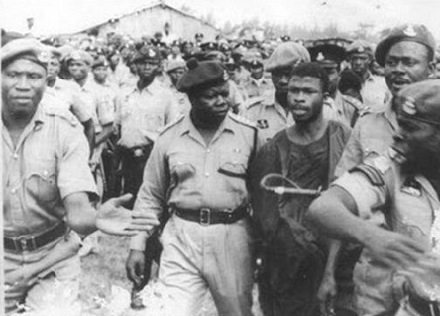
1971: Ishola Oyenusi, smiling to his death

On this date in 1971, the Nigerian robber Ishola Oyenusi — “smil[ing] to his death,” in the words of the next day’s paper — was publicly shot with his gang at Lagos Bar Beach.

Dubbed “the most dangerous criminal of this decade” even though the Seventies were barely underway, “Doctor” Oyenusi — as he liked to style himself — sprang out of the wreckage of the 1967-1970 Nigerian Civil War, a charismatic, cocksure gangster whose lordly disdain for the law cast the terrifying portent of social breakdown.

Beyond Oyenusi loomed a systematic collapse of order that long outlived him. In years to come, other celebrity crime lords would follow; eventually, armed robbery proliferated into a frightfully ubiquitous feature of life in Lagos. Maybe the Doctor smiled at the stake because he foresaw his legacy.

Disturbingly unable to combat the plague systematically, authorities would resort to occasional high-profile executions instead, provided, of course, that the culprit’s misappropriations were of the retail street-crime variety, rather than the fruits of wholesale corruption.

Oyenusi was never in the same universe with such exalted impunity as enjoyed by the masters of the state. He got into the robbery business back in 1959, boosting a car (and murdering its owner into the bargain) to make it rain for his broke girlfriend. While he eventually expanded his operations into a brutal syndicate, he was still just a hoodlum; the infamy that packed the Bar Beach with 30,000 fellow humans who booed and jeered Oyenusi to the stake was merely enough to make him worth the quashing. (He was condemned to death specifically for a raid on the WAHUM factory in March 1971 that also claimed the life of a police constable.)

Six members of Oyenusi’s crime ring went with him to the stake on the same occasion. An eighth man was also shot in the batch for an unrelated armed carjacking.

There is a 1977 film by Nigerian director Eddie Ugbomah based on this flamboyant gangster’s life, The Rise and Fall of Dr. Oyenusi.

On this day..

1914: Seven retreating Frenchmen, with surprising results

One hundred years ago today, during the Battle of the Marne, seven French soldiers were shot without trial for retreating. Most of the resources about this Gallic tragedy are in French, and so are most of the links in today’s post.

The French book Fusille Vivant traces the life of Francois Waterlot, a prolific correspondent who wrote some 250 letters after surviving this date’s execution, before finally dying at the front the following year.

All were enlistees of France’s 327th Infantry Regiment. On the night of September 6, German shelling panicked their sister 270th Regiment into a disorderly retreat away from the front lines. That rout ran right into the 327th, behind them, and panicked that regiment too.

Further in the army’s rear, the hubbub awoke from his farmhouse bivouac division commander Gen. Rene Boutegourd. Boutegard had a simple solution, and ordered seven of the soldiers caught away from their posts to be executed the next morning by way of example. While the war’s later years would feature notoriously unfair courts-martial with predetermined sentences, Gen. Boutegourd didn’t even see the need to pay that much tribute to procedural regularity in this case.

The Battle of the Marne was still ongoing, and the situation in the field, pre-trench warfare, was fluid. Shoot them out of hand and be done with it! Then, the rest of the division will understand the consequences of unauthorized retreat.

Barbieux, Caffiaux, Clement, Delsarte, Dufour, Hubert, and Watrelot were stupefied to learn that they suddenly had mere hours left to live.

According to a postwar newspaper article — printed in 1922, when the bizarre case came to public attention and led to a posthumous pardon — they immediately began pleading for their lives. “Put us in the first wave of the next attack, but I beg you not to subject us to French balls,” Delsarte cried.

In those opening weeks of what was supposed to be a short war, with men’s minds still half at home in the pleasurable prewar idyll, the cruel frequency of the execution pour l’exemple had not yet set its stamp on things. The first such instance had occurred only the week before.

Maybe the men detailed to kill the “deserters” were equally stunned: it is hard to put down the results of the shootings merely to the uncertainties of technology or the hardiness of flesh and bone.

Palmyr Clement survived the fusillade and only died two agonizing days later from his firing squad injuries. This is a bizarre outcome even for those occasional cases where a fellow survives the scaffold. Implicit in such a fate is that there was no coup de grace administered after the volley. Is this oversight intentional — even an expression of distaste for the justice of the sentence soldiers had been tasked with visiting on their comrades?

And could distaste extend so far as an intentional or an indifferent failure of marksmanship by the firing details?

Such doubtful speculation can point to Francois Waterlot, who did Clement one better: he survived the execution full stop (dropping to the ground with the volley even though he was actually uninjured) and returned to the ranks, dying in battle on June 10, 1915. This uncommon feat earned him the nickname “le fusillé vivant”, “the shot alive” (somewhat literally) or “the living corpse” (more to the sense of it). That sobriquet is the title of a French book about Waterlot.

France executed about 600 of her own soldiers during World War I, the second-most (to Italy) of all belligerents in that conflagration. There is a great deal about this particular execution on this French page.

On this day..

1771: Matthias Klostermayr, the Bavarian Hiasl

On this date in 1771, the German outlaw Matthias Klostermayr was broken on the wheel in Dillingen.

The “Bavarian Robin Hood” (English Wikipedia entry | German) led a band of poachers (their merriness or lack thereof is unrecorded) who in the 1760s did a famous business, exploiting the jigsaw of tiny statelets in the region to keep the heat off by ducking across a border every few weeks.

Their exploits zestily raiding the hated private hunting preserves of haughty lords elevated them in the popular imagination to social bandits. They’re really said to have distributed a portion of their booty to the poor. They were slated with nine homicides during their run, of game wardens or soldiers whom they did not hesitate to handle much less generously. The gang’s long run proliferated legends multiplying their prowess, even crediting them with supernatural powers like invulnerability to bullets.

Klostermayr was the subject of folk songs even in his lifetime, and that exposure meant that he eventually became the subject of multilateral coordination among the principalities whose limited jurisdictions he so expertly exploited. A 1769 mutual-assistance arrangement permitted authorities to cross the border in hot pursuit; by the end of 1770, an outright military expedition with 300 troops had been arranged. They took Klostermayr by storm on January 14, 1771 in the town of Osterzell; the theater and the shooting club still carry Klostermayr’s name in Osterzell, a small testament to the robber’s enduring popularity two and a half centuries on from his death.

That death was bound to be a demonstrative one, revenging all the offenses Klostermayr had done to his superiors.

The agonizing public shattering of his bones on the breaking wheel, preserved for us in graphic drawings, did no disfavors to the bandit’s fame. Buttressed by his thinly-veiled appearance a few years later as the protagonist of Schiller‘s first play, The Robbers, Klostermayr’s renown persists in Germanophone Europe right down to the present day.


Detail view (click for a larger image) of the terrifying device on which Bavarian outlaw Matthias Klostermayr was stretched out to have his limbs crushed with a breaking-wheel on September 6, 1772.

Detail view (click for a larger image) of Matthias Klostermayr being broken on the wheel.

On this day..

1782: Bartolina Sisa, indigenous rebel

September 5 is International Indigenous Women’s Day, in honor of the torturous execution in Bolivia on this date in 1782 of the Aymara peasant rebel Bartolina Sisa.

Sisa (English Wikipedia entry | Spanish) shared with her husband Tupac Katari leadership of a huge indigenous uprising against the Spanish.

Eighteen months before Bartolina’s execution, she and Tupac Katari — Julian Apasa, to use his given name before he staked out a nom de guerre claiming the inheritance of Tupac Amaru and Tomas Katari — laid La Paz* under siege with an army 40,000 strong. Over the course of that spring summer, the Bolivian capital lost 10,000 souls and teetered on the brink of collapse — actually in two separate three-month sieges with a brief interim between.

Bartolina Sisa was recognized by the rebels as the coequal of her husband; the two took command decisions together in consultation.

As such, when the siege was finally relieved and the natives defeated that October, Sisa was in line to share her husband’s fate. This was easy to effect because she had been betrayed into Spanish hands between the first and second sieges. Her enemies refused Tupac Katari’s every blandishment to exchange her, and in time had the cruel pleasure of forcing her to watch her defeated husband’s butchery. Nearly a year later Sisa tasted a like fate, and her body was thereafter chopped up to display as a warning in various towns to cow potential future native insurgents.

A present-day peasant women’s union bears Sisa’s name, the Bartolina Sisa Confederation; the president of Brazil’s 2006 Constituent Assembly that drafted the country’s current constitution was an indigenous Quechua woman named Silvia Lazarte, who was the Bartolina Sisa Confederation’s former executive secretary.

* The city‘s full original name was Nuestra Señora de La Paz, “Our Lady of Peace”. It was founded in 1548 at the site of a former indigenous village and the “peace” referred to is the restoration of calm after Gonzalo Pizarro‘s rising.

On this day..

1822: Francisco Javier de Elio

On this date in 1922, Spanish royalist Gen. Francisco Javier de Elio was garroted in Republican Valencia.

Elio (English Wikipedia link | Spanish) was a career Spanish officer noted for being the last Viceroy of the Rio de la Plata in South America.

The Rio de la Plata forms the border between present-day Uruguay and Argentina, and by the time Elio self-proclaimed his viceregal rank, the May Revolution had confined Spanish authority to Uruguay.* He maintained the Spanish monarchy’s power in Montevideo until revolutionaries routed his forces at the Battle of Las Piedras** and Elio had to return to Spain.

This was just in time for the Spanish crown, as that country’s liberals had answered the chaos of the French invasion by promulgating in 1812 one of Europe’s most forward-thinking constitutions. King Ferdinand VII wholly repudiated this constitution upon his re-enthronement at the end of the Napoleonic Wars, and this soon led to yet another liberal revolt in 1820† and yet another French invasion.

Elio, who administered Valencia with a rough hand for Ferdinand, was such a ferocious monarchist that revolutionaries took him prisoner in the 1820-1823 “Liberal Triennum”. The attempt by a group of mutinous cannoniers in 1822 to place Elio at their head (with or without the general’s foreknowledge) led to his condemnation by a military court.

The September 26 London Times preserves two accounts by opposing partisans of Elio’s end.

EXECUTION OF GENERAL ELIO

The infamous General Elio has at length suffered the pain of death (by the garotte). His execution took place this morning at 11 o’clock, after having been publicly divested of his rank and honours. The General was not condemned on account of his conduct as Captain General, but in consequence of the revolt of the cannoniers who occupied the fort of Valencia, on the 30th of May. Being tried before an ordinary Court Martial on the 2d of June, at which General Villa-Campa presided, he was on the 27th of August adjudged to the most ignominious death known to the Spanish laws, that of the garotte. This sentence, submitted to the Auditor of War to be revised, was not only approved, but the Auditor demanded its immediate execution, comformably to the martial law of the 17th of April, 1821. The arrival of the Brigadier Espina, who was provisionally invested with the military command of this district was regarded as the signal for the execution. If it had been retarded, we should have broken into the prison, and ourselves have conducted the victim to the scaffold. The people maintained that demeanour which becomes an heroic nation, and accompanied the culprit to the scaffold with shouts of — ‘To death with Elio! his blood will cement the constitutional edifice.’

And a contasting version …

The scaffold on which General Elio was strangled at Valencia, on the 4th instant, was erected close to a delightful garden which belonged to him when he was all-powerful in that town. It appears that this spot was selected in order that his tragical end might be marked by a circumstance which was calculated to make him regret life. One of our journals, which is at all times distinguished for its violence, affirms that General Eio, previously to walking to the scaffold, knelt down and asked pardon of the authorities who were present, for all the mischief he had occasioned — this is wholly false. Above 12,000 persons were witnesses of the firmness which he showed on this sad occasion, and of the last words which he pronounced. The General protested his innocence in the face of God and man; he declared that he had only carried into execution the orders which he had received from the Government during the period of his command; that he was utterly unconnected with the revolt of the cannoniers; and, finally, that he begged of God to pardon his murderers, as he himself forgave them. ‘I wish,’ he added, ‘that my blood may be the last which is shed in Spain. Spain will one day do justice to the purity of my intentions, and repeat the cry which is now my last prayer — ‘”Long live the King and religion.”‘

* When a Spanish colony, Uruguay was known as the Banda Oriental.

** The date of this decisive battle, May 18 (1812), is still kept as a Uruguayan national holiday.

† Guess what happened to the guy who led that 1820 revolt.

On this day..

2,500 days: Still hanging around

Today’s admittedly slight entry is a milestone not only for Finland but for this site as well: it’s the 2,500th consecutive day we’ve posted since we launched on Halloween all the way back in 2007, roughly two or three Ice Ages in Internet years. Lord knows the site design looks it.

One can well doubt the utility of passing the epoch in execution-hunting. But if there is one thing that thousands of hours over 2,500 days plumbing archives for scaffold stories confers, it’s a certain facility with the subject matter. I’ve read an awful many literary products from many a time and place, on the occasion of this rare meta-post, I’d like to mine them in service of a petty peeve.

There is a certain English convention favoring the use of the word “hanged” to refer to the execution of a human at the end of a rope, in contravention to the word “hung” in every other imaginable context of a dangling past participle. Though this is certainly an intervention in an ancient argument that tends to generate more heat than light, I do wish it understood in no uncertain terms that a vast concourse of primary literature testifies that it is perfectly acceptable to use “hung” to refer to an execution.

While I have my own preference and peccadillos about language, I associate most readily with the descriptivist camp.

But I hope to convince you, gentle reader, that for us to hang together on this matter it is not even unnecessary that you share my readiness to welcome ever more shocking barbarisms into the tongue.


The verb to hang derives from two different Old English words, hon (intransitive) and hangian (intransitive). A good thousand years ago, hon and hangian collapsed into a single word, whose dominant past tense across the board was hanged. Centuries after that, the alternate form hung migrated out of the north of England and basically crowded out the old hanged past participle, sort of like snuck is doing to sneaked today. No doubt the pubs of old rang in their day with outrage that apprentices these days no longer said hanged my codpiece but preferred this degenerate novelty quasi-word instead.

Ever thus. Anyway, when all was said and hung, hanged only hanged on to its archaic noosey usage, perpetuated by innumerable formulaic judicial sentences. It’s hanged right onto it all the way down to the present.


Let’s just see about that.

However, there’s never been any sort divinely inscribed rule to halt the advance of hung at the edge of the scaffold — nor has that been the consensus practice of actual English speakers over the generations.

It’s practically mandatory among the descriptivist set to roll out the 1994 Merriam-Webster Dictionary of English Usage on this subject. The source has its detractors and other dictionaries argue differently, but underscore at a minimum its point as to the worth of the distinction. Sure, your teacher, like mine, probably told you that “pictures are hung and people are hanged,” and hanged is certainly a correct word for what the hangman did. But …

Our evidence shows that hung for hanged is certainly not an error. Educated speakers and writers use it commonly and have for many years … Hanged is, however, more common than hung in writing. It is especially prevalent when an official execution is being described, but it is used in referring to other types of hanging as well …

The distinction between hanged and hung is not an especially useful one (although a few commentators claim otherwise). It is, however, a simple one and easy to remember. Therein lies its popularity. If you make a point of observing the distinction in your writing you will not thereby become a better writer, but you will spare yourself the annoyance of being corrected for having done something that is not wrong.

Tastes aside — and I will admit to a deeply inculcated preference for “hanged” — what does the language profit by throwing up a Berlin Wall to preserve from hung only this one specific sense of to hang — this sense, and no other? How does the noose, a minuscule enclave of usage, command its own irregularity in 21st century English?


Languages evolve in funny ways, to be sure. Hanged is certainly good for the gallows but less so for your picture, and that alone is an acknowledged oddity.

But it is not only in the 21st century that English has resorted to “hung” to refer to execution, and done so with perfect ease and clarity.

The Merriam-Webster source aforementioned was good enough to provide some of the examples informing its conclusion, and these are repeatedly found in the various forum threads on the Internet where the sorts of readers who make war over the Oxford comma hang out. For example:

“These men were … at last brought to the scaffold and hung.”
-Percy Bysshe Shelley

“I have not the least objection to a rogue being hung.”
-W. M. Thackeray

“The negro murderer was to be hung on a Saturday without pomp.”
-William Faulkner

“But no doubt the first man that ever murdered an ox was regarded as a murderer; perhaps he was hung; and if he had been put on his trial by oxen, he certainly would have been; and he certainly deserved it if any murderer does.”
-Herman Melville

“Some eighteen hundred years ago Christ was crucified; this morning, perchance, Captain Brown was hung.”
Henry David Thoreau

We could add a few from Executed Today’s voluminous archives ourselves.

“Some of those hung were known personally to Europeans in Tabriz, who are positive that they took no part in the fighting. They were hung simply because they were Constitutionalists.”
-Bertrand Russell

“My father saw four men hung for being with some others who had set fire to a rick.”
-Thomas Hardy

Till was hung yesterday
for murder and rape with trimmings”
-Ezra Pound

“Convicts are horrible creatures: at least, the old one is, with his long, nasty face … if I were dictator, I should order the old one to be hung at once.”
D.H. Lawrence

Andrè was hung the 2d. inst: He submitted to his fate in a manner that shewed him to be worthy of a better one.”
James Madison

Educated, knowledgeable wielders of the language have been right at home with hung in our sense for centuries. These examples tend to elicit the objection that one is cherry-picking a few careless errors every writer makes here and there, and while that has the look of circularity to me — educated speakers don’t say “hung”, so every example to the contrary is by definition a mistake — maybe the problem is a dearth of data points.

Please allow your narrator to remedy this! Two and a half thousand posts in, I’ve seen “hung” used many times in primary (or secondary, but still quite vintage) sources in a wide variety of literary forms and quoted some number of them on the site.


Richmond (Va.) Times-Dispatch, Feb. 1, 1905

Any individual example of a word’s use can always be defined away. For example, when Thomas Hardy recalled the disturbingly sensuous appeal of a murderess he saw die on the gallows in his youth — “I remember what a fine figure she showed against the sky as she hung in the misty rain and how the tight black silk gown set off her shape as she wheeled half round and back” — one can well note that here he uses “hung” to draw attention not to the execution itself but to the fact of her dangling, her suspended corpse’s impression as an object under his eyes.

Perhaps this is also why our correspondent finds that the beloved thief Skitch “hung but a few seconds, before the rope slipped from the gallows.” It is certainly in this sense that Christ “hung on the cross” because he was physically sagging off it.

And this lyric celebrating Irish “Invincible” Joe Brady would obviously lose the rhyme if it resorted to “hanged”, so artistic license may be admitted as well if it be confined to stylists of poetry and not prose:

It was in Kilmainham Prison the Invincibles were hung.
Mrs Kelly she stood there all in mourning for her son.
She threw back her shawl and said to all:
“Though he fills a lime-pit grave,
My son was no informer and he died a Fenian blade.”

Grammar very quickly becomes the proverbial blind man’s lamppost here, used not for illumination but for support of an ungenerous and predetermined conclusion. But I think the frequency of the examples of “hung” over the years, often used precisely in spots that would induce today’s fastidious language police to fire off a blog comment or tweet, builds a strong case that “hung” has been an acceptable past participle in English for our line of work for a very long time.

While “hanged” is the predominant choice, there are so many instances of “hung” to be dredged from English archival sources that the alternatives are clearly a both/and for writers across several centuries, rather than an either/or.

These official 17th century Middlesex county records, to pick a trifling example, consistently index the various felons “sentenced to be hung.” Much later, the prolific 19th century scribbler George Walter Thornbury‘s Old and New London volumes remark that Lord Sanquhar was “sentenced to be hung till he was dead;” likewise this 1880s tour of York Castle given to the Smithsonian Institute uses the four-letter variant over and over again.

Jonathan Swift’s poetic rogue Tom Clinch went to his death with intrepidity that Swift commended to his readers in a line whose meter could just as easily have borne “hanged”.

Then follow the Practice of clever Tom Clinch,
Who hung like a Hero, and never would flinch.

When Lord Nelson had the Jacobin Neapolitan admiral executed by asphyxiation with a rope attached to a ship’s yardarm on June 29, 1799, he recorded in his journal:

A slight breeze; a cloudy sky. Sentenced, condemned, and hung Francesco Caracciolo.

Ahead to the turn of the 20th century, a lifetime newspaper man paid a different maritime noosing the same four-letter coin when he published a history of his native Brighton:

Crossing the pond, we find the New York Times correspondent reporting the execution of five indigenous Cayuse for perpetrating the Whitman Massacre. “The town,” he reported, “was full of men and women, the former coming to see how the election resulted, and the latter to see how the Indians were hung.” Grammarians may enjoy their chuckle here, but nobody misunderstands the meaning.


New Hampshire Patriot and Gazette, Nov. 29, 1865

Surveying the British suppression of India’s 1857 revolts, Harpers magazine similarly noted that

[s]ome of the mutineers were to be hung, and around the gallows, erected during the night previous, the soldiers were drawn up.

In none of these are the various authors lingering especially over the physical quality of suspension. The word conveys the act of execution, simply and directly.

Even diplomatic cables — whose milieu is a cadre of educated elites — have been seen in these very pages making free use of “hung”:

“Hung” is certainly ubiquitous in the use of everyday speakers who are not literary craftsmen. An eyewitness report to the post-Civil War execution of Confederate guerrilla Sue Mundy:

The fall was not more than three feet, and did not break his neck; he choked to death. We have seen a great many persons hung, but never before did we witness such hard struggles and convulsions.

But this syntax is not confined to the hoi polloi. Even judges — like the one who pronounced sentence on Richard Johnson in 1829 — were known to condemn prisoners to be hung by the neck until dead.

Respectable English newspapers used “hung” sometimes, and without worrying the empire’s fainting-couches, in the 18th and 19th centuries, like the London Times on Fritz Muller’s 1864 hanging:

We’ve seen that even the executioners themselves describe their calling with the word “hung”; more recently, a Liverpool screw recalled the morning of Britain’s last executions for the Telegraph:

At half past seven in the morning, all the prisoners started tapping their cell doors: bang, bang, bang. It just went on. As we got nearer to eight o’clock they started banging quicker: bang, bang, bang, bang. And at eight o’clock exactly they all banged once, hard, and then stopped dead. And I thought, ‘That’s the moment he’s been hung.’ The hairs on the back of my neck went up, they really did. I remember it to this day.

So how many more centuries must the line against common folk saying “hung” be policed to save the Queen’s English from degradation?


I can’t speak readily to the thrust of English in all the many parts of the world that it is spoken, but at least as pertains Great Britain and North America, I do wonder if a wider colonization of the word “hung” in this sphere was unnaturally aborted by the vanishing of the hangman from the Anglo public eye.

Britons have not laid eyes on a public execution in a century and a half; hardly any Americans are still alive who would remember the last one stateside. Although Britain has been fifty years without an execution of any kind, its current frequency of execution by hanging is basically statistically identical to that of the United States. Even allowing for the imprint of judicial executions abroad, or suicides by hanging, most of those who don’t choose to write a daily blog about the death penalty perhaps have altogether less reason to talk or think about hangings than did ancestors milling about the public gallows at Tyburn or the Boston Common.

It’s just a theory.

Two thousand, five hundred posts into this project, only the devil knows how long this site might continue to run or what it will all mean when we come to the end of it. I can only assure the reader that I’ll, er, hang on as long as I can. If the substance of this post can be Executed Today’s legacy, I’ll consider it an epoch well-wasted.

Previous self-congratulatory milestone posts:

  • 2001, musing on the death penalty in literary dystopias
  • 1500, about the Hand of Glory legend
  • 1000 (and one), about the Arabian Nights stories
  • 500, merely a Spartan marking of the date

On this day..

1944: Three Soviet infiltrators, the last in Finland

The last executions in Finland occurred on this date in 1944, claiming the lives of three Soviet spies who had been parachuted behind Finnish lines.

I have been unable to locate the names of these men. They’re invariably presented simply in connection with — or as the denouement following — the September 2 execution of Finnish deserter Olavi Laiho.

The next morning (Russian link), Finland announced its disengagement from its problematic German alliance, an arrangement brokered by the western Allies who wanted to keep Finland democratic and non-communist despite sitting in Russia’s back yard and joining the wrong team in World War II. The Soviet Union immediately redeployed its forces away from the Finnish theater; a formal armistice was signed before September was out and prisoner transfers began in October.

Finland abolished the death penalty for all peacetime crimes in 1949, for all crimes full stop in 1972, and wrote the abolition into its constitution in 2000.

On this day..

1944: Olavi Laiho, the last Finn executed in Finland

Olavi Laiho was the last Finn executed in Finland, on September 2, 1944.

Laiho (English Wikipedia entry | Finnish) was conscripted to the Finnish Navy to fight in Finland’s theater of war against the Soviet Union.

As a Communist himself — Laiho had been imprisoned in the 1930s for his labor agitation — Laiho inclined better to the cause of the other side, and fled to the woodlands near Turku where he gathered intelligence to pass to the Soviets and aided other war deserters. He spent the best part of two years winding towards his date with a military police firing detail after being arrested in December 1942.

While Olavi Laiho was the last Finn executed in Finland, on September 2, 1944, a trio of Soviet paratroopers caught behind Finnish lines were shot as spies on September 3, 1944. Those three men are the last ever put to death in Finland.

Laiho doesn’t technically have the distinction of being the last in all of Finnish history, but he’s the one remembered as the milestone moreso than the Russian paratroopers. Laiho is the last one of the Finns’ own, the last who emerges as an individual with a fate that speaks to the fate of his countrymen in those times. “Through Olavi Laiho, we empathize with the with the story of the first half of the 20th century,” this dissertation put it.

Readers with Finnish proficiency might enjoy the Laiho biography En kyyneltä vuodattanut (I Never Shed a Tear).

On this day..