1697: Three duty stamp counterfeiters

On this date in 1697, nine men hanged at Tyburn — all for property crimes.

Three were highway robbers. A fourth was a coiner. A fifth was a pickpocket. A sixth was a husbandman who stole a gelding.

The remaining three men, Thomas Houghton, Francis Cook and Francis Salisbury, operated a ring selling vellum paper bearing counterfeit sixpenny impressed duty stamps.

Their offense was against a 1694 levy titled “An act for granting to Their Majesties several duties on Vellum, Parchment and Paper for 10 years, towards carrying on the war against France”. This statute (full text here) imposed taxes of varying amounts for any number of a huge variety of officially-registered business. Routine commercial transactions now almost universally came with a rake for the taxman: “every skin or piece of vellum or parchment, or sheet of paper, upon which shall be ingrossed or written any indenture, lease, or deed-poll” had to be executed with a sixpenny stamp.

As a practical matter, such skins or pieces of vellum or parchment were sold pre-stamped, the stamp to be canceled by the parties in question when they signed on the line which is dotted. And it was this market that Houghton, Cook, and Salisbury exploited.

While counterfeiting the specie could be held to imperil the kingdom so dangerously to rate as treason, this trio’s “counterfeiting” was just everyday white-collar siphoning. By forging a bogus sixpenny stamp and applying it to sheafs of contract-ready vellum that they could sell at market rates, they got the revenue-agent’s cut — not the crown. (The scam is described in their Newgate Calendar entry, which inexplicably gives short shrift to Francis Cook.)

Though the “war against France” named by the stamp bill — the War of the League of Augsburg or the Nine Years’ War — had ended weeks before even the hangings we mark on this date, the lucrative levy long outlasted it. In the following century, England revived this type of tax often, notably in 1712 expanding it to encompass printed publications like newspapers and pamphlets. Hey, just require anything printed on paper to have a royal stamp on it — easy! This habit would eventually create the 1765 Stamp Act so obnoxious to North American colonists in the run-up to the American Revolution.

On this day..

82 BCE: The defeated populares of the Battle of the Colline Gate

On November 1 of 82 BCE, the Roman general Sulla clinched victory in his running civil war against the liberal populares by smashing them at a decisive battle at Rome’s Colline Gate. And on November 2 the victorious dictator* had his captured foes put to death en masse in the Villa Publica while Sulla himself laid out the new order in an address to the cowed Senate.

The roots of this climactic — although not literally final — battle stretch back years, decades even, to the populist Gracchi in the 130s and 120s, and even further than that. Rome’s burgeoning had strained her original social contract past the breaking point. Terms were renegotiated in bloody civil conflicts that saw Sulla emerge this date as master of the Caput Mundi.

The Gracchi all those years ago had tried (until the oligarchs’ faction assassinated them) to rebalance an increasingly stratified Roman society by introducing land reform and an early bread subsidy.

The Gracchi banner would eventually fall to Gaius Marius, a successful general noted among other things for defeating Jugurtha. His “Marian reforms” thoroughly overhauled military organization; crucially for the Roman social crisis, he opened to the propertyless masses service in the legions — formerly the preserve of the very landed citizen-farmer being squeezed out by the empire’s concentrating wealth.**

Marius’s program addressed two problems simultaneously: it gave the Roman poor a vector of upward mobility; and, it professionalized an army whose fighting capacity had slipped behind Rome’s imperial reach.

Because the capstone to a career in the newly-professionalized army would be a grant of land secured by Marius himself, it also introduced a dangerous personal alliance between vaunting commander and his troops, the seed of later centuries’ cycles of incessant rebellion.

During the decade of the 80s, a now-aged Marius was still the populares‘ standard-bearer, but was opposed now by the patrician general Sulla, Marius’s own former lieutenant during the war against Jugurtha.

Marius’s attempt to displace Sulla from command of a planned Roman expedition to the East to punish King Mighridates of Pontus for his abuse of Roman citizens in Asia Minor brought the two to open blows. Calling on his troops’ personal loyalty to him, Sulla broke an ancient taboo by marching on Rome itself.

Marius fled into Africa, a death sentence nipping at his heels. (Various artists have imagined him chilling in the ruins of Carthage.) Once Sulla sailed for Asia, however, Marius allied with the consul Lucius Cornelius Cinna and roared back from exile, seizing the capital and instituting a reign of terror against his political enemies. Plutarch:

whenever anybody else greeted Marius and got no salutation or greeting in return, this of itself was a signal for the man’s slaughter in the very street, so that even the friends of Marius, to a man, were full of anguish and horror whenever they drew near to greet him. So many were slain that at last Cinna’s appetite for murder was dulled and sated; but Marius, whose anger increased day by day and thirsted for blood, kept on killing all whom he held in any suspicion whatsoever. Every road and every city was filled with men pursuing and hunting down those who sought to escape or had hidden themselves. Moreover, the trust men placed in the ties of hospitality and friendship were found to be no security against the strokes of Fortune; for few there were, all told, who did not betray to the murderers those who had taken refuge with them.

He died about the age of 70 in 86 BCE, days into his unprecedented seventh consulship.

While all this transpired, Sulla had been several years detained in fighting Mithridates. By 83, he’d hung up the “Mission Accomplished” banner and made ready to march on Rome for the second time.

Marius was dead; his ally Cinna had also been killed in a mutiny. The populares party was now headed by Marius’s altogether less formidable son Gaius Marius the Younger and a plebeian consul named Carbo — guys nobody today has heard of, which pretty much tells you what happened next.

Attempting to stop Sulla in the south, Marius the Younger was thrashed and forced to retreat to Praeneste, where he would be bottled up harmlessly until he took his own life in desperation. Further north, Carbo was trounced and chased into exile (and eventual execution) by Sulla’s ally Pompey, the future Triumvir who got his possibly-sarcastic honorific “the Great” from his action in Sulla’s civil war.

The populares general Pontius Telesinus made the last stand of his movement hurling a force of Samnites and Roman Marian supporters at the capital where, at the Colline Gate, they momentarily pressed Sulla’s wing dangerously against the city wall before another future Triumvir, Crassus, overcame them from the opposite flank.

The ensuing slaughter on this date in 82 settled the Marius-versus-Sulla civil war: Sulla published a large proscription of former Marius supporters who were put to death by the thousands before the general resigned his dictatorship at the end of the year 81.†

Dan Carlin’s Hardcore History podcast series covers these events in Death Throes of the Republic, episode 3. In the indispensable History of Rome podcast, the relevant episodes are 31a. Marius | 31b. Marius | 32. The Social War | 33. Marius and Sulla | 34. No Greater Friend, No Worse Enemy.

* Sulla would be acclaimed dictator by the Senate a few weeks later, reviving an office that had been unused since Hannibal threatened Rome more than a century before.

** Pliny the Elder, writing in the first century AD:

there is a famous utterance of Manius Curius, who after celebrating triumphs and making a vast addition of territory to 290 B.C. the empire, said that a man not satisfied with seven acres must be deemed a dangerous citizen; for that was the acreage assigned for commoners after the expulsion of the kings. What therefore was the cause of such great fertility? The fields were tilled in those days by the hands of generals themselves, and we may well believe that the earth rejoiced in a laurel-decked ploughshare and a ploughman who had celebrated a triumph, whether it was that those farmers treated the seed with the same care as they managed their wars and marked out their fields with the same diligence as they arranged a camp, or whether everything prospers better under honourable hands because the work is done with greater attention. The honours bestowed on Serranus found [297 B.C.] him sowing seed, which was actually the origin of his surname. An apparitor brought to Cincinnatus his commission as dictator when he was ploughing his four-acre property on the Vatican, the land now called the Quintian Meadows, and indeed it is said that he had stripped for the work, and the messenger as he continued to linger said, ‘Put on your clothes, so that I may deliver the mandates of the Senate and People of Rome’. That was what apparitors were like even at that time, and their name itself a was given to them as summoning the senate and the leaders to put in an immediate appearance from their farms. But nowadays those agricultural operations are performed by slaves with fettered ankles and by the hands of malefactors with branded faces! although the Earth who is addressed as our mother and whose cultivation is spoken of as worship is not so dull that when we obtain even our farm-work from these persons one can believe that this is not done against her will and to her indignation. And we forsooth are surprised that we do not get the same profits from the labour of slave-gangs as used to be obtained from that of generals!

† Surviving the proscription was the son-in-law of the late consul Cinna, one Julius Caesar. He was able to pull strings with Sulla to get himself off the list.

On this day..

1938: George Brain, Wimbledon murderer

The headline story from Wimbledon in July of 1938 ought to have been the conquest of its renowned tennis championship by Don Budge. The American great didn’t drop a set in seven rounds romping to a men’s title that left him on the cusp of sweeping the Grand Slam tourneys that year. Weeks later, Budge did indeed complete the Slam by taking the U.S. Open — the first player to accomplish that feat in a single year.

But on the morning of July 14, two weeks after Budge raised the silverware, Somerset Road opposite Centre Court yielded up to a passing motorist the body of a 30-year-old woman.

The badly mangled body suggested a hit-and-run, but examination soon revealed that Rose Muriel Atkins had come to her grievous end via the trauma of a small, sharp instrument and not a large, blunt one: the tire marks over Irish Rose’s legs merely a post-mortem red herring.

By no coincidence, a local driver that morning skipped his shift and disappeared, leaving his van in a buddy’s garage. Once police caught wind of this circumstance and found in the van extensive bloodstains that the fugitive deliveryman had unsuccessfully scrubbed, the nationwide manhunt for George Brain was on.

Brain managed to stay on the lam for more than a week, which caused him to miss his intended July 21 wedding date, but this futile flight was really the strongest defense he could offer.

Irish Rose was a well-known prostitute and Brain a well-known satyr; once arrested, he acknowledged having picked her up in the company van with a professional assignation in mind. At that point, he was already in the soup with his employer for stealing 37 quid to squander on hedonism — money he was past due to return to them. (The firm’s reporting him for theft when he skipped work is what brought his creepy van right to police attention.)

Per Brain, the courtesan tried to extract more money from him by threatening to tattle on the naughty use of his work vehicle, at which point “I said: ‘Don’t be silly.’ I struck her with my hand. She started screaming. Then everything seemed to go blank and I hit her with a starting handle which I keep in the van. When I came to there was her body lying in the van.” (London Times, September 20, 1938)

The old “blacked out during this person’s inexplicable murder” defense. Too bad for that story that he actually killed her with a knife; the judge incredulously instructed the jury that “one who takes a chisel or a knife, such as has been produced — a cobbler’s knife — and tears up the throat of a woman, cannot be heard to say that he never expected her to die and never intended to kill her.” Though Brain meted out the wounds with (per the coroner’s characterization) “savage determination” he had still not gone so ravingly feral that he couldn’t be arsed to stage the hit and run or rummage the moll’s purse for her last four shillings. The jury needed only 15 minutes to convict.

Brain’s convivial reputation around Wimbledon earned him 16,500 subscribers to a petition to save his neck despite what he’d done to Atkins’s, but the Home Secretary turned him down flat. Brain was executed at Wandsworth Prison by Thomas Pierrepoint.

On this day..

Seven-Out: Executed Today’s Seventh Annual Report


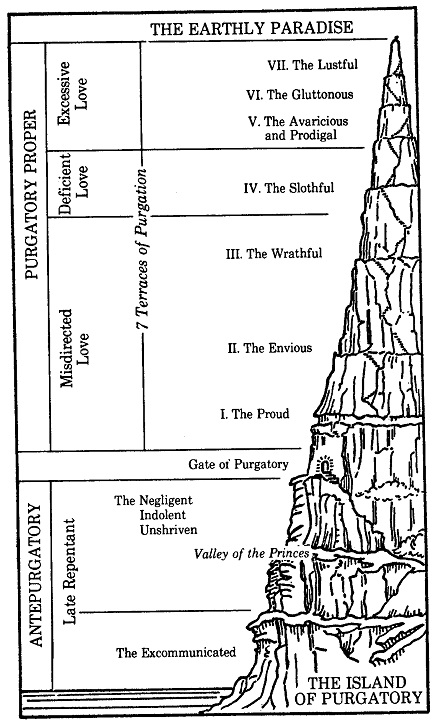
Dante‘s model of Purgatory, with a level for each of the seven deadly sins.

Yesterday’s post completed Year 7 of this here death blog; today’s Halloween anniversary of our maiden post is the traditional occasion for self-indulgent reflection.

Seven straight years of nailing every-24-hours deadlines — over 2,500 posts by now — is a little feather in our headsman’s hood. But even in pausing to preen, I must admit that this labor of love has felt more like labor than ever before these past months. There’s a reason that seven years comes with its own itch.

No need to belabor the point. The site presses ahead to Year 8; as a matter of fact, there are dozens of posts already pre-scheduled. But the editor under the hood is also searching for a fresh spark from the Muse to leave this fallow period behind. Executioner’s angst: surely there must be more to this world than the chopping of heads?

There are innumerable stories worth the telling that we have not yet touched and justify perseverance in an existential desert. But one also must also acknowledge that this will still be true after seven more years or seventeen. Every executioner comes to his end, sometimes when least expected.


Photo of seven Communards in their coffins, by André-Adolphe-Eugène_Disdéri

Traffic

Seven years deep, the annual list of most popular posts ever has ossified to the point where the minor yearly rearrangements just don’t have much new to say that previous annual reports haven’t already said. Last year’s installment ran up to an unwieldy 66; I’ve pared it back to 40 this year for better digestion. Check out the Year 6 report and you’ll get a pretty good idea what the next 20 or 30 on the list would have been.

1. Ted Bundy (January 24, 1989)
2. Eleven from the Stutthof concentration camp (July 4, 1946)
3. Pargali Ibrahim Pasha (March 15, 1536)
4. Hideki Tojo (December 23, 1948)
5. Mohammad Najibullah (September 27, 1996)
6. Rainey Bethea (August 14, 1936)
7. Samuel K. Doe (September 9, 1990)
8. Jesse Washington lynched (May 15, 1916)
9. Karl Hermann Frank (May 22, 1946)
10. Green Tea Hag (March 4, 1771)
11. Eugen Weidmann (June 17, 1939)
12. Thomas Cromwell (July 28, 1540)
13. Mahmoud Asgari and Ayaz Marhoni (July 19, 2005)
14. Nguyen Van Lem (February 1, 1968)
15. Fou Tchou-li (April 10, 1905)
16. Prince Mustafa (Oct. 6, 1553)
17. Allen Lee “Tiny” Davis (July 8, 1999)
18. The rapists of Maggie dela Riva (May 17, 1972)
19. James Corbitt (November 28, 1950)
20. Pulitzer Prize-winning firing squad photograph from the Iranian Revolution (August 27, 1979)
21. Pvt. Eddie Slovik (January 31, 1945)
22. Eva Dugan (February 21, 1930)
23. Hamida Djandoubi (September 10, 1977)
24. Three partisans in Minsk (October 26, 1941)
25. Julius and Ethel Rosenberg (June 19, 1953)
26. Charles Starkweather (June 25, 1959)
27. Claus von Stauffenberg (July 21, 1944)
28. Amon Goeth (September 13, 1946)
29. Eight July 20 anti-Hitler plotters (August 8, 1944)
30. Karla Faye Tucker (February 3, 1998)
31. Robert Francois Damiens (March 28, 1757)
32. Princess Misha’al bint Fahd al Saud (July 15, 1977)
33. Mohamed Oufkir (August 16, 1972)
34. Arthur Lucas and Ronald Turpin (December 11, 1962)
35. Dhananjoy Chatterjee (August 14, 2004)
36. John Bennett (April 13, 1961)
37. Stephen Morin (March 13, 1985)
38. Ruth Snyder and Judd Gray (January 12, 1928)
39. 14-year-old George Stinney, Jr. (June 16, 1944)
40. The Stoning of Soraya M. (August 15, 1986)

One reason this list looks the same year after year is that the lifetime-pageview metric confers such a huge early mover advantage on older posts. Meaghan Good’s guest post on the electrocution of 14-year-old George Stinney, Jr. just squeaked onto our countdown at no. 39 above: it’s the most recently-posted story in that cohort, and it ran 28 months ago. Only two of the remaining 39 were published within the past four years. The random emergence of a news story or bit of cultural ephemera may cause some heretofore obscure post to pop onto the marquee come next year, but the list just posted increasingly resembles the light of a distant star — the snapshot of what transpired when the blog was young.

What’s been going on more recently?


Seven men on the gallows, sketch by unknown artist, Bolognese school c. 1630

Most Popular Posts Within the Past Four Years

Here’s a pull of the most-trafficked posts over the course of the past four years that were actually written during the past four years.

1. Pargali Ibrahim Pasha (March 15, 1536)
2. Eva Dugan (February 21, 1930)
3. 14-year-old George Stinney, Jr. (June 16, 1944)
4. David Tyrie, the last hanged, drawn, and quartered (August 24, 1782)
5. Boonpeng Heep Lek, the last public beheading in Thailand (August 19, 1919)
6. Majid and Hossein Kavousifar (August 2, 2007)
7. Kehar Singh and Satwant Singh, assassins of Indira Gandhi (January 6, 1989)
8. Pin Peungyard, Gasem Singhara, and (twice) Ginggaew Lorsoungnern (January 13, 1979)
9. Twelve blown from cannons in British Punjab (June 13, 1857)
10. The Münster Rebellion leaders (January 22, 1536)
11. Daniel Pearl (February 1, 2002)
12. Three accomplices of Elizabeth Báthory, the Countless of Blood (January 7, 1611)
13. Thomas Shipp and Abram Smith, strange fruit (August 7, 1930)
14. Andrei Vlasov, turncoat Soviet general (August 1, 1946)
15. Cartouche’s brother, hanged by the armpits (July 31, 1722)
16. German soldiers for cowardice (Uncertain/various dates, 1945)
17. Laura and Lawrence Nelson lynched (May 25, 1911)
18. Amelia Dyer, baby farmer (June 10, 1896)
19. Massacre of Waldensians (April 24, 1655)
20. Clarence Ray Allen (January 17, 2006)

The diversity for periods, topics, and especially geography in the above list pleases me. One of the intentions of this site is to capture snapshots of the death penalty experience in many times and places.

Even though the major Anglo countries — the U.S., U.K., Canada, and Australia — ranked one through four in traffic sources and collectively supplied over two million of the site’s three million or so pageviews this past year, we also boasted traffic hot spots from the Philippines, Pakistan and India, South Africa, and (it doesn’t really pop on the map) Singapore … with a clear assist to the fabricators of the British Empire for promulgating English in all these places.

Guest Posts

Outstanding guest posts accounted for more than 10% of the content for the past year, led as usual by the indefatigable Meaghan Good. Meaghan’s own individual contributions to the site are nearing a half-year’s worth of content; she also recently published for Kindle a fictional story, Execution Detail in Tartu, exploring the experience of an ordinary Einsatzgruppe commando carrying out his little bit of the Holocaust on the Second World War’s eastern front.

Meaghan Good

Robert Elder

Amelia Fedo

Harry Brodribb Irving

Aaron Molyneux

Jonathan Shipley

Robert Wilhelm


Seven years went under the bridge like time was standing still …

On this day..

1814: Private John McMillan, deserter

HEAD QUARTERS, FALLS OF NIAGARA
OCTOBER 28TH 1814.

At a General Court Martial, held at Stamford, on the 25th instant, and continued by adjournment to the 28th of the same month, Private John McMillan, of the 2nd regiment of Lincoln Militia, was arraigned on the following charges, viz.: —

1st. For having deserted to the Enemy, with his Arms and Accoutrements, when on Duty, on or about the 6th of Octoer, 1813.

2nd. For having been taken bearing Arms in the Service of the Enemy on or about the 17th of September last.

And “The Court, after duly considering the Evidence for the Prosecution and on behalf of the Prisoner, were clearly of the opinion that he is guilty of both charges, and therefore Sentence him to suffer Death, at such place and time as His Honor the President may be pleased to direct.”

His Honor the President approves the finding and Sentence of the Court, and directs that the same be carried into Execution at Bridgewater [Niagara Falls] on Monday morning next, the 31st instant, at 11 o’clock

British militia general order during the War of 1812

On this day..

1651: Terence Albert O’Brien, Bishop of Emly

On this date in 1651, three days after the Irish city Limerick surrendered to a withering five-month Parliamentarian siege, the victors hanged Bishop Terence Albert O’Brien on Gallows Green.

Limerick was the southern stronghold of the Catholic and anti-Parliamentarian Confederate Ireland.

It was this polity, which allied itself to English Royalists, that Cromwell assailed in his bloody conquest of Ireland.

Though Cromwell lives forever as an oath in Irish memory, the man himself left Ireland in 1650 to smash an awkward Royalist alliance with Scottish Presbyterians.

That left the Irish campaign in the hands of Cromwell’s capable fellow-general (and by this time, son-in-law) Henry Ireton, and it was Ireton who laid Limerick under a siege at an estimated cost of 5,000 civilians succumbed to starvation and plague.

The Catholic Bishop of Emly, Terence Albert O’Brien, had been trapped in the mixed English-Irish city and encouraged continued resistance to the siege. Ireton advanced him to the very front of the queue for punishment, and had him put to death directly after the city’s capture.

A “Last Speech and Prayer” of the martyr was published in London within a few days, together with a “humble petition” of then-imprisoned (and later executed) pro-Stuart highwayman James Hind.

Good people,

This is a very uncomfortable place, for me to deliver my self unto you; but I beseech you pardon my failings, and the rather, by reason of the sad occasion that hath brought me hither: Indeed, I have been long in my race, and how I have looked unto Jesus the Authour and finisher of my faith, is best known to him; I am now come to the end of my race, which I find to be a death of shame, but the shame must be despised, or there is no coming to the right hand of God; Jesus despised the shame for me upon the Crosse, and God forbid but I should despise the shame for him upon the Gallowes; I am going apace, as you see, towards the Red Sea, and my feet are upon the very brinks of it, an Argument I hope that God is brining me to the Land of promise, for that was the way by which of old he led his people.

But before they came to the Sea, he instituted a passe over for them, a Lamb it was, but it was to be eaten with very sowr herbs, as in the 12. of Exodus. I shall obey and labour to digest the sowr herbs, as well as the Lamb, and I shall remember, that it is the Lord’s passe-over, I shall not think of the herbs, nor be angry with the hands that gathered them, but look up only to him who instituted the one, and governeth the other: For men can have no more power over me, than that which is given them from above; and although I am denyed mercy here on earth, yet I doubt not but to receive it in heaven. I am not in love with this passage through the Red Sea, for I have the weakness and infirmity of flesh and blood in me, and I have prayed as my Saviour taught me, and exampled me; ut transiret calix ista, That this cup might passe away from me; but since it is not, that my will may, his will be done; and I shall most willingly drink of it as deep as he pleases, and enter into this Sea, I and I passe through it, in the way that he shall be pleased to leade me. And yet (good people) it would be remembrad [sic], That when the Servants of God, old Israel, were in this boystrous Sea, and Aaron with them, the Egyptians which persecuted them, and did in a manner drive them into that Sea, were drowned in the same waters while they were in pursuit of them: I know my God whom I serve, is as able to deliver me from this Sea of blood, as he was to deliver the 3 Children from the furnace. Dan. 3. And I most humbly thank my Saviour for it. My resolution is now, as theirs was then; their Resolution was, they would not change their principles, nor worship the Image which the King had set up; nor shall I the imaginations which the people are setting up; neither will I forsake the Temple and Truth of God, to follow the bleating of Jeroboams Calves in Dan and in Bethel.

And I pray God blesse all this people, and open their eyes, that they may see the right way, for if it fall out that the blind lead the blind, doubtless they will fall both into the ditch: For my self I am (and I acknowledge it in all humility), a most grievous sinner, and therefore I cannot doubt but that God hath mercy in store for me a poor penitent, as well as for other sinners; I have upon this sad occasion ransack’d every corner of my heart, & yet I thank God, I have not found any of my sins that are there, any sins now deserving death by any known Law. And I thank God, though the wait [weight] of the sentence lie very hard upon me, yet I am as quiet within, (I thank Christ for it) as I ever was in my life; I shall hasten to go out of this miserable life, for I am not willing to be tedious; and I beseech you, as many as are within hearing, observe me, I was born and baptized in the bosome of the Church of Rome (the ancient and true Church) and in that Profession I have ever since lived, and in the same I now die. As touching my engagement in arms, I did it in two respects. First, for the preservation of my principles and Tenents. And secondly, for the establishing of the King, and the rest of the Royal issue in their just Rights and Priviledges. I will not inlarge my self any further, I have done, I forgive all the world, all and every of these bitter Enemies, or others whatsoever they have been, which have any wayes prosecuted me in this kind; I humbly desire to be forgiven first of God, and then of every man, whether I have offended him or no; if he do but conceive that I have: Lord do thou forgive me, and I beg forgiveness of him, and so I heartily desire you to joyn with me in prayer.

From Hugh Fennin’s “The Last Speech and Prayer of Blessed Terence Albert O’Brien, Bishopp of Emly, 1651,” in Collectanea Hibernica, No. 38 (1996).

Any Limerick Catholics who didn’t share the prelate’s forgiving attitude might have taken some spiteful comfort that the strain of commanding the siege caused Ireton to fall ill with fever. He died on November 26 — barely outliving the bishop whom he had hanged.* After the Stuarts regained the English throne, Ireton was exhumed and posthumously executed alongside the body of Oliver Cromwell.

* Ireton’s death indirectly spared the royalist commander of Limerick’s defeated garrison from an execution his conqueror had intended for him: Ireton’s successor instead sent him to the Tower of London, and he was eventually released to Spanish custody.

On this day..

1792: Three of the H.M.S. Bounty mutineers

On this date in 1792, three men were hanged from the yardarms of the H.M.S. Brunswick in Portsmouth Harbor.

Their crime was participating in that famous or infamous act of seaborne resistance, the Mutiny on the H.M.S. Bounty.

There are so many excellent resources already for enthusiasts of this adventure that a generalist site such as this one can scarcely hope to contribute. Much of the commentary through the years has gravitated towards asserting (by implication at least) the ought between the allegedly oversensitive first mate Fletcher Christian and his allegedly tyrannous captain William Bligh.

Their confrontation is too well mythologized to require commentary here. We only wish to note that this workplace spat occurred in furtherance of a mission whose purpose was the application of the lash to other laborers than the Bounty‘s Able Seamen.

Lord Byron fictionalized Bligh’s and other mariners’ accounts to render “The Island”, a poem surprisingly sympathetic (given Byron’s radical proclivities) to the officers mutinied upon. In it, he depicts the Eden-like plenty of Otaheiti

The gentle island, and the genial soil,
The friendly hearts, the feasts without a toil,
The courteous manners but from nature caught,
The wealth unhoarded, and the love unbought;
Could these have charms for rudest sea-boys, driven
Before the mast by every wind of heaven?

The Bread-tree, which, without the ploughshare, yields
The unreaped harvest of unfurrowed fields,
And bakes its unadulterated loaves
Without a furnace in unpurchased groves,
And flings off famine from its fertile breast,
A priceless market for the gathering guest …

Those fertile-breasted breadtrees were the object of Bligh’s voyage: they were to be acquired, potted, and sailed onward to the Caribbean where they’d be transplanted in hopes of providing a cornucopia … of profits to sugar plantations whose slaves’ hands an “unreaped harvest of unfurrowed fields” would free for an added margin in the export economy.*

The Bounty bartered for and potted up over 1,000 specimens during a protracted five-week layover Tahiti, a literal Bounty that the crew would prove to prefer to the floating despotism under Capt. Bligh.

Those mutineers turned the breadfruit-ship ’round and settled themselves back on Tahiti or on Pitcairn Island,* burning the Bounty in hopes of simply disappearing from imperial Britain’s circuits of maritime accumulation.

Cast adrift in the Pacific, Bligh somehow guided the 7-meter open launch 6,700 kilometers to Timor, losing only one of his 18 loyal passengers along the way — a feat of seamanship Bligh himself told all about in a first-person account. From the East Indies, Bligh caught a ride back to England and reported the insurrection to the Admiralty in March 1790, more than two years after his ill-starred voyage had set sail from Spithead.

So in 1791, a 24-gun ship called Pandora set out carrying a box of evils for the mutineers. The latter had, in this time, found the comforts of the South Pacific at least somewhat less congenial now that they proposed to make themselves permanent residents and moreover anticipated native deference to their race despite having opted themselves out of the authority that underwrote said privilege. Fletcher Christian himself is thought to be among the mutineers who died in conflicts with the natives.†

Still, the Pandora found 14 of the Bounty‘s former crew to round up and return for British judgment. (The Pitcairn settlement escaped notice altogether; it was only chanced upon by an American ship in 1808 by which time nobody had any interest in persecuting the last remaining mutineer.)

The three featured today were, perhaps surprisingly, the only ones to pass through all the filters from detention to execution, filters that one might have thought would winnow only fleetingly in the case of such an impudent rebellion.

  • To begin with, the Pandora ran aground on the Great Barrier Reef on its return voyage. Only at the last moment did a boatswain unlock the cell where the prisoners were being held — and only 10 of the 14 managed to escape being swallowed up by the seas.
  • The ensuing court-martial acquitted outright four of those remaining ten — men whom Bligh himself described as innocent loyalists who had been forced to remain with the mutineers.

The Admiralty court-martial had a job to fix the six other sailors in their right spots along the spectrum from “enthusiastic mutineer” to “passive participant” to “had to go along with events outside of their control.” It took a good deal of testimony from Bligh’s loyalists about who was armed, who gave a sharp word, and so forth, during the critical moments of Fletcher Christian’s coup. (Legal proceedings in the Bounty case are collected in their entirety here, part of a rich trove of primary sources related to the incident.)

In the end, all six whom Bligh did not vouch for got the same sentence — death — but the court endorsed several for royal mercy. The three who eventually hanged on October 29, 1792 were:

  • Able Seaman Thomas Burkitt or Burkett. Multiple witnesses made him an armed and active member of the mutiny from its very first stroke, assisting Fletcher Christian’s nighttime seizure of the sleeping captain.
  • Able Seaman John Millward. He too was placed among the armed mutineers by witnesses; in fact, prior to the mutiny, he had attempted with two other crewmates to abscond from the Bounty and spent three weeks hiding out in Tahiti before recaptured.
  • Able Seaman Thomas Ellison. Just 16 or 17 years old at the time of the mutiny, Ellison was made to hand over his watch at the helm to a mutineer. His efforts at court to portray himself as loyal to Bligh and only unwillingly swept up in events were contradicted by one of the men set adrift with the ex-captain, but have been favorably received by many later interlocutors. The Charles Nordhoff-James Hall novelization Mutiny on the Bounty presents Ellison as an innocent.

Three others condemned with this trio at the same court-martial who might have shared their execution date were spared that fate.

  • Able Seaman William Muspratt copped a stay and eventually a commutation of sentence based on having been prevented from calling his desired witnesses. He returned to active duty at sea.
  • James Morrison, notable for having built a schooner on Tahiti with which he attempted unsuccessfully to sail for the East Indies, was recommended for mercy by the court which condemned him. While incarcerated, Morrison wrote a journal giving his account of the mutiny; he too returned to active service as a gunner.
  • Midshipman Peter Heywood, the only officer charged, was like Morrison pardoned at the court’s recommendation. He put in many years of respectable service at sea, eventually retiring with the rank of post-captain. Anticipating his being tongue-tied when the pardon was announced to him, he had a note ready-written to hand the angel of his deliverance: “when the sentence of the law was passed upon me, I received it, I trust, as became a man; and if it had been carried into execution, I should have met my fate, I hope, in a manner becoming a Christian … I receive with gratitude my Sovereign’s mercy; for which my future life shall be faithfully devoted to his service.” (London Times, Oct. 30, 1792)

* This breadfruit scheme was the brainchild of Joseph Banks, an empire-minded botanist who was also a leading advocate of diverting the convict labor formerly exported to America to Australia instead.

After all the mutiny business had been sorted out, Bligh commanded a second, do-over voyage to dump breadtrees on Jamaica. Slaves’ distaste for the delicacy caused the voyage’s immediate objectives to fail; however, the imported fruit would eventually become a Jamaican culinary staple.

** Descendants of the Bounty mutineers and native women still inhabit Pitcairn to this day. It’s the smallest self-governing national jurisdiction in the world.

† The last mutineer on Pitcairn gave vague and contradictory accounts of Christian’s death. It was long rumored that he might actually have escaped Pitcairn and secretly returned to England: if so, he was never exposed.

On this day..

1816: Francisco Jose de Caldas, wise person

Colombia polymath Francisco Jose de Caldas was shot on this date in 1816 during the Spanish commander Pablo Morillo‘s decimation of rebellious intelligentsia in separatist New Granada.

While Europe was mired in the Napoleonic Wars, those United Provinces of New Granada — roughly modern Colombia, which remembers its short-lived New Granada predecessor as la Patria Boba, the Foolish Fatherland — had asserted their independence. As we have detailed previously, it was Morillo who arrived from the mother country to disabuse them of this dream. Morillo did it with such a flair for the merciless that he earned the nickname El Pacificador.

Morillo conquered Bogota by May 1816 and for the rest of the year put large numbers of the pro-breakaway intelligentsia to political trials in an apparent attempt to cripple any future independence movements. (It didn’t work; during this very period, future liberator Simon Bolivar was making his first landings in Venezuela.)

A history by Jose Manuel Restrepo, a political figure of New Granada who was fortunate enough to escape the crackdown, lamented the fate of the men with whom he had once dreamed the dream.

for the space of six months, scarcely a week passed without the execution, in Santa Fe or the provinces, of three, four, or more individuals, shot as traitors. Thus perished the persons of the greatest wisdom, the most virtuous and wealthy, in New-Granada. The object which Morillo had in view, was to extinguish intelligence, remove men of influence, and destroy property, so that, in future, there should be none capable of originating or directing another revolution. New-Granada has deplored, and will for a long time deplore, among other illustrious victims, the loss of Doctors Camilo Torres, Joaquin Camacho, Jose Gregorio and Frutos Gutierrez, Crisanto Valenzuela, Miguel Pombo, Jorge Lozano, Francisco Antonio Ulloa, and Manuel Torices; and of military men, general Custodio Rovira, Libario Mejia, and the engineer Francisco Jose de Caldas. The murder of this celebrated mathematician and philosopher, was a piece of wanton cruelty on the part of Morillo. The exact sciences lost much by his premature death; and the geography of New-Granda especially, retrograded beyond measure, by the loss of the precious works which he had nearly perfected.

The spirit of these dark days is summarized by a reply Morillo supposedly made to petitions for him to spare the wise Caldas: “Spain does not need wise people.”

Present-day Colombia memorializes Francisco Jose de Caldas in the name of a department and numerous public monuments. (He also used to be on the 20-peso note when such a thing existed. Colombia’s smallest paper bill today is 1,000 pesos.)


Statue of Caldas on Bogota’s Plaza de Caldas. (cc) image from Mauromed.

On this day..

1441: Margery Jourdemayne, the Witch of Eye

There was a Beldame called the wytch of Ey,
Old mother Madge her neyghbours did hir name
Which wrought wonders in countryes by heresaye
Both feendes and fayries her charmyng would obay
And dead corpsis from grave she could uprere
Suche an inchauntresse, as that tyme had no peere

On this date in 1441, a Westminster folk magician went to the stake.

The “Witch of Eye” had meddled with powers beyond her control — not the Satanic for which her sentence condemned her, but those of the royal court.

This local wise woman had been arrested as a sorceress once a number of years before. But medieval Europe, before the Reformation and Counter-Reformation and the attendant gloom of existential danger from within, was usually not eager to pursue a local shaman for serving a community’s demand for everyday magick — just so long as the charms and incantations purveyed were not being turned to any apparently injurious purpose. The Witch of Eye, Margery Jourdemayne by name, spent several months imprisoned in Windsor Castle and was released with a pledge to stop with the hocus-pocus.

In her fatal last affair this broken promise would augur very ill. But barring that extraordinary case, this was actually one of those little social regulations that could usually just be ignored in the breach. Our cowherd’s wife returned to purveying salves, potions, and elixirs, perhaps a bit more quietly.

Despite her humble rank, the Witch of Eye seems to have enjoyed a sizable client base among the great lords and ladies.

Such august persons of course had interests outside of love tonics. At the start of the 1440s, the royal court was absorbed by the affairs of the teenage king Henry VI.

In Late June of 1441, three servants of Eleanor, Duchess of Gloucester were accused of compassing the death of the king by using astrological divination to forecast the date of his death — which looked especially treasonable since the result reported is supposed to have been soon.

Though a Peerress by marriage, Eleanor was only the daughter of a knight. A sort of proto-Anne Boleyn, she had raised herself (and not a few eyebrows) by starting off as a lady in waiting of the Duke’s previous wife, and (once dynastic machinations sent that Duchess packing for her native Low Countries) advancing herself into the master’s bed.

A cultivated humanist, Humphrey, Duke of Gloucester gave every impression of having found a satisfying domestic union — but Eleanor’s social-climbing set her up for some resentment. It was even said by a chronicle, laying a retrospective interpretation on events, that only occult arts could account for Eleanor’s boudoir triumph:

And this same tyme was take a womman callid the wicche of Eye, whoos sorcerie and wicchecraft the said dame Alienore hadde longe tyme usid; and be suche medicines and drynkis as the said wicche made, the said Alienore enforced theforsaid duke of Gloucestre to love her and to wedde her.

The rank of the figures involved elevated such gossip beyond the court’s everyday palaver.

Humphrey had claimed the Regency for a brief period before Henry VI declared his own majority in 1437, at age 16. More than that, Humphrey was the most senior uncle to the unmarried* Henry, which made him the heir presumptive. He was a heartbeat away from having the crown on his own head.

And that made it a very colorable accusation that Eleanor’s servants — and those henchmen soon accused Eleanor herself, too — took interest in the prospective imminent death of a king in the springtime of his youth.**

Henry’s alarmed response was twofold. First, he commissioned a horoscope reading of his own; no surprise, this improved horoscope predicted a long, healthy life.† Second, he kicked off the judicial processes that would ruin all concerned — although some ruinations were more final than others.

The servants pointed the finger at Eleanor, and the Duchess desperately fled to the sanctuary of Westminster Abbey. This proved not to help her that much when an ecclesiastical court handed down charges of witchcraft and heresy. One of Eleanor’s three busted cronies, Roger Bolingbroke, had already been forced to publicly abjure his devilries amid a display of his necromancing tools.

Just as Bolingbroke claimed that “he wroughte the said nygromancie atte stiryng of the forsaid dame Alienore, to knowe what sholde falle of hir and to what astat she sholde come,” Eleanor implicated her old magic-vendor, the Witch of Eye for building some of the illicit charms. By now it was pratically beside the point that Eleanor said Bolingbroke’s damning wax figurines were meant to inflict children upon Eleanor rather than injury upon His Majesty. Margery Jourdemayne had shaped the wretched dolls, and nobody caught in the storm of charges had less pull than she. Plus, of course, she was now a repeat offender.

How she in waxe by counsel of the witch,
An image made, crowned like a king,
… which dayly they did pytch
Against a fyre, that as the wax did melt,
So should his life consume away unfelt.

Condemned by a court presided by the Archbishop of Canterbury, she was burned at Smithfield.

Two of the three courtiers died violently, too: Roger Bolingbroke was hanged, drawn, and quartered on November 18, while Thomas Southwell died suddenly in prison around the time of Jourdemayne’s execution. He might have poisoned himself. The third man, John Home, was only shown to have known what his fellows were up to and not to have taken part himself: he skated on a royal pardon.

The Duchess of Gloucester did well to confine her own juridical guilt to ecclesiastical charges only — heresy and witchcraft — and beat the much more dangerous treason charge that was leveled at her. (In another century, Britons would be much more used to the idea of executing elite nobility.) Her marriage was annulled (she procured it by witchcraft, remember?) and she was forced to perform a humiliating, Cersei Lannister-like‡ public penance on foot around Westminster and London before being shunted off into a forced and closely-watched retirement.


The Penance of Eleanor, by Edwin Austin Abbey (1900)

The scandal didn’t directly touch the Duke of Gloucester, but it essentially forced him out of public life. Six years later he was arrested for treason, but he died (possibly of a stroke, or possibly poison) within days.

The sensational fall of this household excited literary interlocutors almost before Margery Jourdemayne’s ashes were cold — such as this nearly-contemporary “Lament of the Duchess of Gloucester” which dwells on the titular character’s self-destruction by dint of her own vanity: “who wille be high, he shalle be low / the whele of fortune, who may it trow.”

The verses excerpted above in this post come from the following century’s “Mirror for Magistrates”, which makes use of historical figures who met terrible fates not unlike this very site. She might also have helped inspire a lost play from the late 16th or the 17th century.

Shakespeare too stages this entire affair in Henry VI, Part 2, representing Gloucester as an innocent tragically bearing the disaster his enemies visit on him through his wife.

In Act I, Scene 2, Eleanor arranges her divination — and we learn that her enemies are in the process of framing her.

Eleanor. While Gloucester bears this base and humble mind.
Were I a man, a duke, and next of blood,
I would remove these tedious stumbling-blocks
And smooth my way upon their headless necks;
And, being a woman, I will not be slack
To play my part in Fortune’s pageant.
Where are you there? Sir John! nay, fear not, man,
We are alone; here’s none but thee and I.

[Enter HUME]

Father John Hume. Jesus preserve your royal majesty!

Eleanor. What say’st thou? majesty! I am but grace.

Father John Hume. But, by the grace of God, and Hume’s advice,
Your grace’s title shall be multiplied.

Eleanor. What say’st thou, man? hast thou as yet conferr’d
With Margery Jourdain, the cunning witch,
With Roger Bolingbroke, the conjurer?
And will they undertake to do me good?

Father John Hume. This they have promised, to show your highness
A spirit raised from depth of under-ground,
That shall make answer to such questions
As by your grace shall be propounded him.

Eleanor. It is enough; I’ll think upon the questions:
When from St. Alban’s we do make return,
We’ll see these things effected to the full.
Here, Hume, take this reward; make merry, man,
With thy confederates in this weighty cause.

[Exit]

Father John Hume. Hume must make merry with the duchess’ gold;
Marry, and shall. But how now, Sir John Hume!
Seal up your lips, and give no words but mum:
The business asketh silent secrecy.
Dame Eleanor gives gold to bring the witch:
Gold cannot come amiss, were she a devil.
Yet have I gold flies from another coast;
I dare not say, from the rich cardinal
And from the great and new-made Duke of Suffolk,
Yet I do find it so; for to be plain,
They, knowing Dame Eleanor’s aspiring humour,
Have hired me to undermine the duchess
And buz these conjurations in her brain.
They say ‘A crafty knave does need no broker;’
Yet am I Suffolk and the cardinal’s broker.
Hume, if you take not heed, you shall go near
To call them both a pair of crafty knaves.
Well, so it stands; and thus, I fear, at last
Hume’s knavery will be the duchess’ wreck,
And her attainture will be Humphrey’s fall:
Sort how it will, I shall have gold for all.

In Act I, Scene 4, the enthusiasts summon a shade from the underworld and our day’s principal is favored with a few lines from the bard:

Margaret Jourdain. Asmath,
By the eternal God, whose name and power
Thou tremblest at, answer that I shall ask;
For, till thou speak, thou shalt not pass from hence.

But the entire party is arrested and Gloucester’s attempts to note the meaningless vagueness of the predictions supplied by the alleged demon are overruled abruptly.


The conjuration scene in Henry VI, Part 2, illustrated by John Opie.

In Act II, Scene 3 the Duke and Duchess are destroyed politically, and their hirelings destroyed bodily.

Henry VI. Stand forth, Dame Eleanor Cobham, Gloucester’s wife:
In sight of God and us, your guilt is great:
Receive the sentence of the law for sins
Such as by God’s book are adjudged to death.
You four, from hence to prison back again;
From thence unto the place of execution:
The witch in Smithfield shall be burn’d to ashes,
And you three shall be strangled on the gallows.
You, madam, for you are more nobly born,
Despoiled of your honour in your life,
Shall, after three days’ open penance done,
Live in your country here in banishment,
With Sir John Stanley, in the Isle of Man.

Eleanor. Welcome is banishment; welcome were my death.

Duke of Gloucester. Eleanor, the law, thou see’st, hath judged thee:
I cannot justify whom the law condemns.
[Exeunt DUCHESS and other prisoners, guarded]
Mine eyes are full of tears, my heart of grief.
Ah, Humphrey, this dishonour in thine age
Will bring thy head with sorrow to the ground!
I beseech your majesty, give me leave to go;
Sorrow would solace and mine age would ease.

Henry VI. Stay, Humphrey Duke of Gloucester: ere thou go,
Give up thy staff: Henry will to himself
Protector be; and God shall be my hope,
My stay, my guide and lantern to my feet:
And go in peace, Humphrey, no less beloved
Than when thou wert protector to thy King.

Queen Margaret. I see no reason why a king of years
Should be to be protected like a child.
God and King Henry govern England’s realm.
Give up your staff, sir, and the king his realm.

Duke of Gloucester. My staff? here, noble Henry, is my staff:
As willingly do I the same resign
As e’er thy father Henry made it mine;
And even as willingly at thy feet I leave it
As others would ambitiously receive it.
Farewell, good king: when I am dead and gone,
May honourable peace attend thy throne!

[Exit]

Queen Margaret. Why, now is Henry king, and Margaret queen;
And Humphrey Duke of Gloucester scarce himself,
That bears so shrewd a maim; two pulls at once;
His lady banish’d, and a limb lopp’d off.
This staff of honour raught, there let it stand
Where it best fits to be, in Henry’s hand.

Earl of Suffolk. Thus droops this lofty pine and hangs his sprays;
Thus Eleanor’s pride dies in her youngest days.

See also: Jessica Freeman, “Sorcery at Court and Manor: Margery Jourdemayne, the Witch of Eye Next Westminster,” Journal of Medieval History, vol. 30, pp. 343-357.

* Henry married Margaret of Anjou in 1445. Despite the Shakespeare portrayal, she had no part in the proceedings against Eleanor or the Witch of Eye.

** It has long been supposed that part or all of the real impetus for these charges was an opportunistic attack by the Duke’s political rivals, specifically around the question of making peace with France in the Hundred Years’ War. Gloucester, who fought at Agincourt (Shakespeare’s Henry V name-checks him in the great Crispin’s Day pre-battle oration), opposed the growing pro-peace faction.

† It did not predict that Henry would end up murdered in prison.

‡ Game of Thrones author George R.R. Martin unquestionably mines historical atrocities for inspiration and the notorious Walk of Shame scene is no exception; however, the specific public penance he’s cited as the fountainhead for Cersei’s ritual humiliation was not Lady Gloucester’s, but a similar walk endured some years afterward by Edward IV mistress Jane Shore, for which affair we may digressively endorse this History of England podcast episode.


The Penance of Jane Shore, by William Blake (1780).

On this day..

1781: Twelve Aymara rebels

[M]ore than 14,000 will have perished in this unhappy city, the great majority through starvation; others were shot, and still others were beheaded by the rebels in the fields that many attempted to cross even though they knew that the rebels would not show them any mercy if they looked Spanish in any way. And I, in the middle of all this misfortune and despite having as many bullets pass over me as passed over Carlos Federico of Prussia, I am still alive up to this date and after having satisfactorily carried out all the enterprises entrusted to me by my friend Commander Segurola, and having shown myself on all occasion to be very competent, and with a selfless love of service towards both Majesties, risking my life and everything I own to defend this hapless city. And everybody has celebrated, but especially said Commander, my activity and boldness at night as well as during the day, as I could always be found in the most dangerous areas of this wretched city, supervising and reprimanding those officers who were slack in their duties. Whatever happens from now on, God was served.

There is no Indian who is not a rebel; all die willingly for their Inca King, without coming to terms with God or his sacred law. On October 26th twelve rebels were beheaded and none of them were convinced to accept Jesus; and the same has happened with another 600 that have died in executions during both sieges.

The head of the infamous Tupac Catari still hangs from one of the gallows of this square, and on the 20th of last month they began to form the cases against twenty-four of the principal rebel officers who served under his perverse and iniquitous command. Equal diligence is being practiced against five women who are being held in the command post of this square. Among them is Catari’s sister and one of his women with the same inclinations as that iniquitous Indian, who must have come from the depths of hell.

More troops are needed from both Viceroyalties or from Spain, some 8,0000 to 10,000 men to make Our Sovereign’s name respected throughout the entire Sierra and to finally, once and for all, cut off some heads and be finished with all these cursed relics.

-Dec. 3, 1781 letter from Juan Bautisa Zavala “summarizing the calamities” of La Paz under Aymara siege over the foregoing months (As quoted in this anthology)

On this day..