1469: Andrea Viarani

The August 12, 1469 beheading of a Ferrara nobleman named Andrea Viarani is the subject of a chapter in the very fine volume The Art of Executing Well: Rituals of Execution in Renaissance Italy.

This scholarly tome explores via six chapters with different authors and several translated texts the spiritual and ritual experience of execution, particularly as mediated by confraternities of lay comforters who worked to steady the condemned for their ordeal and — as they prayed — their salvation.

Notably, The Art of Executing Well favors the reader with a 100-page translation of a Bolognese Comforters’ Manual and its associated hymnal. This resource was used by the Compagnia di Santa Maria della Morte to train its brethren for their weighty task of counseling the doomed.

This manual is, in the first place, a philosophical text for the counselor — to get his mind right, fully versed in Church doctrine concerning the afterlife and approaching his somber task full of contrition, humility, and piety.

Those doing this work must put their heart in it and act only out of love for God, and also out of charity for and the salvation of the neighbor. And they must make a great effort to do this, otherwise it would be displeasing to God. And take note that it will not gain you anything for eternal life if it is done for any vain reasons: any aspect of glory or mundane pomp, or to be held in high esteem by the people of this world, or to avoid disrespect of your fellow man, or for any worldly gain, or to be on everyone’s lips, or to be praised, or to be able to learn the secrets or the deeds of those people, or out of revenge, or out of ill will, or for faction, or for reward. But you should only do it out of reverence for God and to observe his commandment.

And in the second place, it’s a practical handbook for navigating the many reactions and considerations that people in their last hours might have, as part of guiding the sufferer towards reconciliation with God. “You must not tire of speaking” to those who wish to listen and pray with you, but also bring several enumerated volumes for those who prefer to read; in many other cases, “you will find those who do not willingly accept their death and for whom it is a very big thing” and who must be guided empathetically when their thoughts are preoccupied by concern for their family, or by writing their will, or by their raw resistance to death. At times the guidance reads strikingly modern; set aside the figure of the executioner and words like these would not be amiss to aid you or I in a 21st century personal crisis:

There are those whom you will find hard-hearted in the beginning and who do not want to hear anything you say … Be very careful not to unsettle him with words or harshness. Because sometimes those who are so hardened and miserable may react quite violently against one word they don’t like, with the result that you risk never being able to say anything that they do like, and this leads to worse. And if you see that in spite of your words he doesn’t wish to repent and remains hard-hearted, let it be and say nothing to him. Rather, let him say what he wants. And then tell some appropriate story or some example to your companion [i.e., a brother emissary from the confraternity -ed.] or with whoever is around, and tell in such a way that he who is to die hears you. And when his anger subsides and he is just there not doing anything, then go and put your hand on his back and ever so gently reprove him for his folly and place him on the proper road.

We’ve previously seen in these annals an example of lay brother and condemned prisoner working together to ready a soul for the block, in the person of Niccolo Machiavelli associate Pietro Boscoli, who was involved in (or perhaps merely adjacent to) an anti-Medici plot.

That’s not dissimilar from the situation of our day’s principal. Andrea Viarani came from a cultured noble family numbering diplomats, doctors, and astrologers among its ranks — and he came to his grief by his involvement in a conspiracy against the local tyrant, Borso d’Este, Duke of Ferrara.*

Not much is really known about this man’s life, but he comes alive in Alfredo Troiano’s examination of three poems that the man wrote while awaiting execution. These poems later made their way to Bologna, where the aforementioned Compagnia di Santa Maria della Morte incorporated them into its own corpus and for Troiano, that’s no coincidence: they exhort the reader to attitudes characteristic of confraternities, revealing the unrecorded exertions these lay brethren must have made in Viarani’s cell.

If the blind, false, and treasonous world,
full of injustice, betrayal, and deception
has held you many years
far from your Maker and the Supreme Good,

Shows now both the shadowy and the fleeting nature
of hoping for vain pleasures, which
that foolish desire inclines towards
never thinking of its true salvation:

Now that heaven has given you much grace
and you are brought back to the point,
Andrea, that God has made you
repentant of the wrong committed.

Lift your mind to God, move your hard heart
and do not be so obstinate with him
but with devout tears,
repentant of having erred, ask for forgiveness.

Ah! Don’t wish to abandon your soul,
being diffident of eternal grace,
for it never is tired of gathering
he who, repentant, so asks.

This sirvente runs to 35 stanzas, and the translation is original to The Art of Executing Well where the reader may peruse it at length; Viarani also wrote two sonnets, one addressed to the Eternal Father and the other the Eternal Queen (that is, to God and to the Virgin Mary), which also appear in that book.

* The son of Niccolo d’Este, a name distinguished in execution annals by meting that fate out to his young wife and his son for their shocking affair. (The lovers weren’t kin themselves.)

On this day..

979: Gero, Count of Alsleben

On this date in 979, a Saxon lord won a trial by combat at the cost of his head.

You’re not supposed to call this period the “Dark Ages” but it’s fair to say that our sources don’t throw a comprehensive illumination on the story.

Our date’s principal is a count named Gero, possibly/presumably the descendant of one Gero the Great who governed a vast eastern march of the Holy Roman Empire. Famous for his campaigns against the Slavs, the Great Gero is the historical personage behind the “Margrave Gere” character in the Nibelungenlied.

By our Gero’s generation, that vast eastern march had been fragmented into smaller territories, so he carried the same name with nothing like the same political muscle. The man who concerns us was Count of the town of Alsleben, in Saxony, and somehow he made an enemy of a knight named Waldo. What grievance did they have worth fighting about? This is one of those topics left un-lit for us by history, but as we shall see we might be entitled to guess that Gero was the guy in the wrong.

At any rate, the two fought a sanctioned judicial duel on August 11, 979, a date we have via several chroniclers taken by the remarkable event. In the course of the scrap, both antagonists gave like they got, but Waldo having stunned Gero with a blow stepped out of the lists and began unstrapping. We can perhaps picture him, smirking in peppermint-striped armor, pumping his gauntlets … but …

… well, Gero had also wounded Waldo about the neck in the melee, and that wound took lethal, albeit delayed, effect. Was it a subtle injury that left Waldo bleeding out internally, blissfully unaware of death stealing up on him? Or a vicious wedge-shaped gash that spat wheezing gore through his fingers as he tried to stanch it? Whatever it was, it was good enough: “as he refreshed himself, Waldo fell down dead,” the prince-bishop Thietmar noted. (Book 3, paragraph 9 of Thietmar’s Chronicle.)

Executed Today has previously skirted the strange (and strangely long-lasting) juridical enclave of judicial duels/trials by combat. The way this is supposed to work is, the dead guy is deemed owned and the living guy, however concussed he might be, is legally vindicated by prowess at arms.

Not so here. Emperor Otto II revealed the whole spectacle to have been a sham all along and decreed Gero’s death anyway. He was beheaded that very evening.

On this day..

1982: Frank James Coppola, “further incarceration can only lead to my being stripped of all personal dignity”

Former Portsmouth, Virginia, cop Frank James Coppola was electrocuted on this date in 1982.

Coppola dropped appeals and “adamantly” volunteered for the mercy seat after being condemned for the 1978 home invasion robbery-murder of Muriel Hatchell. With a co-conspirator who lured her to open the door with a sham flower delivery, Coppola tied up Hatchell with Venetian blind cords, and bashed her head into the floor repeatedly to force her to yield up the hiding-places of her valuables. In the end, the felons escaped the house with $3,100 in cash plus some jewelry, and Muriel Hatchell died of her injuries.

Coppola continued to claim his innocence but he wasn’t into fighting about it. As Time magazine reported Coppola just wanted to skip to the end.

“Further incarceration,” he said, “can only lead to my being stripped of all personal dignity.” His one request: a summer date, to minimize the taunts to his two school-age sons.

On this day..

1956: Andreas Zakos, Charilaos Michael, and Iakovos Patatsos, Cypriots

On this date in 1956, three Greek Cypriot nationalists were hanged by the British

Andreas Zakos, Charilaos Michael and Iakovos Patatsos were all members of the EOKA guerrilla movement, which fought the British for independence during the late 1950s. Nine of their ranks overall were executed in 1956-1957, including the three on August 9, 1956 and several others whom we’ve met in these grim annals. As for Zakos, Michael and Patatsos, “the first two had been convicted of taking part in an ambush in December 1955 during which a British soldier was killed, and the third was convicted of shooting a Turkish policeman in Nicosia.” (Source)

All nine are entombed together with four other EOKA men who died less ceremonially at British hands, at what’s known as the “Imprisoned Graves”: the British proconsul John Harding buried them behind prison walls in Nicosia quietly, two to a grave, to avoid creating sites of nationalistic pilgrimage.

But holding onto colonies long-term was not in the wind post-World War II. EOKA did not achieve its ultimate objective of unification with Greece, but its rebellion achieved independence for Cyprus in 1960. Today, that cemetery (emblazoned with the words “The brave man’s death is no death at all”) and the gallows that ushered men into it are that very patriotic monument the British once sought to pre-empt.


The gallows at the Central Jail of Nicosia; on the walls behind the visitors, the leftmost photo is that of Andreas Zakos. (cc) image from Lapost.

The EOKA martyrs can also be seen at various other public memorials in Cyprus, such as a bust of Andreas Zakos at the Legions Heroes Monument, or this statue of Iakovos Patatsos communing with a bird.

On this day..

1923: Albert Edward Burrows, Simmondley pit shaft horror

Albert Edward Burrows hanged at Bagthorpe (aka Nottingham) Gaol on this date in 1923.

The 52-year-old — at the time of his death — laborer with a few felonies to his name found himself more than ordinarily in-demand on the dating market of an England whose young male population had been ravaged by World War I. Making time in the Derbyshire town of Glossop with 28-year-old — at the time of her death — Hannah Calladine, Burrows fathered a son.

The party most inconvenienced by this at first was Burrows’s lawful, never-divorced wife. In time, it was Burrows himself in a tight spot.

The bigamous marital arrangements were exposed, landing Burrows another stint in jail. Meanwhile, both wives had what amount to child support orders for their respective families. With the end of the Great War, Burrows’s lucrative munitions factory work had disappeared, leaving him stretched to pay. According to a profile from Peaklandheritage.co.uk, matters came to a head around the holiday season of 1919-1920, when Calladine defied her parents’ good counsel and moved in with the devious tomcat, bringing with her Albert’s young son — also named Albert — and an older daughter from a previous relationship, Elsie Large.

Burrows took her in despite his wife’s protests, saying that she could hardly be sent back on such a night. His wife left next day and Hannah stayed for three weeks.

Burrows’ wife was suing him for maintenance and he was behind with the rent, but he had solved his problems by the time he appeared in court on the 12th of January. He told the justices that Hannah and the children had gone. At first Mrs. Burrows refused to return but four days later she relented, Burrows having told her that Hannah had obtained a good job in Seymour Meads in Stretford Road and that the children were staying in a creche during the day. On the day after Hannah and her son were last seen, Burrows was seen walking down Hollincross Lane at six o’clock in the morning with Elsie Large. A couple of hours later he was alone. A neighbour who enquired as to the whereabouts of the child received the following reply:

“Yes, I was taking Elsie to her mother.”

“Why, where has she gone?” persisted the neighbour.

“I am not telling anyone, we have made it up not to let anyone know. We are keeping it a secret.”

The reader of such a site as this might well guess the secret: Hannah and little Albert had been murdered during a day outing on Symmondley Moor and dumped into a deep, abandoned mine shaft; Elsie was taken to join them the next day.

Amazingly, Burrows got away with this crime. The good thing being caught out keeping separate rival families has to be that the neighbors are more likely to think it natural when one of them vanishes without warning. In time, his first wife moved back in too. Burrows kept up a false correspondence with his absent other family for three years.

It did not out until 1923, when a four-year-old neighbor of Albert Burrows named Tommy Woods disappeared. Burrows’s shifting stories aroused suspicion and investigators zeroed in on the mineshaft where he, too, had been deposited. His body’s retrieval culminated in a wild chase across the moor as Burrows, spying his danger, attempted to flee with most of his neighbors at his heels. The crowd was in the process of fashioning an impromptu noose for a bit of summary justice when police intervened to take Burrows into custody.

And this case naturally aroused fresh interest in that former family whose “secret” disappearance took on a far more sinister cast. Further dredging of the flooded mine shaft turned up those bodies, too.

“The old custom of hoisting a black flag to signify that the extreme penalty of the law has been suffered by a man or woman under sentence of death has been abandoned,” wrote a press-man on the day that Albert Burrows swung. “And today when the faint, solemn notes of the tolling prison bell were heard, ‘finis’ had been written to the last chapter of the Simmondley pit shaft horror.”

On this day..

2001: Vishal and Sonu, honor killings

Late (and seemingly past midnight) the night of August 6-7 of 2001, two teenage* lovers named Vishal Sharma and Sonu were hanged in the Uttar Pradesh village of Alinagar ka Majra, for loving across the caste line.

Late on Monday night [Monday, August 6, 2001 -ed.] the week before last, a neighbour caught the pair together as they chatted on the roadside next to a bush. She accused them of having “suspicious intentions” and dragged them into her shed. And then she summoned their families. It was not that the teenagers had been caught in flagrante — they were not even holding hands. Their crime was far more primal and ancient: they were from different castes. Under India’s enduring system of social stratification, a relationship between the pair was unthinkable.

Vishal was an upper-caste Brahmin; Sonu was a lower-caste Jat. Though it was not generally known, Sonu had recently been expelled from school for skipping lessons and, it seems, being galat — the Hindi word for immoral.

The girl’s parents, Surender and Munesh, decided there was only one way to escape the terrible social humiliation their daughter had heaped upon them — they would kill her. And so, aided by three neighbours, they proceeded to strangle her in the dark shed, with its abandoned bicycle and mattresses, in front of her terrified boyfriend.

“The boy’s mother told them: ‘Don’t do this.’ The girl’s parents then scolded her, so the boy’s mother went and stood outside,” says local police officer Raispal Singh. “After that, they got a rope. They made a noose out of it and hanged the girl. They then told the boy’s mother and brother and sister-in-law: ‘Now you kill the boy.’ They replied: ‘We can’t kill him. You only kill him.’ At this, the girl’s parents hanged the boy.”

Afterwards, both Vishal and Sonu were burned on an impromptu pyre fired by balls of dung.

“Honor killings”, the extrajudicial slaying of kin for bringing shame on the family — often, as here, tied to caste-breaching illicit concupiscence** — remain a going concern in India, particularly the north. The official annual count of such instances runs to dozens per annum, with an unimaginable 251 in 2015 … yet activists think there are many more that go unreported.

* Seemingly every story situates their ages slightly differently in that older teen/young adult spectrum. The youngest ages I’ve seen reported for the pair were 15 and 16 — the oldest, 18 and 19.

** In other cases, consensual relationships that are opposed by a woman’s family are sometimes reported as “rape”.

On this day..

1915: A day in the death penalty (and lynch law) around the U.S.

U.S. hangmen clocked overtime on this date in 1915. The Washington D.C. Herald of August 8 covered the bloodbath thus:

Robert Watkins and John Salter were executed for the murder of Mrs. Mary Lassiter at Evergreen. A militia guard prevented a mob from burning the negroes. The other two executions in Alabama [Millard Carpenter and George James -ed.] were for the murder of white men.

At Fresno, Miss., Peter Bolen and Jim Seales, who killed another negro, were executed while 5,000 persons sang “There Is a Land of Pure Delight.” Bunyan Waters was executed at Fayetteville, Miss.

Nor were legal executions the end of it.

A dispatch from Shawnee, Okla., relating the story of the lynching of Ed Berry, stated that the affair was “one of the most orderly lynchings in the State.” Berry was hanged from a railroad bridge, and his body was riddled with bullets, after which the mob dispersed “in an orderly manner.”

In Trilby, Fla., a crowd of citizens lynched Will Leach, accused of attacking a 13-year-old girl.

Early today a report from Liberty stated that a lynching was almost certain if a mob caught a negro laborer who attacked a farmer’s wife near there.

While this piece focuses on the U.S. South, there was also a hanging on August 6, 1915, in Connecticut. Just minutes after midnight, with the words “Good-bye, Father, good-bye,” followed by a firm “not guilty!” from under the hood, Bernard Montvid died for murdering a Catholic priest named Joseph Zebris, along with Zebris’s housekeeper Eva Gilmanaitis in a home invasion/robbery that earned less than $5. Worse yet, Montvid had to split this paltry blood money with his partner, Peter Krakas — who had already been separately hanged by the time Montvid paid his own penalty.

The Espy file of U.S. executions, a wonderful resource but liable to errors, attributes an August 6, 1915 hanging to the state of Georgia. I’ve trawled several newspaper databases without substantiating this supposed execution of Henry Floyd.

On this day..

1905: Kinjikitile Ngwale, Maji Maji Rebellion prophet

Tanzanian medium Kinjikitile Ngwale was hanged as a traitor to Germany on this date in 1905.

He emerged as a prophet of the Maji Maji Rebellion, a rising in German East Africa (modern-day Tanzania, Rwanda, and Burundi) — provoked by the strains imposed by the mother country’s exploitation of their possession, most particularly the tilt into growing cotton for export.

The rebellion takes its name from the magical maji — that’s just the Swahili word for “water” — supplied by Kinjikitile, a castor oil potion that he said would melt German bullets into water. Both the ointment and the cult* behind it provided an organizing principle for disparate peoples and grievances of what is now southeast Tanzania. The German bullets, however, did not melt.

Kinjikitile was arrested almost immediately with the onset of the revolt in July 1905 and hanged soon thereafter. The rising that he kindled raged on until 1907, and the German reply of imposing famine** laid tens of thousands of souls in the earth in the course of suppressing it. In the 1950s, a journalist would remark that “even today the Southern Province of Tanganyika, the ‘Cinderella Province,’ has not fully recovered from the German terror half a century ago. The economy of the region has never been successfully rebuilt.” But the rebellion’s spirit of fellow-feeling against the colonizer has been invoked many times since as one of the foundational stirrings of Tanzanian nationalism.

* We use the term entirely without pejorative intent.

** Not unlike what had been done immediately prior to the Herero in German South West Africa (present-day Namibia).

On this day..

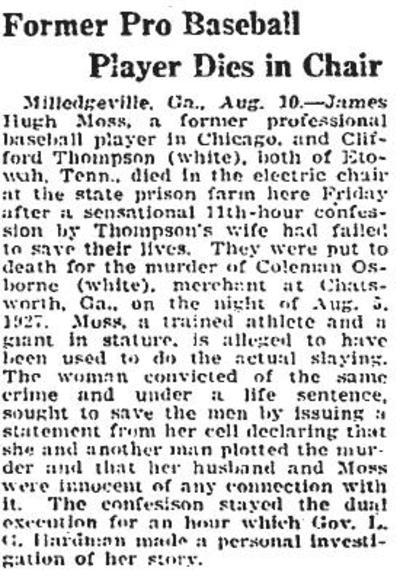
1928: Jim Moss, former Negro League ballplayer


Chicago Defender, Aug. 11, 1928.

Former Negro Leagues baseball player James Hugh Moss was electrocuted in Georgia on this date in 1928, along with a white man named Clifford Thompson.

The threesome of Moss, Thompson, and Thompson’s wife Eula, were Prohibition bootleggers from Etowah, in eastern Tennessee. A year before almost to the day (August 5, 1927), they had rolled up with a car full of moonshine whiskey to a general store in Chatsworth, Georgia, 45 miles away. Although it was after hours they were able to rouse the shopkeep Coleman Osborne. Some kind of argument ensued, and Osborne was shot dead.

All three of the smugglers were capitally convicted.

Eula Thompson’s electrocution was postponed and as we shall see, never ultimately conducted — but on the eve of the men’s death, she attempted to save them with a sketchy confession to an affair with a local farmer that necessitated Osborne’s murder when the latter found out about it. This sent Georgia Gov. Lamartine Griffin Hardman on an 11th-hour investigation into the exculpatory claim but as a physician he knew just what to do and according to a news report, “Governor Hardman announced recently that the phrenology of Clifford Thompson, the woman’s husband, and Jim Hugh Moss, Negro electrocuted for the murder of Osborne, played a part in his decision not to interfere in their cases.”

That gem comes from a writeup of the case at Baseball Prospectus, which notes that after Eula Thompson’s gambit to exonerate the boys failed, she resorted to a gambit to exonerate herself by blaming the whole thing on (the by then already-executed) Jim Moss. This got her a reprieve while Governor Hardman put his skull forceps to work and eventually the Peach State decided not to run any volts at all through the charming young lady. She married an admirer from the public, got paroled in the 1930s, and ended up back in prison for murdering her brother.

As to Moss’s former athletic feats, the thing that draws our attention in the first place, they’re only glancingly alluded to by the period’s press report. He would have played in the complex of black professional leagues during the period that Major League Baseball enforced a whites-only color line.

A Negro Leagues blog made a go at tracking him down and found that a guy named “Moss” (no first name given) made a single documented appearance in 1918 for the Chicago American Giants. The name subsequently appears on a lower-tier barnstorming team, the Havana Stars. (Chicago-based, despite what the name would suggest.)

Moss isn’t the only known ball player to sit in the mercy seat: check out this forum thread on executed players. And on our humble death blog, we’ve noticed other, more oblique contacts between the headsman and the seamhead.

On this day..

1838: Remexido, Liberal Wars holdout

José Joaquim de Sousa Reis, known simply as “Remexido” or “Remechido”, was executed by firing squad at the Campo da Trindade in Faro, Portugal on this date in 1838.

This fellow (English Wikipedia entry | Portuguese) was a partisan of absolutist King Miguel during a furious civil war, the Liberal War(s), that resulted in his deposition.

Remexido maintained a guerrilla resistance in the mountains of the Algarve for years after Miguel’s 1834 defeat. He’s noted for his ferocity, bequeathing the village of Albufeira the nickname of villa negra for the 74 executions he perpetrated upon its inhabitants after an 1833 assault.

Liberals answered stripe for stripe on the collective punishment front, torching his house, publicly flogging his wife, and murdering his 14-year-old son.

Needless to say, there would be no quarter when they finally caught him; allegedly, the Council of War even overrode the young post-Miguel queen’s attempted clemency to force his execution.

Nowadays he’s a colorful figure from a bygone time, and you can catch re-enactors doing Remexido cosplay and even proper city streets named for him, as this one in Estombar.

On this day..