1805: Not Bartlett Ambler, possible buggerer

From “Buggery and the British Navy”, in History of Homosexuality in Europe and America

Unlike modern military law, which tends to distinguish in some way between homosexual acts between consenting adults and what is often the equivalent of rape of a shipmate, the navy during this period made no such distinctions. A boy who had been seduced or forced to commit buggery, therefore, was under great pressure to turn in his partner or attacker, for if they were caught and it appeared he had consented, the “victim” might well be as severely punished as the aggressor. Needless to say, there were serious problems in determining whether or not the boys called to testify were telling the truth, or simply using the buggery charge as a means of destroying a shipmate or officer they particularly disliked.

The courts were often acutely conscious of that possibility and there was even some objection to allowing young boys to testify in buggery trials. In 1772, the defense protested the testimony of John Ellis, a twelve year old boy who had accused one John Palmer of buggery. Despite the protest, however, it was decided that he could legally testify and Palmer was convicted of attempted buggery.

The problem of boys testifying against men in buggery cases are clearly revealed in the Bartlett Ambler case. Ambler was accused by four boys of sodomitic practices. Each testified that Ambler threatened to have them flogged if they told what had occurred. One of the boys, John Davy, said, “…and I had scarce buttoned up my breeches when he said be sure don’t tell no person of it. I’ll be very good to you, but if you tell any person of it I’ll get you flogged.” Ambler based his defense on the alleged wickedness of his accusers. Joseph Dorman, the ship’s corporal, was called upon to discuss the character of three of the witnesses.

Q. Do you know if the boys who have been examined in support of the charge against me are notorious liars?

A. Two of them Hopkins and Willcott have been several times punished for lying.

Court. What is the character of the boy Davy?

A. He bears a very bad character by the whole ship’s company.

Ambler also called upon Midshipman Robert Baker who told the court:

Davy is a very wicked boy indeed as ever lived everyone in the ship will say that if it was in his power he would hang his own father — I hear Hooper’s mother say that her son had denied to her all that had been said against the prisoner.

The court had to weigh the testimony of the four boys who accused Ambler of buggery against the evidence of Ambler’s witnesses, who denigrated the character of the boys and testified to his good reputation. The judges sentenced Ambler to be hanged, but as a sign of their unease, sent the following letter to the Admiralty Secretary, along with the minutes of the trial:

By desire of the members of a Court Martial assembled by me this day to try Mr. Bartlett Ambler, I have to request you will call their lordship’s consideration to the hardship the Court have labored under in being obliged to condemn a man to death, upon the evidence of four boys, the eldest not more than thirteen years of age, and therefore recommend him to mercy.

The recommendation was endorsed by His Majesty on May 8, 1805, and Ambler was pardoned.

It is clear that boys could be intimidated into testifying against innocent men. In one disturbing case, a boy was caught under the blanket of Edward Martin. Evidently, the boy did not have a bed or blanket of his own, and Martin took him in as an act of kindness. The captain of the ship had the boy flogged and threatened him with another whipping if he refused to testify. Under the threat of further punishment, the boy confessed that Martin had buggered him. The trial record reads:

Prosecutor. Did you inform me that the Prisoner had committed that unnatural crime on you twice?

James. Yes, but I was afraid that the Captain would flog me.

In this case, the prisoner was acquitted, but the case does suggest the many possible abuses in buggery trials: that the testimony of boys was suspect, that fear of punishment or promise of reward might be used to intimidate them into giving false evidence against a shipmate, that the boy could be motivated by dislike or a desire for vengeance.

Trial transcripts of the testimony offered against Bartlett Ambler — and summoned by Ambler in his defense, who averred the “wicked” and “very bad” character of the childish witnesses — are available in Gay Warriors: A Documentary History from the Ancient World to the Present.

On this day..

1900: James Nettles

From the St. Louis Republic, July 9, 1898

James Nettle has Partly Confessed.

Suspect in the Mann Murder Case Admits All but the Shooting.
Caused the Arrest of His Double in Order to Confuse the Several Witnesses.

James Nettle, the negro who is accused of the murder of Conductor Edward Mann of the Suburban Railway, on the night of July 4, after emphatically declaring his innocence and even going so far as to bring about the arrest of his “double,” Esbree Manley, a negro ventriloquist, as a suspect in the case, yesterday began to show signs of weakening, and at a late hour last night had confessed everything but the firing of the three shots which proved fatal to Mann.

The arrest of Manley on Nettle’s statement that he had overheard a conversation in the calaboose that a ventriloquist had a hand in the shooting, proved to be Nettle’s undoing. When confronted by Manley, Nettle was unable to carry out his well-laid plans. The striking similarity in the physique of the two negroes would have rendered it almost impossible to pick out the real culprit, but Manley met Nettle and the police with such a straight story of his whereabouts at the time of the tragedy that the former burst into tears and admitted after a little coaxing that he was in the street car fight in which Conductor Mann was slain.

He told his story between sobs, for he broke down completely under the strain. He declared that Mann had ordered him off the car and had returned his fare, in order to hasten his departure, when the fight started. He did not recall how they began fighting, but he said the conductor and motorman tackled him and forced him off the platform, threatening to do him violence.

Even after he had left the car, he said, the conductor followed him several steps. At this point the shooting was done, but all efforts to make the negro Nettle relate these further details have proven futile. In order to avoid the cross-fire of questions from Chief Desmond, the negro complained of being ill and had to be given medicine by the Dispensary physicians. Afterward he said he would not talk further on the murder until to-day.

The negro Manley was released last night after he had established an alibi.


From the St. Louis Republic, Dec. 16, 1898

Testimony Finished.

James Nettles’ Fate Will Be Decided To-Day.

To-day the fate of James Nettles, colored, charged with murder in the first degree, probably will be decided in Judge Tally’s court, after 10 hours’ argument by the attorneys for the State and the prosecution. At 11 a.m. yesterday the State rested and the defense was through at 6 p.m., having tried to establish an alibi.

Thomas L. Brown, the motorman of the car on which Conductor Samuel W. Mann was mortally wounded on the night of July 4 last, was the first witness for the State. He told how the negro boarded the St. Louis and Suburban car at Jefferson avenue, quarreled over car fare, and at Garrison avenue shot the conductor as he retreated from the car. He identified Nettles. Others testified that they were sure Nettles was the assassin.

For the defense, Michael White, a negro, with whom Nettles lived at No. 1321 Linden street, was the main witness. His testimony was that he and the defendant were together all day on July 4, and that Nettles was not at any time near the scene of the murder. He testified that they went to Kirkwood in the morning, returning to their home about 7 p.m., where there was an entertainment, at which both Nettles and White were present until 11:30 p.m. In corroboration of this testimony many witnesses were introduced.

In rebuttal, the State introduced Frederick Brunesman of No. 2641 East Prairie avenue, the motorman of the car which immediately preceded Conductor Mann’s car on the night of the killing. Brunesman identified Nettles as the negro who tried to board his car that night at Jefferson avenue, but was so drunk he fell off. Detective John Gallagher and Policeman Thomas Mahon told of an interview they had with Nettles on the day following his arrest. On that occasion, they testified, Nettles said he assaulted Conductor Mann because Mann rebuked him for misconduct.


From the St. Louis Republic, Dec. 17, 1898

Nettles Found Guilty

Jury Decides That the Negro Murderer Must Hang.

Had James Nettles, a negro, been informed that his dinner was ready, he could not have displayed less concern than when told the jury had found him guilty of murder in the first degree and that he must be hanged. Death seems to have no terrors for him and he smiled at his fate in the same indifferent manner with which he greeted the onslaught of the State’s witnesses. Never through the long trial has he ever manifested even a moderate interest in the proceedings. If he is guilty of the foul murder of Conductor Mann before his wife and children on July 4, he did not show it yesterday.

The cases on both sides were rested on Thursday evening and for four hours yesterday the attorneys for the State and the defense fought an oratorical battle before the jury. Finally, a few minutes before 2 o’clock, the case was given to the jury.

Then, for three hours the jurors debated the case, finally coming to a decision at 5 o’clock. Several of the jurors, it was learned, stood for a life sentence, but were converted to capital punishment on the ground that executive clemency might intervene to cut short the term.

The State had many witnesses who were on the car and identified Nettles as the assassin; while, on the other hand, the defense had nearly a score of negroes to establish an alibi. The State’s attorneys held that it was an alibi for the occasion and made efforts to break it down. One of the defense’s witnesses, who said he was with Nettles at a dance on the night of July 4, testified that there was a roaring fire in the parlor. Other similar statements served to weaken the alibi.

When the verdict had been rendered, Attorneys Van Patten and Morroll, for the defense, declared they would ask for a new trial, and in case it were refused, would appeal.


From the St. Louis Republic, April 5, 1900

Respite for Nettles

Governor Grants the Condemned Man Another Thirty Days

Governor Stephens last night granted a thirty day’s respite to James Nettles, the negro who has been condemned to be hanged for the murder of Conductor Samuel W. Mann on a St. Louis and Suburban car, near Leffingwell avenue, on the night of July 4, 1898. He was to have been hanged a month ago, but a reprieve of thirty days was granted in order to give the Governor time to examine into the merits of the appeals for clemency.

The death watch was placed on Nettles yesterday morning at 6 o’clock and has not yet been removed, as Sheriff Pohlmann has not received official notification of the respite. He expects a letter from the Governor to-day.

Nettles was not in the least perturbed yesterday. When the Reverend Mr. Hurzburger of the German Evangelical Church called at the jail last night with Sheriff Pohlmann and notified the condemned man that the Governor had granted a respite of thirty days, the negro, without any apparent emotion, thanked him for what he had done in the matter and reiterated his assertion of innocence.


From the St. Louis Republic, April 26, 1900

A QUESTION OF WHISKERS — Another attempt is being made to get Governor Stephens to commute the death sentence of James Nettles, the negro who was convicted of the murder of Conductor Sam W. Mann on the night of July 4, 1898. Governor Stephens has granted two stays of execution to allow himself time to investigate the application and petitions. At the trial some of the witnesses testified that Mann’s assailant wore side whiskers. Attorney Maurer had several barbers examine Nettles’s face, and he says that they will make affidavit that he could not raise side whiskers.


From the St. Louis Republic, May 6, 1900

To Be Hanged To-Morrow

Death Watch Placed on the Negro James nettles.

Chief Deputy Sheriff Pohlman yesterday for the third time placed the death watch on James Nettles, the negro who is under sentence of death for the murder of Conductor Samuel W. Mann. Nettles will be hanged at 6 o’clock to-morrow morning unless Governor Stephens stays the execution. Twice Nettles has been within the shadow of the gallows, with the death watch set, when each time the Governor granted reprieves that he might look further into the applications for clemency.

Nettles has all but lost hope. When Deputy Sheriffs Parcel and Hoefer escorted him from his cell on the second tier to cell No. 46 on the round floor, he said he guessed this was the last time. The cell to which he was transferred is the one occupied by all St Louis murderers during the last hours before their execution. Nettles was restless Friday night, alternately reading the Scriptures, praying and singing. When the deputies came in he seemed somewhat relieved. He walked between them up and down the exercise yard until 7 o’clock, when he went into his new cell, where he ate a hearty breakfast. At dinner and supper it was the same way; he seemed to take a last pleasure in ordering what he wanted to eat. He still protests his innocence.

He was convicted of the murder of Conductor Sam W. Mann on the night of July 4, 1898. Nettles got on Mann’s car at Jefferson and Franklin avenues. He refused to pay his fare and Mann ordered him from the car. A scuffle followed and Nettles fired a shot which struck Mann in the abdomen, causing his death a few hours afterwards. Mrs. Mann and two little daughters of the conductor were on the car at the time and witnessed the killing.


From the St. Louis Republic, May 8, 1900

James Nettles, the negro convicted of the murder of Conductor Samuel W. Mann of the Suburban Street railway, was hanged yesterday morning. The drop fell at 6:07 o’clock, and nineteen minutes afterwards the doctors pronounced him dead. Nettles met his death bravely and declared his innocence with almost his last breath.

The execution was conducted with precision and dispatch, but without unnecessary haste. About 250 spectators were present, but they were more orderly than those present at previous hangings.

Nettles was restless throughout the night preceding his execution, and did not sleep any. A number of friends called to bid him good-by early in the night. The Reverend Mr. Sachs, Nettles’s spiritual adviser, the Deputy Sheriffs on the “death watch,” and a few newspaper men remained with him throughout the night. At 3 o’clock in the morning the Century Quartet called at the jail and sang several favorite hymns.

Early in the morning Nettles retired to his cell with the Reverend Mr. Sachs, where they read the Scriptures and prayed until the arrival of Sheriff Pohlman.

At 6 o’clock Sheriff Pohlman read the death warrant to Nettles. The prisoner’s arms were then bound and he was led to the scaffold. Nettles did not falter, although he was a trifle nervous. After his legs and arms had been securely bound Sheriff Pohlman asked him if he had anything to say before he died. In a clear, resonant voice he said,

I am about to die for another man’s crime. The Lord knows I am innocent, and I go to meet him with a clear conscience. I love you and I hope to meet you above. I am innocent!

Then the black cap was pulled down over his head, the noose adjusted and Chief Deputy Sheriff Pohlman sprung the lever. Nettles’s body, after the drop, hung perfectly still. Nineteen minutes later the physicians pronounced him dead and his body was cut down and taken into the morgue. An examination revealed that his neck was broken.

Nettles shot and killed Conductor Mann on his car in Franklin avenue near Leffingwell avenue on the night of July 4, 1898. The negro got on the car and refused to pay his fare. While Mann was ejecting him he pulled a revolver and fired. Mrs. Mann and two little children were on the car and witnessed the murder.

On this day..

1801: Franz Troglauer

On this date in 1801, robber prince Franz Troglauer was hanged at Amberg.

A lifelong picaro, Troglauer had several brushes with the law at his back when around 1790 he formed up the Fürth Diebesbande, or Great Franconian Robbers’ Band.

This lot delivered what their name promised throughout the 1790s. Troglauer’s* gang took enterprising advantage of the emerging technologies that were driving the classical outlaw figure into myth and memory, setting up their own printing press to churn out forged papers and compassing a vast shadow economy ranging from thieves to fences to look-the-other-way inkeepers. Troglauer’s most famous caper was engineering the heist of a Bamberg bishop’s vestments. (And more significantly, his silver plate.)

Some in the latter-day Upper Palatinate aspire to make his haunts into a tourist attraction a la Troglauer’s Rhenish contemporary Schinderhannes, but his life is surprisingly ill-documented and so his fame has little spread to the wider world. (That’s why all the links here are in German.)

The gang was betrayed and broken up in 1798. Troglauer managed to escape and briefly resume his career, but his overt threats to assassinate a prominent landlord who had been involved in his previous prosecutions helped to intensify the search that brought him once more to prison and at last to the gallows.

* This is a network rather than a hierarchy; Jakob Meusel was another important leader, and it’s sometimes also called the Meusel Band after him.

On this day..

1725: John Coamber

The Dublin hanging of John Coamber on this date in 1725 for the previous year’s notorious mugging/murder of a city counselor named Richard Hoar(e) arrives to us, as have several previous posts, via James Kelly’s Gallows Speeches From Eighteenth-Century Ireland.

In this instance, Kelly gives us two rival “last speeches.” It’s a genre that he says was exploding in the 1720s, with the burgeoning of print culture and the importation of similar purported gallows unburdenings.

And as we saw in a 1726 exemplar from the same book, the publishers who flooded this burgeoning market were at daggers drawn with one another over precedence for inside information and autobiographical authenticity. This is another case where one of the documents — Cornelius Carter’s — takes space to take a shot at the rival tract.

We also see here in Carter’s more detailed (and here, sarcastic) narrative that two different, innocent, men were hanged for the murder some time before one of the three real killers saved his own neck by shopping Coamber.


The Last Speech, Confession and Dying Words of

John Comber

who is to be Hang’d and Quarter’d this present Wednesday, being the 5th, of this Inst. May 1725. Near St. Stephen’s-Green; for Murdering Councellor Hoar, in January last.

Good Christians,

My Heart has been so hard hitherto, that I had no Manner of thought of either Soul or Body, but now I seeing Death plainly before my Face, causes me to consider of my latter End; and praise God for giving so much Grace so to do; therefore I am resolv’d to make a Publick Confession of my past Life and Conversation, which is as follows.

As to my Birth and Parentage, it is but a folly to relate, yet I can say I came from very honest Parents, who took what Care they could to bring me up in the Love and Fear of God, but I contrary to the Laws of God and Man, have gon [sic] astray, and follow’d Loose Idle Company, which brought me to this untimely Death; and how it came to pass was thus.

I being Entimitly Acquainted with one Patrick Freel, and David McClure, with whom I went to a House in New-street, where we then (after several meetings) made a Plot to get Money, by reason it was scarce with us, at length we Consulted the 19th, of January last, to Robb the first we wou’d meet with, and being over perswaided by the Devil, I went to the House of Mr. Carter and meeting a Child of his, bid him fetch his Dady’s Pistol, and I would fetch him some sweet things, upon the same promise, the Child brought me a Pistol, and then I, in Conjunction with the above Named Persons, went towards Stephen’s-Green, where we met with Mr. Kennedy, Mr. Leeson’s Clerk, whom we Robb’d of a Ten Peney Piece, from that we proceeded to Henry-street, where we met the Deceased Gentleman, to whom I went up, and Demanded his Money, with that he moving his Arm, and I having the Pistol Cock’d, caused the same to go off, tho’ as I shall Answer my God I did not think of being his Butcher; and when I found the Pistol went off, I never staid to know whether he had Money or no, but took to my Heels as fast as I could.

Then I went to the Sign of the Black Swan in Mary’s-Lane, where I and my Comrads met; from that my Prosocuter Patrick Freel and I, went to the Country where we staid for some small Time, then I came back, and as God, who never suffers Murder to be Conceal’d, I was soon Apprehended and put to Goal, upon Suspission, where I lay as good as a Month, but a Proclamation being Isued out, concerning the Murder, he came in and made Oath that I was the Person that Shot the Councellor, which to my sorrow is True.

Having no more to say but beging the Prayers of all good Christians, I die a Roman Catholick, and in the 22d. Year of my Age, and the Lord have Mercy on my poor Soul Amen.

Dublin: Printed by C.P. 1725.


The Last Speech, Confession and Dying Words of

John Coamber

who is to be Hang’d, Drawn and Quarter’d this Day, being the 5th of this Instant May 1725. For the Murder of Councellor HOAR in Henry Street the 19th of Jan. last.
Deliver’d to the Printer hereof C. CARTER the 5th of May, and to no other, By me John Coamber. And All others are Imposing on the Publick.

All you my Spectators,

This is to give you the following Account, I was born in the Town which is Call’d Thurles, in the County of Tipperary in Munster, of very honest Parents, that brought me up in the fear of God, and Wou’d give me good Learning, but I was too Head-strong, and wou’d not be Rul’d or Guided by my tender Parents, but left ’em and went to serve a Tobacco-twister, which I work’t at for about 5 years, being weary of that I came for Dublin, being a stranger, I turn’d Porter about Cork-hill, where I stood and follow’d that business for near 3 years, all this time I behav’d my self very honestly, and was well belov’d by all that knew me, especially in the above Neighbourhood, being weary of that, I took a fancy to Cry News about this City, which in a little time, I began to get a great many pence by it, and in sometime after, I became Acquainted with Idle and loose Company, Viz. and in the process of time I came to be acquainted with particular Persons and some others who first brought me in Company among Whores to Drink and spend my Money &c. Which was the first Cause of my Destruction.

Afterwards I went of my own Accord, and follow’d the said Evil Custom and other ill Actions, then I became as obdurate and as Wicked as the worst of my Ring-leaders.

I have Reason to Curse them Idle fellows which made me first acquainted with the whores and Pick-pockets in this City, of which there is abundance too many.

But finding Money not Answering to keep the above Company, being acquainted with one David McClure who was my chief Comrade, and who made his Escape to France after the Murder was Committed, he and I stuck together, and followed a very Idle Course of Life, and we Committed several ill Facts in this City and Liberties thereof.

All our shifts not Answering, I, McClure, and Patrick Freel (who was the first Evidence against me) Resolv’d to turn Robber, but never did design to be Guilty of Murder, and did design when we got a Sum of money that was worth While, to leave the Country.

I confess, that Patrick Freel, David McClure and I went on the 19th of January last at Night, to Henry Street, with a Design to Rob, or Plunder the first Gentleman that came that way; which was the luck of that worthy honest Gentleman Councellor Hoar, though I declare before God I did not design to hurt him, or any Man else that time.

I do also Confess that I did own to the Blind Boy, Lawrence Dugan, (who was the t’other Evidence against me) that Patrick Freel, David McClure and I myself, were all Guilty of the Murder for which I now suffer, but I wonder he did not Discover, it when one Pitts and another one Hand, had like to suffer for this Murder. (emphasis added -ed.)

I further Declare, tho’ it was falsely and Scandalously Publish’d in Print, by one Mrs. Needham and her Son Dickson; that I had got Mr. Carter’s Pistols from his young Son about 8 years of Age, (we had but one Pistol among us) and as I am a Dying Man I got no such thing from the said Child, nor none of his Family, neither did I steal any such thing out of his House in my Life time.

I accused one Daniel Field and Michael Tankard falsly, which I am heartily sorry for, but it was by the Advice of Winfred Dunn and Patrick Dunn the 2 Informers, that swore against Pitts and Hand that was Try’d the last Term for this Fact.

I beg of my great God to forgive my Prosecutors, and all my Enemies, as I do forgive them from the bottom of my heart.

I hope this my untimely End will be a Warning to my Comrades, and also to all young Men, which I pray to God it may. For my own part I own I am Guilty of the Fact for which I Die, And I hope the Lord of his infinite Goodness, will have Mercy on my Soul and forgive me.

I am about 19 Years of Age I dye a Roman Catholick, and Desires the Prayers of all Good Christians, and the Lord have Mercy on my poor Soul. Amen.

JOHN COAMBER

DUBLIN: Printed by Corn. Carter. 1725.

On this day..

1945: Majda Vrhovnik, Slovenian resistance

On this date in 1945, Slovene resistance member Majda Vrhovnik was executed by the Gestapo in Klagenfurt, days before the end of World War II.

A University of Ljubljana medical student and Communist destined to be honored as a national hero of Yugoslavia, Vrhovnik (English Wikipedia entry | Slovenian) joined the underground resistance when the Nazis occupied Yugoslvia in 1941. She’d spend the bulk of the war years producing and distributing illicit anti-occupation propaganda but by war’s end she had been detailed to nearby Klagenfurt — a heavily Slovene city just over the border in Austria.
She was finally caught there and arrested on February 28, 1945, and shot in prison even as Klagenfurt awaited Allied occupation which would arrive on May 8.

Her credentials as a patriotic martyr — there’s a Majda Vrhovnik school named for her — would surface her name in 1988 in connection with an affair that helped begin the breakup of Yugoslavia into ethnic statelets, when an opposition journalist published a censored article under the pseudonym “Majda Vrhovnik”.

On this day..

1919: Rudolf Egelhofer, Bavarian Soviet commandante

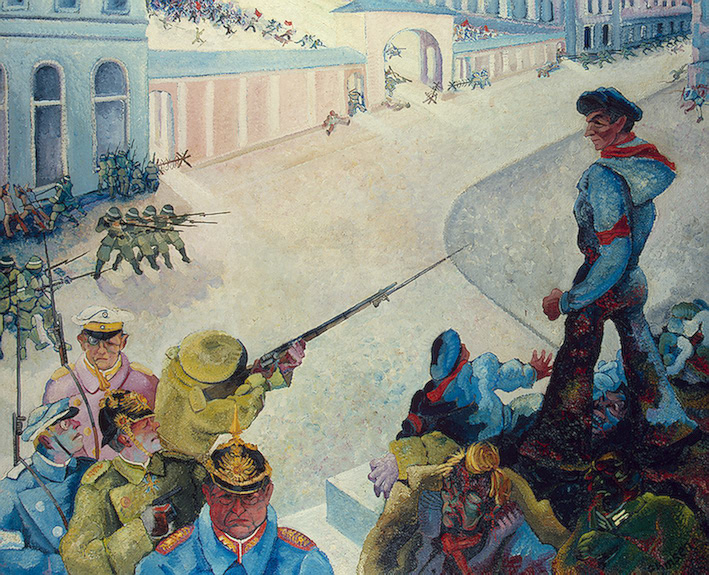
On this date in 1919, the commandante of the “Red Army” of the short-lived Bavarian Soviet Republic was shot by the German soldiers and Freikorps that had just overrun the revolutionary republic.

The son of a pauper basketweaver, Rudolf Egelhofer enlisted in the navy in World War I and was involved in a naval revolt in the war’s closing days. Transplanting to Munich in the chaotic postwar environment, Egelhofer joined the Communist Party and became a fixture of the revolutionary movement; the socialist writer Oskar Maria Graf would record of Egelhofer’s stature at a parade that he stood “determined and sincere, in a sailor’s uniform, sometimes raising his fist. Those who heard him, had to believe in him.”

After a left-wing coup claimed Bavaria in early April, Egelhofer’s steel and magnetism received the impossible mandate of organizing a Red Army before Munich went the way of the Paris Commune. But the Bavarian Soviet was overwhelmed in less than a month.

In the first days of May, Egelhofer’s fate was shared by something like 700 supporters of the defeated Soviet.


The fierce “victim” dominates his executioner in Execution by Firing Squad of the Sailor Egelhofer, by Heinrich Ehmsen (1931). This is only the central panel of a triptych depicting the White storming of Red Munich; the piece is described in this post.

Ehmsen has a similar idea about relative stature at work in Execution by Firing Squad (Red Jacket) (1919).

Though little memorialized at the place of his glory and martyrdom — which fell on the western side of the Iron Curtain — numerous East Germany streets, public buildings, and naval vessels bore Egelhofer’s name in tribute during the Cold War.

On this day..

1821: Tommy Jemmy executes Kauquatau

On this date in 1821, a chief of the Seneca Native American nation slit the throat of a woman named Kauquatau, who had been condemned as a witch.

As Matthew Dennis explains in his book on the Seneca of the early American Republic, Seneca Possessed, the rapid march of European settlement and the Seneca’s recent and ambiguous incorporation into the newborn United States had strained the indigenous society in complex ways.

One of those reactions was a period of gendered witch-hunting in the early 19th century, especially growing out of the religious movement of the prophet Handsome Lake.

“Handsome Lake pinpointed the dangers the Seneca faced, the threats that they faced, the source of those threats, and a way … of purging his society of those who were most likely to resist his changes,” Dennis explained in this New Books Network podcast interview.

The “threat” for the instance at hand was a tribal healer who had become suspected of bewitching a man to his death — and her guilt in the same voted on by the Seneca elders. One of their number, Chief Soonongise — known as Tommy Jemmy to whites — went to her cabin on May 2, 1821, and killed her. It’s anyone’s guess whether Kauquatau realized what was happening — whether she took it as a social call or recognized her angel of death from the outset. But to New Yorkers, it was murder plain as day — and Tommy Jemmy was soon confined to a gaol to stand trial for his life.


Another reaction occasioned by the upheaval of those years, a reaction destined to emerge dramatically in this instance, was a feeling-out of the Seneca people’s position within the Anglo Republic that had engulfed it. “If the Senecas were a conquered people, as some tried to allege, the terms of their conquest were ill defined, their sovereignty, though diminished, still recognizable,” Harris writes. In these very pages we have met this ill-defined sovereignty several times: a few years on from the events of this post, the state of Georgia would defy a Supreme Court stay and execute a Cherokee man in a case turning on disputed sovereignty.*

Here in New York, Tommy Jemmy’s trial would open a different contest over the same underlying question.

Rather than attempting to deny or minimize his “crime,” Tommy Jemmy defended it as a legal execution conducted by the proper jurisdiction of Seneca laws — no matter for the interference of New York. It’s a position that appeared to have ample sympathy among Anglo New Yorkers,** who gingerly kicked the argument to a Circuit Court and thence to the New York Supreme Court which found itself thereby obliged to “a very thorough examination of all the laws, treaties, documents and public history relating to the Indians” going all the way back to the Dutch. (Cherry-Valley Gazette, Aug. 21, 1821)

What musty old scrolls could supply by precedence, the luminous Seneca orator Red Jacket brought to life in his forceful defense. Red Jacket had an expert feel for the pangs in the Anglo conscience, as one can appreciate by his retort against one obvious line of condescension.

What! Do you denounce us fools and bigots because we still believe what you yourselves believed two centuries ago? Your black-coats thundered this doctrine from the pulpit, your judges pronounced it from the bench, and sanctioned it with the formality of law; and would you now punish our unfortunate brother for adhering to the faith of his fathers and of yours? Go to Salem! Look at the records of your own government, and you will find that thousands have been executed for the very crime which has called forth the sentence of condemnation against this woman, and drawn upon her the arm of vengeance. What have our brothers done more than the rulers of your people? And what crime has this man committed, by executing in a summary way the laws of his country and the command of the Great Spirit?

It was by no means certain that Tommy Jemmy’s argument would prevail here; a literally simultaneous case in Michigan saw a native defendant make a similar jursidictional argument and still wind up on the gallows. The question in the end stood outside any existing grant of law — and it was resolved in a legally questionable way, too.

Accepting the merits of Tommy Jemmy’s position but also unwilling to render Indian power over life and death into the statutes, Tommy Jemmy was set free without any judgment and subsequently pardoned by the legislature — the pardon reversing no conviction. He was an executioner, after all.

* U.S. President Andrew Jackson vigorously supported the state in this separation-of-powers dispute: it’s the case of which he alleged to have remarked, “[Chief Justice] John Marshall has made his decision; now let him enforce it.”

** In an essay appearing in New World Orders: Violence, Sanction, and Authority in the Colonial Americas, Dennis notes the precedent here of an 1802 trial involving a Seneca man named Stiff-Armed George. Although Stiff-Armed George murdered a white victim and not on Seneca land, Red Jacket also urged a defense, successfully: “Did we ever make a treaty with the state of New-York, and agree to conform to its laws? No. We are independent from that state of New-York … we appeal to the government of the United States.” (The Seneca did have treaties with the federal government.)

They finessed the issue in the end: Stiff-Armed George was convicted, but immediately pardoned.

On this day..

1691: William Macqueen, the Irish Teague

On this date in 1691, 11 hanged publicly at Tyburn.

From the Ordinary’s Account they make a fairly typical, if voluminous, assortment: an infanticide, a drunken murderer, and thieves and highwaymen of various descriptions.

Two of these rude knights of the road were “William Selwood alias Jenkins, condemned with William Mackquean a Papist,” the latter also called “Bayley, alias the Irish Teague.” Condemned for robbery on the road, Macqueen confessed to having previously murdered a soldier in a similar encounter; they were “Old Offenders” who had previously “been Reprieved, but would not take warning.”

For the veteran robber Macqueen we have a fine instance of the facts-be-damned mythmaking characteristic of the early Newgate Calendar: his entry credits him with stealing the mace of the Lord Chancellor, an outrageous caper that different criminals really did pull off many years before. Not accidentally, our rewrite version from the Whig ascendancy also edits the identity of the Lord Chancellor involved, who perforce must seem ridiculous to have lost the emblem of his station in this manner — replacing the true victim, the moderate and forgettable Earl of Nottingham, with that hated late-Stuart bete noir (and notorious hanging judge), Lord Jeffreys.

The implicit parable of the Glorious Revolution is reinforced by what must surely be a fanciful vignette in which Macqueen mugs the Lady Auverquerque, the wife of one of the Dutch commanders who invaded England with William of Orange in 1688. Both parties involved are foreigners on English soil, and their awkwardness in that most naked transaction of gunpoint robbery has comedic effect. Presented with a confusingly veiled demand for a “loan,” the mistress seeks clarification: “I believe you had as good tell me at once you are come to rob me; for this is an odd way of borrowing.” Macqueen/Teague apologizes and manages crudely but effectively to the convey the point: “I am a stranger in this country, and so if I don’t know the difference between robbing and borrowing, you must excuse me; for all I mean is, to have your money.”

On this day..

1944: Four Italian fascist saboteurs

On this date in 1944,* four young Italian fascist agents of Mussolini‘s rump state were shot as spies and saboteurs by the Allies at a quarry near Capua’s Sant’Angelo in Formis abbey.

Most of the information readily available about Franco Aschieri, Italo Palesse, Mario Tapoli-Timperi, and Vincenzo Tedesco is in Italian: specifically, in nationalist Italian pages celebrating the sacrificial patriotism of the young men who had parachuted into Allied-controlled southern Italy to operate as partisans. A number of their peers were shot in similar circumstances beginning in late 1943 and in greater numbers through the spring of 1944.

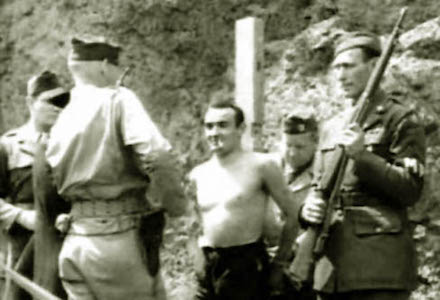
The quartet died game and then some, conferring upon posterity charismatic photos of handsome valor in the face of execution. The most startlingly iconic (at least one design based on it is available for sale) the shirtless and barrel-chested Palesse tied to the stake with an insouciant cigarette a-dangle from his lips. Inevitably their last cries ran to Viva il Duce! and Dio stramaledica gli inglesi! (God curse the Anglos!)


The condemned party in their cell on the morning of the execution, where their confessor remembered “I found them laughing.”


Having shucked off his shirt so the bullets won’t spoil it, Italo (sometimes given as Idalo) Palesse receives the comfort of a priest. (Source)


Franco Aschieri


Vincenzo Tedesco, from the firing squad’s perspective.

Mature Content: Video of this same scene records the men being shot.

On this day..

2014: Two crucifixions in Raqqa

In the Syrian city of Raqqa on this date in 2014, the Islamic State (ISIS/ISIL) reportedly crucified two men in a posthumous public gibbeting, after executing them by shooting. (There were seven executions in Raqqa that day.)

Raqqa was the Islamic State’s breakthrough conquest, and the city it claims as its caliphate’s capital — the “Bride of the Revolution.”

Horrific pictures of these crucifixions circulated worldwide thanks to the dissident group Raqqa is Being Slaughtered Silently. Needless to say, what follows is Mature Content.

On this day..