1460: Tiburzio di Maso, Roman brigand

The Roman outlaw-slash-rebel Tiburzio di Maso was executed on this date in 1460, with seven other members of his band.

Tiburzio’s father had been put to death seven years before for joining in the anti-papal intrigues of his kinsman (by marriage) Stefano Porcaro. Theirs was the old populist dream of Cola di Rienzi, to throw off the depraved overlordship of Rome’s patricians and resume the tribune of the people.

Their enemy in this endeavor, to speak a bit more specifically, must be the pope himself — for as Gibbon observed, “the policy of the Caesars has been repeated by the popes; and the bishop of Rome affected to maintain the form of a republic, while he reigned with the absolute powers of a temporal, as well as a spiritual, monarch.” It was this throne that had destroyed Tiburzio’s father, and upon which he proposed to revenge himself.

White breast, sweet tongue, kind eyes and ready wit! You marble limbs, full of vigour, when shall I see you again? When again shall I bite those coral lips, or feel again that tremulous tongue murmuring in my mouth, or ever handle those breasts.

Why, Achates, you have scarcely seen this woman. Where she is most feminine, there she is most lovely. I wish you could be me! Not the beautiful wife of Candaules, King of Lydia, was more beautiful than she. I cannot wonder that he wished to show his wife naked to his friend, to give him the greater pleasure. I would do the same myself. If it were possible, I’d show you Lucretia naked, for otherwise I cannot describe to you how beautiful she is, nor can you imagine how full and substantial was my pleasure. But rejoice with me, because my delight was greater than words can tell.

-[the man who would become] Pope Pius II, The Tale of Two Lovers

By the time the son Tiburzio came to avenge his father,* the pope in question was Pius II, once so much the gentleman-humanist that he is the only pontiff to byline an epistolary erotic novel. Come election to the seat of St. Peter, however, he had predictably discovered a newly illiberal affinity for the overweening prerogatives customarily asserted by his office

Among the lesser of these prerogatives was the option to make his residence in the less miasmatic confines of his native Siena, and his extended absence from Rome surely gave some air by which the brash youth could kindle a rebellion. Tiburzio attracted a gang who alternately caroused together and sallied together as highwaymen on the famously dangerous roads. “If in Porcaro the democratic movement had already generated to the level of Catiline, in Tiburzio and Valeriano, the heroes of 1460, it had sunk to that of mere brigandage,” wrote the German historian Ferdinand Gregorovius. (Via)

“Mere” brigandae posed a real danger to papacy’s safety, however, enough so that the governor’s running skirmishes with this most dangerous gang eventually required the returned of Pope Pius to steady the situation: a captured informant gave information that Tiburzio’s band was in league with Ghibelline nobles and had even arranged with the condottiero Jacopo Piccinino to throw open the city gates for his army.

But our man, well into the history-repeating-as-farce cycle, squandered his opportunity and his life by recklessly sallying into the city from refuge in nearby Palombara once one of his party was arrested. The Roman masses turned deaf ears on his calls to arms, and papal gendarmes captured Tiburzio and several misadventuring comrades. Without the inducements of torture, he too admitted the conspiracy with Piccinino — and the whole bunch hanged together on Capitoline Hill.

* Dad’s foe was Pope Nicholas V, who died in 1455.

On this day..

1863: William Griffith, for the Marais des Cygnes massacre

One of the signal outrages of Bleeding Kansas was avenged with a hanging on this date in 1863.

“Bleeding Kansas” was the guerrilla war over slavery in the late 1850s that presaged the conflagration about to consume the Republic; here on the frontier, pro- and anti-slavery partisans traded atrocities in their respective campaigns to secure Kansas’s imminent entry to the Union as either a slave or a free state. The stakes, had America continued her antebellum course, were vital Congressional votes on which the continuance of the peculiar institution might one day hang.

The naked brutality of the conflict shocked its contemporaries; as one particularly notorious example, the sons of abolitionist crusader John Brown executed pro-slavery captives with broadswords.

The Marais des Cygnes massacre was one of the last major horrors of that conflict: a party of 30 or so pro-slavery men led by Charles Hamilton seized 11 Free-Staters. They were mostly people who knew Hamilton personally, and seem to have gone along without resistance not anticipating what he had in store for them.

But Hamilton had told his men that on this campaign, “we are coming up there to kill snakes, and will treat all we find there as snakes.” (Source)

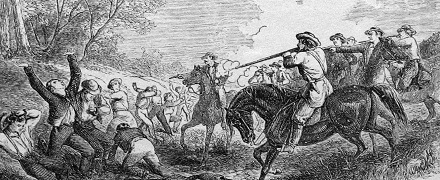
Much to their chagrin, these “snakes” were driven into a narrow ravine and lined up before Hamilton’s men’s guns. The volleys they delivered before fleeing back over the porous border into equally restive Missouri “only” killed five of their hostages: the other six survived by playing dead.


(Via)

Five years later, one of those survivors, William Hairgrove, supplied the identification that damned William Griffith — whose claim that he only helped capture the Marais des Cygnes victims, and didn’t help shoot them was an especially lame offering at the height of the Civil War.

According to Legal Executions in Nebraska, Kansas and Oklahoma Including the Indian Territory: A Comprehensive History, Griffith paid the forfeit for his role in the massacre “in a wood west of [Mound City, Mo.] on the opposite bank of Little Sugar Creek” before a crowd of thousands. There,

[a] little after noon Griffith was conveyed to the wood where he stepped onto the wooden platform a few inches above the ground. His wrists, knees and ankles were bound and the noose was adjusted. The black cap was pulled over his face at 1:07 p.m., and in but a moment William Hairgrove, one of the survivors of the massacre, cut the restraining rope with a hatchet; the four hundred pound weight dropped, jerking Griffith upward. The body rebounded and hung motionless while the attending physicians monitored his vital signs, and in twenty-five minutes they pronounced him dead.

Today, the site of the massacre is a U.S. National Historic Landmark. Quaker abolitionist poet John Greenleaf Whittier also memorialized the blood that was shed there in a poem titled “Le Marais du Cygne”:

A blush as of roses
Where rose never grew!
Great drops on the bunch-grass,
But not of the dew!
A taint in the sweet air
For wild bees to shun!
A stain that shall never
Bleach out in the sun!

Back, steed of the prairies!
Sweet song-bird, fly back!
Wheel hither, bald vulture!
Gray wolf, call thy pack!
The foul human vultures
Have feasted and fled;
The wolves of the Border
Have crept from the dead.

From the hearths of their cabins,
The fields of their corn,
Unwarned and unweaponed,
The victims were torn,—
By the whirlwind of murder
Swooped up and swept on
To the low, reedy fen-lands,
The Marsh of the Swan.

With a vain plea for mercy
No stout knee was crooked;
In the mouths of the rifles
Right manly they looked.
How paled the May sunshine,
O Marais du Cygne!
On death for the strong life,
On red grass for green!

In the homes of their rearing,
Yet warm with their lives,
Ye wait the dead only,
Poor children and wives!
Put out the red forge-fire,
The smith shall not come;
Unyoke the brown oxen,
The ploughman lies dumb.

Wind slow from the Swan’s Marsh,
O dreary death-train,
With pressed lips as bloodless
As lips of the slain!
Kiss down the young eyelids,
Smooth down the gray hairs;
Let tears quench the curses
That burn through your prayers.

Strong man of the prairies,
Mourn bitter and wild!
Wail, desolate woman!
Weep, fatherless child!
But the grain of God springs up
From ashes beneath,
And the crown of his harvest
Is life out of death.

Not in vain on the dial
The shade moves along,
To point the great contrasts
Of right and of wrong:
Free homes and free altars,
Free prairie and flood,—
The reeds of the Swan’s Marsh,
Whose bloom is of blood!

On the lintels of Kansas
That blood shall not dry;
Henceforth the Bad Angel
Shall harmless go by;
Henceforth to the sunset,
Unchecked on her way,
Shall Liberty follow
The march of the day.

On this day..

1936: Ramiro Ledesma Ramos, Falangist

Falangist politician Ramiro Ledesma Ramos was executed on this date in 1936, during the Spanish Civil War.

Ledesma (English Wikipedia entry | Spanish) launched the first fascist publication in Spain as a perspicacious 25-year-old admirer of Mussolini and Hitler.*

La Conquista del Estado — the expressive title was cloned from Curzio Malaparte‘s Italian fascist magazine — positioned Ramos as one of the leading apostles of the right in early 1930s Spain. Despite his youth, he’s been credited by later observers as one of the clearest, earliest intellectual exponents of fascism in Spain. Ledesma affiliated from the start with the Falangist movement Jose Primo de Rivera, and personally signed off on the party’s yoke-and-arrows logo and its motto “¡Arriba España!”

Spain’s Republican government had him detained in Madrid with the outbreak of the Spanish Civil War in July 1936. With the fascist armies closing in on Madrid in late October, Ledesma was among dozens of political prisoners taken out and shot without trial at the cemetery of Aravaca.

* His philo-Hitlerism allegedly led Ledesma to imitate the Fuhrer’s flopover coiffure.

On this day..

1859: Thomas Ferguson, but not on a Sunday

The first judicial execution of a white man* in the history of the Utah Territory took place on this date in 1859.

One Thomas Ferguson earned the distinction by getting roaring drunk and shooting dead the shopkeeper who employed and boarded him. Allegedly, Alexander Carpenter’s provocation had been to accuse Ferguson of being party to the unknown burglars who had lately raided his Salt Lake City shop, which obviously got way under Ferguson’s skin.

This was frontier America, being newly-settled by Brigham Young‘s upstart Latter-Day Saints sect, though not only by them. The capital’s population was perhaps 14,000 — the kind of place where dubious refugees could wash up from parts unknown, trusting their fortunes to their native wit and Colt’s Manufacturing Company.

“Crime has run riot in this city since the assassination of McNeill and Sergeant Pike” a hostile, non-Mormon correspondent wrote to the San Francisco Bulletin (letter dated Oct. 5, 1859, and published Oct. 27).

Till lately, no one has been arrested. Ferguson, a “Gentile,” murdered Carpenter, a Mormon, and for such an outrage “this people” will permit the sentence of death to be carried into effect; but the murderers of McNeill, of Pike, of Drown, of Arnold — the first two “Gentiles,” the last “apostates” — run at large to hold the community in terror and carry out other sentences.* An apostate committed suicide a few nights since by shooting himself twice in the back of the head!

Carpenter murdered his partner named Turner near Fort Laramie, Nebraska, brought their goods to this city, where, he said, (and convinced his associates,) he was tried and acquitted. Tried and acquitted in Utah for murder in Nebraska!

Both men were New Yorkers — and per a less strident observer writing to the New York Herald (datelined Oct. 7; published Nov. 7) neither of the two was Mormon. They had been allured to the West by the usual siren songs: wealth, fortune, fame. As young men do, these may have pictured themselves forever getting the drop on their enemies and never the other way around … and always with a dashing jailbreak at the ready if it came to that.

Unfortunately for Ferguson, he wasn’t the only Old West stock character in this tableau; a hanging-judge of dubious character named Charles Sinclair officiated the trial, so deep into his cups that he initially set Ferguson’s execution date for a Sunday. (It was changed to a Friday.) Ferguson himself gave the judge a right scorching from his scaffold rostrum on his way off this mortal coil:

I was tried by the statutes of Utah Territory, which give a man the privilege of being shot, beheaded or hanged. But was it given to me? No, it was not. All Judge Sinclair wanted was to sentence some one to be hanged, then he was willing to leave the Territory; and he had too much whiskey in his head to know the day he sentenced me to be executed on, and would not have known, if it had not been for the people of Utah laughing at him … A nice Judge to send to any country! (Source)

* The Espy file credits earlier executions of Native Americans, two Goshutes named Longhair and Antelope who hanged for slaying two whites during settler bush wars. (I would not venture to assert the judicial propriety, even by antebellum standards, of these proceedings.) And of course, Ferguson’s distinction excludes extrajudicial killings like the Mountain Meadows Massacre.

** The unpunished killings the correspondent names in this piece took place in the immediate aftermath of the 1857-1858 war between Mormon settlers in Utah and the federal government asserting its jurisdiction — a period when Brigham Young’s martial law had just been rescinded. Utah Gentiles inclined to read these incidents as emblematic of a lawless atmosphere in which reluctance to prosecute gave Mormons virtual impunity in their conduct towards the rest of the population.

On this day..

1821: Elizabeth Warriner, Lincoln poisoner

For this just-in-time-for-Halloween wicked stepmother, we are indebted to the highly browsable The Word On The Street, a collection of highlight broadsides held by the National Library of Scotland.

The Last Dying Words, Speech, & Confession of Elizabeth Warriner. Who was Convicted at the last Lincoln Assizes, for the Horrid Murder of her Step-Son, J. Warriner, by poison, and who was Executed at the City of Linclon [sic], on Saturday the 27th of Oct. 1821.

ELIZABETH WARRINER was indicted for the Murder of J. Warriner, her Step-Son, at Surfleet, by administering poison to him. The prisoner was the second wife of a Farmer. The deceased was his Son by a former marriage, about 12 years of age. From the period of her marriage, the prisoner treated the child with great cruelty. On various occasions she was heard to say she would be the death of him. At length on the morning stated in the indictment, the boy, immediately after breakfast, which consisted of bread and milk, was taken ill. Medical aid was called in, but he breathed his last in the course of the day. After she had poisoned the unfortunate boy, she dragged him out of the house, and put him in the stable, and hanged him up, with a rope round his neck, to make people believe he had hung himself, as there was no marks of violence round the neck. The body was opened by a surgeon, when the stomach and intestines were found to exhibit all the appearance of arsenic having been administered. It was afterwards ascertained that a quantity of arsenic was in the possession of the father, who used it for some husbandry purpose, [and to] which the prisoner had access. It further turned out, that a small quantity was found [in t]he basin from which he had eaten his breakfast: and that the prisoner had given him his breakfast in that basin. This circumstance, added to a variety of others, which in the [cou]rse of the examination of the witnesses, seven in numher, came out, led to to the conclu[sion], that the prisoner administered the poison.

Mr. Justice Holroyd summed up tne evidence, and the Jury found her gulity, The [judge] in passing sentence, obserted to the prisoner, that the crime of murder in all cases [was] an heinous one, and in all countries was punished with death; but there were gradations e[ven] in this crime, and her’s [sic] was of the worst nature. She had destroyed her Step-Son; and no other motive could be assigned than that arising from a cruel, hardened, and vicious disposition — her crime was that of muder, the most heinous and cruel. — He hoped she would sincerely repent of her crime, and take all possible care of her soul during the few hours she had to live, so to be reconciled to her offended Maker; he feared she was not so convinced of the necessity of this as she ought to be, but trusted she would seek for that advice which would satisfy her of that necessity, and enable her to meet her future Judge, with a well-rounded hope in his mercy from the sincerity of her contrition; all that remained for him to do was to pass sentence upon her which the law required, which was, that she should be taken from whence she came, and on Saturday the 27th October, 1821, to be taken from thence, to the place of execution, there to be hanged by the neck till she was dead, and that her body should be delivered to the surgeons for dissection — concluding with — “and may the Lord have mercy on your soul.”

The moment she heard that her life was to be forfeited for the barbarous murder, and her cruel treatment to her Step-Son, she jumped up from the floor in the greatest agony, wringing her hands, and other symptoms of distraction.

About ten o’clock on Saturday morning, she ascended the fatal scaffold with a greater degree of fortitude and resignation than could have been expected; and addressed the numerous spectators around her in nearly the following words: “Good people, you see now before you an unfortunate woman, cut off just in the prime of life, and for the most dreadful of al [sic] crimes, Murder! let my dreadful fate be a warning to you not to suffer your passion to work forcibly on your minds, which has been the cause of the melancholy situation in which I am now placed; let me beg your prayers — good people pray for me; O pray for me.”

On the morning of her awful execution, she was dressed all in white, with a child suckling at her breast, which was taken from her by the executioner and her melancholy cries was heard at a great distance. It was shocking to the surrounding multitude.

She then dropped a handkerchief she held in her hand, as a signal, crying, O my Child! my Child! and was immediately launched into a dreadful eternity.

Printed by John Muir, Glasgow.

On this day..

1781: Gaspard de Besse, social bandit

The French robber Gaspard de Besse was broken on the wheel in Aix-en-Provence on this date in 1781.

From a cave in the Esterel Mountains looming over the French Riviera, Gaspard raided the ample traffic wealthy merchants sent to and from the Mediterranean and Italy. He established a Robin Hood-esque “social bandit” profile by dint of his targets and populist provocations like, “the two scourges of Provence are the mistral and the parliament!”

Legend holds that he was unfailingly courteous in his raids and never killed those he preyed upon.

No surprise, he did not enjoy a like deference once one of his gang betrayed him. Hopefully amid the limb-shattering blows of the executioner he could console himself with the prospect of posterity’s renown.

On this day..

1849: Zsigmond Perenyi, by the Hangman of Arad

In the weeks following his defeat of Hungary’s 1848-49 revolution, the Austrian general Julius Jacob von Haynau consolidated his victory with enough cruelty to merit the title “Hangman of Arad.” On this date in 1849, he advanced Zsigmond Perényi, of late the speaker of revolutionary Hungary’s House of Magnates, to the ranks of Magyar martyrs.

A career politician and judge, Perenyi (English Wikipedia entry | the more detailed Hungarian) was a stately 74 years of age when the barricades went up. He was a baron, but a member of the reform-minded faction of that class who in the 19th century came more and more to see themselves in a national, Hungarian context. This historical thrust would lead, 18 years after the events of this post, to the official arrangement of an Austro-Hungarian Empire, the promotion of Hungary to titular imperial partnership but never to a fully satisfactory settlement of the tensions between Hungarian patriotic aspiration and Habsburg imperial prerogatives.

Perenyi signed the April 14, 1849 Hungarian Declaration of Independence; he and others who had set their hand to this treasonable document and played a role in the national government — they were just the sort of people to invite the attention of the hangman of Arad.

“Many government commissioners who had supported Kossuth were summarily court-martialled and led to the gallows,” Alan Walker notes in Franz Liszt: The Weimar Years, 1848-1861, Volume 2.

Baron Jeszenak, lord-lieutenant of the county of Nyitra; Szacsvay, the young secretary of the Diet; and Csernus of the treasury board all swung from the end of a rope. Baron Zsigmond Perenyi, of the court of justice, listened carefully to the charges against him and replied: “I have to complain that the accusation is incomplete. I request to add that I was the first to press the resolution that the House of Habsburg-Lorraine should be declared to have forfeited the throne of Hungary.”


By Hungary’s own Franz Liszt.

On this day..

1668: Two men and a woman, too early for Samuel Pepys

The L.P. Hartley saw about the past as a foreign country might roll a few eyes at the neighborhood history department, but one cannot dispute that the march of time has fundamentally altered many particulars of our everyday life.

Public executions are among the phenomena that ancestor generations once reckoned a routine fixture of the world, but for most of us are little but the stuff of fantastic nightmares. It requires an act of conscious imagination to project oneself into a world where expiring convicts propped up on breaking-wheels are just a part of the scenery — as in this absurd episode from Monty Python and the Holy Grail.

This date’s entry arrives courtesy of the pen of intrepid 17th century English diarist Samuel Pepys, whose faithful daily journals frequently record the public deaths occurring here and there like so many matinees.** Pepys at one level is a very accessible figure as he hustles through bourgeois banalities; that people are strung up and butchered around him and the fact rates nothing but a stray subordinate clause rudely injects that foreign past into his narrative.

On October 23, 1668, Pepys worked the day’s hanging right into an industrious calendar of business and social calls. (He attended Tyburn in the company of a surgeon, which made it a possible business trip for his companion.) Like the rest of us, Pepys wound up so pinched for time that he ran late and ended up missing the execution full stop, but he didn’t let the snafu perturb his day one bit.

Up, and plasterers at work and painters about my house. Commissioner Middleton and I to St. James’s, where with the rest of our company we attended on our usual business the Duke of York. Thence I to White Hall, to my Lord Sandwich’s, where I find my Lord within, but busy, private; and so I staid a little talking with the young gentlemen: and so away with Mr. Pierce, the surgeon, towards Tyburne, to see the people executed; but come too late, it being done; two men and a woman hanged, and so back again and to my coachmaker’s, and there did come a little nearer agreement for the coach, and so to Duck Lane, and there my bookseller’s, and saw his moher, but elle is so big-bellied that elle is not worth seeing. So home, and there all alone to dinner, my wife and W. Hewer being gone to Deptford to see her mother, and so I to the office all the afternoon.

After which Pepys turns as if to the our guilty-pleasure TMZ bookmark, and begins gossiping about the bawdy shenanigans of the royal court.

* Of course, the question depends on place as well as time; public executions are still routine in a few locales today — such as Saudi Arabia and Iran.

** Viz., the regicides as a successful sequel to the Charles I show:

I went out to Charing Cross, to see Major-General Harrison hanged, drawn, and quartered; which was done there, he looking as cheerful as any man could do in that condition … Thus it was my chance to see the King beheaded at White Hall, and to see the first blood shed in revenge for the blood of the King at Charing Cross.

On this day..

1773: Four convict labor escapees in Maryland

We owe this date’s post, as with a number of others on this site, to Anthony Vaver, proprietor of the superb (albeit recently dormant) Early American Crime blog.

Vaver wrote the book on pre-Revolutionary War convict transportation to the Americas, and we were directed to the men featured today in a post Vaver ran on one of the most common resistance strategies — running away.

Being shipped out of Britain to the American colonies where they faced years of involuntary labor and the prospect of being bought and sold like slaves, convicts could hardly fail to ponder the advantages of escape.

Many did more than ponder: colonial newspapers are rife with adverts for absconded convict laborers, whose descriptions of the fugitives also make for a rich source on the everyday accoutrements of the 18th century working class. Pictured here are a very few arbitrarily chosen samples of the genre:

Such self-liberation did not always entail slipping away in an unsupervised moment: more direct means were occasionally employed, a fantasy that many surely entertained counterpoised by the threat of violent state reprisal. The four men who hanged together at Frederick, Maryland, made bold to put the dream into bloody actuality.

These men had been purchased by a merchant specializing in the convict labor trade — part of “a parcel of convicts” as the New York Gazetteer matter-of-factly described it (Aug. 5, 1773) which Archibald Moffman obtained “in order to dispose of them again to advantage.”

Instead it was Moffman who was disposed of. As Moffman and his nonplussed workingman retinue traveled through Maryland,

about two or three miles on the other side of Frederick-Town, one of the servants told his master that he was too much fatigued to go any further; they therefore all rested themselves on an old tree by the side of the main road. After some time, Moffman told them they must proceed on their journey, but they refused and immediately threw him backwards over the tree, dragged him about five steps into the woods, and then cut his throat from ear to ear; took his pocket book and then went over the mountain, calling at every tavern on the road.

But while the proximity of wilderness and the mutability of identity in the 18th century potentially facilitated escape, the colonies’ sparse habitation also made it harder to disappear into the obscurity of plain sight. Maryland was one of the most populous of the New World jurisdictions with barely 200,000 souls in 1770. It wasn’t that everybody knew everybody, but at such scales one could only go so long without engaging by chance the recognition of some acquaintance or busybody.

Seen in this light, the decision of our murderous fellows to call at every tavern on the road looks a mightily ill-considered course of action for men who ought to have felt the scourge of desperation at their backs. At one of these watering-holes, someone who had noticed these convict laborers on the road recently as they accompanied the yet-unkilled Moffman now ran into them sans oversight, and made inquiries — justifiably skeptical of the “parcel’s” story that their owner was following a few leisurely clicks behind. Failing to find Moffman on his way down the road, he sent up an alarm and the cutthroat tipplers were soon detained. Confession, conviction, and execution all followed within a matter of weeks.

The newspaper stories about this quartet do not so much as mention their names.

On this day..

2009: Soheila Ghadiri

On this date in 2009, Soheila Ghadiri (or Qadiri) was one of five prisoners hanged at Tehran’s Evin Prison.

The homeless 28-year-old killed her newborn child in a possible bout of post-partum depression — telling the court (according to this German anti-death penalty site),

I ran away from my home at age 16 and married the boy I loved. He died in an accident and after that I commenced prostitution and became addicted to drugs. I contracted HIV and hepatitis. When my baby was born, I killed her because I did not want to have the same fate as me.

It’s been reported that the prosecution against her advanced in spite of the forgiveness extended her by the victim’s family; one supposes in this case that means the family of her late husband; ordinarily, under Iran’s sharia law, the victim’s family has the right to pardon an offender any time up to or even during the execution.

You’ll need Persian to understand this video blog about Soheila Ghadiri by Iranian opposition figure Azar Majedi:

On this day..