1900: Ada Chard Williams, the last woman hanged at Newgate

On this date in 1900, Ada Chard Williams was hanged for murdering an infant girl.

A baby farmer, Williams took in unwanted children for money … money that went a lot further when the child died. The milestone nature of her hanging in the yard of Newgate Gaol, which would be closed two years later,* was entirely unforeseen at the time.

Justice moved fast in the Williams case, as evidenced by the London Times blurbs covering the case.**

Monday, December 11, 1899

POLICE COURTS. — At the South-Western, William Chard Williams, 41, and Ada Chard Williams, 24, his wife, were remanded, charged with the wilful murder of a child entrusted to their care, and whose body was found in the Thames at Battersea with the skull battered in. The female prisoner said they were perfectly innocent of the charge. The child was delivered by her to another woman and was then quite well.

Saturday, December 30, 1899

POLICE-COURTS. — At the South-Western the charge against William Chard Williams, 41, and his wife, Ada Williams, 24, of the murder of a child named Selina Jones, 21 months old, which had been entrusted to their care, was further investigated. Mr. Bodkin, who prosecuted for the Treasury, stated the facts of the case as already published, and added that the bodies of two other children tied up in the same way as that of the child Jones had been found in the Thames in July last, and the suggestion of the prosecution was that they had been put in the river by the prisoners. After some evidence had been given the prisoners were again remanded.

Saturday, January 20, 1900

POLICE-COURTS. — At the South-Western, William and Ada Chard Williams, man and wife, were finally examined and committed for trial charged with the murder of Selina Jones, an illegitimate child, 21 months old, which had been entrusted to their care.

Monday, February 19, 1900

CENTRAL CRIMINAL COURT. — Before Mr. Justice Ridley, the trial was concluded of William Chard Williams, 41, clerk, and Ada Chard Williams, 24, his wife, charged with the murder of an illegitimate child named Selina Ellen Jones, 21 months old, which had been entrusted to the care of the female prisoner in August last. On September 27 its body was found in the Thames in a condition which indicated that it had been stunned and strangled before being put into the river. The jury found the female prisoner guilty, and she was sentenced to death. The male prisoner was acquitted.

Wednesday, March 7, 1900

EXECUTION AT NEWGATE. — Ada Chard Williams, 24 years of age, who was convicted at the Central Criminal Court of the wilful murder of Selina Ellen Jones, a child which had been placed in her care, was executed at Newgate yesterday morning. There were present at the execution Lieutenant-Colonel Milman, Governor of Newgate and Holloway Prisons, Mr. Under-Sheriff Metcalfe, representing the High Sheriff of the county of London, Dr. Scott, medical officer of Newgate and Holloway, and other officials. Billington was the executioner. An inquest was subsequently held in the Sessions-house, Old Bailey, before Mr. Langham, Coroner for the City. Lieutenant-Colonel Milman gave evidence, stating that the execution was carried out satisfactorily. Death was instantaneous. The prisoner made no confession. The jury returned the usual verdict.

* Male executions were transferred to Pentonville Prison and female executions to Holloway Prison thereafter.

** With the exception of the last, these items are all from the Times index summarizing its news articles, and not the articles themselves.

On this day..

1986: Mamman Jiya Vatsa, warrior-poet

On this date in 1986,* Nigerian Major-General Mamman Jiya Vatsa was shot (along with nine others) by command of his childhood friend — the dictator Ibrahim Babangida, whom Vatsa was allegedly plotting to overthrow.

A gifted writer since youth, Vatsa was just a nameless twenty-something junior officer in the early 1970s when he emerged onto the national literary scene.

In the 15 years before his death, Vatsa churned out 20-plus volumes, mostly poetry. He had a special inclination for writing for children.

Simultaneously, his star ascended in his professional sphere.

Risen to General, Vatsa was part of the Supreme Military Council of the previous dictator.

But by December of that year,
Vatsa and dozens of others were arrested.

Testimony against them — much of it of the speculative or torture-induced variety — described a ring of officers piqued at the Babangida coup (Vatsa was out of the country when it occurred) and keen to undo it. The scheme would have been only one of many such hatched or imagined in an unstable political situation that surely made the new big man nervous.

In the end, “only” ten (the nine others are named here) were stood up against the wall for the alleged plot. Many others, however, were imprisoned or purged, a lasting injury to the Nigerian brass that particularly crippled its air force.

Babangida, of course, rejected clemency appeals from the Vatsa family he knew well. He has since justified his harshness by arguing that Vatsa would have continued plotting against him in prison or in forced retirement. “Rawlings did it in Ghana,” Babangida said. “And you know Vatsa was very stubborn.”

The fatal tribunal’s judge** is less certain, and is hardly the only one to doubt Vatsa’s guilt outright.

I don’t know, nobody ever asked.
That was how some heroes died.
They died.

-Vatsa, “They Died” (Voices from the Trench)

* Some sources give March 6 as the execution date, but contemporaneous western press reports (admittedly an impeachable source) prefer the 5th. For instance, the March 6 Chicago Tribune says the executions occurred on “Wednesday” (the 5th).

** Ironically, Vatsa himself had once sat on a tribunal for another group of failed putschists, the 1976 Dimka coup.

On this day..

1955: Gerald Albert Gallego, like father like son

On this date in 1955, murderer Gerald Albert Gallego became the first client of Mississippi’s new gas chamber.*

It was a botched job, though that didn’t stop Mississippi from retaining the gas chamber into the 1990s.

Gallego coughed, choked, and wheezed on a less than lethal cloud of cyanide poisoning. Finally, after some forty-five minutes while officials feverishly worked to correct the problem, the repairs were completed and Gallego quickly died. An additional step was then added to the required testing of the chamber prior to an execution: an animal, usually a rabbit, would be placed in a cage in the chamber chair and cyanide gas was released to make sure the mixture was sufficiently lethal.

Gallego killed a cop, then engineered a prison break out of death row by giving a guard a faceful of acid and a fatal beating.

But if you think he was bad, get a load of his son.

The younger Gerald Gallego drew two gas chamber sentences of his own, in California and Nevada, for a far more diabolical crime spree (though he ultimately died in prison, not at the hands of an executioner).

The son’s story is the subject of The Sex Slave Murders: The Horrifying True Story of America’s First Husband-and-Wife Serial Killers, whose author gave an interview to indefatigable true-crime blogger Laura James here.

Despite the familial resemblance in lawbreaking, the father and son never met in this life.

According to The Sex Slave Murders, a prison conversion gave Gallego pere a care for his next life, and on his last walk this day to the gas chamber, he handed the Mississippi sheriff a note that read in part,

Sheriff, if at any time you should have young men in your jail, please tell them that I was once like them, and should they continue, there is no reward but hardships and grief for their parents.

* Mississippi’s gas chamber replaced the electric chair.

On this day..

1974: Salvador Puig Antich and Heinz Ches, the last garroted in Spain

On this date in 1974, in the face of an international controversy, Spain executed anarchist Salvador Puig Antich — the very last execution by garrote.

Handsome young Salvador radicalized as a youth in the 1960s under the oppressive semi-fascist Franco dictatorship.

As was the style at the time, the Catalan nationalist’s philosophy soon migrated to anarchism, and he brought his army experience to the Movimiento Ibérico de Liberación (MIL), whose direction-action credo entailed bank robberies branded as “expropriation.”

Puig Antich was caught in a police ambush that also claimed the life of a police officer — at least some of the bullets seemingly delivered by police friendly fire.

But his defense that his own gun discharged only as he was beaten senseless by the gendarmes never had a chance, since between arrest and trial, another set of proscribed leftists assassinated Prime Minister Luis Carrero Blanco.

Blanco’s successor went by the handle “Butcher of Malaga” for his depredations as a nationalist prosecutor during the Spanish Civil War.

So there was no quarter forthcoming from the Spanish regime, notwithstanding domestic general strikes and worldwide gnashing of teeth.

Salvador Puig Antich went on to a post-mortem existence as anarchist martyr. To help take the political edge off the scene, a non-political murderer, Heinz Ches (Spanish link), was garroted at almost the same time, in a different prison.

Spain soon did away with the discomfiting garrote; its very last executions were carried out by firing squad.

Salvador Puig Antich was the subject of a 2006 film, Salvador. (Here is a hostile anarchist review.)

The junior partner in the day’s twin killing, Heinz Ches, was himself the subject of a documentary, Nobody’s Death: The Enigma of Heinz Ches, exploring the weird near-total obscurity of the man who shared the headlines with Salvador Puig Antich. (A clip can be viewed here.)

On this day..

1289: Ugolino della Gherardesca, ravenous

On an uncertain date in March 1289, fallen nobleman Ugolino della Gherardesca was immured in a Pisan tower with two sons and two grandsons — all doomed to starve to death and land in the Inferno.

Hungry? Ugolino with his starving whelps, as chiseled by Jean-Baptiste Carpeaux. (Ugolino was around 70 at his death, so his sons and grandsons were actually quite a bit older than these tots.) Auguste Rodin also sculpted Ugolino, more literally following Dante’s narrative.

In the dangerous Guelph vs. Ghibelline political landscape, Gherardesca had a knack for switching sides.

Originally a Ghibelline, he was banished once for plotting but returned with the support of Guelphs, and was made podesta to negotiate with Pisa’s Guelph enemies, Florence and Lucca.

Having made the unpopular but perhaps politically necessary decision to buy peace with Florence at the expense of territory and castles, Ugolino schemed to extend his own authority in Pisa, only to find himself hoisted on his own petard when onetime plotting-partner Archbishop Ruggieri Ubaldini had Ugolino and descendants seized for (wait for it) … treachery.

Months later, Archbishop Ruggieri ordered the keys to their dungeon thrown into the Arno and left them to starve to death.

Ugolino’s fate is mostly remembered by way of Dante, who places both Ugolino and Ruggieri deep in hell — where the treacherous noble has at least the satisfaction of gnawing vengefully on the treacherous cleric, but detaches his maw long enough to deliver himself the poem’s longest speech by any of the damned.

Here’s Dante’s Ugolino, from the tail end of Canto XXII through most of Canto XXIII.

I beheld two spirits by the ice
Pent in one hollow, that the head of one
Was cowl unto the other; and as bread
Is raven’d up through hunger, th’ uppermost
Did so apply his fangs to th’ other’s brain,
Where the spine joins it. Not more furiously
On Menalippus’ temples Tydeus gnaw’d,
Than on that skull and on its garbage he.

“O thou who show’st so beastly sign of hate
‘Gainst him thou prey’st on, let me hear,” said I
“The cause, on such condition, that if right
Warrant thy grievance, knowing who ye are,
And what the colour of his sinning was,
I may repay thee in the world above,
If that, wherewith I speak be moist so long.”

HIS jaws uplifting from their fell repast,
That sinner wip’d them on the hairs o’ th’ head,
Which he behind had mangled, then began:
“Thy will obeying, I call up afresh
Sorrow past cure, which but to think of wrings
My heart, or ere I tell on’t. But if words,
That I may utter, shall prove seed to bear
Fruit of eternal infamy to him,
The traitor whom I gnaw at, thou at once
Shalt see me speak and weep. Who thou mayst be
I know not, nor how here below art come:
But Florentine thou seemest of a truth,
When I do hear thee. Know I was on earth
Count Ugolino, and th’ Archbishop he
Ruggieri. Why I neighbour him so close,
Now list. That through effect of his ill thoughts
In him my trust reposing, I was ta’en
And after murder’d, need is not I tell.
What therefore thou canst not have heard, that is,
How cruel was the murder, shalt thou hear,
And know if he have wrong’d me. A small grate
Within that mew, which for my sake the name
Of famine bears, where others yet must pine,
Already through its opening sev’ral moons
Had shown me, when I slept the evil sleep,
That from the future tore the curtain off.
This one, methought, as master of the sport,
Rode forth to chase the gaunt wolf and his whelps
Unto the mountain, which forbids the sight
Of Lucca to the Pisan. With lean brachs
Inquisitive and keen, before him rang’d
Lanfranchi with Sismondi and Gualandi.
After short course the father and the sons
Seem’d tir’d and lagging, and methought I saw
The sharp tusks gore their sides. When I awoke
Before the dawn, amid their sleep I heard
My sons (for they were with me) weep and ask
For bread. Right cruel art thou, if no pang
Thou feel at thinking what my heart foretold;
And if not now, why use thy tears to flow?
Now had they waken’d; and the hour drew near
When they were wont to bring us food; the mind
Of each misgave him through his dream, and I
Heard, at its outlet underneath lock’d up
The’ horrible tower: whence uttering not a word
I look’d upon the visage of my sons.
I wept not: so all stone I felt within.
They wept: and one, my little Anslem, cried:
“Thou lookest so! Father what ails thee?” Yet
I shed no tear, nor answer’d all that day
Nor the next night, until another sun
Came out upon the world. When a faint beam
Had to our doleful prison made its way,
And in four countenances I descry’d
The image of my own, on either hand
Through agony I bit, and they who thought
I did it through desire of feeding, rose
O’ th’ sudden, and cried, ‘Father, we should grieve
Far less, if thou wouldst eat of us: thou gav’st
These weeds of miserable flesh we wear,

‘And do thou strip them off from us again.’
Then, not to make them sadder, I kept down
My spirit in stillness. That day and the next
We all were silent. Ah, obdurate earth!
Why open’dst not upon us? When we came
To the fourth day, then Geddo at my feet
Outstretch’d did fling him, crying, ‘Hast no help
For me, my father!’ There he died, and e’en
Plainly as thou seest me, saw I the three
Fall one by one ‘twixt the fifth day and sixth:

“Whence I betook me now grown blind to grope
Over them all, and for three days aloud
Call’d on them who were dead. Then fasting got
The mastery of grief.”
Thus having spoke,

Once more upon the wretched skull his teeth
He fasten’d, like a mastiff’s ‘gainst the bone
Firm and unyielding. Oh thou Pisa! shame
Of all the people, who their dwelling make
In that fair region, where th’ Italian voice
Is heard, since that thy neighbours are so slack
To punish, from their deep foundations rise
Capraia and Gorgona, and dam up
The mouth of Arno, that each soul in thee
May perish in the waters! What if fame
Reported that thy castles were betray’d
By Ugolino, yet no right hadst thou
To stretch his children on the rack. For them,
Brigata, Ugaccione, and the pair
Of gentle ones, of whom my song hath told,
Their tender years, thou modern Thebes! did make
Uncapable of guilt.

(According to Dante, the Wayfarer, Ugolino’s daughter married Guido Novello, and the couple actually hosted Dante at one point in his long exile.)

Dante’s quite understandable speculation that Ugolino might have been driven to cannibalize children has been recently disputed by scientists examining the apparent remains of this unfortunate bunch. But it hardly matters now … and Dante was sure right about the cannibalism scene’s dramatic potential.

On this day..

1810: Tommaso Tintori, the first guillotined in Rome

It’s easy enough to accuse the Catholic Church of being behind the times.

But this date two hundred years ago found it in the criminological progressive vanguard (just ask Lord Byron!), conducting Rome’s first beheading by guillotine, that brave new instrument of egalitarian execution.
Okay, granted: it wasn’t the ecclesiastical authorities but the French occupiers who introduced the guillotine, as was their wont.

But when the Papal States were restored a few years later, after the Napoleonic Wars, the vicars of Christ were enlightened enough to keep this efficient device (and its sunk capital cost) around … at least as one option among the restored traditional sentences of hanging, quartering, and the local specialty, mazzolatura.

Biographical details of our milestone criminal are scarce on the ground, but we have his name, date of execution, and crime — omicidio — courtesy of the Italian list kept by the famed executioner Mastro Titta.

Seguono Le Giustizie Eseguite Nel Nuovo Edifizio Per Il Taglio Della Testa Nel Governo Francese.

106. Tommaso Tintori, reo di omicidio, li 28 febbraio 1810.

As one might guess, that “106” means that the prolific Titta had already notched 105 official kills in his 14 years as executioner prior to the guillotine. He would run his career total north of 500.

On this day..

1623: Amboyna Massacre

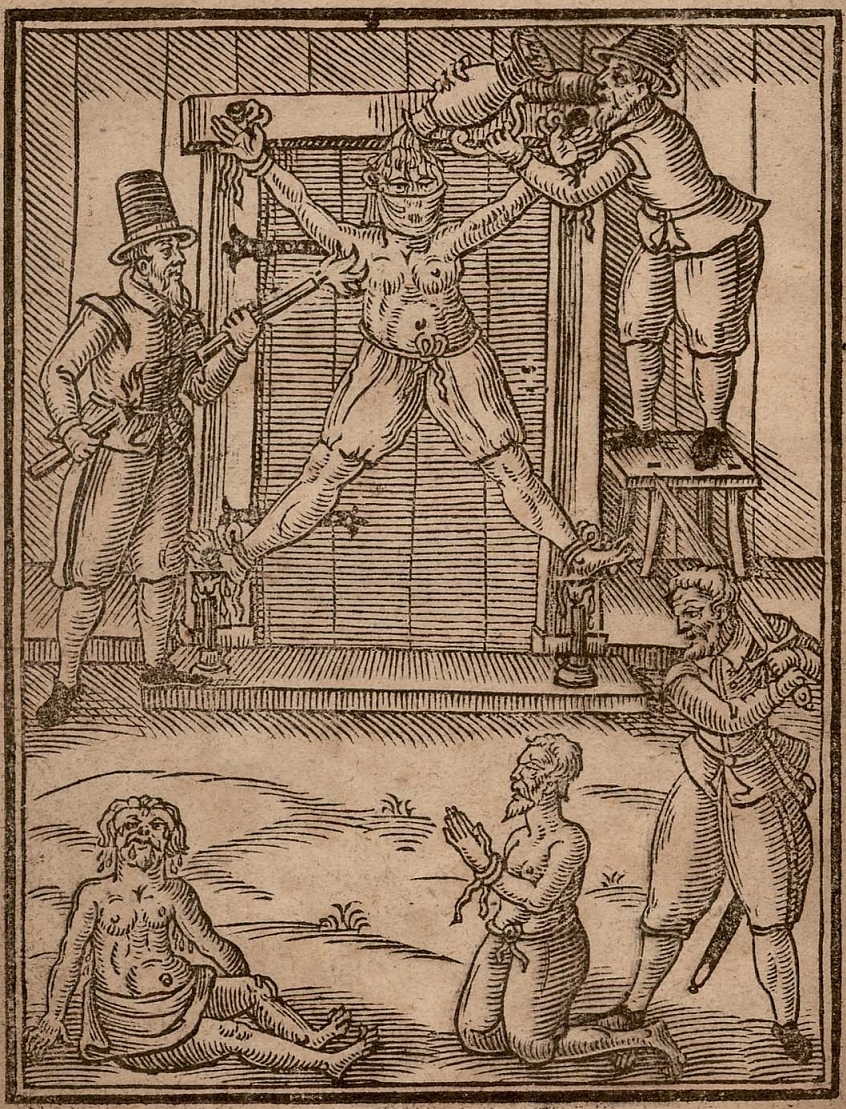
On February 27,* 1623, the Dutch East India Company beheaded twenty who had been waterboarded into confessing to a terrorist plot.

English prisoner suffering “waterboarding” faux-drowning torture, published under the name “A true relation of the unjust, cruell, and barbarous proceedings against the English at Amboyna in the East-Indies 1624”.

The torturers “poured the water softly upon his head until the cloth [wrapping his head] was full, up to the mouth and nostrils, and somewhat higher, so that he could not draw breath but he must suck in all the water.” More nasty description.

(cc) Image from Flickr | BiblioOdyssey

Posh Spice

As in modern times, this scenario originated with resource competition in the Muslim world … in this case, competition for spice, in Indonesia.

European colonialism had pitted the Dutch East India Company against its British counterpart on the archipelago, both scrabbling after the lucrative trade in cloves and pepper, with garnishes of nutmeg, cinnamon, mace, and ginger.

The two rival powers had, as we lay our story, recently come to a tense truce, dividing the commerce between them — and swapping mutual accusations of violating that pact. The arrangement basically gave the Dutch a bigger slice of the pie, so we’ll find them when the cloves hit the fan having the balance of power on their side.

Terrorists

We’re going to oversimplify to set the scene.

On Ambon Island, one of the very “Spice Islands” (i.e., the Moluccas) — at the Dutch-controlled fortification of a trading post also shared by the English — the Dutch merchant-governor Herman van Speult heard that a Japanese mercenary had asked about the Dutch fortifications.

The security-conscious van Speult ordered that unfortunate soldier interrogated under torture.

As tends to happen when the interrogators in such a case are convinced of a ticking time bomb situation, the torture uncovered a ticking time bomb situation.

The mercenary got the Dutch to stop burning and drowning him by “revealing” a highly implausible** English plot to seize the Dutch fort, with 20 guys or so and no prospect of imminent outside aid. Wouldn’t you know it: when the supposed confederates named by the mercenary were similarly tortured, they too admitted the plot. Van Speult’s English opposite number, Gabriel Towerson, was one of them.

The Amboyna Massacre followed anon, with Towerson and nine other British East India Company employees beheaded, along with nine Japanese mercenaries and one Portuguese. (The latter ten worked for the Dutch East India Company, not the British. A fifth column!)

They went to their deaths protesting their innocence, and many smuggled out written recantations to that same effect: “tortured … with that extream Torment of Fire and water, that Flesh and Blood could not endure it, and we take it upon our Salvation, that they have put us to Death Guiltless.”

Anger in the English Street

That last quote comes from Karen Chance, “The Amboyna Massacre in English Politics, 1624-1632,” in Albion: A Quarterly Journal Concerned with British Studies (Winter 1998).

As the title of that piece suggests, the Amboyna Massacre outraged Towerson’s countrymen and -women once word finally made it back to the mothership. (In addition to the torture/wrongful execution dimension, the legal authority of the Dutch trading concern to impose judicial punishment on their English counterparts was questionable at best.)

English demands for satisfaction against the perpetrators continued to complicate Dutch-English relations into the reign of Charles I and beyond. Even Oliver Cromwell required, as the price of peace for the First Anglo-Dutch War in the 1650s, punishment of any surviving offenders. (Which was apparently nobody at all.)

And still later, the burgeoning British Empire’s propaganda arm reached for the Amboyna narrative to justify seizing New Amsterdam on the grounds that the Dutch had attempted to spring a massacre on English settlers — “their Amboyna treacherous Cruelty extended itself from the East to the West Indies, and pursued thus the straight channel of Dutch blood”.

As for the trade-jockeying: the Netherlands’ commanding position in Indonesia ultimately squeezed the English out.** But don’t fret for Old Blighty: she turned attention to gobbling up India, and made a lot more bank than did the Dutch spice racket.

* February 27 was the date according to the Julian calendar in use at this time by the British. By the Gregorian calendar the Dutch were using, the massacre took place on March 9.

** For more on both the fanciful nature of the supposed plot, and the economics of the East Indies trade as it unfolded in the 17th century, see D.K. Bassett, “The ‘Amboyna Massacre’ of 1623”, Journal of Southeast Asian History, September 1960.

On this day..

1939: Stanislav Kosior, Vlas Chubar and Pavel Postyshev

On this date in 1939, a couple of “New Bolsheviks” recently flying high after helping purge the Old Bolsheviks had their own reversals of fate culminate with a bullet to the head.

Stanislav Kosior* (or Kossior), a Pole who ran the Ukrainian Communist Party for much of the 1930’s, and Vlas Chubar, a Ukrainian politburo member who had once served as Prime Minister, were shot this day along with Pavel Postyshev,** once Stalin’s personal representative to the Ukraine.

Left to right: Kosior, Chubar, and Postyshev — the first and last on post-rehabilitation Soviet stamps.

Though these obviously died because of parochial party politics under the terrifying reign of Stalin — and all were accordingly rehabilitated after Stalin’s death — posterity has another bone to pick with them: the Ukrainian famine known as the Holodomor.

Their portfolios included carrying out the forced collectivization to which the famine is generally attributed. Participation was strongly encouraged.

“Join the collective farm or else off to the Solovets Islands.”

–Chubar

It was a grim time: starving peasnts dared not touch collectivized foodstuffs slated for use elsewhere on pain of execution themselves.† (Kosior won the Order of Lenin for his achievements in agriculture.) These Soviet VIPs themselves faced very similar pressure to implement Moscow policy and party line with exactitude … and very similar consequences for any perceived failure. (Kosior, too steely to succumb to torture, finally broke when his captors raped his teenage daughter in front of him.)

State organs adapted to the fall of these powerful men with Orwellian aplomb. “Radio Kosior” was renamed “Radio Kiev” overnight with its namesake’s arrest. Secret police chief Lavrenty Beria personally expropriated Chubar’s dacha. And

there is an account of a case in the Ukraine in which fifty students were charged with forming an organization to assassinate Kossior, who had been named as one of the senior intended victims in the great Moscow Trials. A year’s work on this case, which was a structure of great intricacy, had been performed by the interrogators. In 1938, however, it became known that Kossior himself had been arrested as a Trotskyite. Everyone thought that the students would be released. But a new interrogation immediately started, and they were beaten up for having lied to the NKVD. After a few days, the stool pigeons in the cells let them know what they were supposed to confess this time. It was to change their deposition, putting the name of Kaganovich for that of Kossior. The NKVD could not face the trouble of constructing a completely new fabrication. Finally everything was in order, and the students were sent off to labor camps.

A Ukrainian court recently named Kosior, Chubar and Postyshev among eight individuals personally responsible for the Holodomor.

* When Kosior was assigned to Moscow in 1938, he was replaced in the Ukraine by a good friend: future Soviet Premier Nikita Khrushchev. (According to Nikita’s son.) To judge by the ferocity and extent of the purges Khrushchev oversaw, he took to heart the lesson from his predecessors’ fall.

** But on the plus side, Russians’ and eastern Slavs’ (continuing) tradition of putting up New Year’s trees in at least partly attributable (Russian link) to a Postyshev epistle to Pravda in 1935 calling for same. (The New Year’s yolka was a religious/tsarist tradition that had been discontinued after the Russian Revolution, but like many such cultural artifacts proved amenable — with Postyshev’s nudging — to secular/Communist reappropriation.)

† The nature of the Holodomor is the subject of furious present-day wrangling: can the mass starvation accurately be classed as a “genocide”? Especially given that such a finding could expose Russia and/or Russians to legal liability, there’s something of a difference of opinion on the matter between Kiev and Moscow.

On this day..

1922: Henri Landru, French Bluebeard

“Widower with two children, aged 43, with comfortable income, serious and moving in good society, desires to meet widow with a view to matrimony.”

The personal ads sections of the Parisian papers were the stalking-grounds of French Bluebeard Henri Désiré Landru, guillotined in Versailles this date in 1922.

A former soldier himself, Landru trawled the Craigslists of World War I for their ample population of ample war widows.

His M.O.: enchant one into letting him get his hands on her huge … fortune.

(No, really. Her fortune.)

Then, kill her and incinerate the body in his kitchen stove.

Repeat x10 (plus one teenage son of one the widows), and you’ve got yourself your basic Bluebeard.

Landru’s story inspired the 1947 Charlie Chaplain flick Monsieur Verdoux.

And that’s not the only thing of Landru’s that made it to Hollywood. His severed dome is on exhibit at the Museum of Death.

On this day..

1865: John Yates Beall, well-connected Confederate

On this date in 1865, Confederate John Yates Beall was hanged at Governors Island, New York, as a spy and saboteur.

This Virginian was knocked out of regular service through injuries early in the Civil War, but proceeded to a privateering career harassing Union shipping.

The pinpricks inflicted by Beall’s couple of ships was hardly calamitous for the North, but what he lacked in resources he made up in persistence.

Captured and exchanged midway through the war, he returned to his swashbuckling ways. But sneaking into New York from Canada in a bid to free rebel prisoners, Beall was caught again trying to derail trains — and secretly condemned by a military tribunal.

When the news of his impending execution got out, six Senators and 85 other members of Congress* appealed for leniency.

Despite Lincoln’s reputation for clemency, he did not grant it in this case.

“For days before the execution,” it was said, “the President closed the doors of the executive palace against all suppliants, male or female, and his ears against all appeals, whether with the tongue of men or angels in behalf of the unfortunate prisoner. From the first Mr. Lincoln had responded to all applications for his interposition — ‘Gen. Dix may dispose of the case as he pleases — I will not interfere.’ Gen. Dix on his part replied, ‘All now rests with the President — as far as my action rests there is not a gleam of hope.’ Thus they stood as the pillars of the gallows, on which Beall’s fate was suspended and between them he died.” (Source)

Here’s the capture-trial-and-execution portions of a homemade documentary on Beall (also check the preceding parts 1, 2, and 3)

There’s a strange tradition that the hanged man was a personal friend of John Wilkes Booth, and that the actor’s assassination of Honest Abe seven weeks after Beall’s hanging was partly motivated by personal revenge.

* One of Beall’s clemency supporters was future assassinated U.S. President James Garfield.

On this day..