46 B.C.E.: Vercingetorix the Gaul

On an uncertain date around this time — sort of — in 46 B.C.E., the Gallic chief Vercingetorix was marched as Julius Caesar’s star captive in Rome, then strangled in prison.

A nobleman who in the course of things would have been destined for that class of domestic elites bought off by Rome for orderly management of conquered provinces, Vercingetorix instead mounted a massive and effective semi-guerrilla resistance. A few months after Caesar had declared “Mission Accomplished” and Gaul at peace, it rose in arms … and, as Vercingetorix rolled out a scorched-earth defense, in flames.

Julius Caesar, then serving a long and lucrative career as Governor of Gaul, managed only with difficulty — and staggering bloodshed — to pacify the province at the Battle of Alesia. It was a signal military engagement in the development of the Roman Empire, cementing Roman power in Gaul for centuries to come.

The wily barbarian’s revolt and the very serious danger it posed to Caesar’s ambitions are the subject of a five-part BBC documentary.

Vercingetorix’s allegedly theatrical surrender to Caesar essentially ended the Gauls stubborn, centuries-long resistance to Roman dominion.

Yes, that’s the Highlander, Christopher Lambert, playing the French Braveheart version of barbarian heroism in Druids. HBO’s series Rome went with a less romantic version:

Either way, the once-intractable province became the bastion from which Caesar would overthrow the foundering Roman Republic.

Political rivals in the capital for whom Caesar’s Gallic campaign was nothing to celebrate denied Caesar a ceremonial Triumph and maneuvered to check the ambitious general. When the conflict came to a head in 49 B.C.E., Caesar’s bold move from the provincial borders of Gaul into Italy — crossing the Rubicon — ignited civil war in Rome.

Vercingetorix languished in Roman chains all along, until Caesar finally mopped up his enemies in the field and returned to Rome, where he celebrated an extravagant quadruple Triumph for his various military achievements.

As described by Appian,

when he returned to Rome he had four triumphs together: one for his Gallic wars, in which he had added many great nations to the Roman sway and subdued others that had revolted; one for the Pontic war against Pharnaces;* one for the war in Africa against the African allies of L. Scipio, in which the historian Juba (the son of King Juba), then an infant, was led a captive. Between the Gallic and the Pontic triumphs he introduced a kind of Egyptian triumph, in which he led some captives taken in the naval engagement on the Nile.** Although he took care not to inscribe any Roman names in his triumph (as it would have been unseemly in his eyes and base and inauspicious in those of the Roman people to triumph over fellow-citizens), yet all these misfortunes were represented in the processions and the men also by various images and pictures, all except Pompey, whom alone he did not venture to exhibit, since he was still greatly regretted by all. The people, although restrained by fear, groaned over their domestic ills, especially when they saw the picture of Lucius Scipio, the general-in-chief, wounded in the breast by his own hand, casting himself into the sea, and Petreius committing self-destruction at the banquet, and Cato torn apart by himself like a wild beast. They applauded the death of Achillas and Pothinus, and laughed at the flight of Pharnaces.

It is said that money to the amount of 60,500 silver talents was borne in the procession and 2822 crowns of gold weighing 20,414 pounds, from which wealth Caesar made apportionments immediately after the triumph, paying the army all that he had promised and more. Each soldier received 5000 Attic drachmas, each centurion double, and each tribune of infantry and perfect of cavalry fourfold that sum. To each plebeian citizen also was given an Attic mina. He gave also various spectacles with horses and music, a combat of foot-soldiers, 1000 on each side, and a cavalry fight of 200 on each side. There was also another combat of horse and foot together. There was a combat of elephants, twenty against twenty, and a naval engagement of 4000 oarsmen, where 1000 fighting men contended on each side. He erected the temple to Venus, his ancestress, as he had vowed to do when he was about to begin the Battle of Pharsalus, and he laid out ground around the temple which he intended to be a forum for the Roman people, not for buying and selling, but a meeting-place for the transaction of public business, like the public squares of the Persians, where the people assemble to seek justice or to learn the laws. He placed a beautiful image of Cleopatra by the side of the goddess, which stands there to this day. He caused an enumeration of the people to be made, and it is said that it was found to be only one half of the number existing before this war.

War is hell.

At the Gallic triumph, Vercingetorix — by far the most fearsome enemy Caesar had to display vis-a-vis a five-year-old child and the sister of his lover — was at last the center of attention again for a day. Still defiant, he was marched through the Eternal City, then strangled at the Tullianum, or Mamertine Prison.

But which day? The bare fact is that we just don’t know, but this one has more than the typical imprecision that characterizes dating ancient events. This footnote on a page about Egyptian royalty grapples with the timing.

Suetonius gives us that his Triumphs were celebrated

four times in one month, each Triumph succeeding the former by an interval of a few days.

Since Cassius Dio claims that Caesar dedicated the Temple of Venus (datable to late September of 46) on the last day of the last Triumph, that presumably makes September the “one month” of the various celebrations.

That’s about as close as it gets, but even “September” comes with a caveat. During his few months in Rome between campaigns, Caesar accomplished a frenetic civil agenda (it helps to be dictator). Perhaps none is of such recognizable consequence for posterity as reform of the wacky solar-lunar hybrid Roman calendar — and 46 B.C.E. was the very year he implemented it.

Disdaining incrementalism, Caesar tackled the mess the Roman calendar had become at once, by stuffing the year 46 up to 445 days. As a result, 365 days after the execution of Vercingetorix was not September of 45, but July (or possibly June) — and those months are sometimes given for the dates of Caesar’s Triumphs on this basis. Since Caesar actually won his decisive battle in April of 46 B.C.E. and returned to Rome that July, the potential for confusion multiplies: if you’re not accounting for the exceptional calendar, July Triumphs appear initially plausible.

It is here that one beholds the essential subjectivity behind a putatively mechanistic device like a calendar: if Vercingetorix was executed in spring or summer, was he executed in September?

Whenever it was that he was throttled in the Mamertine, Vercingetorix did not go quietly. If his cause of resistance to Roman authority was doomed for the time being, the eternal allure of rebellion — and, as the Gallic lands later germinated France, the proto-nationalism of his cause — secured him his own symbolic immortality.


Napoleon III, with his complex relationship to the Gallic and Italic dreams of another age, was just the man to put up this statue of Vercingetorix where the barbarian was thought to have made his last stand. Its inscription reads:

La Gaule unie
Formant une seule nation
Animée d’un même esprit,
Peut défier l’Univers.

* The speedily resolved Pontic War gave us Caesar’s “veni, vidi, vici”.

** It was at the Egyptian triumph that Cleopatra’s sister Arsinoe was marched, though she was not executed afterwards.

On this day..

1938: Nikolai Kondratiev, purged economist

On this date in 1938, Stalin’s purges claimed Soviet economist Nikolai Kondratiev.

Not the most recognizable name in the Soviet Union’s 1930’s bloodletting, Kondratiev — also transliterated Kondratieff — was a pre-Keynesian economist of some note, who had a prominent hand in the fledgling USSR’s early agricultural direction.

Thus far goes the portfolio of many a forgotten academic or bureaucrat shot by Stalin.

But Kondratiev made a contribution still much remembered — and one that might just be due to re-emerge from its occult hibernation.

In a series of 1920’s papers, Kondratiev worked out the theory that capitalism had 50-to-60-year economic supercycles. Though not strictly the first to so hypothesize, he put the idea on the map; the (alleged) pattern still bears the name “Kondratiev wave” or “Kondratiev cycle”.

His belief that the intermittent major crises punctuating capitalism were not building towards systemic implosion but clearing the economic debris of bygone ages and allowing new growth were not the least of what got him into hot water with Stalin.

“Creative destruction,” as Joseph Schumpeter would call it, adapting the idea.

Though sidelined from mainline economics for much of the 20th century, Kondratiev waves have never gone entirely out of fashion. Congenial to any number of collateral theoretical hobbyhorses — technological innovation, entrepreneurship, generational psychology, statecraft, and the eternal bracing for end times right around the corner — Kondratiev waves are a niche player in economic theory both conventional and otherwise.

Here’s a site that lovingly describes them.

Its problem, even if you happen to buy into the concept, is its near uselessness as a predictive tool: half-century cycles don’t just arrive like clockwork, and the timing and very existence of particular cyclical epochs is highly dependent on the interpreter’s choice of data. The margins of error run out to decades. You never know at any given moment what you’re looking at — so you can find the supercycle crashing in 1998, or beginning its springtime of growth in this decade.

That very uncertainty accounts for Kondratiev’s intermittent mainstream resuscitation during economic crisis: when worried about Where Things Are Headed, some version of a Long Wave theory is almost sure to have a story to tell.

According to the New York Times‘ database of past articles, the word “Kondratieff” (its preferred transliteration; “Kondratiev” yields stories about New York Rangers prospect Maxim Kondratiev) went essentially unmentioned in the post-World War II paper before appearing in 20 articles from 1973 through 1984 — the period when the capitalist core was buffeted by energy crisis, stagflation, and the punishing Paul Volcker recession of the early Eighties.

And then Kondratiev/Kondratieff faded from the Grey Lady; after a few appearances during Wall Street’s woes in the late 80’s, it doesn’t seem to have appeared in print there since an offhanded reference in a 1992 William Safire column.

Have you seen the news lately? It’s mighty Kondratiev-friendly. His cycle of exclusion has probably just about run its course, and if you’re the wagering type, I’ll take Thomas Friedman against the field.

Behind the theorems, of course, there was the flesh-and-blood man; it so happens that not many dismal scientists went as poignantly as our principal.

Initially imprisoned in 1930, Kondratiev served eight years before he was re-sentenced and executed; he ached for the separation with his family. Kondratiev’s daughter, Elena — Alyona or Alyonushka in the Russian diminutive — preserved his correspondence to her, the only remnants of her father in her life.

The last letter — as it turned out; plainly the writer had no inkling of it — was dated August 31, 1938.

My sweet darling Alyonushka.

Probably your holidays are over now and you are back at school. How did you spend the summer? Did you get stronger, put on weight, get tanned? I very much want to know. And I would like very, very much to see you and kiss you many, many times. I still do not feel well, I am still ill. My sweet Alyonushka, I want you not to get sick this winter. I also want you to study hard, as you did before. Read good books. Be a clever and a good little girl. Listen to your mother and never disappoint her. I would also be happy if you managed not to forget about me, your papa, altogether. Well, be healthy! Be happy! I kiss you without end.

Your papa.

(From Orlando Figes’ The Whisperers: Private Life in Stalin’s Russia.)

On this day..

1560: Arnaud du Tilh, alias Martin Guerre

On this date in 1560, a French peasant was hanged outside the home he had made with another man’s wife in the southwestern French village of Artigat (or Artigues).

A poignant, perplexing tale of identity and social place — and possibly even of love — the story of Martin Guerre is at once exactingly local to its time and place, and timeless in its principals’ humanity.

As told in Natalie Zemon Davis’ captivating social history The Return of Martin Guerre, the restless (or ill-tempered) young titular peasant — impotent with his wife Bertrande, tense living with his father-in-law, chafing in rural Artigat — got out of town in 1548, joined one of the soldiering companies crisscrossing Europe, and was heard of no more.

In the centuries before fingerprints, credit cards, cell phones and Facebook, Guerre just disappeared. Constrained by Catholic law not to remarry without proof of his death, Bertrande just had to wait.

Until “Martin” returned in 1556 simply by reappearing at Artigat — moved in with Bertrande — resumed the vanished man’s name and with it his place in the village. There were suspicions from the first that he wasn’t quite right … but this man had Martin’s stories, and the villagers didn’t have so much as a photograph to test him against.

Martin was accepted in Artigat for three-plus years, fathered two children with Bertrande, and managed the estate as head of household. In Davis’s telling, he appears much the better husband and father than the pre-1548 version, and this bolsters her case that Bertrande must have been complicit in the fraud that unraveled in 1560.

Property and inheritance conflicts with Martin Guerre’s uncle (now married to Bertrande’s widowed mother) brought to the courts the novel case: was this man really Martin Guerre?

The inconclusive tools for establishing identity and a deft defense by “Martin” must have made for a riveting legal drama (French link) — with villagers taking up competing sides and the man put to the test of his memory of Martin’s life, which he impressively aced. So thoroughly did the man command the role that

the gesture, deportment, air, and mode of speaking of the prisoner were cool, consistent, and steady; while those who appeared in the cause of truth were embarrassed, hesitating, confused, and on certain points contradictory in their evidence. (Source)

On the point, perhaps, of acquittal, the case was resolved like any legal potboiler should be: with the dramatic reappearance of the real Martin — for so all the conflicting witnesses quickly agreed him to be, and so confessed the imposter husband, Arnaud du Tilh (or Arnaud du Tilb), a peasant from a nearby village also nicknamed “Pansette”. A onetime army buddy of Guerre’s, the enterprising du Tilh had been mistaken for Guerre, and had pieced together enough of the absconded husband’s life that by dint of total recall and superhuman audacity, he made for his own the place in the world that Martin Guerre disdained.

The sentence of the court was that Martin Arnaud

make amende honorable in the marketplace of Artigat, in his shirt, his head and feet being bare, a halter about his neck, and holding in his hands a lighted torch; to beg pardon of God, the king, and the justice of the nation; of the said Martin Guerre, and de Rols his wife; and this being done, the said du Tilh shall be delivered into the hands of the executioner, who after making him pass through the streets, and other public places in the said town of Artigat, with a rope about his neck, at last shall bring him before the house of the said Martin Guerre, where, on a gallows set up for that purpose, he shall be hanged and strangled, and afterwards his body shall be burnt. (Source of the translation, slightly tidied up based on the French version here)

Arnaud du Tilh, and Martin Guerre with him, passed thereupon into the historical memory, for in assigning names to bodies, had the court really sorted out who was who? What does it mean to drop out of one’s society … and what rights can one expect to command upon returning? What did it mean to be Martin Guerre but to live in the house of Martin Guerre and manage the affairs of Martin Guerre? And the characters: Arnaud with his mysterious spark of bravado; Martin and his sudden and unexplained reappearance; the two of them as if cast for one another’s roles in life and crossed up by the gods.

And the mysterious Bertrande — what did she do, and what did she want?

A bit of Rorschach history, then, which accounts for the still-robust liveliness the tale enjoys four and a half centuries later. And let’s admit: a bit of wistfulness for the time you could start on a clean sheet just by changing your name. (Although illiterate 16th century peasants had achieved TSA-quality security protocols in this respect.)

Natalie Zemon Davis, whose own account has been criticized for overclaiming Bertrande’s role and motivations, also consulted as she was writing it for a Gerard Depardieu film of the same title.

The same story transplanted to the Civil War United States yielded the 1993 film Sommersby:

And if you must, you can see Martin Guerre in show tunes.

(This medley sequence has second and third parts as well.)

On this day..

1973: Victor Jara, among thousands in Chile’s September 11

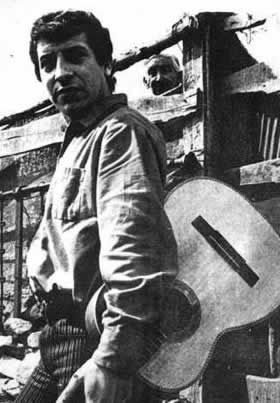
At an unknown time on this evening in 1973, or else the early hours of the following day, Chilean putschists ushering in the Pinochet dictatorship machine-gunned folk singer Victor Jara near the Santiago stadium that today bears his name.

“I don’t see why we need to stand idly by and let a country go communist due to the irresponsibility of its own people,” said Henry Kissinger of Allende’s election. Victor Jara had another idea.

Four days before, Chile’s September 11 had seen General Augusto Pinochet topple the elected leftist government of Salvador Allende, murdering the president in his palace. (Or, go some accounts, Allende committed suicide — “pausing only twice to reload.”)

A long pall of evil settled over the country, with all the accustomed chilling familiars: “disappeared” people, mirrored shades, Jeane Kirkpatrick.

The day after the CIA-backed coup, popular folk singer and activist Victor Jara, a pioneer of the Nueva Cancion (“New Song” movement) then teaching at Santiago’s Technical University, was among thousands of undesirables rounded up and packed off to a makeshift prison camp at the city’s Chile Stadium — a stadium Jara had performed at.*

Left there to the tender mercies of a thuggish Chilean officer, Jara was beaten and tortured over the intervening days — evocative but possibly undependable tradition holds that the guitarist’s hands were cut off, shattered or otherwise destroyed. According to the U.S.-based United States Institute of Peace,

[t]he the last day Víctor Jara was seen alive was September 15. During the afternoon he was taken out of a line of prisoners who were being transferred to the National Stadium. In the early morning of the next day, September 16, shantytown dwellers found his body, along with five others, including that of Littré Quiroga Carvajal, near the Metropolitan Cemetery. As the autopsy report states, Víctor Jara died as a result of multiple bullet wounds (44 entry wounds and 32 exit wounds).

The Commission came to the conviction that he was executed without due process of law by government agents, and hence in violation of his fundamental human rights.

To say the least.

And as the text implies, Jara was only the most recognizable name among unknown hundreds killed as the military cemented its control of the country.

Jara remains larger-than-life martyr figure in Latin America and liberation movements worldwide, but he’s almost unknown north of the Rio Grande. Pinochet was our bastard; in the weird way history writes its own geography, Jara became a political emblem behind the Iron Curtain for the perfidy of the capitalist powers: obscure in Peoria, but a household name in Potsdam, as the credit roll from this 1978 East German film suggests.**

That’s Jara himself on the soundtrack, of course. The pat conclusion for such a figure is that his art is his legacy, and that Jara’s body of work as against Pinochet’s will be a walkover in posterity. Is that enough? Pinochet died in his bed at age 91; earlier this year, the Jara case was closed in underwhelming fashion. Thirty-five years down the road, most authors of Pinochet’s human rights depredations are dead or lost or decrepit. Justice delayed is justice denied.

Victor’s widow, Joan Jara — today director of the Fundacion Victor Jara (it’s a Spanish-only site); you can hear her interviewed on Democracy Now! for the 25th anniversary of her husband’s death in 1998 — managed to leave the country with some of his works.

Her publication of a poem he wrote while imprisoned, an untitled, unfinished work generally known as “Estadio Chile,” made it a signature cry of hope amid desperation. Here it is in the Spanish rough-hewn under the shadow of death; there’s an English translation here.

Somos cinco mil
en esta pequena parte de la ciudad.
Somos cinco mil
¿Cuantos seremos en total
en las ciudades de todo el pais?
Solo aqui, diez mil manos que sembran
y hacen andar las fabricas.

¡Cuanta humanidad
con hambre, frio, panico, dolor
presion moral, terror y locura!

…¡Y Mexico, Cuba y el mundo?
¡Que gritan esta ignomonia!

Somos diez mil manos menos
que no producen.
¿Cuanto somos en toda la Patria?
La sangre del companero Presidente
golpea mas fuerte que bombas y metrallas.
Asi golpeara nuestro puno nuevamente.

¡Canto que mal me sales
cuando tengo que cantar espanto!
Espanto como el que vivo
como el que muero, espanto.

De verme entre tanto y tantos
momentos de infinito
en que el silencio y el grito
son las metas de este canto.
Lo que veo nunca vi,
lo que he sentido y lo que siento
hara brotar el momento…

Whether or not it’s enough, his work is his legacy after all.

* Some 7,000 people were held at Chile Stadium in the days after the coup, most later moved in with other detainees at the larger Estadio Nacional. The USIP excerpt alludes to Jara being pulled out for execution during such a move.

** In a similar vein, Stanford has a small online exhibit of Jara-themed East German propaganda art. Not to be outdone, there’s a Soviet rock opera about Jara, and an asteroid discovered by a Soviet astronomer was named in Jara’s honor within a week of his execution.

On this day..

2004: Mamoru Takuma, for the Osaka school massacre

On this date in 2004, Mamoru Takuma was hanged for one of the most notorious crimes in modern Japan — the Osaka school massacre.

On June 8, 2001 — a day the 11-time arrestee was due in court for assaulting a bellhop — Mamoru Takuma (English Wikipedia entry | Japanese) entered the Ikeda Elementary School in Osaka and knifed 20-plus people, killing eight young students.

Even when taking on 7- and 8-year-old children, that’s an astonishing body count for a guy packing only a blade. Some staff at the school finally tackled the guy.

“I want others to know the unreasonableness that high-achieving children could be killed at any time.”

Takuma had been institutionalized even more often than he had been arrested, so the shocking crime pitted public outrage against the judiciary’s capacity for handling mentally ill offenders.

Guess which won out. In the wake of the crime, in fact, the government toughened laws on crimes committed by mentally ill offenders.

Takuma was hanged barely three years after the attacks, and even though he pushed for his own execution, the lightning-fast completion of the sentence (most death penalty cases in Japan drag on for decades — here’s an extreme example) raised misgivings both domestic and international.

Though his case remains an outlier, those concerns already seem a bit passe: Takuma also turned out to presage the distinctly more aggressive pace of executions in Japan in recent years.

On this day..

1946: Amon Göth, Schindler’s List villain

On this date in 1946, Plaszow concentration camp commandante Amon Göth was hanged near the camp site by Poland’s postwar Communist government.

Göth is most widely recognizable as Ralph Fiennes’ fiendish character in Schindler’s List, one of the American Film Institute’s top movie villains of all time. (And, naturally, a first-class bastard in real life, too.)

A short-drop strangulation is not the way you’d want to go. It turns out, though, that Steven Spielberg (ever the sentimentalist) seriously tidied up the proceedings.

As you watch the video of the real Amon Goeth’s exit below — and it’s a snuff film, so proceed advisedly — consider the following:

  • Amon Goeth does bear a passing fair resemblance to Ralph Fiennes.

  • To judge by their getup — dig the masks! — the executioners might have been Batman and Robin.
  • To judge by the discharge of their duties, the executioners might have been Larry, Moe and Curly. Goeth survived two drops (notice the executioner on the right gesticulating in frustration as the second try fails) before they finally got it right:

On this day..

1860: (William) Walker, Nicaragua Ranger

On this date in 1860, a kid from Tennessee who had made himself President of Nicaragua got his grateful subjects’ comeuppance in the form of a fusillade.

It was westward the wagons that first bestirred the pioneering blood of William Walker, a scion of privilege with an Ivy League medical degree, who uprooted for San Francisco in 1849.

But the “grey-eyed man of destiny” had an altogether grander gold rush in mind, as he stared pensively into the middle distance.

The air was fervid with Manifest Destiny, and most Americans reckoned that the entire hemisphere was its rightful Manifestation. In a time when private settlers effected the statecraft of conquering the Great Plains, was it really any crazier for Walker to fancy privately conquering some distracted European power’s American colonies?

Walker was one of — soon to be the most famous of — a whole class of such characters: filibusters, a word etymologically rooted in piracy but now claimed by the bustling ranks of soldiers of fortune with private militias bent on detaching some parcel of land from south of the border, for money or glory or what have you.*

Oh, and “what have you”? That means slavery.

Nicely dovetailing the individual spur to derring-do, the South’s structural impulsion to expand slaveholding territories to maintain political parity encouraged — and often bankrolled — filibuster adventuring.

It is to these unwholesome fellows that the United States likely owes its sovereignty over Texas, which was pelted with Anglo filibustering expeditions in the early 19th century, helping set the table for the revolution that severed the Lone Star state from Mexico; arguably, the Texas Revolution itself was a (fantastically successful) filibuster.

So Walker had the glittering destinies manifest before his grey eyes when he put off the white collar career to play soldier. After an abortive 1853 attempt to set up his own country in Mexico’s Baja California — a jury instantly acquitted him of waging war on a neutral power; filibustering, and damn near anything that promised America more Manifestly Destined land, was as popular as it was illegal — Walker moved on war-torn Nicaragua under the guise of a “colony”. With a few hundred men, he was able to conquer the capital and set himself up as head of state.

Who knows whether he could have had a future if he’d done it differently. In the actual fact, he wasn’t as hot an administrator as his ego might then have been telling him. He revoked Nicaragua’s anti-slavery edicts, of course; though this sparked resistance, more damaging may have been revoking a Vanderbilt trade concession and bringing a tycoon into the private warfare game on the opposite team.

Cornelius Vanderbilt-backed opponents drove Walker out of Nicaragua in 1857. Not knowing when he was beat, the ex-Presidente kept knocking around stateside piecing together several expeditions, each sadder than the last … until in 1860, when a landing at Honduras collapsed, and he surrendered himself to a British (rather than American) officer. Europeans with colonies to exploit didn’t have much use for filibustering, and Walker had made everyone nervous by openly aspiring to conquer Nicaragua’s neighbors — including British assets. Rather than return him home where he could continue scheming to meddle in the future canal zone, the Brits handed him over to the Hondurans, who stood him in a court-martial, then stood him up against a wall.

Alex Cox (Repo Man) turned this bizarre biography into a film, back when Ronald Reagan’s filibusters narco-terrorists “moral equals of our founding fathers” were having their own unofficial way with the country Walker once governed:

And for a corner of Americana little-known to most in the U.S. — well, the colorful, nigh-unbelievable quality of the action has overridden its obscurity when it comes to the written word.

Various books about William Walker and Filibustering

* More familiar for most Americans is “filibuster” as a legislative maneuver — refusing to yield the floor during debate to forestall the passage of a bill. Not surprisingly, this usage came online at the same time mercenary filibusters were active, and proceeds from the word’s original sense of “piracy”.

On this day..

1599: Beatrice Cenci and her family, for parricide

On the morning this day in 1599, the Cenci family — mother Lucrezia, son Giacomo, and immortal tragic heartthrob Beatrice — were put to death at Sant’Angelo Bridge for murdering the clan’s tyrannous father.

Francesco Cenci, the victim, was more accustomed to making victims of his own: detested around the Eternal City, he indulged his violent temper and fleshy lusts with the impunity of a wealthy cardinal’s son. By all accounts, he enjoyed pushing around his family, too.

This much is stipulated. What lies beyond is legend.

But the legend is why we’re dallying with Beatrice today, so we might as well begin there: in fear that her father would rape her, it goes, Beatrice tried to turn to the authorities, who let mean old dad walk on account of his connections. Desperate to protect herself from incest, Beatrice and family arrange to batter his gulliver and toss him over a balcony to make it look like suicide.

Slight problem: it didn’t look very much like suicide.

So the family was hauled in and tortured, and eventually Lucrezia and Beatrice (both beheaded) and Giacomo (quartered after suffering the mazzolatura of an incapacitating hammer blow to the head followed by gory lethal knifework by the executioner) all paid the price while the youngest child watched, spared death but condemned to life in the galleys.

(The papacy gobbled up the patricides’ estate, which puts a fine point on the ironically-named Pope Clement VIII‘s law-and-order stance on the appeal for mercy, and his subsequent edicts to quash public comment on the affair.)

Then Beatrice’s body — the part below the neck — contrived to disrobe when fumbled by the brethren taking it away for burial.

You’ve got to admit it’s pretty romantic. Some versions even hold that the responsible executioners died violently themselves within a month, or that a ghostly Beatrice returns to the scene of her demise on this anniversary.

And not a word of Italian fluency will be necessary to catch the gist of this excerpt from this 1969 Lucio Fulci film:

It’s a little too Romantic, as in capital-R.

While the case was a true sensation Rome at the turn of the 17th century, the legend as we know it was heavily constructed in the 19th century … and specifically Percy Bysshe Shelley, who heard the story in Italy* where it had persevered as local folklore. A girl who killed her despot-father, executed by the despotic agents of the Divine Father? You don’t get into the canon without knowing what to do with that kind of material.

And he had this charming painting of her to boot:

Shelley amped up the menaced-virginal-purity theme, made the bloodshed a lot more demure, and turned it into a long poem, “The Cenci” (available on Google Books, and on Bartleby.com) which in Melville’s description proceeds from putting its protagonist between the “two most horrible crimes possible to civilized humanity — incest and parricide.”

This doesn’t all actually turn out to be well supported: at a minimum, Shelley inflated an incest allegation of doubtful lineage into accomplished fact. Beatrice’s camp did not raise this claim until just before her execution, when it needed a high card for clemency. The loutish victim eventually got his own biographer, who strongly disputed the incest charges. (Francesco also sports his own Italian Wikipedia page.)

From Shelley’s influential quill** into the DNA of western literature: Stendahl tapped the vein, as did Artaud, and risorgimento figure Francesco Domenico Guerrazzi; both Melville and Hawthorne used that painting so captivating to Shelley as plot devices (Dickens loved the painting, too). American sculptor Harriet Hosmer worked Cenci’s complex sensuality in marble.

Remarkable how the tradition in its modern incarnation proceeds root and branch from Shelley’s apprehension of a single painting, and how his reading stamped itself upon the canvas for later observers — like Hawthorne, writing in his journal:

It is the very saddest picture that ever was painted, or conceived; there is an unfathomable depth and sorrow in the eyes; the sense of it comes to you by a sort of intuition. … It is the most profoundly wrought picture in the world; no artist did it, or could do it again. Guido may have held the brush, but he painted better than he knew. I wish, however, it were possible for some spectator, of deep sensibility, to see the picture without knowing anything of the subject or history; for no doubt we bring all our knowledge of the Cenci tragedy to the interpretation of the picture.

He wrote better than he knew: the painting is no longer attributed to Guido Reni, and it’s doubtful whether it’s a portrait of Beatrice at all. One wonders if it would retain its place in Hawthorne’s estimation as a local washer-woman modeling for an allegory.

* Apparently you can still crash at the same place Shelley first got hep to Cenci.

** Kick back with some polysyllabic literary analysis of Shelley’s Cenci stuff.

On this day..

1977: Hamida Djandoubi, Madame Guillotine’s last kiss

On this date in 1977, the guillotine claimed its last head.

The famous and infamous blade dropped for the last time at Les Baumettes prison in Marseilles on Hamida Djandoubi, a Tunisian immigrant convicted of the torture-murder of the naive young girlfriend he had forced into prostitution. Oddly, he had already had another appendage — a leg — amputated as a result of a work accident; it was while recuperating that he caught the fascination of his hospital roommate’s 19-year-old daughter, Elisabeth Bousquet.

Though the death penalty was grinding to a halt in 1970’s France, Djandoubi was not the last person condemned (the link is French); the guillotine was only abolished with the election of the Francois Mitterand government in 1981.

Today, Executed Today discusses the case with the man who wrote the book on Djandoubi:* expat Canadian writer Jeremy Mercer. Be sure to check his photo series on the Djandoubi case — including discomfiting shots of Djandoubi re-enacting his crime with a police secretary playing the victim, and the killer in happier times.

ET: Thanks for joining us.

JM: Thanks for the opportunity to speak with Executed Today. I moved to Marseille in 2003 and shortly after I stumbled upon the rather arcane fact that the last man guillotined in France was executed at the local prison on September 10, 1977. I thought it was interesting angle on capital punishment and I decided to try and write a book that mixed true crime and death penalty philosophy. As a result, I’ve been immersed in the death penalty debate for the better part of five years.

Let’s start with Hamida Djandoubi himself — 31 years on, he looks like a nasty but fairly run-of-the-mill criminal. Was it strictly coincidental that he became the last man executed?

It was absolutely random fate. It was really odd – during the 1970s, the death penalty debate was raging in France and most capital cases became national news. But the Djandoubi case went completely under the radar, partly because his lawyer didn’t drum up any attention and partly because his victim was a presumed prostitute and the media prefers ‘sexier’ victims – the elderly, little children, a dentist of good standing walking her dog at night.

Even odder, if you surveyed most French people today, they would tell you that Christian Ranucci was the last man guillotined. Ranucci was a young white man who was accused of killing a little girl. He claimed his innocence, but was nonetheless executed in June 1976 (14 months before Djandoubi). Afterward, a best-selling book and major film were released that argued Ranucci was innocent so his name really sticks in the minds of the French.

Obviously, there’s plenty of tension with North African communities in France still today. Djandoubi was Tunisian, and he was convicted of murdering a white woman. How significant was racial marking in the way his case was handled, inside the courts and out?

This is really curious. In the 1960s and 1970s, the French courts were tainted by racism and one of the national papers even ran an editorial saying that it is better to be named “Marius than Mohamed” when appearing before a French judge. But, in this case, it was Djandoubi’s own lawyer who was a member of a far-right party and staunchly anti-Arab so his case was undermined even before it went to court.

It is one of those frustrating moments. You assume that a death penalty case is of such importance that top professionals are involved. Instead, Djandoubi chose the civil lawyer who negotiated his accident benefits after he had an accident at work and ended up with a very poor defence.

As I said above, his murder victim had worked as a prostitute, which diminished some of the public outrage. As well, his three rape victims were all Algerian girls aged 14 – 16. I guarantee you the case would have been much more explosive if those three girls had been white.

Your book is partly about Djandoubi himself, and partly about the history of the death penalty and especially the guillotine in France. How had the guillotine shifted in France’s identity by the time of this execution?

At first, when the guillotine was introduced, it was public sensation and executioners became celebrities with special edition postcards in their honour and fan mail and all that. As late as the 1860s, tour groups like Thomas Cook were actually organizing execution trips so English tourists could see the guillotine at work. But, bit by bit, the French became a little embarrassed by the fame of the machine. First, they removed the scaffolding that raised the guillotine above the crowds so that it would be brought down to earth and spectators’ views would be impaired; then, they stopped holding executions in the afternoon and held them at the less fan-friendly time of dawn; then, instead of guillotining people right downtown, they did it outside a prison in an obscure neighborhood at the edge of Paris; and, finally, in the 1930s they moved the guillotine inside the prison walls and it was no longer a public event. By the 1970s, the guillotine held such a low profile that many people thought it was defunct and that the French government was using the electric chair.

Interestingly enough, the fall from glory of the guillotine mirrors the general attitude toward capital punishment. By the late 1800s, many countries were already abolishing the death penalty and by the 1970s France was the last country in Western Europe to resort to capital punishment. In the end, the guillotine became the country’s dirty little secret that they kept hidden in their closet.

What are the bits of guillotine folklore you found most interesting?

The most popular stories involve the life in the head after it is severed from the body. It all began with the guillotining of Charlotte Corday, who had stabbed Jean-Paul Marat to death as he soaked in his bathtub. After she was guillotined, the executioner held her head up to the crowd and slapped her on the cheek. But, according to newspaper accounts, both cheeks reddened, as if Corday was indignant by this treatment. Suddenly, everyone began to wonder what a severed head can feel or think.

This curiosity became even more intense a few weeks later when the chief executioner, Charles Henri Sanson, guillotined two political rivals one after the other. He told friends that when he looked in the basket where he kept the heads, one politician’s head was biting the other politician’s head!

So, all this got the scientists really excited and the experiments began. One doctor, Dassy de Ligières, was allowed to take a head back to his laboratory where he connected it to a living dog and pumped blood back into it. He kept hoping the head would speak, but alas, no.

The definitive experiment was conducted in 1905 when Dr. Beaurieux was given permission to wait beside the guillotine and examine the head the moment it was cut. Dr. Beaurieux interviewed the condemned man in prison and came up with a pre-arranged set of signals. The day of the execution, the doctor had incredible luck –the head did a little twist when falling and landed on the stump, slowing the loss of blood. Dr. Beaurieux then called the man’s name three times. At 5 seconds, the man was able to look at the doctor and his recognize him; at 15 seconds, the man was able to look at the doctor but his eyes were unfocussed; and at 25 seconds, the man could barely glance at the doctor. So, to the best of our knowledge, a guillotined head maintains some level of consciousness for more than 20 seconds.

You’re working with Robert Badinter — tell us about him, and his upcoming tour in the U.S.

Robert Badinter is simply the greatest man I’ve ever had the honor of working with. He became a dedicated abolitionist after one of his clients was unjustly guillotined in 1972 and dedicated the next decade of his life to fighting the death penalty. In the end, he saved six lives and ultimately wrote the legislation that abolished the death penalty in 1981 when François Mitterrand named him Minister of Justice.

I interviewed Badinter for my own book in 2005 and he asked me if I could look into translating one of his books into English. When I had time in 2007, I set about the task and now Abolition has been released by Northeastern University Press.

Badinter’s Abolition, in French and in Mercer’s translation

To mark the book’s release, Badinter will be holding three conferences in America on the death penalty and strategies to abolish it:

Why, in your judgment, did France abolish the death penalty? And even before abolition, why did its use abate so dramatically in the postwar era?

For many people, it was a tremendous humiliation for France, the birthplace of human rights and the Enlightenment, to be the last country in Western Europe to use the death penalty. The abolition movement began when Portugal abolished the death penalty for common crimes in 1867 and by the late 1970s, nobody was using it in Europe. Even in Spain, one of the first things they did after the death of Franco was abolish the death penalty.

So, the use of the guillotine simply had to abate because the world was becoming aware that the death penalty is a flawed punishment: the risk of executing innocents, the cost of capital trials, the predominance of poor and minorities on death row, the lack of deterrence value. But, as long as there was a right-wing government in power in France, they couldn’t abolish the death penalty because they wanted to appear tough on crime and polls showed a majority of the French people wanted to keep the guillotine.

Once Mitterrand and the Socialists were elected in May 1981, it was clear the death penalty would be abolished, and sure enough, five months later it was gone

Where do you think the death penalty is going in America? And can one really think of worldwide abolition as a legitimate possibility?

I am absolutely convinced we will see almost worldwide abolition by 2050. There will always be a few rogue states, but the death penalty is such an obviously flawed form of punishment it will inevitably be eliminated.

In terms of America, Badinter and I have discussed it at length. He believes the country is ready for abolition and that all is needed is one trigger case: a middle class white guy with a reasonable claim to innocence who is about to executed. This would really instigate a debate on the penalty and as soon as you bring in all stats — the 130 plus people who have been exonerated while on death row, the work of the Innocence Project, the race bias, the cost of capital trials, the overworked public defenders etc etc — I think it would be a slam dunk.

Personally, I think people are selling the abolition the wrong way. Every time I meet a die-hard death penalty supporter who wants a serial killer or a child rapist killed, I ask him or her “Why are you so merciful?” Because, I honestly believe life in prison is a far worse punishment than being executed.

* Here’s a review of Mercer’s book.

On this day..

1990: Samuel K. Doe

On this date in 1990, deposed Liberian strongman Samuel Kanyon Doe was tortured and summarily executed in Monrovia by the putschists that overthrew him … and gruesomely filmed in the process.

Doe had come to power killing his predecessors — personally murdering, some sources say, President William Tolbert in 1980, then executing his chief aides.

That coup toppled civilian authority in the west African country now permanently prefixed with the adjective “troubled.” “The first of the monsters,” the War Nerd called him: Doe’s murderous rule through the 1980’s set up the succession of current war crimes prisoner Charles Taylor.

Samuel Doe’s turn in the obituaries arrived in particularly grisly fashion, with Taylor rival/semi-ally* Prince Johnson swilling beer as he interrogated — and ordered the ear sliced off — the groveling former head of state before having him executed. (Or if you like, just plain murdered.) The video shot of Doe’s ordeal became an international sensation … so it’s a little surprising that only this paltry excerpt seems to be readily available online:

* And current Liberian Senator! He feels just awful about the whole torturing-the-President-to-death thing.

On this day..