1928: Seven electrocuted in Kentucky

On this date in 1928 — Friday the 13th — the Bluegrass State tied a terrible record that still stands to this day by sending seven men to the electric chair on a single day. (New York, the electric chair pioneer, had carried out a sevenfold electrocution in 1912.)

The prolific history writer/blogger Mike Dash fielded a Reddit question with some detail about this event, here; Dash notes that Kentucky habitually carried out (smaller) multiple-execution batches during this period, likely for reasons of administrative convenience moreso than record-hunting.

For additional particulars, we excerpt a summary of their cases from the Owensboro (Kentucky) Messenger of the same date.

Milford Lawson

Milford Lawson was convicted in the Whitley circuit court at Corbin, in 1926, for the killing of John Stansberry. Stansberry, who lived with his wife and daughter on Main street in Corbin was awakened by an alarm at his door at midnight. He was shot to death by Lawson when he opened the door to answer the alarm. The sixteen year old daughter of Stansberry witnessed the shooting. Stansberry was killed instantly.

Orlando Seymour

Orlando Seymour was indicted jointly with William Huddleston for the killing of Will Schanzenbacher in Louisville. Huddleston was given a life sentence and Seymour, who actually did the killing, was given a death sentence. Mr. Schanzenbacher had charge of a coal yard in Louisville. It was known to the two defendants that he was in the habit of carrying the receipts of each day home with him in the afternoon in a tin box. Huddleston and Seymour planned to hold him up and rob him. It fell to the lot of Seymour to do the actual holding up, while Huddleston waited in the car. When demanded by Seymour to give up his money, Mr. Schanzenbacher, instead of acceding to his demands, started to run away and was shot down by Seymour.

Hasque Dockery

Hasque Dockery was tried in the Harlan circuit court in 1926 and given the death penalty for killing Mrs. Elizabeth Howard. Dockery was guilty of a triple murder, having killed Mrs. Howard, Joe Jenkins and Mrs. Jenkins at the same time. He appears to have been estranged from his wife, who was living with Bradley Howard and his wife and the Jenkins family. It appears that Dockery went to that house on the night of the killing search for his wife and without provacation [sic] shot and killed Mrs. Howard, Joe Jenkins and his wife. Charles Howard, a young boy, escaped only by running. Dockery also fired one shot at him.

Charles P. Miltra

Charles P. Miltra was indicted jointly with Carl Hord in the Jefferson circuit court for the murder of Marion A. George in 1926. George opera[t]ed a grocery store at First and Magazine streets in Louisville. This murder was committed in pursuit of a plan which the two defendants had entered into to rob Mr. George. It was agreed that Hord should go into the store and call for cigarettes and that Miltra was to follow, and while Mr. George was getting the cigarettes he was to cover him with the pistol and demand the money. That part of the program was carried out, but Mr. George grabbed a meat cleaver and struck Miltra with it. Miltra then fired two shots, the first missing George but the second piercing his abdomen. Miltra escaped and went to St. Louis where he was arrested a few days after the tragedy and upon his return to Louisville made a voluntary confession. The peculiar defense was interposed for Miltra, that he should not be held responsible for the shooting of George because he was rendered unconscious by the lick which George inflicted upon him with the meat cleaver and did not know that [sic] he was doing when he shot Mr. George. This contention, however, was overruled by the court on the idea that malice is not necessarily confined to specific intention to take the life of the person killed, but it may include an intention to do an unlawful act whose result will probaably [sic] deprive another person’s life.

James Howard

James Howard, negro, was given the extreme penalty in the Jefferson circuit court for the murder of his common law wife, Lucy Buckner. He stabbed his victim to death with a knife. This killing took place April 17, 1926. It is disclosed by the evidence that Howard ran his victim down and stabbed her to death while she was trying to escape from him. Howard was jealous of another negro, which appears to have incited the killing.

Clarence McQueen

Clarence McQueen, negro, was indicted in the Harrison circuit court and given the death penalty for the murder of Louis Williams, another negro. McQueen is a negro about forty years of age. He and Williams were neighbors and had been friends for a long time. On April 25, 1927, while under the influence of liquor, McQueen, who had a shotgun, came upon Williams on the river bank where they became involved in a difficulty and McQueen shot Williams to death. He then escaped and was not apprehended until September, 1927, when he was returned to Cynthiana and placed on trial.

William Moore

William Moore, negro, was indicted and tried in the Jefferson [… omitted text …] Anna Eslick, who appears to have been his sweetheart, and who was the wife of another negro. This killing took place in the absence of any eye witness, but while the evidence against Moore was largely circumstantial, at the same time it was practically conclusive that Moore killed the woman, by beating her to death with a beer bottle.

The state of Georgia supplemented the day’s grim toll with a “mere” double electrocution of Sam Gower and Preddis Taylor, while two men more, Will Burdo and Greene Kirk, hanged in separate executions by two Mississippi counties.

On this day..

1958: Peter Manuel, the Beast of Birkenshaw

Serial killer Peter Manuel hanged at Glasgow on this date in 1958.

U.S.-born to Scottish parents, “the Beast of Birkenshaw” was convicted of seven murders around Lanarkshire between 1956 and 1958 but suspected of more than twice that many.

He had previous convictions for sexual violence and rape was a factor in some murders, such as 17-year-old Anne Kneilands in 1956 (for which he was never convicted due to insufficient evidence) and 17-year-old Isabelle Cooke in 1957 (whose body he located for police with the chilling words, “I’m standing on her now”). Others were more cold and almost gratuitous, like Peter and Doris Smart and their ten-year-old son Michael whom he all shot dead on New Year’s Day 1958, after which he simply relaxed in their Uddingston house for a week and took care of the cat.

Manuel defended himself at trial, with the usual results; however, latter-day investigations have argued that police in building this extremely high-profile case buried evidence of Manuels’ severe mental illness that might have saved him from the gallows.

“I am now more convinced than ever that the authorities played down Manuel’s psychopathic personality in the days ahead of his execution, because they had come to the conclusion that he should not receive a reprieve,” Aberdeen University legal scholar Richard Goldberg told the BBC in 2009. (The BBC broadcast, which no longer appears to be available online, aired Manuel’s voice for the first time.)

Manuel was the third-last person hanged in Scotland; only Anthony Miller in 1960 and Henry John Burnett in 1963 succeeded him before the UK’s death penalty abolition.

On this day..

1507: Paolo da Novi, Doge of the people

Paolo da Novi, the Doge of Genoa for a few days that spring, was beheaded on this date in 1507.

The silk dyer was borne to the apex of power in his French-dominated Mediterranean city-state by a popular anti-oligarch revolt dating to 1506, “goaded to fury by the impertinence of the young nobles, and weary of the rapacity of the French governor.” (And also backed by the Holy Roman Empire, France’s great peninsular opponent of the Italian Wars.)

Mindful of losing his precious beachhead in the north, the French king Louis XII promptly set out to chastise the rebels: in fact, that’s just what he’s on his way to do in this Jean Bourdichon miniature:

The horseman’s cocksure pose here would be fully justified by events, for he quickly brought Genoa to a total surrender. Later on in the same series by the same illustrator — all for Jean Marot‘s* history in verse La Voyage de Genes — we find the Genoese imploringly at Louis’s mercy.

Louis had little mercy for these disobedient subjects, least of all for the “Doge of the people” who had fled by sea only to be betrayed by his ship’s captain for a cash reward. He was beheaded before the Ducal Palace (present-day Piazza Matteotti) on July 10; thereafter his severed head surmounted Grimaldina tower and his quartered corpse adorned the gates of the city.

La Superba today decorates a piazza with the name of this artisan-martyr.

* This poet was eclipsed in his own field by his son, Clement Marot.

On this day..

1985: Hezekiah Ochuka, ruler of Kenya for six hours

On this date in 1985, Kenya air force private Hezekiah Ochuka was hanged for his August 1, 1982 coup d’etat.

By ethnicity a politically marginalized Luo, Ochuka led a putsch of junior airmen whose announcement of leadership over the radio startled Kenyans rising for their breakfast on August 1, 1982.

That leadership lasted only six hours before forces loyal to the ethnically Kikuyu president Daniel arap Moi suppressed it. Some 300 souls were killed in the course of events.

The subsequent security sweep took up not only the putschists themselves but exploited the opportunity to crack down on prominent opposition figures — men like Jaramogi Oginga Odinga and George Anyona, who were tossed into the brutal Nyayo House torture center essentially for being anti-Moi politicians — and beyond them thousands of ordinary Kenyans thought vaguely proximate to sedition by virtue of their politics, lineage, or station in life.

Ochuka himself fled to neighboring Tanzania hoping to find asylum; instead, he was extradited back to Kenya for capital trial and hanged along with two of his collaborators, Corporals Bramwel Injeni Njereman and Walter Odira Ojode, in a badly botched execution.

These men retain to this day the distinction of being the last judicially executed in Kenyan history, even though Kenya still has the death penalty on its books.

On this day..

1941: Alexandru Bessarab, fascist artist

On this date in 1941, the fascist artist Alexandru Bassarab was killed in World War II — generally believed to be among captured Romanian prisoners of war summarily executed by Soviet troops.

A woodcut/linocut specialist — as evidenced by his gaunt self-portrait to the right — Bassarab was an early adherent of the Iron Guard and became one of its outstanding propagandists.

His very Deus Vult-vibing work Arhangel, for example, was used by the Guard as a banner at the 1940 state funeral it threw for far-right martyr Corneliu Codreanu. (The Iron Guard was shorthand nomenclature for an organ formally named the Legion of the Archangel Michael — and its members hence known as Legionnaires.)

But the Iron Guard’s moment at the political apex was a brief one, and when it was sidelined by a different right-wing strongman, Ian Antonescu, Bessarab found himself arrested and forced into a front-line army unit recapturing (appropriately) Bessarabia. He disappeared into presumed Soviet custody and execution near Tiganca, in present-day Moldova.

His work, including apolitical pieces, was taboo in postwar Communist Romania, but has enjoyed a bit of rediscovery since the end of the Cold War

On this day..

1791: Joseph Wood and Thomas Underwood, children

A sad selection from the Newgate Calendar:

JOSEPH WOOD AND THOMAS UNDERWOOD

Two Fourteen-year-old Boys, executed at Newgate, 6th of July, 1791, for robbing another Boy

Court to William Beadle. What age are you?

Fifteen.

Are you acquainted with the nature of an oath; supposing you do not speak what is true now, in the testimony you are going to give against the prisoners at the bar, what will become of you?

I shall go to hell, my Lord.

On the 17th of May, did you see the prisoners at the bar, or either of them?

Yes, I saw them both; I was on the other side of London-bridge; I never was in London before, I was asking for a lodging, and they brought me over to Saltpetre-bank, it was past six in the evening; then they knocked me down, took my money out of my pocket, and took my clothes which I had in a bundle; I lost five-pence: the clothes consisted of a jacket, a waistcoat, a shirt, and a pair of trowsers; I am very sure of the prisoners, I never saw them before, I never was in London before; my clothes were found on Joseph Wood , he was in a shop selling them in Rosemary-lane; a gentleman went and caught him, I was in the shop, and saw them there myself.

Old Bailey records

All the parties in this case were mere children, the malefactors being but fourteen years of age each, and the prosecutor no more than twelve!

Though of this tender age, yet were the two prisoners convicted as old and daring depredators. So often had they already been arraigned at that bar where they were condemned that the judge declared, notwithstanding their appearance (they were short, dirty, ill-visaged boys), it was necessary, for the public safety, to cut them off, in order that other boys might learn that, inured to wickedness, their tender age would not save them from an ignominious fate.

The crime for which they suffered was committed with every circumstance of barbarity. They forcibly took away a bundle, containing a jacket, shirt and waistcoat, from a little boy, then fell upon him, and would probably have murdered him had they not been secured. They had long belonged to a most desperate gang of pickpockets and footpads; but they were so hardened and obstinate that they would not impeach their companions, though the hopes of mercy were held out to them if they would make a confession, so that the villains might have been apprehended.

They were executed at Newgate, the 6th of July, 1791, apparently insensible of their dreadful situation.

On this day..

2010: Akram al-Samawi

AFP dispatches reported that on this date in 2010, Akram al-Samawi

was executed in the presence of the family of the victim, Nassiba al-Aghwani, and his own family, Nader al-Aghwani told AFP. Journalists and the public were kept outside the prison in Taiz, south of Sanaa.

The 32-year-old unemployed man was convicted in November for the rape of his neighbour’s daughter on the roof of his family home last August, after which he smashed her head and threw her corpse off the roof.

Samawi was also ordered to pay 300,000 riyals (about R10 000) in fines and court costs.

Aghwani protested outside the prison, saying the execution should have taken place in public, as in previous executions in Yemen.

He also told AFP he rejected an offer from Samawi’s family to pay up to 15 million riyals in blood money in return for sparing his life, in line with the Islamic sharia laws on which Yemen’s penal code is based.

On this day..

1450: James Fiennes, Baron Saye and Sele

Messenger. My lord, a prize, a prize! here’s the lord Say, which sold the towns in France; he that made us pay one and twenty fifteens, and one shilling to the pound, the last subsidy.

Cade. Well, he shall be beheaded for it ten times. — Ah, thou say, thou serge, nay, thou buckram lord! now art thou within point blank of our jurisdiction regal. What canst thou answer to my majesty, for giving up of Normandy unto monsieur Basimecu, the dauphin of France? Be it known unto thee, by these presence, even the presence of lord Mortimer, that I am the besom that must sweep the court clean of such filth as thou art. Thou hast most traitorously corrupted the youth of the realm, in erecting a grammar-school: and whereas, before, our forefathers had no other books but the score and the tally, thou hast caused printing to be used; and, contrary to the king, his crown and dignity, thou hast built a paper-mill. It will be proved to thy face, that thou hast men about thee that usually talk of a noun, and a verb; and such abominable words as no Christian ear can endure to hear. Thou hast appointed justices of peace, to call poor men before them about matters they were not able to answer. Moreover, thou hast put them in prison: and because they could not read, thou hast hanged them; when, indeed, only for that cause they have been most worthy to live.

Cade. Ye shall have a hempen caudle then, and the pap of hatchet.

Dick. Why dost thou quiver, man?

Say. The palsy, and not fear, provokes me.

Cade. Nay, he nods at us; as who should say, I’ll be even with you. I’ll see if his head will stand steadier on a pole, or no: Take him away, and behead him.

Say. Tell me, wherein have I offended most?
Have I affected wealth, or honour; speak?
Are my chests fill’d up with extorted gold?
Is my apparel sumptuous to behold?
Whom have I injur’d, that ye seek my death?
These hands are free from guiltless blood-shedding,
This breast from harbouring foul deceitful thoughts.
O, let me live:

Cade. I feel remorse in myself with his words: but I’ll bridle it; he shall die, an it be but for pleading so well for his life. Away with him! he has a familiar under his tongue; he speaks not o’ God’s name. Go, take him away, I say, and strike off his head presently; and then break into his son-in-law’s house, sir James Cromer, and strike off his head, and bring them both upon two poles hither.

All. It shall be done.

Say. Ah, countrymen! if when you make your prayers
God should be so obdurate as yourselves,
How would it fare with your departed souls?
And therefore yet relent, and save my life.

Cade. Away with him, and do as I command ye. [Exuent some, with Lord Say.] The proudest peer in the realm shall not wear a head on his shoulders, unless he pay me tribute…

-Shakespeare, Henry VI, Part 2

On this date in 1450, Jack Cade’s rebellion — momentarily in full control of London — visited popular justice on James Fiennes, Baron Saye and Sele.

Distant ancestor of the Amon Göth actor, our ancient Fiennes was the Lord High Treasurer and one of the principal supports of King Henry VI‘s increasingly shaky throne.

The men of Kent who had marched on London had experienced from these years the material and psychological injuries of the realm’s reversals. Their Proclamation of Grievances assailed not the sovereign himself but “the traitors about him.”

Item. They ask gentlemen’s goods and lands in Kent and call them rioters, and traitors and the king’s enemies, but they shall be found the king’s true liege men and best friends with the help of Jesus, to whom we cry day and night with many thousand more that God of His grace and righteousness shall take vengeance and destroy the false governors of his realm that has brought us to naught and into much sorrow and misery.

Item. We will that all men know we blame not all the lords, nor all those that are about the king’s person, nor all gentlemen nor yeomen, nor all men of law, nor all bishops, nor all priests, but all such as may be found guilty by just and true inquiry and by the law.

#Notalllords

The baddies are not named in the proclamation but it’s a sure bet that Lord Saye knew he wouldn’t be in the rebels’ good graces, given their demand for the expulsion from royal favor of “all the false progeny and affinity of the Duke of Suffolk.” Suffolk was one of Saye’s closest allies, or had been until Suffolk had been butchered at sea a few weeks prior. And so

the said captain again entered the citie, and caused the Lord Say to be fet [fetched] from the Tower to Guildhall, where he was arraigned before the maior, and other the king’s justices; and Robert Horne, Alderman before-named, should have been likewise arraigned, but that his wife, and other friends, for five hundred marks, got him restored to his libertie. The Lord Say desiring he might be tried by his peeres, was by the rebels forceably taken from the officers, and brought to the standard in Cheape, where they strake off his head, pight it on a pole, and bare it before them; and his body they caused to be drawne naked at a horse taile, upon the pavement, from Cheape into Southwarke, to the said captaines inne.

Also a squire, called Crowmer, that was then sherife of Kent, that had wedded the said Lord Saies daughter, by commandement of the captain, was brought out of the Fleete, that was committed thither for certain extortions that he had done in his office, and led to Mile-end without London, and there, without any iudgement, his head was smit off; and the Lord Saies head and his were borne upon two long poles unto London-bridge, and there set up; and the Lord Saies body was quartered.


Lord Saye and Sele brought before Jack Cade 4th July 1450, by Charles Lucy.

Jack Cade himself would be expelled from London within days, and dead by July 12.

On this day..

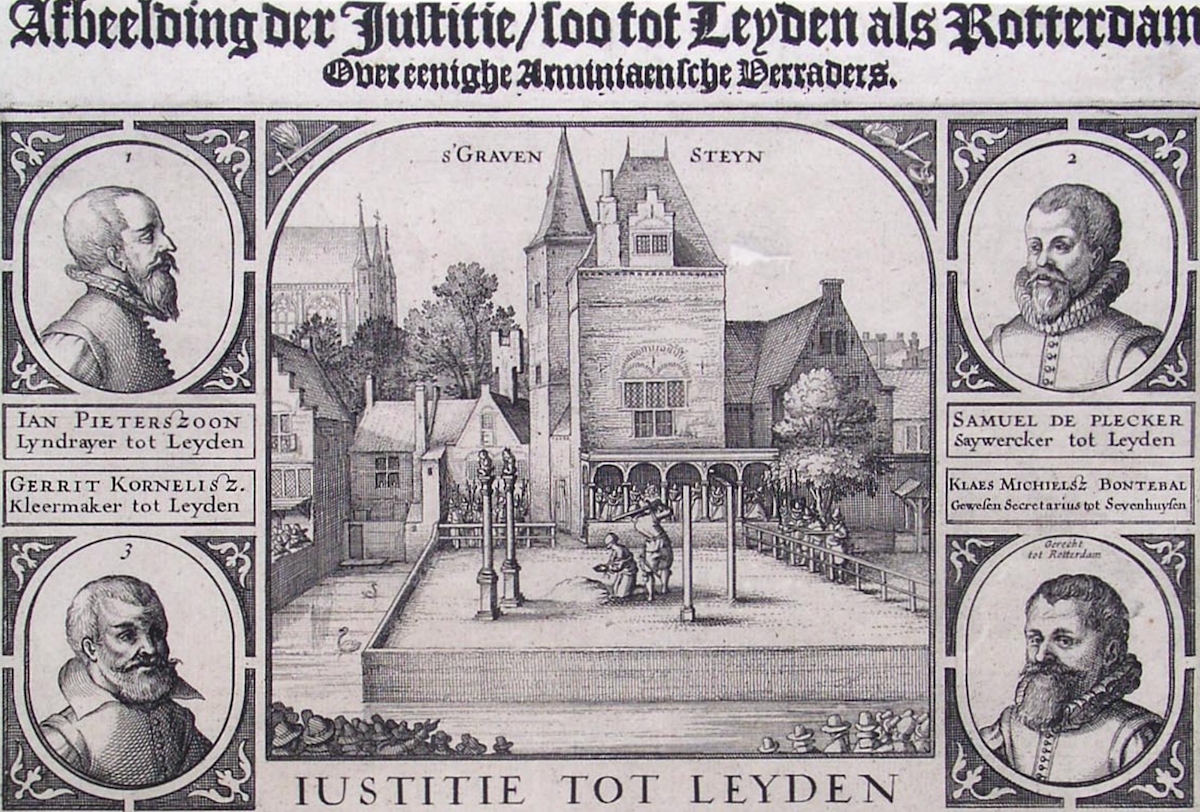
1623: Claes Michielsz Bontebal, Maurice murder moneybags

We’ve previously addressed in these pages the 1623 execution of Reinier van Oldenbarnevelt for attempting to assassinate Maurice, Prince of Orange in revenge for his, Maurice’s, 1619 execution of Oldenbarnevelt’s father.

Well, the scheme here was to hire a number of assassins for the attack, a plan which guaranteed that someone would blab and blow the whole deal. But before the blabbing and the blowing, the hiring required a vast cash outlay — 6,000 guilders to be precise.

Claes Michielsz Bontebal (English Wikipedia entry | Dutch) was one of the financiers who did the hiring, and got caught in the blowback after the blabbing. He was executed with three other conspirators


Detail view of a 1623 print reporting the beheading (click for a larger view with portraits of Bontebal and his collaborators).

On this day..

1350: Tidericus the organist

On or very near this date in 1350,* the plague-ravaged city of Visby burned a man remembered as Tidericus (Diderik) the organist.

The Gotland capital at this point stood at the fore of the Hanseatic league; the medieval maritime Laws of Wisbuy reflect its influence. The arrival in this year of the Black Death would begin Visby’s passage from merchant power to its present-day station as the “City of Ruins”. (The beautiful remains of its medieval grandeur make Visby a UNESCO heritage site.)

Small wonder that the city took its abrupt fall from greatness as an infernal conspiracy, the dimensions of which posterity decodes from a few surviving bits of correspondence.

In the midst of the plague, Gotland arrested nine itinerants as well-poisoners. For people struggling to cope with the sudden, inexplicable ravages of Pesta the inference of a malevolent hand ruining the water supply was a natural one; it emerges frequently during pandemics.

Tidericus the organista — either an organ-builder or an organ-player or both — is the only one of the Visby nine whose name we know; it seems that “with no prior coercion, [he] clearly admitted how he would poison all the wells in the cities of Stockholm, Vasteras and Arboga, and every lake, fresh water source, and various wells as he travelled around Sweden, everywhere poisoning away with his concoctions.” See, all they had to do was ask him.

What’s more, at the same time he [Tidericus] admitted that there are many who belong to a certain society which consisted of rich merchants and all the kinds of people who hold office all over the world, as many people know they do, and each of them goes around with silver belts, and they are all half mad or crazed in some other way. Also, they are all marked with a letter written in Greek or Hebrew. In his last moment he said “Need I say more? All Christendom has been poisoned by us villains and the Jews.”

It seems the well-poisoning mission had been funded by merchant-Jews in Germany named Aaron and Moses. A few different letters between Hanseatic cities around this time attest to a similar fear of Semitic contagion, possibly hinting at a wider panic outside the scanty lines of primary documentation. One letter from LĂŒbeck (cited here) mentions a person named Keyenort who burned at the stake after confessing to pocketing three solidi from Jewish agents who wanted him to poison wells across northern Germany and Prussia; another from Torun has a more ambiguous reference to an apparent mass arrest of “baptized Jews”.

A few years after this organist’s coda, the Danes defeated Visby on the battlefield; Danish control would persist until the 17th century and consigned the once-proud Hanseatic port to a distinctly lesser stature. By century’s end, Visby would be the haunt of the Victual Brothers pirates.

* Citations are split between July 1 and 2; the sources are few, indirect, and barely dated so even the outline of events in this post is somewhat inferential.

On this day..