Feast Day of St. Dismas, the penitent thief

March 25* is the feast date (per the Roman tradition) of the penitent thief crucified alongside Jesus Christ.

“The Good Thief”, by Michelangelo Cerquozzi.

The Crucifixion — Christ flanked by the “bad thief” who taunts Him and the “good thief” who capes for the Messiah — is deeply planted in the western canon. All four of the Gospels refer to two thieves although it is not until Luke — chronologically the latest, and hence the most embroidered and least reliable, of the synoptic gospels — that these nameless extras are surfaced as contrasting archetypes of the damned and the saved.

And one of the malefactors which were hanged railed on him, saying, If thou be Christ, save thyself and us. But the other answering rebuked him, saying, Dost not thou fear God, seeing thou art in the same condemnation? And we indeed justly; for we receive the due reward of our deeds: but this man hath done nothing amiss. And he said unto Jesus, Lord, remember me when thou comest into thy kingdom. And Jesus said unto him, Verily I say unto thee, Today shalt thou be with me in paradise. (Luke 23:39-43)

This is as much as the New Testament has to offer on these characters, but the theme of the Savior’s redemption poured out to flesh-and-blood sinners at the hour of death had a powerful resonance for Christendom and would furnish a good thief cult down the centuries; topical for this site, said thief would headline countless execution sermons to the condemned. (Example) As Mitchell Merback puts it in The Thief, the Cross and the Wheel: Pain and the Spectacle of Punishment in Medieval and Renaissance Europe

For suffering patiently and obediently, for his literal realization of the ideal of imitatio Christi, he is rewarded with the crown of martyrdom. The spectacle of his death, his ‘immediate beatitude’, was therefore consummately edifying: a beautiful death, redeemed and redeeming, not despite but because of the abjection that accompanied it. To the philopassianic late Middle Ages he served as a powerful inspiration for penitents. One could only wish to die so thoroughly cleansed of sin as the man in the image.

We have already seen how a similar wish obtained, individually and collectively, in the theatre of public punishments. Confessed and penitent convicts became, in the eyes of the people, the living counterparts of the historical martyrs and, consequently, the objects of a quasi-cultic veneration … Like his condemned counterparts in the Middle Ages, then, the Good Thief’s worthiness for redemption resided in part in the purity of his self-examination, confession and repentance … [and] also sprang directly from his fleshly pains. As both spectacle and image, the demolished body of the Penitent Thief constituted a sign of this soul’s lightning progress through purgation and towards redemption. Within the purview of a Christian ‘piety of pain’, his torments were both abject and redemptive, fearful and enviable, unbearable and fascinating.

For the Bad Thief, who in stubborn blindness turns away from Christ and dies in despair, unregenerate and damned, this surplus of earthly pain is something else: a foretaste of eternal torments. The same violent death transforms one Thief into a likeness of the Crucified, and hence a figure worthy of compassion, admiration and veneration; the other is marked as an everyday scapegoat, worthy of mockery and scorn. Together, then, the two figures, though marginal in the Passion narrative, become central in the medieval economy of response: they become antithetical models for a culture tuned to pain’s instrumentality in the pursuit of redemption.

In the language of the canvas, Christ gestures at that redemption by inclining his head to the right, towards the Good Thief, and didactic works will sometimes add a cherub retrieving this dying penitent’s soul whilst some infernal monster snatches the nasty one.


“Crucifixion” by Vitale da Bologna, circa 1335.

Both thieves attained their legendary names later in antiquity from the Gospel of Nicodemus, Dismas, Dysmas or Demas (the good one) and Gestas or Gesmas (the other one).** Other apocraphal texts build these two out like spinoffs in a blockbuster franchise; The Story of Joseph of Arimathaea gives us one bloodthirsty murderer and one proto-social bandit with a heavy dollop of anti-Semitism:†

The first, Gestas, used to strip and murder wayfarers, hang up women by teh feet and cut off their breasts, drink the blood of babes: he knew not God nor obeyed any law, but was violent form the beginning.

The other, Demas, was a Galilean who kept an inn; he despoiled the rich but did good to the poor, even burying them, like Tobit. He had committed robberies on the Jews, for he stole (plundered) the law itself at Jerusalem, and stripped the daughter of Caiaphas, who was a priestess of the sanctuary, and he took away even the mystic deposit of Solomon which had been deposited in the (holy) place.

And in a credulity-straining prequel, the Gospel of the Infancy stages a scene where these same two guys (as Titus and Dumachus) mug the Holy Family on the latter’s flight to Egypt only for the Good Thief in a spasm of conscience to call off the attack. Baby Jesus rewards his clemency with the depressing prophesy that they’ll all be crucified together.

Present-day namesakes of the penitent thief include the Christian rock band Dizmas, and Bill and Ted’s hometown of San Dimas, California.

* It shares a calendar date with the Feast of the Annunciation, which is the date that an angel informed the Virgin Mary of her miraculous pregnancy. (March 25 = Christmas Day minus nine months.) Medieval belief cottoned to the symmetry of the divine conception and the passion of the cross falling on the same day.

** The understood arrangement is that Dismas was crucified on Christ’s privileged right side. However, Merback notes that like Tom Stoppard’s Rosencrantz and Guildenstern these two halves of a whole are easily confused with one another, for “one of the surviving manuscripts containing the legend places Gestas on the right and Dysmas on the left; and several works discussed in these pages show the name ‘Gestas’ inscribed near the Thief on Christ’s right. Whether these are the outgrowths of a primitive literary tradition or the result of iconographic confusions or misappropriations is unclear.” As an example, in Conrad von Soest‘s Altarpiece from Bad Wildungen it appears that Dismas is the one bound for perdition:

† In The Story of Joseph of Arimathaea, damnation is explicitly framed as the fate of the Jews, with Christ assuring Dismas/Demas that “the children of Abraham, Isaac, and Jacob, and Moses shall be cast out into the outer darkness.”

On this day..

1673: La Chaussee, for the giblet pie

On this date in 1673, a footman named La Chaussee paid the forfeit for acting the agent of fugitive poisoner.

The malevolent concoctions of the Marquise de Brinvilliers have already been detailed in these pages. The sudden death of her lover and accomplice St. Croix in the summer of 1672 had exposed his incriminating effects to unwelcome scrutiny, as a consequence of which said Marquise was at this moment on the lam.

A mere valet might very much aspire to melt into the scenery when an accusing gaze is cast; indeed, La Chaussee — Jean Amelin was his real name — had been the vehicle for delivering the fatal draught* to that lady’s two brothers via a giblet pie which the servant poisoned. Although the widowed Madame d’Aubray became greatly and rightly suspicious of her sister-in-law — who by the murder of her brothers now stood to inherit a good deal of money — it seems never to have occurred to anyone that the help was in on the plot.

That is, until La Chaussee most unwisely emerged from the background at the sensitive moment of St. Croix’s death, daring to assert his rights as the former servant of that man to a bag of money whose position in the late poisoner’s apartment he could precisely describe. Having volunteered and (by his accurate description) substantiated this eyebrow-raising intimacy, La Chaussee promptly received not the 1,700 livres aspired after but a speedy arrest.

Hours before he underwent his sentence on March 24, 1673, he was put to torture to discover his accomplices, and as intended the pain loosened his previously reluctant tongue. From the public domain Madame de Brinvilliers and her times, 1630-1676:

“I am guilty. Madame de Brinvilliers gave poison to Sainte-Croix. He told me about it.”

“What did he tell you?”

“Sainte-Croix told me that she gave it in order that her brothers might be poisoned.”

“Was it a powder, or a liquid?”

“A liquid. It was administered in wine and in soup.”

“What did you put in the dish at Villequoy?”

“A clear liquid, taken from Sainte-Croix’s casket. I gave poison to both the brothers. Sainte-Croix promised me one hundred pistoles.”

“Did you report to Sainte-Croix the effect of the poison on Monsieur d’Aubray?”

“Yes, and he gave me some more poison.”

“You are exhorted to tell the truth. Who were your accomplices?”

“Sainte-Croix always told me that Madame de Brinvilliers knew nothing about the matter. But I believe that she knew everything.”

“What makes you think so?”

“Because she often used to speak about poisons.”

…

“Was it ever suggested that Madame d’Aubray [the widow of the eldest brother -ed.] should be poisoned?”

“Sainte-Croix was not able to get me into her household. Some days before the death of Sainte-Croix, Belleguise took from his lodgings two boxes, but I do not know what was inside. I knew Belleguise ever since I was in the service of Sainte-Croix. Madame de Brinvilliers asked me to tell her where the casket had been placed, and if I knew what was inside. I did not think it was in Sainte-Croix’s rooms, because for a long while it had been placed in the care of a woman called Guedon, who had been working with me in the Rue de Grenelle. I do not know whether Guedon was acquainted with its contents.”

La Chaussee was again asked if Sainte-Croix had given poison to Madame Villarceau d’Aubray.

“No,” he replied. “But if he could have introduced anyone into her household he would have done so.”

The lackey was then taken to the prison chapel to rest for an hour before being carried to the place of execution. Upon being asked if he had anything further to add, he made some rambling observations about a certain Lapierre who had been living with Belleguise, and who was sent away. The sense is difficult to arrive at, and after his torture he may have been slightly delirious and light-headed.

He was then taken in a cart to the Place de Greve, and his limbs broken with an iron bar, a singularly atrocious punishment which was not abolished until the age of the great revolution. Like all cruelties of this nature, it never prevented a single crime. Indeed the brigands and thieves, for whom it was chiefly intended, were in the habit of hardening their flesh against its agonies, and in their moments of recreation used to carry out mock but painful tortures of the wheel, which enabled them to suffer on the public scaffold with fortitude and resignation.

The Marquise de Brinvilliers was eventually captured, and faced torture and execution in 1676.

* The dark arts of chemistry required for this affair were said to have been learned by St. Croix when he was imprisoned in the Bastille and there chanced to meet the Italian poisoner Exili.

On this day..

1322: John de Mowbray, rebel lord

On this date in 1322, northern baron John de Mowbray was hanged at York as a traitor.

He numbered among the aristocratic opposition to Edward II and to Edward’s favorite Hugh Despenser.

Mowbray was with said opposition’s chief, Thomas, Earl of Lancaster when the latter was trapped and defeated by Andrew Harclay at the Battle of Boroughbridge.

The surrender of these rebel lords offered the king a chance to clear many of his rivals from the board, and he did not miss it: something like two dozen nobles were put to death in its aftermath, Mowbray among them.

According to The Washingtons: A Family History, Volume 3, which notes Mowbray as a paternal ancestor of the American protopresident,

His body was left to hang and rot for an extended period before the vengeful king and the Despensers finally permitted his family to take it down and bury it in the church of the Dominican friars at York. Well into the nineteenth century, a legend proclaimed that his armor had been hung on an oak tree near Thirsk, and that ‘at midnight it may yet be heard creaking, when the east wind comes soughing up the road from the heights of Black Hambleton.’

Mowbray’s wife and son were locked in the Tower of London and their estates redistributed to more loyal subjects. They’d be restored to both liberty and property after Queen Isabella and Roger Mortimer overthrew Edward.

On this day..

1844: Samuel Mohawk


Philadelphia Sun, March 26, 1884.

On this date in 1844, Samuel Mohawk, an indigenous Seneca Indian, was hanged for slaughtering Mary McQuiston Wigton and her five children in Slippery Rock, Penn.

Many witnesses noticed Mohawk in a violent rage as he traveled by stage from New York, and his mood grew fouler with drink and with the repeated refusal of hospitality by white establishments. It’s unclear what specific trigger turned his evil temper to murder at the Wigton residence — if there was any real trigger at all — but in his fury, he pounded the brains of his victims out of their skulls with rocks. The case remains locally notorious to this day, in part for being the first execution in Butler County.

I’d tell you all about it but the (inert but very interesting) blog YesterYear Once More has already got it covered.

On this day..

1549: Thomas Seymour, more wit than judgment

Having been elevated to the shadow of the throne by one sibling, Thomas Seymour on this date in 1549 was seen to the block by another sibling.

The brother of Henry VIII’s favorite queen, Jane Seymour, our Thomas was when that burly king kicked the bucket beautifully positioned for a share of power, being named to the regency council that would govern for his nephew, nine-year-old heir Edward VI.

What dreams may come!

But Thomas Seymour would find like many a Tudor courtier before and after him, that around the throne it thunders.

His vaunting ambitions were blocked by the oldest ogre of all, big brother: Edward Seymour, Duke of Somerset, who surpassed our Thomas in ability and seniority alike, was the man who rose to the top of the regency and as Lord Protector exercised sovereignty in the child-king’s name. “As the Duke was elder in Years, so was he more staid in Behaviour,” one history has it, observing that Thomas Seymour “was fierce in Courage, courtly in Fashion, in Personage stately, in Voice magnificent, but somewhat empty of Matter.”

Courageous, empty Thomas — whom we shall call Sudeley for the sake of his barony* and our clarity — took a more generous estimate of his own talents and the boys soon festered a sibling rivalry of uncommon consequence. Our man connived to attract the favor of young Edward, inveigling and cajoling him to exercise his kingly prerogatives to lever Somerset out and Sudeley in. This campaign found little traction among fellow regents and finally came to the desperate strait of Sudeley skulking on the grounds of Hampton Court Palace one night in January 1549 in a possible adventure to kidnap the king. Instead, it landed him in the Tower with treason charges pending after he gave away the game by shooting one of the king’s barking dogs. It would afterwards emerge that he had conspired with a corrupted official of the mint to coin him a sum sufficient to furnish the rebellious army he had allegedly already begun recruiting.

King Edward wasn’t the only underage royal to labor under Sudeley’s excessive attentions.

This chancer had married the former queen, Catherine Parr, and in early 1548 they had the young princess Elizabeth — Anne Boleyn‘s daughter, the future queen, who was here all of 14 years old** — living with them at Chelsea. Pushing 40, the cocksure Sudeley got far too friendly with Elizabeth, repeatedly entering her chambers early in the morning despite the reprimands of Elizabeth’s governess and playing a lot of slap and tickle. It’s ambiguous just how far this frolic went and what Elizabeth thought about it but despite Catherine Parr’s occasional participation in such romps(!) Sudeley did eventually cross his wife’s boundary for good, giving, and game. As that governess explained,

the Admiral [Sudeley] had loved the Princess but too well, and had so done for a long while … [until] the Queen [Catherine Parr], suspecting too often access of the Admiral to the lady Elizabeth’s Grace, came suddenly upon them, when they were all alone (he having her in his arms). Whereupon the Queen fell out both with the Lord Admiral and with her Grace also … And this was not long before they parted asunder their families [households].

By the time Sudeley fell, he had resumed his suit of Elizabeth, Catherine Parr having died late in 1548 from childbirth — or, as was rumored, poison. It wasn’t merely that Sudeley was on the perv; he had married Catherine Parr secretly, against the will of the council, and that he now intended the princess should succeed the queen in his bed augured a seditious intent. The regents found out about it and swiped left, and their cockblock might have been the spur for Sudeley’s desperate attempt to grab the king’s own person; certainly his efforts to wed the princess featured among the many charges laid by the bill of attainder that claimed Sudeley’s head.

Her stalker’s attentions also put Elizabeth under close questioning and had she not the sangfroid to deny resolutely any part in the man’s schemes her history, and ours, might have gone very differently. It’s not the last time that Elizabeth proved her mettle under interrogation.

As for Thomas Seymour himself, a delicate proceedings unfolded in the winter of 1549 with the Lord Protector and the King ultimately both assenting to a fatal prosecution of their kinsman, and perhaps also to a convenient magnification of his faults. For example, it was said that he went scheming literally all the way to the block, having prepared secret revengeful letters for posthumous delivery intended to set the princesses Mary and Elizabeth against his brother; this detail would lead Hugh Latimer to preach about the Lord Admiral — “a covetous man … an ambitious man … a seditious man, a contemner of common prayer”:

As touching the kind of his death, whether he be saved or no, I refer that to God only. What God can do, I can tell. I will not deny, but that he may in the twinkling of an eye save a man, and turn his heart. What he did, I cannot tell. And when a man hath two strokes with an axe, who can tell but that between two strokes he doth repent? It is very hard to judge. Well, I will not go so nigh to work; but this I will say, if they ask me what I think of his death, that he died very dangerously, irksomely, horribly.

Edward Seymour himself set his own hand to his brother’s death warrant in concert with the rest of the regency council. In a fine case study for parents who might wish to impress quarreling children with their interest in finding common purpose, Edward met the same fate inside of three years.

As for the savvy young Elizabeth, this early brush with reckless sexuality, political intrigue, and the perpetual proximity of the headsman’s axe, was perhaps an instructive event that would help to see her to her own glory. Her would-be lover had admirable qualities but she perceived well enough how they weighed as compared to his incontinence, and she quipped the definitive epitaph upon receiving news of his destruction: “This day died a man of much wit and very little judgement.”

* Sudeley Castle still stands today, and is open to tourists.

** Also crashing at the maison Sudeley in 1548: Lady Jane Grey. One of Sudeley’s numerous vain machinations was to orchestrate a Jane Grey-Edward VI marriage.

On this day..

1901: George Parker, drunk marine

From John Sadden’s Portsmouth Book of Days (via):

Elizabeth Rowland, of Prince Albert Street, Eastney, Portsmouth, received this letter [on January 19, 1901] from 22-year-old George Hill [George Parker], whom she had been seeing while her soldier husband was serving in India.

Hill was a marine at Eastney Barracks until he was convicted of stealing there.

He was later arrested for murdering a man on a train during an armed robbery.

Dearest Lizzie,

It makes my heart bleed, as I am writing these few lines, to think I shall never see you again, and that you will be alone and miserable now … I always loved you dearly … I am truly sorry and penitent for having, in an evil moment, allowed myself to be carried away into committing murder.

I went and purchased a revolver so that when I came down to Portsmouth I could end both our lives if I had not been successful in obtaining money from my father.

I know you were not happy at home, nor I either, for I have been very unhappy of late, mostly on account of the false charges brought against me at the barracks.

I shall get hung now. I believe I was mad; I know I was drunk.

God help me!

My days are numbered, but I will bear it unflinchingly.

Your broken-hearted sweetheart,

Geo H Hill

Hill was hanged at Wandsworth Prison on March 19, 1901

On this day..

1915: Wenseslao Moguel, “El Fusilado”, survives the firing squad

On this date in 1915, Wenseslao Moguel, a soldier of Pancho Villa during the Mexican Revolution, was captured and immediately stood in front of a firing squad.

Miraculously, Moguel survived their volley, and even survived the coup de grace shot to the head afterwards delivered by the squad’s commander.

Although badly disfigured, he managed to crawl away from the execution grounds and went on to live a full life with the nickname El Fusilado (“the executed one”). He died around 1975.


In 1937, Wenseslao Moguel appeared on the Ripley’s Believe It Or Not! radio program.

On this day..

1841: The Jewboy’s Gang

On this date in 1841, Australian bushranger Edward “Teddy the Jewboy” Davis was hanged in Sydney along with five others of his gang. The reader may guess the chief’s distinguishing demographic characteristic, and some lists mark him the only Jewish bushranger.

He’d been transported from England in 1833 at the age of about 16, for a trifling theft. “Obsessed by the idea that he had been wronged when he was transported and governed by an indomitable desire for freedom,” Davis began repeatedly escaping from his penal assignments only to be repeatedly captured.

Indefatigable as Monty Python’s Swamp Castle King, he just kept trying until he got it right.

By 1839 the young Hebrew had formed a seven-strong outlaw gang plundering New South Wales’s future wine country, the Hunter Valley. Their captain seems to have brought along from the old country the romantic conception of a cavalier-thief, as this charming account of one of their raids suggests, wherein the victim “says he was treated in the most gentlemanly manner by them, and that he never spent a happier night in his life.” The stylish marauders, we find, dressed themselves “rather gaudy, as they wore broad-rimmed Manilla hats, turned up in front with abundance of broad pink ribbons, satin neck-cloths, splendid brooches, [and] all of them had rings and watches.”

They kept by a sage policy of Davis’s to eschew deadly violence for fear of bringing down the authorities’ wrath, but they didn’t quite keep to it well enough. One of their number, John Shea, slew a man in December 1840, and a posse hunted them down the very next day, and interviewed in jail, “Davies said that he would always oppose the shedding of blood, for he knew if they once committed a murder they would not reign a week; whilst saying so he looked at the other four men,* and said, you now see we have not reigned a day.”

Edward Davis, 26, Robert Chitty, 37, James Everett, 25, John Marshall, 27, Richard Glanville, 31, and the 27-year-old Shea were hanged behind Sydney Gaol on the 16th of the following March.

The notoriety which the crimes of these men has attained drew together a large concourse of spectators to witness their execution. The entrance to the Gaol, in George-street, was besieged for admission long before the arrival, at nine o’clock, of a strong military guard from the barracks, and so great was the pressure of the crowd, that it required the unremitting exertions of Captain Innes to preserve order. At ten minutes past nine, the culprits were strongly pinioned, and conducted from the cells to the area in front of the drop, where they knelt down. Chitty, Everett, Marshall, and Glanville, were attended by the Rev. William Cowper and the Rev. John Elder. The Rev. Mr. Murphy, Catholic Priest, accompanied Shea; and Davis (being of the Jewish persuasion), was attended by Mr. Isaacs, Minister of the Jewish congregation in New South Wales. All the culprits (if we except Everett), deeply lamented their having committed the crimes for which they were about to die, and acknowledged the justice of their sentences. Everett ascended the scaffold hurriedly, and in an evident state of excitement. He was followed by Chitty, Marshall, and Glanville, all three of whom, on reaching the scaffold sung the first verse of the Morning Hymn, to be found in many editions of the book of Common Prayer, commencing “Awake my soul, and with the sun.”

This act of devotion, we have since heard was entirely spontaneous, not having been suggested, or even expected by either of the reverend gentlemen, who attended to administer the consolations of religion according to the rites of the Protestant Church. The ropes were speedily adjusted, and the white caps drawn over the faces of the wretched criminals; in the short interval which elapsed before the withdrawal of the fatal bolt, Marshall and Glanville were engaged in loud and apparently fervent prayer, and we observed the culprit Davis (who was attired in a suit of mourning), thank the Jewish Minister for the attention paid him in his last moments. The struggles of all the men were of short duration; the immense crowd dispersed peaceably. It will be remembered that these men were apprehended, chiefly through the active exertions of Mr. Day, Police Magistrate, Maitland.

* A fifth accomplice was captured a short time afterwards and joined his mates on the gallows.

On this day..

1766: Nicholas Sheehy, Whiteboys priest

On this date in 1766, Irish priest Nicholas Sheehy was hanged, drawn, and quartered in Clonmel — a victim to the years-long campaign of enclosures by Ireland’s landlords, whom English agriculturist Arthur Young reported as “harpies who squeezed out the very vitals of the people and by process, extortion, and sequestration dragged from them the little which the landlord had left them.”

Sheehy was a sympathizer of the peasant “Whiteboys” resistance movement, so named for the snowy frocks these secret guerrillas donned when out on midnight raids to strike back against the owners where tenants’ livelihoods were at stake. Where landlords enclosed public grounds, Whiteboys knocked down the fences; where they displaced peasant farmer with commercial livestock, Whiteboys hamstrung the cattle.

“It could not be expected,” wrote Margaret Anne Cusack, “that the Irish priest would see the people exposed to all this misery — and what to them was far more painful, to all this temptation to commit deadly sin — without making some effort in their behalf.”

Father Sheehy, parish priest of Clogheen, was one of these, and a villain in the eyes of Protestant elites for his denunciations of enclosure and his comforts to its more muscular foes.

He had interfered in the vain hope of protecting his unfortunate parishioners from injustice; and, in return, he was himself made the victim of injustice. He was accused of encouraging a French invasion — a fear which was always present to the minds of the rulers, as they could not but know that the Irish had every reason to seek for foreign aid to free them from domestic wrongs. He was accused of encouraging the Whiteboys, because, while he denounced their crimes, he accused those who had driven them to these crimes as the real culprits. He was accused of treason, and a reward of £300 was offered for his apprehension. Conscious of his innocence, he gave himself up at once to justice, though he might easily have fled the country. He was tried in Dublin and acquitted. But his persecutors were not satisfied.

A charge of murder was got up against him; and although the body of the man [John Bridge, a former Whiteboy turned informer -ed.] could never be found, although it was sworn that he had left the country, although an alibi was proved for the priest, he was condemned and executed. A gentleman of property and position came forward at the trial to prove that Father Sheehy had slept in his house the very night on which he was accused of having committed the murder; but the moment he appeared in court, a clergyman who sat on the bench had him taken into custody, on pretence of having killed a corporal and a sergeant in a riot. The pretence answered the purpose …

At the place of execution, Father Sheehy most solemnly declared, on the word of a dying man, that he was not guilty either of murder or of treason; that he never had any intercourse, either directly or indirectly, with the French; and that he had never known of any such intercourse being practised by others.

Father Sheehy’s head wound up on a pike (it was said that the birds in reverence would not peck at it), and his name in the rich firmament of Irish martyr-patriots. He’s been occasionally proposed for canonization.

On this day..

1964: Jack Ruby condemned

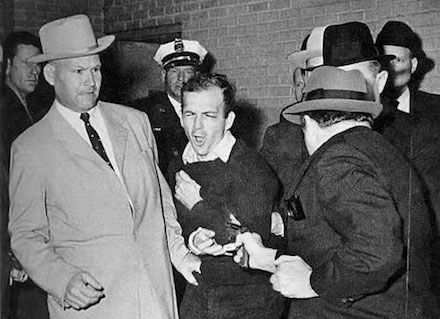
On this date in 1964, Dallas nightclub owner Jacob Rubenstein — notorious to history as Jack Ruby — was condemned to the electric chair for the dramatic live-televised murder of accused John F. Kennedy assassin Lee Harvey Oswald, captured by snapping shutters in one of the 20th century’s indelible images.

Ruby would never sit on that mercy seat.

For one thing, his punishment arrived as the American death penalty lulled into hibernation. Had he lived his sentence eventually would have been vacated by the 1972 Furman v. Georgia ruling. But instead of seeing that juridical landmark, the enigmatic Ruby died in prison inside of three years, awaiting retrial after an appeal.

On this day..