1976: Three terrorists in Syria

On this date in 1976, three Abu Nidal terrorists were hanged before the Hotel Semiramis in Damascus, barely 24 hours after they had entered it and taken 90 hostages in a bid to win release of Palestinian prisoners.

Palestinians Muhammad al-Barqawi and Mouatassem Jayyoushi and Iraqi Jabbar Darwish suffered Syria’s first public execution since an accused Israeli spy more than a decade before — and as the late Syrian strongman Hafez al-Assad had pledged, justice was swift and ruthless.

The security of the citizen is sacred. We shall not be soft in this matter. We shall hit back very hard and we denounce this criminal action committed by the gang, which acted as if it was in Israel.

They were the surviving 75% of a quartet of gunmen who early the previous morning had seized the hotel, barricaded themselves on the fifth floor, and attempted to make their trade. Plainly, it didn’t quite work out; the attempt precipitated a battle with Syrian troops which saw the fourth terrorist killed, along with four of the hostages. The Supreme State Security Court condemned the captured men to death overnight; the sentence was carried out between 6:00 and 6:30 the next morning.

New York Times coverage of the raid and the execution is unfortunately behind the paper’s paid-login firewall, but a photo of the execution shows onlookers ringing a single wooden frame for what must have been a short-drop hanging. An unused fourth noose, possibly symbolically present for the killed fourth terrorist (or possibly not; there’s no explicit comment on it), hangs beside the dead men.

So why the grievance? That June — “Black June,” to the Palestinians — Syria had bailed on hard-line Palestinians and entered the Lebanese Civil War on the side of Phalangist Christians,* just as they were on the verge of being overrun. It was the second time in six years that a neighboring Arab power had turned its guns on Palestinians. (In 1970, Jordan had expelled the Palestine Liberation Organization in “Black September.” Lots of black in the Palestinian annals.)

And why the Iraqi, among the hanged?

Palestinian terrormeister Abu Nidal had hung out his shingle in Iraq, then under the control of a rising young dictator destined for the gallows himself, but who grasped the opportunist potential of backing the Palestinian cause while states like Jordan and Syria visibly sold it out. Television crews had a few words in edgewise with the doomed men the evening before their hanging, and they claimed to have trained for their abortive mission in Iraq.

* This put Damascus on the same side as Israel.

Part of the Themed Set: Semiramis.

On this day..

1792: Jacques Cazotte, occultist

On this date in 1792, Jacques Cazotte, a writer distinctly out of step with his times, was guillotined for treason in Paris.

The Martinique-born Cazotte (English Wikipedia entry | French) was into his 40s when he launched the writing career that earns him notice enough for this blog.

He wasn’t a liberte, egalite, fraternite kind of guy: Cazotte’s works, like Le Diable Amoureux (The Devil in Love),* were fantastical, Gothic — far from the rationalist fare of the Enlightenment.

And that wasn’t exclusively a literary posture.

Cazotte fancied himself gifted with prophecy — enthusiasts’ accounts have him prophesying the course of the Revolution — and preferred the mystical enlightenment of the illuminati to the Voltairean kind.** He viewed the onset of the French Revolution with horror.

When some scribblings to that effect were discovered in his papers, the mystical goose was cooked. The French Wikipedia entry credits his daughter with saving his life during the September Massacres … buying the 72-year-old only a few weeks of life.

Cazotte’s Le Diable Amoureux has the devil as a young man’s servant girl, endeavoring to seduce him. Here is Cesare Pugni‘s balletic rendition, Satanella, with its grand pas de deux, “Le Carnaval de Venise”:

Cazotte finds his way to us, as the dark arts are wont to do, through more meandering channels as well.

Le Diable Amoureux inspired supernatural mystery The Club Dumas by Spanish author Arturo Perez-Reverte. That novel in turn was riffed by Roman Polanski for the weird 1999 flick The Ninth Gate (review), starring Johnny Depp. (Cazotte’s book is explicitly referenced in both its progeny.)

Although only tangentially related, this digression into the occult gives us leave to notice one of the many cultural ephemera of executions linked to no particularly blog-friendly date. The Club Dumas and The Ninth Gate make use of striking woodcuts of modern vintage but after a style of centuries past that help unlock the central puzzle.

Charged with esoterica, the topical-looking “hanged man” print comes clearly modeled after its tarot cousin … although the tarot version, in most instances, is hoped to be of less deadly effect upon the plot.

* Available free in the original French at Project Gutenberg.

** Voltairean rationalism had its own ways of getting in trouble. It may have been an age of ideas, but it was hardly safe to have them.

On this day..

1994: Johannes van Damme, heroin smuggler

At dawn this date in 1994, Dutch citizen Johannes van Damme was hanged at Singapore’s Changi Prison for drug trafficking.

The first westerner hanged under Singapore’s draconian anti-drug law, the engineer had been nabbed at the airport with 4.32 kilos of heroin.

Van Damme, 59 at his death, claimed ignorance of the illicit contents and his case drew appeals from the Dutch government — to no avail.

The city-state’s severe criminal code and comprehensively ordered society — “Disneyland with the Death Penalty” in cyberpunk author William Gibson’s formulation — is somewhat notorious at this point.

But while foreign migrants and guest workers had regularly faced the gallows for similar offenses, van Damme’s hanging marked a significant ramping-up of enforcement. According to Amnesty International, Singapore carried out 54 drug-related hangings in 1994 and another 52 in 1995, after an early-90’s pace of under ten per year. It’s maintained rates in the dozens of executions per annum since then, making it the heaviest per-capita user of the death penalty in the world.

And it doesn’t mind making its visitors sweat about it.

Welcome to Singapore. You’ll also see the warning on your embarkation card.

An intensified pace perhaps came with a new resolve on the part of the former British colony to forswear juridical perks to European offenders — at least to some extent. Van Damme’s fate makes an interesting contrast with that of his countrywoman, Maria Krol-Hmelak (the link is to her scanty Dutch Wikipedia page). Krol-Hmelak had been arrested a few months before van Damme also for possessing enough heroin to be presumed a smuggler and incur an automatic death sentence; at her trial a few months after van Damme’s, she received a surprise acquittal.

On this day..

1938: Nikolai Kondratiev, purged economist

On this date in 1938, Stalin’s purges claimed Soviet economist Nikolai Kondratiev.

Not the most recognizable name in the Soviet Union’s 1930’s bloodletting, Kondratiev — also transliterated Kondratieff — was a pre-Keynesian economist of some note, who had a prominent hand in the fledgling USSR’s early agricultural direction.

Thus far goes the portfolio of many a forgotten academic or bureaucrat shot by Stalin.

But Kondratiev made a contribution still much remembered — and one that might just be due to re-emerge from its occult hibernation.

In a series of 1920’s papers, Kondratiev worked out the theory that capitalism had 50-to-60-year economic supercycles. Though not strictly the first to so hypothesize, he put the idea on the map; the (alleged) pattern still bears the name “Kondratiev wave” or “Kondratiev cycle”.

His belief that the intermittent major crises punctuating capitalism were not building towards systemic implosion but clearing the economic debris of bygone ages and allowing new growth were not the least of what got him into hot water with Stalin.

“Creative destruction,” as Joseph Schumpeter would call it, adapting the idea.

Though sidelined from mainline economics for much of the 20th century, Kondratiev waves have never gone entirely out of fashion. Congenial to any number of collateral theoretical hobbyhorses — technological innovation, entrepreneurship, generational psychology, statecraft, and the eternal bracing for end times right around the corner — Kondratiev waves are a niche player in economic theory both conventional and otherwise.

Here’s a site that lovingly describes them.

Its problem, even if you happen to buy into the concept, is its near uselessness as a predictive tool: half-century cycles don’t just arrive like clockwork, and the timing and very existence of particular cyclical epochs is highly dependent on the interpreter’s choice of data. The margins of error run out to decades. You never know at any given moment what you’re looking at — so you can find the supercycle crashing in 1998, or beginning its springtime of growth in this decade.

That very uncertainty accounts for Kondratiev’s intermittent mainstream resuscitation during economic crisis: when worried about Where Things Are Headed, some version of a Long Wave theory is almost sure to have a story to tell.

According to the New York Times‘ database of past articles, the word “Kondratieff” (its preferred transliteration; “Kondratiev” yields stories about New York Rangers prospect Maxim Kondratiev) went essentially unmentioned in the post-World War II paper before appearing in 20 articles from 1973 through 1984 — the period when the capitalist core was buffeted by energy crisis, stagflation, and the punishing Paul Volcker recession of the early Eighties.

And then Kondratiev/Kondratieff faded from the Grey Lady; after a few appearances during Wall Street’s woes in the late 80’s, it doesn’t seem to have appeared in print there since an offhanded reference in a 1992 William Safire column.

Have you seen the news lately? It’s mighty Kondratiev-friendly. His cycle of exclusion has probably just about run its course, and if you’re the wagering type, I’ll take Thomas Friedman against the field.

Behind the theorems, of course, there was the flesh-and-blood man; it so happens that not many dismal scientists went as poignantly as our principal.

Initially imprisoned in 1930, Kondratiev served eight years before he was re-sentenced and executed; he ached for the separation with his family. Kondratiev’s daughter, Elena — Alyona or Alyonushka in the Russian diminutive — preserved his correspondence to her, the only remnants of her father in her life.

The last letter — as it turned out; plainly the writer had no inkling of it — was dated August 31, 1938.

My sweet darling Alyonushka.

Probably your holidays are over now and you are back at school. How did you spend the summer? Did you get stronger, put on weight, get tanned? I very much want to know. And I would like very, very much to see you and kiss you many, many times. I still do not feel well, I am still ill. My sweet Alyonushka, I want you not to get sick this winter. I also want you to study hard, as you did before. Read good books. Be a clever and a good little girl. Listen to your mother and never disappoint her. I would also be happy if you managed not to forget about me, your papa, altogether. Well, be healthy! Be happy! I kiss you without end.

Your papa.

(From Orlando Figes’ The Whisperers: Private Life in Stalin’s Russia.)

On this day..

1973: Victor Jara, among thousands in Chile’s September 11

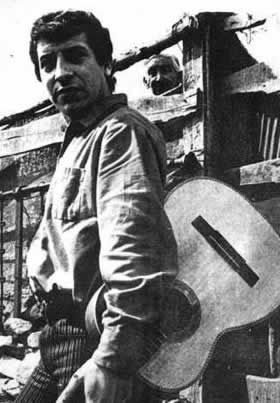
At an unknown time on this evening in 1973, or else the early hours of the following day, Chilean putschists ushering in the Pinochet dictatorship machine-gunned folk singer Victor Jara near the Santiago stadium that today bears his name.

“I don’t see why we need to stand idly by and let a country go communist due to the irresponsibility of its own people,” said Henry Kissinger of Allende’s election. Victor Jara had another idea.

Four days before, Chile’s September 11 had seen General Augusto Pinochet topple the elected leftist government of Salvador Allende, murdering the president in his palace. (Or, go some accounts, Allende committed suicide — “pausing only twice to reload.”)

A long pall of evil settled over the country, with all the accustomed chilling familiars: “disappeared” people, mirrored shades, Jeane Kirkpatrick.

The day after the CIA-backed coup, popular folk singer and activist Victor Jara, a pioneer of the Nueva Cancion (“New Song” movement) then teaching at Santiago’s Technical University, was among thousands of undesirables rounded up and packed off to a makeshift prison camp at the city’s Chile Stadium — a stadium Jara had performed at.*

Left there to the tender mercies of a thuggish Chilean officer, Jara was beaten and tortured over the intervening days — evocative but possibly undependable tradition holds that the guitarist’s hands were cut off, shattered or otherwise destroyed. According to the U.S.-based United States Institute of Peace,

[t]he the last day Víctor Jara was seen alive was September 15. During the afternoon he was taken out of a line of prisoners who were being transferred to the National Stadium. In the early morning of the next day, September 16, shantytown dwellers found his body, along with five others, including that of Littré Quiroga Carvajal, near the Metropolitan Cemetery. As the autopsy report states, Víctor Jara died as a result of multiple bullet wounds (44 entry wounds and 32 exit wounds).

The Commission came to the conviction that he was executed without due process of law by government agents, and hence in violation of his fundamental human rights.

To say the least.

And as the text implies, Jara was only the most recognizable name among unknown hundreds killed as the military cemented its control of the country.

Jara remains larger-than-life martyr figure in Latin America and liberation movements worldwide, but he’s almost unknown north of the Rio Grande. Pinochet was our bastard; in the weird way history writes its own geography, Jara became a political emblem behind the Iron Curtain for the perfidy of the capitalist powers: obscure in Peoria, but a household name in Potsdam, as the credit roll from this 1978 East German film suggests.**

That’s Jara himself on the soundtrack, of course. The pat conclusion for such a figure is that his art is his legacy, and that Jara’s body of work as against Pinochet’s will be a walkover in posterity. Is that enough? Pinochet died in his bed at age 91; earlier this year, the Jara case was closed in underwhelming fashion. Thirty-five years down the road, most authors of Pinochet’s human rights depredations are dead or lost or decrepit. Justice delayed is justice denied.

Victor’s widow, Joan Jara — today director of the Fundacion Victor Jara (it’s a Spanish-only site); you can hear her interviewed on Democracy Now! for the 25th anniversary of her husband’s death in 1998 — managed to leave the country with some of his works.

Her publication of a poem he wrote while imprisoned, an untitled, unfinished work generally known as “Estadio Chile,” made it a signature cry of hope amid desperation. Here it is in the Spanish rough-hewn under the shadow of death; there’s an English translation here.

Somos cinco mil
en esta pequena parte de la ciudad.
Somos cinco mil
¿Cuantos seremos en total
en las ciudades de todo el pais?
Solo aqui, diez mil manos que sembran
y hacen andar las fabricas.

¡Cuanta humanidad
con hambre, frio, panico, dolor
presion moral, terror y locura!

…¡Y Mexico, Cuba y el mundo?
¡Que gritan esta ignomonia!

Somos diez mil manos menos
que no producen.
¿Cuanto somos en toda la Patria?
La sangre del companero Presidente
golpea mas fuerte que bombas y metrallas.
Asi golpeara nuestro puno nuevamente.

¡Canto que mal me sales
cuando tengo que cantar espanto!
Espanto como el que vivo
como el que muero, espanto.

De verme entre tanto y tantos
momentos de infinito
en que el silencio y el grito
son las metas de este canto.
Lo que veo nunca vi,
lo que he sentido y lo que siento
hara brotar el momento…

Whether or not it’s enough, his work is his legacy after all.

* Some 7,000 people were held at Chile Stadium in the days after the coup, most later moved in with other detainees at the larger Estadio Nacional. The USIP excerpt alludes to Jara being pulled out for execution during such a move.

** In a similar vein, Stanford has a small online exhibit of Jara-themed East German propaganda art. Not to be outdone, there’s a Soviet rock opera about Jara, and an asteroid discovered by a Soviet astronomer was named in Jara’s honor within a week of his execution.

On this day..

1946: Amon Göth, Schindler’s List villain

On this date in 1946, Plaszow concentration camp commandante Amon Göth was hanged near the camp site by Poland’s postwar Communist government.

Göth is most widely recognizable as Ralph Fiennes’ fiendish character in Schindler’s List, one of the American Film Institute’s top movie villains of all time. (And, naturally, a first-class bastard in real life, too.)

A short-drop strangulation is not the way you’d want to go. It turns out, though, that Steven Spielberg (ever the sentimentalist) seriously tidied up the proceedings.

As you watch the video of the real Amon Goeth’s exit below — and it’s a snuff film, so proceed advisedly — consider the following:

  • Amon Goeth does bear a passing fair resemblance to Ralph Fiennes.

  • To judge by their getup — dig the masks! — the executioners might have been Batman and Robin.
  • To judge by the discharge of their duties, the executioners might have been Larry, Moe and Curly. Goeth survived two drops (notice the executioner on the right gesticulating in frustration as the second try fails) before they finally got it right:

On this day..

1977: Hamida Djandoubi, Madame Guillotine’s last kiss

On this date in 1977, the guillotine claimed its last head.

The famous and infamous blade dropped for the last time at Les Baumettes prison in Marseilles on Hamida Djandoubi, a Tunisian immigrant convicted of the torture-murder of the naive young girlfriend he had forced into prostitution. Oddly, he had already had another appendage — a leg — amputated as a result of a work accident; it was while recuperating that he caught the fascination of his hospital roommate’s 19-year-old daughter, Elisabeth Bousquet.

Though the death penalty was grinding to a halt in 1970’s France, Djandoubi was not the last person condemned (the link is French); the guillotine was only abolished with the election of the Francois Mitterand government in 1981.

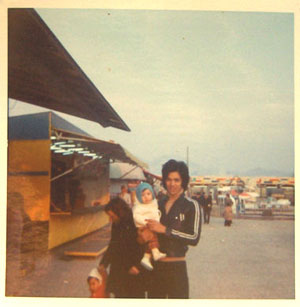
Today, Executed Today discusses the case with the man who wrote the book on Djandoubi:* expat Canadian writer Jeremy Mercer. Be sure to check his photo series on the Djandoubi case — including discomfiting shots of Djandoubi re-enacting his crime with a police secretary playing the victim, and the killer in happier times.
ET: Thanks for joining us.

JM: Thanks for the opportunity to speak with Executed Today. I moved to Marseille in 2003 and shortly after I stumbled upon the rather arcane fact that the last man guillotined in France was executed at the local prison on September 10, 1977. I thought it was interesting angle on capital punishment and I decided to try and write a book that mixed true crime and death penalty philosophy. As a result, I’ve been immersed in the death penalty debate for the better part of five years.

Let’s start with Hamida Djandoubi himself — 31 years on, he looks like a nasty but fairly run-of-the-mill criminal. Was it strictly coincidental that he became the last man executed?

It was absolutely random fate. It was really odd – during the 1970s, the death penalty debate was raging in France and most capital cases became national news. But the Djandoubi case went completely under the radar, partly because his lawyer didn’t drum up any attention and partly because his victim was a presumed prostitute and the media prefers ‘sexier’ victims – the elderly, little children, a dentist of good standing walking her dog at night.

Even odder, if you surveyed most French people today, they would tell you that Christian Ranucci was the last man guillotined. Ranucci was a young white man who was accused of killing a little girl. He claimed his innocence, but was nonetheless executed in June 1976 (14 months before Djandoubi). Afterward, a best-selling book and major film were released that argued Ranucci was innocent so his name really sticks in the minds of the French.

Obviously, there’s plenty of tension with North African communities in France still today. Djandoubi was Tunisian, and he was convicted of murdering a white woman. How significant was racial marking in the way his case was handled, inside the courts and out?

This is really curious. In the 1960s and 1970s, the French courts were tainted by racism and one of the national papers even ran an editorial saying that it is better to be named “Marius than Mohamed” when appearing before a French judge. But, in this case, it was Djandoubi’s own lawyer who was a member of a far-right party and staunchly anti-Arab so his case was undermined even before it went to court.

It is one of those frustrating moments. You assume that a death penalty case is of such importance that top professionals are involved. Instead, Djandoubi chose the civil lawyer who negotiated his accident benefits after he had an accident at work and ended up with a very poor defence.

As I said above, his murder victim had worked as a prostitute, which diminished some of the public outrage. As well, his three rape victims were all Algerian girls aged 14 – 16. I guarantee you the case would have been much more explosive if those three girls had been white.

Your book is partly about Djandoubi himself, and partly about the history of the death penalty and especially the guillotine in France. How had the guillotine shifted in France’s identity by the time of this execution?

At first, when the guillotine was introduced, it was public sensation and executioners became celebrities with special edition postcards in their honour and fan mail and all that. As late as the 1860s, tour groups like Thomas Cook were actually organizing execution trips so English tourists could see the guillotine at work. But, bit by bit, the French became a little embarrassed by the fame of the machine. First, they removed the scaffolding that raised the guillotine above the crowds so that it would be brought down to earth and spectators’ views would be impaired; then, they stopped holding executions in the afternoon and held them at the less fan-friendly time of dawn; then, instead of guillotining people right downtown, they did it outside a prison in an obscure neighborhood at the edge of Paris; and, finally, in the 1930s they moved the guillotine inside the prison walls and it was no longer a public event. By the 1970s, the guillotine held such a low profile that many people thought it was defunct and that the French government was using the electric chair.

Interestingly enough, the fall from glory of the guillotine mirrors the general attitude toward capital punishment. By the late 1800s, many countries were already abolishing the death penalty and by the 1970s France was the last country in Western Europe to resort to capital punishment. In the end, the guillotine became the country’s dirty little secret that they kept hidden in their closet.

What are the bits of guillotine folklore you found most interesting?

The most popular stories involve the life in the head after it is severed from the body. It all began with the guillotining of Charlotte Corday, who had stabbed Jean-Paul Marat to death as he soaked in his bathtub. After she was guillotined, the executioner held her head up to the crowd and slapped her on the cheek. But, according to newspaper accounts, both cheeks reddened, as if Corday was indignant by this treatment. Suddenly, everyone began to wonder what a severed head can feel or think.

This curiosity became even more intense a few weeks later when the chief executioner, Charles Henri Sanson, guillotined two political rivals one after the other. He told friends that when he looked in the basket where he kept the heads, one politician’s head was biting the other politician’s head!

So, all this got the scientists really excited and the experiments began. One doctor, Dassy de Ligières, was allowed to take a head back to his laboratory where he connected it to a living dog and pumped blood back into it. He kept hoping the head would speak, but alas, no.

The definitive experiment was conducted in 1905 when Dr. Beaurieux was given permission to wait beside the guillotine and examine the head the moment it was cut. Dr. Beaurieux interviewed the condemned man in prison and came up with a pre-arranged set of signals. The day of the execution, the doctor had incredible luck –the head did a little twist when falling and landed on the stump, slowing the loss of blood. Dr. Beaurieux then called the man’s name three times. At 5 seconds, the man was able to look at the doctor and his recognize him; at 15 seconds, the man was able to look at the doctor but his eyes were unfocussed; and at 25 seconds, the man could barely glance at the doctor. So, to the best of our knowledge, a guillotined head maintains some level of consciousness for more than 20 seconds.

You’re working with Robert Badinter — tell us about him, and his upcoming tour in the U.S.

Robert Badinter is simply the greatest man I’ve ever had the honor of working with. He became a dedicated abolitionist after one of his clients was unjustly guillotined in 1972 and dedicated the next decade of his life to fighting the death penalty. In the end, he saved six lives and ultimately wrote the legislation that abolished the death penalty in 1981 when François Mitterrand named him Minister of Justice.

I interviewed Badinter for my own book in 2005 and he asked me if I could look into translating one of his books into English. When I had time in 2007, I set about the task and now Abolition has been released by Northeastern University Press.

Badinter’s Abolition, in French and in Mercer’s translation

To mark the book’s release, Badinter will be holding three conferences in America on the death penalty and strategies to abolish it:

Why, in your judgment, did France abolish the death penalty? And even before abolition, why did its use abate so dramatically in the postwar era?

For many people, it was a tremendous humiliation for France, the birthplace of human rights and the Enlightenment, to be the last country in Western Europe to use the death penalty. The abolition movement began when Portugal abolished the death penalty for common crimes in 1867 and by the late 1970s, nobody was using it in Europe. Even in Spain, one of the first things they did after the death of Franco was abolish the death penalty.

So, the use of the guillotine simply had to abate because the world was becoming aware that the death penalty is a flawed punishment: the risk of executing innocents, the cost of capital trials, the predominance of poor and minorities on death row, the lack of deterrence value. But, as long as there was a right-wing government in power in France, they couldn’t abolish the death penalty because they wanted to appear tough on crime and polls showed a majority of the French people wanted to keep the guillotine.

Once Mitterrand and the Socialists were elected in May 1981, it was clear the death penalty would be abolished, and sure enough, five months later it was gone

Where do you think the death penalty is going in America? And can one really think of worldwide abolition as a legitimate possibility?

I am absolutely convinced we will see almost worldwide abolition by 2050. There will always be a few rogue states, but the death penalty is such an obviously flawed form of punishment it will inevitably be eliminated.

In terms of America, Badinter and I have discussed it at length. He believes the country is ready for abolition and that all is needed is one trigger case: a middle class white guy with a reasonable claim to innocence who is about to executed. This would really instigate a debate on the penalty and as soon as you bring in all stats — the 130 plus people who have been exonerated while on death row, the work of the Innocence Project, the race bias, the cost of capital trials, the overworked public defenders etc etc — I think it would be a slam dunk.

Personally, I think people are selling the abolition the wrong way. Every time I meet a die-hard death penalty supporter who wants a serial killer or a child rapist killed, I ask him or her “Why are you so merciful?” Because, I honestly believe life in prison is a far worse punishment than being executed.

* Here’s a review of Mercer’s book.

On this day..

1990: Samuel K. Doe

On this date in 1990, deposed Liberian strongman Samuel Kanyon Doe was tortured and summarily executed in Monrovia by the putschists that overthrew him … and gruesomely filmed in the process.

Doe had come to power killing his predecessors — personally murdering, some sources say, President William Tolbert in 1980, then executing his chief aides.

That coup toppled civilian authority in the west African country now permanently prefixed with the adjective “troubled.” “The first of the monsters,” the War Nerd called him: Doe’s murderous rule through the 1980’s set up the succession of current war crimes prisoner Charles Taylor.

Samuel Doe’s turn in the obituaries arrived in particularly grisly fashion, with Taylor rival/semi-ally* Prince Johnson swilling beer as he interrogated — and ordered the ear sliced off — the groveling former head of state before having him executed. (Or if you like, just plain murdered.) The video shot of Doe’s ordeal became an international sensation … so it’s a little surprising that only this paltry excerpt seems to be readily available online:

* And current Liberian Senator! He feels just awful about the whole torturing-the-President-to-death thing.

On this day..

1943: 186 prisoners at Plotzensee Prison

As dark fell on the evening of September 7, 1943, a mass execution of 186 death row prisoners — including six with unresolved clemency appeals — began at Berlin’s bomb-damaged Plotzensee Prison, continuing by candlelight until the following morning.

An Allied air raid the night of September 3-4 had struck the facility, allowing four prisoners to escape and damaging the guillotine and execution shed where sentences were normally carried out. Coincidentally, that had come hours after Hitler had (as was his wont, in common with many a politician to the present day) castigated the judiciary for the dilatory rigmarole that allowed the condemned to delay their fate with legal appeals.

Converging circumstances generated sensible elite consensus:

That is the last thing we need, that after the air raids a few hundred condemned to death would be let loose on the population in the Reich capital.
-Goebbels

Instead, at the order of Reich Minister of Justice Otto George Thierack, cases were quickly tied up for a night of mass hangings.

Protestant pastor Harold Poelchau described (pdf) what he witnessed.

As darkness fell on September 7 the mass murders began. The night was cold. Every now and then the darkness was lit up by exploding bombs. The beams of the searchlights danced across the sky. The men were assembled in several columns one behind the other. They stood there, at first uncertain about what was going to happen to them. Then they realized. Eight men at a time were called by name and led away. Those remaining hardly moved at all. Only an occasional whisper with my Catholic colleague and myself … Once the executioners interrupted their work because bombs thundered down nearby. The five rows of eight men already lined up had to be confined to their cells again for a while. Then the murdering continued. All these men were hanged. … The executions had to be carried out by candlelight because the electric light had failed. It was only in the early morning at about eight o’clock that the exhausted executioners paused in their work, only to continue with renewed strength in the evening.

And as Poelchau intimates, the fearful harvest of September 7-8 was not the end of the massacre. Dozens more followed over the ensuing days, for a total of more than 250 executions at Plotzensee September 7-12.

Notable among the victims was 27-year-old German-Dutch concert pianist Karlrobert Kreiten, memorialized at this German page. He’d been a little too loose with his distaste for Hitler and been arrested on the eve of a concert a few months before.

In 2003, Dutch composer Rudi Martinus van Dijk debuted his Kreiten’s Passion, an excerpt fo which can be enjoyed on the composer’s homepage.

On this day..

1930: Carl Panzram, rage personified

On this date in 1930, one of the most nihilistic criminals in American history was hanged for murder at Leavenworth Federal Penitentiary — in character to his last breath, a sneer at the hangman about to put him to death:

“Hurry it up, you Hoosier bastard! I could hang 10 men while you’re fooling around!”

Panzram — according, at least, to an autobiography which is largely unverifiable — had the chops to back up his taunt.

A Minnesota-born son of German immigrants, Panzram was into the juvenile detention system by adolescence, and at 14 hopped a freight train bound for a life of vagrancy. In Panzram’s recounting, his boyhood was a hellscape — even knowing what he became, it’s possible to feel compassion for the the killer’s remembrance, “Everybody thought it was all right to deceive me, lie to me and kick me around whenever they felt like it, and they felt like it pretty regular.”

Worse was to come for Carl — sexual molestation, a gang-rape by fellow hobos — and much worse by Carl.

The rape may have shattered the restraints on his conscience … or maybe they was already gone by then. “Might makes right” became his credo; to alcoholic and thief he added a portfolio of rape and enthusiastic homicide, crisscrossing the country (with a side trip to Africa), escaping or wheedling out of jails when he was picked up for something, and finding it amazingly easy to slay his fellow men.

A full narrative of Panzram’s grisly career is available at trutv.com. Much of this is, again, sourced only to Panzram himself, so the possibility of bloodthirsty braggadocio cannot be dismissed; even at a fraction of its alleged scope and brutality, his career was a triumph in horror.

While I was sitting there, a little kid about eleven or twelve years old came bumming around. He was looking for something. He found it, too. I took him out to a gravel pit about one-quarter mile away. I left him there, but first I committed sodomy on him and then killed him. His brains were coming out of his ears when I left him, and he will never be any deader.

It was the murder of a fellow inmate at the federal prison in Leavenworth, Ks., that sealed his fate. Panzram was in his late 30’s by this time, facing a long prison sentence. Something between the fury that fueled him and the desperate reality of not seeing the outside again until he was an old man may have impelled him to check out intentionally: he had warned that he would murder an inmate, and he responded to anti-death penalty campaigners’ attempts to save him by threatening to kill them, too.

In my lifetime I have murdered 21 human beings, I have committed thousands of burglaries, robberies, larcenies, arsons and last but not least I have committed sodomy on more than 1,000 male human beings. For all these things I am not in the least bit sorry.

It seems the fate of common criminals, even those as prolific and infernal as Panzram, to shuffle into obscurity in fairly short order. Among devotees of the dark underbelly, Panzram may be well-known; to the larger public, he’s long forgotten.

Panzram’s memoirs, released as Killer: A Journal of Murder, were turned into a 1996 James Woods vehicle of the same title:

Interestingly, Panzram is also name-checked in another more famous literary artifact: In the Belly of the Beast, the tour de force of Norman Mailer protege Jack Abbott, who had conned the litterateur into backing his bid for parole, was rather boldly dedicated to Carl Panzram.* It will not surprise the reader to learn that Abbott, upon his release, killed again.

But a new generation is waiting to rediscover its butchers … and a new documentary, Panzram, is in production to bring the story back to silver screens and Netflix queues of the 21st century.

* Abbott was writing to Mailer while the latter was banging out his book about notable executee Gary Gilmore.

On this day..