1966: Sayyid Qutb

On this date in 1966, author and intellectual Sayyid Qutb was hanged for plotting to overthrow the Egyptian state.

Qutb — whose names can be transliterated many ways (Saïd, Syed, Seyyid, Sayid, or Sayed; Koteb, Kotb, Qutub or Kutb) — was one of the most influential Islamist thinkers of the 20th century, and helped shape the ideas of Osama bin Laden.

A traditionally-minded Muslim civil servant in a westernizing Egypt, Qutb’s journey to radicalism is traditionally dated to his late 1940’s study abroad in the U.S. at what is now the University of Northern Colorado, where the decadence, materialism, and lax morality of the global hegemon saw him seeing existential evil in the everyday all around him:

The American girl is well acquainted with her body’s seductive capacity. She knows it lies in the face, and in expressive eyes, and thirsty lips. She knows seductiveness lies in the round breasts, the full buttocks, and in the shapely thighs, sleek legs — and she shows all this and does not hide it.

Qutb left Greeley, Colo., in 1950 with a master’s degree and an intention to mount an Islamic revolution in his home country that would implement sharia and keep shapely thighs safely under wraps. (Qutb never married, bemoaning the scanty pickings of pure fish in the sea. He may have faced the gallows a virgin.)

He hooked up with the outlawed Muslim Brotherhood, landed in Egypt’s famously savage prisons (future president Anwar Sadat was one of his judges), and the experience of torture hardened his commitment to a vanguard-led revolution. He kept up his prolific writing output, penning perhaps his most notable work, Milestones (the text was later used against him at his capital trial).

Qutb’s release in 1964 was only for a few months, before Egyptian security got wind of a new Muslim Brotherhood plot to overthrow the government and rounded up Qutb as the supposed ringleader — or just railroaded him because it didn’t like where he was going with passages like

there are many practical obstacles in establishing God’s rule on earth, such as the power of the state, the social system and traditions and, in general, the whole human environment. Islam uses force only to remove these obstacles so that there may not remain any wall between Islam and individual human beings.

With the benefit of hindsight, one can readily imagine that his martyr’s death did not squelch his movement, but greatened his stature to admiring eyes.

But it was hardly a direct path into an un-critiqued hall of martyrs in an undifferentiated “radical Islam”. While Qutb had his own influence in Egypt, Cairo has managed to keep the lid on the Muslim Brotherhood. Qutbism, however, was exported to Saudi Arabia — which intentionally imported it for various practical and geopolitical reasons — where it flourished, often in a fractious relationship with official Saudi Wahhabism.

One of Qutb’s students was the uncle of Ayman al-Zawahiri, and the hanged intellectual greatly influenced Zawahiri’s own path into radicalism and to al-Qaeda. Since September 11, of course, the path Qutb himself followed has become of much more pressing interest to the West as well as within the Muslim world.

Some noteworthy works by Sayyid Qutb

On this day..

1979: Eleven by a Firing Squad in Iran

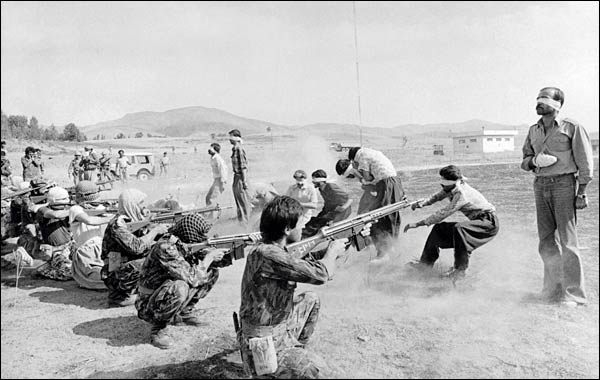
On this date in 1979, the only anonymous photograph to win a Pulitzer Prize captured nine Kurdish rebels and two of the Shah’s policemen executed by firing squad in revolutionary Iran.

This shot, one of a series taken of the event with the permission of the judge who condemned the men to immediate death in a half-hour trial at the Sanandaj airfield, ran the next day in the Iranian paper Ettela’at, whose editor prudently kept the photographer’s identity secret. Within two days, the stunning photo had rocketed around the world.

It won the Pulitzer Prize for Spot News Photography the following spring, still credited anonymously.

Two years ago, the Wall Street Journal revealed — with the photographer’s permission — the identity of the man who shot this indelible image: Jahangir Razmi, who had gone on to a career as one of Iran’s top photographic journalists. He came to New York to collect the prize 27 years late.

The article breaking the story is still available on the Journal‘s website, and on the personal site of reporter Joshua Prager. An NPR story discussing the search for Razmi’s identity is here.

On this day..

1945: John Birch, Society man

On this date in 1945, according to a fringe faction of American conservatism, the first victim of the Cold War was shot by Chinese Communists at Suchow, China, near Xi’an.

John Birch, a military chaplain proselytizing in China and an agent of the CIA’s precursor entity Office of Strategic Services, had the kind of portfolio sure to rub Mao’s boys the wrong way.

Apparently it was his personality that got him into trouble.

On recon duty days after the end of World War II, he bumped into a patrol of Red Chinese. According to Time, he failed his diplomacy check.

As the scene has been reconstructed, Birch argued violently with the Communist officer who wanted to disarm him. Birch was seized and shot after his hands had been tied. The Communists then bayoneted him at least 15 times and tossed his body on a heap of junk and garbage.

“In the confusing situation,” said [Birch’s commanding officer Major Gustav] Krause last week, “my instructions were to act with diplomacy. Birch made the Communist lieutenant lose face before his own men. Militarily, John Birch brought about his own death.”

Days after World War II — how does that square with your international Communist conspiracy? The incident was not especially notable at the time, but some elements later conceived John Birch the first American casualty of Communism during the Cold War, and in this guise he became the namesake of the John Birch Society (Wikipedia entry | homepage — evidently forward-thinking enough to have grabbed their own three-letter acronym)

Here’s candy magnate and founder Robert Welch, Jr., explaining:

Despite the young lieutenant’s credentials as a martyr of evangelical anti-Communism, the oft-loopy Society’s relationship to the mainstream conservative movement and the Republican Party it took over was never completely comfortable and eventually came to a definite sundering.

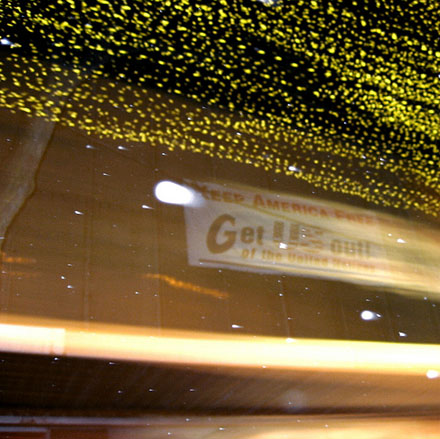
The Society soldiers on, its “Get US out of the United Nations” billboards a minor fixture of Americana from Port Angeles, Washington to this one in Ypsilanti, Michigan.

On this day..

1993: Ruben Cantu, an innocent child?

On this date in 1993, Texas gave a lethal injection to a young man for murder — a crime many involved in the case no longer believe he committed, since the sole witness against him has recanted.

Ruben Cantu was only 17 years old at the time of the crime, and for that reason would not be eligible for execution today. But according to a Houston Chronicle investigation (the story is also mirrored here) 12 years after his death, he shouldn’t have been eligible then because he might not have done it. Cantu himself may have kept a street code of silence to his death.

Lise Olsen — interviewed by NPR here — blew up the case; Cantu’s jury forewoman and the district attorney who tried him for his life are among those who have publicly regretted their roles in what has emerged one of the most compelling cases of an executed innocent in the modern American death penalty era. Nobody could possibly have predicted that pitiable public defender resources and an extremely aggressive capital punishment regime could result in such a thing.

The subsequent (and still current) Bexar County District Attorney checked it out (threatening to prosecute the recanting witness) and declared everything proper. So don’t worry about it. What could she possibly have to gain from a whitewash?

On this day..

1937: Ikki Kita

On this date in 1937, intellectual Kita Ikki (Kita is the family name) was executed by the Japanese military government for inspiring a failed coup d’etat the previous year.

A onetime socialist turned radical nationalist, Kita — born Kita Terujiro — preached a doctrine of authoritarian national restoration around some socialist-sounding communitarian purpose, coupled with an unapologetic imperialism.

His Outline Plan for the Reorganization of Japan (the translation is from a reader, Sources of Japanese Tradition, partially excerpted here) argues that in the wake of Europe’s self-immolation in World War I, initiative lay with the Land of the Rising Sun — and that the country must adopt a muscular unity of purpose to grasp it.

The entire Japanese people, thinking calmly from this perspective which is the result of Heaven’s rewards and punishments, should, in planning how the great Japanese empire should be reorganized, petition for a manifestation of the imperial prerogative establishing “a national opinion in which no dissenting voice is heard, by the organization of a great union of the Japanese people.” Thus, by homage to the emperor, a basis for national reorganization can be set up.

Truly, our 700 million brothers in China and India have no path to independence other than that offered by our guidance and protection. And for our Japan, whose population has doubled in the past fifty years, great areas adequate to support a population of at least 240 million or 250 million will be absolutely necessary a hundred years from now. For a nation, one hundred years are like a hundred days for an individual. How can those who are anxious about the inevitable developments or who grieve over the desperate conditions of neighboring countries find their solace in the effeminate pacifism of doctrinal socialism? … At a time when the authorities in the European and American revolutionary creeds have found it completely impossible to arrive at an understanding of the “gospel of the sword” because of their superficial philosophy, the noble Greece of Asian culture [meaning Japan, of course] must complete its national reorganization on the basis of its own national polity. At the same time, let it lift the virtuous banner of an Asian league and take the leadership in the world federation that must come. In so doing let it proclaim to the world the Way of Heaven in which all are children of Buddha, and let it set an example that the world must follow.

One could quibble about particulars, but it’s essentially fascism — paralleling Mussolini in doctrine as well as ideological evolution. (According to W.G. Beasley Kita also co-founded a Gen. Jack Ripper-esque Society for the Preservation of the National Essence.)

A military coup was supposed to get the ball rolling, which made him a guru to an aggressive cadre of young officers who tried to seize the government in the February 26 Incident, named for the date in 1936 it took place.

Kita wasn’t himself involved in the coup, but his intellectual sponsorship was enough of a connection for the Kempeitai.* Modern Japanese Thought tartly observes that Kita’s vision for an imperial dictatorship didn’t turn on any misty-eyed allegiance to the emperor’s person.

When he was executed for his role in the mutiny of 1936, he was ordered to recant by saying “long live the emperor” as a final act of reverence and submission. He is reported to have refused by replying that he had vowed long ago never to joke about his own death.

In Fighting Elegy (or Elegy to Violence or Elegy to Fighting), Seijun Suzuki’s 1960’s skewering of militarist 1930’s Japan (review), Kita makes cameos to inspire the main male character to greater feats of violent sublimation of his repressed sexuality. (The following clip is merely the trailer.)

There’s also a 1973 biopic — the last film of Yoshishige Yoshida.

* I don’t have definite documentation on the method of execution; I’m supposing it was hanging, the standard method in Japan since the Meiji period.

On this day..

1963: Henry John Burnett, Scotland’s last hanging

On this date in 1963, the executioner paid his last call to Scotland with the hanging of Henry John Burnett for the murder of a rival-in-love seaman.

The type whom parents hope their daughter never dates, Burnett liked to keep his squeeze Margaret May Guyan under lock and key to keep her stepping out on him.

It’s an old, old tale. Boy meets girl, boy makes girl his prisoner, girl gets creeped out and returns to estranged hubby Thomas Guyan at 14 Jackson Terrace in Aberdeen, boy blasts Guyan in the face with a shotgun. How many times have we heard it told?

Even though the noose was on its way out — this is not only the last execution in Scotland, but the only hanging in Aberdeen in the past century and a half — there wasn’t much pussyfooting around when they’d made up their mind to use it: Burnett outlived his victim by only eleven weeks — notwithstanding an insanity plea and clemency petitions from both his own and the victim’s families — before hanging at Craiginches Prison, a facility that surely ought to be somebody’s porn name.

It’s got pride of place in a book about Aberdeen crime history, Blood and Granite. Because you can find anything on YouTube, there’s also this fine teaser for a forthcoming animation project of some kind:

Part of the Themed Set: At the End of the Rope.

On this day..

1936: Rainey Bethea, America’s last public hanging

On this date in 1936, thousands thronged Owensboro, Kentucky, for a glimpse of what would prove to be the last public hanging in the United States.

The U.S. followed the trend of its onetime mother country, England, in moving the formerly iconic public hanging increasingly behind closed doors, but its federalist structure made that change uneven. In Kentucky itself at this time, the law displayed sedimentary layers of death penalty history.

Caught up for killing a 70-year-old woman — done in the midst of a drunken burglary, he had left a telltale ring at the scene; fingerprint analysis also helped establish his guilt — Rainey Bethea was on the hook for murder, robbery and rape. The former two indictments would have subjected him to (private) electrocution at the state penitentiary. The latter charge still carried the punishment of public hanging in the local county seat.

Bethea was charged only with rape.

While the explicit sentencing disparity between the crimes bears the clear marks of racism and patriarchy that made purported black-on-white sexual crimes such live fodder for lynch law, and the four-and-a-half-minute jury deliberation doesn’t have the look of solemnity, Bethea’s actual guilt seems fairly well-established.

But the case attracted a nationwide media swarm not for any exceptional quality of the crime or the anachronistic nature of the punishment, but for the involvement of a female sheriff. The “matronly” (virtually all descriptions of her gravitate to this adjective) Florence Thompson had inherited the top law enforcement post upon the death of her husband … and that meant she had inherited the responsibility of hanging Rainey Bethea, which would make her the first American woman to supervise an execution.

Would she or wouldn’t she? The press descended on Owensboro to cover the edifying spectacle of a plump mother stringing up a rapist, or else maneuvering her way out of the job. Thompson played cagey until the very last moment, when the ringers she had secretly hired appeared on the scaffold while she watched from a nearby vehicle.
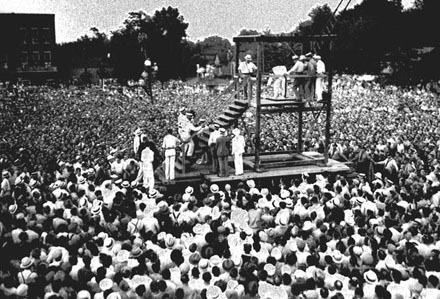
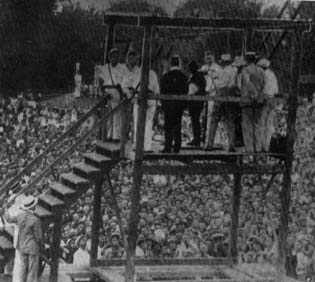
In this photo, Bethea — almost totally obscured between his escorts — has just begun ascending the gallows.

The man who threw the trap showed up drunk and performed appallingly, but press reports subsequently focused on the beastly behavior of the “jeering” crowd rushing the gallows to tear souvenirs from the corpse. (For instance, Time and the New York Times.)

But according to Perry T. Ryan’s 1992 review of the case — including interviews with surviving witnesses — little to nothing of the kind occurred. Ryan claims Bethea faced about the most dignified hanging mob imaginable.

Maybe hyped-up atrocities in the hinterlands were part of what distant editors demanded after H.L. Mencken at the Scopes trial. Certainly, the local Messenger-Inquirer painted a sharply different picture from more prominent outlets in this August 16 editorial (titled “Panderers Galore”) whose themes could have stepped fresh from a modern cable TV gabfest:

Ambitious and irresponsible reporters and photographers who swarmed into Owensboro for the Bethea hanging dipped their ready hands into the cloaca of evil designs and plastered over the name of this fair city the dirty results of their pandering.

Those who saw the dawn kindling in the east and ushering in the last sunrise of the despicable creature about to die, did not expect all of the watchers to be in reverent mood, but a calm, quiet demeanor characterized their behavior, as a group, throughout their long wait, surprisingly moderate for an occasion on which the law was exacting the supreme penalty.

Considering the size of the throng that witnessed the hanging Friday morning and that it was composed largely of people, who journeyed to Owensboro from distant places, the wonder is that there was no demonstration, no emotional outburst. There was not the semblance of ‘mob impulse’ or ‘eagerness for the kill.’ For the sensation seeking star scribes of quacks of American journalism, it was entirely too tame an affair. This is the reason that some of them reported it as they wanted it to be — not as it was.

They heard a very few people on the outskirts of the crowd call out at different times: ‘Hurry up,’ ‘Get it over’ or ‘hang him.’ To give screaming bulletins to the yellow press and to ruthless radio commentators, they magnified and colored it into a scene of ‘great disorder’ though there was never a general outcry of any kind.

When a priest held up his hand from the scaffold for silence, as Bethea was about to go to his death, there was no ‘blood thirst’ mob ‘shouting and yelling.’ Present were several thousand, who came from near and far to see a man legally hanged for the most heinous crime ever committed in Daviess county, and several thousand more, who turned out to see how the rest would act. When that hand went up in a gesture for silence, the buzz of the multitude’s conversations died down till the fall of the proverbial pin could have been heard.

The smart scribes and sob sisters looked on. All they saw was a black man standing on a scaffold with a rope around his neck and a mass of people peering up at him. That was too tame, they would call it a ‘jeering’ throng. All they heard was the click of the trap door. That would not do. There would have to be ‘cheering.’ So they said there was. Then they heard cameramen from cities where nothing is cared about the horrible crime Bethea committed. They were bawling at officials to ‘move out of the way,’ to ‘give us a break.’ They had to have their souvenirs to show the half civilized readers of their yellow sheets. The boys and girls who had to tell the story needed more color to regale them with atrocious accounts of how the people behaved. They found a few individuals who had gone in the bizarre which inspired thundering headlines about ‘gayety’ and ‘carnival’ spirit.

In administering the last sacrament, the Rev. H. J. Lammers, of Louisville, made an opening in the hood. When the doctors pronounced Bethea dead, one of the attendants at the scaffold took a tag off the hood. Another then took a fragment and others, who were at arms length from the dead man, followed suit. The blunder of tearing off that tag gave the high powered thrill-writers their big opening. They pictured the crowd as tearing Bethea’s clothes from his body. The crowd was never in disorder and Bethea’s clothes were never torn.

The ‘souvenir hunting mob’ did not even pick up the sox [sic] and shoes the doomed man left at the foot of the gallows. It did not so much as touch the basket in which Agnew and Wheatley, colored undertakers, placed the body, clothes and all, or molest it or them in the slightest as they bore it away.

The scavenger writers who came to depict a ‘jolly holiday’ and ‘gala occasion’ had both, but they never saw a more orderly throng at a baseball game.

The public hanging of Bethea was not a disgrace to Kentucky. But, a disgrace to Illinois, Missouri, Tennessee, and some other states, was the spectacle made of it in their scandal monger press. Owensboro should not be surprised at the scurrilous attack upon it by lurid writers and glib tongued talkers in northern and eastern states for they delight to distort any news from Kentucky into weird barbaric tales. We have learned how best to protect our women from rapists-murderers, white or colored. The only way, it seems, that we will ever be able to protect them from the cruelties of a sordid section of the press, will be by softening the state’s anti-rape law, which makes public hanging mandatory. So many as favor that will please tell the legislature.

Vendors of news occupy an important place in the nation, and their purpose should always be to maintain unquestioned exactness of facts. Where the subject matter is susceptible to coloring there should be no sacrifice of truth. To pervert the high honor of the profession for the paltry reward of more readers is a dangerous venture and one that should be curbed.

Owensboro’s citizenry, than which no finer representatives of high-bred Americans can be found anywhere, regrets that it was necessary to invoke the Mosaic law, but a sobered regret and a more solemn memory is that the hanging was eagerly seized upon and transformed into a picturization of the exhibition of low passions loosed.

We are proud of our city, and justly so, for no people are of finer fiber. The putrid pens of those who wore the garb of the news profession painted in lurid colors purported happenings, and it is sad but true that such distorted reports are accepted while the plain statement of facts is discarded as an attempted apology.

Thousands of those who witnessed the Bethea hanging came from outside the county. They belonged to good families in their communities, temporarily bereft of their better judgment and bent on viewing a scene which ordinarily would be extremely repugnant to them. And the out-of-town reporters found in the visitors elements to embody in their sordid stories.

A thoughtless word here and there, expressed without cognizance of its probability of misuse, and the staid citizen away from home becomes to the wild-eyed correspondent a Kentuckian gunning for human game. There should be available means of calling to account the writer who for a few filthy shekels diverts his sense of justice into the recording of things that never were.

As the editorial intimates, regardless of what actually happened in Owensboro, the circus atmosphere quickly brought the matter of public hangings into question. In 1938, the Kentucky legislature moved all executions behind prison walls … and Bethea secured an indefinite claim to the status of last person publicly executed in the United States.

Part of the Themed Set: At the End of the Rope.

On this day..

1964: Gwynne Owen Evans and Peter Anthony Allen, England’s last hangings

At 8 o’clock in the morning this date in 1964, two gallows traps 50 kilometers apart opened simultaneously — dropping the last two men England ever hanged.

Gwynne Owen Evans and Peter Anthony Allen couldn’t have been much smaller fare for a milestone as momentous as the last entry in England’s copious annals of execution.


Evans (left) and Allen.

The two twentysomethings had dropped by Evans’s former coworker’s place in the aptly-named port Workington to borrow money. Since the call was at 3 a.m. and the petitioners were armed, it might appear that they had in mind an offer that John Alan West couldn’t refuse. The reader is invited to fill in the rest: a quarrel, a murder, a stolen watch, a medallion dropped at the crime scene with one of the perps’ own names on it …

Three months later, they were on trial for their lives; a month after that, hanged by the neck until dead. If there is tragedy in these hapless thugs, it may be that either could possibly have saved the other by claiming sole responsibility for the murder; since each blamed the other, the jury ended up finding them equally culpable.

While the last hangings in Canada featured two unconnected men hanged together, the last in England had partners in crime hanged separately. Allen died at Liverpool’s Walton Prison; Evans was dropped at Manchester’s Strangeways Prison.*

And unlike the Canadian case, Evans and Allen didn’t die knowing they were likely the last.

Although hangings had slowed to a crawl in Britain — there were just two in 1963, and none in 1964 before this day — death sentences continued to be handed down. But the trend was toward abolition: the British Parliament suspended the death penalty for ordinary crimes late in 1965, and made the suspension permanent in 1969. The handful of exceptional crimes for which the gallows remained nominally available — treason, piracy, espionage — were never enforced as such before those statutes too were removed from the hangman’s jurisdiction by 1998.

* Evans’ executioner, Harry Allen — no relation to Peter Anthony Allen — also conducted the last hanging in Scotland.

Part of the Themed Set: At the End of the Rope.

On this day..

1978: Antonina Makarova, Nazi executioner

On this date in 1978, a young Soviet girl’s desperate collaboration with the Wehrmacht caught up with a 55-year-old mother.

A village girl and the first in her family to go to school, young Antonina Parfenova was dubbed “Makarova” (after her father, Makar) by a teacher when the girl forgot or was too shy to say her surname. This childhood switcheroo would follow her into adulthood and ultimately buy her half a lifetime and a family to mourn her.

At 19, she had moved to Moscow when the German onslaught against the Soviet Union erupted, and like many young people in similar straits, she volunteered to help fight the Nazis. But as the front swept past her, she found herself in enemy territory, and was nabbed by the SS and persuaded to become the Germans’ executioner of Russians at Lokot, a village near the Ukrainian and Belarussian borders for which a short-lived Nazi-controlled “republic” was named.

A 2005 Pravda article (with a somewhat prurient concern over the young woman’s sexual incontinence) delves into her activities:

Usually Antonina Makarova was ordered to execute a group of 27 people, the number of partisans which a local prison could house. Death sentences were carried out on the edge of a pit half a kilometer from the prison. She never knew people whom she executed and they had no notion who the executioner was either. Antonina executed the first group of partisans being absolutely drunk and the girl could hardly realize what she was doing. She often kept clothes of those whom she killed if the things were good; she carefully washed them and heaped them in her room.

In the evenings after work Antonina loved to dress up and enjoy her time dancing with German officers together with other girls who came there as prostitutes. Antonina boasted she used to live in Moscow that is why other girls kept aloof from her.

At dawn, Antonina often came to the prison and peered into the faces of people whom she was to execute in the morning. The woman just did her job when executing people and believed that the war would write her crimes off.*

“Antonina Makarova” was implicated in some 1,500 executions, and formally charged in around 200 cases with identifiable victims. The KGB turned up scores of women of the right age with the right name, but none of them fit the bill: the real Makarova’s passport said “Parfenova.”

Not until 1976 did the case break, when a relative applying for a travel visa named her in a routine list of relatives. Now named Antonina Ginsburg — she had married a veteran and taken his name — she was living quietly in Belarus, but hardly in hiding: the pair attended parades and town functions in the honor accorded World War II survivors.

Viktor Ginsburg would be in for a bit of a shock.

Even 35 years after her spell with the Germans ended, the wounds of the Great Patriotic War were raw enough to spell her death in very quick order in Briansk, the capital of Lokot’s district. She was the last World War II traitor of any note executed in the Soviet Union, and according to this page, the only Soviet woman ever judicially executed by shooting. (I’d take that claim cautiously without more corroboration.)

The Pravda article cited above is about the only original English source readily available online; Russian speakers (or people prepared to grapple with an online translator’s inelegance) can read much more at her Russian Wikipedia page as well as here, here and here.

Update: Courtesy of Executed Today’s own Sonechka, a translation from this Russian story of Makarova’s daughter’s heartbreaking remembrance of a woman she only knew as a mother:

Pain, pain, pain … She spoiled the life of four generations … You would like to know whether I would take her back if she returned? I would. She is my mother after all… I really don’t know how to remember her — as if she’s alive or dead. According to the tacit law, women were not shot. Maybe she’s alive somewhere? And if not, tell me — I’ll finally light a candle for her soul.

(Candles in Orthodox churches are lit for “zdravie” — literally “good health, well being” — or “upokoi” — “peace of a soul.” The former is intended for living beings, the latter for dead ones.)

* This, at least, is what she told her interrogators.

On this day..

1993: Mohamed Mustafa Tabet, serial rapist with a badge

On this date in 1993, the police chief of Casablanca was shot in Kenitra Central Prison for abuse of power.

Mohamed Mustafa Tabet (or Tabit) wasn’t exactly Captain Renault.

While Morocco still has prisoners on death row, Tabet’s was the first execution actually carried out in 11 years, and it’s the last execution in Morocco to date. He went on the rocket docket, just five months from his arrest to standing up against a wall.

To earn that rare distinction, Tabet exploited his official power to rape or sexually exploit hundreds of women. Tabet confessed to some 1,500 victims over 13 years; the minimum figure matches the 518 personal identity cards found in his apartment. (Also found: 118 video cassettes — many of them violent — and a computer list of his crimes.)

The “Tabet Affair” — actually called “Tabetgate,” proving that the United States retains the power of exporting ideas — opened a discomfiting window on gender and power in Morocco.

Webster University Prof. Don Conway-Long was in Morocco at the time researching gender and masculinity for his dissertation. His paper “Sexism and Rape Culture in Moroccan Social Discourse” (pdf) is probably the most illuminating readily-available English* document on the affair — and the many contradictory reactions it drew from contemporaries, and the pressure it put on the government to contain the fallout as “a morals case, instead of looking further into overall police corruption.”

Prof. Conway-Long was good enough to spare Executed Today a few minutes to explore power and gender in Morocco, then and now.

ET: The scale of the crime spree seems just unimaginable, that he could get away with victimizing hundreds upon hundreds of women.

DCL: And not that many came forward! It was just a couple of women. If it’s difficult to talk to rape and sexual assault survivors here [in the U.S.], it’s exponentially harder in Morocco.

You were in Morocco in the years leading up to this trial. What was the country like in terms of its gender outlook?

It’s more like our 1950’s in terms of the attitudes towards women. Some educated professors at one point were laughing at the idea that a man could be charged with raping his wife in the West. In some ways, attitudes in Morocco are maybe 20 years behind what we see in the West. We had that same conception in the 1950’s — Missouri actually finally changed that law in 1993. [See here and here -ed.]

Morocco was also probably one of the most liberal countries of the Muslim world in the sense of being more closely connected to the West. Morocco has had more openness, more tourism.

How did the Tabet case impact women’s position?

[In 1995,] about a year after I left, a battered women’s shelter was set up in Casablanca, the first one in Morocco. By comparison, our first shelters in the U.S. and U.K. were set up in 1971, 1972.

In 2004, they passed a new family law that changed a lot of the freedoms that women have — e.g., women can ask for divorce, and don’t have to obey their husbands.

But I have no idea if you can claim there’s any causal relationship between the discovery of Tabet’s crimes and these later events. At the time, some men thought he was this great sexual hero, very virile.

So what lies ahead?

The old king died in 1999; his son Mohammed VI is in there now and he’s young and more aware and one of the rising stars of the monarchs of the middle east, like the king of Jordan. His [Mohammed’s] head is on the right way, but running a country like this with so much variation — there’s 50% illiteracy, the Western Sahara conflict, a certain level of Islamist opposition, and around twenty political parties all the way out to the Communists.

So there’s no certain future, absolutely not.

As far as cases like Tabet’s — let’s hope it’s not happening still, but Morocco when I was there was a place where you pass six different kinds of uniforms walking down the street with Uzis that would be pointed at your body as you passed.

* There’s more in French and Arabic.

On this day..