On this date in 1944, Nazi Germany’s juridical vengeance against Hitler’s near-assassins commenced.
Barely two weeks after Col. Stauffenberg‘s bomb had barely missed slaying the Fuhrer, eight of his principal co-conspirators stood show trials at the Volksgerichtshof (People’s Court) before hectoring prig Roland Freisler.
The outcome, of course, was foreordained.
Apparently orders had come down from on high to make the deaths as degrading as possible; this batch, convicted August 7-8, was hanged naked this day at Berlin’s Plotzensee Prison on thin cord (piano wire, say some sources, although it’s not clear to me whether this is literally true) suspended from meathooks while cameras rolled. Video and stills from the ghastly scene were shipped back to Hitler’s bomb-damaged Polish outpost for the edification of the powers that be.
Many hundreds more would follow, both at Plotzensee and throughout the Reich where persons distantly connected to the plotters and various miscellaneous resistance figures were swept up in the purge.
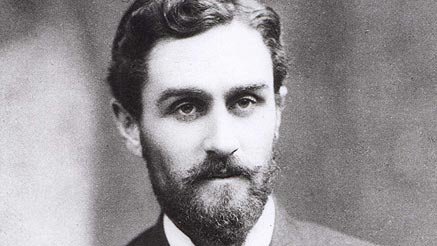
On this date in 1916, Roger Casement was hanged for treason by the British crown that had knighted him only a few years before.
Casement died for his part in the Easter Rising, but this Irish nationalist hero’s layered story has long made him a very different sort of cultural marker than, say, James Connolly.
Casement came to public prominence for his damning report on Belgium’s atrocious treatment of natives in its Congo colony, e.g.:
[T]he great decrease in population, the dirty and ill-kept towns, and the complete absence of goats, sheep, or fowls — once very plentiful in this country — were to be attributed above all else to the continued effort made during many years to compel the natives to work india-rubber. Large bodies of native troops had formerly been quartered in the district, and the punitive measures undertaken to his end had endured for a considerable period. During the course of these operations there had been much loss of life, accompanied, I fear, by a somewhat general mutilation of the dead, as proof that the soldiers had done their duty.
. . . Two cases (of mutilation) came to my actual notice while I was in the lake district. One, a young man, both of whose hands had been beaten off with the butt ends of rifles against a tree; the other a young lad of 11 or 12 years of age, whose right hand was cut off at the wrist. . . . I both these cases the Government soldiers had been accompanied by white officers whose names were given to me. Of six natives (one a girl, three little boys, one youth, and one old woman) who had been mutilated in this way during the rubber regime, all except one were dead at the date of my visit.
[A sentry in the employ of one of the concessionary private companies] said he had caught and was detaining as prisoners (eleven women) to compel their husbands to bring in the right amount of rubber required of them on the next market day. . . . When I asked what would become of these women if their husbands failed to bring in the right quantity of rubber . . , he said at once that then they would be kept there until their husbands had redeemed them.
Casement’s is an honorable name in the campaign for the Congo, an early human rights and anti-colonial struggle; in this 92-minute BBC documentary on the notorious depredations in the Congo, the Casement report’s creation and impact are treated from about 1:15:15 through the end:
A similar investigation undertaken in Peru — where the lens focused on British employers, rather than strictly the malfeasance of foreign states — earned him knighthood in 1911, but Casement’s personal evolution from loyal Protestant* imperial operative with a sympathy for the Irish cause to revolutionary nationalist was already underway. “This journey into the depths of the Congo has been useful in helping me discover my own country and understand her situation, her destiny, her reality,” he wrote his sister. “I’ve also found my true self: the incorrigible Irishman.”
He resigned from the consular service and began recruiting for the Irish Volunteers.
As World War I opened, Casement identified British aggression as its cause, an extension of the violent imperial hegemony he chronicled in The Crime Against Europe:
The British Empire was not founded in peace; how, then can it be kept by peace, or ensured by peace-treaties? It was born of pillage and blood-shed, and has been maintained by both; and it cannot now be secured by a common language any more than a common Bible. The lands called the British Empire belong to many races, and it is only by the sword and not by the Book of Peace or any pact of peace that those races can be kept from the ownership of their own countries.
While any Irish Republican would have agreed with that sentiment, the resulting moral and tactical calculus for the Irish cause to ally with the German was not universally embraced — and was certainly anathema to the British.
All that was beautiful and just,
All that was pure and sad
Went in one little, moving plot of dust
The world called bad.
Came like a highwayman, and went,
One who was bold and gay,
Left when his lightly loving mood was spent
Thy heart to pay.
By-word of little street and men,
Narrower theirs the shame,
Tread thou the lava loving leaves, and then
Turn whence it came.
Ætna, all wonderful, whose heart
Glows as thine throbbing glows,
Almond and citron bloom quivering at start,
Ends in pure snows.
Casement spent the first two years of the Great War in Germany itself, and arranged a shipment of guns that would have supported the Easter Rising, but thought the aid too little and too late. He had a German U-boat drop him at Ireland, trying to get word to the Republican leadership to postpone the revolt.** Instead, he was picked up three days before the doomed rising and hanged after a sensational trial.†
His “treason” — and of course, the very crime of which he was convicted imports a British legitimacy in Ireland that Casement explicitly rejected — shocked many old associates, but he still had friends in high places. To dampen the international clemency campaign, England circulated the notorious “Black Diaries,” photographs of supposed Casement diary pages detailing the author’s homosexuality.
This dirty (and successful) trick brings a personal-is-political quality to Casement’s legacy as well as an enduring debate over the diaries’ authenticity. Since Irish nationalism gained mainstream acceptance well before homosexuality, right-thinking folk long held the Black Diaries a forgery, and time was you solicited a black eye by saying otherwise in the wrong company.
The gay rights movement has seen a posthumous redefinition of Casement; although homosexuality was not on the indictment against him, one could argue that it was the reason he hanged. Given recent handwriting forensics that support the diaries’ authenticity, the general‡ consensus about the Black Diaries has inverted with the effect of only heightening sympathy for their alleged author, albeit at the expense of some tension over how to situate that characteristic within the whole of Casement’s life and thought.
And that is only one aspect of the shifting place of Casement in the firmament of Republican martyrs since his death. His hagiography waxed in the interwar years, with Yeats among those calling for the return of Casement’s remains in The Ghost of Roger Casement”.
But the humanitarian’s German ties were an inconvenience as World War II raged, and not until afterward was that cause renewed. When his body was finally returned in 1965, an Irish state funeral elided the matter of the diaries.
Even Casement himself, who would be the last to die for the Easter Rising, had a hand in the myth-making. His last mission’s purpose to avert the Easter Rising fit neither the government’s interest in maximizing his perfidy nor Casement’s own in identifying with the Irish cause; he himself therefore owned the Rising fully in his defense which made him fine fodder for Republican hymns like “Lonely Banna Strand”:
RTE radio’s What If? series recently explored Casement’s complex legacy:
As Casement put it in his voluminous personal writing, “It is a cruel thing to die with all men misunderstanding — misapprehending — and to be silent forever.”
* Casement’s father was Protestant and his mother was Catholic; he lived with a somewhat split identity between the two faiths, but formally converted to Catholicism while awaiting execution (which surely did not hurt his memory to the Irish cause) and his last meal was simply the Host.
** The guns themselves were interdicted by the British navy and ended up scuttled to the ocean floor.
† Since Casement’s incitements to rebellion had occurred on foreign soil, there was some fine legal parsing over whether he could be tried for “treason.” The dispute resolved to the placement of a comma in a medieval law — leading to the epigram/-taph that Casement was “hanged by a comma.” In the midst of war and before an English jury, however, punctuation was an even weaker defense than it sounds.
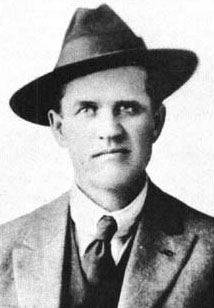
On this date in 1917, Wobbly labor organizer Frank Little was abducted from his hotel and hanged from a railroad trestle in Butte, Montana.
An executive board member of the radical Industrial Workers of the World, the half-Cherokee Little had only rolled into Montana’s copper mining hub two weeks before. A roving agitator who had organized workers all around the west, he would be a signal martyr to America’s nascent Red Scare.
It was a fraught moment nationwide, and worldwide. After winning re-election on the slogan “He kept us out of war,” Woodrow Wilson upon his inauguration immediately (try to act surprised) got the United States into World War I. Just as it had in Europe, the question of war put American labor to the test: would it transfer opposition to war into resistance, or would it line up patriotically with its state?
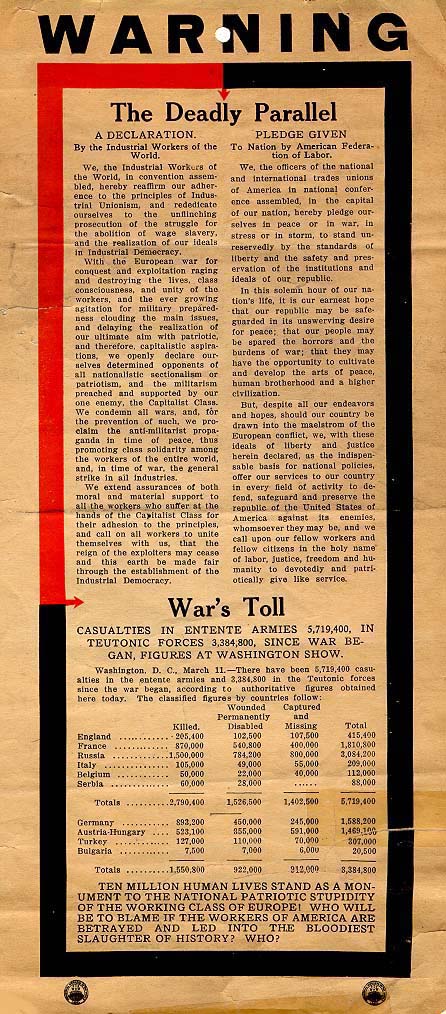
This outstanding IWW poster (via the University of Arizona’s web exhibit on the labor deportations that had expelled Frank Little from Arizona just days before he arrived in Butte) pits the militant Wobbly position against the nationalist American Federation of Labor.*
And Little was one of the most stridently anti-war in his movement.
Either we’re for their capitalist slaughter fest or against it. I’m ready to face a firing squad** rather than compromise. (Source)
Anaconda Copper could nowise welcome this character’s arrival, where he would organize already-striking miners and mix in militant anti-war rhetoric with incendiary potential in the cocktail of immigrant workers being asked (in many cases) to wage war on their homelands.
The local labor conflict, an exceptionally brutal instance of a pattern across the country and especially in western mining country, was probably savage enough on its own to make Little a marked man. Whether his anti-war activity or his union activity motivated his death is not sure, but the dilemma was probably a false one for his killers just as it was for Little himself: they were two heads of the coin. As American troops poured into Europe, and particularly as the Bolshevik Revolution later in 1917 spurred a worldwide Communist scare (and a separate American military expedition), both public and private power violently pursued left-wing elements.
Caption: Copper Trust to the Press: “It’s all right, pal; just tell them he was a traitor.” (Source.)
The film An Injury To One (review) deftly weaves those themes and others together into the tale of a crime which is also the tale of a time and place:
This note was found pinned to Little’s body. “3-7-77”, a Montana vigilante calling card, indicates the dimensions of a grave.
Officially (again, act surprised), it’s an unsolved crime. Even though the New York Timesreport the day after the hanging quoted a labor official claiming “certain” knowledge of five of the six men in the posse, and a prosecutor vowing, “it is a cold-blooded murder and every effort will be used to apprehend the men who did it,” nobody ever went on trial for lynching Little.
Company goons, likely aided by the infamous union-busting Pinkerton detective agency, are the presumed culprits. And it is the nature of lynchings to make extrajudicial the rough justice sought by a certain constituency, as expressed by Montana’s Helena Independent:
Good work! Let them continue to hang every I.W.W. in the state. The time has come. It is beyond the comprehension of the average citizen why the war department has not ordered certain leaders arrested and shot. The people will not stand for much more.
A massive funeral turnout brought federal troops to quash labor unrest in Butte … and in the years to come, the IWW would be hunted from pillar to post.
Pro-Wobbly sites give adoring biographical treatment and fairly extensive resource lists on Little here and here.
On this date in 1963, Iraq’s infant Ba’ath government executed at least 21 soldiers — all Shi’a — who had participated in a Communist coup attempt on July 3.
The Ba’ath were newly in the saddle after overthrowing Qasim earlier that year, and would be ousted again a few months hence before their definitive seizure of power several years later.
For the moment, they were a fledgling government trying to tilt away from the Soviet bloc and towards the west while navigating a minefield of domestic politics. If the coup really occurred as described, it was the fruit of an Iraqi Communist Party with daggers drawn for the regime after the Ba’athists had massacred their membership with CIA help in the course of offing Qasim. (The name is also transliterated Qassim or Kassem.) If it was bogus, it was probably an official cover story to keep massacring Shi’a Communists.
The affair, in either guise, amounted to a minor hazard in the jagged path of the Ba’ath — but of course, we come by that judgment with benefit of hindsight. Far more interesting to follow, courtesy of this site‘s library of historic cables, the perceived unfolding of the situation through the anxious American diplomatic pouch:
Minutes after midnight this date in 1944, four senior Wehrmacht officers who had come within an ace of murdering Adolf Hitler less than 12 hours earlier were summarily shot in Berlin — the first of thousands executed for the most famous assassination attempt on the Fuhrer.
One of those rare moments where historical epochs (arguably) turn on the minutest exigencies of chance, the so-called July 20 plot had seen Col. Claus Schenk Graf von Stauffenberg insinuate a bomb into Hitler’s conference room in modern-day eastern Poland, then fly back to Berlin to mount a coup d’etat.
Blam
Stauffenberg had every reason as he left Wolfsschanze to believe the devastating blast at 12:42 p.m. must have killed the Nazi dictator. Little did he know that another officer at the table where the high command was plotting strategy for the eastern front had, in the name of legroom, shifted the deadly satchel to the other side of a heavy oak table support — shielding Hitler from the brunt of the explosion.
Four men died. Hitler had hearing loss, an injury to his right arm, and one hell of a grudge.
Stauffenberg weaseled out of the confused bunker and flew back to Berlin, expecting that his confederates were even then launching Operation Valkyrie — a contingency plan for martial law in the case of civic disturbance that the conspirators intended to use to mount a coup.
Failure to Communicate
Control and distribution of information was not the least of the many threads in the tapestry of July 20, 1944. Hitler had risen to power on his artful grasp of propaganda; today, his headquarters’ mastery of communications would overpower the putschists’ rank amateurism.
While en route, Stauffenberg had no ability to communicate to the wider world. Landing in Berlin three hours after the not-quite-deadly-enough blast at Wolfsschanze, he must have been stunned to find that Valkyrie had not been launched. Apparently, fragmentary reports from the east were unclear as to whether Hitler had survived; everyone was reluctant about committing himself.
Frantically, Stauffenberg — already deeply committed — rallied his comrades and set the treasonable gears into motion. But by this time, communications with Hitler’s headquarters had been re-established and contradictory reports of the assassination attempt’s success were flying in Berlin. Stauffenberg’s sincere but incorrect eyewitness testimony of Hitler’s death became increasingly untenable. Compounded by the sluggish and ill-coordinated action of the conspirators, officers of a more opportunist bent soon began lining up with the bad guys.
Joseph Goebbels, the senior Nazi in Berlin and Hitler’s wizard of public relations, was inexplicably left unmolested for hours — long enough to phone the radio station (also never seized) an announcement of Hitler’s survival. “To think that these revolutionaries weren’t even smart enough to cut the telephone wires! My little daughter would have thought of that.”
Conspirators’ orders to military units around Berlin went out late, piecemeal, and far too often fell on ears already deaf to the appeals. In some cases, the proclamations that should have been queued up for inundating the airwaves instantaneously were with some other officer not on the scene, and consequently were haphazardly redrafted on the fly — for telex operators who had caught the day’s drift themselves and intentionally delayed or ignored them.
From the perspective of a radio editor it was tragic. Tragic because the way in which details were handled made it obvious that this revolt had had very lithe chance of succeeding. (Source)
The coup fell apart almost as soon as it began.
Fromm Here to Eternity
Most decisively of all, timely information had prevented any participation by Gen. Friedrich Fromm, Stauffenberg’s commanding officer and the head of the Reserve Army — it was that position that allowed his aide access to Hitler’s person, and it was under his authority that the putschists were issuing their Valkyrie orders.
Fromm fell in the “opportunist” camp, and would have been ready to strike had the Fuhrer been demonstrably killed. But a telephone connection straight from the scene of the crime assured him that Hitler had survived … and that his adjutant was a wanted man.
Fromm the potential collaborator quickly turned the tables on Stauffenberg and company late on the night of the 20th.
The Schwein Abides
Before advancing to our heroes’ foreordained fate, take a moment to appreciate this newsreel rushed into production to assure the German public that everything was under control. It’s an impressive advance on statist slick-talking from Germany’s World War I clunkers (like this):
Notice Hitler greeting Mussolini — the two had been scheduled to meet that day; it would be their last encounter in this world. His maimed right arm hanging concealed beneath a greatcoat, Hitler shakes left-handed.
Fromm … had quickly made up his mind to eliminate these men and not only to cover up the traces — for though he had refused to engage actively in the plot, he had known of it for months, sheltering the assassins and not reporting their plans — but to curry favor with Hitler as the man who put down the revolt. In the world of the Nazi gangsters it was much too late for this, but Fromm did not realize it.
He … announce[d] that “in the name of the Fuehrer” he had called a session of a “court-martial” (there is no evidence that he had) and that it had pronounced death sentences on four officers: “Colonel of the Genera Staff Mertz, General Olbricht, this colonel whose name I no longer know [Stauffenberg, his aide], and this lieutenant [Haeften].”
…
In the courtyard below in the dim rays of the blackout-hooded headlights of an Army car the four officers were quickly dispatched by a firing squad. Eyewitnesses say there was much tumult and shouting, mostly by the guards, who were in a hurry because of the danger of a bombing attack — British planes had been over Berlin almost every night that summer. Stauffenberg died crying, “Long live our sacred Germany!”
The courtyard of the Bendlerblock on modern-day Stauffenbergstrasse in Berlin, where Col. Stauffenberg and three compatriots were shot. Photo by Daniel Ullrich, licensed by CC-by-sa.
Minutes after they died, the SS arrived on the scene and forbade any further executions of potential witnesses.
Fromm’s gambit didn’t work any better than Stauffenberg’s had: he was arrested right away, and was himself later shot.
What If?
While the afternoon’s theatrics may have been doomed from the moment Hitler arose unkilled from the bomb’s debris, his miraculous escape from death — “confirmation of the task imposed upon me by Providence,” he told the nation in a radio address an hour after Stauffenberg’s execution — is an inexhaustible mine for historical hypothesizing.
That the bomb could have, and would have with the least change in the principle variables, slain the dictator is widely accepted; a 2005 reconstruction of the blast scene by the Discovery Channel supports that belief in the context of the cable-documentary-friendly format* of Adolf Hitler plus slow-mo explosives. (Parts 1, 2 and 3 of this series set up the episodes excerpted here with the plot’s historical background and the crew’s investigation into the precise dimensions of the blast space — a combination of file footage, modern recreation shots, talking heads, and tromping about the forest in the modern remains of Wolfsschanze.)
But that’s the easy what-if.
More problematic — and well into the realm of bar-stool dickering — are the questions of what would have happened if the explosive had hit its target.
Stauffenberg enjoys latter-day popularity in Germany — the street where he was shot bears his name — in no small measure because of the confessedly quixotic nature of the attempted murder. Indeed, he probably died at the height of his potential popularity for history.
But it’s not for nothing that this attempt (though it did have many botched antecedents) took place in the weeks when Germany’s military position went from desperate to disastrous. Over the preceding two months, Soviet offenses had pushed the front back to the prewar Polish border, and the Normandy landing had opened a rapidly expanding western front. The assassination had a healthy dose of self-interest … and therefore was at least potentially antithetical to other interests at play in the great conflagration.
The motivation of sparing the Fatherland the ravages of war on its own soil is not ignoble of itself, of course. But given this opposition circle’s years-long failure to take effective action against Hitler while he went from successful crime to successful crime, one might ask a little more than a late-breaking suicidal gambit for unreserved historical vindication.
The German military’s deal with the devil had seen Europe’s greatest armed forces squandered by its dumbest commander. The end result would bleed the Nazi state white at unspeakable human cost … but also, arguably, towards one of the better postwar outcomes imaginable.
And would the coup even have achieved the goal of leaving Germany unoccupied? It seems impossible to think that any outcome would have been worse than Hitler, and the last year of the war was also its bloodiest … but among the spectrum of counterfactual alternatives, the appealing possibilities mostly seem to work out in spite of the plotters, rather than because of them.
1. Civil War?
Countercoups, or even outright civil war, might very likely have erupted between rivals for succession. This might have worked out as the best-case situation — fragmenting German resistance and hastening the inevitable — but it might also have given Germany a leaner, meaner fascism with a path to enduring long-term. Predicting any particular arrangement of players to emerge from this black box is a just-so story, and any of them probably leads to one of the other three alternatives; certainly the plotters weren’t banking on their own subsequent overthrow.
2. Status Quo Ante?
The coup might have utterly failed to obtain peace. German was close to defeat; the Allies were demanding unconditional surrender, and the entire point of the plot was to surrender on better terms than that. Had no quarter been offered, the putschist government might then have fought on (either by choice, or by the compulsion of internal politics) to much the same end, although quite plausibly with much less gratuitous bloodletting in the camps. Accidentally abating the Holocaust would be a very significant plus, of course, but probably not what posterity has in mind when it goes naming streets for the man.
3. World War Against Russia?
The new government might have successfully made peace with the western Allies, which was its fervent hope. Under the circumstances of the summer of 1944, that practically implied the continuation of the global war with the capitalist and fascist powers aligning against the USSR. The horrors of the eastern front up to the summer of 1944 then would likely pale in comparison to what followed. You could tell the story so that it all works out in the end, but replacing the long Cold War with an immediate hot war, especially with the United States less than a year away from its first successful A-bomb test, isn’t exactly a presumptive improvement.
4. 1918 Redux?
In the all but unimaginable case that the post-Hitler government successfully sued for peace on both its fronts (or accepted unconditional surrender), it would have had to give up to a Soviet buffer zone much of what the Soviets ultimately conquered. Millions who died fighting for it, and millions more who died in concentration camps while the fighting played out, and millions of women raped by the conquering Red Army, would have considered that arrangement an improvement; still, the peace itself could have ensconced a less crazy and therefore more durable military dictatorship in central Europe, which wouldn’t necessarily seem like an altogether positive outcome vis-a-vis the actual postwar history. More worryingly, this might have horribly recapitulated the post-World War I scenario in which the liberal politicians who accepted defeat, and not the crazed reactionaries who caused it, were blamed for the loss, fueling the subsequent rise of some unattractive revanchist successor state. Precisely because that example would have been uppermost in the officers’ own minds, it’s hard to believe this least-bloodthirsty path would have been the actual consequence of the coup.
And so on …
Second-order effects from any of these possibilities generate a novelist’s trove of alternative histories. What would the map of eastern Europe have looked like? Whither European Jewry … and therefore the postwar state of Israel … and therefore the political chessboard in the Middle East? What would an early resolution in Europe have meant for the Pacific theater, or for the Chinese revolution? How would decolonization movements have been affected had the war concluded earlier, or had it transformed into a worldwide anti-Communist war?
Postscript
Somewhere in those alternate realities, staff at the re-education camp are bantering over happy hour about what would have happened if Stauffenberg had failed.
Who knows if “internally peacable European social democracies” are a bullet point for the pie-eyed optimists, or the incorrigible pessimists?
A few of the books about Stauffenberg and Operation Valkyrie
Poor Col. Stauffenberg is due to be played by a smirking Tom Cruise in the biopic Valkyrie, a role that has drawn some slightly overheated controversy in Germany over Cruise’s adherence to Scientology.
In the small hours after midnight on the night of July 16-17 90 years ago, the former Tsar Nicholas II, his wife, children, and four family retainers, were shot in a Yekaterinburg basement by their Bolshevik jailers.
Doting family man, vacillating dictator, as weak and rich as Croesus … the doomed Emperor and Autocrat of All the Russias was a man small of stature. His reign emerged under a bad star when 1,300 Muscovites were trampled to death in the crush for his coronation largesse; 18 years later, Nicholas‘s support for Serbia against Austria-Hungary was instrumental in pitching Europe into World War I, a blunder for which he reaped a whirlwind long in the making.
When an anti-Bolshevik force approached Yekaterinburg (or Ekaterinburg), where the deposed royals had been stashed in a commandeered private residence,* Yakov Sverdlov (for whom the city was subsequently renamed) ordered the prisoners shot — not only the tsar, but his beloved wife, their hemophiliac heir, and those four daughters who had to be bayoneted because the state jewels secreted in their corsets shielded them from the gunfire.
The executioners (here’s the account of their leader; here’s another guard’s version) did their best to destroy and conceal the remains, helping fuel subsequent rumors that one of the children had survived and escaped.
Those rumors are only now, with post-Soviet investigation and DNA forensics, being debunked, and not yet to the satisfaction of all comers. This very week, Moscow affirmed (though the Orthodox church has not accepted) that the last of Nicholas’s family had been accounted for:
Modern nostalgia for this unimpressive sovereign is making a minor comeback, with Nicholas absurdly contending in a current poll for the title of “greatest Russian” … supported not only by the miseries of the state that succeeded his, but by the family’s decent and accessible private life.
Even a monarchist — especially a monarchist! — shouldn’t reason that the greatest monarch is the one who drove the bus over the cliff. But much is forgiven a martyr. Indeed, like Charles I of England, the last Romanov monarch has been posthumously saddled with divine sanction; he and all the family are certified “passion bearers”. (Update: And possible future relics!)
A handful of the many books about the Romanovs and their fall
* The Ipatiev House where the tsar was held (and shot) no longer stands. On its spot is a church consecrated five years ago yesterday to the Romanov canonization.
Update: The Romanovs were officially rehabilitated by the Russian Supreme Court on October 1, 2008.
Minutes after midnight this date in 1989, Alabama’s executioners electrocuted a developmentally disabled murderer. Nine minutes later, after rewiring the chair, they finally managed to kill him.
Alabama’s fifth execution of the “modern” era initially made the headlines as the nation’s first execution of a mentally impaired prisoner after the Supreme Court’s controversial Penry v. Lynaugh decision (since overturned) green-lighted the death penalty for developmentally disabled defendants.
Horace Franklin Dunkins, Jr. and an accomplice had raped a mother of four, tied her to a tree, and stabbed her to death, an unquestionably horrific crime. A black man with a white victim deep in Dixie … well, his IQ in the high sixties wasn’t going to help him do anything but waive his right to remain silent. The jury at his trial didn’t hear about his borderline mental retardation — Penry would require that juries get that information in the future — and at least one juror later said that little tidbit would have made the difference in Dunkins’s case.
At any rate, the buzz in this morning’s papers wasn’t about the circumstances of Dunkins’s entry into the criminal justice system, but his clumsy exit from it into the great hereafter.
According to the account of a Dr. John Vanlandingham:*
I saw Dunkins in the electric chair and I heard the generator start…. After a short period of time the other doctor … and I were called into the execution chamber. I could see that Dunkins was breathing…. I checked his peripheral pulse, in his wrist, and it was normal. I listened to his heart and his heartbeat was strong with little irregularity…. I told an official that Dunkins was not dead. Dr. – and I returned to the witness room…. I again heard the generator begin.
“I believe we’ve got the jacks on wrong,” the prison guard captain called out. It was flatly not enough current to kill, although it apparently did the killer the favor of knocking him out.
From 12:08 to 12:17, Dunkins sat motionless and seemingly unconscious while the execution team went all MacGyver on Yellow Mama. Once they’d fit Tab A into Slot B into Lethal Electrode C, they were finally able to try again. The doctors pronounced death 19 minutes after the switch had first been thrown.
”I regret very very much what happened,” the Alabama Prison Commissioner, Morris Thigpen, said at a news conference after the execution. ”It was human error. I just hope that he was not conscious and did not suffer.” (The New York Times)
* Dr. Vanlandingham was participating in the execution despite an injunction by the American Medical Association, which considers it a violation of the Hippocratic Oath. Physicians’ involvement (or not) in executions is a thorny ethical issue of its own; Vanlandingham, however, is not the only doctor to break the taboo.
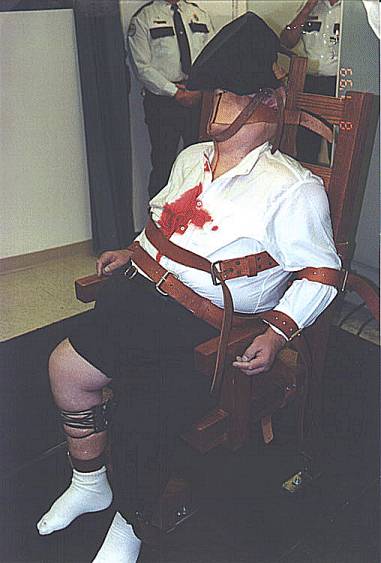
On this date in 1999, America’s obesity epidemic met Florida’s death penalty politics in the ugly electrocution of Allen Lee “Tiny” Davis.
The reader will discern that Tiny earned his nickname ironically. Reportedly 159 kg (350 pounds) at his death, he’d put his ample heft to work bludgeoning a pregnant mother of two beyond recognition with a revolver handle back in 1982 … and then shooting to death the now-motherless two.
As his appeals meandered through the courts, Davis got fatter — and got high blood pressure, arthritis, hypertension and a wheelchair. Meanwhile, the death penalty was meandering its own way across the weird political chessboard of the Sunshine State.
For the American death penalty nowadays, it’s Texas and then everyone else … but time was that Florida was the capital of capital punishment.
It conducted the first “modern” involuntary execution in 1979. It had carried out three executions before anyone else had more than one. And when the the drip-drip-drip pace of one or two execution nationwide per year in the early 1980’s finally burst into a torrent, Florida led the way with eight of the 21 executions in 1984.
Not until late in 1986 did Texas overtake Florida in the body count sweepstakes.
Law-and-order Tampa mayor Bob Martinez won the governorship in 1986 on the promise that “Florida’s electric bill will go up.” There was a high-profile botch in 1990, and another in 1997 — flames shooting from the inmates’ heads. What was the state’s Attorney General going to do about it? “People who wish to commit murder, they’d better not do it in the state of Florida because we may have a problem with the electric chair.” Under pressure to move to lethal injection — the chair’s unsightly malfunctions were spawning legal and public relations nightmares that were gumming up the gears — the legislature voted nearly unanimously to keep Old Sparky.
And then along came a giant.
After three-quarters of a century and 266 jobs, Old Sparky was “falling apart” … and that was going to be a problem for a man of Davis’ carriage.
The killer’s lawyers argued that Davis was so fat he couldn’t conduct electricity efficiently and would be slowly cooked to death. According to Slate, Florida authorities were nervous that he’d break the chair during his electrocution and send a disconnected live cable scything into someone else in the room.
And it worked, in that it killed Tiny. But what a mess — especially when an ensuing Florida Supreme Court opinion once again upheld the constitutionality of electrocution, and a dissenting judge attached the photos on this page to his opinions. Naturally, they became a grisly Internet sensation.
Old Sparky’s custom-built successor would only manage this single execution before Florida finally got on the lethal injection bandgurney.
Or at least, it’s only managed one so far. Old electric chairs don’t die, they just fade away … and in Florida, Tiny Davis’s chair remains available for condemned prisoners who choose it. Since this date in 1999, none have.
On this date in 1947, Ding Mocun was shot for “conspiring with a foreign government to overthrow China” in Shanghai by the Kuomintang.
This former Communist turned right-wing radical may be most readily recognizable outside China as the real-life inspiration behind Ang Lee’s steamy 2007 art-house menace to undergarments Lust, Caution.
That incident was authored by Ding’s young plaything, who turned out to have a very serious side indeed. (Ding had her shot.)
While the attempt on the turncoat spy’s life really happened, there’s some dispute over whether Chang really had this particular woman strongly in mind over the twenty-plus years she composed her story. There’s more about the evolution of the fictional story here, but you’ll need Chinese skills to follow the links to Chang’s evolving text.
At any rate, Ding’s actual death would come by order of a more august character: Chiang Kai-shek.
Why so many people out to get him?
Despite his nationalist credentials, when Ding lost a party struggle in 1938, he found a gig with the collaborationist government of Japanese-occupied China running a nasty intelligence unit that made nationalists and Communists disappear. That’s the sort of resume anyone would be touching up come the mid-1940’s, and Ding went with a revision (not widely credited, though it has its advocates) that he was secretly passing information to the nationalist resistance all along. And as the nationalists and Communists turned on one another in the postwar power vacuum, it looked like his usefulness to the Kuomintang might get him off the hook after all.
It worked for a while, but Chiang — or so goes the story — caught a tabloid expose about Ding catching R&R at a lake when he’d used a medical pass to get out of prison, and impulsively ordered him shot.
Perhaps Ding’s status as official evildoer vis-a-vis a China whose messy birth many are old enough to remember helps account for the resonance of literary works that engage him as a human being. In a nonfiction vein, Konrad Lawson’s layered critique of the pro-Ding apologia linked above thoughtfully evokes the complexity of Ding’s era and the challenges it poses for historiography.
On this date in 1946, officials of Soviet-occupied Poland publicly hanged eleven convicted war criminals of the Stutthof concentration camp.
Set up immediately upon Germany’s September 1, 1939 invasion of Poland and not liberated until after official German capitulation in 1945, Stutthoff handled over 100,000 prisoners during its long service.
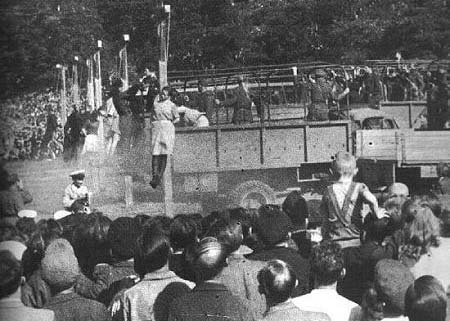
This day’s condemned — camp commandant Johann Pauls, five male kapos, and five female guards — were the product of the first of four Stutthof trials held in 1946-1947. At a hill in Gdansk known as Biskupia Gorka (Bishop Hill), upon a specially-erected row of four T-shaped double gallows centered around a pi-shaped triple gallows, and before a crowd of thousands, the doomed eleven were noosed on the back of military trucks which then drove away to leave them strangling to death with a “short drop” hanging.
The following gut-twisting images are among a number to be found here.
Above: on one end of the gallows row, the truck has just pulled away from Jenny Wanda Barkmann — a modish Hamburg lass in her mid-20’s known to Stutthof prisoners as “the Beautiful Specter” for her cruelty. Down the row, one can see that some of the prisoners are already swinging, while others have not yet been dropped.
Upon hearing her sentence, Jenny Barkmann retorted, “Life is indeed a pleasure, and pleasures are usually short.” (More about Barkmann, including trial photos, here.) In this closer view of her, just as in the first photo, she is still alive and struggling. Next to her, Ewa Paradies, another guard, is prepared for the same fate.
The central triple gallows. Commandant Johann Pauls hangs in the middle with Gerda Steinhoff — one of the senior female guards — in the foreground. The line of five male kapos recedes behind them into the enormous crowd of onlookers.


 An executive board member of the radical Industrial Workers of the World, the half-Cherokee


 While en route, Stauffenberg had no ability to communicate to the wider world. Landing in Berlin three hours after the not-quite-deadly-enough blast at Wolfsschanze, he must have been stunned to find that Valkyrie had not been launched. Apparently, fragmentary reports from the east were unclear as to whether Hitler had survived; everyone was reluctant about committing himself.



 Based on