1949: Nathuram Godse, Gandhi’s assassin

On this date in 1949, Mahatma Gandhi’s assassin was hanged at India’s Ambala Jail, together with one of his co-conspirators.

Often spoken of posthumously as little less than a saint, Gandhi was deeply immersed in the controversial rough-and-tumble politics of his time — India’s independence movement, and the shape of the nascent state. Winston Churchill, for instance, scorned him as “a seditious middle temple lawyer, now posing as a fakir of a type well known in the east, striding half-naked up the steps of the viceregal palace.”

The hatred of a Tory M.P. at the twilight of the empire might be expected, but it was a Hindu nationalist who struck Gandhi down after the partition into a Hindu India and a Muslim Pakistan. Gandhi had vocally opposed partition on the grounds of interreligious tolerance — but he eventually assented to Pakistan’s separation when he became convinced that the alternative was civil war.

Distrusted by Hindu partisans for his “appeasement” of minority groups within India, Gandhi survived numerous attempts on his life. But he sealed his fate by fasting to compel Delhi to make its agreed-upon partition payments to Islamabad even in the midst of war. Nathuram Godse, a Hindu nationalist, gunned him down during evening prayers on January 30, 1948.

(For a less Hollywood take on Gandhi, a five-hour documentary available online surveys his life.)

Godse never betrayed doubt or regret. On the contrary, he cogently justified the murder at trial:

I thought to myself and foresaw I shall be totally ruined, and the only thing I could expect from the people would be nothing but hatred and that I shall have lost all my honour, even more valuable than my life, if I were to kill Gandhiji. But at the same time I felt that the Indian politics in the absence of Gandhiji would surely be proved practical, able to retaliate, and would be powerful with armed forces. No doubt, my own future would be totally ruined, but the nation would be saved from the inroads of Pakistan. People may even call me and dub me as devoid of any sense or foolish, but the nation would be free to follow the course founded on the reason which I consider to be necessary for sound nation-building.

…

I do say that my shots were fired at the person whose policy and action had brought rack and ruin and destruction to millions of Hindus. There was no legal machinery by which such an offender could be brought to book and for this reason I fired those fatal shots.

Sixty years later, the subcontinent and the world at large seem more strained than ever by the collision between these men’s visions — the secular and egalitarian as against violent religious animosity.

Godse’s old party, the RSS, has become a substantial far-right bloc in the modern political scene. And while the party has always disavowed responsibility for the murder, some still consider Godse a hero. Pakistan, for whose birth Gandhi was slain, totters on the brink of an abyss.

Gandhi, meanwhile, is not only the official “father of his country” but has become the very watchword for nonviolence, his tactics and ideas inspiring such luminaries as Nelson Mandela and Martin Luther King, Jr. But his life and legacy remain live topics of research and dispute.

On this day..

1995: Ken Saro-Wiwa and the Ogoni Nine

On this date in 1995, author Ken Saro-Wiwa and eight fellow activists of the Movement for the Survival of the Ogoni People (MOSOP) were hanged by the Nigerian military junta in Port Harcourt.

Saro-Wiwa, the author of works such as Sozaboy, was already considered among Nigeria’s greatest writers before becoming an activist for the rights of his Ogoni people in the face of Nigeria’s lucrative and ecologically destructive Niger Delta oil trade.

Few benefits of that trade returned to the politically marginalized Ogoni, whose overwhelming response to MOSOP’s organizing soon began choking off oil exploitation in Ogoniland and brought a violent response from the Nigerian dictatorship — operating hand in glove with Shell Oil, as Saro-Wiwa himself noted in his closing remarks to the sham tribunal that convicted him of inciting a murderous riot.

I repeat that we all stand before history. I and my colleagues are not the only ones on trial. Shell is here on trial and it is as well that it is represented by counsel said to be holding a watching brief. The Company has, indeed, ducked this particular trial, but its day will surely come and the lessons learnt here may prove useful to it for there is no doubt in my mind that the ecological war that the Company has waged in the Delta will be called to question sooner than later and the crimes of that war be duly punished. The crime of the Company’s dirty wars against the Ogoni people will also be punished.

In my innocence of the false charges I face here, in my utter conviction, I call upon the Ogoni people, the peoples of the Niger delta, and the oppressed ethnic minorities of Nigeria to stand up now and fight fearlessly and peacefully for their rights. History is on their side. God is on their side. For the Holy Quran says in Sura 42, verse 41: “All those that fight when oppressed incur no guilt, but Allah shall punish the oppressor.” Come the day.

Though Saro-Wiwa’s hanging helped quell Ogoniland sufficiently for Shell to resume production, it left an opposition martyr. Saro-Wiwa’s prison diary was published shortly after his hanging; his son, journalist Ken Wiwa, has written a biography; and separate UK- and Canada-based organizations exist to carry on his memory and work.

The tensions left unresolved in the Delta, meanwhile, have spawned ever more militant resistance movements.

On this day..

1911: Charles Justice

On this date in 1911, Charles Justice was electrocuted by the State of Ohio.

It was an ironic end, since when serving an earlier stint in the state penitentiary shortly after the electric chair was introduced, Justice had hit upon the idea of metal clamps in place of leather straps to more securely hold down the chair’s clientele and avoid burnt flesh.

The improvement, duly implemented, was there awaiting its creator.

On this day..

1944: Richard Sorge and Hotsumi Ozaki

On the day of the USSR’s October Revolution holiday in 1944, Stalin’s greatest spies were hanged in Japan.

Renowned among espionage aficionados for supposedly forewarning Moscow of the exact date of Germany’s planned surprise attack in 1941, Richard Sorge‘s work in the pregnant years leading up to World War II produced multiple intelligence coups and could lay claim to the uncommon distinction of having materially affected the course of the war.

His signal achievement was establishing, as a foreigner in a highly xenophobic Japan, a spy ring that for years penetrated the highest levels of the Japanese government and the German embassy, giving Moscow an inside look at Axis planning.

Working under the cover of journalism in the German expat community — he had grown up in a mixed German-Russian household in Berlin and won the Iron Cross for his service in the Kaiser’s army in World War I before embracing communism — Sorge struck Hitler from half a world away. His access to the German embassy was untrammeled — indeed, he had an affair with the ambassador’s wife. His lead Japanese collaborator Hotsumi Ozaki was a major public intellectual similarly privy to sensitive information through his contacts.

The two, along with several other Japanese and foreign collaborators, produced a steady diet of top-shelf intelligence, including the (ignored) forecast of Operation Barbarossa. But the ring’s most important coup — arguably a decisive one in the history of the war as a whole — was to inform Moscow in September 1941 that Japan did not intend to attack the Russian Far East. Relieved of the nightmare prospect of a two-front war, Stalin transfered desperately needed Siberian divisions to help throw back the German advance on Moscow.

Japan by 1941 was a dangerous place to operate, however, and the nerve-rattling work — and the alcoholism to which it contributed — were taking its toll on the master spy just as the authorities were closing in. Sorge and his ring were arrested in October 1941.

Sorge’s decisive communique regarding Japanese intentions in the East had not yet borne its fruit. The war had nearly four years yet to run, and Sorge would languish in prison for most of them — long enough to leave fellow detainees with recollections of the captured operative jubilant at Red Army victories. Soviet tanks were at Germany’s doorstep by the time the two went to the gallows, one after the other, with the few minutes’ notice still customary for Japanese hangings to this day.

The spies in history who can say from their graves, the infomation I supplied to my masters, for better or worse, altered the history of our planet, can be counted on the fingers of one hand. Richard Sorge was in that group.

–Spy novelist Frederick Forsythe

Sorge’s personal role in the crucible of world-shaping politics have proven a compelling topic for biographers. Among the notable works:

The Soviet government did not officially acknowledge Sorge until 1964, but the case had immediate and widespread interest in Japan. Ozaki inspired an early Kurosawa film, No Regrets for Our Youth:

The espionage ring’s operations were also the subject of a recent multilingual Japanese epic, Spy Sorge:

Part of the Themed Set: Spies.

On this day..

1914: Carl Hans Lody

On this date in 1914, German spy Carl Hans Lody was put to death in the Tower of London during the opening months of World War I.

Lody‘s was the first execution in the Tower since its heyday as the chopping-block of disfavored nobility had passed in the mid-18th century. Times had changed by the era of trench warfare: Lody was not beheaded, but shot inside a wooden shed erected for the purpose in the Tower yard. Ten more German spies, who seem to have had a harder go of infiltrating Britain than their English counterparts had in Germany, would suffer the same fate by war’s end.

A Berlin-born naval officer, Lody had no experience spying but was tapped for the job because he had traveled abroad and spoke English well enough to pass for an American tourist. He was dead scarcely three months after he entered the Isles, though his work may have helped a U-boat sink a British warship.

According to A.W. Brian Simpson in Domestic and International Trials 1700-2000, the case was a legal landmark as the first espionage trial in England held partly in camera — outside the public view. The outcome, however, was a foregone conclusion, and Lody himself didn’t bother to contest his guilt — seemingly fixated on going to his grave with nothing short of the utmost in romantic gentlemanly decorum.

Part of the Themed Set: Spies.

On this day..

1925: Sidney Reilly

On this date in 1925, legendary British spy — and subsequent James Bond inspiration — Sidney Reilly was shot in a forest outside Moscow for his efforts to overthrow the Soviet government.

Fact blends insensibly into fiction in Reilly‘s biography; much of what is known or believed about him is conjectural or colored by his posthumous valorization, such the 1967 book Reilly: Ace of Spies written by [the son of] his onetime cloak-and-dagger collaborator Robin Bruce Lockhart — who was himself a close friend of Bond author Ian Fleming.

However, even at the word of less sensational biographers — such as Andrew Cook — Reilly lived a life almost too extraordinary for belief.

A Jewish child of tsarist Russia born in what is now the Ukraine, Reilly claimed to have escaped Odessa by faking his death and hopping a ship bound for Brazil. Like much of Reilly’s life, the story is unverifiable, but by hook or by crook — and possibly by way of a murder in France — he arrived in London in 1895, hitched himself to a wealthy woman a few months after the suspicious death of her husband (discarding the inconvenient surname Rosenblum in the process), and became entangled with British intelligence.

In the first decade of the 20th century, he apparently spied promiscuously on England’s imperial rivals Germany and Russia, though the particulars are disputed. He arrived in Port Arthur, Russia, shortly before the outbreak of the Russo-Japanese War and may have provided the Japanese fleet intelligence enabling it to navigate the mined harbor — in addition to a copious side business in war profiteering. He may also have had a hand in capturing British oil concessions in Persia and reconnoitering behind German lines during World War I.

Like his fictional heir 007, he gambled often and left a string of lovers and mistresses in his wake. His true allegiances, and the extent to which his exploits were inflated or outright fabricated, are debated to this day.

The adventures that brought both death and fame were his machinations to overthrow the Bolshevik government in the fraught early months after Lenin took power. A planned coup d’etat in September 1918 came to grief and Reilly fled Russia steps ahead of the authorities, who subsequently condemned him to death in absentia.

Notwithstanding the sentence, which had been ruthlessly visited on his less-fortunate conspirators, Reilly was lured back to the USSR in 1925 by the Soviet counterintelligence project Operation Trust. Intending to meet anti-Bolshevik agitators, he was instead arrested at the border and tortured at the infamous Lubyanka Prison, where he kept notes on cigarette papers about enemy interrogation techniques for the eventuality of an escape or release that never came.

Part of the Themed Set: Spies.

On this day..

1936: Edgar André

On this date in 1936, communist politician Edgar Andre was beheaded in Fuhlsbüttel Prison for treasonous complicity in the Reichstag Fire.

This 1936 German pamphlet denouncing Andre’s execution concludes: “Edgar André lives. In his spirit, we march: Despite all.”

A politician raised in Belgium, Andre had bolted the Socialist Party of Germany for the Communist Party in the early 1920’s, becoming a major labor leader in Hamburg. Andre was arrested within days of the 1933 Reichstag Fire as Adolf Hitler crushed official leftist opposition.

But Andre was not brought to trial for over three years — by which time torture had crippled and deafened him, and the political climate made the doubtful nature of the evidence against him scant protection in the courts. His conviction and sentence were a foregone conclusion.

The Spanish Civil War, which erupted over the summer of 1936 between Andre’s trial and execution, saw the service of a battalion in the International Brigades named for Edgar Andre.

Just days after Andre was beheaded, that battalion entered its first action — with German volunteers helping stave off fascist capture of Madrid. The unit’s hymn commemorated their namesake:

[audio:Das_Batallion_Edgar_Andre.mp3]

On this day..

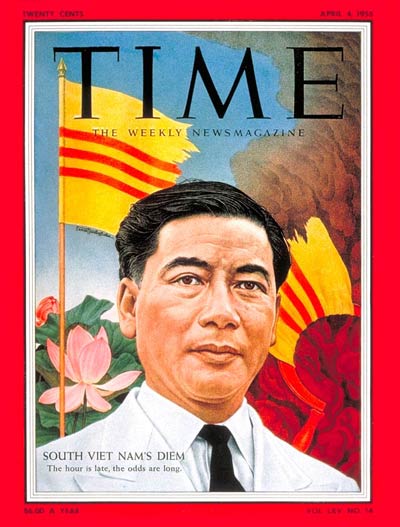
1963: Ngo Dinh Diem

On this date in 1963, Ngo Dinh Diem, the first president of South Vietnam, was executed in the back of an armored personnel carrier along with his younger brother and secret police chief, Ngo Dinh Nhu, the day after their government had been overthrown in a military coup.

Born into the Buddhist country’s Catholic elite, Diem was brought up as a French colonial administrator but fled Vietnam in 1950 under a death sentence from Ho Chi Minh’s nascent Vietminh. Over several years living and lecturing in the United States, he established his anti-communist bona fides with influential conservatives and was returned to his native country as Prime Minister when the U.S. inherited the foundering French war against nationalist guerrillas.

Fearing communist victory at the polls, Diem blocked scheduled 1956 elections to unify North and South Vietnam, making an interim division permanent. But Diem made an inconsistent American client, often spurning Washington’s advice and alienating the Buddhist majority with heavy-handed authoritarianism that eventually prompted Buddhist monks to begin public self-immolation as a form of protest.

The government responded by arresting monks.

By now more a liability than an asset, Diem was ousted with the blessing of a fellow Catholic head of state, John F. Kennedy.

This first successful coup — Diem had already quashed attempted putsches in 1960 and 1962 — began a cycle of internecine revolts in which weak South Vietnamese governments were toppled in rapid succession … leaving Saigon ever more visibly the puppet of Washington, and dragging the United States ever more deeply into the Vietnam War.

On this day..

1920: Kevin Barry

On this date in 1920, 18-year-old Irish Republican Army Section Commander Kevin Barry was hanged in Dublin’s Mountjoy Prison for the murder of English Private Harold Whitehead in an IRA ambush just six weeks prior to the execution.

Denying the authority of the British (civilian) court, the young medical student went undefended, insouciantly reading the newspaper in court as the government built its case against him. His was the first execution of the Irish War of Independence, and stoked Irish nationalist sentiment on the island and abroad.

Refused a request to be shot as a soldier, Barry nevertheless went jauntily to his fate, his bearing making great gains for IRA recruitment and fixing his own name in the firmament of Irish independence martyrs. Britain’s insistence on treating him as a murderer rather than a prisoner of war was widely received as an insult to the movement he represented.

It was not until 1989 that Barry’s short life received a biographical treatment, Kevin Barry and His Times, by the hanged man’s nephew. But a 1920’s song celebrating Barry has survived since that time as a popular hymn of Irish Republicanism.

On this day..