1937: Teido Kunizaki

On this date in 1937, Japanese intellectual Teido Kunizaki was shot as a “spy of the Japanese army” in Moscow.

The reader is not deceived to infer from the date and place the dread hand of Stalin’s NKVD at the height of the Soviet purges. The fate of the Soviet Union’s tiny community of Japanese emigres, one of the hidden chambers in a house of horrors, only became fully understood after the Soviet Union collapsed.

The leader of the Japanese section of the German Communist Party in Weimar Germany, Kunizaki’s opposition to Japanese intervention in China and involvement in a publication as subversively titled as Revolutionary Asians had made him unwelcome in Germany shortly before Hitler took power.

But arriving in Russia in September 1932 with his German wife, he stepped into a struggle for power within the Japanese Communist Party’s Russian organs.

According to Tetsuro Kato, the professorial Kunizaki was among those denounced by another seminal Japanese communist, Kenzo Yamamoto — a working-class activist who distrusted intellectuals.

Kunizaki’s execution this day was only one of many wrought on the Japanese party by the Soviet secret police in the dangerous exchange of accusations and denunciations. On this date, Yamamoto himself was already in prison; early in 1939, he would swallow the same draught as Kunizaki — denounced, as it emerged after the Cold War, by yet another of Japan’s revered old Marxists.

In the 1920s and 1930s, there were about 100 Japanese who dreamed of living in “the paradise of the working class” and went to the USSR. These people were mainly communists, who were oppressed by the imperial police in Japan. There were also ordinary workers, intellectuals and artists who were not communist … Almost all Japanese living in the USSR [in the 1930’s] faced the same destiny. The exact number of victims is not yet known, but I now estimate there to have been about 80 Japanese [shot by the NKVD].

On this day..

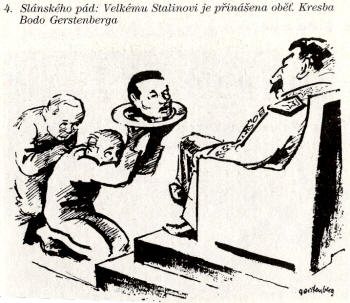
1952: Rudolf Slansky and 10 “conspirators”

On this date in 1952, eleven high-ranking Czechoslovakian politicians were hanged at Prague’s Pankrac Prison two weeks after a show trial purging unreliable elements from the Communist party.

One of the most infamous show trials in Czechoslovakia saw 14 high-ranking Communists — eleven of them Jews — railroaded for a “Trotskyite-Titoist-Zionist activities in the service of American imperialism”. Three received life sentences. The other eleven went to the gallows.

While the roots of the persecution, especially the undertones of anti-Semitism, sink into the id of the Stalinist Eastern bloc, the most evident proximate cause was the USSR’s assertion of control over its satellite states at a time when Josip Tito was successfully charting a course of independent communism. Purges in Poland, Bulgaria and Hungary had taken place in the years before.

The Soviet agents rounding up suspects for Stalin did not trifle with small game. Rudolf Slansky was General Secretary of the Communist Party and therefore the second-most powerful man in the country; by the time he was tried, after a year in prison under torture, he was publicly denouncing himself.

Otto Sling, whose name became synonymous with forbidden heterodoxy, did likewise — “I was a treacherous enemy within the Communist Party … I am justly an object of contempt and deserve the maximum and the hardest punishment.”

And Vladimir Clementis, the Slovak Minister of Foreign Affairs, was erased from a photo taken with the Czechoslovakian President, a circumstance Milan Kundera reflected upon in The Book of Laughter and Forgetting:

In February 1948, the Communist leader Klement Gottwald stepped out on the balcony of a Baroque palace to harangue hundreds of thousands of citizens massed in Old Town Square … Gottwald was flanked by his comrades, with Clementis standing close to him.

…

The propaganda section made hundreds of thousands of copies of the photograph taken on the balcony where Gottwald, in a fur hat and surrounded by his comrades, spoke to the people. On that balcony the history of Communist Bohemia began. Every child knew that photograph, from seeing it on posters and in schoolbooks and museums.

Four years later, Clementis was charged with treason and hanged. The propaganda section immediately made him vanish from history and, of course, from all photographs. Ever since, Gottwald has been alone on the balcony. Where Clementis stood, there is only the bare palace wall.

The hanged were rehabilitated in 1963.

Artur London, who received a life sentence and was released after rehabilitation, wrote about his experiences in The Confession, subsequently a 1970 Costa-Gavras film. The wife and son of Deputy Minister of Foreign Trade (and Auschwitz survivor) Rudolf Margolius have also both written memoirs covering the trial.

The younger Margolius in particular, who has staunchly defended his father as an essentially apolitical man and not a Communist apparatchik, has been in the thick of present-day disputes in Czechoslovakia’s successor states over whom is due sympathy and recognition for bygone political crimes.

On this day..

1944: Lilo Gloeden, Erich Gloeden and Elisabeth Kuznitzky

On this date in 1944, Berlin housewife Elisabeth “Lilo” Gloeden was beheaded with an axe in Plotzensee Prison, along with her husband and mother.

They had been sentenced — and intentionally made an example of — just three days before for hiding a fugitive from the July 20 Plot to assassinate Hitler.

As Martin Gilbert observes in The Second World War: A Complete History, the fury of Hitler’s domestic crackdown came in inverse proportion to Germany’s fortunes in war.

[The family’s] fate was then publicized, as a warning to anyone else who might try to shelter the enemies of the Third Reich.

The fate of that Reich could not, however, be seriously in doubt. On the day of Lilo Gloeden’s execution, American troops drove the Germans from Mackwiller, in the Saar, inside Germany’s pre-war frontier. In Hungary, the Red Army entered Eger, less than twenty-five miles from the central Slovak frontier.

Part of the Themed Set: Women Against Fascism.

On this day..

1941: Zoya Kosmodemyanskaya

On this date in 1941, Soviet partisan Zoya Kosmodemyanskaya was hanged by the Wehrmacht for sabotaging buildings behind German lines near Moscow.

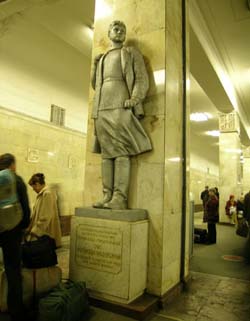
A statue of Zoya Kosmodemyanskaya stands vigil over Moscow’s World War II-era Partizanskaya metro station. Image used with permission.

One of the most famous Soviet war heroines and the first woman decorated as Hero of the Soviet Union during World War II, the 18-year-old had quit school to volunteer for a partisan unit only a few weeks before her hanging as Russia mobilized against Hitler’s race towards Moscow.

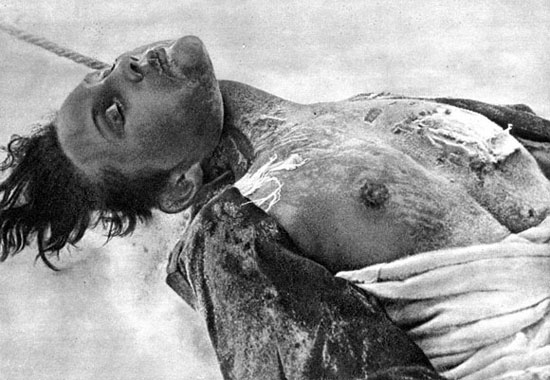
Known simply as “Tanya”, the nom de guerre which was the only information she volunteered during two days of torture, the power of the press offered her apotheosis into a propaganda coup for the Kremlin, and a symbol of courage that would long outlive Stalin. Before the public execution, the Nazis paused to photograph the scene; Kosmodemyanskaya availed the lull to harangue the Germans — “you can’t hang all 190 million of us!” — and call on the Russian villagers present to resist occupation.

Her bayoneted, mutilated body hung on the gibbet until the Red Army recaptured the village; witnesses related the tale of her dying heroism to a newsman.

It was only after the story of “Tanya” hit the press in January 1942 that her identity was established … and then promulgated widely. Anonymous and obscure in death, Zoya Kosmodemyanskaya would inspire millions and become the heroic emblem of other women partisans.


Soviet propaganda poster unabashedly modeled on the already-iconic image of Zoya Kosmodemyanskaya’s abused corpse.

Zoya, a 1944 Soviet film, was scored by Dmitri Shostakovich.

Part of the Themed Set: Women Against Fascism.

On this day..

1922: Six Greek former ministers of state

On this date in 1922,* on the morning after a revolutionary tribunal held them liable for treason in the catastrophic Greek loss of Smyrna, six former high-ranking political and military officials of the Greek government were shot in Athens.

The long-running national conflict between liberals and monarchists had boiled over during World War I, setting the stage for increasingly bitter internecine conflict played out against the backdrop of a misbegotten foreign adventure.

Greece’s territorial aspirations after World War I.

As the Ottoman Empire — Greece’s neighbor and historical rival — collapsed in the aftermath of the world war, Athens under liberal colossus Eleftherios Venizelos set her sights on a vast pan-Hellenic domain spanning Constantinople, western Anatolia, and the Black Sea coast.

In 1919, backed — even pushed — by the British, Greece occupied Smyrna, a multiethnic economic hub in Asia Minor. But cruelty towards the Turkish population sparked immediate resistance which soon blended insensibly into the burgeoning Turkish National Movement, already on the path towards its destiny of forging the modern state of Turkey.

As the Greek army pressed outwards from Smyrna, it became drawn into full-fledged war. In 1920, the Greek government turned over (as it was often wont to do) and under the ascendant monarchists whose irredentism was not to be upstaged “fantasy began to direct Greek policy” — like a quixotic scheme to march on Constantinople rather than hold a defensible position. Greece’s European allies and sponsors began to cut bait.

September 14, 1922: Smyrna burns.

Far from threatening Constantinople, the Greeks suffered one of their greatest disasters — the “Catastrophe of Asia Minor”, when Ataturk drove them back to, and then out of, Smyrna, emptying the once-cosmopolitan city of thousands of Greek (and Armenian) refugees fleeing a sectarian carnage. Some swam out of the burning city only to be refused aid by ships of nations unwilling to be drawn into the affair politically.

In the dismayed Greek capital, anti-monarchist officers who had been purged by the new government revolted and rounded up the opposition’s leadership. “The Six” who faced public trial for treason included three former Prime Ministers:

With two other ministers of state and a general, they comprised all but one member of the offending monarchist government, a bloody thoroughness the New York Times compared to Robespierre. Western governments temporarily broke off relations.

After the day’s bloody deeds, Venizelos returned from exile to conclude the war on Turkish terms, including “population exchange” — fragrant euphemism — to solidify each government’s demarcation as a nation-state and ratify the destruction of Smyrna (renamed Izmir) as a multiconfessional melting pot.

Today, Smyrna is largely forgotten by those to whom it is not intensely remembered — and among the latter, its meaning is ferociously contested. To Turks, a chapter in their founding expulsion of foreign occupation; to Greeks, the calamitous end of the ancient Hellenic presence in Asia Minor; to each, a touchstone for one another’s atrocities; to others of a less parochial frame of mind, a parable of the perfidy of an entire enemy faith, or a subplot in the great game for Ottoman oil, or as Henry Miller conceived it writing in the antechamber of the second World War, the avatar of a stunted and cynical moral sense among European powers that would lead them to their next great reckoning:

Even the most ignorant yokel knows that the name Attila is associated with untold horrors and vandalism. But the Smyrna affair, which far outweighs the horrors of the first World War or even the present one, has been somehow soft-pedalled and almost expunged from the memory of present day man. The peculiar horror which clings to this catastrophe is due not alone to the savagery and barbarism of the Turks but to the disgraceful, supine acquiescence of the big powers.

…

Smyrna, like the Boxer Rebellion and other incidents too numerous to mention, was a premonitory example of the fate which lay in store for European nations, the fate which they were slowly accumulating by their diplomatic intrigues, their petty horse-trading, their cultivated neutrality and indifference in the face of obvious wrongs and injustices.

*Greece did not adopt the Gregorian calendar until 1923, the last European country to do so — so the date in Greece on the day of the execution was actually November 15.

On this day..

1987: Jacek Lazar condemned

On this date in 1987, according to the sentence read to him in the climactic scene of The Decalogue no. 5,* Jacek Lazar was condemned to hang for the senseless murder of a taxi driver. (“Lazar” was fictional, but he had a real-life inspiration.)

The movie, plainly reflecting the director’s opposition to the death penalty, is the most overtly political of Krzysztof Kieslowski‘s ten-film cycle exploring the themes of the Ten Commandments. But it is far from tendentious.

The supposed date of the actual execution, depicted here, is not identified.

If one credits the dates, this hanging would be among the last performed in Poland. After April 1988, death sentences were no longer carried out, and Poland formally abolished the death penalty in the late 90’s — thanks in no small part to this film.

* Or Dekalog, per its Polish rendering. This particular installation of the series is also referred to as “A Short Film About Killing”.

On this day..

1919: Felipe Angeles

On this date in 1919, Mexican hero General Felipe Angeles was shot at dawn in Chihuahua, hours after a military tribunal condemned him for rebellion.

Angeles, a humane and cosmopolitan socialist, had tacked a unique course through the dangerous Mexican Revolution. The career artillerist’s military counsel was a high card in the hands of the revolutionaries, and helped to make the coruscating career of Pancho Villa. Crucially, Angeles advised Villa to seize the mines of Zacatecas, dealing a mortal blow to the putschist Huerta government by throttling its currency at the source.

But that brilliant maneuver countermanded an order of the Revolution’s moderate political face, Venustiano Carranza, and both personality conflicts and support for more radically redistributionist measures soon sundered the Villa factions’ alliance with Carranza.

Angeles hitched his destiny to Pancho Villa and is historically recalled as the “angelic” opposite number to the famed guerrilla’s other top military henchman, the murderous Roberto Fierro. The three lend themselves almost implausibly to allegorical literature — “the decisive biographical proof of Villa’s duality … found in the two men closest to him, equidistant and extreme extensions of his nature.” (Enrique Krauze)

Angeles aimed, perhaps, at a statesmanship that might have remembered him the father of his country.

‘It was the recurrent dream of the impotent revolutionary intellectual: to play Plato to some powerful but pliant popular caudillo.’ This may well be an accurate analysis of Angeles, who probably had ambitions to be president of Mexico, with Villa as the power behind the throne but based in Chihuahua, allowing Angeles free rein to implement radical reforms in the capital

… Angeles probably saw Villa as a tabula rasa on which he could imprint his ideology. The problem was that Villa had no taste for abstract thought; as [John] Reed remarked ironically: ‘You had to be a philosopher to explain anything to Villa.’

To the grief of both, Villa neglected Angeles’ expertise when the Villists faced Carranzo at arms. Against advice, Villa abandoned Mexico City, failed to attack when the constitutionalists were tenuous, then spurned guerrilla operations for a frontal assault into the teeth of a foe with numerical superiority and lethal tactical advances culled from the slaughterhouse of World War I.

All was postscript after the Battle of Celaya — Villa maintaining for a few years as a bandit force and famously raiding New Mexico while his strategist drifted into exile in Texas before returning to Mexico on a quixotic peacemaking mission that led him instead to a show trial.

Angeles’ end came with the all the dignity of his romantic age. Before his judges — before all the world — he gave “full and clear expositions of his history and his ideas about everything from politics to ontology. It was clear that he knew this was his end, and he seems to have written a kind of intellectual memoir in the protracted answers … he was not defeated morally so much as physically.”

Angeles himself arranged particulars of his own execution with the Carranza men detailed to shoot him. He enjoys posthumous esteem commensurate with his qualities in life:

On this day..

1910: Hawley Harvey Crippen

On this date in 1910, the notorious wife-murdering doctor Hawley Harvey Crippen was hanged at London’s Pentonville Prison.

The sensational trial, which saw the American-born homeopath convicted for dismembering his shrewish and unfaithful wife Cora in an attempt to take up with his young mistress, fitted Crippen for both a noose and a likeness at Madame Tussaud’s. (More trial background here.) It has also made his case twice a landmark in the history of crime and technology: once at the time of his arrest, and again just last month as of this writing.

The core of a case a jury found so open-and-shut as to require just 27 minutes to convict was the poorly explained disappearance of Crippen’s wife, followed by the discovery of a considerably mutilated female corpse under the Crippens’ home.

Although much of the crown’s evidence was speculative and circumstantial — to say nothing of the bodice-ripping gossip of nymphomania and infidelity — a corpse under the floorboards tends to be a compelling circumstance to a jury.

Presumably that anticipation prompted Crippen to flee the Scotland Yard investigation with his mistress Ethel le Neve under assumed names on an ocean liner bound for Canada. The case made criminological history as the first use of wireless communication to apprehend a suspect when the ship’s alert captain telegraphed Crippen’s presence to land as the ship steamed away — enabling a policeman to board a faster boat and arrest the pair as they docked in Quebec.

In the century since Crippen went to the gallows still maintaining his innocence, the case has endured in popular notoriety. The killer’s life has been novelized, meditated upon and borrowed for fiction, offering a draught of inspiration to Alfred Hitchcock along the way.

Books inspired by the Crippen case …

Given his suspicious behavior, scant had been the credence given Crippen’s protestation of innocence.

Until now.

In a meeting of Edwardian crime and cutting-edge technology, two scientists from Crippen’s home state of Michigan stunningly announced in October that DNA testing proves the body was not Cora Crippen after all.

If true, it would appear to void Crippen’s conviction in its particulars without quite exonerating the hanged man from the natural question: whose was the corpse? The manufacture of clothes on the body dated it to the Crippens’ occupancy of the house.

One of Crippen’s modern sleuths, in a wholly speculative vein, thinks it might harken to an altogether different sort of crime: a botched back-alley abortion, just the sort of thing a financially struggling physician might have been involved in.

Maybe.

But if the test invites a modern investigator to look 97 years backwards, it also suggests a posture of epistemological humility. It’s just possible that the light this test casts on our own time is as searching as that it shines on 1910.

The Prejudice of Science

The Crippen case was a classic 19th century-style detective job — the inspector who made the arrest cut his teeth as a younger man on a Jack the Ripper murder — but it took place on the brink of a revolution in forensic science.

Just a few years before, fingerprinting had been embraced by British and American law enforcement and begun its march towards total institutionalization. On the heels of fingerprinting came a multiplicity of biometric approaches to crime scenes — hair and fiber analysis, blood typology, and most recently and dramatically, DNA.

And they, in turn, have brought a rising faith in science to adjudicate the law.

While the “CSI Effect” — jurors’ expectation of case-breaking scientific evidence — conventionally plays as a hindrance for prosecutors who usually have no such thing, the excess deference given to less-than-conclusive forensic evidence can likewise cut against the defense. Evidence mishandled at crime labs, even cooked outright, factors into numerous recent post-conviction exonerations. The once ironclad credibility of fingerprint evidence has itself been undermined by subsequent forensic advances.

In short, for all its undoubted contributions to criminal justice, forensic science packs along its own set of pitfalls, caveats and blinders reflexively privileging evidence of the laboratory.

This is not a reflex to indulge uncritically. History grants the benefit of hindsight, but rarely the luxury of certitude.
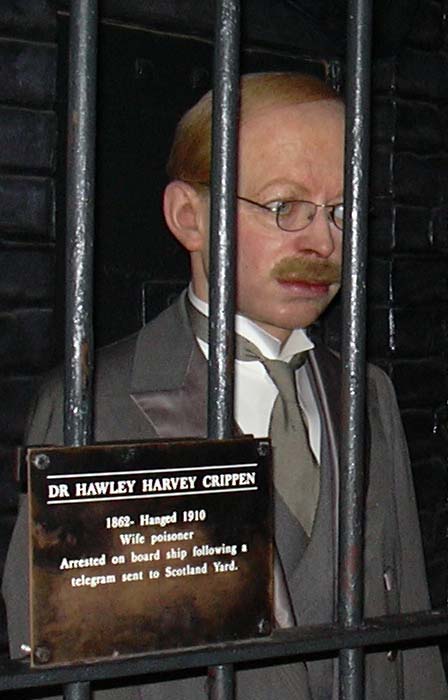
A waxwork Dr. Crippen at Madame Tussaud’s. Image used with permission.

So if the prospect of Crippen’s innocence intrigues, that unexplained body — that sudden flight for Canada — that (permanent) failure of Cora Crippen to resurface — nevertheless remain. They might lead us to question our implicit faith in the finality of DNA’s verdict on history rather than the other way around.

Are we certain that an unbroken line of blood relations really connects Cora Crippen to the modern DNA donors of her “family”?

Are we certain that a reliable chain of custody has preserved the original tissue samples unsullied across a century?

And if we are certain, what do we make of that body after all?

It is humans who must ultimately interpret and contextualize even the firmest forensic science. Whatever we might believe of Dr. Crippen we retain the burden of that belief, with all its intrinsic potential for grievous wrong.

The tales Hawley Crippen has yet to unfold from the grave might or might not shed still another different light on our understanding of what happened at 39 Hilldrop Crescent a century ago.

The gentleman’s place as a continuing attraction at Madame Tussaud’s, however, seems assured.

On this day..

1944: An unknown Allied airman

On this date in 1944, in the midst of a worldwide conflagration that would claim 70 million lives, one unknown crew member of an Allied bomber was shot by Nazi SS/SD troops in the woods around Enschede, Netherlands.

From late 1942, the Allies’ massive industrial capacity had sapped the vaunted Luftwaffe, bleeding down the German air force in desperate airborne combat in the Mediterranean and the Eastern front. Crippling losses in July and August 1943 lay Germany’s industrial heart open to devastating bombing and would within a year spell the end of the Luftwaffe as an effective fighting force.

The contest’s stakes were high. This hour-long compilation of contemporaneous U.S. propaganda footage celebrates the decisive effect of air supremacy in western Europe:

With hostile planes darkening Europe’s skies, the Germans called upon ruthlessness to stand in for materiel. Nazi SS chief Heinrich Himmler issued, according to Robin O’Neil, an August 1943 order to show no quarter to captured enemy pilots.

The young man shot this day suffered its effects:

The airman (estimated age 26 years), who was apparently unhurt, was taken by the SS to the cellar of the villa [serving as SS headquarters], where he was kept under guard while arrangements were made for his disposal. These arrangements consisted of the removal of his flying kit, and the substitution of a civilian light-coloured shirt, a pair of dark trousers, and a pair of socks.

In this dress he was put into a security vehicle, his hands handcuffed behind his back, and taken some distance in the grounds of the SS HQ to a spot within the compound where a grave had already been prepared. The airman was marched from the car by an escort of two SS men, one of whom dropped back and shot the airman in the back of the neck. He was buried and the grave was carefully camouflaged.

To this day, the airman’s identity has not been established. It was assumed that he was British or American, most probably American, as the trousers he was wearing were of a dark shade of khaki, and the fact that when he was informed in the car, in English, that he was to be executed, he made an indistinct reply in which the word “America” was uttered.

Countless such executions undoubtedly took place and were lost, forgotten or concealed in the charnel house of war. Thanks to the witness of Dutch prisoners who survived the war, this single act of routine brutality endured not only historically but juridically: little more than a year later, its author, Dr. Karl Eberhard Schongarth — an SS officer who participated in the Wannsee Conference and slaughtered thousands in occupied Poland and Holland — faced a war crimes prosecution for the execution of the anonymous airman.

His actions this date may have been small by the gauge of a bloodthirsty career, but since pre-war treaties explicitly regulated treatment of war prisoners, they also constituted a conveniently plain transgression of the far-from-bright line demarcating “war crimes.” For this one killing, Schongarth was himself hanged as a war criminal in Hamelin, Germany on May 16, 1946.

On this day..

1915: Joe Hill

On this date in 1915, songwriter, poet and labor activist Joe Hill was shot in Utah for the murder of a local butcher.

Even before his execution, the Swedish immigrant was widely thought to have been railroaded for his IWW affiliation.

Though state authorities had little use for the worldwide clemency bid whose backers included U.S. President Woodrow Wilson — powerless to intervene officially, since the execution was a state matter — Hill walked spryly into his martyrdom. The strange post-mortem career of his totemic ashes is the least of the ways Hill lives on.

His dauntless last message to fellow Wobbly Bill Haywood — “Don’t waste any time mourning. Organize.” — is a permanent fixture on pins and placards among every stripe of left activist. The songs he wrote remain in print — and in performance.

And the Depression-era tribute ballad “I Dreamed I Saw Joe Hill Last Night” can seamlessly serenade ripped-from-the-headlines footage, as a Paul Robeson rendition does in these clips of 1998 protests against then-New York City Mayor Rudy Giuliani.

On this day..