1936: Melquiades Alvarez, a liberal in a revolutionary time

On this date in 1936, the Spanish politician Melquíades Álvarez was shot by the Republicans.

A centrist who disdained “two equally despicable fanaticisms … red fanaticism and black bigotry,” Alvarez (English Wikipedia entry | the more comprehensive Spanish) fell into the chasm torn by the Spanish Civil War.

The Gijon-born former barrister noted for his oratory had been in public life as a liberal back to the last years of the 19th century and in 1912 co-founded the Reform or Reformist Party. Although sympathetic to the democratic aspirations of the Republican movement, the Reform Party was cool to forcing a confrontation with Spain’s monarchy. He was briefly president of the Congress of Deputies before the military coup of Primo de Rivera. Alvarez opposed Primo, judiciously.

I recalled many years ago going to see another vacillating Liberal, the unfortunate Melquiades Alvarez, after he had ventured to criticise Primo at a public dinner. He was shivering in a travelling rug waiting to be arrested while he told with pride that he had made his speech in such guarded, euphemistic and even allegorical terms that no one would have been quite sure what he meant. He vacillated to the end and now the militia have shot him in the Carcel Modelo.

V.S. Pritchett

By the onset of the Republic in the 1930s, Alvarez’s institutionalism and anti-Marxism had his political tendency drifting rightwards in a revolutionary era, to the extent of actually joining the conservative coalition known as CEDA. Alvarez would surely have said that the Republic left him; a liberal to a fault, he even in these years defended the son of Primo de Rivera when this founder of the fascist Falange was arrested for conspiring to overthrow the Republic.

So the start of General Francisco Franco’s rebellion in 1936 found Alvarez in Madrid as a center-right parliamentarian — right in the path of a sharp political repression immediately leveled by the Republicans against perceived internal enemies. Alvarez and other right-leaning politicians were arrested in early August. Many, like Alvarez, were eventually shot by Republican militias after the barest of legal proceedings.

“You kill a man who only did you good,” Alvarez spat at his executioners before they opened up on him. “You slaughter in the worst way any idea of freedom and democracy, you pack of cowards and scoundrels!” (Quote translated from this Spanish-language pdf account of Alvarez’s last days.)


In this 1917 cartoon, Alvarez, a key political player during Spain’s crisis and near-revolution that year, swaps the caps of monarchism and republicanism in an “illusion” … for “everything remains the same”

On this day..

1950: The Hill 303 massacre

North Korean regulars on this date in 1950 committed a notorious mass execution upon 41 U.S. prisoners during the Korean War.

The Hill 303 massacre took place upon a 303-meter hill guarding the northern approach to Waegwan. In mid-August of 1950, said hill was defended by the U.S. Army’s 2nd Battalion, 5th Cavalry Regiment, 1st Cavalry Division, which narrowly escaped encirclement there by the advancing North Koreans.

Most of them escaped encirclement.

It’s a barely remembered atrocity in a war that America has consigned to forgetfulness; the massacre has seemingly never had anything like a thorough investigation. An indelible horror to the five men* who lived to tell the tale, its narrative outline is crude timelessness itself: holding these 42 U.S. POWs for two days, the North Koreans were themselves pummeled by a counterattack on the fiercely-fought hill;** unable to continue guarding the Americans, their captors fusilladed them.

This indiscriminate mass firing mere minutes ahead of the American approach was far from a thorough affair — hence the survivors, who were subsequently able to point out some of the captured Koreans who took part.


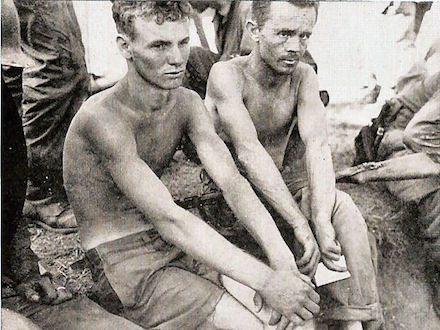
Massacre survivors James Rudd and Roy Day.

As a result of this and other summary battlefield executions, U.S. Gen. Douglas MacArthur addressed a threatening leaflet that was heavily dropped behind North Korean lines, threatening to “hold you and your commanders criminally accountable” according to the recent Nuremberg precedent.

There’s a monument to this gratuitous bloodbath that’s been recently installed, at the site of the shooting which is also nearby to a still-extant U.S. Army base called Camp Carroll. (The stone displays the date “June 25, 1950” — which denotes the start of the war, and not the day of the massacre.)

* Even the exact figures involved are a bit slippery. I believe we have 37 humans killed out of 42 captured, leaving five survivors. Some sources give it as 41 (attempted) executions with four survivors. A private named Frederick Ryan apparently was given last rites and declared dead on the scene but miraculously survived, possibly accounting for the variance.

** Hill 303 changed hands at least seven times.

On this day..

1997: Ali Reza Khoshruy Kuran Kordiyeh, the Tehran Vampire

Taxi driver Ali Reza Khoshruy Kuran Kordiyeh was publicly hanged on this date for a killing spree that earned him the nickname “the Tehran Vampire.”

For four months, the vampire had preyed on women in the neighborhoods near the place of his ultimate demise. He stalked, abducted, raped and slew nine women and girls, ranging in age from 10 to 47 — including a mother-daughter pair.

He’d been subjected first to court-ordered flogging, many of the 214 strokes administered publicly by relatives of the victims who were cheered on by furious onlookers.

“Innocent blood will always be avenged,” a cleric intoned to the crowd. “This is punishment for the criminal but for us witnesses it is a lesson to be learned … We are responsible for our actions.” Others expressed the lesson less politely.

“Do you see finally that God is greater, you son of a dog?” a man shouted.

“He is not a human,” said Marzieh Davani, a 38-year-old woman.

“I really cannot understand a human can do what he did. He deserves to die surrounded by the hatred of people,” said Amir Ezati, who had taken his place in the crowd at 3 a.m.

“Damn you, you killer,” somebody shouted. The chant was taken up by the others as Kordiyeh, wearing a dark green prison uniform and staring ahead impassively, was led underneath the crane where a noose was tightened around his neck.

A 195-second video of the scene, featuring Mature Content images of Kordiyeh’s flogging and hanging, can be viewed here.

On this day..

1918: Boris Donskoy, Left SR assassin

One hundred years ago today, the Germans hanged Russian revolutionary Boris Donskoy.

Donskoy was not a Bolshevik but a Left Social Revolutionary — the party faction most closely aligned with Team Lenin. And his offense was a revolutionary crime, but one that events soon swept into irrelevancy.

In March of that same year, Russia’s revolutionary government had fulfilled its promise to exit the charnel house of World War I, ceding in exchange for peace the huge territorial gains that Germany had exacted in the bloodlands in-between empires.

These prospectively gigantic territorial gains were not long held by Berlin, whose wartime government would collapse suddenly before the year was out … but in the short interim where we lay our post, the Baltic States, Belarus, and Ukraine are under firm German control.

The last of these stood under the authority of Field Marshal Hermann von Eichhorn. Donskoy, a radical sailor who had served on the Executive Committee of Kronstadt when it demonstrated against the Revolution’s initial, too-moderate Provisional Government, on July 29 assassinated the field marshal — declaring to his captors that the old Prussian warhorse had been condemned by the Left SRs for suppressing the Ukrainian revolution.

On this day..

1939: Las Trece Rosas

The Spanish Civil War’s victorious fascists shot Las Trece Rosas — “the thirteen roses” — on this date in 1939.


Plaque at the Cementerio de la Almudena in Madrid in honor of 13 young women shot there by Francoist troops on August 5, 1939. (cc) image by Alvaro Ibanez.

Earlier that 1939, Franco had clinched victory by finally capturing the capital city after a siege of 29 months. A punishing suppression of the Spain’s leftist elements ensued, running to hundreds of thousands imprisoned, executed, or chased into exile.

Our 13 Roses were members of a communist/socialist youth group, JSU, and they had been arrested in rolling-up of that organization. They were crowded into the overflowing dungeons of the notorious women’s prison Las Ventas.

A few Spanish-language books about Las Trece Rosas

And there they resided on July 29, 1939, when their JSU comrades struck back against the dictatorship by assassinating Isaac Gabaldón, the commander of Madrid’s fascist police.* The 13 Roses were immediately court-martialed and executed in revenge. Their names follow; there’s a bit more detail about them in Spanish here:

  • Carmen Barrero Aguado (age 24)
  • Martina Barroso García (age 22)
  • Blanca Brissac Vázquez (age 29)
  • Pilar Bueno Ibáñez (age 27)
  • Julia Conesa Conesa (age 19)
  • Adelina García Casillas (age 19)
  • Elena Gil Olaya (age 20)
  • Virtudes González García (age 18)
  • Ana López Gallego (age 21)
  • Joaquina López Laffite (age 23)
  • Dionisia Manzanero Salas (age 20)
  • Victoria Muñoz García (age 19)
  • Luisa Rodríguez de la Fuente (age 18)

The affair is the subject of a 2007 Spanish film.

* Gabaldon’s predecessor, the police commander under the Spanish Republic, Jose Aranguren, had been removed from his post and executed in April.

On this day..

1938: Mikhail Viktorov, Soviet naval commander

Soviet admiral* Mikhail Viktorov fell in the purges on this date in 1938.

A young officer fresh from the Naval Academy when World War I broke out, Viktorov (English Wikipedia entry | Russian) made a timely switch to the Bolshevik side during the Civil War and scaled the heights of the Soviet navy.

He commanded the Baltic Fleet in the latter 1920s, and the Pacific Fleet in the 1930s, and finally — fleetingly — became chief of the Soviet navy in 1937, filling dead man’s boots when his predecessor was arrested and executed.**

The same fate awaited Viktorov, a perilous occupational hazard in those days.

He was rehabilitated posthumously in 1956.

* Viktorov’s rank was “Fleet’s Flag Officer, First Rank”; in 1938, this was the equivalent of admiral, and after a 1940 reorganization it was replaced full stop with admiral.

** It appears to me that fully seven consecutive heads of the Soviet Navy eventually ended up executed in the 1930s and 1940s (not all of them directly deposed from running the navy). Pantserzhanskiy, Zof, Muklevich, Orlov, our man Viktorov, and also his successors Smirnov and Frinovsky.

On this day..

1940: Udham Singh, Jallianwala Bagh massacre avenger

A national revenge drama 21 years in the making culminated on the gallows of Pentonville Prison on this date in 1940.

The story of Udham Singh‘s hanging begins long before and far away in the British Raj.

There, a crowd of 20,000-25,000 protesting for independence in the restive Punjab city of Amritsar were wantonly fired upon by Raj authorities — an atrocity remembered as the Jallianwala Bagh massacre. British authorities acknowledged a staggering 379 dead; Indian accounts run much higher than that.

The massacre’s principal immediate author was the army commander Reginald Dyer, who fired on the crowd without warning and with so much premeditation as to bar exits from the Jallianwala Bagh garden for maximum bloodshed — his acknowledged intent “not to disperse the meeting but to punish the Indians for disobedience.” but Punjab Lieutenant Governor Michael O’Dwyer, for many years a noted rough hand in the suppression of national militancy on the subcontinent, had his back. “Your action correct,” read an O’Dwyer-to-Dyer telegram on the morrow of the bloodbath. “Lieutenant Governor approves.”

British opinion was not quite so approving; indeed, many Britons were outraged and both Dyer and O’Dwyer ended up sacked. But as is usual for a horror perpetrated under the flag they also never faced any sort of punishment.

Until Udham Singh, avenger, entered the scene.

A survivor of that horrific day — when he’d been dispatched from the orphanage that raised him to serve drinks to the protesters — Singh had unsurprisingly thrilled to the revolutionary cause. A Sikh by birth, the name he adopted, Ram Mohammed Singh Azad, gestures to his movement’s now-remote spirit of unity across sect and nation.

Come 1934 Singh had made his way to London, where he worked as an engineer and quietly plotted revenge against O’Dwyer, pursuant to a vow he had taken many years before. (Dyer escaped justice in this world by dying in 1927.) And on March 13, 1940, he had it when the retired colonial hand addressed a joint meeting of the East India Association and the Royal Central Asian Society at Caxton Hall. As proceedings concluded, Singh produced a concealed pistol and fired six shots at the hated O’Dwyer, killing him on the spot.

Like many (not all) of his countrymen, Singh gloried in his long-awaited triumph in the few weeks remaining him.

I did it because I had a grudge against him. He deserved it. He was the real culprit. He wanted to crush the spirit of my people, so I have crushed him. For full 21 years, I have been trying to seek vengeance. I am happy that I have done the job. I am not scared of death. I am dying for my country. I have seen my people starving in India under the British rule. I have protested against this, it was my duty. What greater honour could be bestowed on me than death for the sake of my motherland?

Many countrymen shared his exultation, even if those in respectable leadership positions had to disapprove of assassination. Nevertheless, a few years after the subcontinent’s Union Jacks came down for the last time, PakistanIndia independence leader-turned-president Jawaharlal Nehru publicly “salute[d] Shaheed-i-Azam Udham Singh with reverence who had kissed the noose so that we may be free.”

On this day..

1913: August Sternickel, terror

Arsonist-murderer August Sternickel was executed by Prussia on this date in 1913.

Sternickel was a miller by training and a thief by inclination, having launched his career in malefaction by stealing from dormitories and swindling on the marriage market.

In 1905, now a released convict nearing 40, Sternickel found work at a Silesian mill and crossed the criminal Rubicon by murdering the owner in order to rob him. He burned down the mill in an (unsuccessful) attempt to conceal the crime and fled Silesia in a (successful) attempt to evade the authorities.

These were still formative years for the bureaucratic state’s capacity to fix and monitor the identities of its subjects, and Sternickel was able — despite the evidence given against him by his confederates — to vanish into the shapeless agricultural workforce, where farmers starved for manpower were little inclined to question a capable hand. From this fluid obscurity, he inflicted during free hours here and there what one contemporary described as his “Sternickel-Schrecken” (“Sternickel-Terror”) on isolated farms. There he could rob and assault with impunity; in 1909, he murdered a hay dealer in the course of a scam, again torching the scene; in 1912, he killed an employer who got too nosy about his missing identification papers, and his wife as well, and even strangled the estate’s luckless 16-year-old milkmaid when she happened upon the murder scene.

It was this last affair that finally resulted in his capture and prosecution, with a sure verdict that Sternickel declined to appeal. The Royal Prussian executioner Lorenz Schwietz cut his head off in Frankfurt an der Oder on July 30, 1913.

On this day..

1961: Rokotov and Faibishenko, black marketeers

On this date in 1961,* two 22-year-old Soviet men were — very much to their surprise — shot as black market currency speculators.

Ian Timofeyevich Rokotov and Vladik Petrovich Faibishenko were leaders of a small ring of illicit currency traders who made their bones swapping Soviet rubles with foreign visitors at a handsome markup, earning “wealth” on the scale of moderate personal ease that seems laughable compared to their homeland’s present-day oligarchy. Among this nine-person ring, authorities recovered 344,000 Russian rubles plus about $19,000 in gold coins and a few thousands each of various western European currencies.

These deeds augmented the inherently parasitic act of profiteering by the inherently subversive act of making unchaperoned contact with foreign visitors, at a moment when the Soviet state was particularly sensitive to both infractions. This was nearly the exact apex of the Cold War, in the tense months between the U-2 Crisis and the Cuban Missile Crisis.** “Peaceful coexistence,” Soviet premier Nikita Khrushchev said in a 1961 address, means “intense economic, political, and ideological struggle between the proletariat and the aggressive forces of imperialism in the world arena.”

In a 13-day trial concluding on June 15, Rokotov and Faibishenko were sentenced along with another of their circle, Nadia Edlis, to 15 years in prison. You might think that’s a stern message sent, but the excitable Khrushchev took an almost personal offense to their behavior and on viewing the intentionally nettlesome exhibition of the black marketeers’ banknote heaps, exclaimed, “They need to be shot for this!”

The minor matter of having no capital statute on the books for the occasion was resolved on July 1 by the Presidium of the Supreme Soviet, which introduced the death penalty for major economic crimes; the statute was then immediately deployed to retroactive effect in a new trial before the Russian Republic Supreme Court.

Many people more would face capital punishment for economic crimes under that 1961 law.

* The official execution date is elusive but press reports indicate that the Soviet news agency TASS announced it on July 26. Given that their final condemnation had occurred only five days previous, we fall at worst within a narrow margin of error.

** Also of note: the USSR had just revalued the ruble as of January 1, 1961.

On this day..

1951: Arno Esch, liberal

On this date in 1951, liberal East German activist Arno Esch was shot in Lubyanka Prison outside of Moscow.

Plaque at the University of Rostock honoring Esch. (cc) image by Schiwago.

Just 17 when World War II ended, Esch emerged as a leading student activist for the Liberal Democratic Party in the postwar Soviet Occupation Zone — a pacifist who advocated political liberalization and civil rights.

These weren’t times for any common fronts: “a liberal Chinese is closer to me than a German communist,” Esch remarked, denoting a clear and present danger in the communist zone: his party attempted in vain to form a coalition across the nascent Iron Curtain with its like-minded brethren in the western zones.

Esch was arrested in 1949 and prosecuted as a spy and counterrevolutionary by a Soviet military tribunal.

On this day..