1962: Roger Degueldre, OAS commando

Thanks to Thomas Kanyak of @ModernConflict for the guest post. -ed.

On this date in 1962, Organisation Armee Secrete (OAS) Delta commando leader Roger Degueldre was executed by firing squad at Fort d’Ivry, near Paris, France.

Degueldre, 37 years old at his death, was one of only three OAS men executed by France for the terrorist excesses in the end game of the Algerian War in 1961 and 1962. Fittingly, that conflict wrenched to a conclusion five days before Degueldre’s death by musketry, with a referendum confirming Algeria’s independence from France. After the January 1960 “Barricades Week” revolt failed, Degueldre swore he “took an oath to keep Algeria French. As far as I’m concerned the oath will be kept. I’ll go to the limit.” He certainly did.

Like many men who joined the French Foreign Legion, Degueldre was the product of a murky past: either a Belgian who joined the SS Wallonie and fought on the Russian front, or a Frenchmen who served in the Resistance in occupied France.

What is known is, he joined the regular Army towards the end of the war, and then enlisted in the Foreign Legion under a nom de guerre. He served in Indochina and was wounded at Dien Bien Phu. In Algeria, he assumed his real name. After being suspected of taking part in the December 1960 riots during President de Gaulle’s visit to Algeria, Degueldre deserted from 1er REP, the French Foreign Legion parachute Regiment, in early 1961. The French Army, after crumpling against Germany, losing in Indochina and being humiliated at Suez, was determined to make a stand in Algeria. But the army’s resolve proved to greatly exceed the nation’s.

As France’s commitment to the fight against the Moslem rebel FLN began to crack, the army’s simmering resentment turned into open revolt, culminating in the failed Generals Putsch of April 1961 and the formation of the Secret Army Organization (Organisation Armee Secrete or OAS) that spring. It was comprised of disaffected soldiers and pieds noirs (black feet, a nickname for the European population of Algeria).

The OAS was structured in early May 1961, and Degueldre was assigned to the Organisation-Renseignement-Operation (ORO) section which was responsible for most of the OAS terrorist violence.

Degueldre’s OAS codename was Delta, and his commandos within the ORO became known as the “Deltas”; they carried out the majority of operation punctuelle (assassinations) from the failed Putsch to Algerian Independence in July 1962.

In Algiers, betrayed, Degueldre was identified slipping away from a OAS meeting in Algiers and arrested by French authorities on 7 April 1962.

“At Caserne des Tagarins, gendarmes toasted Degueldre’s arrest with champagne. They were very relieved. The Captain in charge approached the long, grim, sun baked figure and offered to wager a case of champagne that French Algeria would no longer exist within a few months.

“I won’t be here in a few months to drink it” Degueldre replied simply.

Degueldre went on trial on 27 June at Fort de Vincennes in Paris. After legal maneuvers to unseat a second judge (the first judge resigned, and committed suicide two days after the trial), Degueldre went essentially undefended, refusing to answer questions. After providing no defence witnesses, and hearing the testimony of four prosecution witnesses, Degueldre was convicted by the military court of ten murders and sentenced to death. Upon hearing the verdict, Degueldre smiled.

In Fresnes Prison after the conviction, fellow prisoners discussed going on hunger strike in protest of the death sentence meted out to Degueldre. When Degueldre was informed of the plans for the strike, he curtly replied “there’ll be no strike for me.”

On 6 July 1962, Degueldre was driven to Fort d’Ivry Prison outside of Paris where the sentence would be carried out. An 11-man firing squad delivered a volley of shots, the captain in charge administered the traditional coup de grace, and it was over (there are several versions of the fusille hier matin au Fort d’Ivry; one had it that only one shot of 11 hit Degueldre, and the Captain had to empty his revolver into him). The man described by Jean-Jacques Susini, an OAS leader, as “a magnificent revolutionary” had pour l’honneur de la parole donnee: he kept his oath.

On 23 November 1961, French President Charles de Gaulle delivered a speech to 2,000 assembled military personnel in Strasbourg. This “Lost Soldiers” Speech sought to quell discontent in the Army over the direction of French policy in Algeria after eight years of war.

it’s an illusion to think one can make things be what one desires and the contrary of what they are … at that moment when the state and the nation have chosen the way, military duty is traced out once and for all … outside these limits there can be — there are only — lost soldiers.


Sources:

Wolves in the City, the death of French Algeria by Paul Henissart

A Savage War of Peace: Algeria 1954-1962 by Alistar Horne

Various New York Times articles

@claireparisjazz twitter account

On this day..

1916: Trooper Alexander Butler

One hundred years ago today at Bussy-les-Daours on the Somme, Canadian Trooper Alexander Butler was shot for the unprovoked murder of another soldier during World War I.

Butler was a veteran soldier with six-plus years in the 7th Hussars. For obscure reasons possibly tracing to multiple head injuries he had sustained in falls from horse during World War I, Butler on June 8 approached a fellow Hussar named Mickleburgh and suddenly poured five rifle rounds into his chest.

Butler was one of only two Canadian soldiers executed for murder during the Great War. (Twenty-two others were shot for desertion, and one for cowardice.) Those two soldiers were excluded from the 2006 posthumous pardon of Commonwealth servicemen who were “shot at dawn” during the war.

On this day..

1948: Meir Tobiansky, by summary judgment

On this date in 1948, an alleged spy was extrajudicially executed by the Israeli Defense Forces.

This execution occurred during a short truce punctuating Israel’s War of Independence, but prior to the ceasefire the nascent IDF had become suspicious at Jordan’s gift for accurately targeting critical infrastructure in Jerusalem.
Suspicions came to settle on Meir Tobianski a Lithuania-born former British officer who had become a captain in the Jewish militia Haganah: as an employee of the Jerusalem Electric Corporation, he would have made a great informant for enemy artillerymen.

On June 30, 1948, Tobianski was kidnapped and driven to a depopulated Arab village (present-day Harel, Israel), where four intelligence officers demanded to know if Tobianski had given any information to his British colleagues at the utility (he had), and then declared him condemned as a spy. (Efficiently, they had already prepared the firing squad ahead of time.)

The chief of these four, Isser Be’eri, was later charged with manslaughter for the affair, receiving a symbolic one-day sentence. His subordinates, who were never charged, had long careers in Israeli intelligence; one of them, Binyamin Gibli would go on to help cook up a subsequent espionage debacle, the Lavon Affair.

Tobianski has been officially rehabilitated by Israel. Despite the irregularity of the proceeding against him, he’s sometimes described as the first of only two executions in Israeli history, alongside the much more procedurally defensible hanging of Adolf Eichmann.

On this day..

1942: Evzen Rosicky, athlete

On this date in 1942, Czech athlete and resistance figure Evzen Rosicky was shot with his father at Prague’s Kobyliske shooting grounds.

His country’s former champion in the 800 meters and 400 meter hurdles, Rosicky had the honor of representing Czechoslovakia at the 1936 Olympics … Hitler’s Berlin showcase.

Three years later, it was the Czechs unwillingly playing host to the Germans. By then, Rosicky was a journalist of left-wing proclivities (he was a card-carrying Communist) and he naturally segued right into anti-occupation resistance.

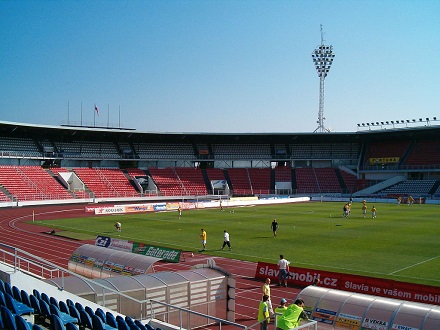
Arrested and shot along with his father, Jaroslav, Evzen Rosicky is the namesake of Prague’s Stadion Evzena Rosickeho.


(cc) image of Stadion Evzena Rosickeho by Honza Záruba.

On this day..

1940: Three saboteurs and a spy, “Fusilles et oublies”

On this date in 1940, the collapsing French state “shot and forgot” four subversives at Pessac. These cases are heavily covered by the French-language blog Histoire penitentiaire et Justice militaire; many links in this post point to well-illustrated articles on that site, which make recommended reading for those inclined to delve deeper.

Late June finds France in the dark weeks after Dunkirk — the very day, in fact, when Marshall Petain’s government formally surrendered to the German blitz.

Elsewhere, the remains of the Third Republic had fled west to Bourdeaux, taking along its death row prisoners. The state that condemned them did not mean to let its imminent disappearance cheat it of their blood.

Jean Amourelle, a stenographer in the French Senate whose duties included shorthanding the secret proceedings of its military commissions, was caught routing intelligence to Germany.

Set to join him for this date’s execution were two pairs of brothers: Roger and Marcel Rambaud, and Leon and Maurice Lebeau. Seventeen-year-old Maurice Lebeau had his sentence commuted to hard labor, however, and was spared from the firing detail.

The Rambauds and Lebeaus were factory workers sentenced as saboteurs for compromising the engine of a French military plane, causing it to explode mid-flight: strange behavior for Communist proletarians explained by the temporary peace between Germany and the Soviet Union that (for the moment) positioned the Comintern-directed French Communist Party as an opponent of the war.

Despite the sacrifice of the Rambauds and Lebeaus, this posture was short-lived. Just one year later — June 22, 1941, in fact — Germany’s invasion of the USSR thrust Europe’s Communist movements into common fronts with anti-fascist parties, and France’s Communists into the forefront of French Resistance martyrs.

On this day..

1996: Daren Lee Bolton

(Thanks to Meaghan Good of the Charley Project for the guest post. -ed.)

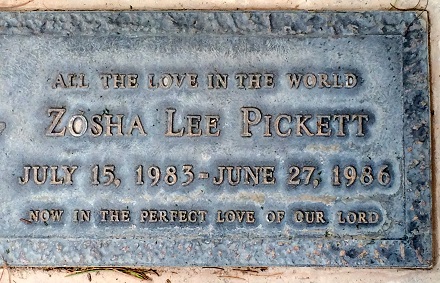
On this date in 1996, 29­-year­-old Daren Lee Bolton was executed in Arizona for the 1986 kidnapping, rape and murder of a Tucson toddler. Bolton had taken two­-year­-old Zosha Lee Pickett from her bedroom at night, stabbed her to death and left her body in an abandoned taxi in a storage lot two blocks from her home. It was found a couple of days later.

The medical examiner would testify that the toddler may have suffered “excruciating” pain for up to half an hour before she bled out.

After little Zosha’s death, the police lifted some fingerprints but couldn’t match them to any suspect, so in 1987 they sent them out to other states for them to have a try. Bolton had some convictions in Illinois, and so his prints were in the computerized system there. (Arizona didn’t have such a system in place at the time.) In 1990, during a training exercise, Illinois police officers found a match between Bolton’s fingerprints and a print on Zosha’s window screen. At the time, he was already serving time in Arizona for unrelated charges.

At his trial, Bolton admitted he’d been to Zosha’s home and to the cab where her body was found, but denied any part in her murder. Instead, he said he’d planned to break into the Pickett residence with an accomplice named “Phil” but was scared away. Phil, he said, had come back later and taken and killed the little girl. Bolton had then murdered the man and buried his body in the desert.

The jury saw through this wild story and convicted him of burglary, kidnapping and first-degree murder in 1991.

Bolton had the kind of childhood you might expect: shuttled back and forth between his divorced parents and his grandmother, the victim of physical abuse and possibly also sexual abuse, he was designated “severely emotionally handicapped” and had a long string of assaults to his name by the time he dropped out of school.

He was also charged in the 1982 murder of seven-­year­-old Cathy Barbara Fritz, also of Tucson, but he was executed before he could be tried in that case. The child had been abducted walking home from a friend’s home, sexually assaulted and then beaten and stabbed to death, all while a “Take Back The Night” demonstration was going on nearby. Bolton was sixteen years old at the time, and he knew the Cathy’s brother. DNA evidence later tied to him to the crime.

He maintained his innocence in both murders, but fired his lawyers and dropped his appeals after less than four years; he said he’d rather die than spend the rest of his life in prison.

His last meal consisted of lasagna, cheesecake and Pepsi.

Zosha Pickett’s parents and Cathy Fritz’s father and brothers were among the thirty witnesses who got to watch him die. He had no last words and, while he glanced at the Picketts once, he refused to acknowledge the Fritz family before he breathed his last, a few minutes past midnight.

On this day..

1967: Moustapha Lô, failed assassin

(Thanks to Meaghan Good of the Charley Project for the guest post. -ed.)

On this date in 1967, Moustapha Lô was executed for treason in the African nation of Senegal. He had tried to kill the country’s prime minister, Leopold Sedar Senghor, less than three months earlier.

At his trial, Lô freely admitted he’d drawn a gun on Senghor during a ceremony at the Grand Mosque of Dakar on the Muslim holiday of Eid-­al­-Adha,* but denied that he ever actually intended to kill him.

“I just wanted to give him a warning to change policy,” Lô said. He added, “I wanted to prove … he was not immune to public condemnation.”

His widow, Fatou Sarr, believed him; nearly 45 years after his death, she gave her first interview to the press and said, “He was not able to kill a fly.”

But if he was in fact only acting, Lô’s performance was very convincing: he pointed his pistol at the prime minister and pulled the trigger twice. Fortunately for Senghor, the gun jammed.

The crowd quickly tackled and overpowered Lô and he was hauled away by the police.

Several other people were also accused of being part of the plot. Moustapha Drame was sentenced to life in prison, Doudou Ndiaye to ten years and Momar Mbaye to five years; two other defendants were acquitted of all charges.

Although the country’s religious leaders pleaded for Senghor to pardon his would-­be assassin, the prime minister refused. Later on he claimed he had agonized over the decision for days and had nightmares about it, but he concluded, “This is not to judge according to the view of God. Only God can judge in the absolute. However, capital punishment still has a deterrent effect in Senegalese society.”

Lô met his death by firing squad. He said a prayer before his death and claimed he was dying “a martyr.”

Senghor outlived his attacker by 44 years, dying in 2001 at the age of 95.

* The holiday is locally known in Senegal as Tabaski.

On this day..

1962: The only hangings in independent Cyprus

Three Men Hanged in Cyprus
From the London Times, June 14, 1962

NICOSIA, June 13

Three Greek Cypriots found Guilty of murder were hanged before dawn at Nicosia Central Prison today, the first capital sentences to be carried out in Cyprus since independence in August, 1960. Their fate had been in the balance until 11 o’clock last night, when Mr. Glafcos Clerides, the acting President, announced that after considering all the circumstances, he had decided not to grant a suspension of the executions.

The three men were Hambis Zacharia, Michael Hiletikos, and Lazaris Demetriou. Zacharia was convicted of killing a man with an axe in a Limassol vineyard in September, 1958. The other two were jointly convicted of the murder of a man outside a Limassol cabaret last year.

Last night Mr. Rauf Denktash [the future president of Northern Cyprus -ed.], the Turkish advocate who appeared for Zacharia, had filed a petition in the High Court seeking a declaration that the execution warrant issued by the acting President was illegal and ultra vires, and a declaration that the superintendent of prisons was not legally appointed and could not carry out the executions. The petition was heard in the chamber of Mr. Justice Vassiliades and adjourned for a full court hearing, but this morning was withdrawn.

The English-language Cyprus Mail this morning commends the courage of the acting President and points out that the House of Representatives has power to amend the law if it wishes to abolish capital punishment. It adds that such action is unlikely to be publicly welcomed in view of the number of murders in the republic in recent months.

Despite the correspondent’s confidence in the endurance of the gallows, these first executions for independent Cyprus were also its last executions: no further hangings occurred before Cyprus abolished the death penalty for ordinary crimes in 1983, and for all crimes in 2002.

On this day..

1945: Mile Budak, Ustasha ideologue

On this date in 1945, seven former members of Croatia’s World War II Ustasha regime were hanged in Zagreb by Tito‘s postwar Yugoslav government — the morning after they had all been death-sentenced at a one-day military trial.*

Despite the presence of wartime Prime Minister Nikola Mandic (English Wikipedia entry | Croatian) in the batch, the marquee name was writer Mile Budak
(English Wikipedia entry | the far more detailed Croatian and German).

The “minister of culture with a machine gun” in the branding of his leftist literary contemporary Miroslav Krleza, Budak spent the interwar years writing hit novels valorizing the Croatian peasantry (The 1,000-page OgnjišteHearth — is the magnum opus) and also voluminous copy for far-right periodicals. Thanks to the latter activity, Budak endured an arrest, an attempted assassination, several years’ self-imposed exile to Italy, and (after his return) the murder of his wife.

Small wonder that when Germany broke off from the post-imperial Kingdom of Yugoslavia an “independent” Croatian puppet state, Budak signed up as its chief propagandist. Initially Minister of Education in 1941, he subsequently became its ambassador to Germany, and in 1943 its Foreign Minister.

He’s most notorious for the alleged aphorism “One third of the Serbs we will kill, one third expel, and the last third convert to Catholicism” — and though adherents widely dispute his authorship of any such phrase, Budak’s racial cosmology elevating Croatians (“an intersection of Slav and Gothic blood”) over their South Slav brethren was part of the intellectual scaffolding for his state’s wartime campaign of ethnic cleansing against Serbs. (It goes without saying that Jews and Roma were even more screwed.)

Judgments on the literary merit of Budak’s output appear to be driven heavily by the critic’s sympathy level with Budak’s politics. Post-independence Croatia has a robust far right that has often shown keen to rehabilitate the Ustasha, so it’s no surprise that Budak has been rediscovered as a writer and his name stapled to numerous streets in Croatia** and even to one in the Bosnian city Mostar — strictly in honor of his artistry and not the war business, mind you.

* Indeed, several — Mandic included — were only yielded up from British captivity in mid-May. (Link goes to a Croatian pdf)

** There’s one, for instance, in present-day nationalist enclave Knin — formerly the capital of the Serbian Krajina during the internecine 1990s wars. Knin’s capture and, er, ethnic reordering is the occasion celebrated on Croatia’s Victory Day holiday (August 5). It was for this operation that Croatian general Ante Gotovina was prosecuted by the International Criminal Tribunal for the former Yugoslavia; Gotovina’s eventual shock acquittal and release to a great nationalist orgy in Zagreb led Serbia to quit cooperation with the ICTY’s “selective justice”.

On this day..

1971: Sean Flynn and Dana Stone, Vietnam War photojournalists

On an unknown date thought to be approximately June of 1971, American photojournalists Sean Flynn and Dana Stone were executed by Communist captors in Southeast Asia.

Flynn is the big name of the pair,* literally: a former actor, he wasn’t in like his superstar father Errol Flynn. After trading on his prestigious name for a few silver screen credits, Sean grew bored of Hollywood and pivoted into a career in wanderlust — trying his hand as a safari guide and a singer before washing up in Vietnam where the action was in January 1966.

He made his name there as a man who would find a way to snatch an indelible image out of war’s hurricane, even at the risk of his own life.


One of Flynn’s photos: A captured Viet Cong being tortured. (1966)

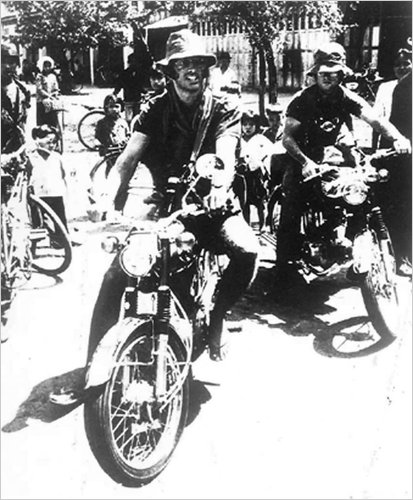
On April 6, 1970, Flynn and fellow risk-seeking photojournalist Dana Stone hopped on rented motorbikes bound for the front lines in Cambodia. It was a last mission born of their characteristic bravado — all but bursting out of the frame astride their crotch rockets in the last photo that would become their epitaph. They were never seen again; having apparently been detained at a Viet Cong checkpoint, it’s thought that they ended up in the hands of Cambodian Khmer Rouge guerrillas and were held for over a year before they were slain by their jailers.


Flynn (left) and Stone mount the bikes for their lethal assignment. This is the last picture ever taken of them.

Sean’s mother, actress Lili Damita, spent years seeking definitive information about his fate, without success. Dana’s brother, John Thomas Stone, joined the army in 1971 reportedly with a similar end in mind; he was killed by friendly fire in Afghanistan in 2006. The prevailing conclusion about their fate arrives via the investigation of their colleague and friend, Australian journalist Tim Page — a man for whom memorializing the journalists who lost their lives during the Vietnam War has been a lifelong mission.

Though Flynn’s and Stone’s guts are undeniable, not everyone appreciated their methods. “Dana Stone and Sean Flynn [son of the Hollywood actor, Errol Flynn] were straight out of Easy Rider, riding around on motorcycles carrying pearl-handled pistols. Cowboys, really,” said fellow photog Don McCullin. “I think they did more harm than good to our profession.”

* He’s not to be confused with present-day actor Sean Flynn — that’s our Sean Flynn’s nephew. (Sean the nephew was named for Sean the uncle.)

On this day..