1943: Yitskhok Rudahevski and family

(Thanks to Meaghan Good of the Charley Project for the guest post. -ed.)

Sometime in early October 1943, fifteen-year-old Yitskhok Rudashevski and his entire family were rousted out of their hiding place in the Vilna Ghetto, taken to nearby Ponary, shot to death and buried in a mass grave.

The Rudashevski family were among the last remnants of a once-vibrant Jewish community in the city once known as “the Jerusalem of the north” for its culture and scholarship. People came there from as far away as the United States to study in its highly regarded yeshivas.

After the start of World War II, Vilna was annexed by the Soviet Union. It became a sanctuary to Jews fleeing from the Nazis, who occupied western Poland.

All of that changed on June 22, 1941, when Operation Barbarossa began. On the day Germany invaded the USSR, there were approximately 80,000 Jews living in Vilna, many of them refugees from the Nazi terror. By the time the Red Army arrived and kicked the Nazis out three years later, Vilna’s Jewish population had been reduced –through starvation, disease, deportation and executions — to zero.

Yitskhok (also spelled Yitzhak, Yitzak, etc., or anglicized to Isaac), was thirteen years old at the time his city was occupied by the Germans.

An only child, he was the son of a typesetter and a seamstress. Talented in writing, history and languages, he was also a faithful Communist and a member of the Pioneers, the Communist youth organization.

From June 1941 to April 1943 he kept a diary in Yiddish. Yitskhok had a sense of the significance of his account; at one point he wrote, “I consider that everything must be recorded and noted down, even the most gory, because everything will be taken into account.”

He not only wrote about his own life and his family and friends, but about the wider community events and the devastation the Germans wrought on his people. The historian Allan Gerald Levine called him “an astute and passionate observer of the times,” and compared him to Anne Frank.

Nor was the diary Yitskhok’s only writing project.

When one of his teachers, a beloved figure in the ghetto, died, he wrote a eulogy for the man and read it out before a large audience. He was a member of a literary group and was also attached to the ghetto’s history project, for which he interviewed ghetto residents about their lives:

I got a taste of the historian’s task. I sit at the table and ask questions and record the greatest sufferings with cold objectivity. I write, I probe into details, and I do not realize at all that I am probing into wounds … And this horror, this tragedy is formulated by me … coldly and dryly. I become absorbed in thought, and the words stare out of the paper crimson with blood.

The Vilna Ghetto, whose population initially numbered 40,000, had a rich cultural life, just like prewar Jewish Vilna had. There were theaters, cabarets, the symphony, art exhibits, a library, public lectures, and underground schools for both children and adults.

Vilna Jews saw art, music, literature and the pursuit of knowledge as a form of resistance. As Jacob Gens, head of the “ghetto’s Judenrat, put it, cultural activity gave a person “the opportunity to free himself from the ghetto for a few hours … We are passing through dark and difficult days. Our bodies are in the ghetto, but our spirit has not been enslaved.”

Reality intruded, however, and in the final analysis the Vilna Jews were doomed to extinction.

Yitskhok’s final diary entry was dated April 7, 1943, two days after five thousand Vilna Jews had been rounded up and shot at Ponary. He was understandably in a very grim mood. His prophetic last line was, “We may be fated for the worst.”

On September 23, 1943, the Nazis began the final liquidation of the Vilna Ghetto, which had by then been reduced to about 10,000 people. After a selection, those who could work were sent off to labor camps in Estonia and Latvia, where almost all of them died due to the brutal conditions there.

Children, the elderly, and the sick were shot at Ponary or sent to the extermination camp Sobibor and gassed.

Yitskhok, his parents and his uncle’s family chose to go into hiding rather than take their chances at the selection. In hiding he sank into apathy and said very little. After about two weeks in the hideout, they were discovered and taken to their deaths.

The only surviving member of Yitskhok’s family was his teenage cousin, Sarah “Sore” Voloshin. Somewhere on the route to Ponary she was able to escape. She joined a partisan group in the forest and survived until the Red Army liberated the area in the summer of 1944. After the war was over, she returned to the family’s hiding place and found Yitskhok’s diary. As of 2010, Sore Voloshin was still alive in Israel.

And the diary she retrieved had become one of the major sources on day-to-day life in the Vilna Ghetto.
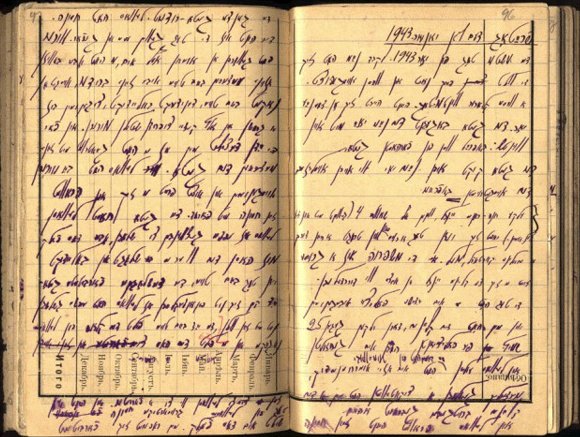
Yitskhok Rudashevski suffered and died in just the same way as hundreds of thousands of others, but unlike them he did not remain anonymous: he is one of the ghetto’s most famous inhabitants. His writings have been published in their original Yiddish and in Hebrew, German and English translations. Extracts of his diary can be found in several anthologies, and it’s available in its entirety under the title The Diary of the Vilna Ghetto.

On this day..

1943: 1,196 Jewish children from Bialystok

(Thanks to Meaghan Good of the Charley Project for the guest post. -ed.)

On this date in 1943, a special transport of 1,196 children and 53 adults arrived at Auschwitz and were gassed shortly thereafter. Thus ended one of the lesser-known tragedies of the Holocaust.

The children were very nearly the last survivors of the Bialystok Ghetto, which had been liquidated in August 1943. Almost all of the inhabitants of the ghetto wound up being sent to the Treblinka Extermination Camp and killed, but over a thousand children were mysteriously separated from their parents and taken away for some as-yet-unknown purpose. (The transport list can be found here.)

At the time, there were tentative negotiations between the Red Cross and the Nazis to trade Jewish children for either German prisoners of war or cold, hard cash. The exact details are unclear, and there’s a great deal of contradictory information about the entire event.

In any case, the Germans selected children from Bialystok, one of the few places in Nazi Europe where there were any Jewish children left alive.

The children, all of them under 16, spoke only Yiddish and Polish. They were in terrible shape, both mentally and physically. One witness later described them:

Suddenly, a column of bedraggled children appeared, hundreds of them … holding each other’s hands. The older ones helped the small ones, their little bodies moving along in the pouring rain. A column of marching ghosts, with wet rags clinging to their emaciated bodies, accompanied by a large number of SS men …

The children, looking like scarecrows, refused to undress. They held on to their dirty clothing, the older stepping in front of the young ones, protecting them with their bodies, clutching their hands and comforting those that were crying. Their clothing permeated with lice, their bodies full of sores, these children refused to wash.

Their first stop was Theresienstadt in Czechoslovakia, the so-called “model ghetto” which was used by the Nazis as a propaganda tool to show that they weren’t mistreating their Jews.

Theresienstadt was in fact a horribly overcrowded, disease-ridden city and its inhabitants were all dying of starvation, but it was the best there was available. There were no gas chambers there, and the Theresienstadters knew nothing about the kinds of horrors the Bialystok children had been through.

To keep knowledge of said horrors from leaking out, once in Theresienstadt the children were placed in isolation and weren’t allowed to leave their barracks. 53 doctors and nurses were recruited from the local population to take care of them, and they were locked up with the children.

In spite of these security measures, some of the adults were able to make contact with people from the outside. Theresienstadt youth leader Fredy Hirsch got caught making an unauthorized visit to the children’s barracks, for example, and as punishment he was sent to Auschwitz on the next train.

A child thought to be Deborah Klementynowska, possibly the only surviving photo of one of these lost Bialystok children.

The adults — one of whom was Franz Kafka‘s sister, Ottilie — didn’t know what to make of the children’s behavior at first.

For instance, why, when they were invited to take a shower, did they start crying and screaming about gas? The children started to talk about their experiences, and their caregivers were horrified by their stories.

The Nazis intended to quite literally fatten up the children before they were sent off into the world, so the group was treated very well. Everyone got enough to eat, and they were given baths, clean clothes, medical treatment and even toys. Anyone who got seriously ill was taken away “to the hospital” and, ahem, never returned.

Slowly, assisted by their kind caregivers, the children got their equilibrium and began to act like normal kids again.

Meanwhile, negotiations continued …

The Allies wanted to send the children to British Mandate Palestine. The Germans, however, were against this plan because they didn’t want the children growing up there, strengthening the Palestinian Jewish community and possibly establishing a Jewish state someday. (The Mufti of Jerusalem, whom the Nazis were quite friendly with, didn’t like the idea either.)

The Germans wanted the children sent to Great Britain instead.

The UK, however, had already accepted many Jewish refugees, including 10,000 German, Austrian and Czech children with the Kindertransport, and were unwilling to take in any more.

And there was another problem, relating to the prospect of exchanging the children for money.

This money would have to be provided by the American Joint Distribution Committee and other Jewish welfare agencies, and they flat-out refused to give anything to the people who had promised to wipe them off the face of the earth.

In the end, the negotiations collapsed, through what one witness later called “an ill-applied sense of ‘correctness'” on the part of the Allies. Of course, given the Nazis’ track record, one wonders if they ever seriously intended to release the children no matter what they were given in return.

The plan was discarded and the Germans were left with 1,196 useless Jewish children on their hands. They dealt with them in the usual manner.

None of the Bialystok group or their caregivers had any idea what was coming up for them when they were sent away from Theresienstadt. They’d been told the negotiations had been successful and they were on their way to Switzerland, and thence to Palestine. They were told to take off their yellow stars and the adults had to sign a statement promising not to say anything bad about the Germans.

The transport set off in high spirits, rejoicing at their upcoming freedom.

But their train went not to Switzerland but to Poland, marked for “special treatment” on arrival at its destination. Apart from a few of the adults who were selected to work, there were no survivors.

On this day..

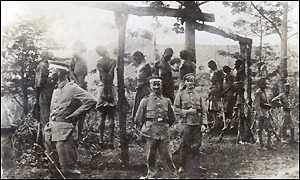
1904: Herero prisoners, at the command of Lothar von Trotha

My initial plan for the operation, which I always adhered to, was to encircle the masses of Hereros at Waterberg, and to annihilate these masses with a simultaneous blow, then to establish various stations to hunt down and disarm the splinter groups who escaped, later to lay hands on the captains by putting prize money on their heads and finally to sentence them to death.

-German General Lothar von Trotha (pdf source)

On this date in 1904, von Trotha did a little of that executing bit, further to doing a whole lot of genocide. It was the very day after von Trotha’s Vernichtungsbefehl, or extermination order, against the Herero people.

We give the narrative here to Jan-Bart Gewald’s “Colonization, Genocide and Resurgence: The Herero of Namibia 1890-1933”, from a collection of papers at a German symposium. Gewald’s complete text is available in scanned pdf form here.

Gewald:


Pocketed by the desert and the German patrols the Herero chiefs and their followers congregated along the Eiseb river. Around the first of October 1904, General Lothar von Trotha, who was actively taking part in the pursuit, and his retinue had reached the waterhole Osombo-Windimbe. During the afternoon of the following day, Sunday 2 October 1904, after the holding of a field service, General von Trotha, addressed his officers. In his address Trotha declared that the war against the Herero would be continued in all earnestness, and read out the following proclamation:

I the great General of the German troops send this letter to the Herero people.

The Herero are no longer German subjects. They have murdered and stolen, they have cut off the ears, noses and other bodyparts of wounded soldiers, now out of cowardice they no longer wish to fight. I say to the people anyone who delivers a captain will receive 1000 Mark, whoever delivers Samuel will receive 5000 Mark. The Herero people must however leave the land. If the populace does not do this I will force them with the Groot Rohr [cannon]. Within the German borders everyHerero, with or without a gun, with or without cattle, will be shot. I will no longer accept women and children, I will drive them back to their people or I will let them be shot at.* These are my words to the Herero people.

The great General of the mighty German Kaiser.

At dawn the following morning, Herero prisoners, who had been sentenced to death by a field court-martial, were hung in the presence of about 30 Herero prisoners, women and children amongst them. After the hanging, Trotha’s proclamation was read out to the prisoners in Otjiherero. Printed copies of the text in Otjiherero were distributed amongst the Herero prisoners. The prisoners were then turned loose and driven out into the Omaheke. [i.e., the western Kalahari desert -ed.]


In a letter the next day, Oct. 4, to the general staff, von Trotha reported on his order the day’s executions, in the context of a detailed tactical and philosophical justification of destroying the entire Herero nation. It’s quoted at length in Absolute Destruction: Military Culture and the Practices of War in Imperial Germany:

For me, it is merely a question of how to end the war with the Herero. My opinion is completely opposite to that of the governor and some “old Africans.” They have wanted to negotiate for a long time and describe the Herero nation as a necessary labor force for the future use of the colony. I am of an entirely different opinion. I believe that the nation mustbe destroyed as such, or since this was not possible using tactical blows, it must be expelled from the land operatively …

Because I neither can treat with these people, nor do I want to, without the express direction of His Majesty, a certain rigorous treatment of all parts of the nation is absolutely necessary, a treatment that I have for the present taken and executed on my own responsibility, and from which, as long as I have command, I shall not detour without a direct order. My detailed knowledge of many Central African tribes, Bantu and others, has taught me the convincing certainty that Negroes never submit to a contract but only to raw force. Yesterday before my departure, I had the warriors who were captured in the last several days [and who were] condemned by court-martial, hanged, and I have chased all the women and children who had gathered here back into the desert, taking with them the proclamation to the Herero people. This proclamation (enclosed), which will unavoidably bcome known, will be attacked … accepting women and children, who are mostly ill, is an eminent danger to the troops, and taking care of them is impossible. Therefore, I think it better that the nation perish rather than infect our troops and affect our water and food. In addition, the Herero would interpret any kindness on my side as weakness.They must now die in the desert or try to cross the Bechuanaland border. This uprising is and remains he beginning of a race war, which I already predicted in 1897 in my reports to the chancellor on East Africa … Whether this uprising was caused by poor treatment [of the Africans] remains irrelevant to its suppression.


It should be added that this explicitly genocidal policy was neither unique to German colonies, nor, as von Trotha himself notes, uncontested within Germany itself.

German Christian missionaries logged a piteous catalog of horrors, “skeletons with hollow eyes, powerless and hopeless,” and their reports of same to their home offices led to church pressure to brake the atrocities.

Gewald also quotes one of von Trotha’s subalterns, undisguisedly revolted at what he was involved in.

Cattle which had died of thirst lay scattered around the wells. These cattle had reached the wells but there had not been enough time to water them. The Herero led ahead of us into the Sandveld. Again and again this terrible scene kept repeating itself … the water became ever sparser, and wells evermore rare. They fled from one well to the next and lost virtually all their cattle and a large number of their people. The people shrunk into small remnants who continually fell into our hands, sections of the people escaped now and later throug the Sandveld into English territory. It was a policy which was equally gruesome as senseless, to hammer the people so much, we could have still saved many of them and their rich herds, if we had pardoned and taken them up again, they had been punished enough. I suggested this to General von Trotha but he wanted their total extermination.

Technically, complete destruction of the Herero was reversed as German policy a few months after von Trotha began implementing it, and the general himself recalled from South West Africa before the end of 1905 — leaving only a “softer” genocide of disease-ridden concentration camps through 1908. Although firm numbers are hard to come by, it’s thought that well over half the Herero population died during this period.

Yet neither was von Trotha a lone butcher. Diary entries of settlers and regular soldiers well before the extermination order record many instances (pdf) of the most cavalier slaying of Herero prisoners and noncombatants, abuses which continued long after von Trotha’s departure.

It’s difficult not to see in the racial ideology and the eliminationist military doctrine prefiguring (pdf) later and better-publicized brutalities. Indeed, even some of the personnel are the same:

  • Hermann Goering‘s father Heinrich was Germany’s first Reichskommissar in South West Africa, plopping his home down right on a Herero burial site.
  • Eugen Fischer, a eugenicist who availed the Namibian concentration camps’ ready supply of subjects to produce career-making research that would influence German race law and make Fischer a big brain in Nazi intellectual circles
  • Franz Ritter von Epp, one of von Trotha’s officers, formed in the aftermath of World War I one of the far-right Freikorps paramilitaries, with many subsequently-influential Nazis among its membership, including Ernst Roehm (who may have cribbed the SA “brown shirt” look from colonial Schutztruppe khakis) and Adolf Hitler himself

* He meant, shooting over their heads to run them off. “I assume absolutely that this proclamation will result in taking no more male prisoners, but will not degenerate into atrocities against women and children,” Lothar explained. “The latter will run away if one shoots at them a couple of times. The troops will remain conscious of the good reputation of the German soldier.”

On this day..

1901: James Edward Brady lynched for criminal assault

(Thanks to Meaghan Good of the Charley Project for the guest post. -ed.)

On this day in 1901, James Edward Brady was hauled out of his jail cell and hanged from a telephone pole on the corner of Main and Lawrence Streets at Haymarket Square in Helena, Montana. He had been arrested three days before in relation to his attack on Hazel Pugsley, a five-year-old girl.

On September 30, Brady, who had arrived in Helena from the city of Boulder, Montana only the day before, waylaid little Hazel while she was on her way to kindergarten. He convinced her to get on a streetcar with him and they didn’t get off until they were three miles outside town.

Hazel’s mother reported her missing after she didn’t arrive home from school, and a search was launched. Later that day, the police found her walking home alone. She was “a nervous wreck, and when the accused man was taken in front of her she began crying hysterically, at the mere sight of him.”

Brady was charged with “criminal assault,” a euphemism for rape.

He had once been a highly respected and influential man in the Yellowstone River area and was credited with bringing the first thoroughbred cattle into Montana, but he developed a drinking problem and somewhere along the line he fell from grace.

Brady had been in and out of trouble in Jefferson County before he moved to Helena, and in Boulder he had become overly familiar with several children. After the Hazel Pugsley incident, it came out that he’d lured at least four little girls to his cabin in Boulder and then molested them.

He was not criminally charged in that instance, but was warned to leave town or else. So he came to Helena.

Although Montana had a long tradition of lynchings and emotions were running high in the aftermath of Hazel’s attack, the sheriff wasn’t worried: Brady was housed in a secure stone jail with five locked doors between him and the outside. On the night of the lynching, the sheriff was asleep with his family as usual.

At 1:30 a.m. on October 2, a mob of thirty masked men pounded on the doors of the jail and demanded the prisoner. When they couldn’t get the jailer to answer the door, they stationed men around the building to keep watch while they started working on the door with a sledgehammer and a crowbar.

The mob easily broke open the outer wooden door, but the next door was barred. Jailer George Mahrt was awakened by the noise and mistakenly opened the barred inner door just as the lynch mob had broken through the outer door. Once inside the building, the men forced Mahrt to hand over his keys, unlocked the last three doors, and barged in on James Brady.

“What is it, gentlemen?” he asked.*

In spite of the early hour, a crowd of about 200 spectators gathered to watch as the vigilantes hustled the helpless Brady out of jail and force-marched him, already noosed, six blocks to Haymarket Square.

The spectators knew what it was.

The lynchers summoned a saloon-keeper who had witnessed Hazel’s abduction, to confirm for the assembling multitude that it was indeed Brady who took her. One of the masked lynchers then forced his way through the crowed and slugged Brady twice in the face; this may have been Peter Pugsley, Hazel’s father. (The same man would later go after Brady again, but the mob held him back.)

“Now, then,” the mob’s leader addressed his prey. “Brady, your time on earth is short. Have you any confession to make?”

Brady had little to say: only to reiterate his innocence, and ask that his last paycheck be sent to the Boulder School for the Blind where his niece was a student.

When asked if he wanted to say a prayer, Brady said he didn’t know how to pray and asked that someone pray for him instead. One of the mob said, “May the Lord help you, Brady; that is all I can say for you.”

Then his time was up.

Several people already positioned on top of the nearby telephone pole jerked Brady up from the ground violently, probably breaking his neck, and as Brady hung twitching and dying, the members of the lynch mob pulled off their masks and melted into the watching crowd.

In addition to the 200-some people who witnessed the lynching, another thousand or so viewed the body by moonlight before it was cut down.


Jackson (Mich.) Citizen Patriot, Oct. 2, 1901.

A coroner’s inquest was held later that day. Several people testified that they’d witnessed Brady’s death, but they all swore they were not part of the lynch mob and developed amnesia when asked if they recognized anyone who was.

The coroner’s jury ruled Brady’s death a homicide.

On October 3, Peter Pugsley — the father — was arrested and charged with murder. Investigators hoped he would provide them with other names, but Pugsley said he hadn’t been present at the lynching and produced an alibi, which friends backed up. He was released the next day on bail, his bond secured by several prominent members of the community.

Ultimately, a grand jury heard testimony from thirty-eight witnesses during an eighteen-day investigation. It then declined to indict Pugsley or any other suspect. Later, some of the jurors said it was impossible to name anybody connected with the crime because so many witnesses refused to answer questions, citing their Fifth Amendment right against self-incrimination.

However, someone did pay for what happened to Brady.

As amateur historian Tom Donovan writes of this case in volume two of book Hanging Around the Big Sky: The Unofficial Guide to Lynching, Strangling and Legal Hangings of Montana, “The Brady incident was the only case where an official was severely disciplined for losing a prisoner to a lynch mob. The Lewis and Clark County grand jury found that Jailer George Mahrt was incompetent and he was apparently fired.”

Not only had Mahrt, an experienced jailer, opened the inside door to the armed mob, he had also failed to notify the sheriff what happened until Brady had already been marched out of the jail. All he would have had to do to arouse the sheriff was press an electric panic button, which would have sounded an alarm at the sheriff’s residence.

In the aftermath of Brady’s death, officials in Butte, Montana announced he was also a suspect in the 1898 abduction and murder of nine-year-old Ethel Gill. She was missing for several days before her body was found in an outhouse.

Gill had been raped, beaten and strangled. Brady lived and worked in the same neighborhood where Ethel’s body was found. He quit his job and left Butte immediately after the murder, but wasn’t considered a suspect until after he was killed. Ethel Gill’s murder was never solved and Brady’s connection to the crime remains a matter of speculation.

* San Jose Evening News, Oct. 2, 1901.

On this day..

1981: Mustapha Danso

On this date in 1981, Mustapha Danso was executed for an attempted coup in Gambia.

Gambia (or “The Gambia”: we’re going to dispense with the article here) is a sliver of a country hugging the Gambia River, entirely surrounded (save the coast) by Senegal.

It became independent of Great Britain in 1970 under the leadership of Dawda Jawara, who held the Gambian presidency democratically from that time until 1994. Mustapha Danso, our date’s principal, was one of a coterie of disaffected Gambian junior officers who were scheming a coup against Jawara as the 1980s got underway.

In October 1980, Danso walked up to the deputy commander of the Gambia Field Force, Eku Mahoney, and coolly shot him dead. “Although the first speculations blamed the constable’s action on possible illicit drug influence,” notes a book about Gambia’s subsequent, and successful, 1994 junior officers’ coup, “Mustapha Danso’s unresentful attitude after the incident convinced many people that there was more to it than what met the eye.” Mahoney may have been killed because he was viewed by the prospective coupists as an obstacle.

Danso caught a death sentence, but since Gambia never actually executed anyone, it was essentially symbolic.

That is, until July 1981, when Jawara was in London to attend the wedding of Prince Charles and Lady Diana. Danso’s former comrades in the Field Force seized the opportunity to join a coup mounted by leftist politician Kukoi Samba Sanyang against the “corrupt, tribalistic, and despotic” Jawara in favor of “the dictatorship of the proletariat.”

From London, Jawara summoned Senegalese aid: Gambia’s neighbor and sometime rival dispatched troops who successfully crushed the rebellion within a week. Some 500 people lost their lives during the turmoil, and its leaders fled abroad. (Kukoi Sanyang died a few months ago as of this writing, but his version of the “people’s revolution under my able leadership” can be perused here.)

While the coup itself was suppressed, Jawara went pretty easy (as these things go) on his actual or perceived enemies. Danso was the only party to the plot who was executed, and Jawara went out of his way to declare normalcy instead of using a national security emergency to smash up everything.

“In the aftermath of this threat to our internal security some have asked whether it would be appropriate at the time to consolidate both the power of the State and the power of the executive. Let me state categorically and unequivocally that the system of democracy that has always existed will prevail. There will be no dictatorship in The Gambia — neither by the President, nor by the Government, nor by the proletariat.” (Source)

Danso was the first and, for 30 years the only, person executed in Gambia; the country has retained the death penalty in law, but was long considered de facto abolitionist. That changed suddenly in August 2012 when current president Yahya Jammeh unexpectedly ordered nine condemned prisoners put to death on a single day.

On this day..

1926: Sataro Fukiage, serial killer

On this date in 1926, serial killer Sataro Fukiage (English Wikipedia entry | Japanese) was hanged at Ichigaya prison for rape-murder.

Most of what’s out there about Sataro Fukiage is in Japanese (like this book). Born in 1889, his hardscrabble upbringing saw him enter the workforce at age nine. He was not a model apprentice, alternating escape attempts with evictions for bad conduct; stealing from his master to procure a prostitute landed him in Kyoto prison at the tender age of 12, and it was in his periodic incarcerations that, Oliver Twist-like, he learned the finer points of pickpocketing from yakuza. He would need those finer points to do the breadwinning for his penniless mother in between his stints behind bars.

His somewhat sympathetic childhood also included a voracious and deviant sexual appetite which was to blossom in time into a carnivorous pattern of abuse.

Fukiage committed his first murder in 1906, when he took an 11-year-old acquaintance to a remote location, then raped and strangled her, only avoiding the death sentence because he himself was still underage at that time.

Released in 1922, he immediately brought himself to widespread public notoriety for a 1922-23 rape spree with at least 27 victims — most of them, again, underage girls. He mixed at least six murders into the one-man crime wave.

He completed an autobiography in prison, but it was banned shortly after its publication.

On this day..

1909: Les Chauffeurs de la Drome

At daybreak this date in 1909, three French rural bandits dubbed “Les Chauffeurs de la Drôme” were publicly guillotined in Valence to the hurrahs of a great crowd.

Most of the (plentiful) information online about these charmers is in French; in their day about 1905 to 1908 they enjoyed quite a lot of notoriety in southern France for their bloody crime spree, comprising at least 11 murders amid numerous home invasion burglaries. They were a throwback gang whose niche the 20th century would eradicate as surely as they themselves. In the time before ubiquitous mass communication and high-speed transport, a sufficiently bold band of robbers could have their way with a rural residence miles from any possible aid: this was one of the great terrors of Europe, and early crime broadsheets from centuries previous dwell often on the terrors of an isolated farmer or miller made prey in his own home by a band of cutthroats.*

The root of the word chauffeur is the French verb “to heat” — think stoking an engine, for the word’s familiar meaning of professional driver — and the specialty of the Chauffeurs de la Drome was torturing their hostages by scorching their feet with hot irons until the sufferers yielded up the hidey-holes of whatever treasure they had on premises. Their trial was a fin-de-siecle circus, and their executions likewise to a discomfiting degree. Though nothing specifically scandalous occurred as the chauffeurs were snuffed out on a public street, there are a number of pictures of this event, some of them made into postcards and circulated.

This was a trend not very much appreciated by the French government, but of course such images make arresting historical artifacts.

We’re here featuring select images of Octave David. When David walked the few steps through a sea of early-rising spectators to the portable guillotine erected on the streetcar tracks directly in front of the prison gates, his companion Pierre Berruyer had already been beheaded. (The chauffeurs were nos. 126 through 128 in the prolific Anatole Deibler’s career.)

He would have glimpsed Berruyer’s headless trunk already rolled into the large box that would soon receive his body as well. (The box had accommodations for four.) And while the execution team washed down the blade between uses, the grotesque bloody puddles and remains of fresh gore were a constant source of complaint. All three executions were completed in a six-minute span; it’s safe to assume that the smell and the feel of Pierre Berruyer’s violent death surrounded David as he walked to the used chopper. As the events here transpired, the third robber Urbain Liottard still awaited his own turn just inside the prison walls — in a few moments, Liottard would see two steaming neckless corpses stacked up in the rude bin gaping to receive him.


Looking alarmingly Christlike, the half-naked form of the condemned murderer emerges from the prison’s maw amid a throng of indistinct, black-clad voyeurs.


David reaches the guillotine; the assistant executioners are about to tip him onto the board that will carry him into place. The identification on these photos is from Bois de Justice, an invaluable site on the history of the guillotine; I’m unsure from my own observation whether to equate the figure in these pictures with the one in the first, above.


One of the beheadings (I’m not certain that it’s David’s) has been completed; the body and head are being transferred to their receptacles. Again, Bois de Justice has details on this scene.


Following one of the beheadings, the visibly stained blade is raised for cleaning before the third criminal is brought out.

* For some examples, see Joel Harrington’s The Faithful Executioner, a book we’ve previously profiled.

On this day..

1939: Six assassins of Armand Calinescu

On this date in 1939, Romanian Prime Minister Armand Calinescu was gunned down on a Bucharest street in an ambush by the Iron Guard. (Romanian link)

Before the day was out, six of members of the hit squad were lined up and machine-gunned on the very same spot.

Armand Calinescu

Calinescu was a conservative politician trying to fight off the rising fascist movement in his country — that aforesaid Iron Guard — and preferred to keep Romania in politic neutrality and friendly with England and France rather than hitching its fate to Nazi Germany.

This entailed an increasingly acrimonious struggle throughout the 1930s against the fascists. Calinescu once called the Guard “an association of assassins,” and the prospect of taking a bullet from them can’t have been far from his mind. Calinescu’s fingerprints were all over press closures, pre-emptive arrests, and still worse offenses to outrage the far right. After years in the cabinet working hand-in-glove with the hated-by-fascists King Carol II, Calinescu finally became Prime Minister in March of 1939. Carol hoped he could be the bulwark against a Legionary takeover.

If by his enemies ye may know a man, know that Calinescu was taken seriously enough for a multilateral meeting between representatives of the Iron Guard, fascist Italy, and Nazi Germany in order to make the arrangements for his murder. But Calinescu would probably have just as soon have preferred his life to this tribute of his foes.

Upon news of the assassination, Calinescu’s place was immediately filled by Gen. Gheorghe Argesanu, whose one week as head of government was distinguished by a ruthless crackdown on his country’s homegrown terrorists.* The very next day’s British papers, in the same stories reporting the assassination, carried news “of an exemplary punishment” delivered within hours: “Last night, under the glare of powerful arc lamps, the murderers were publicly executed by machine-gun on the spot where the crime had been committed.” (London Times, September 22, 1939)

Nor was that the last exemplar.

The Times reported on September 25th that the ensuing days had seen “more than 300 former Iron Guards were shot” all around the country, including many “in the open street as a public example, on the pattern of the machine-gun executions in public at the scene of the crime.”

The “example” did not have the intended effect: in the span of another year, a fascist-aligned government had control of Bucharest and King Carol had hightailed it to Mexico, never to return.

* The Iron Guard would pay back Argesanu a year later by killing him during the Jilava massacre of its political prisoners.

On this day..

1953: Louisa May Merrifield, elder abuser

(Thanks to Meaghan Good of the Charley Project for the guest post. -ed.)

On this date in 1953, housekeeper Louisa May Merrifield, the so-called Blackpool Poisoner, was hanged at Machester’s Strangeways Prison for killing her employer.

She was the third-last woman hanged in Britain and the very last woman to be executed at that particular prison, which now houses only men; the job was performed by Albert Pierrepoint.

Born in 1906, Louisa had already served prison time for ration book fraud by the time of the murder, and she lost custody of her four children due to her excessive drinking and neglect.
She couldn’t seem to hold on to a man (she was married three times) or a job (she had 20 in three years).

She took her final position on March 12, 1953, after she and her husband of one month, 71-year-old Alfred Edward Merrifield, became housekeepers and live-in companions to Sarah Ann Ricketts, a spinster who was nearly eighty years old. Sarah Ricketts owned a bungalow at 339 Devonshire Road, North Shore, Blackpool.

The Merrifields indulged in elder abuse and neglect, and Sarah Ann complained she didn’t get enough to eat and that her housekeepers swilled rum on her dime. Meanwhile, Louisa was going around boasting that she’d inherited a £3,000 house.

When someone asked her who had died, she answered, “She’s not dead yet, but she soon will be.”

Louisa’s prophecy was eerily accurate: Sarah Ann Ricketts expired on the night of April 14, 1953, only a month after she’d hired the Merrifields and three days after Louisa’s prediction … but not before drafting a new will which left her bungalow to the Merrifields.

Louisa didn’t call a doctor until the next morning. She said that, as the old woman was clearly beyond help, she didn’t want to drag anyone out of bed in the middle of the night.

The suspicious GP refused to sign a death certificate and insisted on an autopsy, which revealed the cause of death as phosphorus poisoning, administered in the form of a rat poison called Rodine.

Although a police search of the bungalow didn’t turn up any Rodine, a check at the local pharmacy showed Louisa had recently purchased the stuff and signed the poison register.

The Merrifields found themselves charged with murder. Louisa was arrested first, two weeks after Sarah Ricketts died, and Alfred a few days later.

At their trial in July 1953, Louisa was convicted and sentenced to hang. The judge called her crime “as wicked and cruel a murder as I ever heard tell of.”

The jury couldn’t reach a verdict on Alfred, however, and the district attorney decided not to prosecute again. He was released and in due time inherited a half-share in Mrs. Ricketts’s bungalow. He died in 1962 at the age of 80.

Louisa Merrifield’s ghost is said to haunt the cell she once inhabited at Strangeways Prison.

On this day..

1931: Omar Mukhtar, Libyan revolutionary

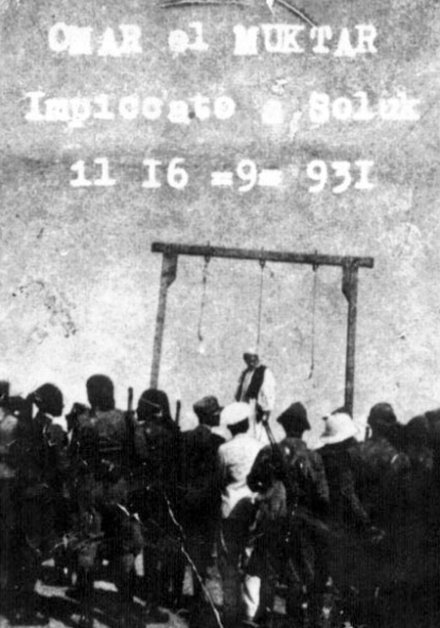
On this date in 1931, Libyan independence martyr Omar [al-]Mukhtar was publicly hanged by the Italians at their concentration camp in Suluq.

Mukhtar (English Wikipedia entry | Italian) was born an Ottoman subject back in 1858 and had lived long enough to see his native Libya seized in the 1911-12 Italo-Turkish War.

Mukhtar, a religious teacher and follower of the Senussi movement, became the leader of the Libyan resistance that dogged the Italian occupation. Mukhtar proved an energetic and successful desert guerrilla fighter, and he had to be given the Italians’ mechanized military.

The Italians executed an estimated 4,000 Libyans in the 1920s, and drove hundreds of thousands into concentration camps, and gradually, only gradually, gained the upper hand on their adversaries.

Captured in battle after he abandoned a 1929 truce, Mukhtar was denied prisoner-of-war status and subjected to a snap military tribunal in one of the small coastal enclaves actually controlled by Italy — “a regular trial and consequent sentence, which will surely be death,” as the Italian general directed. It surely was.

He’s played by Anthony Quinn in the 1981 film Lion of the Desert — a better movie than you might think given that it was bankrolled by Muammar Gaddafi.

A national hero for contemporary Libyans across any social divide you’d care to name, Omar Mukhtar was valorized by the rebels who recently overthrew the aforementioned Gaddafi (here’s Mukhtar on a billboard in rebel-held Benghazi). “The whole world knows what Omar al-Mukhtar did,” Mukhtar’s 90-year-old son told media during the civil war. “That’s where they get their energy from. Ask the youth, they’ll tell you they are all the grandsons of Omar al-Mukhtar.”

His steely profile can be seen on Libya’s 10 10 dinar note.

On this day..