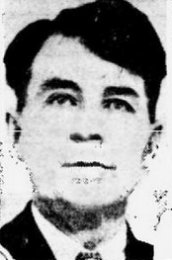
1939: Charles McLachlan

(Thanks to Meaghan Good of the Charley Project for the guest post. -ed.)

On this date in 1939, 57-year-old Charles Augustine McLachlan was gassed at San Quentin State Prison in California. He’d murdered a six-year-old neighbor girl at his home in Downey, California the previous year.

McLachlan was a widower who was half Irish-American and half Mexican by descent but described as white. A master painter and decorator, he owned a plot of land with a few houses he’d built himself.


Mugshot of perp; newspaper sketch of victim.

McLachlan lived alone in the smallest of the houses, an eight-by-twelve-foot shack; the largest building was occupied by his son and daughter-in-law, Joe and Carmen, and their child. The parents of the victim, Jennie Moreno (her name is spelled “Jenny” in many accounts), had known McLachlan for about thirty years. Although he was occasionally seen drunk, he had a reputation as a kind, likeable man.

That is, until April 14, 1938.

At 10:00 that morning, Jennie Moreno and her younger sister went to give a magazine to Carmen McLachlan.

Jennie’s parents last saw her at 11:00 a.m., while she was getting ready to go to church. When she didn’t return home at noon as expected, her parents began searching for her. At some point a neighbor smelled a strange odor and noticed smoke pouring out the windows of McLachlan’s shack, which had no chimney or flue.

The police were summoned. They arrived at his house at midnight and found bloodstained, partially burned clothing belonging to both Jennie and McLachlan lying on a sheet of metal on the floor of the shack. The floor had been washed and was still sopping wet.

A search of the premises turned up Jennie’s shoes and a bloodstained hammer. McLachlan’s mattress was saturated with blood and there was blood on the floor beneath the bed as well. He was arrested on the spot.

At the same time the sheriff’s deputies were arresting McLachlan, a search party that included Jennie’s father and uncle found her partially nude body concealed among the weeds in the vacant lot next to McLachlan’s property.

When they saw McLachlan being led away in handcuffs, they guessed he must be the murderer. Jennie’s uncle struck McLachlan in the face and several others in the crowd called out, “Lynch him!” But the police were able to disperse these aspiring vigilantes without too much difficulty.

McLachlan, who had been drinking wine and whiskey since 9:00 a.m., was quite drunk at the time of his arrest and at first said he had no memory of what happened. He ultimately made a confession to murder. McLachlan stated he’d been lying in bed resting with the door open when little Jennie wandered inside. He took her into the bed and began to fondle her, then struck her in the head with a hammer after she screamed. He waited until after dark, and then carried her body to where it was later found.

Jennie’s body showed evidence that she had in fact been violently raped, something McLachlan never admitted to.

He would go on to repudiate his entire statement, saying the police had kept him in jail without sleep or food and coerced the confession. He pleaded both not guilty and not guilty by reason of insanity, waived his right to a jury trial and was heard by a judge.

McLachlan claimed he heard “witches” speaking to him and said the voices “say most anything.” While in jail he would refuse to eat or speak for days at a time, and he refused to cooperate with his defense. A psychiatrist hired to examine him found “evidence of pre-senility and psychic pain” but believed he was feigning mental illness.

Found both guilty and sane, he was condemned to death. The judge to whom McLachlan had entrusted his fate called Jennie Moreno’s murder “one of the most brutal and horrible ever perpetrated in Los Angeles County.”

Charles McLachlan walked into the gas chamber at 10:10 a.m., eighteen months after his crime. “Twisting and straining against the straps that bound him,” he took seven minutes to die.

On this day..

1970: Udilberto Vasquez Bautista, Peruvian popular saint

Early this morning in 1970, in the prison at Cajamarca, Peru, Ubilberto Vasquez Bautista was shot for the slaughter of a young shepherdess.

The young girl — either 9 or 11 years old — had been raped, then stabbed 27 times.

Udilberto Vasquez was found with some blood incriminatingly all over his underwear. Though he never admitted guilt, his story went through a few iterations, one of which entailed pointing the finger at his brother. (… with whom he shared underwear, I guess.)

Basically desperate for any angle, his attorney pushed that as a defense.

“Without intending it, I contributed to the creation of the myth,” he said later, according to Frank Graziano’s Cultures of Devotion: Folk Saints of Spanish America.* We’ll get to that myth in a moment.

As one might readily infer from his presence on these pages, not that defense nor any other sufficed to save his client’s life.

Rather, Vasquez became the first victim (Spanish link, as are nearly all those that follow) of draconian new legislation imposed by the Juan Velasco Alvarado dictatorship reinstating capital punishment for fatal sexual assaults on particularly young victims.** This law was only in place from 1969 to 1973, so it was bad timing as much as anything for Udilberto Vasquez. (Peru’s 1979 constitution would restrict the death penalty to wartime treason.)

So at 6 a.m. this date, and still having never confessed guilt, Vasquez was shot. A dog barked in the distance; a cock crowed out its protest. Etc.

In execution, Vasquez joined the curious pantheon of Latin American folk saints comprised of ordinary criminals (usually ones thought to be innocent). Vasquez had converted in prison to the Adventist Church, and some fellow inmates believed he had the power to work miracles.

Latter-day supplicants hoping for same crowd to a mausoleum-shrine, especially on Nov. 1, All Saints’ Day. He’s credited with many miracles rescuing the health and fortunes of devotees.†

Such divine providence necessarily implies a view of its author’s innocence in that whole rape-murder thing. Among followers, the attorney’s notion of Vasquez’s brother’s culpability — and still more, the sacrificial concept that Vasquez willingly gave himself to protect his brother (which seems at odds with Vasquez blaming his brother) — has improved into a mythic truism.

Vasquez is the subject of a film by Hector Marreros, Milagroso Udilberto Vasquez.

For a more academic take, check this short Spanish-language article (pdf) by Nanda Leonardini.

* In addition to the book, Graziano has a fascinating site on his investigations into folk religiosity in the Spanish Americas, CulturesOfDevotion.com.

** Ironically, it was doubts about the guilt of the last guy shot for a rape-murder that had caused that law to be rescinded.

† Click here for a photo gallery of Udilberto devotions/festivities.

On this day..

1981: Nasiru Bello, a little overeagerly

It’s certainly understandable that dilatory appeals leaving it nigh-impossible to actually carry out a meritorious death sentence provoke aggravation.

But as always, one is left in the real sphere of human endeavor to choose among alternatives that each sport their own drawbacks — and where “drawbacks” are no mere debating points but actual lives on the line. After all, even a years-long appellate process that actually results in an execution can go and execute the wrong guy, to say nothing of systems that promise more immediate enforcement.

In a similar vein is the maxim that however adroit the hangman, etiquette forbids him entering the scene before the legally constituted appellate process — of whatever length it may be — has actually run its course. At least that much patience is not merely a virtue but absolutely de rigueur.

On this date thirty-two years ago, Nigeria committed a serious breach of that decorum.

Nasiru Bello, on death row for armed robbery — a crime the recently installed civilian government appeared to be easing off treating as a hanging offense* — was abruptly put to death by Oyo State before a filed and pending appeal could actually be heard by the court.

That’s what you’d call an irreversible error.

Five years later, Bello’s kin won a unanimous Supreme Court judgment against Oyo State for the wrongful execution, which stirringly declared that

“the premature execution of the deceased by the Oyo State Government, while the deceased’s appeal against his conviction was still pending, was not only unconstitutional, but also illegal and unlawful.** By it, the deceased has lost both his right to life and his right to prosecute his appeal.”

And then that same court reduced the plaintiffs’ claimed damages of 100,000 naira to 7,400: about US $1,900 by the local currency’s black market exchange rate. Bello, of course, stayed dead.

* See the 1980 entries in this pdf of Amnesty International reports on Nigeria.

** Unconstitutional, unlawful and illegal here being used in particular, juridically distinct senses. Despite the finding, nobody involved faced criminal sanctions for reasons boiling down to sovereign immunity.

On this day..

1951: King Abdullah’s assassins

AMMAN, Jordan, Sept. 4 — Four men sentenced to death here last week for complicity in the assassination of King Abdullah in July were hanged today in Amman prison. Regent Emire Naif had confirmed the sentences of the special tribunal.

Those put to death were Musa Abdulla el-Husseini, Abed Okkeh, Abdulkadir Farhat and Zakariya Okkeh.

Col. Abdulla el-Tell, former governor of Jerusalem, and Musa Ayyubi who were sentenced to death in absentia are reported to be living in Egypt.

–New York Times, September 5, 1951*

The men hanged this day were among the authors of “the most dastardly crime Jordan ever witnessed”: the July 20, 1951 assassination of independent Jordan’s first king.

The cagey Hashemite monarch Abdullah I had been emir of Transjordan, an artificial British mandate jigsaw-piece that Abdullah got by virtue of cutting a deal with Winston Churchill.

This sinecure came with the significant drawback of dependency on London’s reach and interests, and Abdullah’s great achievement was to set Transjordan-cum-Jordan** on firm enough footing to survive the postwar sunset of the British Empire.

Abdullah faced an early test of Jordan’s chops shortly after his country’s 1946 independence when the Arab-Israeli War erupted. For Abdullah, this was a state-building opportunity; indeed, his government had for years backed Palestinian-partition plans that other Arab states had opposed — with the expectation that Jordan could help itself to the eastern part of that partition.

Abdullah did just that in 1948, invading and annexing the Jordan River’s West Bank all the way to East Jerusalem … while willingly acceding to (some have said actively colluding in) the creation of a partitioned Jewish state that was theoretically anathema to Jordan’s allies.

Jordanian territorial aggrandizement, however, brought with it the West Bank’s Palestinian population, severely aggrieved at having seen their aspirations to statehood cynically sacrificed by Abdullah. They got, into the bargain, Jordanian citizenship and a severe suppression of independence agitation.

So when Abdullah came to visit Jerusalem’s Al-Aqsa Mosque, a Palestinian gunman murdered him.

While the assassin himself was immediately shot dead by the king’s bodyguards, ten allegedly in on the plot were very hastily tried in mid-August … eight in the Amman courtroom, and two overseas in Egypt tried in absentia. Dr. Musa Abdullah el Husseini, Abdel Kadir Farahat, and the brothers Abed and Zakariya Okka were condemned to die, along with the absconded Abdulla el Tel and Musa Ahmed el Ayoubi. (The latter two would never be executed.)

According to the London Times‘ Aug. 29, 1951 wrap of the legal proceedings,

The events leading up to the murder, as they were described during the hearing, began with two meetings in Egypt, in September and October [1950], between el Tel and el Ayoubi, who decided then that the king should die. El Tel then met el Husseini i Cairo, and henceforth directed and financed the plot with el Ayoubi as his chief lieutenant. Abed Okka acted as an intermediary, and Zachariya Okka and Farahat were later drawn into the plot, the latter ultimately providing the murderer with a revolver.

The remaining four men who faced trial — Dr. Daud el Husseini, Franciscan Father Ibrahim Ayyad, Tawfik el Husseini, and Kamil Kaluti — were acquitted.

This event, which might have been feared to prefigure a more terrible disruption within Jordan, within Palestine, even in the entire Middle East, did nothing of the sort. Power transitioned to the long reign of Abdullah’s grandson King Hussein, who was actually present at his grandfather’s assassination. (And might have shared his fate, save for a medal the teenaged Hussein had pinned to his breast that deflected a bullet.)

As Mary Cristina Wilson writes,

There was an element of cover-up in the conduct of the trial. The grievances and frustrations of the accused were not broached … The idea of an independent Palestine was, for the moment, dead. Abdullah’s assassination was a terrible revenge wreaked for the death of that idea, but it signified retribution for events that were already history, not the beginning of the new order … Though not without parallels in the future, it was without echoes.

Jordan would govern the West Bank, albeit absent virtually any internationally-recognized legitimacy there, until Israel attacked and occupied the territory in the Six-Day War in 1967. The legacy of this event will be familiar to the reader.

In 1988, Jordan officially resigned its own claims on the West Bank to the Palestine Liberation Organization, “the sole legitimate representative of the Palestinian people.”

* Any number of online sites say this hanging occurred on September 6. Given the existence of September 5 papers reporting the execution, I think it’s safe to rule those erroneous. Wikipedia sources this version to James Lunt’s Hussein of Jordan.

** “Transjordan” officially became simply “Jordan” in 1949. Events in this post span either side of that re-branding, so for the sake of clarity, we’re just going to use “Jordan” throughout.

On this day..

1924: Patrick Mahon, for the Crumbles Murder

On this date in 1924, Patrick Mahon was hanged for the so-called “Crumbles Murder”. Despite a nickname worthy of the family pet, this one was decidedly adult fare.

Patrick Mahon was a 30-something minor crook and major tomcat who had recently conquered his co-worker at the bankrupt soda fountain company Consol Automatic Aerators.

Emily Kaye was “a woman of the world” by Mahon’s nudge-nudge wink-wink report, but she had a mind to be more than a bit on the side for Mahon.

“Her idea,” Mahon later explained in the box as he stood trial for Kaye’s murder, “was that if we were alone together and she could act as my wife, doing the cooking and everything, she would convince me that I could be entirely happy with her.” Such a design the 37-year-old Miss Kaye had no real hope of achieving, but our lothario was more than happy to go along with “this experiment — this love experiment, we called it.”

Their laboratory would be a rented bungalow on the Sussex coast near Eastbourne at a charming strip of beach known as the Crumbles.

Mahon figured it would be convenient for everyone. “After we had finished our experiment and Miss Kaye had returned, my wife and I could use the bungalow.” Clearly these were people involved in two altogether different canoodles. But those canoodles stood Kaye two months pregnant by the time they joined up at the bungalow on April 12, and she was putting her opposite number in a tight spot by telling people that they were engaged. The “love experiment” quickly turned into a Frankenstein’s monster.

On Wednesday, April 16, Mahon left the bungalow alone and took a train back to London, where he kept an assignation with yet another woman, Ethel Duncan. At Mahon’s invitation, Duncan spent that weekend — Easter weekend — at that same Crumbles bungalow. Later, when her little fling was the subject of a humiliating public reckoning, Duncan tearfully said she’d seen no sign of foul play there.

But behind a door that Mahon had screwed shut against his latest girlfriend’s accidental intrusion was a large brown trunk, stuffed with Emily Kaye’s contorted remains.

Mahon’s eventual story — once circumstances required him to produce a story — was that the two had quarreled over their mismatched visions of the future until an enraged Kaye attacked her lover and the two toppled over a chair. Miss Kaye struck her head on a coal bucket in the fall, said Mahon: that’s what killed her.

It was a dubious tale. The lead investigator Bernard Spilsbury, knighted for his pioneering forensic work on the English homicide beat since Dr. Crippen and the Brides in the Bath, noted that a fall upon the bucket heavy enough to cause a mortal injury ought also to have crumpled the bucket. Plus, Mahon had suspiciously purchased a knife and saw just hours prior to the fatal rendezvous.

But Plan A was never to talk to an investigator at all. Mahon was a warm-blooded man when the opportunity presented itself, obviously, but he also had the steel nerve to do the revoltingly meticulous butcher’s work that almost gave him a shot to get away with it.

Once Ethel Duncan returned to London, Mahon unscrewed his secret room and set about thoroughly destroying his victim’s corpse. The head that had shared his pillow Mahon incinerated in the sitting-room grate (apocrypha has it that Mahon said Emily Kaye’s dead eyes flew open during the immolation). Day by day he stewed flesh in pots to soften it for his purposes, so he could systematically cut it down for disposal in the fire or in small bags he could casually dump. Remember that knife and saw he bought just before moving into the bungalow?

As so often with mistresses, the downfall was the wife. Mavourneen had called Patrick Mahon husband since 1910, so she knew what being stepped out on looked like. In late April, she surreptitiously checked the traveling salesman’s jacket pockets and found a railway baggage claim ticket; prevailing on a friend to peep on the left luggage revealed human blood — and when it was reported, authorities set a watch on the bag. Once Mahon turned up to claim it, well, he had a good four months left to reflect on the advisability of disposing of his kit just as thoroughly as he had disposed of Emily Kaye. Maybe he meant to: when police turned up to search the fetid bungalow, they had four parcels of not-yet-disposed human remains for Spilsbury to reassemble as best he could.

On this day..

1942: Henryk Landsberg, Lvov Judenrat

[Adolf Eichmann] did not expect the Jews to share the general enthusiasm over their destruction, but he did expect more than compliance, he expected — and received, to a truly extraordinary degree — their cooperation. This was “of course the very cornerstone” of everything he did … Without Jewish help in administrative and police work — the final rounding up of Jews in Berlin was, as I have mentioned, done entirely by Jewish police — there would have been either complete chaos or an impossibly severe drain on German manpower …

To a Jew this role of the Jewish leaders in the destruction of their own people is undoubtedly the darkest chapter of the whole dark story.

-Hannah Arendt in Eichmann in Jerusalem

Among the many horrors of the Holocaust were the Judenräte, Jewish administrative councils set up under the aegis of Nazi Germany’s occupation of Eastern Europe.

Typically recruited from local elites and granted special privileges by the Germans, these collaborators managed the day-to-day operations of the ghettos, up to and including the horrible sharp end of Final Solution: confiscating Jewish property for the Germans, registering and organizing Jews destined for slave labor or extermination, and even managing deportations with the desperate hope that willingly engaging a sacrifice they could never prevent might enable them to save some others. Once all the deportations were done, the Judenrat itself would be executed or deported: Faust had nothing on this bargain.

Chaim Rumkowski, perhaps the most (in)famous Judenrat administrator, issued posterity the definitive howl of a collaborator’s agony when he was forced by the imminent Lodz Ghetto children’s action to implore Lodz’s families to peaceably surrender their young people to certain death: “I never imagined I would be forced to deliver this sacrifice to the altar with my own hands. In my old age, I must stretch out my hands and beg. Brothers and sisters: Hand them over to me! Fathers and mothers: Give me your children!”

Rumkowski, a deeply checkered figure who fended off liquidation of his ghetto until the very late date of 1944, well knew that Judenrat personnel were entirely disposable. After all, he delivered this plaintive speech on September 4, 1942 — just three days after his counterpart in the Lvov Ghetto had been publicly strung up on a balcony.


Six Jews (including Henryk Landsberg) hanged in the Lvov Ghetto, September 1, 1942 (via). The US Holocaust Memorial Museum also identifies this clearly distinct execution as a picture of Lvov Jewish Council members being hanged in September 1942.

The city of Lwow/Lvov (or to use its present-day Ukrainian spelling, Lviv) had had a centuries-old Jewish population when the Soviet Union seized it from Poland in consequence of the Molotov-Ribbentrop pact. That population almost immediately doubled as Jewish refugees fleeing the half of Poland that Germany got in the deal poured into the city.

Practically on the frontier of the German/Soviet border, Lvov was captured in the opening days of Germany’s June 1941 surprise invasion of the USSR. In November-December 1941, the 100,000-plus Jews* still surviving in Lvov (after several post-conquest massacres) were crammed cheek to jowl into the new Lvov Ghetto. There they endured the usual litany of privations for World War II ghettos: starvation rations, routine humiliation, periodic murders. forced labor at the nearby Janowska concentration camp.

The ghetto’s first chairman, Dr. Josef Parnas, didn’t live to see 1942 before he was killed in prison for non-cooperation. Dr. Adolf Rotfeld followed him, and died of “natural” causes in office a few months later.

Dr. Henryk Landsberg, a lawyer, succeeded Rotfeld. He had been a respected community figure before the war, but was disposable to the Nazis as his predecessors; during a large-scale Aktion to cull the camp and further reduce its boundaries, a Jewish butcher resisting the SS killed one of his persecutors. Landsberg and a number of the Jewish policemen employed by the Judenrat were summarily put to death.

“I have gladly accepted the nomination,” Landsberg’s successor remarked. “Maybe they will shoot me soon.” He was indeed shot (or perhaps committed suicide to avoid that fate) in the first week of January 1943. (All this from Judenrat: The Jewish Councils in Eastern Europe Under Nazi Occupation)

The Lvov Ghetto was liquidated June 1, 1943; a bare handful of its former inmates escaped into the sewers or managed to avoid death in the camps before the war ended. After the Red Army took back the city, a 1945 survey of the Jewish Provisional Committee in Lvov tallied just 823 Jews. Today, there are all of 5,000.

* Among the Lvov Ghetto residents was Simon Wiesenthal.

On this day..

1916: Benjamin De Fehr, fragging driver

On this date in 1916, Canadian World War I enlistee Benjamin De Fehr was shot for murder.

De Fehr was one of 25 Canadians to go to the stake for military offenses during the Great War. Twenty-two of those were condemned as deserters; another for cowardice when he refused to advance.

De Fehr, by contrast, picked up his rifle inexplicably on August 19, 1916, and shot his Regimental Sergeant-Major James R. Scott in the back. He was tried three days later, and executed three days after that. His best defense was a disputed claim that he was drunk, probably not a winner under the circumstances even if true.

“Shot at dawn” soldiers have earned a good deal of latter-day sympathy, but suffering from shellshock and fragging your RSM are two different things. De Fehr wasn’t even a front-line soldier himself; he was a driver behind the lines. He was excluded from the 2006 posthumous pardon of 306 British Commonwealth soldiers executed during World War I.

He’s buried in Nord-Pas-de-Calais, France, just three plots away from his victim.

On this day..

1941: Alexander Svanidze, Stalin’s brother-in-law

On this date in 1941,* Stalin’s own brother-in-law was shot in the gulags.

In 1906, a whole lifetime before, the Georgian Alexander Svanidze introduced young Joseph Dzhugashvili to his, Svanidze’s, sister, Kato. She and Dzhugashvili wed that year, and Kato soon bore her husband’s firstborn, Yakov.

Stalin was already a wanted Bolshevik revolutionary at this time, but so was Svanidze. Kato was a homebody with no known political interest, and sufficient piety to force her communist groom to say his vows in an Orthodox church. Afterwards, his priorities reasserted themselves.

While Stalin agitated, propagandized, and politicked against Menshevism in the wild oil boom city of Baku,** his pretty wife kept an empty apartment tidy and fretted the omnipresent danger of her husband’s arrest. “When he was involved, he forgot everything,” fellow-Bolshevik Mikheil Monoselidze remembered. Many revolutionaries’ wives walked similarly lonely roads.

Kato did not have to walk hers very long: she contracted a horrible stomach/bowel disease and wasted rapidly away late in 1907. Stalin’s own indifference might have been the ultimate cause, for when she was unwell the young cadre took her on a sweltering 13-hour train ride back to Tiflis that greatly worsened her condition — all so that her family could care for her, and free Stalin’s time for his plots. Kato died in Stalin’s arms, but only when he had been urgently summoned back from Baku with word that her condition had become dire.

Whatever his actions said about him as a family man, the future dictator really loved his neglected wife. He “was in such despair that his friends were worried about leaving him with his Mauser,” writes Simon Montefiore in Young Stalin.

“This creature,” [Stalin] gestured at the open coffin [at her funeral], “softened my heart of stone. She died and with her died my last warm feelings for humanity.” He placed his hand over his heart: “It’s all so desolate here, so indescribably desolate.”

At the burial, Soso’s habitual control cracked. He threw himself into the grave with the coffin. The men had to haul him out. Kato was buried — but, just then, revolutionary konspiratsia disrupted family grief. Soso noticed some Okhrana agents sidling towards the funeral. He scarpered towards the back of the graveyard and vaulted over the fence, disappearing from his own wife’s funeral — an ironic comment on his marital negligence.

For two months, Stalin vanishes from the record. “Soso sank into deep grief,” says Monoselidze. “He barely spoke and nobody dared speak to him” … “He cried like a brat, hard as he was.”

Stalin’s deep grief did not change his life’s work. If anything, he would seem in later years almost too aghast by the whole experience (and his uncharacteristic bout of sentiment) to grapple with it. He abandoned little Yakov to the Svanidzes, and would curiously dislike his son so much that he eventually permitted Yakov to die as a German POW during World War II rather than exchange prisoners for his release.

By the time of the great purges, then, being Stalin’s brother-in-law was of little help to Alexander Svanidze. It might have been an outright detriment; certainly Svanidze’s own prominence — he had served as People’s Commissar for Finances of the Georgian SSR, and founded a scholarly journal in his capacity as a historian — were of a kind with Old Bolsheviks who had also attracted denunciations.

In 1937, most of the beloved Kato’s family was arrested: Alexander Svanidze, but also Alexander’s wife Maria, and opera singer, and his sister Mariko. Svanidze defiantly refused NKVD blandishments to confess to spying for Berlin to save himself, perhaps realizing that such a deal would merely sell his pride for a mess of pottage. “Such aristocratic pride!” Stalin is supposed to have tutted upon hearing the way Svanidze went to his execution still insisting he had done nothing wrong. (Svanidze’s ancestors were petty nobility.)

Svanidze’s son, Johnreed† — named for the American radical who chronicled the Bolshevik Revolution in Ten Days That Shook The World — denounced his doomed father to save his own skin, but was sent to the gulag just the same. Johnreed was released, and Alexander posthumously rehabilitated, after Stalin’s death in 1953.

* There are some other dates out there for Svanidze’s execution. I’ve had difficulty identifying a primary source for any of them, but am prepared to be corrected if an alternative possibility can be strongly documented.

** They moved to Baku from Tiflis, where Stalin had helped to orchestrate a huge bank robbery.

† Revolutionary Russia produced a number of similarly curious neologisms on birth certificates, such as “Vladlen” (blending “Vladimir Lenin”), and even the outlandish “Electralampochka” (“light bulb”, inspired by the Soviet electrification campaign).

On this day..

1941: 534 Lithuanian Jewish intellectuals

(Thanks to Meaghan Good of the Charley Project for the guest post. -ed.)

On this date in 1941, 534 Jewish intellectuals were lured out of the Nazi ghetto in the city of Kovno, Lithuania (also known as Kaunas), taken to Ninth Fort, and shot to death.

Over 5,000 Jews would die there during the Nazi occupation.

The Nazis had captured these people using a very clever ruse: on August 14, they had advertised for 500 Jews to help sort out the archives at City Hall, which were in disarray due to the chaos that followed the Germans’ conquering the city in June.

The workers had to be intelligent, educated types and fluent in German and Russian. They would be treated well and given three solid meals a day, in order that they could do the work properly and make no mistakes.

Most of the other jobs available for Jews at that moment involved manual labor under brutal conditions, on starvation-level rations.

More than the requested 500 showed up. The Nazis happily took them all.

Vilius “Vulik” Mishelski (later anglicized to William Mishell), who was 22 and had studied engineering in Vytautas Magnus University [Lithuanian link], was nearly victim no. 535. His mother told him about the job offer, because it upset her when he home from working at the airfield, “my clothes torn, my face covered with dust and sweat, my fingers bleeding, and I myself so exhausted I could hardly speak.” The archives job seemed like a gift from heaven to her.

Vulik wasn’t so sure.

Why, he asked, had the archives not been sorted out sooner? After all, the Germans had conquered Kovno a full two months earlier.

And why not get Lithuanians to do the job? It certainly wasn’t necessary to employ Jews.

He debated with himself for the next four days, then finally decided to go. Many of his friends were going, he wrote later on, and “this put me at ease. All of them could not be crazy.”

When he actually arrived at the gate, however, what he saw made him profoundly uneasy. The size of the guard was unusually large, and he witnessed Jewish police and Lithuanian partisans mistreating and beating people. Because it was taking long for the quota of 500 people to arrive, the Lithuanians started dragging people from their homes by force.

This struck me as odd. This was supposed to be a job where we were to be treated in a civilized manner; was this the treatment awaiting us? Oh, no, I would not be caught in this mess! Without hesitation, I turned around and rushed back home.

My mother was astounded. “What happened, why are you back?” she asked.

“Don’t ask questions,” I said, “move the cabinet, I’m going into hiding.”

Vulik was right not to trust the Nazis’ promises. He stayed in his hideout, a little cubbyhole behind the kitchen cabinet, all day.

The chosen 534 didn’t return that night, or the next night either, and no one believed the assurances that the work was taking longer than they thought, and they had spent the night at City Hall. Before long, the truth leaked out.

That same day, the men had been lead away in several smaller groups to an area containing deeply excavated holes in the ground. Then the Lithuanian guard, known as the Third Operational Group, had shot them all. Several men who tried to escape were killed on the run. Almost the entire intelligentsia of Jewish Kovno had thus been liquidated in one mass execution.

Mishelski stayed in the Kovno Ghetto until 1944, when he was sent to Dachau. He survived the war: 95% of the Lithuanian Jews, including most of his family, did not.

Mishelski moved to America, changed his name to William Mishell, got a master’s degree in engineering from New York University, and settled in Chicago. Following his retirement in the 1980s, he wrote a memoir titled Kaddish for Kovno: Life and Death in a Lithuanian Ghetto, 1941 – 1945. Mishelski died in 1994, aged 75.

On this day..

1929: James Horace Alderman, Prohibition rum-runner

On this date in 1929, James Horace Alderman, the “King of the Rum Runners” or the “Pirate of the Gulf Stream”, was hanged at a custom-built gallows at a Florida Coast Guard base.

Alderman grew up in Florida’s Ten Thousand Islands and therefore became at home on the sea — even taking Teddy Roosevelt out as a fishing guide at one point, according to Florida Pirates: From the Southern Gulf Coast to the Keys and Beyond.

But as he came into his own, his business on the high seas was smuggling, often Chinese immigrant workers trying to sneak into the U.S. from Cuba. It’s rumored that Alderman killed some of these people, too.

Either way, Prohibition made for a much more profitable racket hauling liquor from Caribbean manufacturers to the Everglades, where it could take a train ride and be distributed all the way up the Atlantic coast.

On August 27, 1927, a Coast Guard cutter stopped and boarded Alderman’s speedboat and seized fifty barrels of whiske. Even worse, Alderman shot two of the cutter’s boarders dead.

Alderman’s case might look pretty open and shut, but Floridians proved to be extremely resistant to hosting a federal execution. (The feds at this point generally administered executions in their own name, but at the execution sites of whatever state the malcreant happened to live with. Julius and Ethel Rosenberg, for example, simply died in New York state’s iconic electric chair.

The final judicial decision on this strange question so far from the long-ago deliberations at Liberty Hall came down like this: Florida’s facilities could be barred to the federal government, and that they should carry out the execution on nearby federal property. The U.S. Coast Guard was forced to build a temporary gallows for Alderman inside its seaplane hangar and base no. 6. (Here’s Alderman’s detah warrant, if you’re into that sort of thing.) A short drop from the platform led to an agonizing 12-minute strangulation.

Because Florida itself had only a few years prior ditched hanging in favor of the electric chair, Alderman’s execution was the last judicial hanging in (but not by!) the state of Florida.

On this day..