On this date in 1992, longtime heroin user Billy Wayne White waited 47 minutes while his executioners probed for a vein suitable to inject the lethal cocktail he incurred for a 1976 robbery-murder in Houston.
On this date in 1868, the first Australian known to have attempted a political assassination received the short drop and sudden stop that often constitutes the wages of that distinguished profession.
Someone was smiling down on Alfred that day, because the shot was deflected by a metal buckle and inflicted only a flesh wound. Onlookers tackled the assailant before he could finish the job.
O’Farrell claimed affiliation with the Irish nationalist Fenian brotherhood, which inflamed anti-Irish passions (some cynically whipped up by New South Wales Prime Minister Henry Parkes). Paranoia redoubled when a Fenian assassin killed a Canadian politician a few weeks later.*
Under the circumstances, it was a hopeless struggle for O’Farrell’s attorney, who strove to demonstrate (probably accurately) that his charge was not so much a terrorist as a madman. Even the Duke of Edinburgh’s own intercession for clemency did not secure it, eager as the populace was to make an offering of its loyalty.**
* Irish convicts transported to Australia, especially after the 1798 uprising, formed a significant demographic among early New South Wales settlers. (Source)
On this date in 1945, French general and Resistance figure Charles Delestraint was hastily disposed of, ten days before the liberation of Dachau.
Delestraint, who also spent the First World War as a POW, was among those who noticed the hidebound military dogmas of the past needed updating.
With de Gaulle, Delestraint was a forceful advocate in the interwar period for mechanized warfare.
He didn’t get far enough, certainly not as far as the soon-to-be-vaunted Wehrmacht.
In 1940, just months after retirement, Delestraint was recalled to lead a mechanized division against the Germans, which of course turned out to be a spectacular triumph of tank warfare … for the Germans. While the French distributed armor units throughout their forces, the Germans massed them at a schwerpunkt aiming to break through the French line and speedily conquer in the rear.
Delestraint later remarked of the doctrinal difference,
We had 3,000 tanks and so did the Germans. We used them in a thousand packs of three, the Germans in three packs of a thousand.
Recruited subsequently into the French Resistance and thence betrayed, Delestraint enjoined the hospitality of many concentration camps and the tender mercies of one of their more infamous torturers.
Uncertainty remains over exactly how the Germans killed Delestraint, or even why the Dachau commandants wanted to finish off him in particular, although he was a primo catch in the anti-Resistance operation. The body was immediately cremated, camp records of the execution order disappeared if they ever existed, and eyewitness testimony at variance.
But dying in Dachau for the French Resistance? By any standard, that’s a passport to hero status, as attested by any number of Rue General Charles Delestraints to be found in his native land.
Putatively in the service of a rebellious lord, Topi immediately established himself as the cause’s most capable commander. His forces bloodily seized Cawnpore (Kanpur) in a heady surprise victory during the conflict’s opening stages.
A British counterattack overturned that promising development. The Indian lord was captured, but “all the capacity for resistance that he ever displayed” had been supplied by Topi. Now, Topi found a more impressive liege in Rani Lakshmibai, and deployed his genius for soldiery in a fast-evolving war — harrying the occupiers in both conventional and (increasingly) guerrilla-style combat.
The rebels were outclassed; the time was not yet ripe — but Topi’s was the model of anticolonial guerrilla insurgency that would figure so prominently in the next century.
Topi’s exploits and elusiveness, maintaining his freedom in the field long after every other pillar of the uprising had collapsed, made him a domestic hero, and formed a continuing theme in the British press in 1858 and 1859. He was genuinely admired by his enemies as a soldier, however much his cause was abhorred. (The stiff-upper-lippers dinged him for inadequate personal courage, however.)
Topi was taken, at last, by betrayal, and dead at the order of a drumhead military court within days.
But the day after the London Times published its report of the popular hero’s hanging (“a great scramble was made by officers and others to get a lock of hair, &c”), it editorially eulogized* Topi with the gusto of victor catching, perhaps, the foreshadow of Indian resistance awaiting in generations still to come.
He raised armies as fast as we could disperse them, took up one position after another to our infinite annoyance, and led us a chace which, despite of unexampled efforts on the part of our soldiers, seemed to be really endless. Our troops pursued him without intermission, contrived more than once to surprise him, repeatedly captured his artillery and scattered his troops, but could never deprive him entirely of followers or guns. He seemed to summon forces from the earth as if by magic. As the pursuit grew hotter and hotter he mounted his men on ponies and camels, and marched, it is said, at the average rate of 60 miles a-day. Wherever we found him he had always cavalry and guns, and these he posted with remarkable skill.
…
Be it remembered that for half a century we had been training soldiers, and that in Bengal alone there were 150,000 natives under arms when this revolt broke out. Now, in all this enormous host there was not a single man who, when the bonds of allegiance and discipline were abruptly removed, displayed the intuitive capacities of a military commander. … The two years of the revolt, with all their opportunities, never produced one native General. … One man alone reproduced the old Indian character, and that man was TANTIA TOPEE — an obscure civilian, without place or power. He, by the light of nature alone, discerned the strong points of the rebels’ position and our own weak points. By the exercise of that faculty with which heroes are gifted he could always, even in his most desperate straits, draw followers to his standard. …
Nothing could more forcibly illustrate the reputation which this man had acquired than the fact that his fate has been attended with some regret … if he had not met his match in those opposed to him he might have founded a dynasty.
* May 21, 1859. Information moved a little slower.
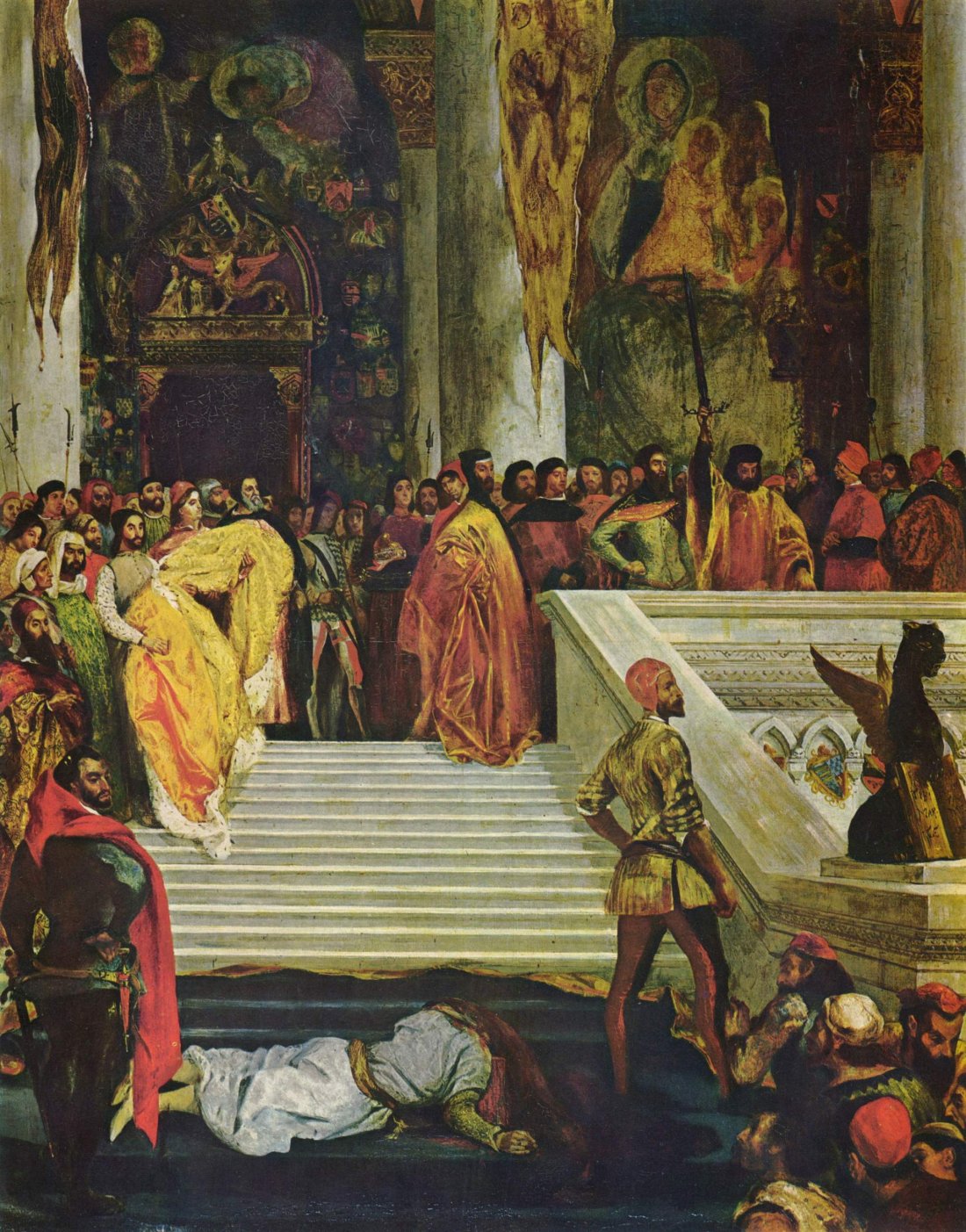
On this date in 1355, Marino Faliero* was escorted to the spot where he had been crowned Doge of Venice scant months before. There, he was ceremoniously relieved of his robes of state … and then his head.
Some fog surrounds the day’s proceedings, product not only of time but of the Doge’s executioners’ damnatio memoriae upon their victim. What was written was circumspect; even Faliero‘s portrait in the great hall of the Doge’s Palace was veiled.
What is known — or at any rate, was admitted by the elderly first citizen — is that the ruler attempted a coup against the overweening power of Venice’s great families.
The putsch was supposed to occur on April 15, with the bell of St. Mark’s Cathedral tolling on a fabricated hue and cry. In the tumult, the Doge’s supporters meant to cut down the nobles who flexed the real political muscle in the maritime republic and consolidate ducal power.
Why?
The salacious version has the old goat in a tiff with a noble, who made fun of his May-December marriage —
Marino Faliero of the beautiful wife,
Others enjoy her while he maintains her
A tribunal of fellow-nobles let the rascal off with a slap on the wrist.
Power being what it is, and princes and nobilities being born for conflict with one another across the centuries in Europe, one may as well discern a straightforward political intent — heightened, perhaps, by the then-dire state of Venice’s naval contest with Genoa.
Downright Byronic under either scenario … and Byron wrote a play about Faliero. The doomed ruler gives throat to quite a magnificent curse upon his city, with all the foresight of Byron’s half-millennium of hindsight:
I perish, but not unavenged; far ages
Float up from the abyss of time to be,
And show these eyes, before they close, the doom
Of this proud city, and I leave my curse
On her and hers for ever! —
…
— She shall be bought
And sold, and be an appanage to those
Who shall despise her! — She shall stoop to be
A province for an empire, petty town
In lieu of capital, with slaves for senates,
Beggars for nobles, panders for a people!
…
Amidst thy many murders, think of mine!
Thou den of drunkards with the blood of princes!
Gehenna of the waters! thou sea Sodom!
Thus I devote thee to the infernal gods!
Thee and thy serpent seed!
[Here the Doge turns, and addresses the executioner.]
Slave, do thine office!
Strike as I struck the foe! Strike as I would
Have struck those tyrants! Strike deep as my curse!
Strike — and but once!
This sort of thing knocking about among litterateurs in the 19th century practically guarantees an opera.
* Or simply “Marin Falier”, in the Venetian dialect.
On this date* in 1881, five members of the Russian terrorist organization Narodnaya Volya were publicly hanged in St. Petersburg, where they had slain the tsar Alexander II a few weeks before.
“The People’s Will” etched in blood its place in the dangerous late 19th century ferment of Russian revolutionaries. In time they would read as the politically immature forerunners of the Bolsheviks, whose turn into terrorism was a political dead end.
But as of this date, they were at the top of their arc.
Every St. Petersburg tourist sees the place Alexander II died: the spot received a picturesque church that is now one of the city’s principal attractions.
On March 13, 1881, Narodnaya Volyaassassinated the former tsar with a suicide bombing on the streets of St. Petersburg. With the death of the monarch who had emancipated the serfs, and was on the very day of his murder tinkering with plans to introduce an Assembly, liberalism arguably lost its weak purchase on Russia’s future.
Their dramatic gesture failed to ignite a social revolution or topple the autocracy, and they would find in Alexander III an implacable foe.
But while this spelled the end for the old man’s five assassins,‡ and even the end of Narodnaya Volya as an effective organization as the 1880’s unfolded, Alexander III’s efficacious repression was a Pyrrhic victory for the Romanov dynasty.
Refusal of Confession (Before Execution), by Ilya Repin, 1879-1885. (Via)
Alexander II’s death in the context of the times and its effect for Russia’s fate receive diverting treatment in a BBC In Our Times broadcast
* April 15 was the date on the Gregorian calendar; per the Julian calendar still in use in Russia at the time, the date was April 3.
** A quick summary of the strains of Russian revolutionary thought of the time here.
† Despite their dramatic tyrannicide, the Nihilists’ letter was angled for the consumption of mainstream post-Enlightenment Europeans. Karl Marx noted its “cunning moderation,” and its call for freedom and civil rights commonplace in more developed countries drew considerable support in the west. The Nihilists even took care to underscore their reasonableness a couple months later by condemning the senseless assassination of American President James Garfield. (See Inside Terrorist Organizations.)
But Honest Abe had one last order of business to attend to before his carriage called him away to destiny: the pardon of a convicted Confederate spy due to be shot in St. Louis two days hence. Lincoln’s handwritten clemency for George Vaughn was the last official act of his presidency.
Lincoln in Story (“The Life of the Martyr-President told in Authenticated Anecdotes,” a light 1901 volume for popular consumption) relates:
Before the war Vaughn, with his wife and children, lived in Canton, Mo. He was a friend of Martin E. Green, a brother of United States Senator James S. Green, both strong pro-slavery men. At the opening of the war Martin E. Green recruited a regiment and received a colonel’s commission from the Confederate Government. George Vaughn enlisted under Green’s command and fought through the war.
After a period of fighting, Green and Vaughn crossed into Mississippi from Tennessee, camping at Tupelo, Miss. Not having heard from his family, Green was anxious to hear from his old home, so he delegated Vaughn to go on the mission of delivering letters to his wife.
Vaughn had almost completed his trip, having reached La Grange, six miles south of Canton, when he was captured by a squad of Federal troops.
They searched his person, and, finding letters and papers concealed about him, he was tried as a spy and sentenced to be shot. John B. Henderson, Senator from Missouri, finally succeeded in getting an order from the President for a retrial, but the verdict remained as hitherto. Again Henderson appealed to Lincoln, who granted a third trial, with the same result.
Henderson was not disconcerted, and again went to Lincoln. It was on the afternoon of April 14, 1865 — a melancholy date — that the Senator called at the White House. He called the attention of Lincoln to the fact that the war was practically closed, and said: “Mr. Lincoln, this pardon should be granted in the interest of peace and conciliation.”
This story gravitates naturally to the clemency of “the Great Heart” (as, for instance, D.W. Griffith called Lincoln). Far be it from us to say otherwise, but this is also self-evidently a story of the unusual prerogatives of the well-connected: not just any accused spy could get two trial do-overs and then a pardon free and clear ordered straight from the White House.
Mr. Lincoln replied: “Senator, I agree with you. Go to Stanton and tell him this man must be released.”
Henderson went to the office of the Secretary of War. Stanton* became violently angry, and swore that he would permit no such procedure.
Vaughn had but two days to live, and Henderson hastened to make one more stand. After supper he went to the White House. The President was in his office, dressed to go to Ford’s Theatre, when the Senator entered and told of the meeting he had had with Stanton.
Lincoln turned to his desk and wrote a few lines on an official sheet of paper. As he handed it to Senator Henderson he remarked: “I think that will have precedence over Stanton.”
It was an order for an unconditional release and pardon — the last official paper ever signed by Abraham Lincoln.
* Stanton is supposed to have delivered the remark as Lincoln’s deathbed, “now he belongs to the ages” … an alleged epitaph whose actual content is subject, like all biography, to textual uncertainty and ideological redefinition.
Update: The excellent tale of a different soldier pardoned on this same date has recently been debunked by the National Archives in an academic scandal: in January 2011, researcher Thomas Lowry confessed to altering the pardon order for one Patrick Murphy from the true (and much less dramatic) date of April 14, 1864 to April 14, 1865.
Vaughn was actually pardoned just before Lincoln went to Ford’s Theater; Murphy (totally unconnected to Vaughn) was pardoned 365 days prior.
As of this date, it’s been 48 years since the United States military last carried out an execution — the Fort Leavenworth hanging* of John Arthur Bennett for rape.
An epileptic black soldier with a family history of mental illness, Bennett had enlisted to find a way up out of sharecropping. Instead, on Christmas Eve 1954, he drunkenly raped a 12-year-old girl near his base in Austria.
He spent six years awaiting execution — “six years,” observed the Los Angeles Times, “in which six other black soldiers were hanged while all four of the white men — many of them multiple murderers — were saved.”
Bennett dodged two execution dates, once receiving his stay during his last meal, but a seemingly compelling plea for clemency — the victim herself, and her parents, asked for mercy — availed Bennett nothing. His last frantic plea to the new president, John F. Kennedy, was dispatched with only hours yet to live.
I beg in the name of God … Will you please in the name of God and mercy spare my life?”
Coincidentally, but poignantly for this case, the Kirk Douglas vehicle A Town Without Pity opened a month before Bennett’s execution. In that film (trailer here), four American servicemen face capital trial for the rape of a German girl — and Douglas, as their lawyer, struggles to talk pity into someone so he won’t be obliged to humiliate the victim in court in order to save his clients from the noose.
The victim’s father in that movie is so blinded by his lust for vengeance that he forces Douglas to destroy his own daughter: striking contrast with the real-life father of Bennett’s flesh-and-blood victim, who wrote in support of clemency for his daughter’s assailant, “I know how hard it is for the parents when their own child is so close to the verge of death.”
Bennett’s milestone, however, is hardly assured of lasting much beyond this 49th year.
In 2008, President George W. Bush affirmed the death sentence of condemned Army cook Ronald Gray, the first such action by any U.S. president since Bennett’s day. According to the NAACP Legal Defense Fund’s Death Row USA most current as of this writing,** Gray is one of nine prisoners currently on the U.S. military’s death row.
* Curious to know about the procedure? The Library of Congress has that period’s Procedure for Military Executions — complete with exact diagrams — online in pdf form.
An alarming rumour, meanwhile, … spread throughout the Colonies; a rumour which, whatever of truth or fact, little or none, might be at the foundation, gathering, as it went, size and gloom, and dust of slander, was calculated to make them all feel very unhappy. The report was that a slave insurrection had been discovered, having its centre on the Berbice West Coast, but extending right and left so as to include all the shore from the Corentyne Coast to Mahaica, about eighty miles; that the negroes had chosen a governor and other officers; that it was their intention to murder all the white men, and take possession of all the rest; that some of the Demerara East Coast negroes were leaders in the rebellion, especially Philip, a member of the church on Le Resouvenir; and that instruction of the negroes was to blame.
…
the account which the negroes gave of the matter was, that there had been formed a society in imitation of the Freemasons, they wishing to have, as well as their buckras or masters, a society of that nature; and that the money collected was to support the poor and defray the expense of their dances, &c.; just as it had been formerly very common for them to assume the names of their masters, or of the Governor or Fiscal, and send invitations to friends to supper or a dance, and appoint a captain of their own as president of the feast; sometimes to put feathers in their hats at holiday time and parade the streets. “No one,” as far as Mr. Wray could learn, “had been injured by them, neither was any property destroyed,” yet on 12th April six of the unhappy people apprehended on the West Coast were executed in New Amsterdam as ringleaders, their heads cut off and fixed upon poles on the different estates to which they belonged; one of them white with age, whose master, Mr. Rader, told Mr. Wray that he denied to the last having any bad intentions. Several others were flogged under the gallows, and some were transported.
A proclamation was subsequently issued to the effect that as “the privilege allowed the slaves of the Colony, of publicly or privately dancing on estates and other places at stated periods, had been perverted by them to purposes of the most dangerous nature, all dancing was forbidden until next year, 1815, or the further pleasure of the Court;” … This was followed, late in the year, by another calling upon the colonists to pay their quota of the expenses incurred in crushing the plot and indemnifying the proprietors of the slaves capitally punished … Better still, the law concerning Sunday labour was amended in favour of the slave, forbidding field-work on that day, except in sudden emergencies; and further enactments were issued limiting and regulating the excessive use of the whip, and forbidding the burial of any slave dying suddenly or by suicide, or in consequence of punishment or hurt, without previously acquainting the authorities …
On this date in 2003, three men who commandeered a Havana harbor ferry and made a bid for American waters were shot as Cuba cracked down hard on a wave of hijackings.
Things moved extremely quickly for Lorenzo Enrique Copello Castillo, Barbaro Leodan Sevilla Garcia and Jorge Luis Martinez Isaac, described as “the three principal, most active and brutal leaders” of a gang of about 10.* It had been less than two weeks before that they seized the Baragua and ordered it to head for Florida.
The ship ran out of fuel, and the Cuban Coast Guard towed it back to Mariel. There were no injuries reported among the 50 passengers.
In the context of a then three-year-old moratorium on executions on the island, this probably would not have been enough to cost the ringleaders their lives, save that Fidel Castro perceived the need for a salutary example.
Despite the Yankee’s post-9/11 reprobation of “terrorism,” its definition of the phenomenon retained the familiar geopolitical biases — who is and is not a terrorist when it comes to Cuba is driven by anti-Castro Cuban exiles’ outsized political weight in Florida.
So Havana had some alarm to observe a spate of hijackings: two passenger planes had been redirected to Key West in the previous two weeks, and the passengers therefore offered American residency.
Accusing the U.S. of abetting terrorism — Washington blamed Cuba’s airport security — the government sent its own message when the Baragua desperadoes made it three hijackings in a fortnight.**
The Cuban Council of State, including Castro himself, reviewed the charges directly and gave the go-ahead to the shootings.
Hijackings did indeed stop.
Still, such a severe reprisal so swiftly enacted drew sharp rebukes from human rights advocates and even Cuban allies abroad.
Whether chastened by the reaction or just because it was indeed an exceptional circumstance, Cuba subsequently reverted to its de facto moratorium, and has not executed anybody else since this date six years ago. In 2008, Raul Castro commuted most of the extant death sentences in Cuba, leaving only three people — condemned on terrorism charges — still potentially in danger of execution.
* Others drew prison sentences ranging from a few years to life.
** The Cuban government claimed to have prevented yet another attempted skyjacking the night before the execution.

 It was March 12 — less than six weeks before — that