2013: Abdullah Fandi Al-Shammary, long time coming

On this date in 2013, the longest-serving (or -waiting) condemned prisoner in Saudi Arabia was beheaded for a murder committed 32 years prior.

Per media reports, he bludgeoned another man to death during a neighborhood brawl in Ha’il around the age of 21. Initially convicted of manslaughter, he paid a “blood money” fine and was released. He got married and resumed his life.

But two years after that — this seems to be about seven or eight years after the homicide — relatives of the victim convinced Saudi authorities to re-arrest Al-Shammary for murder, and this re-trial brought a death sentence.

Only after all the dead man’s heirs could come of age and all refuse offers of blood money to pardon him could he be put to death. Although he could not win the pity of these family members, he gained quite a lot of sympathy in Saudi Arabia since he essentially lived a lifetime on death row — reportedly a model prisoner who memorized the Quran and led his fellow prisoners in the dawn prayer of his last day on earth.

Ha’il Gov. Prince Abdul Aziz bin Saad bin Abdul Aziz personally interceded with an unsuccessful attempt to convince those heirs to pardon Al-Shammary; upon the latter’s execution donors gave his family a house and one million Saudi riyal (about a quarter-million dollars) in cash.

On this day..

1820: The pirates of the William

On this date in 1820, six pirates of the brig William hanged at the Maltese capital Valletta.

This vessel had the previous July departed her Liverpool berth hauling a cargo of lucrative sugar to Malta under the command of Charles Christopher Delano. The latter evidently labored under some legal judgment he considered unjust and convinced a none-too-reluctant crew that it would be “neither a sin nor a shame” to augment their wages by turning buccaneer.

To this end, the William waylaid an Italy-bound English brigantine, the Helen, off the Spanish coast just inside the Straits of Gibraltar on August 2. All that night and throughout the next day the pirates were engaged in transferring the Helen‘s cargo to their own ship, finally boring open the hull and abandoning her to sink with all hands aboard. The contingent of the Helen was able with difficult to force their way out of confinement and take a longboat (likewise disabled by the raiders and therefore in need of constant bailing) towards the coast until they encountered the aid of friendlier mariners. All survived their brush with the William although their prosecutor would rightly observe that “the confidence on which the prisoners relied for their security (and which has led to their present arraignment) must have arisen from the belief that all evidence of their crime was extinct, and that the intention of a deliberate and comprehensive murder must be added to their already too prominent offence.”

The William, meanwhile, had proceeded to Sardinia where her crew was able to unload some of the ill-gotten gains, and thence to Malta, where they discharged the remainder, along with the legitimate sugar cargo they’d carried out of Liverpool.* However, the Maltese transactions attracted enough suspicion that after the William left harbor, British insurance men there hired a ship named Frederick to apprehend the William — which was soon accomplished.

The case itself was open and shut, and from an appendix to its record we discover the usual climax that is this site‘s stock in trade:

On Friday morning, the 4th of February, at eight o’clock, the awful sentence of the law was carried into execution, on board the brig William, upon Charles Christopher Delano, Thomas Thompson, Benjamin Wilcock, John Smith, John Lewis, and John Webb, in the mode prescribed by the following order issued upon that occasion: —

That the William, brig, being the vessel in which the unfortunate convicts committed the flagrant and most atrocious act of piracy, be painted black, hauled out and anchored in the middle of the great port of Malta, viz. that of Valetta [sic]; and that the aforesaid most unhappy convicts be carried on board of the said vessel, at such time and in such manner as may hereafter be directed; and that on Friday morning, being the fourth day of the month, between the hours of eight and twelve, the aforesaid convicts, viz. Charles Christopher Delano, the late master of the said brig; Thomas Thompson, late mate of ditto; Benjamin Wilcock, late mariner and second mate of ditto; John Webb, late mariner of ditto; John Lewis, late mariner and cook of ditto; John Smith, late mariner of ditto; John Curtis, late carpenter of ditto;** and Reuben Marshall, late mariner of ditto, be hanged as may be directed between the hours of eight and twelve on Friday morning next, being the fourth day of the month of February, in the year of Our Lord one thousand eight hundred and twenty; and after hanging till they be dead, that they be cut down, put in open shells, and protected by a proper guard from his Majesty’s ships; that they be carried to the appointed place, viz. Fort Ricasoli, where the body of the late Charles Christopher Delano, late Captain of the William, is to be hung in irons on the right hand gibbet, next to the Port of Valletta, erected for this purpose in the north-west angle of the said fort; the body of John Lewis, late cook and mariner on board the same vessel, on the left hand gibbet in the same angle; the body of Thomas Thompson, late mate, on the right hand gibbet, erected for the purpose on the north-east angle of the same part of the said fort; and the body of John Smith on the left hand gibbet in the same fort; and that the four remaining bodies be interred at the feet of the before-mentioned gibbets — the body of Benjamin Wilcock under the gibbet on which the late Charles Christopher Delano hangs; the body of John Webb under the gibbet on which the late John Lewis hangs; the body of John Curtis under that on which Thomas Thompson hangs; and the body of Reuben Marshall under the gibbet on which John Smith hangs.

It is satisfactory to state, that the unfortunate man, who commanded the piratical vessel, confessed, in the last hours of his life, in order to reconcile himself with that Supreme Being on whom alone all his hopes then depended, that he was the prime mover and instigator of this most heinous crime.

His Majesty’s most gracious clemency was extended to the persons of the other two prisoners, Reuben Marshall and John Curtis, whose fatal sentence was respited on the spot, after the execution of their associates, by a warrant to that effect from his Excellency Sir Thomas Maitland,† issued at ten o’clock on the preceding night.

The following extract from the Malta Government Gazette will explain the laudable motives which induced His Excellency to this most humane and gracious act of clemency: —

We understand that His Excellency was induced to grant this mark of favour from the conviction, after a laborious investigation into the subject, that cases had occurred, although very rarely, of such clemency having been extended, in previous instances, to some of the parties convicted of aggravated piracy.

Such a precedent was, no doubt, most grateful to his Excellency’s feelings, and in the choice of the two persons to be spared, we understand his Excellency was guided by the uncommonly good character which Marshall had possessed previous to this atrocious act in which he was concerned; and in the case of Curtis, independently of his youth, by some very peculiar circumstances which had been disclosed in his favour by the captain and the rest of his ill-fated associates.

* One of the crew members reported receiving a total of 345 dollars from his share of the booty. Even allowing that “legitimate” fourfold share he claimed for himself as the captain, Delano apparently shortchanged his associates.

** So many Johns!

† Catch a Maitland cameo in this post from the Haitian Revolution.

On this day..

1860: James Stephens

James Stephens hanged in New York on this date in 1860, for poisoning his wife.

We’ve referenced passingly a number of 19th century hangings on then-trendy “upward-jerking” gallows — whose action is not to drop the offender down through a trap, but to drop a heavy weight which levers the offender up.

Thanks to the Feb. 4, 1860 edition of the New York Herald, we have a very detailed description of this macabre device.

Perhaps the reporter’s skepticism as to this machine’s humane efficacy is informed here by a bit of hindsight, for when it engaged to end the life of our Mr. Stephens,

Up went the culprit high into the air, not with a sudden violent jerk as usual, but slowly, as if by the strength of a man’s arms, instead of a powerful weight of some 300 pounds. It became evident immediately that something was wrong, and soon a rumor went round that the rope had been unwound instead of cut by the hangman. It appeared that the executioner, who was inexperienced, got frightened, and thus the barbarous manner of hanging the culprit was explained.

It was extraordinary that under these circumstances the unfortunate wretch, suspended between heaven and earth, did not exhibit indications of violent suffering. The moment the rope tightened around his neck, and he was elevated about half way up, a slight twitching of the fingers and kicking of the legs were perceptible. Then a few moments intervened without the slightest indication of suffering, except the hard breathing, which was fearful to listen to. After hanging two minutes in this way, another convulsive throe took place; the vessels in the neck seemed to be swelled almost to bursting, the fingers and wrists assumed a bluish hue, and the feet twitched once or twice spasmodically. Three minutes came, and with it a very feeble tremor showed itself in the whole body; but it lasted only a few seconds, when all further motion ceased, and life seemed to be completely extinct. The surgeons, Drs. Woodward, Simmons and Covell, viewed the body after a suspension of five minutes, and gave it as their opinion that animation was certainly gone; but the body was not lowered until fourteen minutes had expired. The surgeons then again examined the body, found no pulse, and the flesh icy cold. Considering the circumstances, the culprit died a remarkably easy death, which was owing, doubtless, to the feeble condition of his constitution. Had he been in good strength at the time of his execution there is no question but that he would have struggled in the most frightful agony for half an hour.

On this day..

Feast Day of St. Apronian the Executioner

This gentleman is far from antiquity’s most distinguished Christian martyr, but a site such as Executed Today can scarcely omit the sacrifice of one Saint Apronian the Executioner, who we learn was

Executioner for imperial Rome. He was a witness at the trial of Saint Sisinnius who was charged with Christianity in the persecutions of Diocletian. Sisinnius’ statement of his faith converted Apronian. He was martyred soon after.

Many other translations make him not executioner but notary; the Roman Martyrology from which these versions derive marks him as Commentariensis — a prison-keeper.

So there’s a good chance that “executioner” here is a bit of dramatic exaggeration. That said, while ancient Rome had plenty of executions, they wouldn’t necessarily be conducted by a single executioner as we imagine the office from subsequent European history. Depending on the rank of the accused (notably citizen vs. not), the location of the proceedings (Rome vs. provinces), and the prevailing climate, capital punishments might be handled by various civic entities or bodies of armed men.

The office of carnifex, literally “flesh-render” or “butcher”, had the brief to torture and execute slaves and foreigners; evidently, there are hints that this dishonorable position might also be held by a prison warden. Perhaps this is the basis for linking Saint Apronian to the gig.

Despite the distinctive (albeit not unique) professional attribution, Apronian is not the patron saint of executioners. In fact, there is no such sacred patronage, although searches for same turn up this jam:

On this day..

1927: Ada Bonner LeBoeuf and Dr. Thomas E. Dreher

A call back to the sadly demobilized crime blog CLEWS for the double execution on this date in 1927 of Louisiana adulterous lovers Ada Bonner LeBoeuf and Dr. Thomas E. Dreher, for the murder (via hireling) of Mrs. LeBoeuf’ husband …

The first-degree murder trial that followed a month after the murder of Mr. LeBoeuf was billed in the press as one of the Southland’s most sensational legal battles, since, it was reported, the South hadn’t convicted and hanged a white woman for murder since Reconstruction days, and Louisiana had never hanged a white woman for murder, not even in the days of French and Spanish rule.

The trial was a cross-country sensation. The state produced nearly a dozen witnesses who testified to the details of the scandal. Per these many witnesses, the light-o’-loves carried on their small-town affair in the “negro shacks” on the outskirts of the village. The evidence included love letters that were read aloud.

Read the whole jam here.

On this day..

1964: Nguyen Van Nhung, Diem executioner

Vietnamese General Nguyen Van Nhung was (apparently) executed on this date in 1964.

He was the victim of a South Vietnamese coup, after having been a key operative in the previous one. Back on 2 November 1963, he’d piled into the back of an armored personnel carrier with the fresh-deposed President Ngo Dinh Diem, and Diem’s brother Ngô Dình Nhu. When the APC arrived at its destination, Diem and Nhu were both dead.

According to the other putchist in the vehicle with him,

As we rode back to the Joint General Staff headquarters, Diem sat silently, but Nhu and the captain [Nhung] began to insult each other. I don’t know who started it. The name-calling grew passionate. The captain had hated Nhu before. Now he was charged with emotion … [and] lunged at Nhu with a bayonet and stabbed him again and again, maybe fifteen or twenty times. Still in a rage, he turned to Diem, took out his revolver and shot him in the head. Then he looked back at Nhu, who was lying on the floor, twitching. He put a bullet into his head too. Neither Diem nor Nhu ever defended themselves. Their hands were tied. (Source)

Nhung’s turn as executioner — no unfamiliar role; the guy was notorious for tallying his career kills in notches on his gun barrel — made his boss Duong Van Minh the new President … for all of three months. By all accounts he was a useless executive:

the ruling generals were paralyzed by ineptitude. They had formed a military revolutionary council, composed of twelve members who bickered endlessly. Their normal chairman, General Minh, boasted that the collegial arrangement would guarantee against the autocratic excesses of the old regime. In reality, Minh had contrived the committee in order to bolster his prestige without increasing his responsibility. He was a model of lethargy, lacking both the skill and the inclination to govern. As he confided to me one morning as we chatted in his headquarters, he preferred to play tennis and tend to his orchids and exotic birds than to preside over tedious meetings and unravel bureaucratic tangles … In a cable to Washington, [U.S. ambassador Henry Cabot Lodge] described Minh as a “good, well-intentioned man,” but added a prophetic note: “Will he be strong enough to get on top of things?”

On 30 January 1964, Minh was overthrown by another general, Nguyen Khánh, in a bloodless dawn coup. Well, virtually bloodless. The sole casualty was Nguyen Van Nhung, who paid for the assassination of Diem the next day via a pistol shot to the head at a Saigon villa. The official story promulgated by the new regime described him instead committing suicide in shame for the Diem murder.

On this day..

1953: Mat Indera, for the Bukit Kepong incident

Muhammad Indera — popularly known as Mat Indera — was executed on this date in 1953 in British-controlled Malaysia.

The imam turned Communist insurgent directed one of the signal bloodbaths of the Malayan Emergency — the tumultuous decade of political and guerrilla struggle against the British Empire for sovereignty.

Mat Indera’s contribution was the 1950 Bukit Kepong incident — an armed attack on a police station in that town that killed 19 policemen.


The 1981 movie Bukit Kepong dramatizes the events in question.

The British put a handsome price on the man’s head, and in 1952 someone took it.

His name and his deed are still controversial enough in Malaysia that a politician in 2011 found himself upon a sticky wicket for suggesting that Mat Indera was an anti-imperial hero.

On this day..

1733: Henry Neal, for shoes and breeches

That life is often cheap is Executed Today‘s stock in trade and few hanged cheaper than Henry Neal on this date in 19733.

Two bare entries at the Old Bailey Online constitute, we suspect, something close to the entirety of the documentary trail civilization holds for this soul.

Working backwards in time, we begin with the customary account of the Ordinary of Newgate, James Guthrie, of the twelvefold Tyburn hanging on January 29, 1733:

Henry Neal, Twenty Years of Age, his Father a Porter at Billingsgate died, and left him young, and his Mother being a poor Old Woman, could give him no Education at School, after he was Four Years Old; since which time he was forced to Work for his Bread at One Shilling per Week, and as he advanc’d in Years they gave him more. He commonly serv’d the Carters and Scavingers, till about Seven or Eight Months ago a Cart run over his Leg, which disabled him for Work. He own’d the robbing of Mr. Graves’s House, as was Sworn against him, but with a variation of Circumstances; for he said, that he only took the Hat, Breeches, and some small Things; but as to the Rings, the Guinea and a Half, he never saw them, as he said. He said, that he kept the Church, and was not very wicked, neither did he know the vile ways usually practis’d by such wicked People; and that what he did was merely for poverty and want, he having been disabled for Work, having fasted for three Days, and every body refusing him Charity. This is the Account he gave of himself, but as to the truth thereof, we leave it to others to judge thereupon. He was a poor ignorant Fellow, and knew but little of Religion. He declared himself Penitent for his Sins, that he believ’d in Christ his only Saviour, and that he died in Peace with all the World.


Here’s the preceding trial record that got him the noose, with testimony by those he robbed (the last of them seemingly written progressively to capture his distinctive accent):

Henry Neal, of St. Giles’s Cripplegate, was indicted for breaking and entring the House of William Graves, and stealing a Pair of Breeches, a Hat, a Pair of Shoes, 2 Gold Rings, a Guinea and a Half, and 2s. 6d. the Goods and Money of Richard Sims, and a Pair of Leather Breeches, the Goods of Tho Cecil, November 16, about ten at Night.

Richard Sims. I look after the Dog-house Bar. About six at Night the Prisoner came into the House, and desired me to let him warm himself by the Fire, for he said he had been with a Cart to Edmonton, and was very cold. He beg’d an old Pair of Shoes, upon which, I took Notice that those he had on were very bad; but I did not give him any. He staid till eight o’Clock, and then went away, and I shut up the Door as usual, and went to Supper at the Green Man on Windmill-Hill, and after Supper I returned to the House at the Bar, and went to Bed: Next Morning the Taylor came to mend my Breeches, which I had left in my Room overnight before I went to Supper, and there was two gold Rings, a Guinea and a half, and 2s. and 6d. in a brass Box in the Side-Pocket. I look’d for my Breeches but could not find ’em, and at the same Time I mist my Hat and my Shoes. Searching farther I found the Prisoner’s old Shoes, which were tied with Packthread, at the Door, and the Cellar Door was split in two. The Shoes made me suspect the Prisoner. Next week I met with him. He confess’d that he broke the Cellar-Door with a great Stone, and then thrust the wooden Bolt back, and got and took the Goods; that he had pawn’d the Hat in Golden-lane for 6d. and the Breeches in Turnbull-Street for a 1s. He went with me to those Places, and found them there. He had my Shoes upon his Feet.

– Thompson. I took the Prisoner in Coleman-street. I knew him before, and had heard there was a Warrant out against him. He had pilfer’d some Things while he had work’d with me there. I tax’d him with robbing Mr. Sims. He at first denied it, but afterwards own’d that he broke the Cellar-door open with a Stone, and had pawn’d the Hat and Breeches, but said he was drunk when he did it.

Tho. Cecil. I do keep the Dog-house-Bar for Mr. Graves, my Lord-Mayor’s Huntsman. My Breeches did hang up where I did lye, but being Zick, I was vorced to go home and leave’m there, and he have got ‘en on now.

Court. Go and look on ’em.

Cecil. Yes, these be they, I can zafely zwear to ‘n.

The Prisoner made no Defence, and the Jury found him Guilty. Death.

On this day..

1932: Jose Feliciano Ama, Izalco indigenous peasant

El Salvador campesino Jose Feliciano Ama was hanged in the town square of Izalco on this date in 1932 during a ferocious repression of the peasantry.

In an environment of desperate economic immiseration for nearly all Salvadorans below the landed oligarchy, the heavily indigenous western peasantry rebelled on January 22, 1932 — aided or led by the Communist Party.*
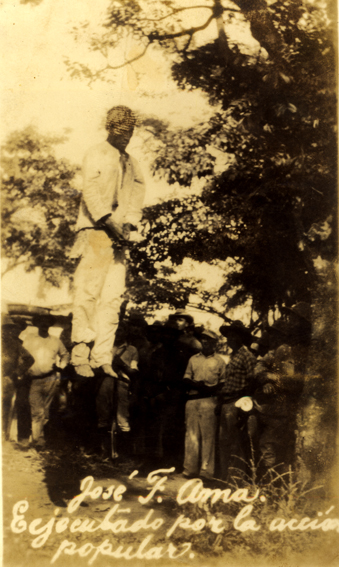
This fate of this rebellion might be inferred by its historiographical sobriquet, the Salvadoran peasant massacre — or simply la Matanza, the slaughter.

In numerical terms, it ran to well into the tens of thousands, maybe up to 40,000 — indiscriminately visited on peasants of originario complexion in the zone of rebellion, batches of them summarily shot into mass graves they’d been forced to dig for themselves.

In the Pipil town of Izalco, where coffee latifundias dominated the best agricultural land,* up to a quarter of the population was butchered. None of those put to la Matanza were more recognizable nor more vividly recalled than the local rebel leader Feliciano Ama English Wikipedia entry | Spanish), extrajudicially noosed in front of the Izalco church. Today a small plaque in this square honors him as a popular martyr.

* See States and Social Evolution: Coffee and the Rise of National Governments in Central America. An heiress of coffee magnate and former president Tomas Regalado allegedly forced our Feliciano Ama off his lands by dint of brute force.

On this day..

1872: George “Charcoal” Botts

It’s the old, old story: conniving war profiteer helps client get divorce, conniving war profiteer installs divorced client as mistress, rival lover also awaiting divorced client’s divorce shoots conniving war profiteer, rival lover winds up on Executed Today.

It’s the story of George Botts (hanged January 27, 1872) and D.C. Civil War gadabout Oliver “Pet” Halsted. Friends of the site Murder By Gaslight has the details.

On this day..