2006: 27 at Abu Ghraib Prison

On this date in 2006, 27 hanged in Baghdad’s notorious Abu Ghraib Prison.

It was just days after the American occupation forces handed back to the Iraqi government control of Abu Ghraib, scene of such iconic contributions to the annals of human rights abuse as this:

Iraqi prisoners would soon miss the old boss.

In the first (known) mass execution since the reign of Saddam Hussein — whose own turn at the gallows was just a few months away — 26 men and one woman were hanged on a variety of terrorism, murder and kidnapping charges.

“This is the message I have for the terrorists,” Prime Minister Nouri al-Maliki said in announcing the executions. “We will see that you get great punishment wherever you are. There is nothing for you but prison and punishment.”

On this day..

2007: Duan Yihe, mistress-murderer

On this date in 2007, former senior Chinese lawmaker Duan Yihe was executed in Jinan along with the policeman nephew who had helped him spectacularly assassinate Duan’s mistress just two months before.

Taking up with a teenager 30 years his junior must have been an appealing perk of the job when Duan Yihe was a rising official in the early 1990’s.

Fast forward 14 years, and he’s in for several cars, a couple of apartments, and tired of the now 31-year-old Liu Haiping, who’s blackmailing him for more. Much less appealing.

Solution?

Why, detonate a remote-controlled explosive in her car.

“The blast was so powerful that her Honda sedan was ripped apart, her lower body was destroyed and her torso landed 30 metres away,” reported The Times.

The case helped crystallize growing official concern with the corrupting potential of senior officials’ ubiquitous mistresses. The day before the car-bombing, the Chinese Supreme Court issued a ruling extending anti-graft laws to mistresses.

The method of execution (either gunshot or — more likely — lethal injection) was not publicized.

On this day..

1942: Bishop Gorazd of Prague

On this date in 1942, the Orthodox Bishop Gorazd — Matej Pavlík is what his parents named him — was shot in Prague along with priests of Sts. Cyril and Methodius Cathedral for sheltering the Czechoslovakian resistance fighters who had lately assassinated Nazi Reichsprotektor Reinhard Heydrich.

After icing Heydrich, the assassins had taken shelter in the Cathedral basement … only to be betrayed by a onetime compatriot.

The Nazis besieged the church — fiercely, but hopelessly defended.

With the Germans already visiting unspeakable collective punishment for the murder, the act of sheltering the assassins had trouble written all over it.

The Serbian-consecrated first bishop of the Czech Orthodox Church, Gorazd sought to limit the potential scope of reprisals by writing the German authorities, directly claiming responsibility — even though, in fact, he hadn’t found out who his sanctuary was concealing until several days after they had already been installed by sympathetic priests.

He enjoyed the characteristic hospitality of the Gestapo, and was shot at Kobylisy along with priests Vaclav Cikl and Jan Sonnevend; theologian Vladimir Petrek followed them the next day.


From left to right (not counting the guards, of course): Jan Sonnevend, Vaclav Cikl, Vladimir Petrek, and the bearded Bishop Gorazd, at their public show trial September 3. From the Czech Ministry of Defense’s slick and well-illustrated publication (pdf) on Operation Anthropoid.

The Czech Orthodox Church was suppressed while the Germans held Czechoslovakia. Bishop Gorazd is recognized in the Orthodox martyrology on August 22nd (the date of his death per the Julian calendar).

On this day..

1918: Fanya Kaplan, Lenin’s would-be assassin

On this date in 1918, a 28-year-old Jewish revolutionary was shot in Moscow for attempting to murder Vladimir Lenin.

Fanya (“Fanny”) Kaplan had actually drawn a life sentence for trying the same trick on a tsarist official 12 years before, so you couldn’t say she was a reactionary element.

No, she was a member of the peasant-based Socialist Revolutionary Party, the SRs — the Bolsheviks’ onetime coalition partners who had splintered into left and right factions, the latter being shut out of power when the Constituent Assembly was closed.

A peasant herself, Kaplan was incensed at the Bolshevik power grab and shot Lenin twice at close range as he left a factory on August 30.

Taken immediately, Kaplan clammed up in interrogation.

My name is Fanya Kaplan. Today I shot at Lenin. I did it on my own. I will not say whom I obtained my revolver. I will give no details. I had resolved to kill Lenin long ago. I consider him a traitor to the Revolution. I was exiled to Akatoi for participating in an assassination attempt against a Tsarist official in Kiev. I spent eleven years at hard labour. After the Revolution I was freed. I favoured the Constituent Assembly and am still for it.

Realizing there was no information to be had from her, the Cheka had her executed four days after her crime — an affair organized by Yakov Sverdlov, the same guy who had recently disposed of the tsar.

On the same day Kaplan took her shots at Lenin, Bolshevik Moisei Uritsky was (successfully) assassinated. The two murders helped justify the Red Terror officially initiated on September 2 — which saw thousands of politically-motivated arrests and executions as the Bolsheviks consolidated their hold on power.


YouTube hosts a great many dreadful student dramatizations of historical events, but this one of Fanya Kaplan by Georgia Tech students is remarkably watchable.

On this day..

1685: Dame Alice Lisle, first victim of the Bloody Assizes

On this date in 1685, an infamous judicial bloodbath claimed its first and most controversial victim.

Dame Alice (or Alicia) Lisle (or Lyle) was beheaded in Winchester for harboring fugitives from the Battle of Sedgemoor, where pretender and fellow execution-fodder Monmouth was defeated.


Alice Lisle Concealing Fugitives, by Edward Matthew Ward. Detailed views here.

The aged woman had evidently taken in the fugitives John Hickes and Richard Nelthorpe as a humanitarian gesture when they happened to show up at her door; despite her late husband’s part in the regicide of Charles I, Alice Lisle doesn’t seem to have been the political type.

So the fact that Lisle was charged with treason was a national (indeed, transatlantic) controversy … and the fact that she was the first of the thousand-plus rebel prisoners tried set the tone for the legal circuit this month that became remembered as the Bloody Assizes.

In an attainder later reversed under William and Mary, Lisle was convicted and condemned to burn (the sentence was commuted to beheading) by notorious hanging judge Lord Jeffreys.

Macaulay describes this infamous landmark case.

If Lady Alice knew her guests to have been concerned in the insurrection, she was undoubtedly guilty of what in strictness is a capital crime … [t]he feeling which makes the most loyal subject shrink from the thought of giving up to a shameful death the rebel who, vanquished, hunted down, and in mortal agony, begs for a morsel of bread and a cup of water, may be a weakness: but it is surely a weakness very nearly allied to virtue … no English ruler who has been thus baffled, the savage and implacable James [II] alone excepted, has had the barbarity even to think of putting a lady to a cruel and shameful death for so venial and amiable a transgression.

Odious as the law was, it was strained for the purpose of destroying Alice Lisle … [T]he witnesses prevaricated. The jury, consisting of the principal gentlemen of Hampshire, shrank from the thought of sending a fellow creature to the stake for conduct which seemed deserving rather of praise than of blame. Jeffreys was beside himself with fury … He stormed, cursed, and swore in language which no wellbred man would have used at a race or a cockfight …

The jury retired, and remained long in consultation. The judge grew impatient. He could not conceive, he said, how, in so plain a case, they should even have left the box. He sent a messenger to tell them that, if they did not instantly return, he would adjourn the court and lock them up all night. Thus put to the torture, they came, but came to say that they doubted whether the charge had been made out. Jeffreys expostulated with them vehemently, and, after another consultation, they gave a reluctant verdict of Guilty.

Lisle was the only victim of the Assizes at Winchester, but her death would preview the wholesale slaughters to follow.

Jeffreys reached Dorchester the next day and his pitiless tribunal began its work of sentencing hundreds to the various modes of English execution, or else to convict transportation — a fate more lucrative for the crown, but little less terrible to its victims.

“More than three hundred prisoners were to be tried,” Macaulay noted. “The work seemed heavy; but Jeffreys had a contrivance for making it light. He let it be understood that the only chance of obtaining pardon or respite was to plead guilty.”

For all that, the Assizes greatly injured the Stuart cause, precisely because of indiscriminately butchering the likes of Alice Lisle.

Judge Jeffreys’ reputation as a vicious, politically-motivated jurist landed him in the Tower of London by 1689, when he, er, injudiciously stuck around after James II fled the country; reportedly, Jeffreys was lucky to make it to the Tower under guard from the mob that wanted to tear him apart.

Though posterity has the luxury of on-the-one-hand, on-the-other-hand assessment, he remains a villain to most accounts … like the vengeful verse to his memory that prefaces this Victorian text on the Assizes.

To Tyburn thee let carrion Horses draw,
In jolting Cart, without so much as straw;
Jaded, may they lye down i’ th’ road, and tyr’d,
And (worse than one fair hanging, twice bemir’d)
May’st thou be maul’d with Pulchers Sexton’s Sermon,
‘Till thou roar out for Hemp-sake, Drive on Car-man.
Pelted and Curst i’ th’ road by every one,
E’ne to be hang’d may’st thou the Gauntlet run.
Not one good Woman who in Conscience can
Cry out,–‘Tis pitty,–Troth, a proper Man.
Stupid and dull, may’st thou rub off like Hone,
Without an open, or a smother’d groan;
May the Knot miss the place, and fitted be
To plague and torture, not deliver thee;
Be half a day in Dying thus, and then
Revive like Savage, to be hang’d agen.
In Pity now thou shalt no longer Live,
For when thus satisfy’d, I can forgive.

Yikes. Jeffreys actually succumbed to a kidney disease a few months into his captivity. Close enough.

On this day..

1851: Narciso Lopez, filibuster

On this date in 1851, Venezuelan-born adventurer Narciso Lopez was garroted in Havana for his repeated expeditions to overturn Spanish dominion in Cuba.

Narciso Lopez had fought for the Spanish against Simon Bolivar, and migrated to Cuba when Bolivar carried the day.

Initially a loyal government functionary, Lopez gradually became sweet on the anti-Spanish cause, and fled Cuba for the United States (pursued by a death sentence in absentia) when a treasonable conspiracy of his was discovered.

Like MacArthur, he meant to return — and did.

Lopez crisscrossed the United States, drumming up support for filibustering raids on Cuba meant to detach it from Spain and make it an American slave state.

In this proposed enterprise, wedded alike to both national expansionism and southern sectionalism, Lopez rubbed shoulders with the likes of Jefferson Davis and Robert E. Lee, even helping precipitate criminal charges against a former U.S. Senator who backed him.

But the five expeditions went from bad to worse, until Lopez was captured in August 1851.

Tom Chaffin’s Fatal Glory: Narciso Lopez and the First Clandestine U.S. War Against Cuba, describes the scene of his death, just days after capture.

Between the wide Gulf sky and the waters of Havana harbor, the Gothic Morro Castle’s high tabby walls gleamed in the Sunday morning light on September 1, 1851. Though it was barely seven o’clock, a noisy crowd of four thousand already had gathered in a public plaza just across the harbor from the Morro. The plaza spread below the walls of the Punta, a small citadel guarding the western side of Havana’s finger-shaped harbor. At the center of the crowd’s attention on the cloudless dawn was a ten-foot high wooden scaffold that rose from the plaza. At its top was a garrote, an iron chair with a pair of clasps on its back. The mechanics of this grim machine were simple: just below its clasps, designed to grip the condemned man’s head, was a metal collar for his throat. With a turn of the screw on the garrote’s back, the collar tightens, strangling the prisoner.

…

Lopez was brought out at seven o’clock. At age fifty-four, with his mustache, white hair, and dark piercing eyes, he remained a handsome man. Accompanied by a line of Spanish soldiers, he wore a long white gown and a white cap. His wrists were tied in front. Another rope, binding his elbows, was knotted from behind, its strands held by guards. With two friends who had been allowed to join him, Lopez climbed the steps of the wooden tower. At the top he knelt in prayer for a moment, then rose and faced the crowd. “Countrymen,” he said in a steady voice that observers would recall as one of remarkable composure, “I most solemnly, in this last awful moment of my life, ask your pardon for any injury I have caused you. It was not my wish to injure anyone, my object was your freedom and happiness.” When an officer interrupted, Lopez quickly concluded, “My intention was good, and my hope is in God.”

He bowed, took his seat in the iron chair, and eased his head back. The executioner, a black man, placed the iron clamps around Lopez’s throat. His feet were then tied to bolts on the sides of the chair. He exchanged a few words with his friends and kissed a small cross. Then, with a turn of a screw, Narciso Lopez’s three-year campaign to vanquish Spain’s dominion over Cuba came to an end.

This forbidding example put a real damper on American plans to annex Cuba (for a while), but hardly stanched the North American appetite for filibustering.

Despite the bad end of his own project, Lopez managed to bequeath the eventually independent Cuba the flag (Spanish link) which it still flies today.

On this day..

1852: Fatimih Baraghani, Tahirih the pure

On this date in 1852, the Persian poet Fatimih Baraghani was strangled with her veil in a Tehran garden for her women’s rights advocacy.

She’s best known as* Tahirih, the title meaning “pure one” given her by the Bab.

The moniker denoted the latter’s support of her in the Babi community that would eventually develop into the Baha’i faith. Tahirih was notable even within that outlawed sect for her staunch advocacy of female emancipation; in 1848, she dramatically unveiled in public at a conference to underscore her rejection of Islamic gender law.

Known for her intelligence as well as her militancy, she came under increasing police pressure. She was killed along with about 30 of her faith in the Persian crackdown on Babism after an assassination attempt on the Shah.

Her reported last words were modern-sounding indeed:

You can kill me as soon as you like, but you cannot stop the emancipation of women.

Most readily available material about this inspirational character tends to the devotional, as with this video series; Executed Today does not necessarily endorse the position that at her apparent death she actually only escaped to trans-dimensional hiding.

* Fatimih Baraghani is also known as Qurratu’l-‘Ayn, or Qurrat al-‘Ayn — “consolation of the eyes.”

On this day..

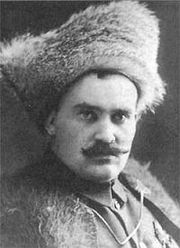
1946: Grigory Semenov, anti-Bolshevik

At 11 p.m. this date in 1946, White general turned Japanese collaborator Grigory Semenov (or Semyonov) was hanged for a generation’s worth of anti-Soviet depredations in the Far East.

The tsarist officer Semenov joined the Russian Civil War as a notoriously vicious White commander with the grandiosely retro title of Ataman of the Baikal Cossacks.

According to G. Patrick March, Semenov’s “penchant for killing, torturing, and looting” extended to executing a captured socialist by tossing the man into his locomotive’s fuel chamber.

Although also a rival in the suicidally fractious White political jostle, Semenov was the designated successor of Aleksandr Kolchak when the latter was shot in 1920, but by that time there wasn’t much left to succeed.

Knocking around the interwar era in gloryless exile, Semenov was an easy recruit for the Japanese war machine, which was in the market by the late 1930’s for locals with command experience and a grudge against Moscow and put him on retainer in Manchuria. Like the Soviet-Japanese front in general after Khalkin Gol, nothing much came of that enterprise; the Ataman’s last great hurrah was but a footnote for Japan, and his death would be a footnote in the annals of postwar victors’ justice.

Having picked a loser two wars in a row, Semenov was captured during the short-lived Soviet invasion of Manchuria at the tail end of the war and packed off for the inevitable. Five co-defendants, including Semenov’s son Mikhail, suffered death as well — although they were simply shot, while Semenov was ignominiously hanged. (According to White Terror: Cossack Warlords of the Trans-Siberian, the hanging was either botched or engineered to be an ugly strangulation job.)

On this day..

1906: Zinaida Konoplyannikov, assassin

On this date in 1906, less than three weeks after she had assassinated tsarist general Georgiy Alexandrovich Min (Russian biography), revolutionary Zinaida Vasilevna Konoplyannikov was hanged at Schlisselburg fortress near St. Petersburg.

Konoplyannikov is mostly noted in Russian sources online (for instance, here and here).

The daughter of a soldier and a peasant, she was educated — hardly a given for a low-born girl in the late 19th century — and taught in the Baltics and St. Petersburg around the turn of the century. By her profession, the plight of her similarly unprivileged students helped radicalize her.

She had a couple arrests for the usual subversive stuff (distributing illicit propaganda and the like) during Russia’s brief flowering towards liberalism in the 20th century’s early years. Those years would be bloodily reversed as tsarism reasserted itself after the revolutionary moment of 1905.

Konoplyannikov avenged herself on one of the great villains (from her standpoint) of that reversal, G.A. Min — commander of the Semenyovsky Life Guards regiment which bloodily bombarded Moscow’s Red Presnia working-class district to crush the last bastion of revolutionary sentiment in December 1905 at the cost of more than 1,000 lives.

Konoplyannikov gunned him down at a Peterhof train station the following August; in a closed military courtroom (giving her no opportunity to use the trial as an oratorical platform), the assassin was condemned to hang in less than an hour.

She was reported to have died calm, sure in the approaching victory of her cause:

the history of the Russian nation is a record of blood … the autocratic and bureaucratic structures are maintained only by violence … You cannot build anything upon the place of the old without first destroying the old. If it is impossible to catch ideas with bayonets, it is also impossible to resist bayonets with ideas only …

No repressions, no arrests, no prisons, no exiles, no shootings, no punitive expeditions, no pogroms, will stop the rising national movement.

I die with one thought: forgive me, forgive me, my people! I have so little to give you — only this, my life. I die full of faith in what will come … when the throne will crumble, and over the Russian plain, a broad, bright sun of freedom arise.

According to Abraham Ascher, Min’s assassination so spooked Tsar Nicholas II that for a time he refused to leave his room … a evocative and emblematic summary of the Romanov dynasty’s ultimately fatal dilemma.

On this day..

1944: Bronislav Kaminski, Waffen SS collaborator

On this date in 1944, the Gestapo eliminated more-trouble-than-he-was-worth Russian SS man Bronislav Kaminski.

The St. Petersburg-born Kaminski was Soviet by citizenship, but not Russian by nationality. Half-German and half-Polish, he’d done time twice for his questionable loyalties during the paranoid 1920’s and 30’s.

Turns out the commissars were on to something … or maybe, to paraphrase the old saying, that a Nazi is a Communist who’s been to the gulag.

Either way, when the front swept past Belarus where Kaminski was serving his post-release internal exile, the engineer jumped on an opportunity to join a classmate with the Russian National Liberation Army (RONA, or ROA). Kaminski soon rose to command the anti-partisan “army,” and earned an Iron Cross and the rank of Major General when it was incorporated into the Waffen-SS.

Unfortunately for Kaminski — and more so for anyone who happened to be in his unit’s vicinity — the 29th Waffen Grenadier Division was much better at roughing up partisans and their presumed civilian sympathizers than conducting disciplined military operations.

Little more than a roving band of armed thugs,* it was completely ineffective in the Siege of Warsaw earlier in August 1944, spending its time raping and looting instead.

That, evidently, was enough for Himmler, who had Kaminski eliminated** in punishment for his own looting (the booty was supposed to belong to the Reich), and the alleged rape-murder of German women along with all the expendables in Warsaw.

The exact trigger for this execution (for the juridical machinery always veils acts of discretion and intentionality; certainly, this is evident in a state like Nazi Germany) has never been completely clear; it may have been that between Kaminski and turncoat Red Army general Andrei Vlasov, the shrinking Reich had room enough for only one Russian commander.

Devil knows what he was commanding, anyway.

When, post-Kaminski, Vlasov assigned the remains of the RONA to Ukrainian collaborator Sergei Bunyachenko, the latter fumed, “So that’s what you’re giving me, bandits, robbers and thieves! You’ll let me have what you can no longer use!” … and soon bailed on his “patrons” by switching sides in the war yet again.

* It had some operations with the notorious Dirlewanger Battallion.

** The official announcement was that Kaminski had been killed in a partisan ambush; crazy conspiracy theorists refused to buy it.

On this day..