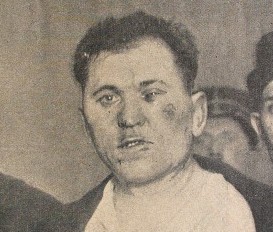
On this date in 1961, two former Turkish ministers of state were hanged together on the island of Imrali.*
A ten-month trial on the island of Yassiada had ended just the previous day, condemning 15 to death; 12 sentences were commuted, leaving only the biggest fish to fry.
Zorlu, the former Foreign Minister, and Polatkan, late the Finance Minister, were both implicated in the financial crimes often characteristic of high office. Zorlu was also condemned for helping instigate a notorious 1955 anti-Greek riot. The two were helicoptered to Imrali for a pre-dawn hanging.
Zorlu, at least, was reported to have died game. He helped slip the noose over his own neck, and at his hanging “asked that he be allowed to kick away the chair himself. Permission was granted.” (Los Angeles Times, September 18, 1961)
* Tangentially, the prison on Imrali is the one American drug-smuggler Billy Hayes subsequently escaped from. Hayes went on to write Midnight Express, later adapted for the silver screen by Oliver Stone.
On this date in 1842, church bells throughout Central America tolled in celebration of the death by firing squad of the great liberal statesman Francisco Morazan.
Morazan monuments litter Central America. Colombian writer Gabriel Garcia Marquez once claimed (he later backed away from it) that this equestrian job in Tegucigalpa, Honduras was actually a remaindered statue of Napoleonic general Michel Ney.
The self-educated soldier and politician rose to helm the short-lived Federal Republic of Central America after it broke free of Spain (and a brief hitch with Mexico) but before it splintered into Guatemala, Honduras, Nicaragua, El Salvador and Costa Rica.
After beating conservative forces in the field, Morazan forced upon them a slate of liberal reforms that had the knives out for him for a decade-plus: free speech, civil equality, separation of church and state guaranteed by the expulsion of clergy. As this patronizingly favorable biography from the late 19th century wrote,
His ambition was for the advancement and development of Central America; and while the means he used cannot be entirely approved, his purpose should be applauded. His crusade was quite as important in the civilization of this continent as the bloody work England attempted to accomplish in Egypt and the Soudan. He was better than his race, was far in advance of his generation …
Thanks, racist uncle.
Anyway, the Federal Republic fell apart in the late 1830s as its constituent statelets broke apart and the familiar conservatives-landowners-priests coalition started getting the upper hand on Morazan. After an 1842 landing that briefly established him as ruler of Costa Rica (he had also had shifts as the head of state of El Salvador and of Honduras), he overreached with an announcement for universal conscription to form an army that would reunite the Central American state.
“Posterity,” he said before the bullets felled him, “shall do us justice.”
On this date in 1932, deranged Russian emigre Paul Gorguloff was guillotined for murdering President Paul Doumer four months before.
The forgettable Paul Doumer — distinguished for reasons quite beyond his control as the penultimate President of the Third Republic — was a week short of his one-year anniversary in office when the nutbar gunned him down at a Parisian book fair.
Disturbed 37-year-old Gorguloff had some impenetrably incoherent justification for the murder having to do with some “Idea” formed in a trance-like state.
From the moment of my arrival in Paris, and even in the train, I had a sort of hypnotic obsession that I must kill the President. I went and prayed in Notre Dame; then I drank heavily, and gradually decided to kill myself, the idea almost supplanting that of assassination. After drinking I conceived the idea of getting arrested to prevent me from committing the crime, so I asked a policeman on the Boulevard Saint-Michel a lot of stupid questions, hoping that he would ask for my papers and, finding them not to be in order, arrest me. All the time the Devil was saying: “Kill yourself, if you like, but only after you have killed the President.” Until 2 o’clock in the afternoon on the day of the crime I drank in a bar, emptying a bottle of cognac in the hope that I would get too drunk to do anything. Nevertheless I finally went to the book exhibition in the Rue Berryer, where the President was expected. After I had spoken with M. Farrere [he was later shot in the arm by Gorguloff] and looked at a few books, the President arrived. I was in a kind of hypnotic sleep, and fired without really knowing what I was doing. (The Times of London, May 18, 1932)
Whatever this daemon may have amounted to in Gorguloff’s mind, he cherished it; the brief trial was punctuated by repeated invocation of the never-explicated “Idea”:
France, listen to me! I am the apostle of my Idea. My crime was a great protest in the name of the miserable ones who wait ‘over there’ [in Russia] … My Idea is more precious than my life. Take my life, but save my Idea. (The Times of London, July 26, 1932)
The “idea” may have been fame. Gorguloff’s defense counsel — understandably pinning its hopes on an insanity defense (French link) — entered into the record a request the assassin had forwarded Czech authorities to be launched in a rocket to the moon; a correspondent for Le Matindiscovered that the killer had nursed similarly half-baked plots to do in Hindenburg, Lenin, and Czech President Thomas Masaryk instead/as well.
Gorguloff was beheaded just before 6 a.m. outside La Sante Prison in Paris.
At 9:30 a.m. this day, as the American army raised the Stars & Stripes over Chapultepec Castle during the Mexican-American War, it simultaneously carried out a mass hanging of 30 Irish deserters who had gone over to Santa Anna — the Saint Patrick’s Battalion, or the San Patricios.
Irish had been migrating to the United States en masse even well before the Great Famine got rolling in 1845.
And for those of that great migration wave who wound up in the service fighting the Mexican-American War, there was a hint of deja vu — an Anglo and Protestant imperial power seizing land from a “black”* and Catholic neighbor?
Some of the Irish decided they were fighting for the bad guys, and switched sides.**
These were the plurality (though not necessarily the majority) of the couple hundred soldiers who comprised the Saint Patrick’s Battalion. German immigrants and other nationalities, along with American-born deserters (desertion during the Mexican-American War seems to have been rife), made up the balance.
Knowing full well the fate that would await them upon capture, the San Patricios were renowned for their ferocity in battle; at the hopeless Battle of Churubusco, they reputedly forced down a white flag that Mexican comrades were trying to hoist on three separate occasions.
Eventually, the ammunition ran out, and with it, the San Patricios’ luck.
Within days, courts-martial began handing out death sentences to almost the whole of the surviving unit. U.S. General Winfield Scott subsequently reduced a number of sentences, and those who had deserted before the war couldn’t legally be executed … but even the “lucky” ones suffered faint-inducing scourgings and branding on the cheeks with the letter “D”.
And 50 men more were still bound for the gallows.
Twenty hung in the days prior to this at two separate sites, but the Yanks’ piece de resistance was an orchestrated scene on the second day of the Battle of Chapultepec.
On September 13, 1847, at dawn, Harney ordered the thirty remaining prisoners to be brought forward. They stood on wagons with nooses placed around their necks. This included one man who had lost both legs and was unable to walk to his own execution. The site of these executions was within viewing distance of the site where the final battle — the outcome of which could not have been in doubt — was to be fought. There the sentenced soldiers watched until finally, at 9:30, the US victors raised the American flag atop Chapultepec Castle.† At that point the order was given, the wagons were pulled away and the men were all hanged.
It must be remembered that the San Patricios had been standing, bound hand and foot, each with his head in a noose, for nearly four hours in the burning Mexican sun. When Harney finally gave the order for the hangings to proceed, such was the relief that their sufferings were finally at an end that “some of the men actually cheered as the nooses tightened and the wagons pulled away.”
The cruelty of the punishments led a Mexican paper to spit,
these are the men that call us barbarians and tell us that they have come to civilize us … May they be damned by all Christians, as they are by God.
They brand with hot irons the faces of the Irish deserters and then hang them from the gallows. The Saint Patrick Irish Battalion arrived with the invaders, but fought alongside the invaded.
From the north to Molino del Rey, the Irish made theirs the fate, ill fate, of the Mexicans. Many died defending the Churubusco monastery without ammunition. The prisoners, their faces burned, rock to and fro on the gallows. -Eduardo Galeano, Masks and Faces
* The “blackness” of the Irish and the process of their “becoming white” later in the 19th and 20th centuries is one of the more illustrative and well-documented case studies of race and racism as social rather than biological constructs.
** They weren’t alone in this opinion. Many hundreds of miles from the fighting, Henry David Thoreau famously landed in jail for tax resistance in 1846 largely because of his disgust with the war. From Civil Disobedience:
The government itself, which is only the mode which the people have chosen to execute their will, is equally liable to be abused and perverted before the people can act through it. Witness the present Mexican war, the work of comparatively a few individuals using the standing government as their tool; for in the outset, the people would not have consented to this measure.
† The capture of Chapultepec Castle, forgotten north of the Rio Grande, is still commemorated in Mexico for the heroism of six teenage cadets who died in its defense. The last of their number, Juan Escutia, leapt from the castle walls wrapped in the Mexican standard to prevent its capture.
General de Maud’huy had just been roused from sleep on the straw of a shed and was standing in the street when a little group of unmistakable purport came round the corner. Twelve soldiers and an NCO, a firing party, a couple of gendarmes, and between them an unarmed soldier. My heart sank and a feeling of horror overcame me. General de Maud’huy gave a look, then held up his hand so that the party halted, and with his characteristic quick step went up to the doomed man.
He asked what he had been condemned for. It was for abandoning his post. The General then began to talk to the man. Quite simply, he explained discipline to him. Abandoning your post was letting down your pals, more it was letting down your country that looked to you to defend her. He spoke of the necessity of example, how some could do their duty without prompting but others, less strong, had to know and understand the supreme cost of failure. He told the condemned man that his crime was not venial, not low, and that he must die as an example, so that others should not fail. Surprisingly, the wretch agreed, nodding his head. He saw a glimmer of something, redemption in his own eyes, a real hope, though he knew he was about to die. Maud’huy went on, carrying the man with him to comprehension that any sacrifice was worthwhile while it helped France ever so little. What did anything matter if he knew this? Finally, de Maud’huy held out his hand: ‘Yours also is a way of dying for France,’ he said.
The procession started again, but now the victim was a willing one. The sound of a volley in the distance announced that all was over. The general wiped the beads of perspiration from his brow, and for the first time perhaps his hand trembled as he lit his pipe.
On this date in 1941, as Nazi armies surged into the USSR, the Soviet NKVD summarily executed a reported 157 prisoners held in the soon-to-be-Nazi-occupied city of Oryol (Orel).
Kameneva (top), Rakovsky (middle) and Spiridonova.
Most prominent among them were:
Olga Kameneva, a pol in the 1920’s, she was the sister of recently-murdered Communist heretic/Stalin gadfly Leon Trotsky, and she was the widow of executed Old Bolshevik Lev Kamenev.
Christian Rakovsky, internationalist Bulgarian revolutionary turned Soviet diplomat. Rakovsky, Dmitry Pletnyov and Sergei Bessonov had been the only three to avoid execution at the Trial of the 21, one of Stalin’s red-letter purges. But all three were shot together this day.
Prominent Left SR Maria Spiridonova, a revolutionary who had taken four decades of beatings from tsarist and Bolshevik alike, and who Emma Goldman saluted as “one of the most sincere, well-poised, and convincing” opponents of the Soviet regime.
Many other political transgressors less memorable than these went along with them, leftover targets of opportunity from a generation’s internecine purges and counterpurges.
Why bother to spend the resources evacuating an enemy of the people? By this time, Operation Barbarossa was nearly three months old, and mass prisoner executions ahead of the advancing Germans were a practiced art. One difference this day: this hecatomb was not in the western Soviet Republics, but in Russia proper.
In the autumn of 1941, the Left SRs Spiridonov, Izmailovich, and Mayorov, the Maximalist Nestroyev, and the SR Timofeyev were among the 157 prisoners shot in the Medvedevsky woods. (A Century of Violence in Soviet Russia
As many of them might have been denounced as “fascist” in their time for not hewing the correct revolutionary line, one doubts they would have enjoyed any more comfortable treatment at the hands of the Wehrmacht, which overran Oryol on Oct. 3.
On this date in 1852, John and Jane Williams hung in Richmond for the hatchet-murder of the wife and infant child of their master.
This one was a sensation for the antebellum crime beat, the “deep brain-cuts” to the heads of Joseph Winston (who survived) and Virginia Winston and nine-month-old child (who, obviously, did not) administered in the small hours July 19th was just the sort of thing to tap white slaveholders’ fears. (Reportedly, they were cruel masters and had recently threatened to sell Jane without also selling her child.)
That the crime was authored by urban slaves assimilated to the money economy connected it directly with broader anxieties about social transformations, as explored by Midori Takagi in Rearing Wolves to Our Own Destruction:
[U]rban slaves who enjoyed a variety of privileges including hiring out, living apart, socializing without supervision, and cash bonuses. White Richmonders believed these privileges encouraged the slaves to be rebellious …
Although John belonged to the Winston household, he worked at the docks for John Enders during the day. Like most hired slave workers, John could move about the city before and after working hours with no supervision. He also probably received cash from his earnings and could earn extra by performing overtime work. John was not required to live in the Winstons’ house but chose to in order to be with his wife. Janes, on the other hand, was directly owned by the Winstons and most likely did not enjoy the same privileges as her husband. But she was able to move about in the city making trips to the market, did socialize with other slaves and possibly free blacks, and was well aware of the privileges and expectations of hired slaves including her husband.
White residents came to believe that these factors encouraged slaves to act violently by planting within them “the germ of rebellion.” One influential Richmonder, Joseph Mayo (who later became mayor), attributed the “glaring evils” of the slave population to “the system of board money … [and] the assumptions of equality exhibited by the blacks in riding in carriages contrary to law, and in dress and deportment.” Increasingly, white city dwellers began to wonder if they had been — in the words of one resident — “rearing wolves to our own destruction.”
These anxieties, piqued by crimes such as the Williamses’, would lead to a welter of new restrictions on the movement, behavior, and even attire of urban slaves in Richmond in the ensuing years.
But that was for the future. While Richmond had real-life master-murdering miscreants in its clutches, it gave vent to all its opprobrium.
Papers described the crimes as “hardly paralleled in history,” anticipated for Jane (who eventually copped to the crime and unsuccessfully tried to exculpate John) “the fires of her eternal doom,” and her execution “without the smallest particle of sympathy from any human being possessed of the ordinary feelings of justice.” The exhortations of her pastor, the Richmond Daily Dispatch opined, fell upon “unwilling ears. The thick-crowding thoughts of the diabolical murder of two innocent, guileless beings, committed by Janes with the coolness and deliberation of a fiend, rendered unimpressive, cold, and tedious, those ceremonies.”
It is to be hoped [the Dispatch concluded] that her merited and summary execution will operate as a warning to the fractious portion of our negro population.*
In a show of scrupulous regard for the inalienable rights endowed by the Creator, the state of Virginia compensated the convalescing Joseph Winston to the tune of $500 for expropriating and executing his property.
On this date in 1986, African National Congress cadre Andrew Sibusiso Zondo was hanged in Pretoria nine months after bombing a shopping center near Durban, with five white fatalities.
Zondo claimed he had intended to non-fatally target the South African Airways office at Amanzimtoti’s Sanlam Centre, but couldn’t find a functioning, available telephone in time to phone in his attempted bomb warning. Did we mention that he was 19?
Zondo, it turned out, had been radicalized by South African security forces’ indiscriminate violence against claimed ANC “strongholds” — and specifically by a still-infamous attack, the “Matola raids,” on neighboring Mozambique.
The apartheid regime wasn’t out to win hearts and minds. And it didn’t.
[T]here have never been any ANC bases or camps in Mozambique. There are residences … and if the qualification to make a home a base is only that the people in it can use a gun, then let us be told now: because every white man in South Africa can use a gun and there are weapons in every white household. Are these bases too? (ANC Acting President Oliver Tambo)
The bomb (actually a mine) was planted three days after a South African raid on Lesotho. One of Zondo’s accomplices later turned state’s evidence in exchange for immunity.
Both the ANC, which had an official policy of avoiding civilian casualties, and Zondo himself portrayed the affair as a regrettable rogue operation carried out unofficially by an understandably frustrated cadre.
Two other persons suspected of being involved in the Amanzimtoti blast, Mr Phumezo Nxiweni and Mr Stanley Sipho Bhila, were [extrajudicially] executed by Security Branch members after they were acquitted in court … At Andrew Zondo’s memorial service, his brother was so severely assaulted that he developed epilepsy, which subsequently killed him. Two mourners were shot dead leaving his parents’ home after the memorial service. Lembede, one of the security policemen involved in the killing of Zondo’s alleged accomplice, was himself later killed, allegedly by members of MK.
Hanged along with Zondo were two unrelated ANC cadres, plus three unrelated common criminals.
I have no information about the criminals, but the other revolutionaries to swing were Clarence Lucky Payi and Sipho Brigitte Xulu (or Sipho Bridget Xulu — but a guy, by either name).
Payi and Xulu assassinated another ANC agent, Benjamin Langa, the brother of present-day South African Chief Jutsice Pius Langa.
South Africa’s post-apartheid Truth and Reconciliation Commission has officially attributed the murder to a false flag operation conducted by Pretoria — whereby a mole in the ANC ordered the killing and, with its perpetrators’ subsequent execution, achieved for the white government “a triple murder … without firing a single shot themselves.”
A murky affair by any standard, and one that may not be entirely buried. There’s been some attempt (hotly disputed) to establish a sinister (if vague) alternate hypothesis linking current South African President Jacob Zuma himself to the Langa murder.
On this date in 1820, Scottish radicals John Baird and Andrew Hardie were hanged and then posthumously beheaded (execution broadside | another) at Stirling for treason.
They were the casualties (along with James Wilson, who suffered the same fate on August 30) of the “Radical War”, a short-lived Scottish uprising for economic and political reform.
The whole realm was convulsed by the birth pangs of industrial capitalism: artisans driven into factories; urbanization, exacerbated by lagging political representation for burgeoning population centers; and the revolutionary ideas of 1789 everywhere afoot in Europe.
Indeed, ever since the cataclysmic French Revolution, nervous authorities had kept a very tight lid on excesses of popular agitation. On May 1, 1820, London police hanged the Cato Street conspirators, a small group of radicals baited into plotting an assassination by an agent provocateur who meant to destroy them.
Similar methods were employed further north.
Troubled by dangerous reform movements, the government itself helped instigate a violent rising so it could identify and round up radical elements.
Long story short: in spite of giving itself a bit of a fright with the breadth of response to a general strike, it got a few easily crushed firebreathers to march out in arms. Baird and Hardie, two weavers (an artisan profession that had been particularly affected and therefore particularly radicalized by incipient industrialization), were two of its leaders.
While this blog naturally gravitates to the activities of the iron fist, the crown had wit enough to wear the velvet glove as well. Agitation like the Radical War and the Cato Street conspiracy helped shape the context of gradual constitutional concessions that enabled the British Empire to adapt itself to its changing circumstances. In 1822, the great Scottish jurist Lord Jeffrey (who defended Baird and Hardie at the bar) would write in a private correspondence, “I rather think we are tending to a revolution, steadily, though slowly — so slowly, that it may not come for fifty years yet.”
Traitors’ heads were all a part of the dialectic of authority and legitimacy, the prospect of popular violence in the streets and official violence on the scaffold helping validate moderate reforms as sensible accommodations by both state and populace.
As Gordon Pentland puts it,*
The lesson was one for putative radicals and the authorities as well — attempted risings and executions were to be expected if the opportunities to engage in constitutional activities … were shut down in favour of relying on the machinations of spies.
This lesson looks simple enough in retrospect. But states that did not heed it as the 19th century unfolded ultimately charted a very different course.
That intervening history, Pentland observes, has left layers of contesting interpretative frameworks to debate the proper understanding of the Radical War “martyrs”.
The usability of 1820 was enhanced by its leaving, like William Wallace, precious little in the way of documentary information on actions and intentions. This has allowed the martyrs to be imagined and reimagined in a number of different ways and recruited to a range of political narratives: as the innocent victims of rancorous Tory persecution and as an object lesson in the strengths of British popular constitutionalism; as heirs to the Covenanters and as exemplars of the continuing constitutional duty to resist tyranny; as prototype proletarian revolutionaries; and, latterly, as insurrectionary republican nationalists.
* “‘Betrayed by Infamous Spies’? The Commemoration of Scotland’s ‘Radical War’ of 1820”, Past & Present, November 2008, 201(1).
At 10:09 a.m. this morning in Starke Prison, 46-year-old Ernest Dobbert threw a wink to his minister and was electrocuted for torturing his nine-year-old daughter to death.
He was a child abuser, dating back to 1969. With his wife in prison for kiting paper, his four children obviously got on his nerves. His daughter, age 9, he tortured by beating with boards and belts, by kicking, by poking in her eyes, and by holding her head underwater in the toilet. He celebrated New Year’s Eve of 1971 by dressing her poor abused body in the finest garb on hand, placing it in a garbage bag and concealing it in the attic.
No chauvinist, he. Within weeks, he had done much the same with his son, aged 7. With the help of another terrorized son, age 12, he buried them both out in the scrub somewhere, with their bodies not yet found.
An unsympathetic character deservedly forgotten a quarter-century later, Dobbert interestingly illustrates some of the wide legal and ethical gray area in the real-life application of the death penalty for the many prisoners who are guilty yet not the like of Ted Bundy.
The Sun editorial cited urges Dobbert’s commitment to a mental institution on the nicely circular grounds that “no person is truly sane who tortures — much less kills — the fruit of his own loins.” This might bespeak an impoverished appreciation of human psychology’s potential.
More legally serious is the matter of intent and premeditation, ambiguous here as it so frequently is in life. Dobbert was convicted of only second-degree murder for killing his son; for slaying his daughter, the jury convicted him of capital murder but recommended only a life sentence, unsure of his degree of calculation.
But Ernest Dobbert is on this blog because Florida law allowed a judge to overrule the jury’s recommendation, opining,
this murder of a helpless, defenseless and innocent child is the most cruel, atrocious and heinous crime I have ever personally known of — and it is deserving of no sentence but death.
Maybe so … maybe no. In a 2000 paper* that undoubtedly plays better for an academic audience than a popular one, death penalty expert (and opponent) Michael Radelet points out that if one does suppose Dobbert’s intent to be less than fully formed, a case like his could be held to constitute a species of “wrongful execution” notwithstanding his guilt for the crime.**
The cases of those wrongly sentenced to death and who were totally uninvolved in the crime constitute only one type of miscarriage of justice. Another (and more frequent) blunder arises in the cases of the condemned who, with a more perfect justice system, would have been convicted of second-degree murder or manslaughter, making them innocent of first degree murder. For example, consider the case of Ernest Dobbert, executed in Florida in 1984 for killing his daughter. The key witness at trial was Dobbert’s 13-year-old son, who testified that he saw his father kick the victim (this testimony was later recanted). In a dissent from the Supreme Court’s denial of certiorari written just hours before Dobbert’s execution, Justice Thurgood Marshall argued that while there was no question that Dobbert abused his children, there was substantial doubt about the existence of sufficient premeditation to sustain the conviction for first-degree murder. “That may well make Dobbert guilty of second-degree murder in Florida, but it cannot make him guilty of first-degree murder there. Nor can it subject him to the death penalty in that State” (Dobbert v. Wainwright, 468 U.S. 1231, 1246 (1984)). If Justice Marshall’s assessment was correct, then Dobbert was not guilty of a capital offense, and—in this qualified sense—Florida executed an innocent man.
Ernest Dobbert has been executed because of his brutal actions toward his own children. I hope that this indication of the seriousness of child abuse will be an example of the value which the people of Florida place upon the lives of infants and young people in our state, and a measure of the lengths the people of Florida are prepared to go to prevent and punish such crimes.
* “The Changing Nature of Death Penalty Debates,” Annual Review of Sociology, vol. 26, August 2000.
** Fellow anti-death penalty academic Hugo Bedau on people whose murders are “arguably not … capital murder”:
We rarely think about this category when discussing innocence and the death penalty, but it is relevant and extremely important. The problem has been with us for at least two centuries, ever since the invention of the distinction between first-degree (capital) murder and second-degree (noncapital) murder.

 A ten-month trial on the island of Yassiada had ended just the previous day, condemning 15 to death; 12 sentences were commuted, leaving only the biggest fish to fry.