1922: Cemal Azmi, the butcher of Trabzon

On this date in 1922, a Turkish official implicated in the Armenian genocide had a death sentence enforced upon him … by an assassin’s bullet.

Cemal Azmi, wartime governor of the Black Sea littoral of Trabzon,* was the point person in his region for the murder of some 50,000 Armenians. One distinctive twist in Trabzon (though by no means confined to that locality) was the prevalent use of drowning for cost-effective wholesale murder.

The Italian consul in Trabzon, Giacomo Gorrini — a veteran diplomat who hereafter would become consumed by the Armenian community’s travails until his death in 1940 — gave a heartbreaking account. His accounts of systematic mass drownings were corroborated by many other witnesses, including Turkey’s wartime German allies.

The passing of the gangs of Armenian exiles beneath the windows and before the door of the Consulate; their prayers for help, when neither I nor any other could do anything to answer them; the city in a state of siege, guarded at every point by 15,000 troops in complete war equipment, by thousands of police agents, by bands of volunteers and by the members of the “Committee of Union and Progress”; the lamentations, the tears, the abandonments, the imprecations, the many suicides, the instantaneous deaths from sheer terror, the sudden unhingeing of men’s reason, the conflagrations, the shooting of victims in the city, the ruthless searches through the houses and in the countryside; the hundreds of corpses found every day along the exile road; the young women converted by force to Islam or exiled like the rest; the children torn away from their families or from the Christian schools, and handed over by force to Moslem families, or else placed by hundreds on board ship in nothing but their shirts, and then capsized and drowned in the Black Sea and the River Deyirmen Dere — these are my last ineffaceable memories of Trebizond, memories which still, at a month’s distance, torment my soul and almost drive me frantic.

According to the tribunal that tried him in absentia in 1919, Governor Azmi personally ordered many such mass drownings. He also used the Red Crescent hospital to lodge young Armenian girls for his use as sex slaves, only to have them killed late in the war to tie up loose ends. To complete his cycle of deadly sins, Azmi also took liberal advantage of the looting opportunity afforded by the speedy vanishing of Armenian subjects.

Azmi absconded rather than face postwar prosecution but his symbolic death sentence gained bodily force via Armenian revolutionaries’ Operation Nemesis: a campaign to assassinate the chief authors of the genocide.

Nemesis’s most famous targets were the “Three Pashas” who ruled the Ottoman Empire during World War I. (They successfully murdered two of the three.) But Azmi was on the list as well, and on April 17, 1922, a pair of Armenian hit men gunned him down on the Berlin’s Uhlandstrasse along with another genocidaire, Behaeddin Shakir. The assassins weren’t even arrested.

* Centuries before, Trabzon’s Byzantine precursor, Trebizond, had been the last redoubt of the vanishing Roman Empire.

** Vahakn Dadrian, “Children as Victims of Genocide: The Armenian Case,” Journal of Genocide Research, 2003, 5(3). The same author has written widely on the Armenian genocide, including but not limited to Azmi’s conduct in Trabzon; also see his “The Turkish Military Tribunal’s Prosecution of the Authors of the Armenian Genocide: Four Major Court-Martial Series” (Holocaust & Genocide Studies, 1997 11(28) and “The Armenian Genocide as a Dual Problem of National and International Law” (University of St. Thomas Journal of Law and Public Policy, 2010, 4(2)).

On this day..

1868: Gujarat’s “Tribal Martyrs”

When current India Prime Minister Narendra Modi was Chief Minister of Gujarat, he implemented a “Tribal Martyrs’ Day” celebration for April 16 — in honor of a hanging on that date in 1868 of five Nayak.

Joriya Parmeshwar, Rupsingh Nayak, Golaliya Nayak, Ravjida Nayak and Babariya Galama Nayal all hanged in the city of Jambughoda, against the British Raj. Their authenticity as patriots rather than brigands has been disputed, but certainly Britain’s ready resort to summary justice in the course of her authority on the subcontinent earns no presumption of good faith for any designation.

“The stories of rebellion and martyrdom by Gujarat’s tribal leaders against tyranny of foreign rulers had remained buried in history and I have unfolded the chapter about the valour of these five forgotten leaders from tribal-dominated town of Jmbughod,” Modi declared. In a seeming dig at the governing Congress Party that he would soon expel from power, Modi added that “sacrifices of a large number of martyrs, who laid their lives for freedom of our nation, have been deliberately erased by some elements so that people could no longer remember their martyrdom.”

On this day..

1345: Giovanni Martinozzi, missionary Franciscan

On this date in 1345, Giovanni Martinozzi died for the faith in Cairo.

Martinozzi was a Franciscan who hailed from one of the prominent families of Siena. Like the famous founder of his order, Martinozzi undertook to convert the Saracens: part of a missionary movement of Franciscans abroad from Europe which had been encouraged by the papacy as a means to discharge the troublesome ferment of the Franciscan movement. (As a reference point, Martinozzi would have died in the generation following the events of The Name of the Rose.)

Where Saint Francis found the Ayyubid sultan al-Kamil mild and welcoming, Martinozzi attained from the Mamluks the laurels of “missionary martyrdom” that had eluded the master.

After re-converting a Genoese merchant who had apostatized to Islam, Martinozzi was tortured and on April 15, 1345, immolated along with the inconstant entrepreneur.

According to S. Maureen Burke (“The ‘Martyrdom of the Franciscans’ by Ambrogio Lorenzetti”, Zeitschrift für Kunstgeschichte, 65 Bd., H. 4 (2002)), a fresco of Beato Martinozzi’s martyrdom once adorned the Basilica of San Francesco in Siena; the fresco either does not survive or has eluded my online peregrinations. Giotto’s thematically topical 1320s Ordeal by Fire before the Sultan of Egypt will have to serve: it alludes to an episode (perhaps apocryphal) during Saint Francis’s travels in Egypt a century before.

On this day..

1725: William Dickson, collared

Original Dublin broadsheet via James Kelly’s Gallows Speeches: From Eighteenth-Century Ireland:

The Last Speech, Confession and Dying Words of William Dickson

who was Try’d and Condemned, for High Treason against his Majesty King George, for Counterfeiting the current Coin of Great Britain, at the General Assizes holden at Ardmagh, the 23d of March, 1725, and was Executed, Tuesday the 13th of April, for the same; with an Account of the Coller he had to save himself, as it was taken from his own Mouth in the Gaol, &c.

Good Christians my time being very short, expecting a Reprieve from Dublin, this morning, it did not come according to Expectation I did not loose any Time in preparing my self for the World to come, and hopes that I shall Reign with my Blessed Redeemer.

First, I Recommend my Soul to Christ, my Lord and Saviour, to forgive me my manifold Sins and Wickednesses which I have committed from Time to Time, in not Obeying his Laws, nor taking my dear and beloved Parents Advice, in what they would have me to do, which I hope will be a warning to all Men, as I am a Dying Man, this Day, the Truth I will declare before God and the World, to whom, and through his great Mercy, I hope to merit Salvation.

I William Dickson was Born of very good Parents, and come of an honest Family and Married one of the Richisons, whom God preserve and keep them from all Danger Ghostly and Bodily, and all their Enemies. I am aged to the best of my Knowledge, about 29 Years of Age, and in all that Time, I thank my God, I never was guilty of any ill Vices in all my Life, nor, did any harm to any Body till I went to Live with Mr. Alexinder Hurdman as Overseer, near Kilalee in the County of Ardmagh, and in a little while, he sent me to lay out Five Guineas for him, but they were returned back again to me, the first Time I saw James Dunbar was at his House.

The first time that ever I saw any of the Molds was at Drum, where I went to get a Cavesson that I lent to James Glass [sic], and they told me he was in the Garden, where I found the said Dunbar, James Gass, and Robert Gass, and when they saw me they thrust the Mold into the left side Pocket of Robert Gass, that I might not see it. The next Morning going to the Smiths Shop, and coming back again, I met Robert Gass in the Wood, and he told me that James Gass was going for Mettle and Fire, desiring me to stay till I saw them try the Mold. Soon after the said Gass cast two Crowns, and would have given one of them to Robert Gass for a Pocket Piece, but he would not receive it for fear I should discover them on him, he melted them down to Dross, and hid it in the Moss. As I answer before God and a dying Man, I never had any thing to do with the said James Gass in the whole course of my Life, nor did I ever Coin tot he value of six pence in all my Life, nar had I any Moulds for that Use. As for James Gass that has sworn my Life away wrongfully, and not only so, but has most barbarously Murder’d me, and has been the occasion of making the best of Wives loose a Husband; for which I do not doubt, but the Lord of Heaven and Earth will do us Justice and Revenge my Cause.

As for Mr. Francis Scott who was Accus’d &c. I never knew any thing by him in all my Days. And likewise John Hurdman. I hope the World will not Reflect on any of my Friends for Dying this Untimely Death, I not being Guilty of what is laid to my Charge, I do desire my good and loving Wife, (that Lives in the Parish of Kildree in the County of Tyrone) to take good Heart and not to Pine for me, for I hope with the Assistance of my blessed Saviour to be with him in a very little time, which is better than this Worldly Wealth, for there is nothing in it but Trouble & Sorrow. And my Daughter whom I leave my Blessing, take heed to mind your Redeemers Commandments, and your Mothers Orders, and then the Lord will bless and prosper you in all your Doings, be sure to mind the Church and keep Gods laws, and every thing will prosper that you take in Hand, Likewise I begg all good People may not reflect on my Dear Father and Mother, that lives in Carinomoney in the Parish of Baleniscron in the County of Derry, brought me up in the fear of God, and gave me a good Education, may the Lord Prosper Them, and when they depart this Life, they may have Life Everlasting, and that the Lord May Crown them with a Crown of Glory.

O dear Brothers, mind to shun Bad Company, which was my Overthrow in this World and be Upright and Just in all your Dealings before God and Man, and you need not fear Living in the World. Mind your Father and Mother’s Advice. My time is almost spent, and having no more to say, Sweet Saviour open thy Arms of Mercy, look down upon me, O Lord, and Shut not thy Gate against me, but take me to Thy Self, into Thy Heavenly Kingdom, where I shall rest in Peace, and all you who are Spectators of this my unfortunate and Tragick Scene, lift up your Hands and say, Lord, receive my poor Soul.

I die a member of the Church of England.

An Account of a Collar he had about his Neck to save his life

As the prisoner was going to the place of Execution, the Sheriff and High Sheriff, perceiving he went very stiff, the[y] wonder’d what was the matter, but they never minded him till they came to the place of Execution, and when the Minister had done with him, then he went 4 or 5 steps up the Ladder very fast, but the Sheriff and High Sheriff perceiving his Neck very thick, desir’d him to come down, on searching they found a Collar of Iron well fix’d about his Neck, they call’d to the Gaoler to take it off upon that the Executioner took it off, it weighed about three pound, there was a Hinge in the middle and 3 hooks to it, one before and another at each side, it Clasp’d together, like a woman’s Clasp for Shoes, with a Girth Web, before and behind which went between his Legs.

We testify the above is True, as Witness our Hands

Terence O’Neill Sub-Sheriff
Will. Watts Head Sheriff.

Tomorrow will be publish’d the Last Speech of a Woman Cook Maid to the Bishop of Londonderry, who was Burnt alive at Derry for the murder of her own child.

Belfast Printed and Reprinted in Dublin by C.C., 1725.

On this day..

1715: Jeremiah Meacham, “mightily distressed”

Jeremiah Meacham was hanged in Rhode Island on this date in 1715 for a double murder committed during a disturbing psychotic break.

In the execution sermon below by Newport Rev. Nathaniel Clap, he attributes what we would today take as clear mental health problems to the man’s disinterest in attending church — for, “while, he was generally esteemed exemplarily exact in his Dealings, and punctual to his Promises, about his Worldy affairs … he seldom or never seemed altogether free from some terrible reflections upon his Conscience, for his Apostasy from God. And it hath been thought that his Convictions about some Concerns of his Soul, mixed with some vexations about his Affairs in the World, brought him into a grievous hurry, which by degrees boil’d up into a sort of a raging fury: And keeping out of the way of suitable directions for his Soul, his troubles of mind grew so intolerable, that he told some, that he was weary of his life.”

Things grew so uncomfortable with him, that he loved not Home; he thought that all his Neighbours looked strangely upon him; he pretended that he feared some body designed mischief against him, and that he should be slain. Every day seemed unto him as if it would be the last day of his life: And he asked of others, if they knew of no contrivance against him.

The Day before he committed his Murders, he appeared mightily distressed, walking about in a very great agony, a great part of that day, chusing to be at the Neighborbours. But on the said day of his Murders (22 d., 1 m.) he got and sat upon his House, with a Penknife in his hand, for several hours, if discoursing sometimes with those that came near him, seeming afraid some or other would hurt him; Others feared more that he would hurt himself; none seemed much to fear that he intended any hurt to any body else. And he declar’d, that he would hurt neither Man, Woman nor Child, if they would let him alone.

After he came down from his House top into his Chamber, he kept there most part of the Afternoon of that day, until after Sun set; and then his Wife, and her Sister, upon his invitation, going up to him, urging of him to go down with them, or striving with him to keep him from hurting of himself; it seems that then he struck his Wife in her throat with his Pen-knife: and then struck her and her Sister down with an Ax (that he had carried up, and he had also Charged his Gun; but made no use of that, in his Murders) how many blows he gave them is not known: But the dreadful marks of several remained on their miserably mangled Bodies.

When he had murdered them, he stood watchfully upon his Guard, with his Ax in hand, threatning all that offered to come up Stairs; knock’d one man down with his bloody Ax. Others endeavouring to apprehend him, by breaking up the Chamber Floor under him, & the Roof over him; he laboured to defend himself, as if against the worst Enemies. And when they carried some Fire, flaming to light their way before them, he snatch’d away the Fire, and laid it among some combustible matter, and got ready more, and quickly kindled a great Fire in the midst of the Chamber, as if he chose rather to Burn himself alive, and the dead Bodies with him than to be taken …

At some time or other, in these hurries it seems, he had cut his own throat; but fearing that death would not come soon enough that way, and finding that he could not bear burning to death; it was thought, he was willing to try, if he could dash himself to pieces, by throwing himself out at the Window; by which he also hurt his head, if no other part of his Body; but his Wounds were near healed, before he came to Dye.

On this day..

1775: A robber under the apartments of Joseph Jekyll

We owe this date’s entry to Joseph Jekyll, a young gentleman (kin to the late judge of the same name whom Alexander Pope had once teased as an “odd old Whig/Who never changed his principle or wig”) who had just taken up residence in Paris in his 22nd year. Just a year later, he would be back in Albion’s soul, bound for his life’s calling as barrister, M.P., and celebrated wit.

Jekyll’s correspondence with his father shows him consumed with a worldly young man’s affairs, alternately French society (in whose salons he left a happy impression) and Europe’s churn of news and rumors. But we catch a glimpse in one of his first letters of a scene to which, perhaps, young Jekyll soon became as inured as most Frenchmen: an exceptionally brutal execution right outside the window of his quarters.

What follows is from Jekyll’s letter dated Ash Wednesday, April 12, 1775.


The police of this country is much commended, and deservedly; yet in Paris I was assured murders were so frequent that it is customary to see five or six bodies to be owned in the morning at a place called the Morgue, and there are nets on the Pont-neuf let down every night to receive persons thrown over by banditti. The morning we saw the Greve there was a gibbet erected. We inquired if there would be much crowd, and were told “No,” for there was generally an execution every day.

The road from Paris hither is full of crosses, with inscriptions to perpetuate the infamy of some robber or murderer. We lodge in a beautiful place or square, and saw from our balcony yesterday evening a criminal broke on the wheel. He arrived at five o’clock in the evening, in a cart guarded by the marechaussee (who constantly patrol the roads). He was attended by a cordelier, and held in his hands two laths nailed together in the form of a cross. He had received the tonsure and unction, and, while he was undressing, the crowd around the scaffold (which was far from being great) sang a voluntary requiem. The executioner, a very spruce fellow in a bag and a bien poudre, extended the criminal’s bare arms and legs on a St. Andrew’s cross, which had two deep notches under the long bones of each limb; then with an iron crow, bent like the blade of a scythe, struck him nine violent blows, the last across the reins. [kidneys] Thus with two fractures in every limb, at each of which he cried out Mon Dieu! the agonising wretch was untied and thrown on the forewheel of a waggon elevated about four feet above the scaffold. The holy father drew a chair near him, and muttered something during his last gasps. At night the body was exposed in the neighbouring forest. Horrible and frequent as these executions are (for there are twelve more now in the chatelet here under the like condemnation), their effects are as insufficient as ours in England. The crime of the unfortunate creature we saw yesterday was burglary, as we learnt from his sentence, which is posted up at every corner in the streets.

On this day..

2018: Zahid Iqbal

Via UrduPoint.com. A different report give the spur to the murder not as a “minor dispute” but a “robbery bid”.

FAISALABAD, (UrduPoint / Pakistan Point News — 10th Apr, 2018): A condemned prisoner was executed in Central Jail Faisalabad on Tuesday. According to Prisons Department, Zahid Iqbal had murdered three persons Rehana, Anayat Ali and Haris over a minor dispute in 2005 and the session court had awarded him death sentence on three counts.

The apex court also upheld the decision of the trial court whereas the President also turned down his mercy appeal. After the rejection of mercy petition, death warrants were issued against the condemned prisoner Zahid Iqbal and the court fixed April 10 for implementation on his execution. Later, the body was handed over to his heirs after completing necessary formalities.

On this day..

1836: Two English poisoners

On this date in 1836, two different Englishwomen hanged in Gloucester and Liverpool for seeing off their respective husbands with arsenic.

They’re the subjects of an excellent pair of posts by Naomi Clifford, author of such topical-to-Executed Today fare as Women and the Gallows, 1797-1837 and The Murder of Mary Ashford: The Crime that Changed English Legal History, which concerns the long overdue abolition of juridical trial by combat in Great Britain … after an accused murderer used this artifact to escape prosecution in 1817.

Here’s Clifford on our poisoners, bound for separate gallows on April 9, 1836:

Clifford makes a triptych here with a third post about yet another poisoner who shared the same fate five days later.

On this day..

1818: Juan Jose Carrera and Luis Carrera

Juan Jose Carrera and Luis Carrera were shot together in Mendoza as traitors on this date 200 years ago.

They two of the Hermanos Carrera, a generation of siblings that played a prominent role in the Chilean War of Independence during the 1810s. We have already detailed them through the entry on their more notable brother Jose Miguel Carrera … who would go on to share their fate in 1821.


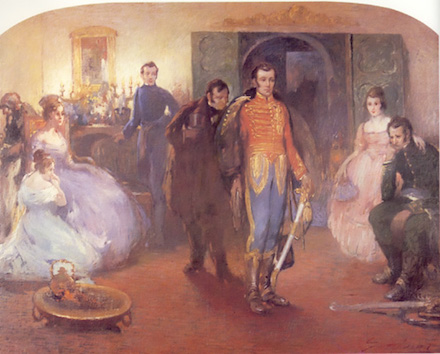
The Carrera Family, by Arturo Gordon Vargas (early 20th c.) features patriarch Ignacio, who was part of Chile’s first independent junta, along with Jose Miguel, flanked by brooding brothers Juan Jose and Luis, as well as their sister Javiera Carrera, the “Mother of Chile” and creator of the Chilean flag.

Said Jose Miguel had established a dictatorship in 1811-1812, with his brothers as trusted lieutenants. But Chile’s initial flower of independence from 1810-1814 was crushed by Spanish reconquest thanks in part to a deadly rift that had opened between the Carreras and fellow independentista Bernardo O’Higgins: prior to the decisive loss to the Spanish, Luis Carrera and O’Higgins had fought a literal battle with one another. They patched things up well enough to fight the Spanish together a few weeks later, but once in exile in Mendoza, Argentina, after their defeat they hurled recriminations at one another for the outcome. Luis even killed O’Higgins’s aide Juan Mackenna in a duel.

In the fullness of time it was the destiny of O’Higgins to be the father of a (permanently) independent Chile … and the destiny of the Carreras to be antagonists he overcame to do it.

O’Higgins attained leadership of the independence movement from exile and after elevated himself to dictator of free Chile in 1817. The Carreras promptly began scheming against him lead in old times, resulting in the arrest of Luis and Juan Jose in Mendoza. They were executed there hours after word reached the city that the Chilean patriot army had finished off the royalists.


The Carreras on their way to execution.

On this day..

1995: Nicholas Ingram

British-American Nicholas Ingram was electrocuted in the U.S. state of Georgia on this date in 1995.*

Born in England to a British mother and an American father, Ingram at age 19 had invaded the Cobb County home of J.C. and Mary Sawyer. The Sawyers complied with the armed intruder’s demands for money ($60) and the keys to their pickup truck, but Ingram still marched them to a nearby woods and executed them. J.C. Sawyer was killed; Mary Sawyer feigned death and survived to give evidence against their tormenter.

Thanks to his nationality and his legal representation (British lawyer Clive Stafford Smith, who would later found the anti-death penalty NGO Reprieve), Ingram’s prospective execution because a cause celebre in Old Blighty. British MPs and the Archbishop of Canterbury issued appeals for mercy, although Tory Prime Minister John Major gave a chilly refusal when solicited for intervention by Ingram’s family:

I found your letter very moving and I can imagine the profound distress you must be feeling. But I have concluded, with deepest regret, that there are no proper grounds for the British Government to intervene with the State of Georgia.

The Georgia prison commissioner who conducted this execution, Allen Ault, later turned against capital punishment.

On this day..