1883: Emeline Meaker, child abuser, first woman hanged in Vermont

(Thanks to Meaghan Good of the Charley Project for the guest post. -ed.)

On this day in 1883, Emeline Lucy Meaker was hanged for the murder of her nine-year-old sister-in-law and ward, Alice. She was the first woman executed in Vermont and almost the last; the only other one was in 1905, when Mary Mabel Rogers was hanged after killing her husband for his insurance.

Alice’s father died in 1873 and her impoverished mother sent her and her brother Henry to live in an overcrowded poorhouse. There, the little girl was reportedly sexually abused. Others noted that she was “a timid, shrinking child—of just that disposition that seems to invite, and is unable to resist—persecution.”

In 1879, Alice and Henry got a chance for a better life when their much older half-brother* Horace (described by crime historian Harold Schechter as a “perpetually down-at-heels farmer”) agreed to take them in for a lump sum of $400. However, Horace’s wife, Emeline, was unhappy at this extra burden. She referred to Alice as “little bitch” and “that thing.”

Schechter writes of the killer in his book Psycho USA: Famous American Killers You Never Heard Of:

Married to Horace when she was eighteen, forty-five-year-old Emeline was (according to newspapers at the time) a “coarse, brutal, domineering woman,” a “perfect virago,” a “sullen, morose, repulsive-looking creature.” To be sure, these characterizations were deeply colored by the horror provoked by her crime. Still, there is little doubt that … Emeline’s grim, hardscrabble life had left her deeply embittered and seething with suppressed rage — “malignant passions” (in the words of one contemporary) that would vent themselves against her helpless [sister-in-law].

Young Alice’s life, however difficult it may have been before, became hell after she went to live with her half-brother and his family.

She was forced to do more and heavier chores than she was capable of, and for the slightest reason, Emeline would beat her horribly with a broom, a stick or whatever else was at hand.
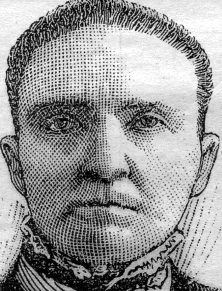
Soon Alice’s sister-in-law dropped the pretense of punishment and simply hit Alice whenever she felt like it. Emeline was quite literally deaf to the little girl’s screams, as she had a severe hearing impairment. So did Horace.

Some of the neighbors later said they could hear the child’s cries from half a mile away, and Emeline had no compunctions about abusing Alice in front of visitors. Everyone in in their small community of Duxbury was aware of what was going on, but no one bothered to do anything about it until it was too late.

Less than a year after Alice’s arrival, Emeline decided to do away with her. The crime is reported in detail in Volume 16 of the Duxbury Historical Society’s newsletter.

Emeline convinced her twenty-year-old “weak minded” and “not over bright” son, Lewis Almon Meaker, to help. He later said his mother had persuaded him that Alice would be “better off dead” and that “she wasn’t a very good girl; no one liked her.”

Emeline’s first suggestion was to take Alice out into the mountain wilderness and leave her there to die, but Almon thought this was too risky. Instead, on the night of April 23, 1880, Almon and Emeline woke up Alice, shoved a sack over her head and carried her to the carriage Almon had hired in advance. They drove to a remote hill and forced Alice to drink strychnine from her own favorite mug, which her mother had given her.

Twenty minutes later, the child’s death agonies ceased and Almon buried her in a thicket outside the town of Stowe.

Emeline and Almon, people who had been concerned about the riskiness of a previous murder plot, didn’t bother to get their stories straight about the unannounced disappearance of their charge, so when the neighbors asked where Alice had gone their contradictory explanations for her disappearance raised suspicions.

On April 26, a police officer subjected both mother and son to questioning. Almon didn’t last long before he broke down and confessed. He led the deputy sheriff to the burial site and they disinterred Alice’s remains, still visibly bruised from her last thrashing. Because the deputy’s buggy was small, Almon had to hold Alice’s corpse upright to keep it from falling out during the three-hour journey back to Roxbury.

That must have been some ride.

Emeline and Almon were both charged with murder. Each defendant tried to put as much blame as possible on the other, but both were ultimately convicted and sentenced to death. Almon’s sentence was commuted to life in prison, but Emeline’s was upheld in spite of years of appeals and a try at feigning madness.

Her violent tantrums, attempts at arson, and attacks on the prison staff didn’t convince anyone she was crazy — they merely alienated her family and others who might have otherwise supported her. Once she realized she wasn’t fooling anybody, she calmed down and passed her remaining days quietly knitting in her cell.

She was hanged at 1:30 p.m., 35 months after the murder.

On the day of her execution she asked to see the gallows. The sheriff explained to her how it worked and she declared, “Why, it’s not half as bad as I thought.” For the occasion — she had a crowd of 125 witnesses to impress — she wore a black cambric with white ruffles.

The not-half-bad gallows snapped Emeline Meaker’s neck, but it still took her twelve minutes to die. Emeline wanted her body returned to her husband, but Horace refused to accept it and it was buried in the prison cemetery.

Ten years after his mother’s execution, Almon died in prison of tuberculosis.

* Some reports say Alice was Horace’s niece rather than his half-sister.

On this day..

1913: Floyd and Claude Allen, for the Carroll County courthouse massacre

Today is the centennial of the electrocution of Floyd Allen, the wealthy patriarch of a Virginia clan, and his son Claude — for an astounding shootout right in the Carroll County (Va.) courthouse.

Before the unpleasantness, Allen was for Carroll County gentleman farmer, prosperous shopkeep, moonshine-distiller, and political operator. He was also a guy with a violent reputation.

That’s him on the right, but maybe you want to picture an Old Dominion Don Corleone instead.

“The worst man of the clan,” said a local judge who suspected that Allen had dodged other brushes with the law by intimidating witnesses. “Overbearing, vindictive, high tempered, brutal, with no respect for law and little or no regard for human life.”

Mix a guy like that with an innocent rustic harvest-produce ritual and bloodshed is bound to follow.

Matters began for the 50-something Allen with teenage hormones at a local cornshucking. Custom dictated that finding a lucky red ear of corn would entitle the corn-shucker who drew it to a kiss from any girl of his choice. A youth named Wesley Edwards, nephew to Floyd Allen, drew a red ear.

The girl he kissed happened to have a boyfriend. So here we go.

The next day, the jealous beau got his by jumping Wesley Edwards, which drew Wesley’s brother into the brawl, which led to assault and weapons charges against the Edwards boys. They were arrested over the border in North Carolina, but en route to returning them to the Hillsville, Va., lockup, Floyd Allen stopped the cart and liberated his kin. Allen would say later that he didn’t intend this to go full-outlaw; rather, his lordly sense of prerogatives was offended to see the boys tied up instead of treated with dignity, and a political foe of a sheriff rushing to get them in manacles when Allen full intended to post bail for them.

And that led to the March 1912 trial of Floyd Allen for interfering with an officer of the law. Allen was convicted on this count and sentenced to one year in prison.

“Gentlemen,” replied our put-upon paterfamilias to this sentence. “I ain’t a-goin’.”*

Literally, this is what Floyd Allen got up and said in court in direct response to the judge’s delivery of sentence moments before.

And with this, the Carroll County courthouse turned into a shooting gallery.

There’s a great deal of after-the-fact argument and finger-pointing about who started this mess. It must have been mayhem: the sheriff plunked Allen, who collapsed on his attorney; Allen fired back with the revolver that he was naturally carrying to his own criminal sentencing.

Fears and rumors had circulated that exactly this sort of thing might go down if the surly Floyd Allen drew jail time, so quite a lot of attendees in the crowded courtroom were jittery and packing heat. Now they all started crouching and firing. At least fifty spent rounds were later retrieved from the hall of justice.

When the smoke cleared, the Allen clan had absconded as a gang with the now-fugitive Floyd. Five other people left the room for their coffins: the judge, the prosecutor, the sheriff, the jury foreman, and a 19-year-old girl who had testified against Allen.

Considering the distribution of bodies, that’s less a shootout than a massacre. (pdf)

A massive manhunt brought the Allens in within weeks. This time, jurors nervous of retaliation handed Floyd Allen the death penalty, and a like sentence to his son Claude.** The eventual clemency appeals for the latter would focus on his honorable adherence to the family, complaining that Claude was condemned for doing “no more than any boy would do for an old gray haired Father without a moments [sic] time to consider.” The appeals for the former blamed the sheriff for starting the shootout and the entire affair from the nephews’ arrest on down on political rivalries among Carroll County’s elites. Between these and clemency opponents decrying the “maudlin sentimentality” that proposed to spare these murderers, the standard of Virginia manhood was thoroughly litigated on editorial pages throughout the Commonwealth — indeed, throughout the country, for the astonishing case drained newsprint ink from coast to coast.

And why not? From corn-shucking to the twisted family honor to the electric chair, every pore oozed Americana. Even a young woman who was described as “a mountain girl” descended from her haunts to appeal for the life of her betrothed, Claude.


From the Trenton (N.J.) Evening Times, September 13, 1912.
“They were men of the mountains; they were out of the beaten parts of civilization; they were untaught in the ways of the world outside. Their habits and training had led them to adhere to a code of almost primal instincts in many ways; to them the right to do as they pleased regardless of what custom or other people demanded was ingrown. And yet they had never been criminal at heart.” -From a profile of the family in the March 28, 1913 Miami Herald

Gov. William Hodges Mann‘s verdict on all this inclined against the maudlin.

Though the Allens managed a few short delays as their appeals percolated, Mann was steadfast in his refusal to mitigate the crime. The two went to Virginia’s electric chair eleven minutes apart on this date.

All that from a red ear of corn. Incidentally, somewhere in this whole timeline, Floyd’s nephews were themselves sentenced for the original brawl with the boyfriend (long before the shootout, and the resulting serious prison sentences they got for that). Their punishment was 30 and 60 days working the sheriff’s orchard. That, plus the destruction of their family.

A book and a DVD under the title Carroll County Courthouse Tragedy can be had from the Carroll County Historical Society. There’s also an out-of-print 1962 volume, The Courthouse Tragedy, Hillsville, Va.

* Allen had successfully refused to serve a one-hour jail sentence for a 1903 scrape. One measly hour.

** Several other Allens got long prison sentences eventually truncated by executive pardons in the 1920s. Most of their estate was seized and the family generally scattered across the country, far from Carroll County. (Floyd Allen’s brother Jack got into a barroom argument in North Carolina in 1918 about the notorious Hillsville events, and Jack wound up shot dead himself in the dispute.)

On this day..

1811: Adam Lyal, highwayman

On this date in 1811, Adam Lyal was hanged as a highwayman in Edinburgh.

Adam Lyal went on trial with his brother John on January 3.

John’s counsel went with the insanity defense — you know, the classic; he’d been raving incoherently in prison and seemed not in his right mind. A doctor ruled that John “laboured under a state of idiotism … incapable of knowing the right hand from the left.”

So, despite the jailer’s suspicion that Lyal was simulating (he testified that John Lyal knew a hawk from a handsaw when he was first captured and didn’t start with the crazy talk for a few days), John Lyal was ruled unfit for trial.

That left Adam alone to answer for both. Maybe he should have requested a psychological evaluation too, because he was crazy to go on trial.

In that proceeding, he faced the detailed testimony of Matthew Boyd that on Oct. 25 previous, he was returning from the fair when the pair approached him.

On coming up, one of them laid his arm over the bridle, and having both pistols in their hands, they presented them, and desired him to deliver up his pocketbook, or they would blow his brains out.

Boyd boldly tried to bluff his way out of this at the risk of his life, but the robbers thrashed him until he coughed up a parcel of small notes … and then, most begrudgingly, another £100 of large notes he had stashed in his vest.

He’d relinquished his cash, for now, but this Matthew Boyd was an intrepid soul.

As he had been robbed in broad daylight, Boyd had plenty of time to get to Stirling, procure a warrant, and track Boyd’s assailants all the way to Edinburgh where the next day he finally found them in the streets and personally collared them.

Conclusion: do not rob Matthew Boyd.

Adam Lyal’s defense, considerably less effective than that of his brother, was to argue that the indictment charged a robbery in the shire of Perth, but it was actually done in the county of Stirling.

That … did not help.

Adam Lyal’s unfortunate fate has not precluded his latter-day career as an Edinburgh tour guide with an active Twitter account.

On this day..

1907: Emile Dubois, Valparaiso popular saint

On this date in 1907, Emile Dubois was shot in Valparaiso, Chile for murder.

The French-descended Dubois (English Wikipedia link | Spanish) was credited with a string of homicides in Valparaiso spanning 1905-1906. (Although the first murder attributed to him, and the only one he was formally convicted of, was that of an accountant in Santiago.)

The official version of our man’s career is roughly this: in September 1905, he killed a merchant named Reinaldo Tillmanns; in October, he killed another one named Gustavo Titius — robbing both.

The following April, he stabbed the French trader Isodoro Challe, although he did not rob him. In June, he attacked an American dentist in his office, although the dentist fought him off and the assailant fled.

All this was rolled up into the indictment when “Emile Dubois” was finally captured that summer. This was the name he gave, but his Colombian documents were sketchy; his real name might have been Luis Amadeo Brihier Lacroix, or heaven knows what else.

The crime spree alone would be interesting enough for this site, but it’s really the least interesting thing about this unusual man.

Dubois exerted a curious magnetism. He was handsome, certainly, but more than that: he was gracious, impossibly serene in the face of the dangerous charges against him, and his adherence to his innocence was calm and unshakable. Dubois’s intelligence was impossible to miss; he spoke ironically with inspectors, like their fellow-man instead of their prey. “He had ideas above those of a common criminal,” wrote one biographer. (Spanish link)

His long time loose on his crime spree — if indeed the attributed crimes were really all his — had served to direct popular scorn at the police who were unable to locate the criminal. At the same time, the victims in these cases were wealthy foreign “usurers” with limited purchase on public sympathy. (Especially as Valparaiso endured a natural disaster.) Meanwhile, in the courtroom itself, Judge Santa Cruz was so convinced of Dubois’s guilt that he cut a vindictive Javert-like figure hounding the accused to his death.*

Guilty or innocent, the wry and gentlemanly Dubois compared very favorably to the other characters in his drama.

Dubois played the part unerringly to the last, when he declined a blindfold and unpertubedly puffed a cigar as he faced his four-man firing detail with open eyes and the command “¡Ejecutad!”

Dubois’s last statement reasserted his innocence without vitriol or bitterness. “It was necessary that someone be held responsible for these crimes, and that someone was me,” he said. (More Spanish)

Then he died.

And after that Christ-like exit, he lived.

Dubois, who was obviously an utter obscurity prior to his arrest, went on to a surprising posthumous life as a popular folk saint. His brightly-painted grave in Valparaiso is a pilgrimage shrine forever crowded with votive offerings from followers convinced of Dubois’s powers of divine intercession (and, accordingly, his innocence).

* Dubois to the priest sent to confess him before execution: “You should be taking the judge’s confession, not mine. The judge who ordered my murder. Go inspire his repentance.” (Source)

On this day..

1936: George W. Barrett, the first to hang for killing an FBI man

(Thanks to Meaghan Good of the Charley Project for the guest post. -ed.)

On this date in 1936, Kentucky native George W. Barrett was hanged in Lockport, Indiana.

A rather nasty but ordinary enough career criminal specializing in car theft, Barrett also dabbled in murder. According to Keven McQueen’s book Offbeat Kentuckians: Legends to Lunatics, in 1930 he shot to death his elderly mother and his sister (who lingered for an extended time before dying of pneumonia, the consequence of her wounds), but pleaded “self-defense.”

Two juries were unable to reach a verdict.

Minor detail: Barrett’s cousin, Frank Baker, was the prosecutor in that case, and observers noted he appeared rather less than zealous about convicting his relative; the judge even remarked that Baker sounded more like Barrett’s defense attorney.

After his 1931 murder trial, a decidedly ungrateful Barrett allegedly murdered Frank Baker.

At his 1933 trial in that case he got a hung jury again, in spite of the fact that the only relative of his involved in the trial was the victim.

FBI agent Nelson Klein: shot dead in Ohio, but his killer hanged in Indiana.

Third time’s the charm: Barrett finally got his just deserts on December 7, 1935, when he was convicted of murdering FBI Agent Nelson B. Klein. The jurors stayed out for two days, but supposedly they decided on his guilt long before then and only wanted a few more free meals.

Barrett had killed Agent Klein in a shootout on August 14, 1935; before dying, Klein shot back, hitting Barrett in the legs and crippling him. The other agent involved in the gunfight, Donald McGovern, was unscathed and arrested Barrett.

There was an interesting dispute as to which state had jurisdiction over the crime; the agents had been standing in College Corner, Ohio, but the killer fired his shots from a position 22 feet over the Indiana state line. In the end, Indiana got the honors.

A recent federal law had mandated the death sentence for anyone convicted of killing an FBI agent. Barrett was the first to die under the new law; another man who’d murdered two agents in 1934 got a life sentence in Alcatraz.

The leg wounds Barrett suffered in his last shootout never healed. He attended his trial in a wheelchair and ultimately had to be carried to the gallows.

On this day..

1860: William Fee, the only person hanged in Wayne County

On this date in 1860, William Fee became the only person ever executed in Wayne County, New York.

Fee’s alleged victim is not distinguished by a name, at least not one known to Fee’s prosecutors. The anonymous woman turned up dead September 26, 1859 on Wayne County’s old Montezuma Turnpike. She had been strangled, the coroner said — and ravished.

Though she was a stranger, the victim had been seen in the area inquiring about employment. Fee and another man named Muldoon had been observed following her the day previous, and that “following” was cast in a sinister light by their now-unknown whereabouts. Both men were laborers working on an enlargement of the Erie Canal around Lyons, N.Y.

Fee was eventually arrested in New York City; Muldoon, in Scranton, Pa. We’ll return to Muldoon later.

Fee and his ill-favored “Hibernian countenance” stood trial from January 30 to February 3, 1860. “Seats were at a premium in the court room and in the gallery behind the curtains there was a crowd of ladies, listening breathlessly to the testimony,” ran a retrospective from 1913. “During the noon hour, seats were bargained for and sold at 10 cents to 50 cents apiece.”

And though he maintained a superficial calm when the jury returned a guilty verdict against him — “Damn tough, but I’m not going to lie awake thinking about it” — William Fee broke down sobbing when the judge finally sentenced him.

The kid came from a working-class family and had a scrappy reputation. It wasn’t clear as he approached execution that he was handling it with the gravity expected for the occasion by right-thinking gentlemen. Then there was the worry for his eternal salvation: born of mixed Protestant/Catholic parents, he was essentially irreligious and indifferent to a parade of ministers who called upon his cell. (Fee accepted the ministrations of a couple of Catholic priests in his very last hours.)

While clerics kneaded the hard clay of Fee’s soul, municipal officials took a chisel to logistics. Since this was the first (and last) hanging in these parts, the equipment had to be obtained on loan: they borrowed the upward-jerking gallows recently used to execute Ira Stout in upstate New York.*

The gallows was erected in one of the small halls of the jail … four upright posts twelve feet high and five feet apart. Across the top was an oak timber projecting two feet or more beyond the frame. At the front end, above where the prisoner was to stand was a grooved wheel or pully; and another was inserted in the timber over the centre of the frame. The main rope ran over these rollers, one end falling in front, to which the halter was attached, the other dropping to the centre of the gallows frame, where heavy weights were attached. These weights, in all 254 pounds, were suspended by a small cord passing through the main timber above and over it to a pin. The weights had a fall of perhaps eight feet. When the cord was severed by a blow of the axe, the weights fell and jerked the main rope running over the grooved wheels. In order that there should be no failure, Sheriff Snedaker had the gallows put up in the court house and fully tested before removing it to the jail. (New York Herald, April 3, 1860)

Fee came to this device still asserting his innocence, but also asserting that Muldoon wasn’t involved. Don’t worry if those seem a bit at odds; the execution party was confused enough to require clarification, too. Cut him some slack: those 254 pounds of weights weren’t going to cut him any.

The hanging went off without difficulty and, whether influenced by Fee’s parting attempt at exoneration or otherwise, Muldoon was never ultimately brought to trial. The evidence against him being unsatisfactory, he was released some months later.

William Fee’s afterlife — apart from this blog post — is allegedly spent haunting his old Lyons Jail (today, the Wayne County Museum).

* From reports, Wayne County didn’t return the gallows: it was eventually scrapped (someone made a chair out of part of it), and the Lyons Republican nicked the hanging-weight to use as a doorstop.

On this day..

1881: George Parrott, future footwear

(Thanks to Meaghan Good of the Charley Project for the guest post. -ed.)

On this date in 1881, George Parrott, a cattle rustler popularly known as Big Nose George, was lynched in Rawlins, Wyoming.

His story doesn’t end with his death, however: as his Wikipedia entry notes, Parrott was notable for “Banditry, Murder, being made into a pair of shoes.” Oh, and being pickled.

The series of events that lead to Parrott’s death began on August 19, 1878, when he and his gang tried to wreck a train near Medicine Bow, Wyoming so they could rob it. They loosened a rail and waited patiently, but an alert section foreman spotted the loose rail and notified railroad authorities, who came and fixed it before the train arrived.
Realizing the law would be after them, Parrott’s gang fled toward Elk Mountain and hid in Rattlesnake Canyon, waiting to ambush the posse they knew would be coming.

As soon as the lawmen were within their rifle sights, the bandits opened fire. Parrott killed Tip Vincent, a Union Pacific Railroad agent; one of the other fugitives, “Dutch” Charley Bates, killed Deputy Sheriff Robert Widdowfield. The gang then fled and hid out in Montana for a span, eventually reaching Canada — and all the while continuing their criminal ways.

Parrott couldn’t keep his mouth shut about his outlaw exploits and bragged everywhere he went. Inevitably, someone who’d heard one of his stories went to Rawlins and happened to mention the hook-nosed man who’d tried to derail a train, then killed two people when their plan failed.

“Dutch” Charley Bates was arrested in Green River, Wyoming in December 1878 and put on a train bound for Rawlins to face trial. Ironically, it was the same train he’d tried to derail earlier that year.

But Bates never made it to Rawlins: when the train made a stop at Carbon City, a group of masked vigilantes overpowered Bates’s guards, hauled him off the train, forced him to confess to his crimes and then hoisted him up on a rope to slowly strangle to death.

Parrott remained at large and the reward for his capture grew to $2,000 before his big mouth got him into trouble again. He and his gang had held up several stagecoaches and pulled off a particularly lucrative job in July 1880. He bragged about it to a lady friend, who told other people, and eventually word reached the ears of the Rawlins sheriff. Within hours he was under arrest.

In a repeat of the Bates lynching, a posse forced Parrott from his Rawlins-bound train in Carbon City. R. Michael Wilson, in his book Frontier Justice in the Wild West, writes what happened next:

They escorted him onto the station platform, put a noose around his neck, yanked him up, then lowered him and asked for a full confession. When he hesitated the men pulled him up several times and then promised that if he confessed, he would be given a fair trial — but if he did not confess, he would be hung. Parrott talked, and once he began, he gave every detail of his various criminal ventures, some of which were quite a surprise to the vigilantes. The mob, true to their word, then returned the prisoner to the custody of Sheriff Rankin.

That’s touching behavior for a vigilante mob, but it sure feels like Carbon City could stand to tighten up its railroad security.

At any rate, Parrott was tried for Tip Vincent’s murder in the fall of 1880, convicted, and sentenced to death.

However, on March 20, 1881, thirteen days before he was scheduled to hang, he made a desperate escape attempt. Though Parrott managed to knock Sheriff Rankin unconscious, Mrs. Rankin foiled the breakout by locking up the cells before Parrott could get out. Extra guards were assigned to watch him after that.

As Wilson records,

Sheriff Rankin asked the townsmen to wait the short time remaining before the prisoner was to be legally hanged, but the general opinion was that the sheriff had taken enough abuse from the prisoner and that Parrott might yet escape if left to await his fate on April 2. On March 22 at 10:55 p.m., a party of thirty masked men went to the jail and removed Parrott. They marched him to the telegraph pole … A rope was placed over the crossbeam of a telegraph pole, the noose was secured around the prisoner’s neck, and Parrott was forced to stand upon a barrel. Parrott begged piteously to be shot and cried out that it was cruel to hang him, but his pleas were ignored.

They kicked the barrel out from under him, but it was too short: the rope and Parrott’s neck stretched enough so that his toes touched the ground.

The mob cut him down and went and got a ladder. Parrott climbed it and said he would jump off and break his neck, but as far as the vigilantes were concerned, that was too good for him: they pulled the ladder away instead, and he slowly strangled to death, tearing off one of his ears in the process.

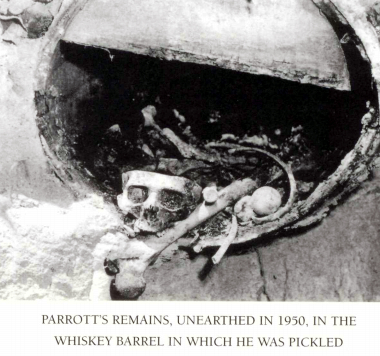
Drs. Thomas Maghee and John Eugene Osborne conducted the autopsy, examined Parrott’s brain, and could find no apparent abnormalities. Osborne then removed a large piece of skin from the dead man’s chest, kept the skullcap, and put the rest of the body in a whiskey barrel full of saline solution, effectively pickling it. The barrel was buried without ceremony, and Dr. Osborne had the skin tanned. He sent the leather to a shoemaker, who made him a pair of shoes with it.

Dr. Osborne was disappointed that Parrott’s nipples weren’t on the tips of the toes like he’d requested (!!!), but you can’t have everything you want in life.

He wore the human leather shoes on special occasions, including at his inaugural ball when he was elected governor of Wyoming in 1890. The skullcap he gave to his fifteen-year-old female assistant, Lillian Heath, who used it variously as a doorstop and an ashtray. (She would grow up to become the first female doctor in Wyoming.)

Parrott’s pickled remains were dug up at a construction site in 1950, and identified after some confusion. His skull, as well as the shoes, are now on display at the Carbon County Museum.

On this day..

1857: Gaspard Matraccia, parrot-lover

From the London Times, March 26, 1857.

AN EXECUTION AT MARSEILLES. — Matraccia, the Italian who, as reported in the Messenger, was some short time back condemned to death by the Court of Assizes of Aix for a series of extraordinary murders at Marseilles, was executed in the latter city on Saturday morning.

At 4 o’clock he was awakened by the chaplain and director of the prison, and told that the petition for a commutation of punishment which he had sent to the Emperor was rejected, and that he was about to be executed. He received the announcement with the greatest calmness, and getting up, seated himself on the side of the bed, and took some coffee and smoked several cigars.

At 6 o’clock he attended mass, and during the service he appeared very devout. The mass was followed by a sermon, which seemed to make a great impression on him. The service was attended by all the prisoners.

When it was concluded, Matraccia was taken back to his cell, and supplied with breakfast. Shortly before 7 o’clock the clerk of the Court of Assizes read to him the text of his condemnation, the chaplain translating it into Italian. He listened to the reading and translation with great resignation, and when they were concluded embraced the clerk and all the persons present, most of whom were so affected that they shed tears.

Shortly after the executioners of Aix and Nismes, accompanied by an assistant, arrived, and proceeded to pinion the condemned. He was then freed from the irons on his legs and he asked if he could not be allowed to walk to the scaffold, but was told that he must be conveyed in a cellular van.

He then begged, as a special favour, that he might be accompanied by one of his friends, a countryman, who had been with him all the morning, and that his parrot, which was in a cage in his cell, might be taken with him to the scaffold. Both these requests were granted, and he was placed in a van, the chaplain being in attendance on him.

Arrived at the scaffold, which was erected in the Place St. Michel, and which was surrounded by an immense crowd, consisting of at least 30,000 persons, the vehicle stopped, and the cage containing the parrot was, to the surprise of the spectators, first placed on the scaffold; the criminal, his friend, and the chaplain then alighted from the van, Matraccia cast a glance at the guillotine, and embraced several persons who were present.

Then, supported by his friend and the chaplain, he ascended the steps of the scaffold, and in doing so it was observed that he slightly trembled.

When he reached the platform he kissed with great fervour the crucifix which the chaplain presented; then he embraced the chaplain and his friend, and then, turning to the parrot, he said in Italian, “Your master is about to die, and he embraces you for the last time.”

Afterwards he advanced towards the front of the scaffold, and cried to the people, “I demand pardon of the inhabitants of Marseilles for the scandal I have occasioned. Pray for me, for in a few minutes I shall pray for you.”

He was then seized by the executioners, and in a few seconds all was over.

On this day..

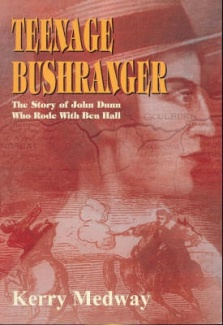
1866: John Dunn, teenage bushranger

On this date in 1866, 19-year-old Australian bushranger John Dunn was hanged at Darlinghurst Gaol.

Young master Dunn, deft hand with a horse and a firearm, in 1864 joined a notorious outlaw gang then under the leadership of Ben Hall and John Gilbert.

This gang very quickly came to grief as both Hall and Gilbert were shot dead by police in May 1865. They’d been outlawed under new anti-bushranger legislation (pdf) enacted in 1865 by a parliament impatient with “the constant outrages on person and property of which the interior has for years been the scene.”

This new Felons Apprehension Act — despite its name — empowered people to kill alleged bushrangers without attempting to detain them. It did this by setting up a fast-track process to legally outlaw (pdf) individuals by name.

Dunn done did his own part to stir up this legal hornet’s nest by killing a constable named Samuel Nelson (father of eight children!) during a hotel stickup at the New South Wales hamlet of Collector.


(cc) image from AYArktos.

But the kid had better elusiveness than his bosses.

Dunn managed to escape the shootout that killed Gilbert and disappear for the best part of a year. Only in December of 1865 was he finally recognized and captured. (Then he escaped from detention, and had to be re-captured.)

Once they could keep him long enough to try him, Dunn was done for. It took a jury ten minutes to order him to hang.

Dunn’s godmother buried him at Sydney’s Devonshire Street Cemetery under a headstone reading, “He has gone to his grave but we must not deplore him though sorrow and darkness encompass his tomb — the Saviour has passed through its portals before him and the light of his love was the lamp through his doom.”

On this day..

1825: Peggy Facto, Plattsburgh infanticide

On this date in 1825, a woman named Peggy Facto was hung on Plattsburgh, N.Y.‘s Broad Street Arsenal Lot.

Facto — or “Facteau,” which variant recalls the French influence here on the shores of Lake Champlain — started her way to the gallows the previous autumn when some neighborhood dogs unearthed the remains of a human infant. It had been partially burned in a fireplace, and when found it still had fast about its throat the cord used to choke it to death. (Plus, of course, the dogs had done their own damage.)

This hideous discovery led back to our day’s principal character, the local mother of two [living] children whose husband had abandoned her due to her affair with a guy named Francis LaBare. Both Peggy and Francis were indicted for “being moved and seduced by the instigation of the devil” to murder their inconvenient bastard immediately after birth.

They faced separate trials for the crime, just hours apart on January 19, 1825, on very similar evidence. Witnesses established the discovery of the body, and an acquaintance named Mary Chandreau testified that she had seen Peggy Facto in an obvious late stage of pregnancy that August. This woman also visited Peggy Facto in jail before trial, and testified that Peggy admitted to having taken a string from one of her gowns to furnish the strangulation-cord.

While this evidence was sufficient to condemn Peggy Facto upon mere minutes of juror deliberation, the same case against Francis LaBare resulted in an acquittal. The mother, who did not testify at her own trial, did take the stand at LaBare’s trial, claiming (according to the notes of the judge), that immediately after she delivered the child, Facto

asked [LaBare] to go find her mother & he refused. She then asked him to go find Mrs. Chandreau & he refused, and next asked him if he meant to let her die there & he said the damned old bitch, I can do better than she can. She then requested him to help her & he did & then the child was born & he took it out and went off & was gone an hour, and when he returned … he came towards her with a knife & threatened her life if she said anything about it.

This quote, and much of what is known about Peggy Facto generally, comes via the research of Plattsburgh judge Penelope Clute. See here and here for HTML versions of the article, or here for a pdf.

It’s difficult to account, on the face of it, for the wildly differential outcomes of these trials; the all-male juries might have something to do with it.

At any rate, while LaBare walked, judge Reuben Walworth* pronounced Facto’s fate with enough fury for two … and a distinct disbelief in Facto’s attempt to blame LaBare:

there are very strong reasons for the belief that your own wicked hands have perpetrated the horrid deed. And if there was any other guilty participator in the murder, that your own wickedness and depravity instigated and persuaded him to participate in your crime. To the crime of murder, you have added the crime of perjury, and that in the face of Heaven, and even on the very threshhold of eternity. I am also constrained to say, it is much to be feared, that you will meet more than one murdered child, as an accusing spirit at the bar of Heaven.

Wretched and deluded woman! In vain was the foul and unnatural murder committed under the protecting shade of night, in your lone and sequestered dwelling, where no human eye was near to witness your guilt.

Facto’s only “appeal” after her half-day trial was the clemency consideration of Gov. DeWitt Clinton, a petition that ended up garnering a great deal of popular support, on three stated grounds:

  1. doubts with many as to the guilt of the convict
  2. as to this being a case that requires a public example
  3. As to the policy of executing any person for the crime of murder when the public opinion is much divided on this subject

Even Judge Walworth ultimately supported this appeal, despite his confidence “that the woman was perfectly abandoned and depraved and that she had destroyed this child and probably the one the year previous, not for the purpose of hiding her shame which was open and apparent to everybody that saw her but for the purpose of ridding herself of the trouble of taking care of them and providing for their support.”

The governor disagreed, arguing that the sort of enlightened people who signed on to death penalty appeals were out of touch with the rank terror necessary to keep the criminal orders cowed.**

So on March 18, 1825, an enormous crowd (fretfully many of them women) summoned from all the nearby towns slogged through spring-muddied roads to be duly cowed by the execution of the infanticide. The condemned, visibly terrified, barely made it through her death-ritual without fainting away, but she managed to re-assert her innocence from the gallows. (Some of the firsthand newspapering is here.)

After execution, Peggy Facto’s remains were turned over to the Medical Society for dissection. “A great many went to see her body, although it had been agreed that it should not be seen,” one woman later recollected in her memoirs. “Many young men went. So much talk was made of this that they said that no other body should ever be given to the doctors.”

* Walworth was a man of illustrious descent; one ancestor, William Walworth, was the Lord Mayor of London who killed Wat Tyler.

Judge Walworth would later become, for two decades, New York’s highest-ranking judicial officer; Walworth, N.Y. and Walworth County, Wisc. are named for him. But the American Walworths were bound for a tragic end … including a scandalous murder.

** “Their excellent character elevates them above those feelings which govern the conduct of the depraved … if terror loses its influence with them then indeed the life of no man will be secure.” For more on the evolution of the idea of “exemplary deterrence” as the death penalty’s raison d’etre, see Paul Friedland.

On this day..