1983: Wang Zhong, small-time grifter

On this date in 1983, Wang Zhong, once the Communist Party Secretary and district head of Haifeng county, Guangdong, was executed for corruption.

The first official of his rank to be so punished, Wang did business on a truly paltry scale relative to the titanic graft compassed by China’s latter-day oligarchs: his first booty was a 17″ black-and-white TV in 1979. In the end, between payola extorted and contraband expropriated, Wang sold his life for 69,000 yuan — a little over US $10,000.

The Associated Press translated a Canton newspaper report of Wang’s execution thus:

His crimes were read out and his sentence before more than 17,300 people at a rally at Swatow, 200 miles east of Canton.

Wang then was driven in a truck to an execution ground about 25 minutes away.

Between 600 and 700 bicycles were parked near the execution ground, and some people ran on foot to watch after the truck and its escorts passed by thousands of spectators along the route.

A cold wind blew and a light rain fell as the convoy arrived and a policeman asked Wang if he had any last words. It [was?] said he asked police to tell his children not to follow his examples.

At 2:45, Wang Zhong knelt facing south. The policeman carrying out the execution once again confirmed his identity. Then he picked up an automatic rifle and, ‘peng,’ a bullet pierced Wang Zhong’s heart.

On this day..

1630: Christina Plum, at the stake, in Cologne

On this date in 1630, the city of Cologne burned Christina Plum.

This aptly-named fruit vendor was a real peach. During Cologne’s 1627-1630 witch hunt, Plum in 1629 denounced a bushel of Cologne’s leading citizens for devilry. While threatening established elites with torture and the stake certainly seems downright bananas with benefit of hindsight, the free city had in 1627 burned an influential woman — and possibly Germany’s first female postmaster — named Katharina Henot. Indeed, it was Plum’s contention that such varied characters as the wife of the Burgermeister, the pastor of St. Alban’s Church, and Katharina Henot’s brother had all been keeping regular dates at the late Katharina’s Black Sabbath orgies.

The city was at that moment facing intense pressure by the Archbishop of Cologne Ferdinand of Bavaria — an imperial elector and enthusiastic hammer of witches — to root out Satan’s earthly minions. It was not at all past thinking that Plum’s accusations could have cut a swath through the city’s upper crust.

Instead, they destroyed the credibility of the witch hunts.

After unsuccessfully pressuring Plum to just pipe down and go away, the city had her arrested as a witch. After all, how did she know so much about who was going to the orgies? And, as was almost inevitable in such cases, the consequent interrogation proved sufficiently vigorous to force a confession from the woman’s lips.

In 1631, as the witch fever abated in Cologne, and elsewhere throughout Germany, the Cologne-educated jurist Friedrich Spee published one of the seminal takedowns of witch-hunting, Cautio Criminalis. (Spee himself lost a kinswoman to the Hexenprozesse.)

On this day..

1784: Cassumo Garcelli, a Tuscan sailor on Boston Common

On this date in 1784, for a murder in a bar brawl he had committed with his hard-drinking cronies, Tuscan mariner Cassumo Garcelli was hanged on Boston Common.

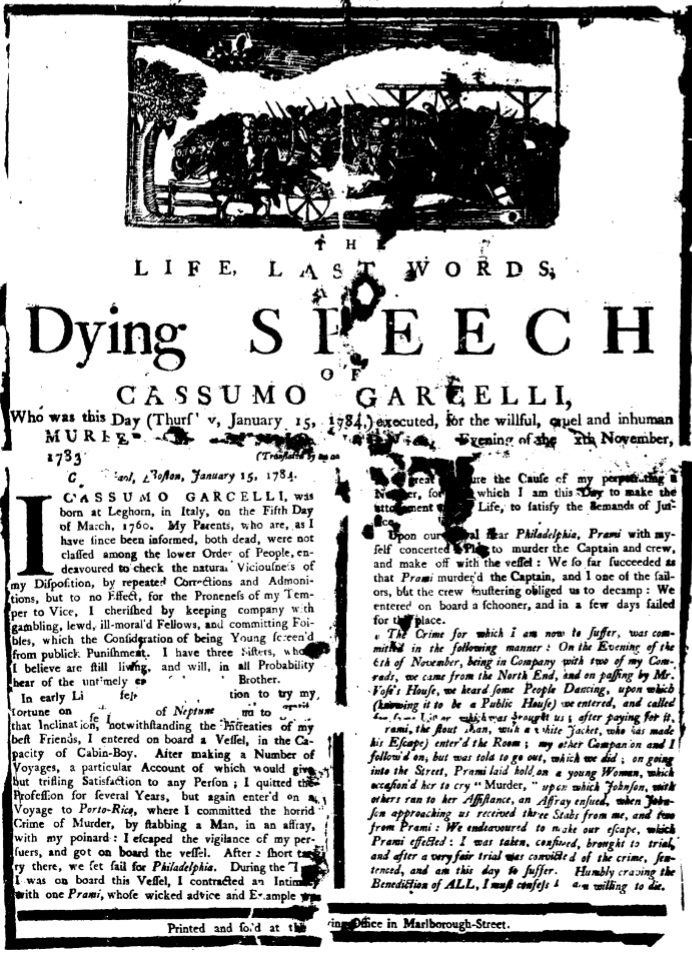
To judge by the bog-standard broadsheet purporting to report the condemned man’s gallows’ shade contrition for his youthful vice and wicked examples, piratical Catholic seamen appear to have understood the spectacle of their public execution in a friendless foreign land in a manner quite suspiciously similar to the understanding likely to be held by a New England printer.

In the transcription that follows, I have made a few interpolations, and one outright elision, owing to sections of text obscured by printing faults on the preserved version of this document.


Click on the image to see the full original document.

Who was this Day (Thursday, January 15, 1784) executed, for the willful, cruel and inhuman murder of Mr. John Johnson on the evening of the sixth November, 1783.

I, Cassumo Garcelli, was born at Leghorn, in Italy, on the Fifth Day of March, 1760. My Parents, who are, as I have since been informed, both dead, were not classed among the lower Order of People, endeavoured to check the natural Viciousness of my Disposition, by repeated Corrections and Admonitions, but to no Effect, for the Proneness of my Temper to Vice, I cherished by keeping company with gambling, lewd, ill-moral’d Fellows, and committing Foibles, which the Consideration of being Young screen’d from publick Punishment. I have three Sisters, who I believe are still living, and will, in all Probability, here of the untimely [death of their] Brother.

In early Life […] to try my fortune … notwithstanding the Intreaties of my best Friends, I entered on board a Vessel, in the Capacity of Cabin-Boy. After making a Number of Voyages, a particular Account of which would give but trifling Satisfaction to any Person, I quitted the Profession for several Years, but again enter’d on a Voyage to Porto-Rico, where I committed the horrid Crime of Murder, by stabbing a Man, in an affray, with my poinard: I escaped the vigilance of my persuers, and got on board the vessel. After a short tarry there, we set sail for Philadelphia. During the Time I was on board this Vessel, I contracted an Intimacy with one Prami, whose wicked advice and Example was in a great Measure the Cause of my perpetrating a Number [sic], for [one of?] which I am this Day to make the attonement of my Life, to satisfy the demands of Justice.

Upon our arrival near Philadelphia, Prami with myself concerted a Platt to murder the Captain and crew, and make off with the vessel: We so far succeeded as that Prami murder’d the Captain, and I one of the sailors, but the crew mustering obliged us to decamp: We entered on board a schooner, and in a few days sailed for this place.

The Crime for which I am now to Suffer, was committed in the following manner: On the Evening of the 6th of November, being in Company with two of my Comrads [sic], we came from the North End, and on passing by Mr. Vose’s House, we heard some People Dancing, upon which (knowing it to be a Public House) we entered, and called for some Liquor, which was brought to us, after paying for it.

Vami, the stout man, with a white Jacket, who has made his Escape, enter’d the Room; my other Companion and I follow’d on, but was told to go out, which we did; on going into the Street, Prami laid hold on a young Woman, which occasion’d her to cry “Murder,” upon which Johnson, with others ran to her Assistance, an Affray ensued, when Johnson approaching us received three Stabs from me, and two from Prami: We endeavoured to make our escape, which Prami effected: I was taken, confined, brought to trial, and after a very fair trial was convicted of the crime, sentenced, and am this day to suffer. Humbly craving the Benediction of ALL, I must confess [and am] willing to die.

On this day..

1528: Leonhard Schiemer, Anabaptist pacifist

Forasmuch then as Christ hath suffered for us in the flesh, arm yourselves likewise with the same mind: for he that hath suffered in the flesh hath ceased from sin.

1 Peter 4:1, a verse very dear to this date’s principal*

Anabaptist Leonhard Schiemer was beheaded on this date in 1528 at Rattenberg.

Schiemer abandoned a Franciscan monastery, preferring to set his table with honest labor as a tailor, and to succor his soul with that that new heresy minting martyrs in northern Europe.

In 1527, Schiemer was both a vigorous missionary and an eloquent proponent of the pacificism for which the sect would eventually become known. In Schiemer’s time, before the catastrophe of Münster’s Anabaptist theocracy, this was quite naturally a hot dispute among the persecuted adherents trying to determine how to make their way in a world where they were considered heretical even by the other heretics: turn the other cheek, or come like Christ with a sword?

Schiemer’s answer was for the true Christian to give himself to the ordeal of Christ’s cross.

[The Holy Spirit] teaches no one, however, unless he despaired of all human comforting and wisdom first. He does not comfort or strengthen anyone unless he feels a horror and turns away from all comforting and power of man. This is why the Lord says, “Do not be called masters.” But this master, Christ, does not accept anyone as His pupil or disciple, unless he renounces and hates everything that he has, and follows Him and carries his cross daily. In doing this, one has to trust in the Lord’s comforting and keep still, as the Scriptures say in many passages, particularly in the Psalms, the Prophets, most of all in Isaiah and the Lamentations of Jeremiah.

The strength of all Christians consists in keeping still, by not forsaking the words of the Lord so quickly, by not losing courage so soon, but by being patient, waiting for the comfort of the Holy Spirit, in the midst of the greatest desolation and misery. This is true weakness of which the Scriptures speak, in particular Paul when he says, “For when I am weak I am strong.”

He also says, “For as we share abundantly in Christ’s suffering, so through Christ we share abundantly in comfort too.” That is what Christ means when He says, “A little while and you will see me no more, again a little while and you will see me.” And when the apostles asked Him what He meant by this, He answered, “Truly, truly, I say to you, you will weep and lament, but the world will rejoice; you will be sorrowful, but your sorrow will turn in to joy … Indeed the hour is coming when whoever kills you will think he is offering service to God.

The Threefold Grace

It is often suspected that Schiemer’s execution on January 14 might have inspired the Rattenberg grandee Pilgram Marpeck to convert — for he was dismissed from a post as a mining magistrate on January 28, and thereafter became an influential, itinerant Anabaptist “wandering citizen of heaven” crisscrossing southern Germany.

* According to an essay on Schiemer in The Anabaptists and Contemporary Baptists: Restoring New Testament Christianity.

On this day..

2015: Laila Bint Abdul Muttalib Basim, filmed

Last year on this date, Saudi Arabia’s execution wave consumed a Burmese woman named Laila Bint Abdul Muttalib Basim.

Condemned for the murder and sexual abuse of her seven-year-old stepdaughter, Basim went to her public beheading protesting her innocence and resisting in whatever way she could — which we know, because a cell phone recording of the execution attained worldwide dissemination. In it, the black-shrouded condemned shrieks over and over, “I did not kill! This is unjust!” She denounces her executioners, invokes the Shahada … until her throat is horrifically emptied of its last protest by the blade.

Warning: This is the on-camera death of a human being from just a few meters’ distance, obtained via Liveleak. It’s awful.

Thanks to the outrage this video spawned, a “human rights organization” underwritten by the Saudi government demanded the arrest of the person who recorded the video … which did indeed occur.

On this day..

1957: Jack Gilbert Graham, terror of the skies

Jack Gilbert Graham was gassed* on this date in 1957 in Colorado for a cold-blooded mass murder in the skies.

Just a petty crook until his turn towards cinematic infamy, Graham fell badly in debt and looked to the friendly skies to recover his financial footing.**

When his mother, Daisie King, flew to Alaska to visit family on November 1, 1955, Graham purchased a $37,500 life insurance policy on her at the airport,† knowing that 25 sticks of dynamite had been packed into her luggage. When Graham’s bomb exploded minutes after departure, mom went down in the wreckage … and 43 other people besides. Nobody survived. Chillingly, it appeared to be a crime copied from a notorious 1949 Canadian airline bombing that sent two people to the gallows over an affair of the heart.

These cardinal sins turned literally deadly were bad enough when folks in the way got quietly poisoned off, but one could hardly fail to be alarmed at the prospect of an actual trend developing out of random private grievances turning into terror in the skies with bystanders killed by the (at least) dozens.

Once Colorado authorities zeroed in on Graham, they sought a quick trial and maximum sentence for deterrent effect. Graham halfheartedly retracted his confession but otherwise did little to fight the result; if anything, his callous indifference to the fates of a whole planeload of people stood him in a very poor light.

“As far as feeling remorse for those people, I don’t. I can’t help it,” he told a Time magazine reporter. “Everybody pays their way and takes their chances. That’s just the way it goes.”

He was easy to find, and even easier to hate.

The bombing happened on the first of November in 1955. Twelve days on, he had confessed to the FBI.‡ By May of the following year, Graham was convicted in a sensational trial — one of the first ever televised — and his appeals wrapped up a mere eight months after that.


Graham is also the reason Lenny Bruce is on the no-fly list.

* Graham died hard, screaming and thrashing against the straps in the gas chamber. The warden assured observers (accurately) that this sort of thing, horrible as it was to behold, was not uncommon.

** In Mainliner Denver: The Bombing of Flight 629, Andrew Field argues that personal resentment towards his mother drove Graham more than did pecuniary motives.

† Air travel was regarded as a much more perilous venture at this time, and insurance was commonly sold at airports.

‡ Though the feds helped the investigation, there were at that time no applicable federal statutes under which to charge Graham — so the judicial proceedings were strictly Colorado’s affair. Formally, he was charged with only one count of murder: that of his mother. It was charge enough for the task at hand.

On this day..

1946: Laszlo Bardossy, former Prime Minister

Laszlo Bardossy, one of Hungary’s several wartime Prime Ministers, was shot on this date in 1946.

Bardossy was a longtime diplomat who had become Minister of Foreign Affairs under Pal Teleki — the Count fate tragically cast to lead Hungary into the Second World War’s meatgrinder.

An esteemed geographer in his non-political life, Teleki foresaw the whirlwind Hungary might reap should she ally herself with Germany. But the conservative governments he affiliated with drew much of its vitality from a restive irredentist movement wishing to retrieve for “Little Hungary” remnants of its historical empire that had been stripped away after World War I.

Under Teleki’s predecessor Bela Imredy, Hungary gratefully reclaimed sovereignty over parts of Slovakia and Ruthenia as its price for supporting Hitler’s seizure of Czechoslovakia in 1938; two years later, German arbitrators returned northern Transylvania from Romania to Hungary.

These were halcyon days for Hungary: for the pleasure of doubling its territory it had not been required to accept German occupation or political direction.

But those days changed for Teleki, whose ministry from 1941-1942 was characterized by an increasingly uphill struggle to maintain a free hand in the shadow of Berlin’s growing strength. In the end he couldn’t manage it, and when (with the support of Hungary’s regent and many of his peers in government) Germany marched into Hungary in 1941 en route to invading Yugoslavia, a country Hungary had a peace treaty with, Teleki shot himself and left behind an anguished note: “We broke our word, out of cowardice … we have thrown away our nation’s honor. We have allied ourselves to scoundrels … We will become body-snatchers! A nation of trash. I did not hold you back. I am guilty.”

With Teleki’s death, Hungary now became a firm partner of the Axis powers — a move personified by the immediate elevation of our man Bardossy.

His first order of business was joining the invasion of Yugoslavia, once again snatching back a piece of territory Budapest considered rightfully hers. He also tightened Hungary’s anti-Semitic laws — Bardossy’s Third Jewish Law basically attempted to cut Jews out of the economic life of the kingdom — and began approving deportations to Germany and direct massacres by Hungarian troops.

The enthusiasm of Bardossy’s participation in Germany’s project might have been his undoing — in the immediate political sense as well as his eventual fate. By the next spring, with Hungarian troops taking casualties as the junior associates in a dangerous invasion of the Soviet Union, Prince Regent Miklos Horthy was again looking to put some daylight between Hungarian policy and German, and he sacked Bardossy. Bardossy joined the leadership of a fascist party that eventually supported the pro-Nazi government installed by German invasion in 1944.

He was arrested after the war and tried as a war criminal by a People’s Court for war crimes and collaboration.

On this day..

1899: Bailer Decker, Theodore Roosevelt’s first

This report of the New York Times, Jan. 10, 1899, concerns the forgettable murderer whose electrocution was approved on his first day in office by New York’s new governor — Theodore Roosevelt, soon to become President of the United States.

SING SING, N.Y., Jan. 9 — Bailer Decker, the negro wife murderer of Tottenville, Staten Island, died to-day in the electric chair in Sing Sing Prison. The curren was twice turned on, each time with a voltage of 1,780. He was pronounced dead five minutes after the first shock.

Decker met death without flinching. Just before he started from his cell to the execution room he requested of Warden Sage that the other four murderers in the condemned cells be permitted to sing “Comrades.” The Warden granted the request, and Decker joined in the singing with a clear tenor voice.

The witnesses to the execution included H.F. Bridges, Warden of the Massachusetts State Prison, at Charlestown. That State, it is said, is likely to adopt the electric chair. Mr. Bridges expressed himself as pleased with the method of the execution.*

The crime for which Decker was executed was the murder of his wife, a white woman, on May 25 last. Decker was an oysterman, but spent much of his time in saloons. He was jealous, and shot the woman while in a drunken rage. He then fired a bullet into his own abdomen with suicidal intent.

* Indeed, Massachusetts did adopt the electric chair in 1900: it would eventually use this device to kill Sacco and Vanzetti in 1927.

On this day..

1932: Asbury Respus, North Carolina serial killer

(Thanks to Meaghan Good of the Charley Project for the guest post. -ed.)

On this date in North Carolina, a middle-aged man named Asbury Respus was executed for the murder of nine-year-old Vera DeWitt Leonard.

And that wasn’t all: though virtually forgotten today, Respus was a serial killer with eight confessed murders to his name.

He claimed that he fell from a barn rafter as a youth and was never quite the same after that, being prone to “spells” of homicidal rage. This story may well have been true; he had a noticeable indentation in his skull.

According to Respus’s confession, he killed his first and second victims in Northampton County in the early 1900s. Their names were Lizzie Banks, whom he shot, and Zenie Britt, whom he beat to death with a stick. The third victim was Becky Storr, killed in Boydton, Virginia around 1910; she too had been bludgeoned with a stick.

These early murders are attested only by Respus’s own confession; the first verifiable homicide by his hand took place in 1912. Sentenced to 15 years for manslaughter in the shooting death of a Northampton County man named Ed D. Wynne, Respus escaped from a road gang in 1916 and began life as a drifter.

They can’t have hunted this fugitive very hard. He never went far, always staying in the vicinity of Greensboro, North Carolina.

All four victims prior to his incarceration had been African Americans, as was Respus himself. On January 14, 1918, Respus crossed the color line to axe to death a 56-year-old white woman named Jennie Brown in her home, which he then burned to the ground. So thoroughly did his arson consume the premises that no evidence of a crime remained … leaving Respus free to continue his murder spree. From here on out, by whatever happenstance, all victims were white.

On July 22, 1920, he came across a little boy named Robert Neal Osborne and drowned him in a stream, just for kicks. Again he got lucky: little Robert’s death was recorded as accidental. On July 17, 1925, he murdered 80-year-old widow Eunice Stephenson by striking her on the head and hanging her body from a ceiling beam. This homicide was recognized as such but went unsolved for years.

Vera Leonard was Respus’s youngest female victim and his undoing. Respus may have killed her with rape on his mind. As it was, he went with his old standby, a blunt instrument to the head; afterwards, he burned her body “to a char.” He did not blame his “homicidal spells” for Vera’s murder but instead said he’d been out of his mind on drugs.

Respus expressed gratitude that he was going to his death. “I’d rather he dead and in heaven,” he said, “than here on earth being tormented to death.”


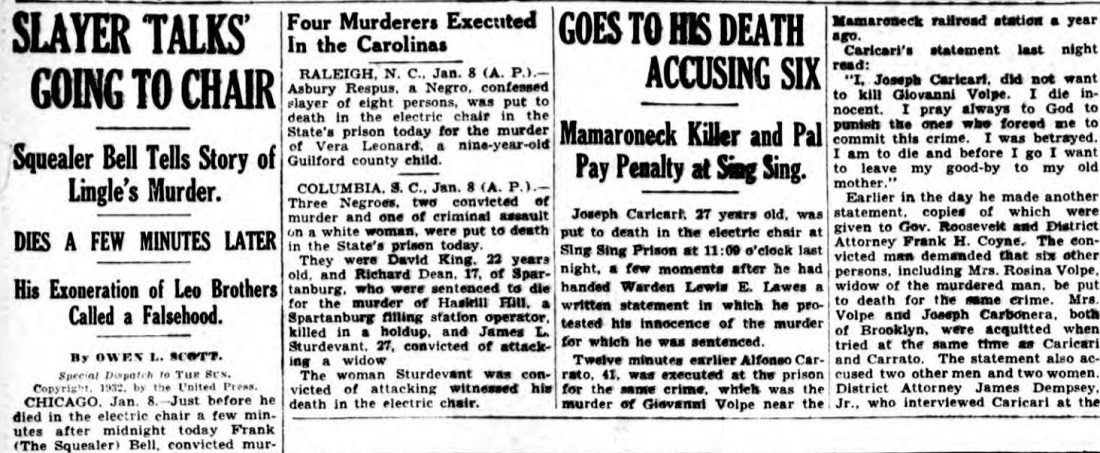
It was a busy day for U.S. executioners. Headlines from the Jan. 8, 1932 edition of the New York Sun.

On this day..

1859: William Burgess

(Thanks to Meaghan Good of the Charley Project for the guest post. -ed.)

An unusual handbill was distributed in the areas of North Somerset and North Devon in the late summer of 1858, about a somewhat peculiar criminal case: a child had been murdered, and a suspect arrested, but authorities had yet to find a body.

The handbills read,

£10 REWARD — Whereas I have received information which leads me to suppose a Girl of six years of age, named Hannah Burgess, has been murdered and her body concealed either on Exmoor Forest or in the vicinity of Porlock, I am therefore authorised to offer a Reward of Ten Pounds to any Person who shall discover the said Body. Should the Body be found, the person finding it is requested not to move it or remove anything on it, but immediately to communicate the circumstances to the nearest Police Constable, or to Mr. Superintendent Jeffs at Exford. The above stated Reward will be paid by Valentine Good, Esquire, Chief Constable, to any person who may become entitled to it under the conditions of this notice.

CRESANT JEFFS, Superintendent
Exford, August 24, 1858

The dry legalese of those notices had a tragic story behind it, involving “a man of weak character” with “dissolute habits,” and a little girl, his own daughter. William Burgess was hanged for her murder on this date in 1859.

William Burgess was a widower with several children and, like most men in that time and place, he was poor and made his living doing hard physical labor in the mines and farms. Unlike most men, however, he was not too proud to beg, going around to wealthier people’s homes and asking them to put up a collection for him and his motherless offspring. At one point the locals did raise a sum of money on behalf of the Burgess family, but the father spent it all on a drinking binge and people were far less sympathetic to him after that.

By the summer of 1858, William had placed all of his older children “in service,” working for landowners as domestics or farmhands. Only the youngest, Hannah Maria, remained with him; at six, she was too young to go to work. At first he asked his sister and brother­-in­-law in Porlock to take her in, but that arrangement fell through and William arranged for Hannah to be fostered by a local couple for two shillings a week.

Then, in June, he removed Hannah from her foster home and they both moved into a lodging house, Gallon House Cottage, run by Sarah Marley in the village of Simonsbath on Exmoor. William paid half a crown a week in rent for his bed, which he shared with Hannah and another lodger. For an extra two shillings and sixpence, Mrs. Marley looked after the child, fed her and did her laundry.

At the time, William had a steady job at the local iron mine and was paid two shillings a day, so Hannah’s care ate up a significant, but not unaffordable, part of his income.

In his book No Justice for the Poor: Four True Tales of Death and Mystery of West Country Pauper Children (from which most of the information in this account is drawn), Harry Clement writes,

Hannah’s father is described as a placid man except when he was in drink, which apparently happened quite often. From comments that he made, it was obvious that he begrudged paying Sarah Marley the half­a­crown each week, probably desiring instead to spend it on drink … It was also claimed that he did not appear to have any love for the child, no doubt this was assumed because of his attitude towards the child, although the reports do not clarify why this was thought.

Only three weeks after Hannah was placed in Sarah Marley’s care, William announced that he planned to move her again. He told Mrs. Marley to have Hannah cleaned up and her clothes packed and ready to go by the evening of Saturday the 24th because in the morning he was going to take her to stay with his sister in Porlock.

At half-­past three in the morning on Sunday — a most unusual hour to be starting a trip of this kind — William got up, dressed Hannah and left the house with her and her spare clothing, what there was of it, wrapped in a bundle.

Their bedmate, a fellow laboring man named Cockram, was the last person to see her alive. William returned to Simonsbath later that day without his daughter.

Some time later, men working in the surface mines had noticed that some earth had been moved from the top of one of the shafts. Burgess was present and suggested somebody had stolen a sheep and buried the carcass for retrieval later on. (This was apparently a common practice.) The miners decided to exhume the dead sheep, butcher it and share the meat, but when they dug down, they didn’t find anything. They shrugged and returned to work.

William did not have a reputation for honesty, and as the weeks passed, when he was asked about Hannah he gave conflicting answers as to her whereabouts. He said once that she was at Brimsworthy, and another time that she was with her aunt.

On the tenth of August, he left town in a hurry, saying he was going to leave the country and take Hannah with him.

On the eleventh, a farmowner’s son was walking across one of his father’s fields and noticed a place where someone had had a small fire. The following morning, he and his brother went to the site again and stirred through the ashes. They found some charred bits of cloth, a piece of fur, and some buttons and hook-­and-­eye fasteners.

Clement reports,

These rumors and suspicions caused several people to take an interest in the matter, and on Sunday 15th August, Mary Fraley, who also lived at Gallon House cottage, walked across the fields to where John Mills had discovered the pile of ashes. Mary also stirred about the remains and picked up a piece of lilac cotton print and a piece of black yard stocking. She later said she knew this piece of print to be part of the pinafore that Hannah had worn, in fact she had washed it at Sarah Marley’s house. Still intent to unravel what was ominously becoming what appeared to be the foreboding of a terrible tragedy, Mary Farley took the pieces to Mrs. Marley and asked her if she recognized them, to which Mrs. Marley replied, “Yes, it is a piece of Hannah Burgess’s pinafore.”

The concerned local vicar, W.H. Thornton, sent people to both Brimsworthy and Porlock to look for Hannah. When they came back and said she wasn’t in either place, Thornton was so alarmed he made a five­-hour ride on horseback to the Chief Constable’s home in Somerset to tell him his suspicions.

Thornton brought the police to Simonsbath and was met by a crowd of villagers who told them about the disturbed soil they’d seen near the mine, which, in retrospect, was beginning to seem ominous. A group went back to the spot and found fresh turf had been laid over it. They raised the sod and found a rectangular hole, about four feet long by two feet wide. It was empty, but there was the telltale stench of decaying flesh. Something, or someone, had been buried there recently.

By the sixteenth of August, Superintendent Jeffs had put the word throughout rural North Devon and North Somerset, and its fishing villages and ports, to find William Burgess, as he was wanted on suspicion of murder. They learned he’d gotten a ferry ride to Swansea in Wales, and began looking there.

It didn’t take long: on the nineteenth, Jeffs personally arrested Burgess, who had found a job at the docks in Swansea. When Jeffs told him why he was being arrested, Burgess replied, “I done it and must die for it. I would sooner die than live. I shall never be happy no more.”

He wasn’t kidding about wanting to die: a few days after his arrest, Burgess tried to commit suicide by stabbing himself in the throat with a pair of scissors, opening them up to widen the wound, and struggling against the four police officers who held him down while a doctor stitched it shut. His jailers kept a much closer eye on him after that.

Meanwhile, the police and the community continued looking for Hannah’s body.

Although Burgess claimed he’d dumped it far off at sea, searchers focused on local mines where he’d previously worked. One of them, an iron mine known as the Wheal Eliza, had been shut down and was flooded. Deeming it too risky to send down a diver, the authorities spent months having the water pumped out “at great expense,” stopping from time to time when the mine became filled with foul air. It wasn’t until the evening of December 2 that conditions were safe enough to send someone down. By then the water level was down to just a few feet.

On some staging in the mineshaft, 207 feet down, rested a coarse hemp sack, tied with cord.

They brought it up on a windlass and untied it. Inside that bag were two large, heavy stones and another bag, containing the remains of a small child.

The search for Hannah Burgess was over.

The body was in surprisingly good shape, considering how long it had spent in the water. Sarah Marley, the Burgesses’ landlady, and William Cockram, who shared Hannah and William’s bed, identified it. Sarah said the child was wearing the clothes she was dressed in the morning she was last seen alive. She also identified the raincoat as William Burgess’s. Burgess had had a pair of child’s boots among his possessions when he was arrested. They were Hannah’s: Sarah knew them very well, for it was she who had laced the little girl’s boots every morning and tied them for her.

The local surgeon had a look at Hannah’s body and noted there were clods of dirt and bits of gravel stuck to her clothes and under her shawl — soil that matched that in the area of the apparent gravesite. Hannah had a skull fracture that would probably have been fatal, but not instantly so; the doctor thought the actual cause of death was suffocation.

William Burgess was tried less than two weeks later. It wasn’t much of a trial. Given the damning circumstantial evidence and his confession to Superintendent Jeffs, there was very little he or his defense counsel could say.

The defense lawyer, a Mr. Rotton, presented no evidence and merely made a statement to jury claiming there was no motive for the crime and suggesting Burgess was insane. He said he could have presented a better case for insanity, but a lack of time and money made this impossible. As it was, the only evidence he count point to was Burgess’s suicide attempt while in custody, and the fact that one of his brothers had died in a lunatic asylum.

The jury voted for conviction more or less immediately.

In the brief interval between his conviction and his execution, Burgess was visited by the usual stream of clergymen, including W.H. Thornton, the man who had brought Hannah’s disappearance to the attention of the police. To all of them he admitted his guilt and said he deserved to die. He continued to make threats of suicide and the authorities watched him very closely, lest he try to cheat the gallows. At least two and possibly four of his surviving children came to visit him during his last days.

In his final confession to the Reverend Thornton, he supposedly said,

I murdered my child for the purpose of saving two shillings and sixpence per week, that I might be enabled thereby to indulge myself in more drink; and to indulge in drunkenness I committed this awful deed. Do you sir, go back to Simonsbath and tell the drunkards there to forsake drunkenness and strong drinks, or they may yet stand a condemned felon as I now stand.

On the morning of his hanging he had the usual breakfast that was served to every inmate, and was allowed to attend chapel during the eight a.m. service, but he was not permitted to take Communion.

It was said that the prison officials were afraid Burgess might put up a fight when the time came, but he surprised them with “a fortitude that had not been anticipated.” His executioner was the famous William Calcraft.

On this day..