1882: Dead Shot, Dandy Jim and Skippy, mutinous Apache scouts

On this date in 1882,* the U.S. Army hanged three White Mountain Apache scouts as mutineers.

This small tragedy in the long-running Apache Wars of the American Southwest had its seeds in the 1870s, when the Army forced onto the San Carlos reservation several bands of Apache peoples, including the Chiricahua, Yavapai, and the Western Apache nations of Tonto, White Mountain, and Cibecue.

The concentration proved potent, unexpectedly so since the tribes in question were not all on friendly terms with one another.

Noch-ay-del-klinne (many other transliterations are possible), an influential White Mountain medicine man of 36 summers or so — and a man who had been to Washington DC with a peace delegation and laid his own eyes on the encroaching industrial civilization — began cultivating something very like a ghost dance for the San Carlos Indians.

Though the ghost dance is most closely associated with the Lakota Sioux, several years and several hundred kilometers’ distance from the Apache of Arizona, the movement actually originated among the much nearer Nevada Paiute. Incarnations of ghost dancing throughout the American West gave a millenial expression to indigenes’ shared trauma of defeat, displacement, and death.

Noch-ay-del-klinne’s rituals were called Na’Ilde’, meaning raising from the dead,** and his prophesy that lost comrades would rise from their graves and the white man would vanish from Apache lands when the corn was ripe, spoke to that trauma for the denizens of the San Carlos reservation — and alarmed the U.S. Army troops stationed at nearby Fort Apache. Especially troubling was the “fraternizing that went on between tribes and elements of tribes which had always held for each other the most deadly aversion,” in the words of the later memoir of Thomas Cruse, who commanded the army’s company of native Apache scouts. He had granted leave for some of his scouts to attend these dances and didn’t like what he saw when they returned.

After the medicine dances began around the post I noticed a change. Generally they [the scouts] are very ready to communicate anything they know or may have seen, but after these dances they became very uncommunicative and would not tell anything that was going on among the other Indians or among themselves … when they came back they were not only exhausted and unfit for duty, but they showed surliness and insubordination. They grumbled constantly and made vague remarks about the country being theirs, not ours. Dozens of small incidents showed that something, or someone, was giving them new thoughts.

Cruse gave a grim — and as events soon proved, sound — assessment of his men’s unreliability: “he entirely distrusted his scouts in event of the rising of the White Mountains and believed all or nearly all would go with the enemy.” But the affirmative reply to Cruse’s plea to discharge the unit was delayed due to telegraph problems by the time that unit set out with Col. Eugene Asa Carr on an August 1881 mission to arrest Noch-ay-del-klinne.†

This incursion, which will set in motion dozens of untimely deaths, was entirely aggressive, justified by no act of overt hostility by the Apache. Although Cruse was writing many years after the fact, his complaints about his subalterns’ “surliness” and “new thoughts” have the ring of the boss’s know-your-placeism, as directed in this same period at social insubordination elsewhere in the American experiment — at organized labor, for example; or at Black men and women.

The army found the medicine man and took him into custody on August 30. That evening, as the troop bivouaced down for the night, Apaches began gathering ominously beyond their fringes. They were visibly armed, and unhappy about the unprovoked seizure of Noch-ay-del-klinne; according to an oral history relayed by Tom Friday, the orphaned son of one of the men destined for the gallows in this post, “All Cibecue Indian people know that the soldiers were coming. They were ready for them. They were ready to fight. They sent word to all Indians, ‘Come, clean your guns; get ready.’ … The Indians were very angry: they had done no wrong and could not understand why the soldiers would come.”‡

Whether upon an arranged signal or merely the alert of the sort of random confrontation this situation invited, those Apaches started firing at the army camp — and as Cruse had anticipated, his scouts in the breach adhered to their people, not the flag.

The Battle of Cibecue Creek could easily have wiped out the expedition, for as one of their number named William Carter later wrote, there were at the outset of “more than 100 Indians besides the scouts in camp, and less than forty dismounted men engaged in a hand-to-hand conflict.”

In averting catastrophe, Carr was one of four U.S. soldiers to earn the Medal of Honor for gallantry in the battle, repulsing the hostiles from the camp and scrambling his surprised men to hold off any further attacks until night dispelled the combatants. He also had Noch-ay-del-klinne summarily shot during the fight. Carter again:

Before leaving the field Colonel Carr sent Lieutenant Carter to examine the body of the Medicine Man and determine if life was extinct. Strange to say, notwithstanding his wounds [he’d been shot in the head -ed.], he was still alive. The recovery of this Indian, if left in the hands of his friends, would have given him a commanding influence over these superstitious people, which would have resulted in endless war. Colonel Carr then repeated the order for his death, specifying that no more shots should be fired. Guide Burns was directed to carry out the order with the understanding that a knife was to be used. Burns, fearing failure, took an ax and crushed the forehead of the deluded fanatic, and from this time forward every person murdered by these Apaches was treated in a similar manner.

Carr’s bloodied expedition proceeded that night upon a forced march for the safety of Fort Apache, reaching it the following afternoon — although “many of the Indians had preceded the command, and all night they were haranguing in the vicinity. They covered the roads and trails, and killed a number of citizens.” The fort came under a brief siege in the ensuing days, and hostilities in the resulting regional uprising dragged on for two years, concluding with the outcome customary for the Apache Wars.

Four of the absconded scouts were arrested in the months ahead and tried at court-martial. (Other captured Apache who were not enlisted in the army were not prosecuted for the firefight.) A Private Mucheco was sentenced to hard labor at Alcatraz. The other three, sergeants jauntily known to the whites as Dead Shot, Dandy Jim, and Skippy,

On the appointed day, per a detailed report in the New York Herald (March 4, 1882),

Wagons of all descriptions loaded with men anxious to see the execution of the Indian scouts, Dead Shot, Dandy Jim and Skippy, came pouring into this place from Wilcox, Thomas, Safford and all points from very early this morning. The time not being known at which the event would take place, there was a state of suspense until the moment arrived for the execution. The gallows was erected in front of the guard house and was fourteen feet high, with a platform six feet four inches from the ground and a distance of seven feet four inches from the floor to the gallows pole. The whole measured twelve feet in length by eight feet wide. The rope used was three-quarters of an inch thick and the drop was four feet six inches.

Dandy Jim, from this forum thread.

[On the scaffold] Dead Shot said he had nothing to say. What was being done was correct. He would probably meet his people. He had suffered much in this world and now he was through and would see his people. Since he first saw white men he had been well treated. He had plenty to eat and plenty of clothes, but this day paid for all he got from the white men. He also said Dandy Jim was a nephew and Eskiticha, or “Skippy,” a cousin of his. He had seen a good many of his people die and did not know where they went, but he was going to follow. He thought there was no use in dressing an Indian up as he was and then hanging him. When he came into San Carlos, if he had done anything wrong, he would not have given himself up, yet he gave up his rifle and the twenty rounds of ammunition that were furnished him at Camp Apache.

Dandy Jim said he had to be hanged, as such were the orders. He could not talk much. It was no use to beg for his life, as people would only laugh at him for his trouble. Eskiticha said: — “The sun is going down, and God is looking after me.” He did not think they were doing right, as he had never done anything to warrant being hanged.

The chaplain, Rev. A.D. Mitchell, then repeated a short prayer, which was interpreted by Merijilda, when all retired from the scaffold, except the hangman, a military prisoner. The black caps were then placed over the heads of the men, and at one o’clock the drop fell. Death was instantaneous in the case of Dead Shot and Eskiticha; Dandy Jim quivered once or twice. After being allowed to hang about twenty minutes they were cut down and pronounced dead by the doctors.

* The same date as an unrelated Mississippi double hanging, previously covered in these pages.

** According to John R. Welch, Chip Colwell-Chanthaphonh and Mark Altaha in “Retracing the Battle of Cibecue: Western Apache, Documentary, and Archaeological Interpretations,” Kiva, Winter 2005. Noch-ay-del-klinne had some exposure to Christian doctrine, which seems present in his own movement’s interest in resurrection.

† Also in the scouting party for this mission was famed frontiersman and eventual Executed Today client Tom Horn.

‡ Thomas Friday’s full account of this affair — which is a second-hand version, since Friday himself was a small child at this time — comes courtesy of William B. Kessel in “The Battle of Cibecue and Its Aftermath: A White Mountain Apache’s Account,” Ethnohistory, Spring 1974.

On this day..

1423: William Taylor, Lollard

On this date in 1423 the Lollard theologian William Taylor was burned at Smithfield.

We have only fleeting glimpses of this excommunicate priest but the Oxford master made a scintillating entrance to the historical record by preaching a Wycliffite sermon for Advent of 1406 — which stirred a hornet’s nest and saw him excommunicated by the Lollard-quashing Archbishop Thomas Arundel. This denunciation of clerical privilege survived to our digital age as a single, damaged manuscript, and was published in 1993.

Certainly we great cause to weep if we behold the nobility, glory and cleanness of the church in Christ’s time and his apostles … for in that time the people fervently loved God and his law, and were diligent in the keeping thereof, and dreaded the hideous sins of usury, simony, whoredom, forswearing, manslaughter, and the unmeasurable filthiness of lechery …

So wonderful is our church in comparison to the time here before … shiningly arrayed and delicately fed with poor men’s goods, it lifts its voice in gladness — and great weeping. And so the voice of him that makes mirth and the voice of the weeping of the people being melded together. But the voice of the weepers, taking heed to their own wretchedness bodily and ghostly, desiring for to be relieved from bodily discomfort and to be lightened in soul by the word of God, bewail their own discomfort and others’ both. But that voice is so thin and so low that it may not be heard among the voice of those that make joy, the which, not reckoning the health of their own soul neither of others entrusted to their care, say in effect in the words of Zachary, “Blessed be God we are made rich!” and live as delicately and recklessly as though they despaired of the life to come.

We have scant evidence of him in the succeeding generation, but references in his 1420s legal difficulties to his ongoing excommunication make plain that Taylor did not reconcile: instead, he seems to have retreated to the fringes of the high church’s writ, preaching in his native Worcestershire and availing the protection of sympathetic elites during Lollardy’s apex years.

Taylor was finally run to ground in 1420 when he was forced to do penance to resolve his excommunication, and then once again made to abjure his heresies in 1421 — an occasion that might easily have been construed as his second offense and resulted in his execution.

His submissions entirely lacked sincerity, however, and each time returned to his subversive doctrines. His last arrest in February 1423 saw him “brachio seculari traditus fuerat, ac igni combustus in Smythfeld, secundo die Martii, A.D. MCCCCXXII,* et regis Henrici sexti primo,” as described in Fasciculi Zizaniorum (see “Sententia lata contra Willelmum taylor Wycclevistam” on p. 412) on a host of charges that confirm his unreconstructed Lollardy: for denouncing clerical alms; for calling on the devout to pray to God alone, sans intercessors; for insisting that “in no way does Christ wish priests of the church to rule” in the sense of any secular authority. (Translation per Lollards and Reformers: Images and Literacy in Late Medieval Religion.)

* 1423 by present reckoning, or 1422/23 as one often sees it rendered: England at the time marked the New Year on March 25.

On this day..

1888: Oscar Beckwith, the Austerlitz Murderer

On this date in 1888, the “Austerlitz Murderer” — not a Napoleonic figure but an irascible septuagenarian woodsman — hanged in New York.

Oscar Beckwith’s crime, explains the New York Herald of Jan. 18, anticipating the sixth issuance of his sentence for this crime,

was the killing of Simon A. Vandercook at Austerlitz, Columbia county, in January, 1882. Both men were wood-choppers and quarrelled over a supposed gold mine near the town. The victim’s body was found in Beckwith’s hut, portions of it having been burned.* Beckwith fled to Canada and eluded capture until February, 1885. He was extradited, and while in custody admitted the killing, but claimed that it was done in self-defence.

That same paper four days afterwards informs us that he favored the court on this occasion with an “excited tirade” blaming the affair on “Freemason devils” as he was hauled back to his cell, where “he kept up a running invective against everybody who had any connection with his case.”

* More specifically, after suspicions were aroused by the awful smell belched by Beckwith’s stovepipe, the body was found hacked up and stashed under Beckwith’s bed, save that “the head, one hand and a foot were gone. The teeth were found in the ashes of the stove.” (Troy Weekly Times, March 1, 1888) This grisly pile spurred (likely baseless) rumors of cannibalism; he’s also sometimes tagged the “Austerlitz Cannibal”.

On this day..

1525: Cuauhtémoc, the last Aztec emperor

Although the primary accounts — those by conquistadors Hernán Cortés and Bernal Díaz del Castillo, and historian Francisco Lopez de Gomara* — did not explicitly record the date, February 28 is the traditionally recognized anniversary of the execution of the last Aztec emperor, Cuauhtémoc.

A monument to Cuauhtemoc in Mexico City. (Author’s photo; public domain)

Cuauhtemoc (English Wikipedia entry | Spanish) was enthroned early in 1521, in a Tenochtitlan already in the train of devastation brought by the Spanish, which had over the preceding months laid low the Emperor Moctezuma II (by violence) and his brother Cuitlahuac (by smallpox, a disease that halved the city’s population within a year).

He was about 23 or 24 years old, a nobleman who must have distinguished himself in war — “a handsome man, both as regards his countenance and his figure,” in Bernal Diaz’s estimation; “a valiant man and a good warrior” by Gomara’s account.

And it would fall to him to bear his proud kingdom’s ruin.

Having previously been welcomed to Tenochtitlan as guests, Cortes and the Spanish had fought their way out and now returned as besiegers, joined by most of the Aztecs’ resentful former subject kingdoms. They soon had Tenochtitlan in a stranglehold, undaunted by the frightening sacrifice of captured prisoners.

all in a moment the large drum of Huitzilopochtli again resounded from the summit of the temple, accompanied by all the hellish music of shell trumpets, horns, and other instruments. The sound was truly dismal and terrifying, but still more agonizing was all this to us when we looked up and beheld how the Mexicans were mercilessly sacrificing to their idols our unfortunate companions, who had been captured in Cortes’ flight across the opening.

We could plainly see the platform, with the chapel in which those cursed idols stood; how the Mexicans had adorned the heads of the Spaniards with feathers, and compelled their victims to dance round the god Huitzilopochtli; we saw how they stretched them out at full length on a large stone, ripped open their breasts with flint knives, tore out the palpitating heart, and offered it to their idols. Alas! we were forced to be spectators of all this, and how they then seized hold of the dead bodies by the legs and threw them headlong down the steps of the temple, at the bottom of which other executioners stood ready to receive them, who severed the arms, legs, and heads from the bodies, drew the skin off the faces, which were tanned with the beards still adhering to them, and produced as spectacles of mockery and derision at their feasts ; the legs, arms, and other parts of the body being cut up and devoured!

In this way the Mexicans served all the Spaniards they took prisoners; and the entrails alone were thrown to the tigers, lions, otters, and serpents, which were kept in cages. These abominable barbarities we were forced to witness with our own eyes from our very camp; and the reader may easily imagine our feelings, how excessively agonizing! the more so as we were so near our unfortunate companions without being able to assist them. Every one of us thanked God from the bottom of his soul for His great mercy in having rescued us from such a horrible death!

Bernal Diaz

Wracked by famine after Cortes successfully cut off its food and water, Tenochtitlan succumbed that August. (The conquistadors found they could barely endure the stench of countless rotting bodies as they took control of the famished city.) When captured, Cuauhtemoc implored Cortes through tears (again according to Bernal Diaz),

I have done what I was bound to do in the defence of my metropolis, and of my subjects. My resources have now become entirely exhausted. I have succumbed to superior power, and stand a prisoner before you. Now draw the dagger which hangs at your belt, and plunge it into my bosom.

There would be no bosom-daggering. Cortes had a much worse fate in mind.

He saluted Cuauhtemoc for his intrepidity in defense, vowing to maintain the latter as the ruler of Mexico … Cortes’s ruler, to ratify the dictates of the conquerors, beginning with commanding his remaining loyalists to surrender. Cuauhtemoc obeyed, with what posterity can only guess must have been fathomless shame and sorrow.

Upon humiliation, Cortes heaped physical torture when the invaders’ ransack of their captured city turned up far less lesser quantities of material loot than they had anticipated — torture which Cuauhtemoc and a cousin-king of a loyal Aztec ally both endured heroically without augmenting the Spanish bottom line. Bernal Diaz once again:

The next thing which Cortes did was to collect all the gold, silver, and jewels that had been found in Mexico, of which, however, there was very little; for Quauhtemoctzin, it was said, had ordered all the treasures to be thrown into the lake four days previous to his capture. A great quantity had likewise been purloined by the Tlascallans, Tezcucans, Huexotzincans, Cholullans, and other auxiliary troops which had assisted us in the siege, besides what had fallen into the hands of the troops on board the brigantines.

The crown officials were positive that Quauhtemoctzin had concealed the greater part, and asserted that Cortes was very pleased that the monarch refused to say a word where it was hidden; for he would then be able to get the whole treasure into his own possession.

The officers then proposed that Quauhtemoctzin and the king of Tlacupa, his most intimate friend and cousin, should be put to the torture, in order to extort from them a confession as to what had become of the treasures: but Cortes could not make up his mind to insult so great a monarch as Quauhtemoctzin, whose territory more than trebled that of Spain, and that for mere lust after gold. Moreover, the monarch’s household assured us they had given up all the gold they possessed to the officers of the crown, which, it was well known, amounted to 380,000 pesos, the whole of which had been melted into bars; and one thing is certain, that the emperor’s and Cortes’ fifths were deducted from that sum; but the conquistadores were not at all satisfied, and considered this sum much below the real amount, and several expressed their suspicion to Alderete, the royal treasurer, that Cortes’ only reason for not wishing to put the monarch to the torture was, that he might secretly take possession of all his riches. Cortes, not willing that such a suspicion should any longer he upon him, or that he should afterwards be called to an account on this score, at last consented that both should be put to the torture.


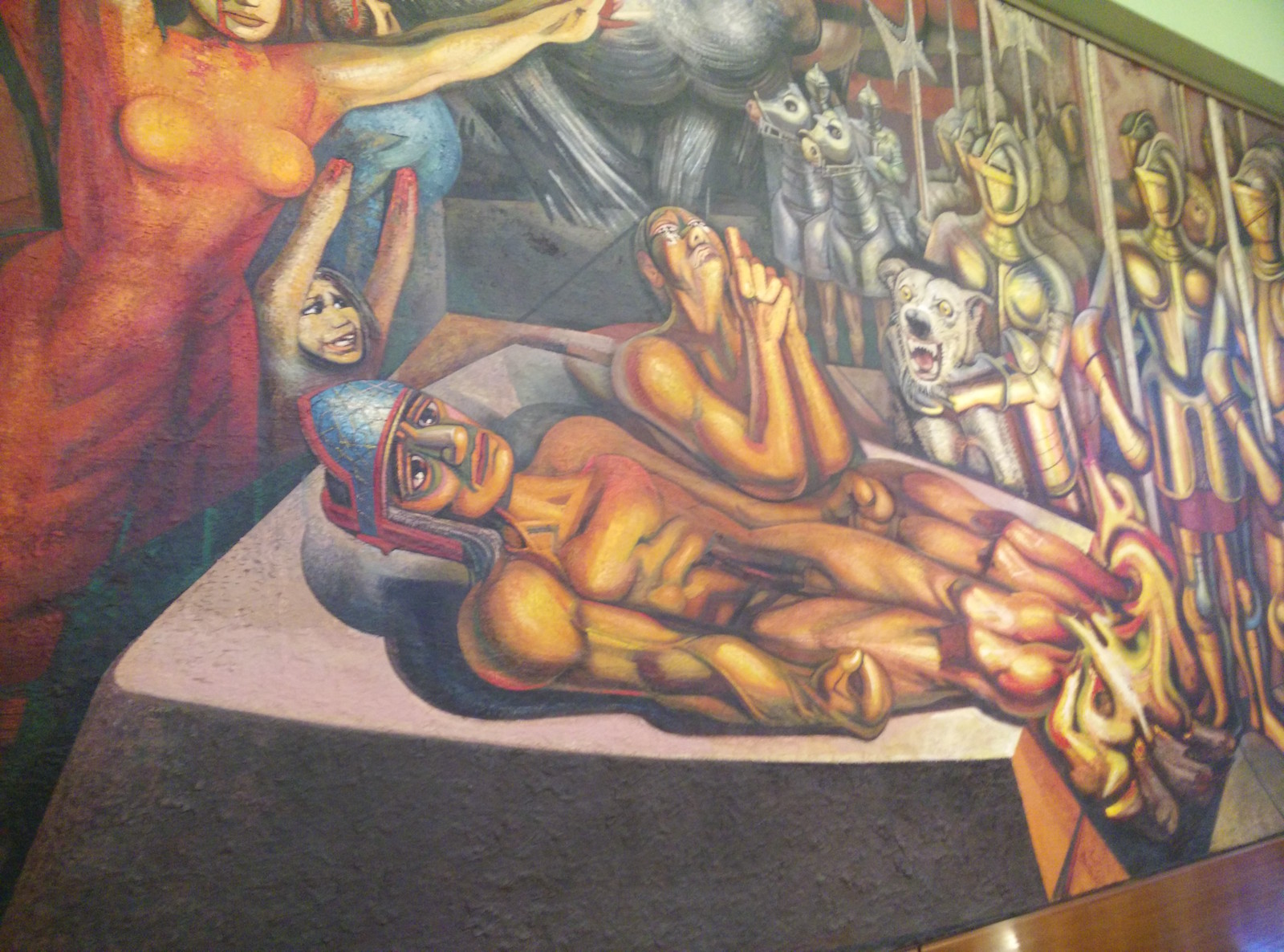
Detail view (click for the full image) of David Alfaro Siquieros‘s monumental 1950-51 mural, The Torment of Cuauhtemoc.

Boiling hot oil was then applied to their feet; upon which they confessed that, four days prior to Quauhtemoctzin’s capture, all the gold, with the cannon, crossbows, and muskets, which we had lost in the night of sorrows, when we retreated from Mexico, besides those which had been taken in Cortes’ last defeat on the causeway, had been thrown into the lake. A number of good swimmers were then sent to dive for the treasure in the spot they pointed out, but nothing was found. Yet there was some truth in the statement; for I was myself present when Quauhtemoctzin led us to a large and deep reservoir of water, built of stone, which lay near his palace. From this reservoir we fished up a sun of gold similar to the one sent us by Motecusuma, besides many jewels and other trinkets, though all of little value. The king of Tlacupa also informed us that he had hidden all manner of valuable things in some large houses, about twelve miles from Tlacupa, and he would accompany us there to point out the spot where he had buried them.

Alvarado was then despatched thither with six soldiers, among which number I also was; but when we arrived at the spot, this king assured us he had merely invented all this in the hopes that we would have killed him in a moment of anger at our disappointment.

(Diaz later added that “the suspicion was become pretty general that he [Cortes] had concealed the greater part of Quauhtemoctzin’s treasure,” and indeed some disgruntled companions — unsatisfied with the share they had been allotted for so magnificent a conquest — would come to lodge this charge against Cortes formally with Emperor Charles V.)

Cortes eventually brought both these hostages/puppet kings/torture victims along with him on a 1524-1525 expedition to Honduras, perhaps to deprive them of any opportunity to rebel in his absence.

On the evening of February 27, Cortes received a report or a rumor that the Indian kings had rebellion on their mind just the same. The timetable from this report to execution is uncertain from the records, but if it was not within 24 hours it cannot have been much longer. Diaz, a hostile-to-Cortes witness here whose narrative indicates his dismay at proceedings, describes it thus:

I have now to relate a circumstance of a very different nature, which occasioned much grief to us all. Quauhtemoctzin and other Mexican chiefs who accompanied our army had, it would appear, spoken among themselves, or secretly determined to put the whole of us to death, then march back to Mexico, and assemble the whole armed power of the country against the few remaining Spaniards, and raise an insurrection throughout the whole of New Spain. This circumstance was discovered to Cortes by two distinguished Mexican chiefs, one of whom was named Tapia, and the other Juan Velasquez. This latter personage had been Quauhtemoctzin’s captain-general during our war with Mexico, and his testimony was borne out by the investigation which Cortes made into the matter, and by the confession of several of the caziques themselves who were implicated in the conspiracy. These men fearlessly declared, that seeing how carelessly and dispiritedly we roamed about; that numbers of the men were ill from want of food; that four of our musicians, with the buffoon and five soldiers, had died of hunger; and that three other men had turned back, more willing to run the risk of reaching Mexico again than of moving forward, the thought struck them that they could not do better than fall suddenly upon us while we were crossing some river or marsh, particularly as they were upwards of 3000 in number, all armed with lances, and several of them with swords. Quauhtemoctzin did not hesitate to acknowledge that these men had spoken the truth, but added that the conspiracy did not emanate with him, and that he himself had never for a moment contemplated carrying it into effect, but had merely spoken about it with the other caziques. All the cazique of Tlacupa confessed was, his having declared to Quauhtemoctzin that it was better to die at once than daily to have death before their eyes on these fatiguing marches, and see their countrymen and relations perish with hunger.

These were sufficient proofs for Cortes, and without any further ceremony he sentenced Quauhtemoctzin and his cousin the king of Tlacupa to the gallows. Before, however, this sentence was executed, the Franciscan monks, with the assistance of Dona Marina, strove to comfort these unfortunate men, and commended their souls to God. When they were being led to the place of execution, Quauhtemoctzin turned to Cortes, and said: “Oh Malinche! I have for a long time perceived, from your false words, that you had destined me for such a death, because I did not lay violent hands on myself when you entered my city of Mexico! Why are you thus going to put me unjustly to death? God will one time ask this of you!”

The king of Tlacupa said, he could only rejoice in a death which he would be permitted to suffer with his monarch Quauhtemoctzin.

Previous to their being hung, both these unhappy caziques confessed to father Juan, who understood the Mexican language, and they begged of him to commend their souls to God. For Indians they were good Christians, and they died in the true faith, and fully believed in our holy religion.

The death of these two monarchs grieved me excessively, for I had known them in all their glory, and on our march they honoured me with their friendship, and showed me many little attentions; for instance, they would often order their servants to go in quest of fodder for my horse; besides which, they were innocent of the guilt imputed to them, and it was the opinion of all who accompanied this expedition that they were put to death unjustly.

But I will leave this miserable subject, and return to our march, on which we henceforth observed the utmost vigilance, for we greatly feared the Mexicans might rise up in arms against us, after they had thus beheld their monarch ignominiously hung by the neck from a tree. But hunger, fatigue, and sickness weighed heavier upon their minds than the misfortune of Quauhtemoctzin.


Detail view (click for the full image) of the “rebel” kings hanged from a tree.

Gomara and, of course, Cortes characterize the accusations against the Indian kings as true and the proceedings against them lawful. From the footnotes in this same Bernal Diaz volume, we have this from the later Jesuit historian and ethnographer Juan de Torquemada, who was fluent in Nahuatl:

I find it differently represented in a history written in the Mexican language, and which I believe to be perfectly correct. While Cortes (the Mexican author says) was quartered in a certain township, the Mexican chiefs one evening began to discourse among themselves about the recent hardships they had suffered, and Cohuanacotzin said to Quauhtemoctzin, to Tetlepanquetzaltzin, and to other distinguished Mexicans, ‘Thus you see, gentlemen, from kings we are become slaves, and we suffer ourselves to be led about by Cortes and this handful of Christians. If we were other people than we are, and would break through the promise we have made these Spaniards, we could play them a pretty trick here, and revenge ourselves upon them for all they have done to us, and the ill-treatment my cousin Quauhtemoctzin has suffered at their hands.’ To this the Mexican monarch replied, ‘I beg of you Cohuanacotzin to drop this subject, lest some one should overhear us, and imagine we were in earnest.’ It appears (continues Torquemada) that they were indeed overheard, for the whole of this discourse was reported to Cortes by a low-minded Mexican of the lower classes.

By law, Mexican flags fly at half-staff in his honor on February 28.

* These texts are cited throughout the post, but for ease of reference … Bernal Diaz: Memoirs of the Conquistador Bernal Diaz del Castillo, vol. 1, vol. 2 | Gomara: The Pleasant Historie of the Conquest of the West India; now called New Spaine | Cortes: History of New Spain, which is a Spanish text as I could not locate an English translation. However, even the Anglophone is liable to appreciate (from p. 225) the illustrations of Indian material culture observed by the Spaniards.

On this day..

1838: William Moore, thirsty for blood

On this date in 1838, William Moore hanged at High Street, Maitland, New South Wales, a mere 25 days after slaughtering his master.

Australian convicts were commonly assigned to work for the free population — as Moore was to a butcher named John Hoskins/Hosking. Pissed that Hosking had reported him absent to the police when he ditched work the previous day, Moore on February 1st got drunk and

made an attack upon him with a knife, and inflicted six wounds, either of which would have caused death; he then left the house with the bloody knife in his hand, and wiping the blood off with his hand, he put it to his lips, saying, “This is flash Hosking’s heart’s blood, and, thank God! I have got a good appetite to eat it.” He then drew his finger along the blade, licked off the blood, and swallowed it!

The blood-licking was the least of it. Once the maniac was overpowered and the butcher’s shop examined, well,

[t]he first thing, which met the eye on entering, was a stream of gore flowing over the shop, and proceeding backwards by the track of blood visible on the floor, the body of the unfortunate Hoskins was discovered perfectly lifeless, his throat cut through to the bone, the vertebral column broken and a frightful gash on the chin; independent of these wounds, which were enough to have destroyed him, there was a second in the pit of the stomach, a third in the region of the heart, a fourth in the right side, a fifth above the hip, from which the intestines protruded in a frightful manner, a sixth across the arm, and a seventh, by which his left thumb was nearly severed from his body, that had evidently been inflicted when the unfortunate man was struggling with his murderer.

He was hanged to the hisses of a hostile populace at the site of Hoskins’s house.

On this day..

2000: Ahmad Ismail Uthman Saleh and Ahmad Ibrahim al-Sayyid al-Naggar, renditioned

On this date in 2000, Egypt hanged two Islamic militants whom it had been torturing for months. They were signal early victims of the U.S. Central Intelligence Agency’s program — more (in)famous after the September 11 freakout but in fact long predating it — of “extraordinary rendition”.

“Rendering” — chill word — involves kidnapping a target and transferring him to some other country, and it enables the state(s) in question to sidestep strictures at both ends of the pipe. When first authorized by U.S. President Bill Clinton in 1993, the proposed kidnapping of a militant was endorsed by Vice President Al Gore in these words:

That’s a no-brainer. Of course it’s a violation of international law, that’s why it’s a covert action. The guy is a terrorist. Go grab his ass.

Over the course of the 1990s, quibbles about international law would fade from the discussion, and “renderings” became routine, albeit still secretive.

“The fact is,” wrote former National Security Council counterterrorism official Richard Clarke, “President Clinton approved every snatch that he was asked to review. Every snatch CIA, Justice, or Defense proposed during my tenure as [Counterterrorism Security Group] chairman, from 1992 to 2001, was approved.”

Nor did they remain merely tools to make an extra-legal “arrest” for the benefit of American courts — as was the case when Gore purposed to “grab his ass.”

According to Stephen Grey’s history of the rendition program, Ghost Plane, the CIA by by the mid-1990s had a growing presence in Europe, particularly the Balkans as Islamic militants began congregating. With the 1998 onset of the Kosovo War, Langley moved from watching to … rendering.

And in this case, that meant grabbing asses for Egypt, where those asses would certainly be tortured.

Members of Egyptian Islamic Jihad, including the two men whose hangings occasion this post, Ahmad Ismail Uthman Saleh and Ahmad Ibrahim al-Sayyid al-Naggar, were kidnapped from Tirana, Albania in June 1998. They were then blindfolded, loaded onto a private plane, and flown to Egypt where they vanished for many months into the rough hands of its state security organ. Naggar, according to a lengthy November 20, 2001 Wall Street Journal story by Andrew Higgins and Christopher Cooper,*

was nabbed in July 1998 by SHIK on a road outside of town. He, too, was blindfolded and spirited home on a CIA plane. In complaints in his confession and to his defense lawyer, Mr. Abu-Saada, Mr. Naggar said his Egyptian interrogators regularly applied electrical shocks to his nipples and penis.

Mr. Naggar’s brother, Mohamed, said in an interview that he and his relatives also were — and continue to be — harassed and tortured by Egyptian police. He said he had suffered broken ribs and fractured cheekbones. “They changed my features,” Mohamed Naggar said, touching his face.

Naggar also complained of being hung from his limbs and locked in a cell knee-deep in filthy water. One of four Tirana militants captured in this operation, Naggar’s torture would yield crucial evidence for the 1999 “Returnees from Albania” mass trial,** and indeed his confessions still remain an essential primary text on the movement of Islamic extremists in the 1990s.

As for Saleh,

in August [1998], Albanian security agents grabbed him outside the children’s park. During two months of detention in Egypt, he was suspended from the ceiling of his cell and given electrical shocks, he told his lawyer.

Both these men were executed on February 23, 2000, in connection with terrorism-related death sentences that had been handed down in absentia prior to their kidnappings in Albania. All of the nine death sentences issued by the Returnees from Albania trial were applied to absent defendants, notably including Al Qaeda bigwig Ayman al-Zawahiri — a man who himself perhaps owes a large measure of his radicalization to Egyptian torturers.

CIA Director George Tenet testified in 2002 that his agency “had rendered 70 terrorists to justice” all told prior to September 11, 2001 (source). Most of the known third-country renditions of that period went to Egypt.

* As an index of the historical moment, it’s editorially interesting that this 3,600-word investigation ten weeks after 9/11 chooses to give its last word to an Egyptian state spokesman.

Egyptian presidential spokesman Nabil Osman said of such mass prosecutions: “Justice is swift there, and it provides a better deterrent. The alternative is to have cases of terrorism in this country dangling between heaven and earth for years.”

Mr. Osman brushed off torture claims by members of the Tirana cell, without commenting directly on their validity. Egypt permits alleged torture victims to seek remedies in civil court, he said. Members of the Tirana cell, however, have been held incommunicado with no way to file suit.

“Forget about human rights for a while,” Mr. Osman said. “You have to safeguard the security of the majority.”

This article was published right around the time the CIA captured Ibn al-Shaykh al-Libi, who was himself soon rendered into Egyptian hands so that he could be tortured into “confessing” a spurious link between Saddam Hussein and Al Qaeda; the “safeguarders” then shamelessly cited this absurd product of the rendition program as justification for the approaching Iraq debacle.

** Despite the nickname, not all “returnees” had been captured from Albania; others had been taken from Kuwait, Saudi Arabia, Yemen, and other countries. There were also 64 people charged in absentia.

On this day..

1794: The Comte de Feuillide, Jane Austen in-law

To Madame la Comtesse de Feuillide this novel is inscribed by her obliged humble servant The Author.

-Jane Austen’s author’s dedication in Love and Freindship

On this date in 1794, the guillotine brought tragedy to Jane Austen’s family.

The blade’s more immediate victim was Jean Gabriel Capotte, the Comte de Feuillide and the husband of Eliza de Feuillide (nee Hancock), Jane Austen’s “outlandish cousin.”

Fourteen years the novelist’s senior, Eliza was born in India to Jane’s Aunt Philadelphia who went abroad seeking a mercenary marriage and landed an unhappy one to a surgeon twice her age, Tysoe Saul Hancock. Eliza Hancock might possibly have been the illegitimate daughter of colonial administrator Warren Hastings, who stoked rumors by establishing a trust for the young woman. (Eliza also later named her only son “Hastings”.)

Either way, she didn’t grow up in the colonies but in England and France, where her vivacity conquered the heart of a prosperous French officer on the make, a barrister’s son who self-aggrandized his rank of Comte de Feuillide. As a gadabout exile “French countess” during the French Revolution, the charming Eliza de Feuillide was a hit both with London society and with her debutante cousin Jane, “whose kind partiality to me” Eliza would write in a letter “indeed requires a return of the same nature.”

Eliza exerted a magnetic influence on her kinswoman, and she’s popularly suspected to be the model for the Mansfield Park character Mary Crawford.* There’s even a book theorizing that this peripatetic polyglot was the true author of Jane Austen’s canon.


Lucy Cohu as Eliza de Feuillide makes some guillotine banter in Becoming Jane.

Back in France, where he served in the army, the hubby with an emigre wife and an aristocratic pretension made a decidedly poorer impression upon the Jacobins, as Maggie Lane observes in Jane Austen’s Family:

On 22 February 1794 the Comte de Feuillide fell victim to the guillotine. He had foolishly, if gallantly, tried to bribe one of the Secretaries of the Committee of Safety to secure the liberty of the widow of an army colleague, Jacques Marboeuf, Marquis and Marechal-de-camp. The fifty-five-year-old Marquise stood accused of laying down certain arable lands on her estate to fodder crops, with the idea of producing a famine in an effort to undermine the Republic.

De Feuillide was double-crossed by the Secretary and arrested at his lodging in the rue Grenelle et St Honore, where incriminating documents and sums of money parcelled up for the bribery were seized. The Marquise, the Comte and the Marquise’s man of business who had acted as a go-between in the attempt, all were sentenced to death.

After a few years as a merry widow, Eliza wed her cousin Henry Austen — Jane’s brother and Eliza’s “perpetual sunshine”. Eliza Austen died in 1813, with Jane Austen at her bedside.

* In Jane Austen and the French Revolution, Warren Roberts argues that the Comte de Feuillide has his own literary doppelganger in the unfinished Austen novel Catherine, in the form of Edward Stanley.

On this day..

1896: Ivan Kovalev, Russian meddler

On this date in 1896, Russian refugee Ivan Kovalev was hanged for a Sacramento double murder.

Kovalev and nine other Russian convicts had in 1893 fled from the most remote and dreaded of Russia’s Far East penal colonies, Sakhalin Island.

They might have met Anton Chekhov when he visited in Sakhalin in 1890 to compose the investigative articles that would become his book Sakhalin Island, one of the great pieces of journalism of his time. “Utter hell,” the great playwright mused of that brutal and befogged colony. “I feel that if I were a convict, I would escape immediately, whatever the consequences.”

Kovalev and nine mates felt exactly the same and they did it in the form of a downright suicidal flight from Sakhalin’s abyss in an open launch ventured into the Pacific in hopes of reaching Japan. They were on the brink of succumbing to their privations when they were miraculously picked up by a San Francisco-based whaler, the Charles W. Morgan.**

The convicts claimed that they were escaped political prisoners, a demographic that enjoyed western sympathy; there’s every chance that they were actually violent criminals but their tale of woe in the bowels of tsardom was persuasive and times being what they were a background check with the nearest consulate was not an option. The Sakhalin escapees were allowed to stay in California.

On December 30, 1894, about sixteen months after they drew their last moldy Sakhalin rations, Kovalev with two accomplices† bashed the brains out of the aged grocer F.H.L. Weber and his wife with an axe so that they could rob his store. Chekhov? Make that Dostoyevsky.

It took several months to zero in on the perpetrator but once the conviction was secured, indignant Sacramentans applied in record numbers for passes to attend the hanging, such “a spirit of enmity and hatred toward this son of far-away Russia” having been aroused by the horrid circumstances of the butchery that “it is evident that a spirit of satisfaction is abroad in the community at the thought that … Ivan Kovalev will expiate that crime with his life.”

* The New York Public Library hosts a digital collection of photos of the Sakhalin penal colony, here. Others can be browsed at the Sakhalin Regional Museum site.

** The Charles W. Morgan had an 80-year service history; it’s been restored and can be visited in Mystic, Connecticut.


1971 U.S. postage stamp commemorating the Charles W. Morgan‘s preservation.

† The accomplices don’t figure in the execution story: one was mortally wounded in an unrelated subsequent robbery, prior to Kovalev’s arrest; the other wound up serving time for burglary.

On this day..

1948: Thomas Henry McGonigle, murder without a body

(Thanks to Meaghan Good of the Charley Project for the guest post. -ed.)

The Latin legal term corpus delicti literally translates to “the body of the crime,” and many people are under the impression that it means the actual corpse of a murdered person and that no one may be convicted of murder without the victim’s body.

This is erroneous. Although it is true that no person can be convicted of murder without the corpus delicti, the term doesn’t mean the murdered person’s body but rather the body of evidence that proves a crime has been committed. Every criminal case must have the corpus delicti and, in most murder cases, that includes the victim’s body … but it doesn’t have to.

In the United States, murder-without-a-body prosecutions are not unheard of and happen with increasing frequency due to the advancement of forensic technologies like DNA analysis. Tad DiBiase, a former federal prosecutor, even wrote a book about them, titled No-Body Homicide Cases: A Practical Guide to Investigating, Prosecuting, and Winning Cases When the Victim Is Missing, which includes an appendix of over 400 cases.

On this day in 1948, Thomas Henry McGonigle was executed in California’s gas chamber in what was one of the earliest, perhaps THE earliest no-body homicide prosecution in the state. His victim was a fourteen-year-old high school sophomore named Thora Afton Chamberlain, and her body was never found and is believed to have been washed out to sea.

The prosecution would later call the case “one of the best organized and most intense investigations in the annals of the crime of kidnapping and murder.”

McGonigle, a married construction laborer with an arrest record for a variety of crimes including assault with intent to commit rape, was waiting in his car outside Campbell High School when classes ended for the day on November 2, 1945. Thora’s classmates saw her talking to him, and he offered her a job: he needed someone to babysit his sister’s children. It would only be for half an hour, he said.

For whatever reason, Thora trusted the stranger. Perhaps it was because he was dressed respectably in a Navy uniform with medals, including a Purple Heart. She didn’t know they weren’t his, that he’d never been in any branch of the military. He’d stolen the clothes and medals six weeks earlier.

Thora Chamberlain was never seen again after she got into the strange man’s car. McGonigle was an immediate suspect because of his record, and several witnesses identified him from a photo lineup, but in the immediate aftermath of Thora’s disappearance he skipped town.


Murderer and victim.

McGonigle told his wife he was taking a bus to Los Angeles, but in fact he hitchhiked to Illinois where his father lived. The FBI kept on his trail as he drifted across the country, registering in hotels under alias names. Finally he took an overdose of sleeping pills while on a bus bound for San Francisco, and was semiconscious on arrival. The Feds were waiting for him, but instead of jail they had to take him to the hospital for treatment. He was arrested upon discharge.

In custody, McGonigle gave a series of statements admitting culpability but providing wildly differing details as to what happened. He’d stabbed Thora. He’d shot her. He’d strangled her. She’d jumped from his car and was fatally injured. Her death was an accident. He hadn’t killed her at all; she was alive and well and working as a prostitute.

Although the entire truth about what happened is only known to Thora and her killer, the shooting story has the most evidence to support it.

McGonigle said he had shot Thora in his car and the bullet passed through her and got stuck in his car door. He said he’d removed the bullet and buried it under a certain tree in his yard, and also ripped out the vehicle’s bloodstained padding and upholstery and buried it near the construction site where he worked. There was a bullet hole in the door of McGonigle’s car, police recovered the bullet from under the tree where he said it would be, and ballistics later proved it had been fired from a .32 caliber revolver he owned. The police also found the ripped car upholstery at the indicated spot, and it was stained with human blood.

McGonigle lead the authorities to a coastal cliff in San Mateo County known as the Devil’s Slide. He said he’d thrown Thora’s body off the cliff, 350 feet down into the ocean. An extensive search revealed important, chilling evidence that may well have been the clincher: on the day of her abduction, Thora was dressed in her school colors of red and blue, including one pair of red socks and one pair of blue socks, one on top of the other. Searchers found both pairs wedged in separate crevices on the cliff face, and Thora’s parents identified them.

At the trial, prosecutor John McCarthy told the jury how it might have happened, painting a word picture of McGonigle killing Thora in a rape or attempted rape, then lifting her from his car by her armpits and dragging her along the ground to the edge of the Devil’s Slide. In the process her loafers come off and her socks are pulled down her feet. As she falls, they come off entirely and get stuck in the crevices of the cliff.

“In finding the socks,” McCarthy concluded, “the crime was solved.”

Given McGonigle’s string of confessions — which continued even at his trial — and the eyewitnesses who identified him, and the physical evidence that backed it all up, it’s no wonder the jury only deliberated half an hour. He was convicted on March 1, 1946.

While his conviction was under appeal he retracted his previous statements and denied everything. It was a frame-up, he said, all of it: he’d never confessed to anything and the FBI had planted all the evidence and the witnesses had lied. The police, meanwhile, stated he’d also confessed (over and over again…) to the murder of an unnamed “Negro waitress” from San Francisco and the only reason they weren’t going to charge him was because he was already under sentence of death.

The day he was executed, McGonigle wrote down a statement in longhand and left it with the warden:

I, Thomas Henry McGonigle, in this last testimony to the people declares [sic] that I did not shoot Thora Chamberlain and did not throw her body over a cliff and I have never made any such confession that I shot Thora Chamberlain in Santa Cruz County.

Santa Cruz County Sheriff Wallace P. “Bud” Hendrick didn’t agree. He witnessed the execution and later told reporters, “He threw his head back and gasped three times. Every time he gasped with that look of pain and death about him, I smiled. He was the most despicable … that ever walked the face of the earth. I only wish it could have taken longer.”

(Robert E. Cornish, a mad scientist and former child prodigy who made various Frankensteinian attempts to raise dead animals, wanted to try reviving a death row inmate after an execution. McGonigle volunteered himself for the experiment, but permission was denied.)

As for Thora, her body is presumed to have washed out to sea. She remains listed in missing persons databases, however, in the unlikely event that it turns up.

On this day..

1951: Jean Lee, the last woman to hang in Australia

(Thanks to Richard Clark of Capital Punishment U.K. for the guest post, a reprint of an article originally published on that site with some explanatory links added by Executed Today. CapitalPunishmentUK.org features a trove of research and feature articles on the death penalty in England and elsewhere. -ed.)

Jean Lee, an attractive 31-year-old redhead, made history as the last woman to hang in Australia when she went to the gallows in Pentridge prison in the Coburg suburb of Melbourne in Victoria state on the morning of Monday, February 19th, 1951. She and her two male companions were hanged for the murder of 73-year-old dwelling house landlord and bookmaker, William “Pop” Kent.

Jean Lee was apparently quite intelligent and a bit rebellious at school and had a succession of dead end jobs from which she soon left or was fired.

She married at 18 and lived with her husband for about nine years before leaving him and entrusting her daughter to her mother. She had a relationship with a petty criminal who got her into prostitution with American servicemen. He acted as her pimp whilst she worked to support them both.

She left him for another professional criminal, Robert David Clayton, with whom she fell deeply in love. As is so often the case, she became caught in a downward spiral. She was in love with a criminal who abused her and used her in his criminal activities.

These centered principally on what was known as the “badger game.” Lee, at the time, a voluptuous and attractive woman would pick up men and get them to a hotel room, their own home, or a car where she would appear to be about to have sex with them. Once they were semi-naked and vulnerable, Clayton would appear in the role of outraged husband and demand money from them. Usually the victims handed over their ready cash but kept quiet for fear of their wives finding out or of being ridiculed — so it was a fairly safe bet. If they were not forthcoming Clayton would beat them up. It was a scheme that had worked well, although at least two previous cases had been reported to the police.
On the evening of November 7th, 1949, Lee, Clayton and a third accomplice, Norman Andrews, whom Clayton had met in prison, saw William Kent in a Melbourne hotel lounge. Jean Lee had several drinks with Kent and soon succeeded in persuading the old man to take her back to his apartment where she tried to pick his pockets.

However, Mr. Kent, although inebriated and quite elderly, was of sterner stuff. He put up a fight with Lee which was ended when Clayton and Andrews entered his room. Mr. Kent was systematically kicked, beaten and tortured over the next hour in an attempt to get him to reveal where he kept his money. His hands had been tied behind his back and his thumbs tied together with bootlaces. He had been repeatedly stabbed with a small knife and was finally manually strangled.

The trio were soon arrested at their hotel and bloodstained clothing was found in Lee’s and Andrew’s rooms. At police headquarters, they were questioned in separate rooms where each initially denied their involvement and then started to blame the others.

They came to trial on March 20th, 1950 at Melbourne’s Criminal Court and the proceedings lasted six days. As each had tried to shift the blame on to the others in their statements to the police, the trial judge Mr. Justice Gavan Duffy explained the law of “common purpose” to the jury, i.e. that when three people take part in a violent robbery and murder they are all equally guilty, irrespective of which one had actually strangled Mr. Kent. The jury took less than three hours to find them all guilty and they were sentenced to death. Lee became hysterical whilst Clayton shouted abuse at the jury.

Their appeal was heard by the Court of Criminal Appeal and was upheld by a two to one majority decision on the 23rd of June 1950. The Appeal Court ruled that their statements to the police had been obtained improperly as the statement of one was used to extract confessions from the other two. They were thus granted a retrial. However, this was not to be as the High Court overturned the Appeal Court and reinstated the convictions and sentences.

There was considerable protest, led by left-wing and feminist groups, when Lee was sentenced to death. However, it seemed to primarily be against the execution of a woman by hanging, rather than the execution of women per se.

Lee would became the first woman to be hanged in Victoria since Emma Williams in November 1895. She had aged noticeably during her time in prison and suffered violent mood swings — now abusing her wardresses, next begging them for an alcoholic drink. She told one of her wardresses: “I just didn’t do it. I haven’t enough strength in my hands to choke anyone. Bobby was stupid but the old man was trying to yell for help. None of us meant to kill him.”

It was decided that Lee should be the first to hang at 8 am, the two men being executed two hours later.

She was heavily sedated as she shuffled under escort to a double cell near the gallows. Her weight was recorded as 7 stone 6 lbs, her height as 5′ 7″ and the drop was set at 8 feet exactly.

Sheriff William Daly was required to read the death warrant to her. She collapsed on seeing the hangman and his assistant — both wearing “massive steel rimmed goggles [with a] soft felt hat … to ensure that they were not recognised in the future”. A doctor examined her and found she was unconscious. However, the execution had to proceed so Daly continued to read out the details of her conviction and sentence although she would not have heard a word of it — if she had, she would have spotted a mistake (the date on which she had been sentenced).

Because of her state of collapse, the executioner pinioned her arms in front of rather than behind her back as was normal. His assistant then pinioned her legs with a strap whilst he put the white hood on her head, and they carried her from the cell the few yards to the gallows where she had to be placed on a chair on the trap. Her head drooped to her chest and the executioner had to pull it back in order to adjust the noose correctly.

The flap of the hood, which was to cover her face, had been left open. At a signal from the sheriff, the executioner dropped the flap to obscure her face, stood back from the trap and pulled the lever. The trap fell and both she and the chair plummeted through. The chair had been secured to the gallows by a cord and although it fell with her, the two parted company at the end of the drop leaving her suspended normally. Her weight was recorded as 7 stone 6 lbs, her height as 5’ 7” and the drop was set at 8 feet exactly. The knot was positioned under her left ear and death was said to be “instantaneous”. At 8.05 am the prison doctor found no heartbeat. The death certificate was signed at 8.20.

Two hours later Clayton and Andrews, both mildly sedated, shared her fate.

Capital punishment ended in Australia with Victoria’s next execution, that of Ronald Ryan on the same gallows at Pentridge prison on the 3rd of February 1967.

A recent book, Jean Lee: The last woman hanged in Australia by Paul Wilson, Don Trebl and Robyn Lincoln casts doubt on the justice of her conviction and execution based upon the police interrogation methods and her part in the murders.

On this day..