1841: The Jewboy’s Gang

On this date in 1841, Australian bushranger Edward “Teddy the Jewboy” Davis was hanged in Sydney along with five others of his gang. The reader may guess the chief’s distinguishing demographic characteristic, and some lists mark him the only Jewish bushranger.

He’d been transported from England in 1833 at the age of about 16, for a trifling theft. “Obsessed by the idea that he had been wronged when he was transported and governed by an indomitable desire for freedom,” Davis began repeatedly escaping from his penal assignments only to be repeatedly captured.

Indefatigable as Monty Python’s Swamp Castle King, he just kept trying until he got it right.

By 1839 the young Hebrew had formed a seven-strong outlaw gang plundering New South Wales’s future wine country, the Hunter Valley. Their captain seems to have brought along from the old country the romantic conception of a cavalier-thief, as this charming account of one of their raids suggests, wherein the victim “says he was treated in the most gentlemanly manner by them, and that he never spent a happier night in his life.” The stylish marauders, we find, dressed themselves “rather gaudy, as they wore broad-rimmed Manilla hats, turned up in front with abundance of broad pink ribbons, satin neck-cloths, splendid brooches, [and] all of them had rings and watches.”

They kept by a sage policy of Davis’s to eschew deadly violence for fear of bringing down the authorities’ wrath, but they didn’t quite keep to it well enough. One of their number, John Shea, slew a man in December 1840, and a posse hunted them down the very next day, and interviewed in jail, “Davies said that he would always oppose the shedding of blood, for he knew if they once committed a murder they would not reign a week; whilst saying so he looked at the other four men,* and said, you now see we have not reigned a day.”

Edward Davis, 26, Robert Chitty, 37, James Everett, 25, John Marshall, 27, Richard Glanville, 31, and the 27-year-old Shea were hanged behind Sydney Gaol on the 16th of the following March.

The notoriety which the crimes of these men has attained drew together a large concourse of spectators to witness their execution. The entrance to the Gaol, in George-street, was besieged for admission long before the arrival, at nine o’clock, of a strong military guard from the barracks, and so great was the pressure of the crowd, that it required the unremitting exertions of Captain Innes to preserve order. At ten minutes past nine, the culprits were strongly pinioned, and conducted from the cells to the area in front of the drop, where they knelt down. Chitty, Everett, Marshall, and Glanville, were attended by the Rev. William Cowper and the Rev. John Elder. The Rev. Mr. Murphy, Catholic Priest, accompanied Shea; and Davis (being of the Jewish persuasion), was attended by Mr. Isaacs, Minister of the Jewish congregation in New South Wales. All the culprits (if we except Everett), deeply lamented their having committed the crimes for which they were about to die, and acknowledged the justice of their sentences. Everett ascended the scaffold hurriedly, and in an evident state of excitement. He was followed by Chitty, Marshall, and Glanville, all three of whom, on reaching the scaffold sung the first verse of the Morning Hymn, to be found in many editions of the book of Common Prayer, commencing “Awake my soul, and with the sun.”

This act of devotion, we have since heard was entirely spontaneous, not having been suggested, or even expected by either of the reverend gentlemen, who attended to administer the consolations of religion according to the rites of the Protestant Church. The ropes were speedily adjusted, and the white caps drawn over the faces of the wretched criminals; in the short interval which elapsed before the withdrawal of the fatal bolt, Marshall and Glanville were engaged in loud and apparently fervent prayer, and we observed the culprit Davis (who was attired in a suit of mourning), thank the Jewish Minister for the attention paid him in his last moments. The struggles of all the men were of short duration; the immense crowd dispersed peaceably. It will be remembered that these men were apprehended, chiefly through the active exertions of Mr. Day, Police Magistrate, Maitland.

* A fifth accomplice was captured a short time afterwards and joined his mates on the gallows.

On this day..

1766: Nicholas Sheehy, Whiteboys priest

On this date in 1766, Irish priest Nicholas Sheehy was hanged, drawn, and quartered in Clonmel — a victim to the years-long campaign of enclosures by Ireland’s landlords, whom English agriculturist Arthur Young reported as “harpies who squeezed out the very vitals of the people and by process, extortion, and sequestration dragged from them the little which the landlord had left them.”

Sheehy was a sympathizer of the peasant “Whiteboys” resistance movement, so named for the snowy frocks these secret guerrillas donned when out on midnight raids to strike back against the owners where tenants’ livelihoods were at stake. Where landlords enclosed public grounds, Whiteboys knocked down the fences; where they displaced peasant farmer with commercial livestock, Whiteboys hamstrung the cattle.

“It could not be expected,” wrote Margaret Anne Cusack, “that the Irish priest would see the people exposed to all this misery — and what to them was far more painful, to all this temptation to commit deadly sin — without making some effort in their behalf.”

Father Sheehy, parish priest of Clogheen, was one of these, and a villain in the eyes of Protestant elites for his denunciations of enclosure and his comforts to its more muscular foes.

He had interfered in the vain hope of protecting his unfortunate parishioners from injustice; and, in return, he was himself made the victim of injustice. He was accused of encouraging a French invasion — a fear which was always present to the minds of the rulers, as they could not but know that the Irish had every reason to seek for foreign aid to free them from domestic wrongs. He was accused of encouraging the Whiteboys, because, while he denounced their crimes, he accused those who had driven them to these crimes as the real culprits. He was accused of treason, and a reward of £300 was offered for his apprehension. Conscious of his innocence, he gave himself up at once to justice, though he might easily have fled the country. He was tried in Dublin and acquitted. But his persecutors were not satisfied.

A charge of murder was got up against him; and although the body of the man [John Bridge, a former Whiteboy turned informer -ed.] could never be found, although it was sworn that he had left the country, although an alibi was proved for the priest, he was condemned and executed. A gentleman of property and position came forward at the trial to prove that Father Sheehy had slept in his house the very night on which he was accused of having committed the murder; but the moment he appeared in court, a clergyman who sat on the bench had him taken into custody, on pretence of having killed a corporal and a sergeant in a riot. The pretence answered the purpose …

At the place of execution, Father Sheehy most solemnly declared, on the word of a dying man, that he was not guilty either of murder or of treason; that he never had any intercourse, either directly or indirectly, with the French; and that he had never known of any such intercourse being practised by others.

Father Sheehy’s head wound up on a pike (it was said that the birds in reverence would not peck at it), and his name in the rich firmament of Irish martyr-patriots. He’s been occasionally proposed for canonization.

On this day..

1964: Jack Ruby condemned

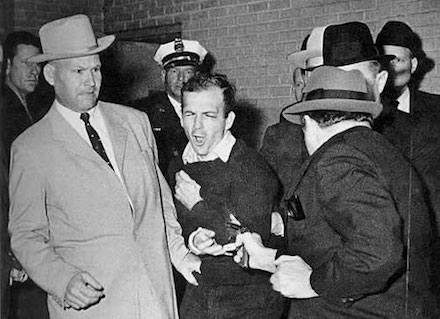
On this date in 1964, Dallas nightclub owner Jacob Rubenstein — notorious to history as Jack Ruby — was condemned to the electric chair for the dramatic live-televised murder of accused John F. Kennedy assassin Lee Harvey Oswald, captured by snapping shutters in one of the 20th century’s indelible images.

Ruby would never sit on that mercy seat.

For one thing, his punishment arrived as the American death penalty lulled into hibernation. Had he lived his sentence eventually would have been vacated by the 1972 Furman v. Georgia ruling. But instead of seeing that juridical landmark, the enigmatic Ruby died in prison inside of three years, awaiting retrial after an appeal.

On this day..

1663: Alexander Kennedy, forger of false bonds and writts

On this date in 1663, Alexander Kennedy was hanged at the Cross of Edinburgh for forging false bonds and writs, whose particulars we discover in The Records of the Proceedings of the Justiciary Court, Edinburgh, 1661-1678.


Edinbr. 24 feb. 1663. Deput Cuningham pt.

Alexander Kennedy, sometimetime Porter in the Castle of Edr., now prisoner, dilated and accused for the crime following, viz. for that notwithstanding of the common, municipall Laws and constant practise of this kingdome, the forgers, Counterfeiters and Devisers up and Users of false Bonds, obligations and other Writts, are to be punished be tinsell of their lives and moveable estate and especially by the 22d Act, 23 Parl. Ja. 6, it is statute and ordained, that whosoever makes any false writ or is accessory to the making thereof shall be punished with the pains due to the Committers of falsehood, which by the constant practise of this kingdome is the pain of Tinsell of Life and moveable estate, and that it shall not be but that after Tryall of the Writt quarrelled it be found false the passing from or Declaration of the Party that he will not use the same shall no ways free him from the punishment due to the committers of falsehood as at more length is contained in the said Acts whereupon it is subsumed that the Pannell has forged, feinzied, counterfeited and made up the six Bonds, Obligations, and Contracts under written, four of the which Bonds are alledged granted by the decast John Renton of Lamberton, therein designed Constable of the Castle of Edinbr., to the deceast Dame Agnes Renton, Countess of Levin, all dated 17 Octor. 1648, by each of which four Bonds, the said umq John Renton granted him to have borrowed (here follows the contents of the Bonds as they are made payable to the Lady and her Daughter, then follows the tenor of a Contract made up by the Pannell betwixt himself and Lamberton, be which he is obliged to pay 3000£ to the Pannell upon his delivery of him of the forsaid six Bonds by the Lady Leven’s warrand, and Alexr. upon receipt of the forsaid sum is obliged to deliver tye Bonds and the Lady’s warrand, and subsumes that the Pannell is the forger of all these Writts, or airt and part, and that the Lo: of Session has found so by a Decreet of Improbation, dated 22 July last, and finds that the Pannell is an infamous and perjured person, and has remmitted him to be criminally tryed, and ordained the King’s Advocate to process him, which being found by an Assize, he ought to be punished with the Tinsell of Life and moveables, to the terror and example of others.

Mr. And. Birnie, Pror. for the Pannell, alledges the Dittay is not relevant, because it does not condescend wherein the Pannell is forger of the Writts lybelled, whether in the Subscription of the principall party, granter, or Subscriptions of the Witnesses, or date, or some other substantiall head. 2d. Nonrelevat accessory or user because by the Act of Parliat. the User of a false Writte unless he byde by it is not liable to the punishment of falsehood. Neither is Accession relevant unless the way of his accession be condescended upon, frae which Condescendance a Defence may result. 3d. The Lybell non relevat in so far as it concludes Tinsell of Life and Goods, because the Act of Parliamt. lybelled on does not express the Punishment, but referrs to prior Acts, and it is clear both from K. Jas. the 5th and Q. Mary‘s Acts that the Punishment is restricted to Imprisonment, Banishment, etc. which is placed in Arbitrio Judicis.

My Lo: Advocate to all this oppones the Dittay as it is lybelled, and the Act of Parlt. whereupon it is founded bearing the punishment of falsehood to be inflicted on such as are forgers and users of false Writts, or art and part thereof, and both the Act of Parliament and custom of the Justice Court has determined the pain to be loss of Life and Moveables.

Duplys Birnie to the last part of the Advocate’s Alledgiance, that it is to be understood only as to falsifying Writts that can proceed only from authority, and oppones the Act of Parliament.

The Justice Depute ordains the Dittay, notwithstanding of the Answer, to pass to the Tryall of an Assize. The Assize being sworn, the King’s Advocate produces the Lo: of Session’s Decreet of Improbation per modum probationis, and thereupon the Assize finds the Pannell guilty as art and part, accessory and user of the false Writts mentioned in the Dittay, conform to the Decreet of Session. Vide sentence 12th instant.

I repeat here my Observe which I made on Birnie’s sentence day of 1662. [I’m unsure what this alludes to -ed.]

Edinbr 12 March 1663. Deput Cuningham.

Alexr. Kennedy convict ut supra of falsehood, sentenced to be hanged at the Cross of Edinburgh.

On this day..

1817: John Cashman, Spa Fields rioter

On this date in 1817, a sailor named Cashman was hanged for the Spa Fields riots.

In the aftermath of the Napoleonic Wars, Britain’s economy had all but ceased to function for her lowest orders, burdened by spiraling food prices and cratering wages. An ample stock of radical agitators put the powdered wig set in mind of so many Robespierres, and here and there they were sacrificed on the scaffold.

Three years on, in the wake of a different protest against these unresolved crisis that was crushed with the same violence, Shelley would put the spirit of swelling desperation into verse in his “Masque of Anarchy”

Men of England, heirs of Glory,
Heroes of unwritten story,
Nurslings of one mighty Mother,
Hopes of her, and one another;

Rise like Lions after slumber
In unvanquishable number,
Shake your chains to earth like dew
Which in sleep had fallen on you —
Ye are many — they are few.

What is Freedom? — ye can tell
That which slavery is, too well —
For its very name has grown
To an echo of your own.

‘Tis to work and have such pay
As just keeps life from day to day
In your limbs, as in a cell
For the tyrants’ use to dwell,

So that ye for them are made
Loom, and plough, and sword, and spade,
With or without your own will bent
To their defence and nourishment.

‘Tis to see your children weak
With their mothers pine and peak,
When the winter winds are bleak,–
They are dying whilst I speak.

‘Tis to hunger for such diet
As the rich man in his riot
Casts to the fat dogs that lie
Surfeiting beneath his eye;

‘Tis to let the Ghost of Gold
Take from Toil a thousandfold
More than e’er its substance could
In the tyrannies of old.

In November of 1816, activists convened a 10,000-strong meeting/rally at Spa Fields, Islington, demanding political reforms including universal male suffrage, the secret ballot, and annual general elections. After a petition to this same effect had been repeatedly rebuffed by the corpulent Prince Regent, a follow-up meeting on December 2 doubled the crowd, and doubled its anger. Balked of even so much as a hearing for their petition, the crowd rioted — incited in one instance by a demagogue thundering,

A man who receives one million a year public money gives only 5,000l. to the poor. They have neglected the starving people, robbed them of every thing, and given them a penny. Is this to be endured? Four millions are in distress; our brothers in Ireland are in a worse state, the climax of misery is complete, it can go no further. The Ministers have not granted our rights. Shall we take them? (Yes, yes, from the mob.) Will you demand them? (Yes, yes.) If I jump down, will you follow me? (Yes, yes, was again vociferated. It shall go no further.) (London Times, Dec. 3, 1816)

In a trice the crowd sacked the nearby establishment of a gunsmith called Beckwith for armaments, and a gentleman in the shop was shot in the fracas which is a painful place to be shot. He survived, but it’s for this attack that our principal will find his way to the gallows: the riot itself was restrained after some hours.

The tumult made witnesses uncertain to the detriment of the law but although four comrades were acquitted beside him, John Cashman was condemned thanks to a firm identification by the gunsmith’s apprentice. Cashman denied it in words calculated to stir the ire that had launched Spa Fields.

My Lord, —

I hope you will excuse a poor friendless sailor for occupying your time. Had I died fighting the battles of my country, I should have gloried in it, but I confess that it grieves me to think of suffering like a robber, when I can call God to witness that I have passed days together without even a morsel of bread, rather than violate the laws.

I have served my King for many years; and often fought for my country. I have received nine wounds in the service, and never before have been charged with any offence. I have been at sea all my life, and my father was killed on board the Diana frigate. I came to London, my Lord, to endeavour to recover my pay and prize money, but being unsuccessful, I was reduced to the greatest distress; and being poor and pennyless, I have not been able to bring forward witnesses to prove my innocence, nor even to acquaint my brave officers, for I am sure they would all have come forward in my behalf.

The Gentlemen who have sworn against me must have mistook me for some other person (there being many sailors in the mob): but I freely forgive them, and I hope God will also forgive them, for I solemnly declare that I committed no act of violence whatever. (Morning Chronicle, January 31, 1817)

Cashman’s spirits were less exalted come execution day, when the man was hauled in a cart to a gallows situated opposite the gunsmith’s outraged shop — in the presence of a vast and testy mob. Authorities feared a rescue attempt or an attack upon the execution team, a replay of the Porteous riot that had many years before lay Edinburgh in flames on the occasion of a provocative public hanging. If ever there was a man they hoped would do the submissive penitential act, it was this bluff sailor. Instead, Cashman bantered with onlookers, cheeky and fearless, stirring the pot.

The Rev. Mr. Cotton and Mr. Devereux now ascended the platform, and endeavored to bring the wretched man to a sense of his awful situation. Their benevolent exertions, however, were fruitless, he appeared callous to all religious exhortations, and pushing them aside, exclaimed, “Don’t bother me — it’s no use — I want no mercy but from God!”

The executioner then came forward, and put the rope round his neck. This operation excited new tumults, and fresh exclamations of disapprobation burst from the crowd. On the night cap being put over his face, he said, “For God’s sake let me see to the last; I want no cap.” In this he was indulged, and the cap was withdrawn. He now turned towards Mr. Beckwith’s house in an angry manner, and shaking his head, said, “I’ll be with you there” — meaning that he would haunt the house after his death. Again turning to the people, he cried “I am the last of seven of them that fought for my King and country: I could not get my own, and that has brought me here.” The executioner having quitted the platform, the unfortunate wretch addressed the crowd nearest him, and exclaimed: “Now you —— [bastards?] give me three cheers when I trip.” — “Hurra you ——.” And then, calling to the executioner, he cried out, “come, Jack, you ——, let go the jib-boom.” The few remaining seconds of his existence he employed in similar addresses, and was cheering at the instant the fatal board fell beneath his feet. The cap was then drawn over his face, and he died almost without a struggle. A dead silence instantly prevailed, which continued for a few moments.

The Sheriffs during the execution took their station in the window of a home opposite Mr. Beckwith’s shop.

After the lapse of about ten minutes the populace renewed the expressions of disgust and indignation towards every person who had taken a part in the dreadful exhibition. Cries of “Murder! Murder!” were distinctly heard from the innumeraboe mouths, followed by crimes of “Shame! Shame!” “Where are the conspirators? Why not hang them?” &c. Groans and hisses accompanied these allusions. (New York (USA) National Advocate, April 25, 1817, reprinting the Commercial Advertiser

In the end, the potential violent recrudescence did not come to pass and the angry onlookers dispersed to carry their foul tempers and unsatisfied grievances back to the workingmen’s haunts. Parliament paid the Spa Fields petitioners one last rude tribute by enacting just days later a Seditious Meetings Act barring any unauthorized assemblies “for the purpose … of deliberating upon any grievance, in church or state.”

On this day..

1931: Alfred Arthur Rouse, Blazing Car Murderer

On this date in 1931, Alfred Arthur Rouse hanged at Bedford Gaol for the murder of … someone.

A traveling salesman, Rouse tomcatted around old Albion leaving several illegitimate children and at least three bigamous marriages in his wake.

The weight of these strata of deceptions (and financial obligations) eventually drove Rouse to start thinking about how he could “start afresh” (his words) and darned if he wasn’t undone by the added decency of wanting to be sure that his legal wife and son would be looked-after once he walked out on them. And they say romance is dead.

The answer to his dilemma was a life insurance policy plus “a down-and-out” case that Rouse met at a pub who tellingly remarked over pints that “nobody in the world cares whether I live of die.”

Dangling the prospect of a job, Rouse convinced this man to accompany him to the Midlands on Guy Fawkes night of 1930 — a night when “a fire would not be noticed so much.” Before the night was over, Rouse’s Morris Minor made just such a fire, with a charred corpse of Rouse’s age and build behind the wheel.

The Headsman is fully prepared to believe that the Edmond Dantes-like corpse switcheroo has been executed by a few clever folk in history. Rouse, however, seems not to have thought through the endgame for he returned home — just briefly, but long enough for his wife to get a cockamamie story from him about his car being stolen — and then proceeded to Walea and the arms of one of those mistresses on whom he was allegedly trying to get a fresh start. Suspicious of him because he scrammed when she showed him the newspaper article reporting his possible roadside murder, she rang the police.*

Rouse’s claims that he’d picked up a hitchhiker who accidentally set himself ablaze in the car while refilling the gas tank while Rouse took a piss didn’t get much traction in view of the obvious motive presented by Rouse’s misbehavior. (And the fact that he’d previously told his wife and mistress the different story about his car being stolen.) Furthermore, crown forensic witnesses were able to show that whoever burned to death in that car was alive but unconscious when the fire killed him — perhaps incapacitated by a blow from a wooden mallet also found in the Morris Minor.

Rouse professed innocence of murder deep into his appeals but as hope disappeared he wrote a confessional to the Daily Sketch from which the quotes herein have been derived.

In it, he said that he never asked his passenger’s name. It’s a name that has not been established in the intervening decades, and not for want of trying; there have been several DNA misses on leads brought by families of men who disappeared in 1930. We may one day discover it; for now, the mysterious last word belongs to the Times of March 21, 1931.

At dawn yesterday the funeral of the unknown man murdered by Alfred Arthur Rouse in his motor-car took place in secret at Hardingstone parish church.

On Thursday night the remains of the body were removed from Northampton Hospital to the mortuary. Early yesterday morning the coffin was placed in a police tender and taken to Hardingstone.

The vicar officiated at a brief service. Six police officers carried the coffin to the grave by the side of the path behind the church. The plate on the coffin bore the inscription, “Man unknown. Died November 6, 1930.” A wreath was placed on the coffin by Superintendent Brumby, and was inscribed: “With deepest sympathy from the officers and constables of the Northampton and Daventry Division.”

* Rouse would claim that he intended to disappear to some new life but, having been observed by passersby down the road from the blazing car, he feared that he would not after all be taken for the victim.

On this day..

2016: Coy Wayne Westbrook

Going to his death on this date in 2016, Texas mass murderer Coy Wayne Westbrook was anything but.

I want to say that I’m sorry for the pain that I have caused you people. I’m sorry I can’t bring everybody back. I wish things could have been a lot different …

I can understand your outrage and why you are mad at me. God be with all of us.

He’d had a lot to say over the years about the incomprehensible quintuple shooting that brought him to that moment, a moment he claimed to be “looking forward to.”

Hoping to reconcile with his ex-wife, Gloria Jean Coons, Westbrook joined her at a small party at her Channelview, Texas, apartment. After several drinks, he says — and he’s the only witness remaining — he was incensed when Coons took two different men to the bedroom at which point Westbrook, to use the clinical term, flipped his shit.

“You hear all your life if you catch your old lady in bed with somebody, don’t just shoot her but shoot her lover too,” Wesbrook informed journos. “In her case, there was a bunch of lovers. I just took care of my business.” And also he had to shoot the other two people there when they came running at him for some reason.

The victims were Coons, 37; Diana Ruth Money, 43; Anthony Ray Rogers, 41; Antonio Cruz, 35; and Kelly Hazlip, 32. The state would argue that our man was being, well, coy about the degree of calculation in this rampage.

“As I saw her collapse and die, the spell was broken,” he said of Coons. “I could see her for what she was. I no longer found her attractive.”

In a different interview Westbrook said that he’d “regretted everything a trillion times.” But he struck a less penitent note in conversation with the television program 60 Minutes, saying that “I’m a victim in this as well as everybody else.”

The man’s already quite extensive roster of “everybody else” fortunately never came to include Westbrook’s first (pre-Coons) ex-wife, upon whom he allegedly tried to put out a hit while in jail.

On this day..

2000: Hu Changqing, Jiangxi deputy governor

On this date in 2000, the former deputy governor of China’s southeastern Jiangxi province was executed for corruption. The day before, the Supreme People’s Court had denied his appeal.

The ambitious Hu Changqing (or Chongqing) had steered his way up the ranks of the Communist party and into his political position by the 1990s, where he was nailed for taking some $600,000 in payola.

“Over the decades, I became lazy about studying, and all the diplomas I got illegally were just to pave the way for my political promotion,” he said shortly before his execution, sounding more social critic than struggle session. “I have no idea what makes a Communist Party member, except for paying monthly dues.”

China as a whole has been grappling with this same question since the post-Mao turn towards state capitalism with a heavy dollop of corruption undeterred by regular executions chastising same. The rewards available are so very asymmetric, as Hu himself allegedly remarked: “Now I may cost you a little money, but when I become a big official, all I’ll have to do is write a note or make a call and you’ll be raking in tens of millions.”

He wasn’t even wrong, and had some reason to believe he might have already ascended into a zone of de facto impunity — for he was the highest-ranking official executed for corruption in China in several decades.

As it turned out, he was actually only big enough for trophy hunting. His execution occurred while China’s parliament sat in session considering anti-corruption measures, and it led The People’s Daily to editorialize that “For such a flagrant criminal, only the death penalty is sufficient to safeguard national law, satisfy popular indignation, rectify the party work style and fight against corruption.”

On this day..

1829: Jane Jameson

The newsprint below (with spaces added for readability) comes from the Newcastle Courant of March 14, 1829, but the real interest in this date’s hanging tale lies in Jane Jam(i)eson’s public anatomization after hanging.. Here’s a fascinating story about it by Patrick Low of LastDyingWords.com.

On Saturday last, Jane Jameson, the unfortunate woman who was condemned at the assizes here on the preceding Thursday, for the murder of her mother in the Keelmen‘s Hospital, suffered the sentence of the law. After her condemnation she was frequently visited in her cell by the Rev. Robt. Green, the chaplain of the prison, who prayed with her, and afforded her all the religious consolation in his power.

She seemed most anxious to attend to any thing said to her for her spiritual good, and showed none of the hardihood or indifference which she has been said to have evinced. The impression on the chaplain’s mind was, that she was sincerely penitent for her ill-spent life, and the Vicar, who saw her on Friday, felt the same persuasion.

When exhorted by the Rev. Mr. Green to unburden her mind, to speak the truth freely, and confess the justice of the sentence under which she was about to suffer, as she must shortly appear before the Almighty, she replied, “I might as well say that I had done it as that I had not done it, for I was so drunk that I knew nothing at all about it.” Indeed she seems to have been very sensible of her past misconduct, for she observed, “It was all that cursed drink” that had brought her to her present situation.

In the course of conversation, when the worthy chaplain expressed his hope that she was truly penitent for the many and great sins she had committed, and particularly for the great crime for which she was about to suffer, her answer was, “that she hoped she was, and it was a great crime indeed.” This may be regarded as an indirect confession — she made no other.

She appeared, and said she was, resigned to her death, and the only thing she lamented was, the being hanged like a dog.

At 7 o’clock on Saturday morning, she was visited by the Rev. R. Green, who continued in prayer with her for some time. The sacrament was administered at 8 o’clock, when, besides the Chaplain, there were present the Rev. Mr. Shute, and the Rev. F.A. West, Wesleyan minister.

The period for affording her religious consolation previous to the awful change she was to undergo soon expired, and at a ¼ before nine o’clock she was pinioned: in a few minutes more the cart arrived at the gaol, which was to convey her to the place of execution. Mr. Turner, the turnkey, got into it with her, in order to support her.

About 9 o’clock, the procession moved forward at a very slow pace. The order in which it advanced was as follows: — The Town-Serjeants on horseback, in black, with cocked hats and swords; the Town-Marshal, also on horseback, in his usual official dress; the cart with the prisoner sitting above her coffin, guarded on each side by 8 javelin men, and 10 constables on each side, with their staves; then came a mourning coach containing the Rev. R. Green, Chaplain; Mr. Adamson, Under-Sheriff; Mr. Sopwith, Gaoler; and Mr. Scott, Clerk of St. Andrew’s. The unhappy woman kept her eyes shut all the way, as she had been directed, that her thoughts might not be distracted by the sight of the crowd.

The procession arrived at the gallows, which was erected at the usual place, on a part of the Town-Moor near the Barracks, at a few minutes before 10 o’clock.

The Rev. R. Green, on the reaching [sic] the fatal spot, prayed with her, and a psalm was sung. The worthy chaplain then asked her if she died in charity with all mankind, and she said she did. To his question, whether she had the same faith in Jesus Christ for the salvation of her soul which she had before expressed, she also answered in the affirmative. The rev. gentleman recommended her to continue in prayer till the last moment, which she appeared to do, then shook hands with her, and bidding her farewell, said, “May Almighty God have mercy on your soul.”

She appeared till the last remarkably firm, and when the cap was placed over her face, she got on a stool upon the platform in the cart, and when the cord was adjusted about her neck, she said in a steady tone of voice, “I am ready,” then stooping as if to meet her fate, she was launched into eternity, expiring almost in an instant without a struggle.

After she had hung nearly an hour, the body was taken down, and conveyed to the Surgeon’s Hall for dissection, where lectures have since been given upon it. This unfortunate woman was very ignorant, and her course had been extremely vicious. It was given in evidence on the trial that her mother had charged her with destroying her two illegitimate children; and it is currently reported that in one of her mad drunken fits she had attempted to kill her father.

The crowd that attended to witness the execution was immense. We have heard the number of persons present estimated at 20,000, more than half of whom were women. The dreadful ceremony does not seem to have made on all who witnessed it the impression it should have made, for there were some pockets picked at the time.

On this day..

1957: Larbi Ben M’Hidi, in the Battle of Algiers

On this date in 1957, Algerian revolutionary Larbi Ben M’Hidi — more familiarly referred to as Si Larbi or Ben M’Hidi — was extrajudicially executed in French custody.

He was one of the founders of the militant nationalist National Liberation Front (FLN) and was a critical commander in the guerrilla war against French occupation, the Battle of Algiers. Small wonder he also features prominently in the cinematic masterpiece of the same name, where he and his opposite number, the French Col. Mathieu, are bracingly clear-eyed as to their respective sides’ necessary forms of terror.

In this scene,* for instance, the captured Ben M’Hidi is asked by a journalist whether it is not cowardly to have women kill people with bombs hidden in their baskets.

“Isn’t it even more cowardly to attack defenseless villages with napalm bombs that kill many thousands of times more?” the shackled M’Hidi replies. “Obviously, planes would make things easier for us. Give us your bombers, sir, and you can have our baskets.”

This exchange adapts a conversation that “Col. Mathieu’s” real-life model, Marcel Bigeard, reportedly had with his prisoner over dinner.

Bigeard respected Ben M’Hidi too much to torture him but the French brass was not so sanguine — perceiving that the Algerian would present a great danger to the occupation as a political prisoner. This was a dirty war, and men like Ben M’Hidi met dirty fates.

Major Paul Aussaresses,** the officer eventually tasked with dispatching the revolutionary, described how it happened in his The Battle of the Casbah: Terrorism and Counterterrorism in Algeria 1955-1957.

Ben M’Hidi didn’t want to cooperate and Bigeard knew full well what the consequences of such a refusal would be … would he have talked under torture? We knew that Ben M’Hidi was responsible for most of the attacks and that he deserved the gallows ten times over, yet it wasn’t absolutely certain that he would be found guilty in court.

On March 3, 1957, [General Jacques] Massu and I discussed the problem in the presence of [Massu’s second-in-command Roger] Trinquier. We agreed that a trial of Ben M’Hidi was not a good idea. There would have been international repercussions …

“So what do you think?” asked Massu.

“I don’t know why Ben M’Hidi should get preferential treatment compared to the other rebels. When it comes down to terrorism the leaders don’t impress me any more favorably than their underlings. We’ve already executed many poor devils who were carrying out this guy’s orders and here we are hesitating for three weeks just to find out what we’re going to do about him!”

“I agree with you completely, but Ben M’Hidi is not just some cipher who will be quickly forgotten. We can’t just make him simply disappear into thin air.”

“There’s no way we can hand him over to the police either. They claim they’ll give him the third degree to make him talk but I’m convinced he won’t say a word. If there were to be a trial and he hasn’t confessed, he could actually walk away free, along with the entire FLN cadre. So let me take care of him before he becomes a fugitive, which is bound to happen if we keep on hesitating.”

“Very well, go ahead and take care of him,” answered Massu with a sigh. “Do the best you can. I’ll cover you.”

I understood that Massu already had the government’s approval to proceed.

I picked up Ben M’Hidi the following night at El-Biar. Bigeard made sure he was somewhere else because he had been told ahead of time that I was coming to take the prisoner away. I came with a few Jeeps and a Dodge pick-up. There were about a dozen men from my first squad, all of them armed to the teeth. Captain Allaire was in charge and had a little combat group lined up and presenting arms. I asked him to go get Ben M’Hidi and hand him over to me.

“Present arms!” ordered Allaire, when Ben M’Hidi, who had just been awakened, was escorted out of the building.

To my amazement the paratroopers of the 3rd RPC gave the defeated FLN leader his final honors. It was Bigeard in effect paying his respects to a man who had become his friend. This spectacular and somewhat useless demonstration didn’t make my job any easier. Obviously at that instant Ben M’Hidi fully understood what was in store for him. I quickly shoved him into the Dodge. We traveled very fast since an ambush to free him was always a possibility. I gave very strict orders to the NCO guard sitting next to the FLN leader:

“If we’re ambushed, you shoot him immediately, even if we come out unharmed. Make sure you knock him off without hesitating!”

We stopped at an isolated farm that was occupied by the commando unit belonging to my regiment and located about twenty kilometers south of Algiers, on the left off the main road. A pied-noir had placed the farm at our disposal. It was a modest building and the living quarters were on the ground floor. My second team was waiting for us there.

The commando unit of the 1st RCP included about twenty men, some of whom were draftees, but all of them were completely reliable. Captain Allard, nicknamed Tatave, who was very much devoted to me, was in charge. I had told him what was going on and he had been briefed. I told him to have his men set up in a corner of the room where Ben M’Hidi would be placed. The farm was messy and they had to move a few bales of hay around and sweep the floor. While this was taking place the prisoner was kept isolated in another room, which had been prepared. One of my men was standing guard at the door.

Then I entered with one of the soldiers and together we grabbed Ben M’Hidi and hanged him by the neck to make it look like suicide. Once I was sure he was dead, I immediately had him taken down and brought the body to the hospital. Following my orders, the NCO who was driving left the engine running while the car was parked, in order to be able to drive off at top speed without volunteering any explanations as soon as the emergency room doctor appeared. It was about midnight.

I immediately phoned Massu.

“General, Ben M’Hidi has just committed suicide. His body is at the hospital. I will bring you my report tomorrow.”

Massu grunted and hung up the phone. He knew full well that my report had been ready since early afternoon, just to make sure. Judge [Jean] Berard was the first one to read it. It described in detail the suicide that was to take place the next night. Berard was impressed:

“Well, this is very good! You know, it does make sense!”

Actually the report didn’t make sense for very long. Massu called me to his office a few days later.

“Aussaresses, I’m in the shit. District Attorney [Jean] Reliquet [a torture foe -ed.] has called me in.”

“What? He dared summon you!”

“Yes, to discuss the suicide of Ben M’Hidi.”

“But that’s an outrageous thing to do! Because of your position you shouldn’t have to answer the summons. I’ll go, since I’m your representative to the legal authorities.”

I therefore paid a visit to the judge’s office.

“Mr. District Attorney, I am here to represent General Massu. Because of my position I can discuss the circumstances of Ben M’Hidi’s death. I’m also the author fo the report that you’ve seen.”

The district attorney was absolutely enraged.

“Yes, of course! Let’s discuss your report! What you state in it is purely circumstantial. And only circumstantial! There’s no proof. Can you military types offer any proof at all?”

“I can offer our good faith.”

I think that had I slapped Reliquet across the face it would have had less of an impact than that answer.

“Your good faith!” he answered, choking on the words. “Your good faith as soldiers. Soldiers who are suddenly being candid?”

I put my beret back on, saluted him, clicking my heels, and walked out of the room.

We never heard from the district attorney again after that. The death of Ben M’Hidi was a decisive blow to the FLN in Algiers. The attacks died down and the bulk of the rebels began retreating toward the Atlas Mountains near Blida.

We used the farmhouse again where Ben M’Hidi had been executed. I had the men dig a long ditch and some twenty bodies, including that of a woman, were buried there.

The French military’s success by 1957 in the Battle of Algiers did not clinch its fight to retain Algeria — which attained its independence in 1962, to the horror of the far right. But it did put the army in such a vaunting position vis-a-vis the civilian authorities — one can see it in Aussaresses’s disdainful treatment of Reliquet — that the generals would author a 1958 coup led by Gen. Massu himself which called Charles de Gaulle out of retirement and initiated France’s Fifth (and current) Republic.

Larbi Ben M’Hidi’s name today graces one of the main thoroughfares of Algiers.

* The full film is a must-watch and can often be searched up in the usual places. This press interrogation occurs about 88 minutes in … closely followed by a scene of a spokeman announcing that M’Hidi “hanged himself” and Col. Mathieu allowing that he “appreciated the moral fiber, courage and commitment of Ben M’Hidi to his own ideals. Notwithstanding the great danger he represented, I pay tribute to his memory.” Game recognizes game.

** Eventually, General Paul Aussaresses … although he’d be stripped of this rank (and of his Legion of Honor) for celebrating the use of torture in Algeria in The Battle of the Casbah.

On this day..