1778: Abraham Carlisle and John Roberts, triggering Benedict Arnold’s betrayal?

On this date in 1778, the hanging in Philadelphia of two elderly Quakers for treason perhaps set in motion Benedict Arnold’s notorious defection from the American Revolution.

Brotherly love was a little scarce on the ground in Philly after Gen. William Howe occupied it for the British in 1777-1778.*

British control of the cradle of liberty exacerbated the social tensions swirling around the revolution, most particularly between radical revolutionaries and those of a more go-along, get-along variety. Plenty of North Americans, after all, were British loyalists. Plenty of others were fine with political independence but horrified at the more radically democratic ideas of, say, Tom Paine.

Pennsylvania had proven a relative bastion for militants, who authored its progressive 1776 constitution and imposed loyalty tests to disenfranchise Tories and neutrals. When Howe withdrew from Philadelphia, these elements returned, loaded for bear. Or in this case, Quakers.

Members of this sect were suspect to begin with for pacifism, which is the sort of ideology that would fail a loyalty test. Spurning a Moravian pitch for exemption from the oath, the authorities complained of

persons among us, preferring a slavish dependence on the British King, from prejudice, expectation from lucrative offices, or the most unworthy motives, and screening themselves from the notice of Government, by a professed neutrality, have, nevertheless, as soon as opportunity offered declared themselves in favour of our Enemies, and became active against the Liberties of America

Abraham Carlisle and John Roberts, Quakers of an advanced age who had collaborated with the British, were thought to have done precisely this perfidious thing. In the sentence delivered to Roberts (the men had separate trials), the judge insisted his defendant was either with liberty, or against it.

Treason is a crime of the most dangerous and fatal consequence to society; it is of a most malignant nature; it is of a crimson colour and of a scarlet dye. Maliciously to deprive one man of life, merits the punishment of death, and blood for blood is a just restitution. What punishment, then, must he deserve, who joins the enemies of his country, and endeavours the total destruction of the lives, liberties, and property of all his fellow citizens; who wilfully aids and assists in so impious a cause; a cause which has been complicated with the horrid and crying sin of murdering thousands, who were not only innocent, but meritorious; and aggravated by burning some of them alive, and starving others to death. It is in vain to plead, that you have not personally acted in this wicked business; for all who countenance and assist, are partakers in the guilt.**

The wholesale purge such a logic would license was thankfully not forthcoming, because even revolutionary sentiment was uncomfortable with the treatment of these exemplars. Roberts’s own jury had to be cajoled into a conviction, and most of its members joined thousands of Philadelphians of different political stripes petitioning for mercy.

The post-Howe military governor of Philadelphia at this time was none other than Benedict Arnold, still an American general but putting himself ostentatiously into the tug-of-war over the proper revolutionary line with his profligate living and his courtship of a British-friendly merchant‘s daughter.

Arnold stuck his thumb in the radicals’ eye by hosting a party on the eve of this date’s hanging for society ladies of doubtful [revolutionary] virtue … prompting a fulsome protest by Joseph Reed

Treason, disaffection to the interests of America, and even assistance to the British interest, is called openly only error of judgment, which candour and liberality will overlook … it would astonish you to observe the weight of interest excited to pardon [Carlisle and Roberts] … will you not think it extraordinary that General Arnold made a public entertainment the night before last, of which not only common Tory ladies, but the wives and daughters of persons proscribed by the State, and now with the enemy at New York, formed a very considerable number. The fact is literally true.

Left- and right-wing factions of the revolution crystallized around Reed and Arnold, and the abuse of the more-patriotic-than-thou set soon wore on Gen. Arnold. The latter put his contacts with un-revolutionary Philadelphia to work — specifically, that merchant’s daughter’s former suitor, British Major John Andre. Arnold and Andre began their correspondence six months after Carlisle and Roberts hanged; little more than a year later, Arnold ditched the American revolution … and entered the American lexicon.

* This was the winter George Washington famously spent at Valley Forge, 20 miles from Philly.

** The sentence is as printed in in the Pennsylvania Evening Post, Nov. 6, 1778. The magistrate concludes the sentence by pointing out that in Pennsylvania’s “leniency,” treason was punished “only” with hanging … while in the mother country, it could still get you drawn and quartered.

On this day..

1920: James Daly, Connaught Rangers mutineer

The British Empire administered its last execution for mutiny on this date in 1920 — that of Irish Private James Daly of the Connaught Rangers.

A Dublin cemetery preserves a monument to Daly and his comrades.

You can take the Irishman out of Ireland, but not Ireland out of the Irishman. Something like that.

Daly was shot in Dagshai prison, India, but the reason for his death was that old familiar of his homeland’s history: nationalism.

Half a world away, London was playing the bad guys in the Irish War of Independence.

It was a conflict uniquely suited for dividing comrades; little wonder that it also divided comrades in arms.

Having lately bled for His Majesty in the War to End All Wars, plenty of Irish enlistees were nonplussed to see troops deployed to their own neighborhoods, Black and Tans shooting up their friends and family.*

From June 1920, a number of Irish Connaught Rangers “grounded arms” for their brethren in Eire, refusing to serve Britain while British troops occupied Ireland. One thing led to another, and a group (led by Daly, and his brother William) ended up trying to rush an armory to recover its weapons, opposed by other Rangers who remained loyal to the crown.

Fourteen death sentences were handed down for this show of indiscipline, but Daly’s was the only one actually carried out. The Rangers were disbanded two years later with the formation of the Irish Free State. And everyone lived happily ever after.

* Connaught Rangers had been used (without incident) to suppress the Easter Rising in 1916.

On this day..

1943: Six POWs, inscribed on a ouija board

Here lie the remains of 3529270 Pte T Jackson Manch Reg. CQMS C Anderson FMSVF, A S H Justice USS Houston. 33271– Pte Mar- … here the letters had been eaten away. At the bottom of the board there were several more words which it was not possible to decipher but still discernible were the words

Executed 1/11/43

The WW2 People’s War is an online archive of wartime memories contributed by members of the public and gathered by the BBC. The archive can be found at bbc.co.uk/ww2peopleswar.

This date’s execution — contributed to WW2 People’s War by Chris Comer of Stockport Libraries on behalf of Arthur Lane — concerns six Commonwealth POWs who were shot for attempting to escape at Thambazayat, a prison camp in Burma.

They’re remembered by a fellow-prisoner from their time at the Thailand prison camp Chungkai, where the prisoners pulled off a memorable caper with a ouija board and some of their guards.


Chungkai War Cemetery, on the site of camp’s POW burials. (From Australian War Memorial)

These executions did not reshape history. But this story of a few men under the shadow of a senseless death has the spark of humanity that animates these pages. Read it in its entirety here: part 1 | part 2.

On this day..

1492: Sir Nicholas de Mimsy-Porpington, Nearly Headless Nick

(Thanks to Elizabeth M. Hull for the guest post. -ed.)

Post-mortem resident of Gryffindor House, Hogwarts School of Witchcraft and Wizardry, Hogsmeade, U.K.

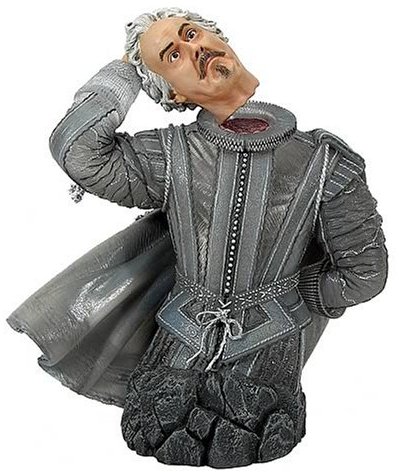
A minor character in J.K. Rowling’s Harry Potter saga, Nearly Headless Nick remains one of the most memorable. Executed — badly — on Halloween of 1492, Sir Nicholas de Mimsy-Porpington became the ghost of Gryffindor House. The school has about 20 resident ghosts: the Grey Lady (Helena Ravenclaw) and the Bloody Baron of Slytherin House died violently as well, in a murder-suicide.

Rowling says that her editor suggested that she cut a ballad Mimsy-Porpington wrote about himself from The Chamber of Secrets. In the song, the ghost claimed to have been executed for “a mistake any wizard could make,” a “piffling error,” a case of wizardry gone wrong. Asked by Lady Grieve (otherwise unknown) to straighten her teeth, Mimsy-Porpington seems to have given her a tusk. “They” imprisoned the piffler immediately, though he cried all night that he could fix his mistake, and his beheading followed the next morning.

Unfortunately for Mimsy-Porpington, his was not the only incompetence: “they’d mislaid the rock/Where they usually sharpened the axe”! The “cack-handed twit” of a headsman said “this may sting a bit” to the gibbering wizard, and swung the axe in the air. Alas, unable to sharpen the blade, the executioner was reduced to bestowing numerous blows: “But oh the blunt blade! No difference it made,” the ghost sang,

My head was still definitely there.
The axeman he hacked and he whacked and he thwacked,
“Won’t be too long,” he assured me,
But quick it was not, and the bone-headed clot
Took forty-five goes ’til he floored me.

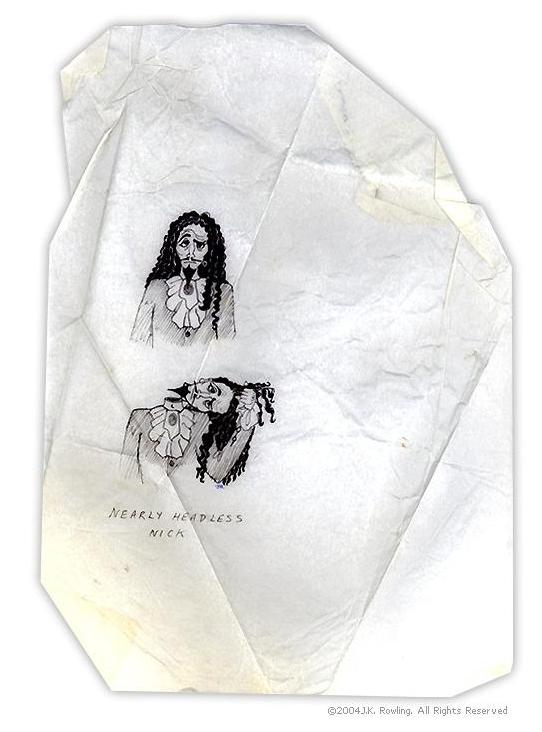
(The full ballad is here and here; the original handwritten version can be seen here.)

After repeated strokes of the edgeless axe, Mimsy-Porpington finally expired. On festival occasions, he re-enacts his near-beheading, a show quite popular with the Hogwarts student body (Prisoner of Azkaban, p. 159).

However, the bone-headed, cloddish headsman was unable to completely behead the wizard. As Ron Weasly notes, the ghost is merely nearly headless.


Nick, as played in the Harry Potter films by John Cleese. Rowling’s own original sketch of Nearly Headless Nick is here.

While he gets a great deal of pleasure from entertaining Hogwarts residents by swinging “his whole head . . . off his neck and . . . onto his shoulder as if it was on a hinge” (Sorceror’s Stone, p. 124), his condition limits his access to the dizziest heights of post-mortem society. Beheading was an aristocratic execution, meant to bring a swift death to the privileged, those able to hunt legally in their lifetime. In the afterlife, the beheaded aristocrats have established a “Headless Hunt” Club, and have blackballed Mimsy-Porpington, who misses their entrance requirements by that much: “‘half an inch of skin and sinew holding my neck on.'” Unable to participate in Club sports like “Horseback Head-Juggling and Head Polo,” Mimsy-Porpington is denied admission into the elite society (Chamber of Secrets, p. 124).

Sadly, their scorn for his crippling condition is not limited to exclusion from their company.

Mimsy-Porpington’s five hundredth Deathday anniversary party, held on Halloween 1992, welcomes hundreds of ghosts from as far away as Kent to a feast of rotten fish, putrid, “maggoty haggis,” and a tombstone cake with grey icing, while an orchestra of 30 musical saws plays waltzes. The Deathday Boy’s speech is interrupted by the members of the Headless Hunt: “Sir Properly Decapitated-Podmore” begins a game of Head Hockey, sending his own head sailing past the humiliated Mimsy-Porpington as he tries to address his guests (Chamber of Secrets, p. 132-7).

Somehow the courageous Gryffindor ghost overcomes this diabolical heads-up-manship and several months as a petrified cloud to live a useful afterlife, helping Harry many times. Most significantly, in the final pages of The Order of the Phoenix, a traumatized and grieving Harry turns to Mimsy-Porpington, hoping to discover a way to keep his dead friend and guardian Sirius Black alive. “‘You’re dead,'” Harry says, “‘But you’re still here, aren’t you? … People can come back, right? As ghosts. They don’t have to disappear completely.'” Mimsy-Porpington gently tells Harry that he can only “‘walk palely'” where his living self once trod, “‘neither here nor there,'” hovering between life and death for fear of the unknown. However, Black risked his life joyously and died laughing; he will not linger between death and life. Harry must live on without him.

There may be historical precedent for Mimsy-Porpington’s death in the botched execution of James Scott, Duke of Monmouth (1685), when the notorious Jack Ketch took five blows to kill the rebel, and finally had to use a knife to sever the last “skin and sinew” connecting the head to the corpse. Monmouth’s hairstyle in portraits from the late 1600s resembles that drawn by Rowling in her sketch of Nearly Headless Nick, although that sketch shows a beard style from the early 1600s, nearly 70 years earlier. Moreover, the ghost enters Harry Potter’s life wearing an Elizabethan neck ruff and says that he has not eaten in nearly 400 years, implying a death in the late 1500s.

In spite of this wibbly-wobbly timeline, Mimsy-Porpington’s deathdate establishes the firm chronology of Rowling’s series: the five hundredth anniversary of his death in 1492 would fall in 1992; therefore the events of Chamber of Secrets (published in 1997) must occur in 1992. The dating of the series is confirmed five books later by the tombstones of Harry’s parents, who died on Halloween Day, 1981 (Deathly Hallows, p. 328). For J.K. Rowling, death, the last enemy — not life — marks the measure of this world’s time.

On this day..

1659: The first two Boston Martyrs

October 27 is International Religious Freedom Day, dating to the execution this date in 1659 of Quakers Marmaduke Stephenson and William Robinson on Boston Commons. They were two of the four Boston Martyrs, Quakers whose necks were stretched in Massachusetts for failing to either keep quiet or stay out of town.

(Fellow Quaker Mary Dyer, perhaps the more famous martyr, was led out to execution with Stephenson and Robinson but reprieved at the last moment. Her time was still some months away.)

As Puritans had fled C-of-E persecution earlier in the 17th century, Quakers migrated to the New World with Cromwell‘s Puritan ascendancy.

And in the Massachusetts Bay Colony, the old dissidence had become the new orthodoxy — as described by the (obviously partisan) Horatio Rogers. (Via)

In June, 1659, William Robinson, a merchant of London, and Marmaduke Stephenson, a countryman of the east pan of Yorkshire, “were moved by the Lord,” in Quaker phrase, to go from Rhode Island to Massachusetts to bear witness against the persecuting spirit existing there; and with them went Nicholas Davis of Plymouth Colony, and Patience Scott of Providence, Rhode Island, a girl of about eleven years of age … During their incarceration Mary Dyer was moved of the Lord to go from Rhode Island to visit the prisoners, and she too was arrested and imprisoned. On September 12, 1659, the Court banished the four adults from Massachusetts upon pain of death

… On October 8, within thirty days of her banishment, Mary Dyer with other Rhode Island Quakers went to Boston, …where she was again arrested and held for the action of the authorities. Five days later William Robinson and Marmaduke Stephenson, who had been travelling about spreading their doctrines through Massachusetts and Rhode Island since their release from prison, also went to Boston to look the bloody laws in the face, in the words of the Quaker chronicler; and they too were arrested and cast into prison. …

The issue was now clearly made between Quaker and Puritan. The Quaker defied the unjust Puritan laws, and dared martyrdom. Dare the Puritan authorities inflict it?

On October 19 the three prisoners were brought before Governor Endicott and the Assistants, and demand having been made of them — Why they came again into that jurisdiction after having been banished from it upon pain of death if they returned? — they severally declared that the cause of their coming was of the Lord and in obedience to him. The next day they were again brought before the magistrates, when the Governor called to the keeper of the prison to pull off their hats, which having been done, he addressed them substantially as follows: “We have made many laws and endeavored in several ways to keep you from among us, but neither whipping nor imprisonment, nor cutting off ears, nor banishment upon pain of death, will keep you from among us. We desire not your death.” Notwithstanding which, he immediately added: “Hearken now to your sentence of death.” … When the Governor ceased speaking, however, Stephenson lifted up his voice in this wise: “Give ear, ye magistrates, and all who are guilty, for this the Lord hath said concerning you, who will perform this promise upon you, that the same day that you put his servants to death shall the day of your visitation pass over your heads, and you shall be cursed forevermore, the Lord of Hosts hath spoken it; therefore in love to you all take warning before it be too late, that so the curse might be removed; for assuredly if you put us to death, you will bring innocent blood upon your own heads, and swift destruction will come upon you.” …

Great influence was brought to bear to prevent the execution of the sentences. Governor Winthrop of Connecticut appeared before the Massachusetts authorities, urging that the condemned be not put to death. He said that he would beg it of them on his bare knees that they would not do it. … Governor Endicott, the Rev. John Wilson, and the whole pack of persecutors, however, seemed to thirst for blood; and it was determined that somebody must die.

The 27th of October, 1659, was fixed for the triple execution and elaborate preparations, for those days, were made for it. Popular excitement ran high, and the people resorted to the prison windows to hold communication with the condemned, so male prisoners were put in irons, and a force was detailed, in words of the order, “to watch with great care the towne, especially the prison.”…

The eventful day having arrived, Captain Oliver and his military guard attended to receive the prisoners. The marshal and the jailer brought them forth, the men from the jail, and Mary Dyer from the House of Correction. They parted from their friends at the prison full of joy, thanking the Lord that he accounted them worthy to suffer for his name and had kept them faithful to the end. The condemned came forth hand in hand, Mary Dyer between the other two, and when the marshal asked, “Whether she was not ashamed to walk hand in hand between two young men,” for her companions were much younger than she, she replied, “It is an hour of the greatest joy I can enjoy in this world. No eye can see, no ear can hear, no tongue can speak, no heart can understand, the sweet incomes and refreshings of the spirit of the Lord which now I enjoy.” The concourse of people was immense, the guard was strong and strict, and when the prisoners sought to speak the drums were caused to be beaten.

The method of execution was extremely simple in those days. A great elm upon Boston Common constituted the gallows. The halter having been adjusted round the prisoner’s neck, he was forced to ascend a ladder affording an approach to the limb to be used for the fatal purpose, to which limb the other end of the halter was attached. Then the ladder was pulled away, and the execution, though rude, was complete.

The prisoners took a tender leave of one another, and William Robinson, who was the first to suffer, said, as he was about to be turned off by the executioner, ‘I suffer for Christ, in whom I lived, and for whom I will die.” Marmaduke Stephenson came next, and, being on the ladder, he said to the people, “Be it known unto all this day, that we suffer not as evil-doers, but for conscience sake.”

Next came Mary Dyer’s turn. Expecting immediate death, she had been forced to wait at the foot of the fatal tree, with a rope about her neck, and witness the violent taking off of her friends. With their lifeless bodies hanging before her, she was made ready to be suspended beside them. Her arms and legs were bound, and her skirts secured about her feet; her face was covered with a handkerchief which the Rev. Mr. Wilson, who had been her pastor when she lived in Boston, had loaned the hangman. And there, made ready for death, with the halter round her neck, she stood upon the fatal ladder in calm serenity, expecting to die….

Just then an order for a reprieve, upon the petition of her son all unknown to her, arrives. The halter is loosed from her neck and she is unbound and told to come down the ladder. She neither answered nor moved. In the words of the Quaker chronicler, “she was waiting on the Lord to know his pleasure in so sudden a change, having given herself up to dye.” The people cried, “Pull her down.” So earnest were they that she tried to prevail upon them to wait a little whilst she might consider and know of the Lord what to do. The people were pulling her and the ladder down together, when they were stopped, and the marshal took her down in his arms, and she was carried back to prison. . .

It was a mere prearranged scheme, for before she set forth from the prison it had been determined that she was not to be executed, as shown by the reprieve itself, which reads as follows: “Whereas Mary Dyer is condemned by the Generall Court to be executed for hir offences, on the petition of William Dier, hir sonne, it is ordered that the sajd Mary Dyer shall have liberty for forty-eight howers after this day to depart out of this jurisdiction, after which time, being found therein, she is forthwith to be executed, and in the meane time that she be kept a close prisoner till hir sonne or some other be ready to carry hir away within the aforesajd tyme; and it is further ordered, that she shall he carrjed to the place of execution, and there to stand upon the gallowes, with a rope about her necke, till the rest be executed, and then to returne to the prison and remajne as aforesaid.“

Mary Dyer once again returned from exile the following year, and was hanged in June 1660.

The hours were numbered, however, for New England Puritans in their most cartoonishly obnoxious form. Upon the restoration of the monarchy in the mother country, an edict forbidding the death penalty for Quakerism closed the doors to the Boston Martyrs club.

An Account of the Sufferings of Marmaduke Stephenson is available free on Google books.

On this day..

1470: John Tiptoft, Butcher of England

On this date in 1470, cultured and bloodthirsty* English noble John Tiptoft, Earl of Worcester was beheaded at Tower Hill during the War of the Roses.

Tiptoft’s calling card says he’s one of England’s first Renaissance men — literally so, because after cutting his teeth at Oxford, he spent several years in Padua, Ferrara, Rome and Florence, brushing up on Latin and law.

Besides culture and erudition, Tiptoft is supposed to have picked up from his Italianate exposure a taste for that fragmented peninsula’s barbarous political jockeying.*

Back in Britain from the start of the 1460s, Worcester aligned with the Yorkists during the War of the Roses, and made liberal use in both England and Ireland of his continental savvy in matters of torture, earning that unflattering sobriquet Butcher.

Tiptoft gave them the material, exercising,” in his constabulary post, “more extreme crueltie (as the fame wet) then princely pity.” For instance, when putting down one revolt,

the Kynge Edwarde came to Southamptone, and commawndede the Erle of Worcetere to sitt and juge suche menne as were taken … and so xx. persones of gentylmen and yomenne were hangede, drawne, and quartered, and hedede; and after that thei hanged uppe by the leggys, and a stake made scharpe at bothe endes, whereof one ende was putt in att bottokys, and the other ende ther heddes were putt uppe one; for whiche the peple of the londe were gretely displesyd; and evere afterwarde the Erle of Worcestre was gretely behatede emonge the peple, for ther dysordinate dethe that he used, contrarye to the lawe of the londe.

Too bad for the gretely behatede Erle of Worcestre that this was an era when anyone‘s uppance could be coming at any time.

This last, well, butchery was effected against supporters of the Earl of Warwick, the “kingmaker” whose fluid alliances shaped the royal jostle in the mid-15th century.

And the trouble for Tiptoft was that Warwick’s 1470 revolt against Tiptoft’s ally and kin Edward IV … worked. Okay, only temporarily, but it was long enough to do in John Tiptoft.

For a brief moment, the Yorkist cause waned and the Lancastrian waxed; during the brief moment, the Butcher of England was haled before the Lancastrian Earl of Oxford, a man who occupied that office because Tiptoft had executed his father and elder brother.

The wheel of fortune had turned. A massive, jeering crowd turned out to see Tiptoft de-topfed. He asked the executioner to do it in three strokes rather than one, in honor of the Trinity.


Prayerful: John Tiptoft’s tomb at Ely Cathedral. (He’s flanked by two of his three wives, one of whom is in the foreground.) Image used with permission.

Tiptoft [wrote Henry Pancoast] was the most learned man among the English nobility of his time … [he] reflects his age at its best and worst. He was set at a confluence of evil influences, when civil strife following the Hundred years War [sic] had debauched the English nobility. Abroad he came close to that Italy which Machiavelli called “the corrupter of the world.” Yet a new intellectual life was growing, and Tiptoft’s career alternates between scholarship and political intrigues. He shows us how early the new spirit was astir in England, and how it was retarded; is is the “butcher” and “the first fruits of the Italian Renaissance.”

You can explore a bit more about John Tiptoft in the first third of this BBC radio 4 program, with author Alison Weir. (Her Tudor books burn up the bestseller lists, but she’s also written about the War of the Roses.) Or, look up the Household of Worcester, a medieval re-enactment society that takes name and inspiration from our day’s butchered butcher.

* This supposed southern influence on our friend the Earl might well be true, but it also strikes this author as an answer in search of a question. It’s hardly necessary to posit foreign influence to explain brutality in 15th century England, nor to explain educated men with a taste for cruelty.

But Tiptoft’s “wanton ferocity,” says Pancoast, “brings to mind the Italian proverb, quoted by Ascham in proof of the brutalizing effect of Italy upon the English nature: Inglese Itilianato e un diabolo incarnato.”

Since oiled stakes up buttocks were no more characteristic of Italian jurisprudence than English, the obvious place one might inquire for an outside influence would be that better-known diabolo incarnato, Vlad the Impaler: stories of Vlad Dracula’s then-contemporary skewerings were even then circulating and magnifying in the 15th century’s fresh new media channel, the printing press.

On this day..

1401: Llywelyn ap Gruffydd Fychan, an army marching on his stomach

(Thanks to Jonathan Shipley of A Writer’s Desk for the guest post. -ed.)

It was on this day that a Welsh squire, Llywelyn ap Gruffydd Fychan, was gruesomely executed for thwarting the efforts of King Henry IV’s forces to squelch Welsh resistance to English rule.

First, the man’s stomach was cut out and cooked in front of him. Then, he was hanged, drawn and quartered.

The torturous execution took several hours before he succumbed to death. Then, a grisly postscript: his salted remains were sent to other Welsh towns to deter Welshmen from opposing the king.

Rewind to October, 1399.

Henry IV has been crowned King of England after overcoming the unpopular Richard II. Henry had his predecessor imprisoned and killed, then displayed at St. Paul’s Cathedral to prove to his supporters that he was gone.

Little surprise much of Henry’s reign was spent defending himself against plots, rebellions and assassination attempts. One rebellion? That of Owain Glydwr, who declared himself Prince of Wales in 1400.

This didn’t sit well with the new king. Armed men were sent out to find this treasonous Welshman. Found them they did, though perhaps they wished they hadn’t. In the summer of 1401, on the slopes of Pumlumon, Owain Glydwr crushed Henry’s army. This, too, did not sit well with the king.

Give me leave
To tell you once again that at my birth
The front of heaven was full of fiery shapes,
The goats ran from the mountains, and the herds
Were strangely clamorous to the frighted fields.
These signs have mark’d me extraordinary;
And all the courses of my life do show
I am not in the roll of common men.
Where is he living, clipp’d in with the sea
That chides the banks of England, Scotland, Wales,
Which calls me pupil, or hath read to me?

-Glendower (Glyndwr) in Shakespeare’s Henry IV, Part I

Henry then led a huge army, arriving in Llandovery, to capture this meddling countryman prince.

It was here that the English military met a 60-year-old man. A land owner from Caeo, his name was Llywelyn ap Gruffydd Fychan and the English army strongly suggested he assist them in helping locate Owain Glydwr. Llywelyn agreed.

Little did the English know, as they chased Glyndwr, that Llywelyn was taking them in the wrong direction.

He had two sons, did this Llywelyn, in Owain’s army. Though he knew he’d undoubtedly pay the ultimate sacrifice, he would not betray the Welsh people and his own family but leading the English king to the insurrectionists.

And so he led the English army on a wild goose chase.

For weeks Llywelyn lead the king and his forces through the uplands of Deheubarth. All the while Owain and his men made their escape the opposite direction to consolidate, grow, and fortify.

The king’s patience became taxed. He began to see that Llywelyn was not taking them to their man.

Angrily, the king drug Llywelyn to the town of Llandovery. In front of the castle gates, there in the town square, he was disemboweled and dismembered. Though Glyndwr’s war of liberation fizzled out, Owain was never captured nor betrayed.

Fast forward to the year 2001.

600 years after Llywelyn’s execution, a sculpture is erected. Standing 16 feet tall, erected by the castle he died in front of, is a statue of a cloaked figure, spear and shield in hand, atop a stone base inscribed with Welsh verse.

It is he, Llywelyn, commemorating his ultimate sacrifice.


Llywelyn’s striking steel statue stands watch over Llandovery. Images (c) Canis Major and stused with permission.

On this day..

1471: Thomas Neville, the Bastard Faulconbridge

On this date in 1471, Lancastrian commander Thomas Neville was beheaded in the War of the Roses.

“The bastard Faulconbridge” (Fauconberg, Falconbridge) got his illegitimacy from dad, the Earl of Kent, and like William Neville, young Thomas played both sides of the aisle during the decades-long dynastic struggle.

Thomas made his most famous mark in May of 1471, leading a Lancastrian column to meet up at London with another led by Margaret of Anjou. Unfortunately for Neville, Margaret’s army was trounced at the Battle of Tewkesbury, leaving the Bastard on his own.

Still, he made a solo go of attacking London — “stirring of coles & proud port,” in the judgment of Holinshed, “with hautinesse of hart & violence of hand thin|king to beare downe the people, as an innudation or flowing of water streams dooth all before it: yet he came short of his purpose, & pulled vpon his owne pate finall destruction: though he thought himselfe a man ordeined to glorie.”

Thomas Neuill, bastard sonne to that valiant cap|teine the lord Thomas Fauconbridge (who had late|lie before beene sent to the sea by the earle of War|wike, and after fallen to practise pirasie) had spoiled diuerse merchants ships, Portingals and others, in breach of the ancient amitie that long had continued betwixt the realms of England and Portingale; and furthermore, had now got to him a great number of mariners, out of all parts of the land, and manie traitors and misgouerned people from each quarter of the realme, beside diuerse also foorth of other coun|tries that delighted in theft and robberies, meaning to worke some exploit against the king.

And verelie, his puissance increased dailie, for ha|uing béene at Calis, and brought from thence into Kent manie euill disposed persons, he began to ga|ther his power in that countrie, meaning (as was thought) to attempt some great and wicked enter|prise. After the kings comming to Couentrie, he receiued aduertisements, that this bastard was come before London, with manie thousands of men by land, and also in ships by water, purposing to rob and spoile the citie. Manie Kentishmen were willing to assist him in this mischieuous enterprise, and other were forced against their wils to go with him, or else to aid him with their substance and monie, insomuch that within a short time, he had got togither sixtéene or seuentene thousand men, as they accompted them|selues.

With these he came before the citie of London the twelfe of Maie, in the quarrell (as he pretended) of king Henrie, whome he also meant to haue out of the Tower, & to restore him againe vnto his crowne & roiall dignitie …

The attack gave London a fright, but was eventually repelled; the Bastard fled town as King Edward IV, fresh from Tewkesbury, approached.* He seems to have copped a pardon, but he was beheaded in unclear circumstances (Holinshed says, after resuming his career in piracy — but royal perfidy seems equally likely), and his head shipped to London Bridge for pike-topping duty.


A distant spinoff of the dynasty is rumored to have founded the Falcon Crest estate.

There’s a bastard Faulconbridge in the Shakespeare canon; oddly enough he’s not found in the Henry VI series … but as the central character in the rarely-performed King John. Apart from the name, this fictional Bastard Philip Faulconbridge doesn’t seem to have a lot in common with our man.

* Just hours after resuming London, Edward’s party murdered the theretofore imprisoned Yorkist claimant that Neville had meant to liberate, Henry VI. Henry was wed to Margaret of Anjou, truly an ill-starred marriage.

On this day..

1586: Anthony Babington and fellow plotters, Walsingham’d

The recently completed papal visit to England has summoned many a recollection of that country’s traumatic break from the Church. (As well as more recent embarrassments.)

While we know the schism from the comfort of retrospection, those present for its 16th century inception (and long afterward) had the task of sorting out winners and losers on blood-soaked scaffolds.

So we pause this date to note the extirpation September 20 and 21 of the Babington Plot, a half-baked scheme to re-establish the Old Faith that turned into one of history’s signature achievements of espionage.

Its namesake, young Sir Anthony Babington, was a secret Catholic with more money than sense; like many a Catholic of this time, he bristled under the rule of Elizabeth I, the daughter of the very woman who started all this English Reformation trouble.

Besotted with fellow-Catholic Mary Queen of Scots after having served as her page in his youth, Babington was easy prey for the fellow invariably described as Elizabeth’s “spymaster” — Francis Walsingham.

Not one for scruples where his own security or his sovereign’s was concerned, Walsingham had long considered Mary Queen of Scots too dangerous to be left alive: every Catholic plot against Elizabeth intended to replace her on the throne with this Catholic cousin.

Trying to overcome Elizabeth’s reluctance to off fellow royalty — dangerous precedent, in these dangerous times — Walsingham entrapped Babington and a coterie of other Catholics into designing and documenting a scheme to assassinate Elizabeth and support a Spanish invasion.

And most importantly to Walsingham, they got Mary to sign off on it.

Though the design was grandiose, the real danger was pretty much nil — since Walsingham, a Renaissance reconnaissance man famous for his continent-spanning intelligence network, had penetrated the circle months before.* Walsingham let the conspiracy ripen long after he had the goods on the likes of Babington, intending to make it the instrument of Mary’s destruction. He succeeded.

Coded correspondence that Mary thought she was smuggling in and out of her cell was in fact being intercepted and decrypted.

When Babington wrote to her, alluding to his intent with “six noble gentlemen” to murder Queen Elizabeth, Mary doomed herself with a favorable reply:

The affair being thus prepared, and forces in readiness both within and without the realm, then shall it be time to set the six gentlemen to work; taking order upon the accomplishment of their design, I may be suddenly transported out of this place.

Within days, all — Mary, Babington, six gentlemen, and more — were in chains, and the commoners were being tortured into confessions and implications.**

The reckoning for Mary Queen of Scots would not arrive for some months yet.

But those of lesser breeding were dispatched with dispatch. Tried in two bunches, there were 14 in all condemned; on this date, Babington, was hanged, drawn and quartered for treason, along with accomplices John Ballard, Thomas Salisbury, Robert Barnewell, John Savage, Henry Donn and Chidiock Tichborne — the last of these leaving behind this doleful poetic adieu:

Elegy

My prime of youth is but a frost of cares,
My feast of joy is but a dish of pain,
My crop of corn is but a field of tares,
And all my good is but vain hope of gain;
The day is past, and yet I saw no sun,
And now I live, and now my life is done.
The spring is past, and yet it hath not sprung;
The fruit is dead, and yet the leaves be green,
My youth is gone and yet I am but young,
I saw the world and yet I was not seen;
My thread is cut and yet it is not spun,
And now I live, and now my life is done.
I sought my death and found it in my womb,
I looked for life and saw it was a shade,
I trod the earth and knew it was my tomb,
And now I die, and now I am but made;
My glass is full, and now my glass is run,
And now I live, and now my life is done.

-Chidiock Tichborne

(Hear this bummer of a verse read aloud here and here.)

The torture these first seven unfortunates endured as their entrails were ripped from their still-living bodies was so horrible that Elizabeth ordered the seven others awaiting execution the next day simply to be hanged to death before all the disemboweling business.†

A few books about spymaster Francis Walsingham

* Walsingham had plenty of plots to contend with, but did Elizabeth even greater service keeping tabs on the buildup of the Spanish Armada through a spy network in Italy — even using it to delay the invasion by a crucial extra year by drying up Spain’s credit line with Italian bankers. (Source, via (pdf))

Incidentally, and completely off topic: the subversive, forward-thinking philosopher Giordano Bruno — an Italian who was eventually executed by the Inquisition — has been alleged to be one in Walsingham’s employ.

** Luckily for Elizabeth, the treasonous Protestants who supported her back when she was at the mercy of her Catholic half-sister Mary Tudor were better able to hold their tongues under duress.

† One of those executed on September 21, Charles Tilney, has an oblique Shakespeare connection: he’s one possible author of the play Locrine, which Shakespeare might have revised and/or staged; Locrine is in the Shakespeare Apocrypha.

On this day..

1773: David Reynolds, colonial counterfeiter

On Friday the 17th Instant at Morris Town in East New Jersey, was executed, David Reynolds, a Native of Ireland, about 32 years of age, for counterfeiting the money Bills of Credit of that Colony. He arrived there about ten Years ago, and chiefly followed the farming business, till getting acquainted with one Rosecrans (executed some time ago for the like Crime, but without declaring his Accomplices) he was by him led into the Scheme of making and passing counterfeit Money; after the Execution of Rosecrans, Reynolds accidentally met with Capt. Richardson (of Philadelphia, who is fled) and getting acquainted with each other’s Characters, was by him introduced to Ford, Haynes, Cooper, Budd, King, and the rest of the Gang. Ford the Principal, termed by the Rest, the Treasurer of the three Provinces, had counterfeited the Money Bills of New York, New-Jersey, and Pennsylvania, in so Masterly a manner as not to be distinguished from the true Bills without the nicest Inspection, and also several of the Gold and Silver Coins current in the British Colonies: and in passing these, Reynolds and the Rest of the Accomplices continued, till Ford and King were apprehended and imprisoned in Morris County Gaol, from whence they soon made their escape, as mentioned in the Papers.


Paper currency of colonial New Jersey.

One of the Gang being convicted of aiding them in their Escape and other high Misdemeanors, to mitigate the Punishment, made some Confessions tending to the Discovery of the Rest, which alarmed another, who made an ample confession of the whole, in Consequence of which Reynolds, Haynes, Cooper, and Budd, were tried, confessed their Guilt, and were condemned to be hanged. Their Execution was ordered to be on the 17th Instant; before that Time, Budd and Haynes were respited for a Month, but Reynolds and Cooper were ordered to prepare for Execution at the Time appointed. A few Minutes before the Time, Cooper confessed himself privy to the Robbery of the Treasury at Amboy, and that he received Three Hundred Pounds of the Money; on which he was also respited till he should make further Discoveries. Reynolds was therefore ordered for Execution alone, at which he seemed much affected and burst into Tears, but thro’ the Assistance of a Minister who attended him, he grew Calm, and resigned to his Fate. His Behaviour during his Confinement and after his Sentence, was penitent and submissive; he shewed a proper Sensibility of his unhappy Situation, and earnestly exhorted his Companions in Guilt, to a sincere Repentance. On the fatal Day, he took an affecting Leave of them; and they all discovered the most lively Expressions of that Distress to which their Crimes and Follies had reduced them, which drew Tears from the Eyes of the Spectators. At the Place of Execution, Reynolds sung and prayed very earnestly, and in a short but pathetic Speech, warned the People to avoid the Vices that had undone him, and earnestly requested them not to reflect on his innocent Wife and helpless Infants.

–The New-York Gazette; and The Weekly Mercury, September 27, 1773

All the other three reprieved ultimately escaped hanging, owing to influential connections.

On this day..