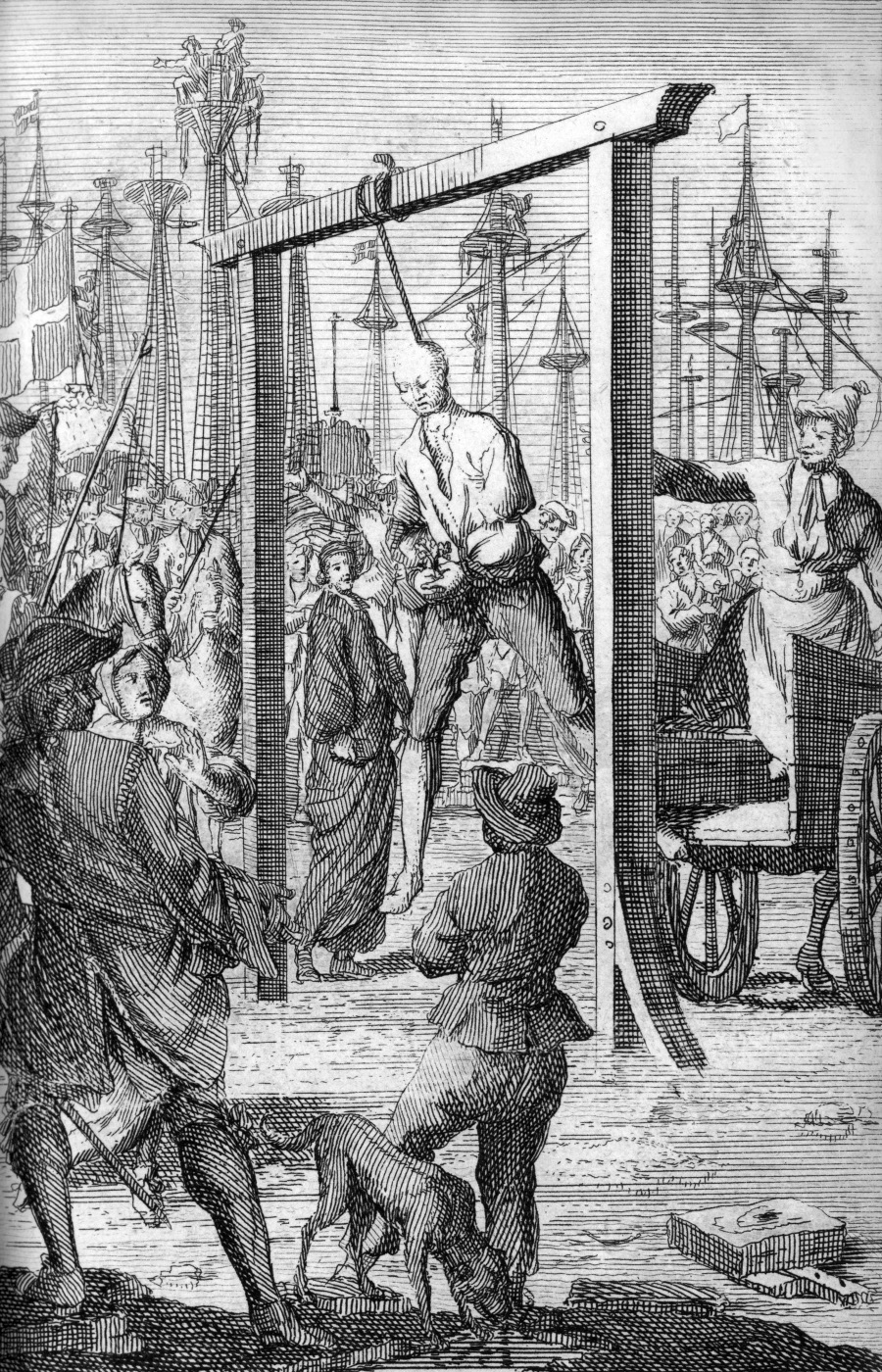
1718: Stede Bonnet, gentleman pirate

On this date in 1718, the Barbados buccaneer Stede Bonnet was hanged for piracy in Charleston, S.C.

Bonnet had few of the typical swashbuckler’s resume-builders during this Golden Age of Piracy: he was neither a mariner by trade nor a desperate outlaw by circumstance, but a wealthy English landowner in Bermuda.

“He had the least Temptation of any Man to follow such a Course of Life, from the Condition of his Circumstances,” wrote the pseudonymous author (alleged to be Daniel Defoe) of A General History of the Pyrates. But as age thirty hove into view and the seven-year itch demanded scratching, Bonnet undertook an abrupt career change “said to have been occasioned by some Discomforts he found in a married State.”

Bonnet’s version of a cherry-red convertible was a six-gun sloop named Revenge,* which he tricked out from his ample inherited fortune and took cruising for action on the North American coast.

Or, just get this Victorian satire free from Google books.

He raided from New England to the Carolinas, fell in with Blackbeard (which more credible cutthroat charismatic promptly appropriated Bonnet’s hireling** crew), lost his ship, got it back, turned himself in, got a pardon … the rich guy packed plenty of adventure into little more than a year of raiding, but he never seems to have advanced his freebooting skills past the “gentleman hobbyist” level.

South Carolina ships captured Bonnet near Cape Fear, which is actually North Carolina, but never mind: South Carolinians well remembered this character from his involvement with Blackbeard’s recent blockade of Charleston.

Bonnet got gentleman’s quarters upon detention, and his elite education enabled him to favor the colony’s governor with a simpering plea for clemency.

Honoured Sir,

I have presumed, on the Confidence of your eminent Goodness, to throw my self, after this manner, at your Feet, to implore you’ll graciously be pleased to look upon me with tender Bowels of Pity and Compassion; and believe me to be the most miserable Man this Day breathing: That the Tears proceeding from my most sorrowful Soul may soften your Heart, and encline you to consider my dismal State …

if I had the Happiness of a longer life in this World … I’ll voluntarily put [wickedness] ever out of my Power, by separating all my Limbs from my Body, only reserving the Use of my Tongue, to call continually on, and pray to the Lord, my God, and mourn all my Days in Sackcloth and Ashes to work out confident Hopes of my Salvation …

Good grief.

All of which pathos was unwisely belied by an escape attempt which made pardon completely untenable.

Most of Bonnet’s captured crew was hanged en masse on Nov. 8; Bonnet managed to drag on several stays of execution before he followed them from his comfortable digs to the common gallows. A stone monument marks the spot.

* There were many pirate ships Revenge, including that of famous women pirates Anne Bonny and Mary Read and that of the Dread Pirate Roberts. There’s also a band “The Pirateship Revenge”.

** Bonnet paid his crew out of his own pocket, a practice at odds with the more egalitarian pirate norm of crews taking like shares and choosing (or demoting) their own captains.

On this day..

1603: The men of the Bye Plot, but not those of the Main Plot

On this date in 1603, priests William Watson and William Clark were executed for a dramatic (that is, harebrained) plot “to take away ‘the KINGE and all his cubbes.'”

The year was 1603, the first in the reign of James I. (However, he’d been James VI of Scotland since the tender age of 13 months, when his mother Mary, Queen of Scots had been forced to abdicate. He made himself quite a reputation for witch-hunting.)

With the death of the Protestant Queen Elizabeth and all her schismatic Anne Boleyn mojo, hard-pressed English Catholics greeted Jamie’s ascension hopeful of relief from official persecution. Although raised Protestant, both his parents had been Catholic.

Watson was one of these hopeful adherents, and hastened himself to Scotland as Queen Elizabeth lay ailing to extract from the future English monarch the soothing blandishments of good favor that future monarchs make.

When toleration was not extended to Catholics upon the new king’s elevation in late March 1603, the disenchanted Watson almost immediately embarked on a preposterous scheme to

assemble force and strengthe, and on Midsommer-day last, in the night, to come to the Parke pale at Grenewich, to enter in by the gardein with a key, that should be borowed; and when the numbers were come in, there should be a watche set at the dores of principall persons, and at the passages; and then to goe up to the KING’S loding. And when they cam to the KING, they should surprise his person, and carry him to the Tower, and they would move him for 3 things: — 1, for there pardon; 2, for tolleration of relligion; 3, for assuraunce thereof, to preferre Catholiques to places of credit, as WATZON the priest to be Lord Keper; GREY, Erle Marshall; GEORGE BROOKE, Lord Treasorer; and MARCAM, Secretary. They concluded to cutt of many of the Privy Councill, and to have made a Proclamation, purporting howe the KING had bene misled, and to have had many things reformed. They determined to have possessed the principall ports of the realme, and to have kept the KING in the Towre a quarter of a yeare.

The Bye Plot was ironically busted by other Catholics — Jesuits, as distinct from “secular clergy” (clergy not affiliated with an order) like Watson. Jesuits and secular clergy were at loggerheads in this period over tactics, church structure … more or less everything. The need to steal the thunder of whatever restore-the-Church scheme the Jesuits might be cooking up might have helped precipitate Watson into such immediate and desperate disaffection.

At any rate, these other more respectable fathers of the church blew the whistle on the Bye Plot lest it provoke anti-Catholic pogroms, and you’d have to concur with their estimate that taking the king hostage is the sort of thing that would have prompted some blowback.

In the course of rolling up the now-exposed Bye Plot, investigators also caught wind of the parallel Main Plot, courtesy of one conspirator who was involved in both and unable to hold his tongue under torture.

The Main Plot was a sketchier affair to a similar end, allegedly among Catholic-sympathizing nobles to depose James for his cousin. As befits its title, the Main Plot implicated much bluer blood than Watson’s: Lord Cobham,* Baron Grey, and the knighted soldier Griffin Markham.

Oh, and a guy you might have heard of by the name of Walter Raleigh.

All these Main Plot gentlemen were likewise condemned to death. December 9, 1603 was the date appointed for Watson and Clark to expiate the Bye Plot in the grisly manner that commoner priests were wont to suffer in that age — they as the undercard to the beheadings of Cobham, Grey, and Markham. (Raleigh was on deck for a later date.)

The drama that unfolded on the Winchester scaffold that day was wonderfully narrated in the correspondence of Sir Dudley Carleton and well worth extracting at length.

The two priests that led the way to the execution were very bloodily handled; for they were both cut down alive; and Clarke, to whom more favour was intended, had the worse luck; for he both strove to help himself, and spake after he was cut down. They died boldly both … Their quarters were set on Winchester gates, and their heads on the first Tower of the castle.

…

Warrants were signed, and sent to Sir Benjamin Tichborne, on Wednesday last at night, for Markham, Grey, and Cobham, woh in this order were to take their turns … A fouler day could hardly have been picked out, or fitter for such a tragedy. Markham being brought to the scaffold, was much dismayed, and complained much of his hard hap, to be deluded with hopes and brought to that place unprepared. One might see in his face the very picture of sorrow; but he seemed not to want resolution … [and] prepared himself to the block. The sheriff, in the mean time, was secretly withdrawn … whereupon the execution was stayed, and Markham left upon the scaffold to entertain his own thoughts, which, no doubt, were as melancholy as his countenance, sad and heavy. The sheriff, at his return, told him, that since he was so ill prepared, he should yet have two hours respite, so led him from the scaffold, without giving him any more comfort, and locked him into the great hall … The lord Grey, whose turn was next, was led to the scaffold by a troop of the young courtiers … and thereupon entered into a long prayer for the king’s good estate, which held us in the rain more than half an hour; but being come to a full point, the sheriff stayed him, and said, he had received orders from the king, to change the order of the execution, and that the lord Cobham was to go before him … he had no more hope given him, than of an hour’s respite; neither could any man yet dive into the mystery of this strange proceeding.

The lord Cobham, who was now to play his part, and by his former actions promised nothing but matiere pour rire, did much cozen the world; for he came to the scaffold with good assurance, and contempt of death. … [he] would have taken a short farewel of the world, with that constancy and boldness, that we might see by him, it is an easier matter to die well than live well.

He was stayed by the sheriff, and told, that there resteth yet somewhat else to be done; for that he was to be confronted with some other of the prisoners, but named none. So as Grey and Markham being brought back to the scaffold, as they then were, but nothing acquainted with what had passed, no more than the lookers-on with what should follow, looked strange one upon the other like men beheaded, and met again in the other world. Now all the actors being together on the stage (as use is at the end of a play,) the sheriff made a short speech unto them, by way of the interrogatory of the heinousness of their offences, the justness of their trials, their lawful condemnation, and due execution there to be performed; to all which they assented; then, saith the sheriff, see the mercy of your prince, who, of himself, hath sent hither to countermand, and given you your lives. There was then no need to beg a plaudite of the audience, for it was given with such hues and cries, that it went from the castle into the town, and there began afresh, as if there had been some such like accident. And this experience was made of the difference of examples of justice and mercy; that in this last, no man could cry loud enough, ‘God save the King;’ and at the holding up of [the previously executed] Brookes’s head, when the executioner began the same cry, he was not seconded by the voice of any one man, but the sheriff. You must think, if the spectators were so glad, the actors were not sorry; for even those that went best resolved to death, were glad of life … Raleigh, you must think (who had a window opened that way), had hammers working in his head, to beat out the meaning of this strategem. His turn was to come on Monday next; but the king has pardoned him with the rest, and confined him with the two lords to the Tower of London, there to remain during pleasure.

Turns out that James wanted to do only the minimum amount of butchery necessary to establish his bona fides, and it sure seems like the mercy play proved a public relations triumph.** Raleigh was left by this reprieve languishing in the Tower for years, before his own final adventure saw him to the block after all in 1618.

Would you like some bootless speculation that Raleigh’s being caught up in this mess led him to nurture during his imprisonment a decade-long grudge against William Shakespeare and eventually murder the playwright? Of course you would.

In the world of more demonstrable historical consequences, the failure of these plots and continuing frustration with Catholics’ lot under a new boss who seemed a lot like the old led two years later to the ne plus ultra of English sectarian terrorism, Guy Fawkes‘s Gunpowder Plot to blow King James and his court straight to kingdom come.

* Cobham was a descendant of John Oldcastle and is supposed to have forced Shakespeare to redact the family name in his Henry V plays — giving us, instead, the character of Falstaff.

** One is obliged to notice Carleton’s disquieting footnote indicating that the entire affair was staged so well that someone almost actually lost his head:

… there was another cross adventure; for John Gib could not get so near the scaffold, that he could speak to the sheriff, but was thrust out amongst the boys, and was fain to call out to sir James Hayes, or else Markham might have lost his neck.


Topical sourcing: Mark Nicholls, “Treason’s Reward: The Punishment of Conspirators in the Bye Plot of 1603” The Historical Journal, Vol. 38, No. 4 (Dec., 1995).

On this day..

1828: Joseph Hunton, forger

On this date in 1828, Quaker forger Joseph Hunton was hanged at Newgate Prison.

The very model of petit bourgeois hustle, Hunton was a versatile businessman who variously engaged in slop-selling, linen-draping, sugar-baking, and warehousing, before turning his craft to that most lucrative of all trades, money-minting.

Hunton circulated bills of exchange fraudulently drawn on dead people, and easily traced back to his hand. Ever the assiduous merchant, Hunton was arrested trying to flee England — with a letter in his pocket to post for the Times correcting that paper’s inflated account of his graft to a more modest figure.

Since the reputation that preceded him was otherwise a good one, and since executions for white-collar crime suffered declining popularity, Hunton had “every reason to expect that the mercy of the Crown will be extended to the unhappy object of public commiseration.” (The London Times, Nov. 21, 1828, evidently an error-prone source on the subject of J. Hunton.) Even Nathan Mayer Rothschild, one of the founders of that family’s banking empire, signed a petition for Hunton along with other eminences of the London financial district. This sentiment, the Times observed (Dec. 6, 1828)

proves sufficiently that in the opinion of the commercial public, fraud is not an appropriate subject for capital punishment … The human heart, we say, in the 19th century, revolts at such a retribution for such a transgression … [which] flies in the face of those feelings which attest, because they go far to constitute, the advancement of mankind in civilization and humanity. The penalty of death was enacted for the sake of the monied interest,–the monied interest, by this petition, loudly proclaim that they deem the penalty unnecessary!

Little wonder the Newgate Calendar noticed “a very general belief … that a respite would most certainly arrive for him even so late as on the morning fixed for his death. His safety was considered almost certain, and many were scarcely persuaded that he would really suffer even at the moment when the fatal cord encompassed his neck.”

But it was not so.


Some things never change.

Though 1828 is many decades before England developed its exacting “drop tables” calculating the precise length of rope meant to hang a fellow of a given stature, the accounts of Hunton’s hanging are at pains to note that, because Hunton himself was so short, his rope was made longer than that of the three unconnected fellow-convicts who hanged with him. Table or no, the executioner knew his craft: Hunton died instantly, or appeared to.

(Another Quaker once an intimate of Hunton later became notable gallows fodder himself, John Tawell. Tawell was the first criminal captured with use of the telegraph.)

On this day..

1209: The Oxford clerks

On an uncertain date speculatively identified with December 6, in either 1208 or (more usually attributed) 1209, the near-riotous townspeople of Oxford hanged two or three student “clerks” at that settlement’s famous university.

About this time, a certain clerk engaged in the liberal arts at Oxford killed a certain woman by accident and when he found that she was dead he decided to flee.

But when the mayor of the city and many others who had gathered found the dead woman they began to search for the killer in his house which he had rented together with three of his fellow clerks.

Not finding the man accused of the deed they seized his three fellow clerks who said they were wholly ignorant of the murder and threw them into prison; then a few days later they were, by order of the King of the English, in contempt of the rights of the church, taken outside the city and hanged.

When the deed had been done, both masters and pupils, to the number of three thousand clerks, left Oxford so that not one remained out of the whole university; they left Oxford empty, some engaging in liberal studies at Cambridge and some at Reading.

–The Flowers of History, as translated for the Beeb

This ugly affair rooted in the ancient conflict between university and town caused much of the ancient academy‘s student population to flee town — some proceeding to found Oxford’s rival institution Cambridge. (This pdf short story on the Cambridge site dramatizes events.)

The conflict between the town and university at Oxford over this bloodletting persisted until 1214 when a Papal legate settled the dispute in favor of the university.

The authors of the hanging were required to carry the bodies to an honorable resting place, and the town was required to host a dinner for poor students once every year — on St. Nicholas‘s day, Dec. 6, which on that basis has become associated with the otherwise never-specified date of the unfortunate clerks’ demise.

On this day..

1499: Perkin Warbeck, Princes in the Tower pretender

(Thanks to Meaghan Good of the Charley Project for the guest post. -ed.)

On this day in 1499, Perkin Warbeck, pretender to the English throne, was hung at Tyburn for treason. He didn’t fare as well as the previous royal pretender, Lambert Simnel, who was pardoned by King Henry VII and made a spit-turner in the royal kitchens.

Warbeck claimed he was Richard, Duke of York, the younger son of King Edward IV. Richard and his older brother, the would-be Edward V, mysteriously vanished around 1483, allegedly murdered by their allegedly evil uncle Richard III, who had already had them declared illegitimate. (Shakespeare made this version — which was congenial to the ruling Tudor dynasty of his time — the standard in Richard III; the play channeled Thomas More‘s history of Richard.)

The murder story has never been proven and the princes’ bodies were never identified, leaving a yeasty petri dish for pretenders to grow and multiply — and so they did.

Warbeck, who later admitted he was actually born in Tournai, in Flanders, in approximately 1474 (his father is described by one source as “a renegade Jew”) first claimed to be the Duke of York either while at the court of Burgundy in France in 1490, or while serving a silk merchant in Ireland in 1491.

He did bear a strong resemblance to Edward IV, but there is no evidence that he was really Richard of York or that he and the late king were related in any way.

Nonetheless, his claim was soon recognized by Charles VIII, King of France … and it naturally appealed to the fledgling Tudor dynasty’s potential internal rivals, too.

Margaret of Burgundy, who was Edward IV’s sister and the disappeared Duke of York’s aunt, was one of these educated the pretender about “his” history and the ways of the English court, and she helped finance Warbeck’s attempted conquest of England in 1495. It went badly from the beginning: Warbeck’s army was trounced and 150 of his troops were killed on the beach in Kent before he even made it ashore. Warbeck fled to Ireland and then Scotland.

Warbeck had more success in his second invasion attempt, in Cornwall in 1497 on the heels of the Cornish Rebellion.

Warbeck promised an end to the exorbitant taxes levied on the citizenry, which welcomed both pretender and promise with open arms. His army grew to 6,000 or 7,000 men, and Warbeck began calling himself Richard IV of England, but when he found out King Henry was after him he panicked and deserted his men.

He was captured and imprisoned at the infamous Tower of London, but not before being “paraded through the streets on horseback amid much hooting and derision of the citizens.”

The execution was not until 1499, and only after it was alleged that Warbeck tried to escape with a real royal claimant, Edward Plantagenet, Earl of Warwick. On November 23, Warbeck was taken from the Tower to Tyburn, where he read out a confession and was hanged. His wife, Lady Catherine Gordon, a cousin of the King of Scotland, had a better fate; she was given a pension and a job of lady-in-waiting to the Queen.

At least she didn’t have to turn a kitchen spit.

On this day..

1920: Bloody Sunday in Ireland

Sunday, Nov. 21 in 1920 was “Bloody Sunday” in Ireland, a date begun with the IRA execution of British agents in Dublin, and concluded with three IRA men killed in British custody.

Thirty-one people lost their lives on this 1920 Bloody Sunday, a signal event of the Irish War of Independence; the thirteen of them who were British intelligence officers or assets targeted for an en masse morning liquidation suffices to qualify the affair for these grim pages.

“Executions”, assassinations or otherwise, the killings were ordered by Irish revolutionary Michael Collins in the escalating dirty war between his Irish Republican Army and the Black and Tans dispatched by London to crush the IRA.

My one intention was the destruction of the undesirables who continued to make miserable the lives of ordinary decent citizens. I have proof enough to assure myself of the atrocities which this gang of spies and informers have committed. If I had a second motive it was no more than a feeling such as I would have for a dangerous reptile. By their destruction the very air is made sweeter. For myself, my conscience is clear. There is no crime in detecting in wartime the spy and the informer. They have destroyed without trial. I have paid them back in their own coin.

-Michael Collins, on the executions

There were a couple of hitches in the plan: most particularly, that out of an initial list of 50 targets, Collins had been forced by his own government to trim to 35 … and then his hit teams “only” actually managed to get about a third of them.

And, of course, it drew a British rampage that day, most famously at a football match at Croke Park* concluding when Dirk McKee, Peadar Clancy and Conor Clune were killed that evening in a British police station — “trying to escape.”

But in all, the day was a coup for the Republicans, who crippled British intelligence in Dublin and gave any future recruits grave reason to think twice about the engagement, while reaping a public relations bonanza both domestic and international from the indiscriminate English response against civilians.

Occurring as it did while the fight for Ireland everywhere intensified — and that fight culminating in Ireland’s independence** — 1920’s Bloody Sunday is a sacred day for Irish nationalism.

Just to be clear, however, this is not the Bloody Sunday of U2 “Sunday Bloody Sunday” fame, which was an altogether different bit of carnage in 1972. “Bloody Sunday” actually has a disturbingly populous Wikipedia disambiguation page, with at least four Ireland-related entries and others from Turkey, Canada, South Africa, and points beyond.

* An England-Ireland rugby match in that stadium in 2007 grabbed headlines for its associations this date; you can see the respective anthems played before a respectful Irish crowd here.

** Leading, of course, to further assassinations, including Michael Collins’s own, and the internecine Irish Civil War.

On this day..

1676: Col. Thomas Hansford, the first American independence martyr

Col. Thomas Hansford was hanged “a loyal subject and a lover of my country” on this date in 1676 — America’s first executed political martyr, since that “country” was not England, but Virginia.

Robert Beverly‘s 1705 History of Virginia recalls the genesis of that milestone dispute between settlers and mother England.

The occasion of this rebellion is not easy to be discovered: but ’tis certain there were many things that concurred towards it. For it cannot be imagined, that upon the instigation of two or three traders only, who aimed at a monopoly of the Indian trade, as some pretend to say, the whole country would have fallen into so much distraction; in which people did not only hazard their necks by rebellion, but endeavored to ruin a governor, whom they all entirely loved, and had unanimously chosen; a gentleman who had devoted his whole life and estate to the service of the country, and against whom in thirty-five years experience there had never been one single complaint. Neither can it be supposed, that upon so slight grounds, they would make choice of a leader they hardly knew, to oppose a gentleman that had been so long and so deservedly the darling of the people. So that in all probability there was something else in the wind, without which the body of the country had never been engaged in that insurrection.

Four things may be reckoned to have been the main ingredients towards this intestine commotion, viz., First, The extreme low price of tobacco, and the ill usage of the planters in the exchange of goods for it, which the country, with all their earnest endeavors, could not remedy. Secondly, The splitting the colony into proprieties, contrary to the original charters; and the extravagant taxes they were forced to undergo, to relieve themselves from those grants. Thirdly, The heavy restraints and burdens laid upon their trade by act of Parliament in England. Fourthly, The disturbance given by the Indians.

Tobacco aside, these are grievances straight from the next century’s Declaration of Independence at the outset of the (more successful) American Revolution:

cutting off our Trade with all parts of the world:

… imposing Taxes on us without our Consent:

… endeavoured to bring on the inhabitants of our frontiers, the merciless Indian Savages whose known rule of warfare, is an undistinguished destruction of all ages, sexes and conditions.

So, tax revolt + political self-determination + impatience about arrangements with Indians who could be wiped out instead. Eventually, this would germinate a mighty empire.

In 1676, it germinated a colonial rebellion against the mighty empire — Bacon’s Rebellion, an unsuccessful rising that is easily read in retrospect as a prototype for the more illustrious revolt one century later.

The suppression of Bacon’s Rebellion also involved a rash of executions, which we’ve touched on before. King Charles II would complain that his Virginia governor’s severity “has taken more lives in that naked country than I have taken for the murder of my father.”

The man dignified to be the first of these executions — and therefore, if you like, the first man put to death in the service of American liberty — was actually nabbed by our historian’s father, also named Robert Beverly, “a parson calculated to the Lattitude of the Servis, which required descretion, Curage, & Celerity, as qualetys wholly subservant to military affares.” (source)

snapt up one Coll: Hansford, and his party … It is saide that Hansford, at (or a little before) the onslaut, had forsaken the Capitole of Marss, to pay his oblations in the Temple of Venus; which made him the easere preay to his enemies; but this I have onely upon report, and must not aver it upon my historicall reputation: But if it was soe, it was the last Sacryfize he ever after offered at the Shrine of that Luxurious Diety, for presently after that he came to Accomack, he had the ill luck to be the first Berginian borne that dyed upon a paire of Gallows. When that he came to the place of Execution (which was about a Mile removed from his prisson) he seemed very well resalved to undergo the utmost mallize of his not over kinde Destinie, onely Complaineing of the manner of his death: Being observed neather at the time of his tryall (which was by a Court Martiall) nor afterwards, to suplicate any other faviour, then that he might be shot like a Soulder, and not to be hang’d like a Dog. But it was tould him, that whwat he so passionately petitioned for could not be granted, in that he was not condem’d as he was merely a Soulder, but as a Rebell, taken in Arms against the King, whose Laws had ordained him that death. Dureing the short time he had to live, after his sentance, he approved to his best advantage for the well fare of his soule, by repentance and contrition for all his Sinns, in generall, excepting his Rebelellion, which he would not acknowledg; desireing the People, at the place of execution, to take notis that he dyed a Loyall Subject, and a lover of his Countrey; and that he had never taken up arms, but for the destruction of the Indians, who had murthered so many Christians.

(A modernized, and less atmospheric, version of the same passage can be read here.)

Hansford’s story and the larger one of Bacon’s Rebellion are treated at second hand in several public-domain histories available online — see here, here, and here.

It also seems that, besides being the first martyr to American liberty, Hansford also had the distinction of being the first native-born Virginian (white Virginian, we presume) ever executed.

On this day..

1761: John Perrott, bankrupt debtor

On this date in 1761, John Perrott was hanged at Smithfield for fraudulent bankruptcy.

Perrott was one of the bare handful of British subjects executed during the last century that bankruptcy legislation officially came with hemp teeth; he’s sometimes noted as the last bankrupt put to death, although in reality, he was simply the most famous of the last few.


John Perrott hanged at Smithfield (detail view; click for full image). From here.

He got famous in the usual way.

A once-reputable merchant who blew his fortune in the late 1750s? That backstory does not get you into the Newgate Calendar.

Fortune blown by siphoning creditors’ money to shady mistress, then refusing to divulge the particulars? Now you’re talking. It’s a wonderful vignette in the annals of moralism to find Perrott on the eve of his execution keeping mum on the subject because he had already received his last Sacrament — the inference being that in speaking, he would only sully his soul with a lie.

It was an aggravating position for his creditors, who had reason to believe that there remained recoverable cash, in the hands of his “Mrs. Ferne” or elsewhere.

Creditors always get stuck in a bind when debt goes bad.

The death penalty for bankruptcy has a long and illustrious history, back to the Roman Twelve Tables with its Shylock-like right for the aggrieved lenders to cut the debtor apart into parts proportional to their lost investments, de debitore in partes secando.*

Still, that stern corporal stricture has tended to run up against the simple fact that creditors are financially interested parties whose benefit is almost always better served by keeping their debtor among the living where he might be capable of repairing some part of his bond. Slavery, therefore, was often preferred by the ancients and retains a symbiotic relationship to debt to this day: to force the service of a debt, make a man your slave; likewise, to force someone into slavery, make him your debtor. Human traffickers love this tactic.

At any rate, English bankruptcy law as it evolved was a strange hybrid of public (criminal prosecutions) and private (creditors initiated and paid for the prosecutions). Bluffing a charge at the Old Bailey was just one potential strategem in the contentious relationship between borrower and lender, and not the most effective one, as this Duke law journal article (pdf) by Emily Kadens notes:

“[I]f this Bill Pass,” [critics of a 1706 bankruptcy measure] warned, “it will never be executed.” The latter prognostication turned out to be virtually correct. Creditors prosecuted infrequently because of the severity of the punishment and the cost and difficulty involved. Even when creditors did bring lawsuits, juries may have been reluctant to convict not only because of the penalty but also because they understood the potential for fraud in the bankruptcy system itself … A man was made a bankrupt by the ex parte declaration of a person claiming to be a creditor … The alleged bankrupt had no right to object … In the meantime, his alleged creditors had taken possession of his assets, leaving him nothing with which he could fight his case, unless he committed a felony by concealing his assets or had friends or family support him.

That fraud aspect was essential to making it, as Perrott did, so far as the gallows; plain-vanilla bankruptcy was not in itself a capital offense, but a debtor hiding his assets in the process changed matters. The law distinguished the accidental bankruptcy (e.g., the ship with your imports sunk) from the larcenous: “To the misfortunes … of debtors, the law has given a compassionate remedy,” Blackstone notes. “But denied it to their faults.” Which is not to say that many, many debtors did not indulge these “faults.”

It was nearly two full years from the time Perrott sat his lenders down in a tavern in — naturally — Cheapside to give them the bad news that he was a little bit short, until the time he met the hangman. In that span, auditors picking through the wreck of his estate gradually became aware that the numbers didn’t add up, and his bum business practices (selling 20% below cost to obtain ready cash) still left up to 17,000 missing pounds unexplained.

By the by, the emergence into the investigation of a paramour, who then turned out to be hiding Perrott-issued banknotes, transformed an ordinary bankruptcy into one of those felonious asset-concealment situations. (And, into fine tabloid fodder for the broadsheets.) When Perrott wouldn’t come clean with the whereabouts of his purloined boodle, his creditors had him up on hanging charges. And when Perrott still wouldn’t come clean — Sacrament and all — he stiffed his lenders at the last by leaving them no way to recover their swag.

Hopefully, Mrs. Ferne was worth the trouble.

* More discussion of the Roman jurisprudence here.

On this day..

1610: Blessed George Napier

On this date in 1610, the Catholic priest George Napier (or Napper, or Nappier) was hanged, drawn, and quartered at Oxford, having said Mass that very morning.

A son of Oxford himself who went abroad to France for ordination in his outlawed faith, Napier cut a fairly typical martyrology for the Catholic clergy. He was caught red-handed with the implements of the Roman church, refused to avow the supremacy of the English crown, and aggravated his offense by converting a fellow-prisoner to Catholicism.

This unfortunate has made headlines recently around the fourth centennial of his martyrdom, for which occasion a pilgrimage of Catholic faithful unveiled a plaque in Nappier’s honor at Oxford Castle.


Archbishop Bernard Longley blessing on Oct. 23, 2010 the marker honoring George Napier. Images on this page (cc) Joseph Shaw.

On this day..

1817: The Pentrich Rebellion leaders

On this date in 1817, Jeremiah Brandreth, William Turner, and Isaac Ludlum or Ludlam were hanged and posthumously beheaded for the Pentrich Revolution or Pentrich Rising.


Retrace the “revolution” on a walking trail (pdf). Scenic!

The executions this day were an ugly consequence of government vigilance against subversives after the Napoleonic Wars.

There was plenty of “subversion” to spark vigilance: economic realignments of the early Industrial Revolution pushed workers into untenable positions, and a political system overgrown with archaic privileges and undemocratic veto points could not respond pending desperately needed reform.

Political Hampden clubs interested in parliamentary reform had cropped up all over England. The government viewed them as potential Robespierres.

So not only the Pentrich rising’s suppression but the rising itself were the product of the state security apparatus. A government spy named William Oliver, in the employ of Home Secretary Lord Sidmouth, infiltrated himself into radical circles in the Derbyshire village, and convinced the real radicals that nationwide protests were planned for June 9.

Expecting sympathetic labor actions in London and elsewhere, a few dozen Pentrich men assembled themselves — alone in the nation, drenched in a downpouring rain. They marched towards Nottingham, killed a man along the way, dissolved pathetically and were rounded up by soldiers in the days ahead. Forty-five stood trial for treason: three doomed to die this day, others sentenced to jail terms or transportation. It was a warning shot against airing grievances, a harbinger of more infamous top-down violence to come.


These hangings and the throwback chopping-off-heads bit succeeded by just a few hours the sudden death of the young Princess Charlotte, a sort of Princess Di moment for the Hanoverians.

Percy Bysshe Shelley, who knew from scaffold bathos, produced for the occasion a meditation on the contrasting characters of their deaths, and the incommensurate public mourning reserved for privileged royalty as against suffering subjects.

The execution of Brandreth, Ludlam, and Turner, is an event of quite a different character from the death of the Princess Charlotte. These men were shut up in a horrible dungeon, for many months, with the fear of a hideous death and of everlasting hell thrust before their eyes; and at last were brought to the scaffold and hung. They too had domestic affections, and were remarkable for the exercise of private virtues. Perhaps their low station permitted the growth of those affections in a degree not consistent with a more exalted rank. They had sons, and brothers, and sisters, and fathers, who loved them, it should seem, more than the Princess Charlotte could be loved by those whom the regulations of her rank had held in perpetual estrangement from her. Her husband was to her as father, mother, and brethren. Ludlam and Turner were men of mature years, and the affections were ripened and strengthened within them. What those sufferers felt shall not be said. But what must have been the lone and various agony of their kindred may be inferred from Edward Turner, who, when he saw his brother dragged along upon the hurdle, shrieked horribly and fell in a fit, and was carried away like a corpse by two men. How fearful must have been their agony, sitting in solitude on that day when the tempestuous voice of horror from the crowd, told them that the head so dear to them was severed from the body! Yes—they listened to the maddening shriek which burst from the multitude: they heard the rush of ten thousand terror-stricken feet, the groans and the hootings which told them that the mangled and distorted head was then lifted into the air. … When man sheds the blood of man, revenge, and hatred, and a long train of executions, and assassinations, and proscriptions, is perpetuated to remotest time. … Their death, by hanging and beheading, and the circumstances of which it is the characteristic and the consequence, constitute a calamity such as the English nation ought to mourn with an unassuageable grief. …

On the 7th of November, Brandreth, Turner, and Ludlam ascended the scaffold. We feel for Brandreth the less, because it seems he killed a man. But recollect who instigated him to the proceedings which led to murder. On the word of a dying man, Brandreth tells us, that “OLIVER brought him to this”—that, “but for OLIVER, he would not have been there.” See, too, Ludlam and Turner, with their sons and brothers, and sisters, how they kneel together in a dreadful agony of prayer. Hell is before their eyes, and they shudder and feel sick with fear, lest some unrepented or some wilful sin should seal their doom in everlasting fire. With that dreadful penalty before their eyes—with that tremendous sanction for the truth of all he spoke, Turner exclaimed loudly and distinctly, while the executioner was putting the rope round his neck, “THIS IS ALL OLIVER AND THE GOVERNMENT.” What more he might have said we know not, because the chaplain prevented any further observations. Troops of horse, with keen and glittering swords, hemmed in the multitudes collected to witness this abominable exhibition. “When the stroke of the axe was heard, there was a burst of horror from the crowd. The instant the head was exhibited, there was a tremendous shriek set up, and the multitude ran violently in all directions, as if under the impulse of sudden frenzy. Those who resumed their stations, groaned and hooted.” It is a national calamity, that we endure men to rule over us, who sanction for whatever ends a conspiracy which is to arrive at its purpose through such a frightful pouring forth of human blood and agony. But when that purpose is to trample upon our rights and liberties for ever, to present to us the alternatives of anarchy and oppression, and triumph when the astonished nation accepts the latter at their hands, to maintain a vast standing army, and add, year by year, to a public debt, which, already, they know, cannot be discharged; and which, when the delusion that supports it fails, will produce as much misery and confusion through all classes of society as it has continued to produce of famine and degradation to the undefended poor; to imprison and calumniate those who may offend them, at will; when this, if not the purpose, is the effect of that conspiracy, how ought we not to mourn?

Mourn then People of England. Clothe yourselves in solemn black. Let the bells be tolled. Think of mortality and change. Shroud yourselves in solitude and the gloom of sacred sorrow. Spare no symbol of universal grief. Weep-mourn—lament. Fill the great City—fill the boundless fields, with lamentation and the echo of groans. A beautiful Princess is dead:—she who should have been the Queen of her beloved nation, and whose posterity should have ruled it for ever. She loved the domestic affections, and cherished arts which adorn, and valour which defends. She was amiable and would have become wise, but she was young, and in the flower of youth the despoiler came. LIBERTY is dead. Slave! I charge thee disturb not the depth and solemnity of our grief by any meaner sorrow. If One has died who was like her that should have ruled over this land, like Liberty, young, innocent, and lovely, know that the power through which that one perished was God, and that it was a private grief. But man has murdered Liberty, and whilst the life was ebbing from its wound, there descended on the heads and on the hearts of every human thing, the sympathy of an universal blast and curse. Fetters heavier than iron weigh upon us, because they bind our souls. We move about in a dungeon more pestilential than damp and narrow walls, because the earth is its floor and the heavens are its roof. Let us follow the corpse of British Liberty slowly and reverentially to its tomb: and if some glorious Phantom should appear, and make its throne of broken swords and sceptres and royal crowns trampled in the dust, let us say that the Spirit of Liberty has arisen from its grave and left all that was gross and mortal there, and kneel down and worship it as our Queen.

On this day..