1692: Giles Corey, “more weight!”

Monday, September 19, 1692. About noon, at Salem, Giles Corey was press’d to death for standing mute; much pains was used with him two days, one after another, by the Court and Capt. Gardner of Nantucket, who had been of his acquaintance: but all in vain.
–Diary of Salem witch trials judge Samuel Sewall

Pressing to death — peine forte et dure — was a brutal procedure that wasn’t technically a method of execution: courts used it to extract a plea from a defendant, since the law of the time (altered in the 18th century) would not allow criminal proceedings to get underway without one.

Procedure: stake a fellow down and start piling crushing weight on his chest for hours or days until he agrees to enter a plea and start the trial.

For the sufficiently obstinate prisoner, it was a manner of exiting the world quite a bit more unpleasant than hanging. But it came with one significant advantage: since one died without a capital conviction, one could pass on one’s property rather than having it confiscated by the state. For Giles Corey, that was worth two days of agony.

PROCTOR: And Giles?

ELIZABETH: You have not heard of it?

PROCTOR:* I hear nothin’, where I am kept.

ELIZABETH: Giles is dead.

(He looks at her incredulously.)

PROCTOR: When were he hanged?

ELIZABETH (quietly, factually): He were not hanged. He would not answer aye or nay to his indictment; for if he denied the charge they’d hang him surely, and auction out his property. So he stand mute, and died Christian under the law. And so his sons will have his farm. It is the law, for he could not be condemned a wizard without he answer the indictment, aye or nay.

PROCTOR: Then how does he die?

ELIZABETH (gently): They press him, John.

PROCTOR: Press?

ELIZABETH: Great stones they lay upon his chest until he please aye or nay. (With a tender smile for the old man.) They say he give them but two words. ‘More weight,’ he says. And died.

PROCTOR (numbed — a thread to weave into his agony): ‘More weight’.

ELIZABETH: Aye. It were a fearsome man, Giles Corey.

–Arthur Miller‘s The Crucible

Hard core, that Giles Corey.

Giles Cory pleaded not guilty to his indictment, but would not put himself on Tryal by the Jury (they having cleared none upon tryal) and knowing there would be the same witnesses against him, rather chose to undergo what death they would put him to. In pressing his tongue being forced out of his mouth, the Sheriff with his Cane forced it in again, when he was dying. He was the first in New England that was ever prest to death. (Source)

* Arthur Miller availed himself some dramatic license in The Crucible; among the more trifling was that the historical John Proctor was actually hanged a month before Giles Corey’s death.

On this day..

1820: John Baird and Andrew Hardie, for the Radical War

On this date in 1820, Scottish radicals John Baird and Andrew Hardie were hanged and then posthumously beheaded (execution broadside | another) at Stirling for treason.

They were the casualties (along with James Wilson, who suffered the same fate on August 30) of the “Radical War”, a short-lived Scottish uprising for economic and political reform.

The whole realm was convulsed by the birth pangs of industrial capitalism: artisans driven into factories; urbanization, exacerbated by lagging political representation for burgeoning population centers; and the revolutionary ideas of 1789 everywhere afoot in Europe.

Indeed, ever since the cataclysmic French Revolution, nervous authorities had kept a very tight lid on excesses of popular agitation. On May 1, 1820, London police hanged the Cato Street conspirators, a small group of radicals baited into plotting an assassination by an agent provocateur who meant to destroy them.

Similar methods were employed further north.

Troubled by dangerous reform movements, the government itself helped instigate a violent rising so it could identify and round up radical elements.

Long story short: in spite of giving itself a bit of a fright with the breadth of response to a general strike, it got a few easily crushed firebreathers to march out in arms. Baird and Hardie, two weavers (an artisan profession that had been particularly affected and therefore particularly radicalized by incipient industrialization), were two of its leaders.

While this blog naturally gravitates to the activities of the iron fist, the crown had wit enough to wear the velvet glove as well. Agitation like the Radical War and the Cato Street conspiracy helped shape the context of gradual constitutional concessions that enabled the British Empire to adapt itself to its changing circumstances. In 1822, the great Scottish jurist Lord Jeffrey (who defended Baird and Hardie at the bar) would write in a private correspondence, “I rather think we are tending to a revolution, steadily, though slowly — so slowly, that it may not come for fifty years yet.”

Traitors’ heads were all a part of the dialectic of authority and legitimacy, the prospect of popular violence in the streets and official violence on the scaffold helping validate moderate reforms as sensible accommodations by both state and populace.

As Gordon Pentland puts it,*

The lesson was one for putative radicals and the authorities as well — attempted risings and executions were to be expected if the opportunities to engage in constitutional activities … were shut down in favour of relying on the machinations of spies.

This lesson looks simple enough in retrospect. But states that did not heed it as the 19th century unfolded ultimately charted a very different course.

That intervening history, Pentland observes, has left layers of contesting interpretative frameworks to debate the proper understanding of the Radical War “martyrs”.

The usability of 1820 was enhanced by its leaving, like William Wallace, precious little in the way of documentary information on actions and intentions. This has allowed the martyrs to be imagined and reimagined in a number of different ways and recruited to a range of political narratives: as the innocent victims of rancorous Tory persecution and as an object lesson in the strengths of British popular constitutionalism; as heirs to the Covenanters and as exemplars of the continuing constitutional duty to resist tyranny; as prototype proletarian revolutionaries; and, latterly, as insurrectionary republican nationalists.

* “‘Betrayed by Infamous Spies’? The Commemoration of Scotland’s ‘Radical War’ of 1820”, Past & Present, November 2008, 201(1).

On this day..

1685: Dame Alice Lisle, first victim of the Bloody Assizes

On this date in 1685, an infamous judicial bloodbath claimed its first and most controversial victim.

Dame Alice (or Alicia) Lisle (or Lyle) was beheaded in Winchester for harboring fugitives from the Battle of Sedgemoor, where pretender and fellow execution-fodder Monmouth was defeated.


Alice Lisle Concealing Fugitives, by Edward Matthew Ward. Detailed views here.

The aged woman had evidently taken in the fugitives John Hickes and Richard Nelthorpe as a humanitarian gesture when they happened to show up at her door; despite her late husband’s part in the regicide of Charles I, Alice Lisle doesn’t seem to have been the political type.

So the fact that Lisle was charged with treason was a national (indeed, transatlantic) controversy … and the fact that she was the first of the thousand-plus rebel prisoners tried set the tone for the legal circuit this month that became remembered as the Bloody Assizes.

In an attainder later reversed under William and Mary, Lisle was convicted and condemned to burn (the sentence was commuted to beheading) by notorious hanging judge Lord Jeffreys.

Macaulay describes this infamous landmark case.

If Lady Alice knew her guests to have been concerned in the insurrection, she was undoubtedly guilty of what in strictness is a capital crime … [t]he feeling which makes the most loyal subject shrink from the thought of giving up to a shameful death the rebel who, vanquished, hunted down, and in mortal agony, begs for a morsel of bread and a cup of water, may be a weakness: but it is surely a weakness very nearly allied to virtue … no English ruler who has been thus baffled, the savage and implacable James [II] alone excepted, has had the barbarity even to think of putting a lady to a cruel and shameful death for so venial and amiable a transgression.

Odious as the law was, it was strained for the purpose of destroying Alice Lisle … [T]he witnesses prevaricated. The jury, consisting of the principal gentlemen of Hampshire, shrank from the thought of sending a fellow creature to the stake for conduct which seemed deserving rather of praise than of blame. Jeffreys was beside himself with fury … He stormed, cursed, and swore in language which no wellbred man would have used at a race or a cockfight …

The jury retired, and remained long in consultation. The judge grew impatient. He could not conceive, he said, how, in so plain a case, they should even have left the box. He sent a messenger to tell them that, if they did not instantly return, he would adjourn the court and lock them up all night. Thus put to the torture, they came, but came to say that they doubted whether the charge had been made out. Jeffreys expostulated with them vehemently, and, after another consultation, they gave a reluctant verdict of Guilty.

Lisle was the only victim of the Assizes at Winchester, but her death would preview the wholesale slaughters to follow.

Jeffreys reached Dorchester the next day and his pitiless tribunal began its work of sentencing hundreds to the various modes of English execution, or else to convict transportation — a fate more lucrative for the crown, but little less terrible to its victims.

“More than three hundred prisoners were to be tried,” Macaulay noted. “The work seemed heavy; but Jeffreys had a contrivance for making it light. He let it be understood that the only chance of obtaining pardon or respite was to plead guilty.”

For all that, the Assizes greatly injured the Stuart cause, precisely because of indiscriminately butchering the likes of Alice Lisle.

Judge Jeffreys’ reputation as a vicious, politically-motivated jurist landed him in the Tower of London by 1689, when he, er, injudiciously stuck around after James II fled the country; reportedly, Jeffreys was lucky to make it to the Tower under guard from the mob that wanted to tear him apart.

Though posterity has the luxury of on-the-one-hand, on-the-other-hand assessment, he remains a villain to most accounts … like the vengeful verse to his memory that prefaces this Victorian text on the Assizes.

To Tyburn thee let carrion Horses draw,
In jolting Cart, without so much as straw;
Jaded, may they lye down i’ th’ road, and tyr’d,
And (worse than one fair hanging, twice bemir’d)
May’st thou be maul’d with Pulchers Sexton’s Sermon,
‘Till thou roar out for Hemp-sake, Drive on Car-man.
Pelted and Curst i’ th’ road by every one,
E’ne to be hang’d may’st thou the Gauntlet run.
Not one good Woman who in Conscience can
Cry out,–‘Tis pitty,–Troth, a proper Man.
Stupid and dull, may’st thou rub off like Hone,
Without an open, or a smother’d groan;
May the Knot miss the place, and fitted be
To plague and torture, not deliver thee;
Be half a day in Dying thus, and then
Revive like Savage, to be hang’d agen.
In Pity now thou shalt no longer Live,
For when thus satisfy’d, I can forgive.

Yikes. Jeffreys actually succumbed to a kidney disease a few months into his captivity. Close enough.

On this day..

1751: Thomas Colley, witch-killer

Supposed witches are a staple of history’s scaffold-rolls, and we may well take relief at the passing of this superstition.

England’s last witchcraft executions were in 1682; the law that hanged them was repealed in 1736. But the human story is not confined to parliamentary parchment, and popular belief in witches was not instantly dispelled at the stroke of a pen. Indeed, the belief never has been dispelled altogether.

In our mid-18th-century scene, figures who might have once been thought “witch”-like can now achieve mass-market fame. But old traditions died hard — and on this date* in 1751, Thomas Colley died for believing them to the extent of killing a “witch” himself.

Aging beggar Ruth Osborne got herself on the bad side not of Colley but a Tring farmer prosperously named John Butterfield when she pooh-poohed his refusal to spare her some scraps, and Butterfield’s livestock thereafter got sick.

Obviously, witchcraft!

Whether Butterfield was animated by genuine supernatural paranoia or merely by dick-swinging, he organized a witch-ducking of Ruth and her husband John: organized to the extent of having criers announce it days in advance.

Now, granted, witch-ducking was now illegal. But Mr. Butterfield draws a lot of water in this community, and he turned out a mob to wreck a couple of suspected hiding-places before the two were captured, trussed-up, and paraded to Marlston Meer.**

Butterfield got local yokel Thomas Colley drunk and agitated enough to do for him the dirty work of casting two impoverished souls into a pond so shallow they could scarcely sink, and therefore were obviously guilty for floating. This public torture continued until Ruth died† — Colley prodding the victims with a pole and passing the hat for community underwriting.


“The Ducking of John Osborn”, as reprinted (pdf) by the Hertfordshire Countryside.

Colley was prevailed upon after his conviction to sign a recantation of the belief that had brought him to his inglorious end, a neat inversion of the forced confessions of previous generations’ “witches”, and no less indicative of the operations of power upon the mind as well as the body of the condemned.

GOOD PEOPLE!

I beseech you all to take warning by an unhappy man’s suffering; that you be not deluded into so absurd and wicked a conceit, as to believe that there are any such beings upon earth as witches.

It was that foolish and vain imagination, heightened and inflamed by the strength of liquor, which prompted me to be instrumental (with others as mad-brained as myself) in the horrid and barbarous murder of Ruth Osborne, the supposed witch, for which I am now so deservedly to suffer death.

I am fully convinced of my former error, and with the sincerity of a dying man, declare that I do not believe there is such a thing in being as a witch; and pray God that none of you, through a contrary persuasion, may hereafter be induced to think that you have a right in any shape to persecute, much less endanger the life of a fellow creature.

I beg of you all to pray to God to forgive me, and to wash clean my polluted soul in the blood of Jesus Christ, my saviour and redeemer.

So exhorteth you all, the dying

Thomas Colley

Whatever the state of Thomas Colley’s mind by the time it was strangled by the halter at Gubblecote Cross, Colley’s come-to-the-Enlightenment moment didn’t exactly impress his former audience.

[T]he infatuation of the greatest part of the country people was so great that they would not be spectators of his death (perhaps from a consciousness of being present at the murder as well as he); yet many thousands stood at a distance to see him go, grumbling and muttering that it was a hard case to hang a man for destroying an old wicked woman that had done so much damage by her witchcraft.‡

As if to prove the point, it is said that Colley’s spirit has haunted the area ever since — in the form of a big black dog. (Colley – collie, is that it?)

* Some sources (incorrectly) give August 22nd as the date of the hanging, which might be a confusion with April 22nd, the date of the crime. Similarly, the Newgate calendar dates Thomas Colley’s hanging to April 24th, which is certainly wrong.

** “It only became possible to restrain collective violence towards witches in England … when from 1856 onwards a paid and uniformed police force came into existence. Up to that point the elected, non-professional constable or his deputy had kept well out of incidents of this sort or had even supported his fellow villagers in their infamous activities.” (Source)

† John Osborne is often reported to have died hours after he was pulled alive from the pond, but at least some (pdf) contemporaneous sources seem to indicate that he lived on and even stayed in the area — where nobody would hire him because of his wizardry stigma.

‡ Cited in W.B. Carnochan, “Witch-Hunting and Belief in 1751: The Case of Thomas Colley and Ruth Osborne” Journal of Social History, Vol. 4, No. 4 (Summer, 1971).

On this day..

1909: Madanlal Dhingra, Indian revolutionary

A century ago today, the first Indian revolutionary martyr to be hanged in England was put to death at Pentonville Prison.

Madanlal Dhingra (or Madan Lal Dhingra) was a bright young scion of a loyalist Indian family that disowned him when he took to radical politics.

As an engineering student in London, Dhingra quaffed the martyr’s cup by assassinating Sir William Curzon Wyllie, a career imperial official spending his golden years keeping tabs on nationalist types among England’s Indian students. (Evidently, he could have been doing his job better.)

Dhingra rejected the legitimacy of the British court, disdained a defense, and was sentenced to death on the first day of trial. His martyrdom being the shared object of both the prosecutors and the offender, he was not long for the world — supposedly checking out with the well-turned last words,

My only prayer to God is that I may be re-born of the same mother and I may re-die in the same sacred cause till the cause is successful.

Dhingra is a noteworthy martyr to the cause of Indian independence now, but like anything else things weren’t so black and white at the time. Gandhi was not down with Dhingra — Gandhi’s own differences with Hindu extremists would eventually cost him his life — and plenty of Indian liberal types shared his abhorrence.

On the other hand, a subversive Brit like poet Wilfrid Scawen Blunt filled his blog-like diary with admiration for the assassin during the weeks of his celebrity — writing of this date, for instance:

They have done me the honour of choosing [my birthday] for Dingra’s execution, thus making of it an anniversary which will be regarded as one of martyrdom in India for generations.

And reflecting later, after the hanging:

People talk about political assassination as defeating its own end, but that is nonsense; it is just the shock needed to convince selfish rulers that selfishness has its limits of imprudence.

Other subjects of the Empire were inclined to agree.


From the Aug. 19, 1909 London Times.

On this day..

1868: Thomas Wells, the first private hanging in England

The hanging this date at Kent’s Maidstone Prison of Thomas Wells for the murder of the Dover postmaster stamped the understated debut of England’s era of private executions.

It was a shift almost a century in the making; in 1783, Albion had eliminated London’s traditional, disorderly procession to Tyburn in favor of public hangings just outside the walls of the prison — to the chagrin of traditionalists like Samuel Johnson.

As the 19th century unfolded, even this compromised spectacle attracted increasing criticism, noticeably from literary types who decried the aesthetics, effectiveness, and/or morality of public execution.

Eventually, on May 29, 1868,* Parliament passed the Capital Punishment Amendment Act of 1868, also known as the Capital Punishment within Prisons Act. The public hanging was no more.

Our day’s otherwise mundane murderer became the first to answer for his crime in this brave new behind-prison-walls world. And if the objective was to banish the spectacle and theater of the scaffold — well, the report in next day’s London Times of Thomas Wells’ hanging would suggest the measure achieved its purpose.

Yesterday morning Thomas Wells, aged 18, who was found guilty at the last Kent Assizes of the wilful murder of Mr. Walsh, the master of the Priory Station on the London, Chatham, and Dover Railway, by shooting him in revenge for a reprimand which that gentleman, under whom he served as a porter, had given him for some misconduct, suffered the extreme penalty of the law. This was the first execution under the new Act requiring executions in future to be inflicted within the prison walls.

It was, of course, generally known that the execution would be conducted in private, and that the only sign would be the hoisting of a black flag outside the prison wall. At the moment of the falling of the drop there were very few, if any, strangers in the vicinity of the prison, and the town presented quite its ordinary appearance, presenting a marked and extraordinary contrast to that which it has hitherto exhibited on the occasion of a public execution. The scaffold was erected in a small yard adjoining the debtors’ portion of the gaol, which had at one time been used as an exercise yard for the prisoners. It is enclosed by four high walls. The apparatus is the same that was formerly used, with some slight alterations. The drop is on a level with the stone paving of the yard, and the executioner has to descend several steps to remove the bolt which supports the platform, and the latter then drops into a recess prepared for it. No one was present at the execution but the undersheriff, governor, sergeant, chaplain, and the representatives of the Press.

After his trial the culprit seemed to have been fully aware that there was no hope for him, but he expressed remorse for the act he had committed, and wrote a very penitent letter to Mrs. Walsh, the widow of the deceased, entreating her forgiveness. No efforts appear to have been made in any quarter to obtain a remission of the capital sentence.

The culprit prayed fervently with the Rev. Mr. Frazer, the chaplain, for a few seconds, and as the drop fell he was singing with a loud clear voice the 486th hymn. He appeared to die after two or three convulsive struggles.

Of course, not everything old can be new overnight; this hanging was carried out by longtime public hangman William Calcraft, who’d had his start in the trade back in 1829 and was renowned for unpleasantly strangling his charges with his itty-bitty drops. Though the Times report downplays the climax, other press attendees agreed that Wells died hard.

This day’s milestone, nevertheless, was a way station en route to further innovations, the decisive transition from an ancient form of public corporal discipline to the rational, calculated, mechanistic procedure meet for an industrial empire.

Behind prison walls, Calcraft would yield his own place to William Marwood’s precisely measured drops, and then to the 20th century’s coolly efficient Albert Pierrepoint. The changes may have been incremental, but by the end, little save the rope remained of England’s storied hanging era.

The natural end of that evolution, some would have us believe, is disposing the rope altogether. If Wells’s private hanging held the seed of capital punishment’s eventual abolition, it sprouted quite neatly indeed: it was this same date in 1964 that England conducted its last private hangings — or executions of any kind.

* The act was passed only three days after the last public hanging in England.

On this day..

1922: Joseph O’Sullivan and Reginald Dunne, helping spark the Irish Civil War

(Thanks to Rob at Another Nickel In The Machine, a delectable blog about 20th century London, for this post. It originally ran on Another Nickel October 4, 2008.)

“I do not approve, but I must not pretend to misunderstand” – Eamon de Valera

The arrest of Reginald Dunne and “James Connolly” (Joseph O’Sullivan) in 1922

On December 1921 at 22 Hans Place in Knightsbridge, a treaty was signed between a provisional Irish Government and the British to create what was called the Irish Free State. However only six months later, a few hundred yards away in Eaton Place, an assassination occurred, the reverberations of which could be said to have helped start the Irish Civil War in 1922.

Sir Henry Hughes Wilson in 1918

Sir Henry Hughes Wilson in 1921

At around midday of 22 June 1922, Field-Marshall Sir Henry Wilson unveiled a war memorial at Liverpool Street Station. He made a speech, quoted some relevant Kipling poetry and soon after returned by taxi to his home at 15 Eaton Place in Knightsbridge. Two 24 year old men, Reginald Dunne and Joseph O’Sullivan, were surreptitiously waiting for his arrival. They watched while Wilson paid for his taxi before running up to him and killing him in cold blood on the footsteps leading up to his front door. In Dunne’s words:

I fired three shots rapidly, the last one from the hip, as I took a step forward. Wilson was now uttering short cries and in a doubled up position staggered towards the edge of the pavement. At this point Joe fired once again and the last I saw of him he (Wilson) had collapsed.

Joseph O’Sullivan

Reginald Dunne

The Field Marshall had half withdrawn his sword in a futile effort to protect himself but after being shot seven times he fell face first on to the pavement with blood running profusely from his body and mouth. Dunne and O’Sullivan started to run but O’Sullivan had been seriously wounded at Ypres during WW1 (both men had fought for the British) and his wooden leg severely hindered their escape. Dunne and O’Sullivan both attempted to shoot their way out of trouble and shot and injured two policemen and a civilian in the process but were soon surrounded by an angry and hostile crowd and the two men were quickly arrested. They actually had to be protected by the police from a mob who wanted instant revenge for Wilson’s death.

The steps of 36 Eaton Place where the Field Marshall fell fatally wounded.

The killing of Field-Marshall Wilson in Eaton Place turned out to be pivotal in an extraordinarily complex political period of Ireland’s history when a national liberation struggle turned into a civil war. However much of Britain was outraged with the murder and The Times wrote:

Field-Marshall Sir Henry Wilson, the famous and gallant soldier, was murdered yesterday upon the threshold of his London home. The murderers were Irishmen. Their deed must rank among the foulest in the foul category of Irish political crimes.

Six months earlier at 2.20 am 6th December 1921 the Anglo-Irish Treaty was signed between an Irish delegation, led by Michael Collins, and the British Government at 22 Hans Place. Incidentally, there is nothing on the outside of the building commemorating the historical event and today, in what is probably one of the most expensive property areas of London, seems to be unused and empty with security boards up in the windows.

22 Hans Place in Knightsbridge and where the Anglo-Irish Treaty was negotiated

Signing the Anglo-Irish treaty in 1922

Michael Collins in London October 1921

11th October 1921

Collins outside Downing Street 1921

The treaty envisaged an independent Ireland that would be known as the Irish Free State but the agreement was hugely controversial, especially back in Ireland. For a start, de Valera, the President of the Irish Republic and who had a difficult relationship with Collins at the best of times, was angry that the treaty was signed without his authorisation (although it was at his insistence that Collins went, with de Valera considering it wrong to be involved in the negotiations if Britain’s King George V wasn’t either). Also controversial was both the British insistence that they continued to control a number of ports, known as the Treaty Ports, for the Royal Navy and that Northern Ireland (which had been created in the Government of Ireland Act 1920) was able to leave the Irish Free State within one month, which of course it duly did.

In April 1922 a group of 200 anti-treaty IRA men had occupied the Four Courts in Dublin in defiance of their Government. Collins, wanting to avoid Civil War at all costs, decided to leave them alone. However after the Field Marshall’s assassination and the subsequent Fleet Street outrage this all changed. It was assumed by the British that Dunne and O’Sullivan were anti-treaty IRA men and after the shock of the Field Marshall’s murder Winston Churchill wrote to Collins threatening that unless he moved against the Four Courts anti-treaty garrison he (Churchill) would use British troops to do so for him. After a final attempt to persuade the men to leave the Courts, Collins borrowed two 18 pounder Artillery guns from the British and bombarded the Four Courts until it’s garrison surrendered. A surrender which almost immediately led to the Irish Civil War with fighting breaking out over Dublin and subsequently the rest of the country.

The Four Courts siege, Dublin 1922

Sackville Street, Dublin 1922

Meanwhile back in London at the Old Bailey, and before Mr Justice Shearman, Dunne and O’Sullivan were both tried together for the murder of Sir Henry Wilson on 2 July 1922. Dunne stood with his arms folded while the charge was being read while O’Sullivan stood stiffly at attention. When Dunne was asked, “Are you guilty or not guilty?” he replied “I admit shooting Sir Henry Wilson.” “Are you guilty or not guilty of the murder?” the Clerk of Arraigns repeated. “That is the only statement I can make,” was the response. O’Sullivan made a similar reply and after some discussion the plea was treated as one of “Not guilty.”

Towards the end of the trial, which lasted just three hours, the defence Counsel handed the judge a double sheet of blue official paper given to him by Dunne. After perusing the contents Mr Justice Shearman said – “I cannot allow this to be read. It is not a defence to the jury at all. It is a political manifesto…I say clearly, openly, and manifestly it is a justification of the right to kill.”*

Dunne’s hand written statement

Dunne and O’Sullivan were sentenced to death by hanging and sent to Wandsworth gaol where they were both hanged together by the executioner John Ellis on the 10th August 1922.

Less than two weeks later Michael Collins was ambushed and shot dead in his home county of Cork by anti-treaty IRA members.
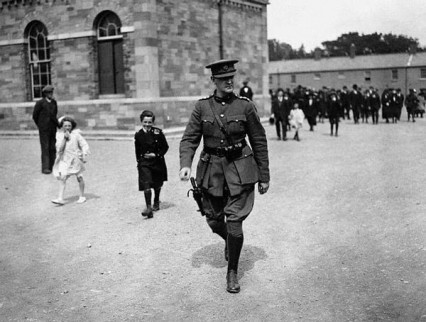
Commander in Chief Michael Collins in July 1922, two or three weeks before he was assassinated in Cork.

Michael Collins' funeral, O'Connell Street August 1922
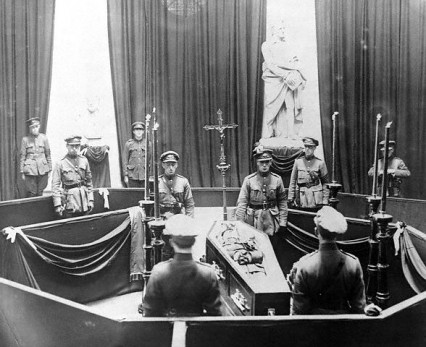
The coffin bearing the body of Michael Collins lying in state in the City Hall, Dublin. September 2, 1922 Dublin, Ireland

Michael’s brother Sean Collins

It was never really established whether Dunne and O’Sullivan acted on their own (the assassination seemed pretty badly organised for an official assassination so this was likely) or with the approval and help of Michael Collins. Collins had been a friend of Dunne’s while Sir Henry Wilson was responsible for establishing the Cairo Gang (a group of experienced British Intelligence agents who met frequently at Dublin’s Cairo Cafe) twelve of whom were murdered by the IRA acting under Collins command in 1920. The Cairo Gang killings provoked the British Auxiliaries in Dublin to shoot trapped innocent civilians at Croke Park in not the bloodiest but perhaps the nastiest of the various historical Bloody Sundays.

The infamous Cairo gang

Perhaps the ironic aspect to the story of the murder of Sir Henry Hughes Wilson was that Reginald Dunne and Joseph O’Sullivan were both born and bred in London, whereas Field-Marshall Wilson was born smack bang in the middle of Ireland at Ballinalee in County Longford.

A letter sent to O'Sullivan while waiting for his execution

Sinéad O’Connor – She Moves Through The Fair

* The text of Dunne’s intended last statement, as transcribed from the images in this post.

Lord and Members of the Jury. My friend and I stand here before you today charged with the offense of murder; and I have no doubt that, from the evidence placed before you by the prosecution, you will find us both guilty. With respect to the charges of attempted murder, we merely tried, as everyone must know, to try and escape arrest.

The offence of murder is a very serious matter; so much so, that any act which results in loss of human life requires very grave and substantial reason. We have never until now been charged with any crime. As you have heard from the Police Officer, who gave evidence as to our character and our previous records, we have both been in the British Army. We both joined voluntarily, for the purpose of [making Europe safe?] in order that the principles for which this country stood, should be upheld and preserved. These principles, we were told, were Self-Determination and Freedom for Small Nations. We both, as I have said, fought for these principles, and were commended for doing so; and I imagine that several of you gentlemen of this jury did likewise. We came back from France to find that Self-Determination had been given to some Nations we had never heard of, but that it had been denied to Ireland, We found, on the contrary that our Country was being divided into two Countries; that a Government had been set up for the Belfast district, and that under that Government outrages were being perpetrated, that are a disgrace to civilization — many of the outrages being committed by men in uniform and in the pay of the Belfast Government. We took our part in supporting the aspiration of our fellow Countrymen, in the same way as we took part in supporting the nations of the world who fought for the right of small nationalities.

Who was Sir Henry Wilson? What was his policy? And what did he stand for? You have all read in the newspapers lately, and been told, that he was a great British Field Marshal; but his activities in other fields are unknown to the men of the British public. The nation to which we have the honour to belong, the Irish nation, knows him, not so much as the British Field Marshal, but as the man behind what is known in Ireland as the Orange Terror. He was at the time of his death the Military Advisor to what is colloquially called the Ulster Government, and as Military Advisor he raised and organized a body of men known as the Ulster Special Constabulary, who are the principle agents in his campaign of terrorism.

My Lord and Members of the Jury, I do not propose to go into details of the horrible outrages committed on men, women and children of my race in Belfast and other places under the jurisdiction of the Ulster Government. Among Irishment it is well known that about 500 men, women and children have been killed within the past few months, nearly two thousand wounded, and not one offender brought to justice. More than 9000 persons have been expelled from their employment; and 23,000 men, women, and children driven from their homes. All the big cities of this country and even those of Northern France are now receiving these refugees. Sir Henry Wilson was the representative figure and the organiser of the system that made these things possible.

At his suggestion and advice the Ulster Parliament passed an Act authorising the [purging?] of political opponents and this power is now exercised and enforced by the Courts in Ulster.

There is and can be no political liberty in a country where one political party outrages, oppresses, and intimidates not only its political opponents, but persons whose religious opinion differ from those of the party in power. The same principle for which we shed our blood on the Battle Field of Europe led us to commit the act we are charged with.

My Lord and Members of the Jury, you can condemn us to death today, but you cannot deprive us of the belief that what we have done was necessary to preserve the lives, the homes, and the happiness of our countrymen in Ireland. You may by your verdict find us guilty, but we will go [to] the scaffold justified by the verdict of our own Conscience.

Dunne truncated his statement to “cut out the patriotic adjectives I feel inclined to use under the present circumstances” (as well as his specific delineation of the atrocities of Henry Wilson and the Ulster government). -ed.

On this day..

1812: Daniel Dawson, for the integrity of sport

On this date in 1812, Daniel Dawson “suffered the awful sentence of the law, at the top of Cambridge Castle, amidst a surrounding assemblage of at least twelve thousand spectators, it being market-day.”

The crowd was an appropriate ornament to the condign punishment of the most famous horse-poisoner in English history — and perhaps the most severely-punished sports cheat in all of modernity.

A tout scrabbling his living about the storied Newmarket tracks of Cambridge, Dawson killed the favorite for a high-profile race (and three other horses besides) by poisoning their trough, intending only to hamper the beasts enough to make good a variety of bookies’ bets against the fair Pirouette.

Although acquitted for that crime, Dawson was promptly returned to the dock for a previous, and previously unsolved, horse-poisoning, and convicted under a “black act” statute to punish livestock-killing.

According to the inevitable trial pamphlet, freely available from Google Books,

DAWSON behaved with a sullen and impudent levity during the trial, and he frequently abused the witnesses whilst giving their testimony, loud enough to be heard throughout the court … with horrid imprecations, ill becoming his unhappy situation, and at other times he was nodding at and saluting with his hand different persons in court. The verdict of GUILTY had not the slightest effect on him, and his general conduct was altogether depraved. On his return to the castle, his conduct, at times, bordered on insanity, and he appears too illiterate to feel a consciousness of wrong, although he has confessed his guilt to the full extent.

(Katherine Watson adds that although Pirouette’s owner sought a reprieve for the poisoner, Dawson “spoke bitterly of the hypocrisy of the Jockey Club, few of the members of which were above cheating.”)

On this day..

1726: Mary Standford, shunning convict transportation

(Thanks to Anthony Vaver of Early American Crime for the guest entry, reposted from a fascinating entry in his series on convict transportation. Vaver is the author of Bound With An Iron Chain: The Untold Story of How the British Transported 50,000 Convicts to Colonial America. -ed.)

Mary Standford was convicted of privately stealing a shagreen pocket book, a silk handkerchief, and 4 guineas from William Smith on July 11, 1726. After her conviction, she strongly rejected transportation to the American colonies as an alternative to execution.

Early Years

Standford was raised just outside of London by good parents who sent her to school and educated her in the principles of Christian values. Standford, however, showed more interest in the “Company of Young Men,” so she was sent to London to become a servant, where she lost several positions due to her behavior. In her last position she was seduced by a footman, which subsequently forced her into prostitution.

Standford quickly fell in company with Mary Rawlins, “a Woman of notorious ill fame,” and the two of them walked the streets between Temple Bar and Ludgate-Hill looking to empty the pockets, one way or another, of gullible men. Later, they had considerable success targeting sailors who, after returning from their voyages, had money to spend for their favors. Standford eventually married a man with the last name of Herbert, but after a year and a half she left him or, by her account, he abandoned her. Soon afterward, she had a child out of wedlock from another man, who was a servant.

Standford’s Arrest

With two mouths to feed, Standford set out to practice prostitution on her own, and it was then that she was arrested for theft. William Smith, who brought her to trial and was surprisingly frank in his testimony, related that he was walking along Shoe Lane after one o’clock in the morning when he was approached by Standford, who offered him to “take a Lodging with her.” He spent 2 or 3 three hours with her, all the while ordering drinks to be brought up from downstairs. He soon realized that he was missing money, and when he confronted Standford about it, she bolted from the room.

A constable caught Standford running away from Smith in the street. He picked up one of Smith’s guineas after Standford had dropped it, and he found another in her hand and two in her mouth. He also discovered Smith’s handkerchief and pocket book on her. In his testimony, the constable called Smith a “Country Man” and described him as very drunk at the time.

Standford’s version of the event was quite different. She claimed that Smith was drunk when she met him, and that he forced himself up to her room. There, he placed the four guineas one by one in her bosom and then threw her onto the bed. In the struggle, she speculated that his pocket book must have fallen out of his pocket, and when she discovered it after he left, she ran after him to return it. Not believing her story, the jury found her guilty, and she was sentenced to death.

A Rejection and a Defense of Transportation

After receiving her sentence, Standford’s friends pleaded with her to ask for a pardon in exchange for transportation. Standford refused, “declaring that she had rather die, not only the most Ignominious, but the most cruel Death that could be invented at home, rather than be sent Abroad to slave for her Living.”

The author of the Lives of the Most Remarkable Criminals was baffled by Standford’s position and presents a lengthy defense of the institution of convict transportation:

such strange Apprehensions enter into the Heads of these unhappy Creatures, and hinder them from taking the Advantage of the only possibility they have left of tasting Happiness on this side the Grave, and as this Aversion to the Plantations has so bad Effects, especially in making the Convicts desirous of escaping from the Vessel, or of flying out of the Country whither they were sent, almost before they have seen it. I am surpriz’d that no Care has been taken to print a particular and authentick Account, of the Manner in which they are treated in those Places; I know it may be suggested that the Terrour of such Usage as they are represented to meet with there, has often a good Effect in diverting them from such Facts as they know must bring them to Transportation, yet . . . if instead of magnifying the Miseries of their pretended Slavery, or rather of inventing Stories that make a very easy service, pass on these unhappy Creatures for the severest Bondage. The Convicts were to be told the true state of the Case, and were put in Mind that instead of suffering Death, the Lenity of our Constitution, permitted them to be removed into another Climate, no way inferiour to that in which they were born, where they were to perform no harder tasks, than those who work honestly for their Bread in England do, and this not under Persons of another Nation, who might treat them with less Humanity upon that Account, but to their Countrymen, who are no less English for their living in the New, than if they dwelt in Old England, People famous for their Humanity, Justice and Piety, and amongst whom they are sure of meeting with no variation of Manners, Customs, &c. unless in respect of the Progress of their Vices which are at present, and may they long remain so, far less numerous there than in their Mother-Land. I say if Pains were taken to instill into these unhappy Persons such Notions . . ., they might probably conceive justly of that Clemency which is extended towards them, and instead of shunning Transportation, flying from the Countries where they are landed, as soon as they have set their Foot in them, or neglecting Opportunities they might have on their first coming there, be brought to serve their Masters faithfully, to endure the Time of their Service chearfully, and settle afterwards in the best Manner they are able, so as to pass the Close of their Life in an honest, easy, and reputable Manner; whereas now it too often happens, that their last End is worse than their first, because those who return from Transportation being sure of Death if apprehended, are led thereby to behave themselves worse and more cruelly than any Malefactors whatsoever (Vol. III, pp. 287-289).

The author’s cheery account of life as an indentured servant in the American colonies certainly makes transportation sound like a compelling alternative to execution. The reality of life overseas under such conditions, though, does not match this picture, and some criminals valued their liberty over enforced servitude, even if it meant their own death.

Execution

In his account of her execution, James Guthrie, the minister at Newgate Prison, described Standford as “grosly Ignorant of any thing that is good.” He went on to say that “she was neither ingenious nor full in her Confessions, but appeared obstinate and self-conceited.” Standford continued to maintain her innocence in the affair with Smith, and she appeared indifferent about the fate of her child, expressing to Guthrie the hope that the parish would take care of it. Guthrie claimed, however, that “she acknowledg’d herself among the chief of Sinners.”

Mary Standford was executed on Wednesday, August 3, 1726 at Tyburn. She was 36 years old. Executed alongside her were 3 other criminals. Thomas Smith and Edward Reynolds were both sentenced to die for highway robbery. John Claxton, alias Johnson, was put death for returning twice from transportation before his 7-year sentence had run out.

Resources for this article:

On this day..

1540: Three Papists and Three Anti-Papists

On this date in 1540, two days after disposing of his former Vicegerent of Spirituals Thomas Cromwell, the just-wedded Henry VIII wrote a terrifying message of religious conformity in blood and smoke at Smithfield.

Edward Hall (as he did with Cromwell) records the scene.

The thirtie daie of July, were drawen on herdelles out of the Tower to Smithfield, Robert Barnes Doctor in Diuinitee, Thomas Garard, and Wyllyam Jerome Bachelers in Diuinitee, Powell, Fetherston and Abell. The firste three were drawen to a stake, there before set up, and were hanged, hedded, and quartered. Here ye must note, that the first three, wer menne that professed the Gospell of Jesu Christ, and were Preachers thereof … [the first three] were detestable and abhominable Heretickes, and … had taught many heresies, the nomber whereof was to greate in the atteindor to be recited, so that there is not one alleged … in deede at their deathe, they asked the Sherifes, wherefore they were condempned, who answered, thei could not tell: but if I maie saie the truthe, moste menne said it was for Preachyng, against the Doctryne of Stephen Gardiner Bishoppe of Wynchester, who chiefly procured this their death … but greate pitie it was, that suche learned menne should bee cast awaie, without examinaction, neither knowyng what was laied to their charge, nor never called to answere.

The laste three … were put to death for Treason, and in their attaindor, is speciall mencion made of their offences, whiche was for the deniyng of the kynge ssupremacie, and affirmyng that his Mariage with the Lady Katheryne was good: These with other were the treasons, that thei wer attainted of, and suffered death for.

Terrifying and confusing: here were burnt three Protestants (Barnes, Gerrard and Jerome) for heresy under the Six Articles, essentially for excess radicalism; beside them were hanged, drawn and quartered three Catholics (Powell, Fetherston and Abel) for treasonably refusing the Oath of Succession, that is, for refusing to admit the King of England as the head of the Church of England. It was that old dispute about Anne Boleyn, who was three queens ago by now. (All three Catholic theologians were advisors to Anne’s predecessor and rival Catherine of Aragon, back in the day.)

The one thing that couldn’t possibly be confused in the day’s proceedings was that matters of the faith were matters of state, and in them Henry would brook heterodoxy of neither the liberal nor conservative variety.

“Good Lord! How do these people live?” exclaimed a foreign observer (cited here). “Here are the papists hanged, there are the anti-papists burnt!”

Good for the martyr industry all-around, and fodder for contemporaries to imagine their respective hereafters, as in “The metynge of Doctor Barons and Doctor Powell at Paradise gate”. (pdf)

On this day..