1606: Caravaggio murders Ranuccio Tomassoni

This site is occasionally prepared to stray outside its execution-anniversary beat to cover especially fascinating manifestations of the death penalty in history.

So for this date, we observe the anniversary not of a punishment, but of the crime itself: a capital homicide in the capital of the world that changed art forever.

NNDB summarizes Caravaggio as a “temperamental painter,” but a less generous interlocutor might prefer a descriptor like “lowlife.”

Painter, he certainly was.

Caravaggio’s pioneering realism and flair for the dramatic …


Caravaggio’s Judith Beheading Holofernes, 1598-1599. Though the young painter on the make would hardly want for models of public decapitation in 16th century Rome, the gendered intimacy with the act invites consideration of Caravaggio’s likely attendance at the execution of Beatrice Cenci.

… made him a rock star on the canvas.

Though the papacy in its dogmatic counter-reformation aspect may have viewed Caravaggio’s eye-catching chiaroscuro with suspicion, there were scudi enough to burst the coinpurse of a talent who could grace a chapel with awe-inspiring stuff like this:


Caravaggio’s Crucifixion of St. Peter, painted in 1601 for Rome’s Santa Maria del Popolo.

However many souls his stark brushwork won for the Church, Caravaggio’s reverential fare belied the creator’s own distinctly profane pastimes: gambling, boozing, brawling, and whoring around. He needed the intervention of well-placed patrons to duck prosecution on several occasions.

May 29, 1606 finds our “temperamental” antihero encountering a wealthy scoundrel by the handle of Ranuccio Tomassoni and a problem that would outstrip any political pull the artist could muster.

Allegedly, the two met to settle a paltry tennis wager, although this may have been a cover story for a rivalry over a courtesan.*

On whatever pretext, the young hotheads fell into a melee. Caravaggio won … and Tomassoni bled to death from the gash his foe dealt to his femoral artery.**

Caravaggio now had mortal blood on his hands. Homicides were treated very harshly by the authorities. Caravaggio was about to have a price put on his head, and if he were caught, that head would be summarily removed from his body and hung on a public street. Allies of Ranuccio bent on revenge were likely to be after him as well. … Caravaggio, the celebrated Italian painter, was now a notorious wanted killer. (Source)

Condemned an outlaw by Pope Paul V — himself fruit of Rome’s Borghese family, great patrons of art in their own right — Caravaggio fled the Eternal City. His brilliance went with him, perhaps even amplified by the exile.

“The fall from grace was huge,” a curator of late Caravaggio works argued. “It had a profound impact. He started expressing the psychological essence of the stories he is telling.”

The painter and killer had four years left to him — an exile spent sleeping clothed and armed, forever looking over his shoulder. But what his jangled nerves could still spare for the canvas would help launch the baroque artistic epoch and still influences us today.

Flight, fancy, and fortune took Caravaggio to Malta and to Sicily, but the year or so he spent as Naples’ visiting genius would make his artistic legacy: that city’s succeeding generations of painters took enthusiastic inspiration from Caravaggio’s Neapolitan offerings — like a Seven Works of Mercy that must have carried a very personal meaning for the hunted man.

He was reportedly as arrogant and hot-tempered on the run as he had been in Rome, but Caravaggio’s art in exile also traces his desperate attempts to undo the consequences of his bad behavior.

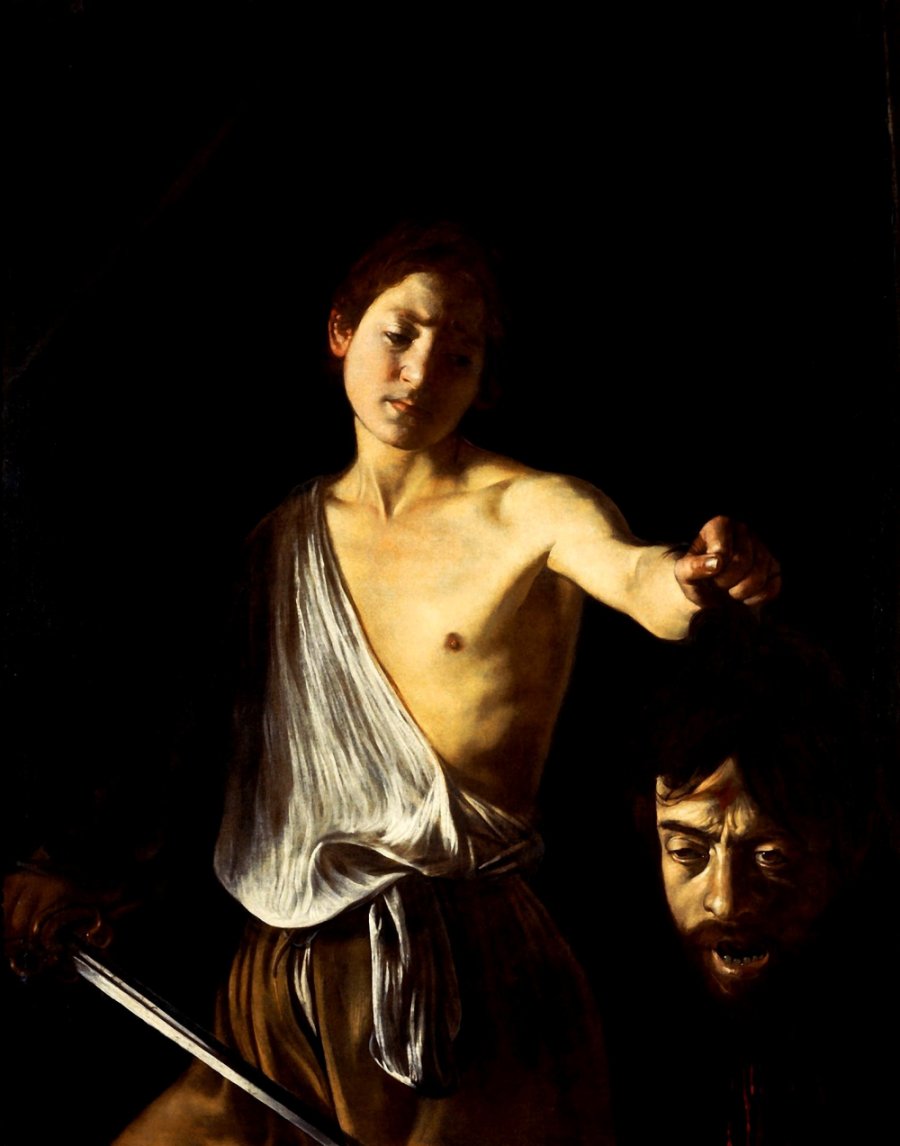
Exploiting his apparent affinity for the sawing off of heads, Caravaggio rendered his own head in a severed state in at least two apparently penitential paintings during this vulnerable period.

This Salome with the Head of John the Baptist was made for the Grand Master of the Knights of Malta after the latter had in 1608 booted Caravaggio from that island refuge:

While David with the Head of Goliath seems to have been created shortly before Caravaggio’s own death for the pope’s art-hounding “Cardinal Nephew” Scipione Borghese, in a bid to earn a pardon. Caravaggio’s self-portrait as the dead man, and Latin inscription “humility kills pride” on the Israelite hero’s sword, suggest an attempt to effect through his creative virtuosity his own execution in effigy.
That would be, at any rate, the only execution Caravaggio ultimately had to endure. He died in the summer of 1610 under unclear — and inevitably suspicious — circumstances while attempting to return to Rome.

A few biographical books about Caravaggio …

… and some Caravaggio art books

* Ranuccio Tomassoni was the pimp and lover of a prostitute named Fillide whom Caravaggio had painted years before, and become enamored of. This Fillide was also Caravaggio’s model for Judith in the arresting painting of the Biblical heroine in mid-decapitation above.

** Possibly, if you like the love triangle angle, in a botched attempt to castrate his rival.

On this day..

1965: Eli Cohen, Israel’s man in Damascus

On this date in 1965, Israel’s greatest spy suffered an ignominious public hanging in Martyrs Square, Damascus.


The signage swaddling the body denounces his crimes.

Eliahu Ben Saul Cohen — you can call him Eli(e) — was an Egyptian Jew who got recruited by Israeli intelligence to put his Arabic credentials to use in the cloak and dagger game.

You could say he’d found his calling.

After a spell establishing his cover story credentials in Argentina, he “returned” to Syria posing as a prodigal returning emigrant. There, he became the Zionist Richard Sorge.

Brazenly infiltrating the ascendant Ba’ath party and Syrian elite circles as wealthy businessman “Kamel Amin Thaabet”, Cohen piped years of high-quality intelligence to Israel from the very pinnacle of its enemy’s power structure.

(As described in this account, Eli’s own brother, another Mossad agent, was at one point charged with deciphering the spy’s communiques — thereby accidentally catching up with the family business.)


The trusted Eli Cohen in a snapshot with Syrian officials in the Golan Heights, overlooking Israel.

Cohen’s information on Syrian positions in the Golan has been credited with helping Israel win the Six-Day War in 1967.

But he wasn’t around to see it.

By that time, Syrian and Soviet intelligence had finally traced the damaging radio transmissions to “Kamel’s” apartment. He was purportedly — the matter is disputed, and smacks of hagiography — so influential and well-trusted at that point that he was on the verge of being named Deputy Minister of Defense.

Instead, he had a future in the martyr business.

A few books about Eli Cohen

After Cohen’s January 1965 arrest, events moved with implacable dispatch, and neither spy swaps nor diplomatic arm-twisting would avail an agent so embarrassingly, damagingly accomplished. Thousands turned out to cheer the spy’s public hanging, or gawk at the body as it remained hanging throughout the morning. Thousands more watched the live telecast of the execution.

(Six Syrians drew prison sentences for their parts in Cohen’s spy ring.)

Israel is still on about getting his body back from the Syrians. Whether or not that ever happens, the man lives on as a hero for his side. His story is the subject of the 1987 TV movie The Impossible Spy.

On this day..

1909: Jesus Malverde, narco patron saint

On this date in 1909, a Mexican bandit was executed by the police. Maybe. Unusually for these pages, the date is quite certain but the existence of the executed man is not.

If he existed — and this caveat is standard in practically every profile of the fascinating cultural phenomenon fathered by the man or phantom — Jesus Malverde was a Robin Hood-esque “social bandit” who preyed on Mexico’s plutocratic agricultural lords and distributed the spoils to the poor.

According to Patricia Price (“Bandits and Saints: Jesus Malverde and the Struggle for Place in Sinaloa, Mexico”, Cultural Geographies 2005; 12; 175), the Malverde of legend entered the world as Jesus Juarez Mazo, but his

own parents died of hunger or a curable illness, and that this was the catalyst for his turn to a life of crime. While Malverde was said to have worked variously on the railroads, as a carpenter, or as a tailor, he soon joined the ranks of bandits that roamed Mexico’s countryside at the end of the nineteenth century. He reportedly stole gold coins from the rich hacienda owners living in Culiacan and threw them in the doorways of the poor at night.

Truly a figure who, if he did not exist, it were necessary to invent.

All the particulars about his legendary exploits are a bit fuzzy, right down to his end on May 3, 1909 — possibly gunned down, possibly left to die of exposure with his feet hacked off, or possibly (and certainly more picturesquely) summarily hanged from a mesquite tree by a posse.

(In a version that appealingly combines these threads, he’s said to have been dying of gangrene after being shot, and in a last act of charity prevailed upon his friend to bring in his body to collect the reward. The police gibbeted his corpse.)

In the years since, Malverde has become a popular divine intercessor for the marginal social classes who could identify with such a figure, like Sinaloa’s poor farmers of corn and beans.

And other cash crops.

Malverde is also the patron saint — decidedly unofficial, of course — of the region’s robust narcotics trade.

His shrine stationed across the way from a government compound in Sinaloa’s capital city draws a bustle of devotees.* Offerings like produce and shrimp share space with icons of marijuana and AK-47s, and votive notes appreciating “how things turned out, and how nobody was grabbed.” Breaking Bad gave him a shout-out from the mouths of disdainful DEA agents north of the border.

The underworld angle may draw the gawking Yankees, but Jesus Malverde — man, legend, shrine, all — is a genuine civic institution who meets a genuine need for solace not unlike his very namesake. In the words of a researcher quoted by Price, Malverde draws

the poorest, the handicapped, pickpockets, thugs, prostitutes, drug traffickers and drug addicts, in sum, the stigmatized who, in civil or religious iconography don’t find anyone who looks like them, in whom to confide and in whose hands to put their lives.

We’ll drink to that.

* So does Malverde’s Facebook page.

On this day..

1951: Ospan Batyr, Kazakh freedom fighter

On this date in 1951, Kazakh national hero Ospan Batyr was executed in Urumqi.

Ospan — the second name is an honorific, not a family name — hailed from an ethnic Kazakh region in China’s eastern Xinjian region, noted today for its still-robust Uighur separatist movement.

Executed Today does not envy any ethnic group attempting to sort out its national aspirations on the frontiers of great powers, and this was the dangerous matter to which our day’s principal applied himself.

The powers in question here are the Soviet Union and China; their degree of sway over Xinjiang (or “East Turkestan”) shapes the parameters of the struggle.

During the early 1940’s, the Soviets’ dire wartime position gave them less weight to throw around; accordingly, the formerly Soviet-allied local warlord Sheng Shicai — an ethnic cleanser of Kazakhs from way back — made nice with the Koumintang.

As Moscow gained the upper hand over Berlin, however, it had leave to tend its eastern ambitions as well.

Since Sheng’s attempt to sell out to Stalin failed, he left Xinjiang with 50 trucks full of loot, and retired to Taiwan to write this 1958 volume on his erstwhile demesne.

When Sheng got bounced from his post trying to re-defect to the victorious Soviets, Ospan Batyr (alternatively, Osman or Uthman Batur) led Kazakh forces in a multi-ethnic Muslim rebellion that established a short-lived East Turkestan Republic, allied with the Soviet Union.

But what the political expediency of great powers giveth, it also taketh away.

The postwar partition of the globe left Xinjiang in China’s sphere of influence, drawing down the East Turkestan Republic’s Soviet support. When that state-like entity became involved in a border conflict with Soviet-backed Mongolia, Osman and the Kazakhs lined up with the Koumintang — not Russia.

As a matter of straight realpolitik, this was an inauspicious moment to get with Chiang Kai-shek since he was on the verge of finally losing China’s long civil war. But it’s a move that would be subsequently vindicated by the way Kazakhs voted with their feet under Mao.

Ospan Batyr had to settle for the judgment of history when the People’s Liberation Army absorbed Xinjiang, and in 1950 finally corralled the remnants of his Kazakh resistance. He repelled demands under torture that he sign on with the Reds and make an appeal to his people in their name: “I can give a life. My nation will continue the struggle.”


Ospan Batyr awaits execution.

Most of the information readily available online about this Kazakh martyr is not in English, and a good deal of it tends to the hagiographical — like this Turkish-language page, lavishly illustrated.

On this day..

Feast Day of St. George

This is the feast date, and the traditionally-ascribed execution date in 303, of St. George — legendary dragon-slayer and patron saint of half the world and darn near everything that the original apostles didn’t nail down.

Saint George is supposed to have been a well-favored officer in Diocletian‘s army who suicidally announced his Christian faith during the latter’s persecutions, and refused every sop and entreaty to renounce it. He was martyred at Nicomedia.

Pretty standard persecution fare — and there’s next to nothing that can be reliably verified about his life — but George did well by his future cult to get into the martyr’s game right before Christianity’s official triumph. Still, at the end of the day, it’s one of those unaccountable accidents of history that this particular fellow ended up as perhaps Christendom’s most widely venerated champion.

He’s most immediately recognizable for the story of having slain a dragon, a plain metaphor for paganism (and usable metaphor for anything and everything else) that’s been depicted in all its scaly corporeality by innumerable artists.

England has liked him jolly well ever since his suitability to the chivalric ethos positioned him to supplant Edmund the Martyr as that realm’s patron saint during the Middle Ages. The red cross on the English flag is a St. George’s cross.

And so there he is, too, in one of Shakespeare’s most rousing patriotic monologues:

I see you stand like greyhounds in the slips,
Straining upon the start. The game’s afoot:
Follow your spirit, and upon this charge
Cry ‘God for Harry, England, and Saint George!’

But George gets around, and England has to share him.

That St. George’s Cross also adorns the flag of Georgia (the country, that is: it’s so hard core that it’s named for the guy), and he’s claimed as a sponsor throughout Orthodox Christendom: Serbia (which celebrates a major holiday when April 23 hits on the Julian calendar); Bulgaria; Greece; Ethiopia; the city of Constantinople and its heir, the city of Moscow, and Russia generally. There were two George’s [Yuri’s] Days on Old Russia’s calendar, and the autumn one was marked as the one time in the year that serfs were permitted to change their landlords, at least until Boris Godunov canceled the privilege and left Russian with the idiom “so much for Yuri’s day!” to mark an expectation disappointed.

George is big in Spain, and even bigger in Portugal; through its Portuguese heritage, he’s also venerated in Brazil, where he’s the patron saint of the Corinthians football club. He’s the sponsor (via that dragon connection) of the snaky Hungarian military order that gave Vlad the Impaler the immortal sobriquet of Dracula.

There are other countries and any number of cities who also trust the dragon-slayer’s patronage; George accepts the further devotions of saddle-makers, lepers, animal husbandmen, shepherds, Crusader knights, butchers, the Maltese, gypsies, farmers, archers, syphilis-sufferers, cavalrymen and therefore also armored tankmen, Palestinian Christians, and the Boy Scouts of America. He’s generally got a stupendous worldwide collection of churches, art, legends, and devotional rites dedicated to his name.

On this day..

1590: Anne Pedersdotter, Norwegian witch

The most famous witchcraft execution in Norwegian history took place on this date in 1590, with the burning of Anne Pedersdotter.

Pedersdotter (English Wikipedia entry | Norwegian) was the wife of Lutheran minister Absalon Pedersson Beyer (Norwegian link), a reformist theologian in Bergen.

Anne may have become a target of her prominent husband’s enemies; she was first implicated for witchcraft in 1575 when her husband’s uncle dropped dead, clearing the way for Absalon to take his place as bishop.

While she repelled that round of allegations, Absalon himself soon followed his kin into the great hereafter, leaving his widow a bit shorter on political pull. She lived on as a near-hermit, forever shadowed by the intimation of infernal intercourse.

In 1590, Anne’s neighbors, and maid, accused her again; her fate was sealed when a forbidding storm broke during her trial. (So says Witch Hunts in the Western World)

Anne Pedersdotter’s execution has become a literary staple in Norway, with a (highly dramatized) play (available free online here) itself re-stylized into other notable cultural products — such as Danish director Carl Theodor Dreyer‘s 1943 Vredens Dag (Day of Wrath) …

… and two different operas, Edvard Fliflet Braein‘s Anne Pedersdotter, in Norwegian; and, Ottorino Respighi‘s more conventionally Italian-language La Fiamma:

On this day..

1906: Pyotr Schmidt, Sevastopol uprising leader

On this date* in 1906, tsarist Russia executed the naval officer who had made bold to style himself Commander of the rebellious Black Sea Fleet.

During the unsuccessful 1905 Russian Revolution, our firebrand Pyotr Schmidt was lieutenant commander of a destroyer stationed at the Black Sea port of Sebastopol/Sevastopol.

Schmidt made an impassioned revolutionary speech that got him arrested, and was in turn freed by protesting workers and soldiers.

So they knew just the guy to call when a collection of Black Sea Fleet vessels finally out and mutinied. And Pyotr Schmidt knew how to talk the talk.

The glorious Black Sea Fleet, sacredly devoted to the people, demands Your Majesty to immediately call a meeting of the Constituent Assembly, and no longer obeys orders of Your ministers.

Commander of the Fleet P. Schmidt.

Nicholas II decided he was better advised to just order the mutinying ships stormed, and Schmidt was taken prisoner.

The most famous ship under Schmidt’s “command” was, of course, the battleship Potemkin, which trumps the cruiser Aurora as the revolutionariest hulk of floating steel in the Russian fleet by virtue of Sergei Eisenstein‘s silent cinematic celebration of the Sevastopol mutiny, The Battleship Potemkin.

With this sort of insurrectionary credential, Schmidt was a popular choice for Soviet-era naming and renaming — streets, bridges, other naval vessels.

(And come this, er, sea change in fortunes, the commander of the firing squad that did Pyotr Schmidt to death was himself arrested, and shot in 1923 by the Cheka.)

Schmidt thereby contributed his name to an entirely different innovation in the Russian language: in one Ostap Bender novel, there’s a “Children of Lieutenant Schmidt” network of con artists each claiming (in a different part of that vast country) to be the martyred mutineer’s progeny and mooching the material comforts due such an impressive lineage.

So striking and popular was this portrayal that “children (or sons) of Lt. Schmidt” remains a going Russian idiom for anyone running a similar scam.

* March 19 was the Gregorian date; it was March 6 by the obsolete Julian calendar still hanging on in Russia at this time.

On this day..

1536: Pargali Ibrahim Pasha, Suleiman the Magnificent’s friend and grand vizier

On this date in 1536,* the Ottoman Empire’s mightiest Grand Vizier was strangled at the order of the Sultan Suleiman the Magnificent.

Say what you will about the Grand Vizier, the man knew how to enjoy the fruits of his transitory power. This, his Istanbul palace, is today the Museum of Islamic and Turkish Arts. (cc) image from docman

An Albanian [update: and/or Greek] Christian, Ibrahim Pasha — not to be confused with several other historical figures of that name, notably an Egyptian general — found his way into the Ottoman slave quarters and became a boyhood friend of the young Suleiman.

Thereafter the two would rise together: as Sultan, Suleiman rapidly promoted his trusted friend, and even married a sister to him.

So absolute was Ibrahim’s power that Italian diplomats** called him “Ibrahim the Magnificent”. At the Ottomans’ acme, his word was law as surely as his distinguished master’s. Ibrahim’s achievements in war, diplomacy, and as a patron of the arts attested his worthiness of the honors.

Unfortunately, he may have taken those honorifics a little too much to heart.

We do not know the precise cause of Ibrahim Pasha’s fall: only that it was precipitous. Two months after returning from a campaign against the Safavids that reconquered Baghdad, he was put to death, reputedly spurning an opportunity to flee and loyally submitting himself to the Sultan’s punishment. Much as this smacks of poetic amplification, Ibrahim’s last meal was said to be taken dining alone with Suleiman.

It’s impossible that in 13 years as Grand Vizier, this Islamic convert and upstart slave had not won himself powerful enemies — but he lived in Suleiman’s favor, and was destroyed when that favor reversed. One theory of Ibrahim’s fall has it that his self-awarded titles started getting a little bit, er, “magnificent” and Suleiman jealously snuffed out any potential for actual political rivalry. Another looks towards the Ukrainian slave girl who was taking over Suleiman’s harem — Roxelana, who would ruthlessly destroy all the political obstacles to her son’s eventual succession.

Between those two, or other palace machinations, or factors yet un-guessed, Suleiman was induced to destroy his boyhood companion and right-hand man. And in the thirty years the sultan had to outlive his vizier, who knows what pangs conscience held in store.

Dear Lord! Shower me with your grace
Whether there is any remedy other than You I do not know.
Help me, forgive my sins,
Please, help me, forgive my sins.

poetry by Suleiman the Magnificent, writing as “Muhibbi”

* There are some other March 1536 dates out there, but the Ides seems like the strongest.

** Very tight with the Ottomans.

On this day..

277: Mani, dualist

It was perhaps on this date, that the prophet Mani — he of Manichaeism — underwent his Passion at the hands of the Sassanid Empire in a Gundeshapur prison.

The actual date of this event is an Aramaic (lunar) date whose year is unrecorded, so it attaches only uncertainly to the Julian calendar. (2 March 274 is another possibility, as are other dates in the mid-270s.)

Perhaps more to the point for this blog is that Mani’s “crucifixion” as celebrated by his followers was a literary exultation: the 60-year-old died in prison after 26 days in chains, maybe even sooner than his captors had intended. After Mani “rose [from his body] to the residences of his greatness [in] the heights, and he met his shape,” the Sassanids decapitated the corpse to make the whole scene more properly resemble the awful majesty of an offended sovereign.

But even as merely a metaphorical “execution,” Mani’s martyrdom merits mention.

Born into a Judaic-Christian sect, Mani (also known as Manes) experienced a conversion, went east for enlightenment, and returned with a syncretic theology of a good spirit world and an evil material one — and east-meets-west twist, in other words, on gnosticism, rooted in both Christianity and Buddhism. (And Zoroastrianism, dominant in Persia at this time — to Mani’s ultimate grief.)

This seems like the sort of thing that someone ought to have revived in California in the 1970’s.


Shrine of Mani as Buddha in Quanzhou, China.

Alas, though it once spanned the Eurasian landmass all the way to China, Manichaeism today is extinct except for its linguistic remnant … the word “manichean”.

Most of us won’t do so well as to thrust our fame into the dictionary, but Mani’s shape-in-the-heights can’t be altogether satisfied with this word’s connotation of jejune, black-and-white dualism — as in a “Manichean struggle with a single overarching enemy called terrorism”.

The man wrote his own holy book, after all, and it’s a bit more elegant than the likes of neoconservative foreign policy.

the first precept for hearers is this: …they shall not kill …, [and] they shall forgive those creatures who provide them with meat for food so that they do not kill them as if they were evil people. But dead flesh of any animals, wherever they obtain it, be it dead or slaughtered, they may eat …

And the second precept for hearers is that they shall not be false and they shall not be unjust to one another … he shall walk in truth. And a hearer shall love [another] hearer in the same way one loves one’s own brother and relatives, for they are children of the living family and the world of light.

And the third precept is that they shall not slander anybody and not be false witnesses against anybody of what they have not seen and not make an oath in falsehood in any matter …

From the Shabuhragan (pdf)

Now is that so bad?

Manichaeism found favor (though not a conversion) with the broad-minded and long-reigning king Shapur I. (Shapur is most famous in the West as the Persian ruler who captured the Roman emperor Valerian.)

But one of Shapur’s less impressive heirs was persuaded by the sectarian Zoroastrian priesthood — for whom the Manicheans were an upstart rival — to bust Mani.

It seems they were able to make use of the prophet’s distaste for war to question his patriotism. Some things never change.

The founder’s laying down his life hardly slowed the faith’s growth; instead, it prospered as one of the more successful entrants in the confusing late-antiquity hustle and bustle of competing cults. Dualism was a hot mystical trend literally from ocean to ocean, and nobody proselytized it like Mani’s followers.

“In its Manichaean form,” observes Johannes van Oort, “Gnosticism once was a real world religion.”

Had it stayed that way, there’d be endowed chairs of Manichean gnosticism at every university and politicians conspicuously rubbing shoulders with Manichean clergy and Major League sluggers with WWMD bracelets. Instead, it’s a metonym for naivete. Them’s the breaks.

In the West, at least, the lost sect’s unflattering reputation comes by way of no less a personage than St. Augustine of Hippo.

You know what they say about the zeal of converts? Well, Augustine used to know Manichaeism from the inside.


St. Augustine Sacrificing to a Manichaean Idol, 15th century painting by an unknown Flemish master.

After spending his twenties as an enthusiastic Manichean, the future Church Father (re)converted to orthodox* Christianity and turned on his former philosophy with vehemence.

His Confessions denounces a Manichean bishop with whom he once had an unsatisfying audience — “Faustus by name, a great snare of the devil.” That association might very well be the etymological root of that great literary devil-bargainer Dr. Faust.

One could, at the minimum, follow a thread from Augustine’s establishment anti-dualism to the Middle Ages practice of calling any dualistic heresy — Bogomilism, Catharism, whatever — “Manichean”, and the intertwining of those forbidden gnostic traditions with Christendom’s devil mythology.


Medieval image of St. Augustine confounding devilish heresies.

At the same time, Augustine’s philosophy draws much of its enduring appeal from that very dualism, absorbed at such a formative age that the writer late into life was still repelling Christian colleagues’ accusations of immutable Manichaeism — “like an Ethiopian can not change his skin, nor the leopard his spots.” Augustine’s City of God proceeds from opposing that virtuous spiritual metropolis to the corruption of the City of Man.**

Moreover, Johannes van Oort concludes,

Nowhere in the early church before 400 does there appear to be such a tender and appealing piety, along with such a prominent place given to the Christ, except for Augustine and the Manichaean writings … In some essential features of Augustine’s spirituality we may perceive one of the most important channels through which the Gnostic religion of Manichaeism has exercised a lasting influence on western culture.

* Manichaeism, at least in the North African context where Augustine engaged it, is probably best thought of as one of the competing strands within the Christian community rather than a rival religious edifice. (Gnosticism’s capacity to syncretize with varying spiritual traditions has always been essential to its appeal.) Manicheans themselves insisted that they were secta, within Christianity, not schisma, like the pagans.

** Augustine had particular cause to be down on the prospects of the City of Man: at the time of writing, Rome had just been sacked by the Visigoths.

On this day..

1945: Not Fabian von Schlabrendorff, saved by a bomb

On this date in 1945, July 20 plotter Fabian von Schlabrendorff was on his way to a certain death sentence at the hands of the German Volksgerichtshof.

Asshole jurist Roland Freisler

The outcome in the kangaroo court for anyone involved in the previous year’s near-miss bomb attack on Hitler was foreordained. Just the day before, the movement’s ineffectual but conscientious political statesman Carl Goerdeler had hanged for it.

But a funny thing happened to the lawyer and reserve officer Schlabrendorff on the way to the gallows.

As he awaited this date his tongue-lashing and inevitable condemnation at the hands of the vituperative Nazi judge Roland Freisler, a bombing raid led by Jewish future Nuremberg prosecutor Robert Rosenthal struck the People’s Court — killing not the prisoner, but the judge, who was reportedly found still clutching his prey’s file.

“It is God’s verdict” was the succinct epitaph issued by a worker at the hospital where they raced his body, and nobody cared to dispute the subversive remark.

Hysterically badgering defenseless prisoners in farcical show trials, ostentatiously obeisant to the Reich, and personally responsible for thousands of executions, Freisler was a hard guy to admire. His role model for courtroom demeanor was supposed to be the ruthless purge trials of the Soviets.*

(Freisler also attended the Wannsee Conference, where Reinhard Heydrich organized the Final Solution. What a guy.)

In the confusion of the bomb blast, Schlabrendorff was hustled off to detention un-sentenced, and spent the last months of the war being shifted from one concentration camp to the next. The Third Reich — and admittedly, it had a few other things on its mind in those days — neglected to kill him, trial or no.

Schlabrendorff went on to become a West German constitutional court judge, though in this career he could hardly be as memorable as his onetime persecutor.

That Schlabrendorff miraculously escaped the war with his life thanks to a timely explosion was a particular irony: Hitler had once unwittingly been preserved from a Schlabrendorff assassination attempt by a bomb that failed to detonate.

In a March 1943 attempt on Hitler’s life, Schlabrendorff himself had passed one of Hitler’s entourage a package supposedly containing two bottles of cognac for delivery to another officer. In fact, the package was meant to blow up Hitler’s plane.

When [Hitler] was boarding the plane I started the mechanism of the delayed-action bomb … timed to explode within half an hour. At a sign from Tresckow, I handed the parcel to Colonel Brandt,** the member of Hitler’s escort who had promised to take it. It was a great nervous strain to remain quiet at this juncture.

After more than two hours of waiting, we got the shattering news that Hitler had landed safely …

We were stunned and could not imagine the cause of the failure … even worse would be the discovery of the bomb, which would unfailingly lead to our detection and the death of a wide circle of close collaborators.

After considerable reflection Tresckow resolved to ring up Colonel Brandt at Hitler’s headquarters and ask whether the parcel for General Stieff had already been delivered. Brandt replied that it was still in his keeping. This gave us hope that the bomb had not been discovered. Its delivery had to be prevented by all means. So Tresckow asked him to keep the parcel. He added there had been some mistake. I would call on him the following day to exchange the parcel, as I had anyway to go on official business to headquarters in East Prussia.

On some military pretext, I flew to Headquarters with the regualr messenger plane. I called on Colonel Brandt and exchanged a parcel containing two bottles of brandy for the one containing the bomb.

I can still recall my horror when the man, unaware of what he held, smilingly handed me the bomb and gave it a jerk that made me fear a belated explosion. Feigning a composure I did not feel, I took the bomb, immediately got into a car, and drove to the neighboring railway junction of Korschen. From there a sleeper train left for Berlin in the evening.

At Korschen, I got into a reserved compartment, locked the door, and … dismantled the bomb … The mechanism had worked; the small bottle had broken; the corrosive fluid had consumed the wire; the striker had hit forward; but — the detonator had not fired.

* Not the only ostpolitik admiration the Nazis showed for their battlefield foes’ ruthlessness; Hitler, similarly, applauded (sometimes envied) Stalin’s 1930s purge of the officer corps.

** This Heinz Brandt, too, has another unwitting part left to play in the story of the German resistance: it was he who, on July 20, 1944, moved Col. Stauffenberg’s deadly parcel behind an oaken table support, preserving Hitler from the bomb’s worst effects. Brandt died in that explosion.

On this day..