1888: Tsimequor, indigenous Snuneymuxw

(Thanks to Meaghan Good of the Charley Project for the guest post. -ed.)

On this date in 1888, Tsimequor, a member of the Snuneymuxw First Nation, was executed in Nanaimo, British Columbia for a bizarre murder that clashed Aboriginal and white Canadian cultures.

What happened is explained in Jeffrey Pfeifer and Ken Leyton-Brown’s book Death By Rope: An Anthology of Canadian Executions:

The matter that brought Tsimequor to public attention arose out of a tribal custom designed to help members of the community better deal with grief following the death of a child. The custom dictated that when a child died, it was the practice for all other persons in the tribe who bore the same name to immediately change their names. In this way, relatives of the deceased child would be less likely to be reminded of their loss.

Tsimequor’s son Moses died in 1888 and, as per custom, all the Snuneymuxw who were named “Moses” changed their names to something else.

But there was one little boy in the community whose name was Moïse — “Moses” in French — and Tsimequor demanded that he change his name as well. The four-year-old’s parents refused, and days later somebody killed their son.

Had it been solely in the hands of the Snuneymuxw, the crime might have been forgiven. But to the Canadian legal authorities killing a four-year-old because of his name was unambiguously capital murder, and so Tsimequor was arrested and brought to trial. He maintained his innocence, but was convicted on November 7, 1888 and sentenced to death.

Pfeifer and Leyton-Brown record:

Surprisingly, there was considerable sympathy for Tsimequor expressed in the local newspaper, which pointed out that the crime had been committed “through superstition” and noting that Tsimequor had had no legal counsel to defend him at the trial. According to one newspaper report, “a sentence designed to educate Aboriginal people would be more appropriate.” There was however no doubt which tradition would be followed in this case.

Tsimequor was hanged in the Nanaimo Gaol five weeks after his trial.


Privy Council minutes determining that ‘law should be allowed to take its course’ with the hanging of the indigenous man Tsimequor in 1888

On this day..

1895: Harry Hayward, the Minneapolis Svengali

Minnesota executed Harry Hayward shortly after midnight on this date in 1895.

Dubbed the “Minneapolis Svengali” by the press for his perceived similarity to the sinister hypnotist of that year’s hit literary release, the prodigal rake Hayward cast his spell over a New York emigre with the name of Kitty Ging and a pocketbook every bit as alluring.

On December 3, 1895, Kitty rented a horsey from a livery stable, but the ride returned to the stable alone. What terrible fate befell her? And how did the Mesmer of Minneapolis work her murder from his innocuous booth at a theater that night?

Our oft-endorsed friends at Murder by Gaslight unwind this terrible tale here.

He fixed me with his eyes. I couldn’t say no when he looked at me that way — nobody could.

On this day..

1806: Jesse Wood, filicide

On July 9, 1806, Jesse Wood was returning from a hard day’s work on the farm with his sons Joseph and Hezekiah. All of them being somewhat in their cups, they fell to arguing and the father went to his home and retrieved a musket — “loaded with a heavy charge of slug shot” according to the Sherburne, N.Y. Olive Branch of July 30.

Wood pere‘s wife soon heard the report of the gun. Running out of the house, she found Jesse and Hezekaih, upright, and Joseph Wood and the discharged musket, at rest.

“His conduct at the place of execution, was deliberate and calm,” ran a report from Poughkeepsie that ran in many New York papers that December. “He died solemnly denying his built.”

The concourse of spectators was great, and they seemed deeply impressed with the solemnity of the scene, and greatly shocked at the hardened iniquiry of the criminal, in persisting to declare his innocence, when he was convicted on the clearest testimony. There is something inexpressibly awful in the idea that a rational creature has rushed into the presence of his God, with deliberate falsehood on his lips!

In a fine instance of history’s running game of “telephone”, this story was written up in the late 19th century featuring Joseph and the father as co-murderers of the brother … and as such parables demand, Joseph in the end makes good his father’s shocking scaffold denial by confessing on his own deathbed many years later.

1806 sources are absolutely unambiguous that Joseph was the murder victim. I have not found any indication that Hezekiah ever copped to the crime that hung his father.

On this day..

1900: Joseph Holden, killer of his own grandson

This morning in 1900, Bury ironturner Joseph Holden was executed at Manchester’s Strangeways Prison for the murder of his grandson.

“The convict’s sanity had been in some doubt,” in the bloodless words of the next day’s London Times. To read it a century later is to see a man deeply in need of help.

It was his married daughter Mary Dawes who tried to give it to him by taking him in under her own roof after Holden was reduced to living in a workhouse.

In August of 1900 he took another of his grandchildren — not by Mary Dawes — to a quarry to cut tobacco, then hurled a stone that hit the child in the head. George Eldred was badly injured, but survived.

The mental deterioration betokened by such behavior must have put Mary Dawes or any other kin with an interest in the patriarch’s well-being into a terrible bind. What resources of state or charity could they have called upon, short of consigning him to the miasma of some gaol? At 57 years of age, Holden was already 10 years past the male life expectancy for the time and looked still older thanks to the ravages of alcoholism. Maybe Mary thought that having him at her hearth would stabilize him well enough to dignify whatever little measure of life remained to her father.

That is nothing but a speculative assessment of these bare and tragic facts: Mary Dawes took her father in; days later, on September 5, Mary’s father took Mary’s son John to a quarry and drowned him.


Hampshire Advertiser, September 12, 1900.

Holden’s only defense — practically the only one really available to him — was insanity. But Holden wasn’t starkers; his mind perambulated that foggy wilderness between lucidity and dementia and this was simply insufficient disturbance for the then-prevailing legal standard of madness, the M’Naghten Test. Basically, if he could understand what he’d done, he was sane enough to hang. Still to this day the basis of competency assessments in much of the English-speaking world, M’Naghten offers only a narrow ground for avoiding the full measure of criminal responsibility. And Holden was clearly competent enough by that test; indeed, he had complained of his treatment in Mary’s house, hinting at a real motive.

Although Holden’s death sentence was automatic upon the unhelpful sanity assessment of the doctors,* he was thought a prime candidate for a reprieve from the Home Secretary. This too did not materialize; Holden’s own contrition and resignation to his fate in the days leading up to the execution might have contributed to the judgment that he was in fact sane enough to die. That’s some catch: the best there is.

A murderer named Oscar Mattson — a Russian sailor who had slain a young English prostitute named Mary Ann Macguire in a rage over stolen money and rebuffed advances — did win a Home Secretary reprieve on the same day that Holden hanged.

* It was only necessary for doctors to find him competent enough to make his own plea. When they did so, he simply pleaded guilty.

Part of the Themed Set: Filicide.

On this day..

1556: Beatrice, a servant

An everyday execution in 16th century Montpellier, from the diary of Swiss medical student Felix Platter — whom we have already had cause to notice in these pages:

Beatrice, Catalan’s former servant girl, who had drawn off my boots when I had first arrived in Montpellier, was executed on the 3rd of December. She was hanged in the square, on a little gibbet that had only one arm. She had left us a year before to go into service in the house of a priest. She became pregnant, and when her child was born, she threw it into the latrine, where it was found dead. Beatrice’s body was taken to the anatomy theatre, and it remained several days in the College. The womb was still swollen, for the birth of the child had occurred no more than eight days before. Afterwards the hangman came to collect the pieces, wrapped them in a sheet, and hung them on a gibbet outside the town.

Part of the Themed Set: Filicide.

On this day..

2006: Sanjaya Rowan Kumara, with “signs of life”

Sri Lankan national Sanjaya Rowan Kumara was hanged on this date in 2006 at Kuwait’s Central Prison for murdering a woman while robbing her house.

He was pronounced dead and cut down within eight minutes. But …

medics who transported his body to a morgue said they noticed he was still moving, Al-Qabas daily reported.

Forensic experts were immediately called to examine the body and they confirmed that “there was some weak pulse in his heart,” the daily said.

The examination was repeated several times and each time “the dead body showed some signs of life,” Al-Qabas quoted unnamed medical sources as saying.

“They eventually pronounced him completely dead at 1400 hours local time,” five hours after his hanging, the sources said.

The justice ministry refused to comment on the report but head of the criminal execution department, Najeeb al-Mulla, who supervised the hanging, told Al-Watan newspaper the report was “baseless.”

On this day..

1802: Captain William Codlin, maritime insurance scammer

From A Peep Into the Past: Brighton in the Olden Time, with Glances at the Present, by John George Bishop:

In 1802 an event, at which “all the world wondered,” took place off Hove. This was the supposed foundering of the good ship Adventure, Captain William Codlin, commander.

The morning of Sunday, August 8th, 1802, was bright and beautiful; towards noon, however, there was a dense fog, which lasted the whole afternoon. There was little or no wind; the sea was calm; and in the evening, as the fog cleared, a brig, evidently abandoned by her crew, was seen coming heavily, as if water-laden, westward.

Just as she reached opposite the bottom of Hove-street, the water was up to her bulwarks, when down she sank, and was wholly lost to view.

Strong suspicion of foul play was excited, as there appeared to be nothing to account for such a disaster. This suspicion proved to be true — the object of the Captain evidently being to obtain the insurance money. All was apparently well-planned; but

The best laid schemes o’ mice and men,
Gang aft a gley.

As the tide receded, the top of one of the brig’s masts appeared above water, indicating her whereabouts; and Mr. S. Stepney, of Brighton, was employed to raise her.

A day or two after the occurrence Dr. Hargraves was on “the Bank,” at the bottom of West-street, Brighton, and Captain Codlin happened to be standing near him. The Doctor said, “Don’t you think, Captain, they’ll get her up?”

“I’ll swallow hell fire, if they do,” replied Codlin.

The four fishing-boats engaged by Mr. Stepney, however, did their work successfully; and when the Adventure was towed ashore, a hole was discovered in the ship’s bottom; and the auger with which it was bored was lying near it!

Codlin, anticipating this discovery, had previously taken the coach to London, going thence to Dover, where he got on board a vessel, with the vie of getting across the Channel.

But justice was on his track. Another vessel was dispatched, which overtook the former, and he was brought back to London — a prisoner.

Codlin was subsequently tried for the offence, found guilty, and, as was then the custom, hung for his crime at Execution Dock, Woolwich. The raising of the Adventure cost Mr. Stepney £30, for which he was never reimbursed one farthing! His sole memento of the transaction was a dirk, found on board the ship; and this is still in the possession of a member of his family.


From the Morning Post and Gazetteer (London, England), November 29, 1802.

As early as six o’clock on Saturday morning [Saturday, November 27, 1802], a croud began to assemble opposite Newgate, to see Codlin go into the cart, and proceed to the place of execution, pursuant to his sentence for sinking the brig Adventure.

About eight, the spectators had increased prodigiously, so much so, that the multitude extended from Ludgate hill to Newgate-street. All the windows were crouded, and the tops of the houses were covered with people.

At ten minutes before nine, the unhappy man was brought out at the felons’ door. When he appeared, he was perfectly composed, and indeed cheerful.

He was a very personable man, as it is called, of the age of 36, and a ruddy complexion; and was well dressed in a blue coat, white waistcoat, mixture small clothes, and white stocking.

He ascended into the cart, which was covered with black, with a firm step and steady countenance, attended by the two executioners, Jack Ketch and his deputy, and another person appointed to read prayers to him on the road.

His arms were tied back with ropes, and the rope was round his neck. The cart went towards Newgate-street, preceded by the City Marshal on horseback, and the whole phalanx of peace officers, mustering nearly 100.

The Under Sheriffs, as usual, attended in their carriages, in one of which went the Chaplain.

In this order the procession proceeded slowly through Newgate-street, Cheapside, Cornhill, Leadenhall street, to Whitechapel.

During the journey, the prisoner looked up only once, and that was when the cavalcade got to the Royal Exchange. At Whitechapel they turned down the New Road, and arrived at Execution Dock soon after ten o’clock; the procession, preceded by the Deputy Marshal of the Admiralty on horseback, with his silver car.

At the sight of the gibbet (which had been previously erected at low water mark), the unhappy man started back with an apparent horror in his countenance at the vie of his approaching fate; that was the only symptom of fear which he betrayed on the occasion.

The obstructions by the different turnings in the way, and by the concourse of people filling every passage, did not seem to disturb the settled firmness of his mind.

As the procession drew near to the scene of execution, the difficulties of the passage became continually greater, so that it was hardly possible for the peace officers to clear the way.

At the entrance towards the dock, it became necessary that the criminal should be removed out of the cart, to walk to the scaffold, which was yet at some distance. He descended from the cart with the assistance of those who were beside him. After coming down, he stood as erect as the confinement of his shoulders and arms would allow. His looks wore still an air of unchanged firmness. He walked on with a steady step, and was even observed, by some gentlemen, to chuse the least dirty paths, so as to avoid bemiring his legs, while he went on.

He ascended the ladder to the scaffold, without betraying any new emotions of terror.

On the scaffold he joined in prayers with the clergyman, who was there in attendance, for two or three minutes. He shook the clergyman’s hand in taking farewell, with somewhat of a convulsive grasp.

He turned up his eyes and looked for a moment earnestly at the shipping opposite. A cap was put on his head; he drew it with his own hand, over his eyes. The board, upon a signal from the Sheriff, who sat in an opposite window, was soon after dropped from under his feet. In to or three minutes he appeared to expire without a struggle.

After hanging the usual time, the body was cut down and put into a coffin, covered with a cloth, then into a boat, and attended by the executioners, Mr. Gale, the undertaker, and two peace officers, the boat, a four-oared one, proceeded up the river, nearly to Blackfriars-bridge, where the coffin was landed. The body was conveyed to the house of Mr. Gale, in the Old bailey, here it remained yesterday for interment.

The concourse of people was as great as ever remembered. Many seafaring men were of course present. An immense concourse of people attended his progress from the gaol to the place of execution; it continually augmented while he proceeded.

When he reached the scaffold, the whole neighbourhood, to a considerable distance, was filled with one throng; all the decks of the ships round the dock, and a multitude of boats on the river, were equally crowded with spectators. The solemnity of the occasion seemed to make a due impression on the mob.

It was not until the night of Thursday that the unhappy man ceased to entertain hopes of a reprieve; he was very cheerful until his brother visited him on that evening, and bade him prepare for death, for that every hope was lost.

The prisoner as then much affected; but his brother, by his repeated assurances that he would be a friend to his wife, and a father to his child, made him more easy and collected. His wife was with him until twelve o’clock on the night preceding his execution.

Codlin was a native of Scarborough. We are assured by those who knew him, that a better seaman was not in the North coast trade, in which he had long sailed between Sunderland and London.

He had two or three years since begun to drink occasionally too much. He was not in employment, and his wife and children were in distress, at the time he entered into the fatal engagement.

On this day..

1948: Hans Karl Möser, for rocketry

In 1943, punishing Allied bombing had chased Germany’s brilliant rocket scientist Wernher von Braun and his team away from the Baltic port of Peenemünde where their pioneering work on the V-2 rocket had taken such a heavy toll on London.

Casting about the Third Reich for a suitable spot to base the missile team, the rocketeers settled on the Kohnstein, a hill in Thuringia already hollowed out by gypsum mines. This tunnel network was readily adapted into a subterranean munitions factory called Mittelwerk — difficult for the Allies to find, and once they found it, difficult to bomb.


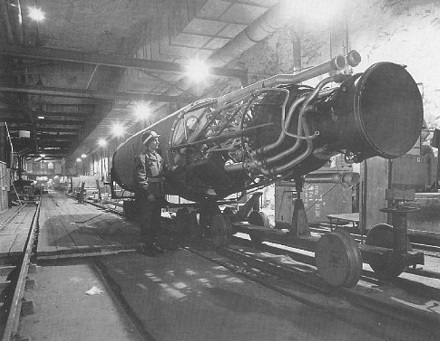
A U.S. Army soldier poses with a half-assembled V-2, one of about 250 such rockets found in the Mittelwerk labyrinth when the facility was captured.

With the facilities and the big brains in place, only one thing was missing: millions of man-hours of labor.

Nazi Germany had that in plentiful supply.

Beginning in late 1943, concentration camp inmates at Buchenwald began to be funneled out to a new facility, Mittelbau-Dora. Initially just a Buchenwald sub-camp, Dora grew over the course of 1944 into an immense facility holding 50,000 prisoners — a handful of German undesirables, but mostly captured foreign nationals: French, Dutch, Polish, Czech, and Russian. Short of food, sleep, and clothing for the 1944-1945 German winter, they were systematically worked to death in the Mittelwerk shafts to build a better bomb.

Our day’s principal, Hans Möser/Moeser (English Wikipedia entry | German) was an SS-Obersturmführer who made a living throughout the war years pulling guard detail in a number of concentration camps.

On May 1, 1944, Möser was transferred from Auschwitz to Mittelbau-Dora. It was the last job he would ever hold, but were Möser on the market today his C.V. would laud his team-player orientation and project management skills on a high-priority initiative. No doubt he was just the sort of reliable agent who understands how things are done that the world’s mad bombers need at their back.

“Ninety percent of the prisoners lived and worked in the tunnel of the mine,” testified one German who worked at Dora as a secretary and doctor’s aide.

As a result of the uninterrupted work in the mines and the absence of any installation for forced draft and ventilation, there prevailed a stuffy cold atmosphere, which made breathing difficult. The prisoners also slept in the subterranean tunnel in big chambers hewed out of the rocks, in five beds on top of each other. Already in 1944 3,500 prisoners used to sleep in such a room. In the tunnel of the mine there was no ater, the prisoners got absolutely insufficient quantities of tea for drinking purposes. But for weeks they were not able to wash themselves. As a result of the heavy work in the mines and of the bad food numerous prisoners died from exhaustion during their work.

According to that same testimony, the camp received a frightful order on Good Friday, which fell on March 30 in 1945: drive every last prisoner into those tunnels and bring down the caves around them. “No prisoner should be allowed to fall into Allied hands alive.”

The speedy arrival of the American 3rd Armored Division and 104th Infantry Division just days later prevented that order from taking effect.

The facilities themselves, too, were to be destroyed as part of Hitler’s scorched-earth “Nero Decree” intended to deny the benefit of German industry and infrastructure to the arriving conquerors. But Hitler’s War Production Minister Albert Speer was intentionally ignoring that order, a decision that might well have helped him avoid hanging at the Nuremberg trials.

Mittelwerk was a valuable capture indeed for the Allies. The Americans who first occupied it, and then the Russians who took it over a few months later, ransacked it for parts and technical specifications. The V-2 was the first man-made object to reach space, blasting at the speed of sound to the edge of orbit before plummeting back with its payload into the heart of London or wherever. It’s the ancestor of the long-range, intercontinental ballistic missiles that would come later, as well as the space programs of the countries who could build such missiles.

And of course, it wasn’t just the parts.

Wernher von Braun himself was the top prize of all — the young genius (he was just 33 when World War II ended) with the weapons of the future in his skull. As Germany collapsed in 1945, von Braun and his team of engineers had resolved to surrender themselves to the Americans rather than the Russians, but they too were subject to an order given the SS to execute the scientists if their capture appeared imminent. The Fuhrerbunker knew as well as the Allies how valuable this asset was.

In the event, von Braun managed to give himself up to a surprised American private. He disappeared into American custody, the crown jewel of “Operation Paperclip” that grabbed some 1,500 scientists from Germany and helpfully whitewashed their past misdeeds — misdeeds like Nazi party affiliation, and participating in slave labor camps.

Firing guided rockets into space was one thing. Unfortunately for our man Möser, his own skill set of bullying subordinates was not in short supply for either of the Cold War antagonists.

Möser was the one defendant (among 15) condemned to death at the resulting trial of Dora camp personnel. Rocket scientists, naturally, were not present for the occasion; Wernher von Braun and his team were hard at work at this time at Fort Bliss, Texas adapting the V-2 to the American Hermes program.

But at Dora, it had been Möser’s job to oversee camp discipline and labor strength for the slaves doing the grunt work manufacturing von Braun’s brainchild. Testimony convinced the court that the SS man had done this far too brutally, and perhaps with sadistic pleasure.

Several witnesses testified Möser frequently beat prisoners and participated in executions, often shooting at the men who were hanged for camp infractions — while they were hanging, or after they were taken off the gallows. (And of the latter, some already dead and some still alive.) “The accused told the twelfth witness that it was a pleasure to give the mercy shots, like shooting a deer.”

Möser for his part countered that he took no joy himself in the beatings and killings that he had to conduct as part of his job — and that the camp commandant had early on reprimanded him for leniency, threatening that “in view of the importance of the V-weapons operation, this could be interpreted as sabotage because it reduced the work efficiency.” How’s that for a hostile work environment?

(There’s a large .pdf of the entire trial summary here. Möser’s section begins on page 36 of the pdf (page 68 per the numbering in the scanned book pages).)

His presence on this here site betrays the outcome. On this date in 1948, Hans Möser was hanged at Landsberg Prison along with several other (unrelated) convicted war criminals.

On this day..

1964: Glen Sabre Valance, the last hanged in South Australia

On this date in 1964, Glen Sabre Valance became the last person hanged in South Australia.

Born Paul Fraser, he jazzed up the handle by cribbing the surname of the title outlaw from the 1962 John Ford Western The Man Who Shot Liberty Valance.

Like that Lee Marvin cutthroat, “Glen Valance” was destined to live a brutal life with a violent end.

In the early morning of 16 June 1964, the 21-year-old Valance broke into the home of his former employer, Richard Strang. He had a standing dispute with the Bordertown farmer over wages but his real grudge ran deeper than that. Strang had bemusedly read the sensitive youth’s diary to other farmhands weeks before, resulting in an altercation — and, after Valance drove off with some of his effects, a police report and an arrest.

Valance nursed “bad thoughts” against his tormenter, he muttered to his family. They turned out worse than anyone could have expected: bad enough to justify his adopted alias.

As Strang and his wife dozed in bed, Valance leveled his rifle at the hated ex-boss, and leveled the score. Then he seized the waking Suzanne Strang and raped her there in the bed sodden with the gore of her husband’s warm corpse.

As Valance hightailed it out of Kooroon Station, Suzanne Strang phoned police — and the resulting roadblocks snared the murderer that very day, with the murder weapon right there in the passenger seat … actually riding shotgun. Valance mounted an unsuccessful insanity defense.

In 2011, Lillian Clavell — ten years old at the time of her half-brother’s execution — published a book, A Tormented Soul: The Tragic Life of Glen Sabre Valance, the Last Man to be Hanged in South Australia.

In it, a Clavell still affectionate for her big brother points to their savagely abusive mother as the root cause of the adult Paul/Glen’s horrific crime. (Lillian says that her father shielded her from the worst of any domestic violence, but Paul had no father in his life and no such protection.)

I know she burnt his hands on the stove. I know she put his face through a window. Once she held a knife to his throat and said she’d kill him if he ever stole anything from the cupboard again. I believe that (abuse) led very much to his crime.

Valance was hanged in an unused guard tower (the “Hanging Tower”) of Adelaide Gaol. The facility is unused today, but the date November 24, 1964 and the letters GSV still remain printed on the brick wall.

On this day..

1721: Christiana Bell

(Thanks to Meaghan Good of the Charley Project for the guest post. -ed.)

The story of Christiana Bell’s execution in Gloucester County in modern-day New Jersey on or shortly before November 21, 1721, begins in 1703. That was the first time she was accused of infanticide: they had found a dead baby and Christiana, a domestic servant who was probably only in her teens at the time, came under suspicion because she had been pregnant out of wedlock and was suddenly not pregnant but with no infant to show for it.

Her trial in 1703 was presided over by Edward Hyde, Lord Cornbury, 3rd Earl of Clarendon, governor of the New York and New Jersey colonies. She was convicted and sentenced to death. However, Lord Cornbury took pity on her — perhaps because of her youth, or maybe there were doubts about her guilt — and first commuted the death sentence, then issued a full pardon. Christiana returned home, having spent fourteen months behind bars but not stretched her neck.

She didn’t learn the lesson Lord Cornbury might have wanted her to learn from her fortuitous escape.

In 1720, she was rearrested for the exact same crime: she’d gotten pregnant out of wedlock again, delivered a live baby and did away with it.

Christiana very nearly got lucky again: her death sentence was suspended and she got a chance to plead her case before New Jersey Supreme Court on May 2, 1721. Today, appeals in capital cases are automatic; in Christiana’s time, this was an unusual and perhaps unprecedented legal maneuver.

Unfortunately, it backfired on her: the prosecution was ready with witnesses who testified about Christiana Bell’s notorious past and her prior conviction and death sentence. This time there would be no reprieve.

The exact date of her execution is not known for certain, but on November 21, 1721, the Gloucester County Board of Freeholders approved funds to reimburse the sheriff for expenses he’d incurred in hanging her.

See Legal Executions in New Jersey: A Comprehensive Registry, 1691-1963.

On this day..