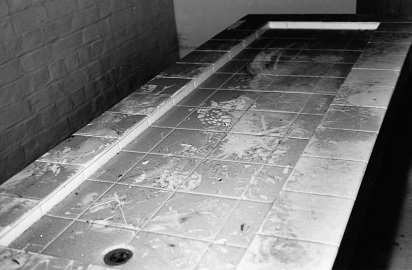
1945: An unfortunate woman, name and nationality unknown


AP caption: “The expression on the face of this Hun posing for the camera standing by the gallows from which a woman is hanging, Jan. 3, 1945 shows a lack of concern. The name and nationality of the unfortunate woman is unknown. One of the many victims of Nazi terror. The German soldiers seem to be quite used to this kind of sights for them a picture like this is just a souvenir.” (Via)

On this day..

1757: Father Andreas Faulhaber, seal of the confessional martyr

On this date in 1757, Catholic priest Andreas Faulhaber was hanged at the order of Frederick the Great to defend the seal of the confessional.

Frederick had been appointed by the Heavenly Father, and a cruel earthly one, to a task far too monumental to tarry with theology: lifting the Kingdom of Prussia from the morass of German principalities and into the ranks of Europe’s great powers. Frederick was nominally a Protestant, as was the bulk of his domain, and der Alte Fritz once remarked that this profession pleasingly liberated his sovereignty from papal interference; his real doctrine was nothing but pragmatism.

Accordingly, the great enlightened absolutist sponsored Jesuit educators where schools were needed and Jewish merchants where trade was needed.

Disgusted at Frederick’s aggressive war on Austria, Voltaire scribbled to a friend,

I’ve seen his good intentions dropped
At the first trumpet blast.
They are nothing more than kings;
And live their lives with bloody things,
They take or rape a few provinces
To suit their ambitious ends
I give up, say goodbye princes
I want no one now but friends.

(Source)

But Voltaire did not in fact break with his royal admirer and correspondent over Silesia.

Frederick christened his new reign in 1740-42 by ripping the wealthy* province of Silesia away from the Habsburgs.

The Habsburgs were Prussia’s Catholic rivals for preeminence in central Europe and Silesia too was heavily Catholic, so Frederick extended over that province as liberal a grant of religious toleration as he might.

But the attachments of men for the kings of their forefathers are not always so easily displaced, and neither are those of kings for the most lucrative soil of their patrimony. Austria made two subsequent attempts to retrieve Silesia; together with Frederick’s initial invasion, these are the Silesian Wars.

The last of the three was itself just one theater of the gigantic Seven Years’ War. The conflict between Prussia and Austria over Silesia, and the complex continental diplomatic entanglements** each power effected in its pursuit, were among the root causes of that entire globe-spanning conflict.

Prussia won the first two Silesian Wars handily, but the third was a much more doubtful affair — indeed, Prussia was well on its way to defeat before the shock death of the Russian empress delivered that country into the hands of an unabashed Germanophile who pulled Russia out of the war.

But in view of Frederick the Great’s strained situation prior to this providential deliverance, some of his Silesian subjects made free to prefer their prospective Catholic/Austrian allegiance to that of their recent conqueror.

Desertions among Silesian conscripts, some of them even escaping to Austrian lines, called down the dark side of the religious toleration policy. Frederick let people pray as they liked so that he could rule as he liked; here, when he suspected the Silesian Catholic clergy of countenancing wartime disloyalty among their flock, those religious scruples had overstepped their proper sphere.

And so at last we come to our day’s execution.

One young man caught attempting to desert Frederick’s army was captured and interrogated by his commanders. He allowed that he had undertaken the sacrament of confession before escaping, and expressed to the priest his intention to abandon the army.

The priest, Father Andreas Faulhaber, was arrested on this basis, but between his calm defense of himself and the deserter’s shifting, unreliable story, the military court found little basis to proceed. The impression one gets is that the contemplated desertion was not the main thrust of the confession and that Father Faulhaber accordingly discouraged the sin in passing but didn’t bother to dwell on the point.

The impression is difficult to substantiate because the padre rigorously kept the seal of the confessional — another imposition demanded by faith that secular authorities who had armies to field preferred not to honor.

But evidently looking to serve notice that the monarch’s religious indifference could not be used to abrogate subjects’ responsibility to the state, Frederick himself ordered Faulhaber’s sudden execution for the morning of December 30.

The unfortunate priest only discovered his impending fate moments before it was enacted, but still refused under the makeshift gallows to give up anything incriminating about his parishioner. “Hang up the Jesuit Faulhaber, but let him not have a confessor,” read the order, according to this decidedly Catholic account, which adds that Faulhaber was not actually a Jesuit at all, and the word only added to invoke the going 18th century prejudice against that order.

Prussia won this war, too. It kept Silesia in Prussian hands, and then German hands, for two centuries. The bulk of Silesia was transferred to Poland after World War II.

* Silesia provided one-quarter of all the Habsburgs’ tax revenue, according to Frederick the Great: A Life in Deed and Letters.

** For the Seven Years’ War, Austria made common cause with its traditional foe, France: one consequence of this arrangement was the betrothal of the Austrian princess Marie Antoinette to the future French king Louis XVI.

On this day..

1868: Thomas Jones, bad uncle

(Thanks to Meaghan Good of the Charley Project for the guest post. -ed.)

Four days after Christmas in 1868, Thomas Jones was executed in London, Ontario for one of the most sensational murders perpetrated in the region at the time. He had brutally slaughtered his twelve-year-old niece in the town of Delaware.

Early that year, according to this article on the case, Jones had tried to rob his own brother’s house while wearing a false beard to disguise his identity. Unfortunately for him, young Mary Jones recognized her uncle and subsequently testified against him in the ensuing trial. Thomas Jones held this against her, as did Thomas’s daughter Elizabeth, who was thirteen.

On June 11, 1868, Mary’s mother sent her to Uncle Thomas’s house to fetch a cup of flour. (One wonders why she did so, given the history of bad blood between uncle and niece.) Mary never returned.

Suspicion inevitably fell on Thomas, who insisted she’d come and gotten the flour and left his home alive and well. Forty-eight hours after Mary’s disappearance, the search party got fed up, grabbed Thomas’s ten-year-old son and threatened to kill him if he didn’t tell what happened to his cousin.

The boy led them to her body, hidden in the woods under a fallen tree. Her skull had been fractured.

According to the child, both his father and his sister Elizabeth had participated in Mary’s murder. Public feeling ran high against the accused and the entire family had to be taken into custody and transported from Delaware to London to avoid a possible lynching. Only Thomas and Elizabeth faced murder charges, but according to this account, Thomas’s wife and younger son were kept in jail for four months and his two older sons, both in their teens, remained there until well after their father’s death.

The prosecution’s theory was that either Thomas had murdered his niece after Elizabeth lured her into the woods at his direction, or Thomas talked Elizabeth into committing the murder.

At trial, Elizabeth tried to take the rap for her father, claiming she’d beaten Mary to death entirely on her own and Thomas had only helped her hide the body. Thomas’s youngest son testified in support of this, saying he’d witnessed his sister striking Mary with a club.

Thomas used his underaged daughter’s statements like a shield — he would maintain his innocence to his dying breath — but in the end the jury convicted him of murder. What may have tipped the balance was the medical evidence, which indicated Mary had been dealt some powerful blows, stronger than a child could have inflicted.

Elizabeth was convicted of manslaughter and sentenced to ten years for her role in the crime, in spite of her youth. The older two of Thomas’s three sons, ages seventeen and fifteen, were finally released without charge in the spring of 1869. Elizabeth served seven years before she was freed.

In spite of the bitter cold many residents of Delaware came to watch Thomas hang at the Middlesex County Gaol. Around six thousand people were in the crowd — approximately half the population of London. This would be the last hanging in Middlesex county.

On this day..

1821: Ketaukah and Kewahiskin, the first hangings in the Michigan Territory

From the Salem (Mass.) Gazette, Jan. 18, 1822.

Executions — Two Indians,* Ketaukah and Kewahiskin [elsewhere given as Kewaubis -ed.] were hanged at Detroit on the 27th ult. the former for the murder of Dr. W.S. Madison, the latter for the murder of Charles Ulrick.

The criminals (says the account) often acknowledged the justice of their sentence,** and in their way they had prepared themselves to meet its execution.

For several weeks past they appeared very anxious to obtain presents of tobacco, pipes, &c. none of which they used, but carefully laid them aside as an offering to the Great Spirit on the day of their death.

They had contrived a sort of drum, by drawing a piece of leather over the vessel that contained their drink, and often engaged in their solemn death dance. On the night previous to their execution, they continued their death dance to a very late hour, and commenced it again early in the morning.

They had been presented, among other things, with some red paint — with this they painted on the wall of their cell numerous figures of men, quadrupeds, reptiles, &c. — on their blankets were also painted many figures — among the rest, an Indian, hanging by the neck, was observed.

From the jail they were taken to the Protestant Church, where an appropriate discourse was delivered to the assemblage by Mr. J.S. Hudson (one of the gentlemen belonging to the Mission family).

They appeared throughout the whole of the solemn preparatory steps to be perfectly collected — they walked firmly to the gallows, and previously to ascending to the drop, shook hands with the Rev. Mr. Juvier, Mr. Hudson, the Sheriff and Marshal, and several other gentlemen who stood near them.

They ascended the steps of the drop in a manner peculiarly firm — after which, they asked, through the interpreter, the pardon of the surrounding spectators, for the crime they had committed.

They then shook hands and gazed for a few minutes on the assemblage and on the heavens, when their caps were drawn over their faces, and they were launched into eternity.

* Ketaukah was of the Ojibwe (Chippewa) people, while Kewahiskin was a Menominee. (Source) The two men were not associates of each other prior to their shared condemnation, and their crimes were completely unrelated.

** Be that as it may, Ketaukah tested the jurisdiction of the Territorial Court (Michigan had not yet been admitted to statehood). He argued (like Tommy Jemmy in New York) that Anglo juries had no jurisdiction over his crime, which had been committed against a white doctor on Winnebago land. He also demanded the inclusion of Indians on the jury; complications of a potential language barrier within the jury pool, and the matter of whether an interpreter’s presence at jury deliberations would vitiate the verdict, defeated that motion. (For the jurisdictional question, see American Indians and State Law: Sovereignty, Race, and Citizenship, 1790-1880. For the jury composition, see the footnote on page 123 of this masters thesis.)

On this day..

1960: Anthony Miller, the last hanged at Barlinnie

On this date in 1960, 19-year-old Anthony Miller became the 10th and last person executed at Scotland’s Barlinnie Prison.*

Miller worked in a team with a 16-year-old accomplice in a “queer-rolling” racket: the younger James Denovan would lure a mark with the promise of an assignation, then Miller would jump him and turn a 2-against-1 robbery. Artless, but effective.

With such a crude m.o., it’s no wonder Miller and Denovan beat a man all the way to death in the course of one of their shake-downs. Since he was a minor, Denovan drew a prison term. Miller … not so lucky. His plaintive last words, “Please, Mister …” form the title of a play about his life written by Patrick Harkins.

Tour Barlinnie’s capital punishment environs with one of its old death-watch officers in this David Graham Scott short film, “Hanging With Frank”:

David Graham Scott was good enough to share some firsthand recollections of the film’s title character Frank McKue, and the process of producing “Hanging With Frank”.

Frank McKue was an extremely likeable chap with a very dark sense of humour. Definitely my type of guy. Used to have a drink with him at his local pub in Edinburgh called ‘The Diggers Arms’ (called as such because local gravediggers would drink there) . The sound of the trapdoor swinging open that you hear in the film is actually the door to the beer cellar crashing open in the pub which I recorded as a foley. Frank said it was almost the exact sound! Since the trapdoor in the execution chamber at Barlinnie Prison was shored up and unable to open when we visited it seemed a logical idea to use this nice little soundbite.

Incidentally, the prison that we were filming was still (and still is) very much in operation. There are some shots where you can see prisoners moving about in the upper galleries. It’s Barlinnie Prison in Glasgow, Scotland and dates from the Victorian era. Frank worked there in the 50s as a prison officer who occasionally did deathwatch details. That involved sitting with the condemned man on his last nights and drinking tea, engaging him in conversation and playing draughts [checkers in the U.S.].

Frank showed how the prison officer’s escorting the condemned man would walk a few paces across the gallery and through the doors into the execution chamber.

They’d stand on planks placed over the trapdoors …

… and hold onto safety ropes dangling from the ceiling to stop them from falling down with the prisoner. There had been various instances in the past of prison guards and assistant executioners falling through the trapdoors with the condemned man.

The deathwatch officers would sit with the condemned prisoner at all times after sentence was pronounced. Cups of tea, mingled with small-talk and endless games of draughts and they just chatted away about everything ‘except the obvious’! Their job on the morning of the execution was to escort the condemned man out of his cell (which was actually two normal sized cells knocked into one) and into the execution chamber just a few paces across the gallery in D-Hall of the prison. They steadied the man as the executioner led the way onto the scaffold and the assistant helped buckle his wrists and feet with leather straps when they reached the correct position on the trapdoors. A signal from the assistant to the executioner sent the man on his downward journey to the basement below where the mortuary slab awaited.

The positioning of the noose was crucial for a clean break between the 2nd and 3rd vertebrae The rope always did a quarter turn to throw back the head and cleanly sever the spinal column at those points and the hangman treated the affair with diligence and extreme reverence. Frank would then often sit with the executioner and assistants as they had their breakfast and left the executed man dangling for a full hour. The prisoner was then pulled back up, the noose removed and then he was lowered back down with other ropes to the basement room again where he was stripped and laid on the mortuary slab. The body ‘belonged to the state so it was buried within the prison grounds’ and no relative was allowed to visit the grave site or send flowers.

I storyboarded much of the film due to the restrictions of time, the nature of the equipment we were using and, of course, the mood I was trying to evoke. I also used black and white, grainy, light-sensitive film stock to try and get the feel of the execution facility in its heyday of the 1950s. If I had more money and time I would have made this film about 10 minutes longer but alas it was not to be. There was always the odd event that we shot spur-of-the-moment. Like when I noticed a butterfly trying to escape from the window of the execution chamber. In this space it took on quite a metaphorical aspect as it struggled desperately and futilely against the glass. Strangely, there was a large group of them roosting on the ceiling. I’ve never seen such a thing in my life and have no idea why they were acting like this. There were also mounds of pigeon droppings too which we tried to avoid as best we could (it can be quite toxic when breathed in). There’s a very brief shot in the film of two pigeon chicks which were nested snugly within a cavity of the execution beam … another bizarre metaphor about death and resurrection, I guess.

When we visited there were major renovations taking place within D-Hall and, as we see in the film, the condemned cell and execution chamber were torn apart. Even the grave sites were not spared. Drainage for the new toilets being built (this was the end of the notorious slop-out era) actually passed through the graves of the executed men. Indignity upon indignity heaped upon these pathetic corpses with each flush of the toilet. The graves had been marked with initials to denote where each of the murderers lay but these had been removed at some point as if to completely erase any trace of them. Frank knew exactly where each lay though and reeled them off one by one. He told me about the way the coffins were designed with a hinged flap over the face of the dead man. Once sealed in the coffin with quicklime scattered over him, Frank would open the flap and add water over the face of the executed prisoner to hasten the destruction of the body. The grave was then filled back in. One of the graves was forever sinking and had to be refilled with ashes from the boiler house on a regular basis. It was the grave of James Robertson, a former policeman who had run over and killed his lover in 1950. He was duly executed for the cold-blooded murder but it was as if his body was restless in the grave the way the tarmac kept on sinking down. In refilling the grave Frank told me that the body seemed to be miraculously well preserved and that somehow the quicklime designed to dissolve it had had the very opposite effect! The prisoners on that grave-filling detail were often terrified and were offered extra perks like cigarettes to make it a bit easier for them. To this very day that same grave is still sinking for some odd reason … the depression in the tarmac can be clearly seen in the film.

There were many stories that Frank related to me about his good friend Albert Pierrepoint, who he befriended during his time at Barlinnie Prison. Pierrepoint was the famous British state executioner at that time and conducted various executions throughout the entire United Kingdom. Frank kept up his friendship with Albert way after capital punishment was abolished and used to visit his pub in Manchester called ‘Help the Poor Struggler’. At his home in the west side of Edinburgh, Frank proudly showed me his various bits of execution related paraphernalia.

One of the prize exhibits was an engraved glass from the Albert’s pub. There was also an amazingly detailed scaled down model of the Delaware gallows which his retired carpenter friend and fellow execution enthusiast, Sudsy, had made for him. Frank showed me with great relish how this unique hanging apparatus would operate. It was obvious that he wanted more than mere models to play with and his real ambition was to be the British state executioner. He had contacted the British Home Office to put his name down as one of the persons willing to train as a state executioner should capital punishment come back. There was no way he’d be getting that job at the time I met him though as he’d already undergone a major operation and had a pig’s heart valve sewn into him. I felt guilty asking Frank to climb the rungs of the ladder into the beam room for a third take, I recall. He was happy to do it but breathless by the end! I thought how awful it would have been, and ironic, if he’d died within this space he loved so much.

But it seems that within the film Frank does fulfill the dual role of hangman and condemned man. The two aspects merged into one at the crowning moment as he puts the bag over his own head — a touch that I thought might be ridiculous at first but somehow does work quite well in the finished film.

Alas for Frank the calling to be a state executioner never came to happen and he died in 2008 from heart complications. Hanging with Frank will remain his legacy, however. A film as much a character study as it is a piece of history. [See more movie stills here -ed.]

I made this film with very little funding indeed and despite its receiving various accolades over the years the government funded film agency in Scotland at the time, The Scottish Film Council, refused to send it to film festivals as it was deemed distasteful. My work has frequently led me to being despised by the powers that be in the largely straight-laced documentary scene … I must be doing something right I suppose!

* Not to be confused with the last executed in Scotland full stop. Miller was the second-last in Scotland.

On this day..

1875: Henry Wainwright, Whitechapel murderer

On this date in 1875, Whitechapel’s most notorious murderer ere Jack the Ripper arrived on the scene paid for his double life on the gallows of Newgate.

Henry Wainwright, brushmaker and philanderer, came to his mortal ruin by way of a financial one.

The expansive Wainwright could not confine his adventures to actresses at the theater adjacent his Whitechapel Road shop* but in 1872 installed a mistress, one Harriet Lane, in a flat of her own with a liberal £5-a-week stipend. “Mrs. King”, as she styled herself with a better ear for the forgettable name than Wainwright would evidence (we’ll come to that part), bore her lover two children.

But by the next year, Wainwright’s prodigalities and a worldwide economic crisis had sunk him in debt. As his creditors circled, Wainwright pinched farthings where he could, putting predictable strain on his lover’s allowance — and with it, her affection, her sobriety, and her discretion.

As Wainwright succumbed to bankruptcy, Harriet Lane’s demands for money and occasional drunken forays into his very place of business had Wainwright scrambling for some way to fob the mistress off on some other man. His efforts thereto were frustrated, so he contrived the next best thing: prevailing on his brother Thomas** to write his mistress mash notes under the ungainly pseudonym of “Edward Frieake”, Wainwright spun a plausible scenario for her elopement.

Unfortunately for Mrs. King, the honeymoon would be a chloride of lime pit under the floorboards of Wainwright’s warehouse.

On September 11, 1874, the lady sallied out of her apartment, and was never heard from again.

Laborers working near Wainwright’s warehouse that night would report hearing three gunshots, but being unable to pinpoint their source they let the matter drop — just as did police with Harriett Lane’s disappearance. With the help of a chaser letter or two from his brother, Wainwright represented that she had run off to Paris with her correspondent. Why, she might never be heard from again!

According to Jonathan Goodman, the 1844 Thomas Hood poem “The Bridge of Sighs” was a Wainwright favorite, one he often recited to entertain his family(s):

One more Unfortunate,
Weary of breath,
Rashly importunate,
Gone to her death!

Take her up tenderly,
Lift her with care;
Fashion’d so slenderly
Young, and so fair!

Wainwright himself qualified for verse not long after poor Harriet Cole’s remains tumbled into plain view on that London street, like the “Awful Murder and Mutilation of a Female At the East-end of London”, whose composition mirrors its expository title:

Her head was severed from her body,
Her arms as well — how sad to tell

The above fragment (I have not located the entire original) is from this informative post about murder ballads

Another year on, Wainwright had good cause to believe he’d gotten away with the whole thing.† But his finances having finally collapsed, the warehouse that doubled has Harriet Lane’s tomb had been foreclosed upon in July of 1875, and it would soon be sold to new and potentially nosy owners. Wainwright had a body to move. And when the hole was opened up on September 10, 1875, it uncovered not a few scraps of a satisfyingly dissolved corpse — but the body entire, preserved rather than eroded by its chemical bath.

And the corpse stank disgustingly.

Showing the extraordinary judgment that had got him into this mess in the first place, Wainwright bought a spade and a cleaver to dismember the foul limbs he had once made love to, and then engaged a colleague to help him schlep the resulting packages out to the street. Arthur Stokes would later attribute his decision to peek to a divine command that struck him from the firmament, but nothing more remarkable than below-average curiosity will be required of a man encumbered by a heavy, fetid parcel to wonder what they might contain. A more impressive explanation will be required to justify Henry Wainwright’s decision to leave Stokes alone with the horrors while Wainwright jogged off to hail a cab.

Thinking fast for a man come face to face with a severed head, Stokes rewrapped the horrendous bundle and casually helped his homicidal friend pack it all onto the cab. When Wainwright drove off, Stokes trailed him, looking for constables to summon. And when he found them, and they approached the cab asking to inspect his cargo, all Henry Wainwright’s nauseating hypocrisy spilled out on the street in a lurid pile. He lamely tried to bribe the constables two hundred quid to ignore the putrid sackful of human remains.

A distinct scar and the dress Harriet Lane had worn on the day of her “elopement” identified the body to everyone’s satisfaction, and the circumstances of the body’s discovery did not admit much hope for Wainwright’s defense team.‡

So notorious was Wainwright’s crime that a vast concourse of gawkers mobbed the exterior of Newgate on the morning of his hanging, just like in the bad old days — even though, all executions by this late date being private affairs, these masses had no opportunity to glimpse anything save the black flag hoisted over Newgate to signal that the sentence of the law had been carried into effect.

Sources:

* Wainwright’s old shop apparently still stands, in relatively good condition. There are some 21st century photos of it and some interesting discussion of the case on casebook.org.

** Exactly when Thomas Wainwright became aware of what his brother had been up to with this “Edward Frieake” stuff is not certain. He did help his brother open Harriet Lane’s lime grave prior to its catastrophic attempted move.

Tried for his life alongside his brother, Thomas was acquitted of capital murder but caught a seven-year prison sentence as an accessory after the fact.

† The illegitimate children were in the care of a dressmaker, Ellen Wilmore, who still had them by the time of Wainwright’s trial. (Wilmore was called to testify.) It is not known what became of them thereafter.

‡ We are indebted to Foul Deeds and Suspicious Deaths in London’s East End for this outstanding detail: librettist W.S. Gilbert appears as a part of Wainwright’s defense. Gilbert, a barrister by training who had just made his big breakthrough by writing the 1875 musical theater hit Trial by Jury, was in the process of launching the collaborative career that puts Gilbert and Sullivan productions on community playhouse stages down to the present day.

Late in 1875, W.S. Gilbert received a jury summons highly inconvenient to his burgeoning artistic career. Consequently, he managed to finagle for himself a nominal assignment on the Wainwright defense team as a means of re-establishing “practicing attorney” bona fides that would exempt him from any jury boxes.

On this day..

1879: Swift Runner, wendigo

The first legal hanging in Alberta, Canada, took place on this date in 1879. Generations later, it’s still remembered as one of the province’s worst, and strangest, crimes.

The hanged man was a native Cree known as Swift Runner (Ka-Ki-Si-Kutchin) — a tall and muscular character with “as ugly and evil-looking a face as I have ever seen,” in the words of an Anglo Fort Saskatchewan officer. Whatever his comeliness, Swift Runner was on good terms with the frontier authorities, who trusted him as a guide for the North West Mounted Police. That is, until the Cree’s violent whiskey benders unbalanced him so much that the police sent him back to his tribe … and then his tribe kicked him out, too.

He took to the wilderness to shift as he could with his family in the winter of 1878-79: a wife, mother, brother, and six children.

But only Swift Runner himself would return from that camp.

When police were alerted to the suspicious absence of Swift Runner’s party, the former guide himself escorted investigators to the scene.

One child had died of natural causes, and was buried there.

The eight other humans had been reduced to bones, strewn around the camp like the set of a slasher film.*

They had all been gobbled up by a wendigo.

The wendigo (various alternate spellings, such as windigo and witiko, are also available) is a frightful supernatural half-beast of Algonquin mythology, so ravenous it is said to devour its own lips — and human flesh too. For some quick nightmare fuel,* try an image search.

The revolting wendigo was mythically associated with cannibalism, so closely that humans who resort to anthropophagy could also be called wendigos. According to Swift Runner, the ferocious spirit entered into him and bid him slaughter and eat all his relations.

Swift Runner is the poster child for the “Wendigo Psychosis”, a mental disorder particular to the Northern Algonquin peoples. In the psychosis, diagnosed by the early 1900s but hotly disputed in psychological literature, people are said to have experienced themselves possessed by the wendigo and wracked by violent dreams and a compulsion to cannibalism. It’s importantly distinguished from famine cannibalism: though it was the wilderness during winter, Swift Runner had access to other food when he turned wendigo. The author of a 1916 report on the phenomenon said he had “known a few instances of this deplorable turn of mind, and not one instance could plead hunger, much less famine as an excuse of it.”**

The disorder, whatever it was, was nevertheless surely bound to the precariousness of life in the bush; wendigo cases vanish in the 20th century as grows afflicted populations’ contact with the encroaching sedentary civilization.

For Canadian authorities in 1879, however, there was no X-File case or philosophical puzzle: there was a man who had shot, bludgeoned, and/or throttled his whole family and snapped open long bones to suckle on their marrow.

But if the verdict and sentence were clear, the logistics were less so: hangings were virgin territory for the Fort Saskatchewan bugler put in charge of orchestrating the event. Swift Runner, by this time repentant, had to wait in the cold on the frigid morning of his hanging while the old pensioner hired to hang him retrieved the straps he’d forgotten, to pinion his man, and fixed the gallows trap. “I could kill myself with a tomahawk, and save the hangman further trouble,” Swift Runner joked

* In the Stephen King novel Pet Sematary (but not in its cinematic adaptation) the master adversary behind the reanimation of murderous household pets is a wendigo. For a classical horror-lit interpretation, Algernon Blackwood’s 1910 The Wendigo is freely available in the public domain.

** Cited by Robert A. Brightman in “On Windigo Psychosis,” Current Anthropology, February 1983.

On this day..

1694: James Whitney, highwayman

Dapper highwayman James Whitney was hanged at Smithfield on this date in 1694.

A monument to the allures and the perils of a midlife career change, Whitney threw over a tiresome life as the proprietor of an inn in Cheshunt, Hertfordshire,* purchased with his liquidation the accoutrements of the gentleman thief, and took to the road.

“Captain” Whitney — he had no right to the rank he appropriated for himself — was one of those stickup men who greatly esteemed the pose of honor associated with his new calling. On one occasion, he relieved a gentleman traveler of a large sack of silver on Newmarket Heath, but when his victim pleaded the length of his journey Whitney opened the bag to its former owner with an invitation to take what he would need.

The man plunged his hands in and hauled out as much as they would carry, leading Whitney to remark with a smile, “I thought you would have had more conscience, sir.”

In another fine caper (there are more of them assembled here) Whitney told a man to stand and deliver, only to have the traveler reply that he was about to say the same back to him. The two robbers laughed at their encounter and went their separate ways, but Whitney later chanced to turn up at the same inn as his so-called brother plunderer and overhear him regaling his fellows with the tale of having outwitted a highwayman by pretending to be one of the same profession.

Whitney stalked the man and a companion out of the hostel the next morning and this time robbed them successfully: “You should have kept your secret a little longer, and not have boasted so soon of having outwitted a thief. There is now nothing for you but to deliver or die!” Nobody likes your stories anyway, you blowhard.

True, James Whitney ended his adventure at the gallows: death is the fate of us all. From his day to ours, folk toiling away the ceaseless lonesome days between ashes and ashes have understood the soul’s stirring to exalt their scant mortal hours with deeds of valor and romance and derring-do. And as Whitney himself is said to have remarked to a miser whose lucre he was seizing, “Is it not more generous to take a man’s money from him bravely, than to grind him to death by exacting eight or ten per cent, under cover of serving him?”**

Nobody knows any of James Whitney’s peers in the publican guild, but as Captain Whitney he joined England’s most legendary gentleman outlaw in verse.

When Claude du Val was in Newgate thrown,
He carved his name on the dungeon stone;
Quoth a dubsman, who gazed on the shattered wall,
“You have carved your epitaph, Claude du Val,

Du Val was hanged, and the next who came
On the selfsame stone inscribed his name;
“Aha!” quoth the dubsman, with devilish glee,
Tom Waters, your doom is the triple tree!”

Within that dungeon lay Captain Bew,
Rumbold and Whitney — a jolly crew!
All carved their names on the stone, and all
Share the fate of the brave Du Val!

Full twenty highwaymen blithe and bold,
Rattled their chains in that dungeon old:
Of all that number there ‘scaped not one
Who carved his name on the Newgate Stone.

* The George Inn. A map search does yield a The George in Cheshunt; whether this is actually the same facility where our famous highwayman once earned a lawful keep, I have not been able to establish.

** Parables from this golden age of highwaymen often place in the mouths of outlaws sharp critiques of their targets, who despite putative respectability turn out upon examination to be far more deeply corrupt than the dashing adventurer. See for example Old Mobb.

On this day..

1865: William Corbett and Patrick Fleming

(Thanks to Ramicles, the pseudonymous 19th century Chicago correspondent of the Providence Press, for this eyewitness account of a December 15, 1865 hanging of two hired assassins. It appeared under a December 16 dateline in that paper’s December 21, 1865 edition. -ed.)

I have promised the numerous readers of the EVENING PRESS a description of a death scene, and I will keep my word. But believe me, it is no welcome task; my heart is not in it. On my mind one solemn moral is impressed — one moral only: the terrible reality of crime, the terrible reality of punishment. One naturally follows the other, as night follows day.

At the hour of three, lacking ten minutes, on yesterday afternoon, I saw two men, William Corbett and Patrick Fleming, take a formal farewell of this world and enter an untried existence. Those who love to linger on the few hours which the wretched men passed, in the anticipation of that final scene, may do so. I will not. They knew that they had incurred the law’s extreme penalty, and must suffer that penalty. There is a disposition on the part of doomed men to “die game;” and much of the apparent heartlessness is bravado only.

As I have said in a former letter, Fleming has for several days seemed indifferent or defiant. Whether he had faint hopes of pardon, I know not; but there seemed to be something in his manner that showed his reliance to some extent on the mobid [sic] humanitarianism of the age, (as exhibited in the case of the Malden murderer Greene,) and had not finally made up his mind for death.

Those who had not made human nature a study, were therefore unprepared to see the difference in demeanor of the two men, on the scaffold. Corbett, who, since his sentence, has seemed to realize his solemn situation, and has been much depressed, because, as his last moments drew near, cheerful and even jubilant, and the gloomy Court House echoed his hilarious merriment, which was startlingly horrible, as wild laughter wakened in the throat of death. There is something grotesquely awful in hearing a man laugh while the rope is around his neck. (The Republican reporter styled that death “ecstacies!” [sic] I had always supposed that ecstacy was less boisterous; but I am ready at all times to receive new ideas and novel definitions. — Who ever knew a man in Chicago to be wrong? “If any, speak, for him have I offended.”) The conduct of Flemming [sic] was in striking contrast. He seemed chilled with the thought of death, and was so lost in contemplation that he scarcely heard the voice of the clergyman admonishing him to pray.

He indeed repeated the words of the prayer, but so unconsciously that it seemed only mechanical. His eyes were vacantly staring, and his countenance was ghastly in its expression of deadly fear. Was that gaze fixed on vacancy alone? Was it a retrospective vision of the soul gazing on itself, and with reversed sight recalling all the past — the hours of childhood — the fleeting moments of early manhood — the years whose only noteworthy incidents were damning deeds of midnight robbery — that night of blood — that death-cry of his victim — the fatal shot — the flight — the vision of justice and the avenging Nemises [sic] following his track — the arrest — the trial — the death sentence, and the lingering death of expectation preceding its infliction? Or was there one more torture? Was his the gift of prescience, and the power to look beyond the Shadow of the Dark Valley, and was it what he there saw that transfixed him into a statue of cold horror? Who shall say?

Those were my reflections when I looked on the miserable man; and I unconsciously repeated to myself the heartfelt words of the psalmist: “Cut me not off, O, my God, in the midst of my days!”

I shuddered as I thought that the doomed one might be silently repeating the same prayer, and II, by mesmeric rapport or sympathy, had caught up his inaudible petition. Then came another hideous laugh from the lips of Corbett — a few hasty words of farewell — a slight gliding sound as the well oiled bolts slid swiftly back — and two forms shrouded in white cloth were spasmodically struggling with death. The drop was located in the east wing of the Court House, the trap being constructed in the floor. After the two surgeons in attendance had pronounced them both dead, the bodies were lowered into the coffins, as usual, and a few had a curiosity to look at the faces. Singular as it may seem, Flemming had undoubtedly suffered the least pain of the two. The features were somewhat distorted and discolored. But Corbett’s face was a sight such as one would look on but once, and wish to efface [sic] the memory of that one look, and think of it no more forever. The tongue protruded fearfully from the mouth, and the teeth had bitten through it, in that last agony of dissolution. Truly is an execution a moral lesson which no one may witness without a thrill of horror whatever one may think of the theory of capital punishment.

There was one fact in connection with the affair, which I cannot understand. The widow of the murdered man repeatedly made application to the Sheriff for permission to see the hanging and it was refused. At an early hour I saw a lady dressed in deep mourning standing at the Court House gate and I was informed that it was Mrs. Maloney. After all was over, she still stood there, shivering in the intense cold, the bitter freezing cold. It appears some one had told her that the men who had murdered her husband and left her desolate, would be reprieved, and that only increased her anxiety to see the sentence of the law fulfilled.

Hour after hour she waited, while stout men, wrapping more closely their overcoats and mufflers around them, hurried on more rapidly as they felt the keen blast which swept across the square. Several times she was assured that the criminals were hanged; but she refused to believe it, till an acquaintance in whom she had confidence told her, and then with an expression of relief and satisfaction on her face, she suddenly left for home, and I saw her no more. Poor woman! the wrong done her and her child had been avenged. Justice had vindicated itself. Who shall say but half the sorrow of bereavement was lifted from her heart by the knowledge that the slayers of her husband had tasted the bitter waters of death, held to their unwilling lips by the hand of Retribution? Why was it that the satisfaction of witnessing the punishment was denied her? I may be wrong, but I only repeat the sentiments of many men here and elsewhere when I say: Hangings should be public.

I have heard and read many objections to public executions; but I am convinced that whatever may be said of the rude and brutal deportment of the crowd — the levity — the profanity, &c. &c., I am convinced that no man ever saw an infliction of the Death Penalty, and forgot it. Men may read the long accounts given by newspaper reporters, but the reality beggars description. The reader can get but a very poor idea from the most graphic account, and like any other item of news, it is not long remembered. If the grand object is to warn men, by impressing on their minds the terrible consequences of crime, then that warning should be given in the most public manner possible.

When I commenced this communication I had no thought of making a plea for the gallows; and I will only say, that until some more fearful mode of punishing the crime of murder can be invented, hanging commends itself to the approval of reflecting people. It is a severe remedy, but it is the only effectual one; and those individuals who oppose capital punishment so zealously, may easily find other ways to vent their sentimentalism. Sympathy for those whom crime has injured would be better placed than sympathy for criminals. You will hear from me on this subject no more until Jeff. Davis is hanged, and then I shall probably have some comments to make, as I shall endeavor to “be there to see.”

On this day..

1949: John Wilson and Benjamin Roberts, Syd Dernley’s first(s)

On this date in 1949, two young miners from northern England were hanged together at Durham prison for unrelated crimes of passion: one had ravaged and strangled another man’s wife when his attempts to seduce her were met with a demand for money; the other had murdered a local girl (and then botched his suicide) when he found himself on the third point of a love triangle.

Both crimes happened on the same weekend, just a few miles apart — so they were tried at the same assizes and advanced through the process from murder to hanging-date together. Double executions were already quite rare at this point: this date’s affair was among the last such events in UK history.*

However, it was the very first execution in which Syd Dernley participated.

Dernley was an assistant executioner for 20-odd hangings, and while he’s far from the most noteworthy man to tread the scaffold, his 1989-90 The Hangman’s Tale: Memoirs of a Public Executioner might interest the person who takes up the pen for a labor history of the modern death penalty.

Dernley, a Nottinghamshire pit welder by day, gives an inside look at the recruitment process and on-the-job operations for a minor-league hangman. Bored with his job, he wrote the Prison Commission cold in January 1947 offering his services (“I feel sure that I could do the job”), got a generic polite dismissal, and then was one of several rookie volunteers summoned in October 1948 for a training course — a rationalization of the qualification process to go with the rationalization of hangings themselves.

Dernley had to wait a full year and then some to actually get into the act.** The basic hanging protocol featured a lead executioner and an assistant who would together escort their man to the gallows platform and perform the hanging; since this was a double execution, there are two such pairs involved. Dernley here is the assistant of veteran hangman Steve Wade. The other pair has Henry Kirk as the lead hangman, assisted by Harry Allen.†

Britain didn’t have the volume of executions for anyone to be a full-time hangman, although some hangmen, like Kirk, were also prison officers.

Jobs were farmed out by the Prison Commission among its small roster of active executioners, and would begin for the hangman with the receipt of a package from the Commission with two copies of a Memorandum of Conditions for executioners’ employment — one for the executioner’s records, and one to return to the Commission when formally accepting the assignment.

The day before the hanging, the executioners traveled to the prison where the sentence was to be carried out. The hanging team would not leave the prison’s walls until the execution was complete: after their prep work on execution’s eve, they slept in the jail.

Although prisoners rarely realized this until the last moment, the gallows platform stood just steps outside the condemned cells, the better for the instant performance of the actual hanging. They waited until Wilson and Roberts were safely out of earshot at chapel or in the exercise yard to set up the ropes.

The lead executioner Wade “controlled and double-checked everything from the moment he opened the execution boxes and took out the three ropes. He examined each of them minutely before rejecting one of them which was immediately coiled up and returned to the box. He measured the drop along the rope and marked it with chalk. I was allowed to shackle the rope to one of the chains hanging down from the beam and I had to go up the steps to adjust the chain as we got the chalk mark to the height of the man’s head, but [Wade] went up the steps to check both the shackling and the chain when I had finished.”

Once both ropes had been prepped, they noosed two sandbags approximating the respective weights of the prisoners, summoned the prison governor, and performed an actual test hanging. Everything went off without a hitch.

They dined that night, and breakfasted the next morning, on prison mash — it was invariably eggs and bacon for breakfast, Dernley remembered later in his career. After stealing silently back into the execution chamber, practically in the shadow of the last devotions of their unwitting prey, they repositioned the ropes which had been (intentionally) stretched out by half an inch from being left dangling their sandbags overnight. The ropes, and their supporting chains, needed to be positioned such that the noose dangled at convenient head height — again, the efficiency of the actual hanging was paramount — and so that, when the trap was released, the rope provided a drop of the precise length necessary to break the neck.

The next forty-five minutes as we waited in our quarters for the call were about the worst of my life. Everything that needed to be said had been said and it was clearly no time for social chit-chat, so we sat there and waited. There was fear afoot in the prison; you could almost smell it. The whole place was silent, waiting.

The butterflies in my stomach, which had disappeared when we went to the execution chamber and had something to do, were back with a vengeance. A jumble of thoughts flitted through my mind. Questions: Would we do a good job? Would I put up a good showing? Would we be quick? There were fears too: Will he fight? How will I handle it if he does?

The door opened and a warder took a step into the room. Wade got to his feet. “It’s time,” he said simply. “Are you ready?” I nodded. I don’t think I could have said anything. Kirky looked across at me and smiled. “Make it a good job, young ‘un,” he said quietly.

In those last few moments I was most conscious of faces, faces turned towards us … screws standing quite still at strategic points, all staring at us … the people standing near the doors of the condemned cells watching us approach … the faces of the official party as they glanced over their shoulders … but above all the face of the clock hanging on the wall at the end of the wing. It was a gigantic thing, about three feet across, and the minute hand was now just a fraction away from nine o’clock.

We were halfway to the condemned cells when the silence was broken and my blood froze. The sound was faint to begin with but it rapidly swelled — singing!

I could not believe my ears. “Jesu … lover … of my soul,” croaked the quavering voice.

Another stronger voice joined in: “Let me to thy bosom fly.”

“Who the hell is that?” I asked one of the screws who was walking along beside me.

He looked shattered but he was not going to admit it. “It’s one of them you’re going to top in a minute,” he replied, trying to sound cool.

With that eerie sound ringing round the wing, we arrived outside the condemned cells. The singing was coming from number two cell, and for the next thirty seconds we stood listening to the doomed man and his priest singing in harmony. In other circumstances it might have been lovely. Here, now, it was weird and unreal.

Everyone was in position as the hands of the huge clock moved the last fraction of an inch to nine o’clock: Wade and I outside the number one cell; Harry and Kirky a few steps away across the landing outside the number two cell …

From the instant the cell door cracked open, the prisoner should have just a few seconds left to live — although the prisoner wouldn’t realize that fact since his guards were under strict orders to brush off the doomed fellow’s inevitable questions about procedure. The two executioners would walk to the center of the cell, stand the prisoner up, and each taking an arm, efficiently pinion them behind his back. Then they whisked him out a secondary door which opened directly to the execution chamber, where they’d glide right into the waiting head-height noose. The name of the game for the hangmen was calm and firmness: don’t scare the man unnecessarily, just enter with professional inevitability and have the man on his noose in less time than it would take him to find the wit for panic or swoon or fight.

The double job complicated matters, but only slightly. The plan was for Wade and Dernley to enter cell number one only moments before Kirky and Allen entered cell number two. That way, both Wilson and Roberts would enter the scaffold singly and the respective hanging teams wouldn’t be in one another’s way — but it would only entail an extra second or two on the traps for the dead men as they were positioned in rapid sequence. It didn’t quite work out that way.

Wade moved straight through the door and I followed him into the cell. It seemed quite crowded with the two warders backing clear and the white-faced priest sitting on the other side of the table looking up at us. The condemned man was positioned as per the book, sitting at the table with his back to the door.

By the time I got to him, he was on his feet and Wade was bringing his left arm behind his back. There was no resistance as I caught hold of his right arm. He just let me bring it behind his back and Wade was waiting for it.

Things were moving incredibly quickly, there was hardly time to take anything in. Wade was walking through the yellow doors. Our man had turned to watch him but had not moved so I just put my hand on his shoulder and, with only the gentlest of pressure, he started to follow. A warder either side of him, we walked through and on to the trap. Wade stopped him and I slipped the legstrap out of my pocket, bobbed down and fastened it round his ankles.‡ I doubt I had ever done it so quickly but by the time I stood up and took a pace off the trap, Wade had finished and the man was standing with his head hidden under the bag and the noose round his neck.

Just the way they drew it up … except the Kirky-Allen team was nowhere to be found.

They should have been on the trap by now and there was no sign of them!

They were having some sort of trouble, but what? As the seconds ticked away, I strained to hear what was going on, but there was not a sound coming from the other side of the landing. That at least was reassuring because whatever was going wrong it was not some massive fight. We would have heard that.

I looked around the cell. Wade was staring through the open door, brow creased in a frown, with wide, worried eyes. By God, he looked worried. The governor and the under-sheriff looked as white as a pair of sheets.

In the centre of all this, the hooded and noosed figure of our man — who should have been dead by now — stood waiting patiently without a sound.

I looked back through the door. Still nothing. I felt so helpless; I wanted to run through and help or do something, but I knew I had to stand just where I was.

A double hanging should take around fifteen seconds from start to finish; we had now been standing with our man ready to go for at least forty-five seconds, although it felt like hours.

A sound to my right brought my eyes back from the door into the execution chamber. One of the screws seemed about to take a pace towards our man, a look almost of horror on his face. The hooded figure was starting to sway. He was going to faint!

At that moment Kirky rushed through the door followed by the lover and Harry. Kirky, looking red-faced and flustered, immediately peeled off to the left and Wade in a blur of motion was stopping the man on the chalk T. In what seemed almost one motion, he whipped the white hood over the man’s head and flicked the noose on. I didn’t even see Harry get the legstrap on before Wade was hurling himself off the trap. The lever went over and away the whole lot went with that massive boom.

Allen later told Dernley that their man, the singing one, “just wasn’t ready” and while he didn’t fight the executioners he also didn’t comply with them as they tried to get his arms into their straps. “In the end we just had to force him.”

His nerves none the worse for the off-script debut, Dernley would remain an assistant executioner — he was never the head man — until another one of his hobbies came embarrassingly to light.


From the April 28, 1954 London Times.

Dernley published his book in 1989, by which time the British hangman was almost as archaic as the smut bust. (The poor lech died in 1994, just short of the Internet revolution.) But Dernley, unlike Pierrepoint, never evinced any second thoughts about his career on the gallows and had an unabashed pro-capital punishment position.§

“I have no regrets about what I did and I sleep pretty soundly in my bed,” he sums up. “I do not believe that my career as a hangman has had any ill-effect on me. Not that you ever get away from it so far as people are concerned — once a hangman always a hangman, it seems. Even after all these years I am still pointed out to people and I have a little chuckle to myself when I find somebody in a pub staring at me in that familiar way and I wonder who has been talking to them.” The inference from his lines, and the photos of Dernley jovially showing off his private model gallows, is that the old hangman made it a point to keep the talk going.

* Per the extremely useful Capital Punishment UK page, there was a double execution in 1950, another in 1951, another in 1952, and the last in 1954.

** Dernley did avail himself of an opportunity to witness personally the March 29, 1949, hanging of James Farrell.

† A man named Harry Allen, from Manchester, would one day be dignified Britain’s Last Executioner. In the 1960s, Allen literally did conduct one of the two simultaneous last hangings in England, as well as the last in Scotland and the last in Northern Ireland. However, Dernley’s counterpart in this execution is a different Harry (Herbert) Allen, from Birmingham.

‡ “As assistant your job will be to strap [the prisoner’s] ankles and get yourself off the trap; the number one will do everything else,” Dernley had been told at his training the year before. “If you’re still mucking about when he’s ready, the number one will tap you on the shoulder and then you don’t bugger about … you get off or go down — and it’s a nasty drop even if you haven’t got a rope round your neck.”

§ Dernley was Pierrepoint’s assistant for the hanging of Timothy Evans, for a murder that, three years later, would be imputed to a serial killer living in his building. Dernley’s autobiography credulously backs the government’s whitewash conclusion that Evans was probably guilty too, citing the weak grounds that Evans failed to declare his innocence at his hanging.

On this day..