1936: Arthur Gooch, the only execution under the Lindbergh Law

This date in 1936 marks the first and only occasion that the federal government hanged a (non-murdering) kidnapper under the Lindbergh Law.

Even before the notorious Lindbergh baby kidnapping case, the “snatch racket” of kidnappings for ransom had claimed a firm foothold among Depression-era America’s moral panics. The bill that would become known as the Lindbergh Law was actually introduced in Congress three months before little Charles Lindbergh, Jr. disappeared out the window of his New Jersey nursery. Its sponsors were Missouri lawmakers concerned that gang-ridden St. Louis was becoming a kidnapping hub, like the high-profile 1931 abduction of Dr. Isaac Kelley.*

The theory behind the bill — and this was particularly relevant to St. Louis, a border port right across from Illinois and accessible via the Mississippi River to the whole Midwest — was that kidnappers could more easily ply their nefarious trade by carrying their hostages over a convenient border and exploiting the respective states’ inability to coordinate with one another. By elevating interstate kidnapping to a federal felony, the idea was to put manhunts into the hands of the FBI, whose jurisdiction was the entire United States.

The Lindbergh case provided just the right impetus for Congress to advance into law a bill that might otherwise have died quietly in committee. There’s just something to be said for being the one with a plan at the right time … even though the Lindbergh baby was found dead four miles away from the house he was plucked out of, and probably never crossed a state line himself.

At any rate, the Lindbergh Law also made kidnapping alone a capital crime, even if the abductee was not harmed. And it is for this that Arthur Gooch ascended into barstool trivia.
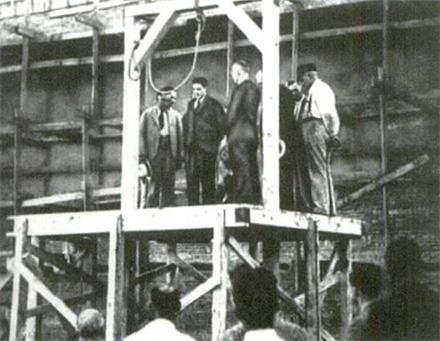
Gooch’s life and case are the focus of this 125-page Master’s thesis (pdf), but the long and short of it is that Gooch and a buddy named Ambrose Nix were on the lam after busting out of the Holdenville, Okla., jail, and ended up heading south to Texas.

They committed a robbery in Tyler, Texas on November 25, 1934. The next day, while stopped with a flat at a service station in Paris, Texas — close by the Texas-Oklahoma border — two policemen approached the suspicious vehicle. In the ensuing struggle, Nix managed to pull a gun on everyone and force the subdued cops into the back of their own patrol car, which the fugitives then requisitioned to high-tail it over the Oklahoma border. There they released their captives unharmed. There had never been a ransom attempt.

A month later, Gooch was arrested in Oklahoma — while Nix died in the shootout, leaving his partner alone to face the music.

Arthur Gooch was a career criminal, and the fact that he violated the Lindbergh Law was easy to see, but his crime also wasn’t exactly the scenario that legislation’s drafters had foremost in mind. In fact, Gooch also underscores one of the oft-unseen dimensions of the death penalty in practice: the discretionary power of prosecutors and judges at the intake end of the whole process.

Gooch attempted to plead guilty to his charge sheet, but his judge, former Oklahoma governor Robert Lee Williams, refused to accept it. Williams was explicit that his reason was that the Lindbergh Law’s language required a jury verdict to impose a death sentence.

By contrast, in October of 1934 — a month before the legally fateful confrontation at the Paris service station — a black farmhand named Claude Neal suspected of the rape-murder of a white girl was dragged out of protective custody in Alabama and taken across the adjacent Florida state line, where an angry mob lynched him. Despite the urging of the NAACP, FDR’s Attorney General Homer Stille Cummings completely refused to interpret Neal’s abduction as a Lindbergh Law kidnapping. The two cases even turned on the same phrase of the Lindbergh statute: interstate kidnapping “for ransom or otherwise.” While Cummings decided pre-emptively that “or otherwise” didn’t cover lynch law, one of his U.S. attorneys would go to the Supreme Court in January 1936 to argue for a broad interpretation of that phrase in the context of Gooch’s appeal.

But even without a comparison to Claude Neal’s murder, the justice of executing Arthur Gooch was hotly disputed by a vigorous clemency campaign. The chance intercession of a state line had elevated a small-time crime committed further to avoiding arrest into a capital offense, basically on a technicality. “It would be a rotten shame to hang that boy when a short jail term is his desert,” one Oklahoma City society woman argued to the Jeffersonian Club. “Gooch was given an application of the poor man’s law.” It seems clear that for Judge Williams as for President Roosevelt (who denied Gooch’s clemency appeal) the result was heavily influenced by the political exigencies of pushing a tough-on-crime standard, and by Gooch’s previous history as a crook. (He’d broken out of jail in the first place because he was a member of a group of local hoods in Okmulgee that committed several armed robberies.)

Gooch was philosophical at the end. “It’s kind of funny — dying,” he mused. “I think I know what it will be like. I’ll be standing there, and all of a sudden everything will be black, then there’ll be a light again. There’s got to be a light again — there’s got to be.” We can’t speak to what Gooch saw after everything went black, but it definitely wasn’t “all of a sudden”: Oklahoma’s executioner, Richard Earnest Owen, was an old hand with his state’s electric chair, but the federal execution method was hanging, which Owen had never before performed (and never would again). Gooch took 15 minutes to strangle at the end of the rope.


Arthur Gooch on the gallows

* The Kelley kidnapping, unsolved for several years, eventually traced to the strange character Nellie Muench. Readers (at least stateside ones) who follow that trailhead should be sure to keep an eye out for the cameo appearance of Missouri judge Rush Limbaugh, Sr. — grandfather of the present-day talk radio blowhard.

On this day..

1948: Kiralyfalvi Miklos, Hungarian Catholic

London Times, June 9, 1948:

SCHOOLS DISPUTE IN HUNGARY
CARDINAL’S REPLY TO MINISTER
CATHOLICS’ CONCERN

BUDAPEST, June 8
The village priest and other persons held responsible for the murder of a policeman and the wounding of two others in a village in north-east Hungary last Sunday will be tried in Budapest on Thursday.

The letter of protest from the Minister of Education to the Primate, Cardinal Mindszenthy, says that the villagers had clearly been aroused to violence by the priest’s sermon, in which he spoke against the projected nationalization of the schools. They went straight from church to the mayor’s house and the municipal buildings, where the council had voted by a majority in favour of the nationalization, and the policeman was killed while trying to protect the mayor. The Minister asked the Cardinal to put an end “by central decree” to this pulpit agitation, adding: “If not, the responsibility will be shifted where it belongs, and the law will be evoked upon all who continue it or direct it.”

The Cardinal, in his reply, says that he knows no more of the incident than is contained in the Minister’s letter, and therefore can take no stand upon it. He adds that the idea of nationalization is still causing great excitement among Catholics all over the country, an that the only way to end the excitement is to abandon nationalization. He denies that the agitation is directed centrally (that is, by himself), and puts the responsibility on those who “insist on putting forward such provocative measures.”

Church’s Divine Right

The Primate has already refused to follow the example of the Protestant churches, which have agreed with the State that nationalization shall go through, but that their ancient seminaries shall be excluded and the teaching of religion in the schools continued, and that the State shall grant them a large annual payment, gradually decreasing, for 25 years. On the contrary, in his third pastoral letter, which was read in all Catholic churches on Sunday, the Cardinal said that nationalization violated natural law and the Church’s divine right.

People were saying, the pastoral letter continued, that it was now time for the State to take over; but certain principles, among them the ten Commandments, were timeless. It called upon the faithful “to pray for strength to resist with all their might this violation of the immortal soul.” Never had the shameful misleading of the people been so great in Hungary as now. The faithful must refuse to allow their families to read the newspapers of those who opposed their faith, and must offer a Novena to God that the “Satan prowling among us like a roving lion may be driven away.”

It is in this guise that the Cardinal sees the Communists. They see him as an inflexible survivor of the Middle Ages.

It was in the village of Pocspetri that all the trouble went down: a march to the local municipal building to protest school nationalization. For years after, Pocspetri would be shorthand (Hungarian link, as is the next) in the official press for any clerical backlash — something right out of the Middle Ages.

Kiralyfalvi, at his trial

At the end of this march, a policeman was dead. It’s alleged now — in anti-communist post-Cold War Hungary — that what really happened was that one of the policemen deployed for crowd control accidentally triggered his own gun and killed himself with it.

Whatever occurred in the march, it was a productive incident for Hungarian communists then executing their political takeover of Hungary. The resulting show trial (more Hungarian) is sometimes seen as one of the signal events in a concomitant crackdown on organized religion — a potential pole of opposition to the Soviet-backed state. The victim, of course, enjoyed the fallen cop’s prerogative, a fast-track beatification by the propaganda ministry. (No need for Hungarian to get the point of the pictures in this pdf.) Miklos Kiralyfalvi got the death sentence, but the prerogatives the church was focused on — those were the real prize.

London Times, June 12, 1948:

MURDERED HUNGARIAN POLICEMAN
PRIEST SENTENCED TO DEATH

BUDAPEST,June 11
Janos Astezlos, the priest whose trial on a charge of inciting his villagers to the murder of a policeman began here yesterday, was sentenced to death this afternoon. The villager who actually killed the policeman was also condemned to death, and of the other four who took part one received life imprisonment and the other three 12 years.

Such, five days after it happened, is the end of this affair, though not of the dispute that lies behind it. In this week’s edition of the Catholic weekly Hazank Mr. Barankovics, head of the Catholic Party in Parliament, which has at least 16 per cent of the country’s votes, writes that a true Christian is bound to defend the right of the Catholic Church to keep the schools, because once they were lost the Church would have nothing left to do but celebrate Mass, and its whole cultural influence would be gone. “Whoever is our leader,” he says, referring to rumours that he disagrees with the Cardinal, “we are bound to act in the same way.” Of the murder the newspaper writes that the Church never counselled violence and regrets deeply what happened.


BUDAPEST, June 11. — The villager accused of killing the policeman was hanged here tonight. -Reuter.

(The priest’s sentence was commuted to a prison term. Only Kiralyfalvi was executed for the Pocspetri murder.)

On St. Stephen‘s Day 1948, Cardinal Mindszenty himself was arrested for treason. This was old hat for the cardinal; he’d been arrested for opposing Bela Kun‘s interwar people’s republic, and arrested again by the Nazi collaborationist government in 1944.

This time, he copped a life sentence.

Briefly released during the 1956 Hungarian Revolution, Mindszenty fled to the American embassy as Soviet tanks subdued the country. He would live on the embassy grounds for the next 15 years, a potent symbol of living martyrdom against communism until he was finally released to Vienna.

If your Magyar is up to snuff, this documentary on the Pocspetri incident might be enjoyable.

On this day..

1902: Hirsh Lekert, Jewish assassin

On this date in 1902, the Jewish socialist Hirsh Lekert was hanged in Vilna (Vilnius) for his attempt on that city’s governor.

The 22-year-old shoemaker, active in the Bund since childhood, was aggrieved along with many others by repressive measures taken against that leftist council by Vilna governor Victor von Wahl — culminating with the calculated humiliation he inflicted by personally overseeing the flogging of 20 Jews and 6 Poles arrested at a May Day demonstration.

As was the style at the time, Lekert took some retaliatory potshots at the municipal dictator on May 18, 1902. He scored a couple of flesh wounds before the police on hand beat him all to hell.

And that was pretty well that. Lekert got sent to face a military tribunal with a foreordained result. But he made his bones with posterity by refusing to apologize and instead fearlessly vindicating his action as a defense of the Jewish worker’s dignity.

This carried his legend in the early 20th century Jewish community much further than one might assume.

For Jewish Workers Bund, “the first great attempt at the organization of the Jewish masses for secular and independent political activity,”* Lekert’s uncompromising embrace of revolutionary violence created an internal controversy: radical workers saw a martyred hero; elites, and the Bund officially, were much more wary of terrorism provoking official backlash in an empire where Jewish communities were still liable to be targeted by pogroms at any time. All this during a renaissance of cultural and political thought among Eastern European Jewry.

Even decades later, the esteem remaining Lekert from his sacrifice gave his name power. Another generation of Jewish terrorists — in Mandate Palestine — was incensed at the British for flogging some Irgun members, leading Menachem Begin to invoke Lekert as his justification for kidnapping several British soldiers and flogging them. (Source) The British had no stomach for this, and desisted with floggings.

Artistic tributes followed as well — folk songs; plays by Arn Kushnirov and H. Leyvik; the bust that illustrates this post; a monument in Soviet Minsk; even this appearance in a 1927 silent film called His Excellency:

And from the hellish Vilna Ghetto under Nazi occupation, the great poet of the Holocaust Abraham Sutzkever depicted his “Teacher Mira” trying to keep her students’ heads up by reminding them of the Vilna cobbler who fought back.

Her skin, a windowpane in stains of dusk,
Mira must not reveal the darkness thus.
She bites her lip, of courage she will tell:
About Hirsh Lekert, how he fought and fell.

* Koppel Pinson, “Arkady Kremer, Vladimir Medem, and the Ideology of the Jewish ‘Bund'”, Jewish Social Studies July 1945.

On this day..

1715: Margaret Gaulacher, Cotton Mather ignorer

American poet Jill McDonough wrote this moving sonnet to the Irish servant Margaret Gaulacher (sometimes also called Margaret Callahan), who was hanged on this date in 1715 for the infanticide of her (ill-)concealed newborn.

June 4, 1715: Margaret Gaulacher
Boston, Massachusetts

The news that week includes a lyonefs
displayed, attacking Fowls and Catts. They watched
her feeding time, remarked on her mercilefs
cruelty. Meanwhile, Cotton Mather preached
against Hard-hearted Sinners, and Hardnefs of Heart.
He helped with her confession, which reflects
on attempts to destroy her unborn child, a part
of her Wicked crime, completed through Neglect.
Now hers is a Stony Heart, of Flint. Ah! Poor
Margaret, behold: the congregation calls
on your wondrous Industry, Agony, your death four
days off. Pray for a Clean, and a Soft Heart; don’t fall
from this fresh gallows to the Mouths of Dragons,
unconcerned, adamant, so little broken.

I believe the poet here may be getting “June 4” here from the Espy file of historical U.S. executions. Unfortunately that date is not correct; it’s unequivocal in primary colonial news accounts that this hanging occurred on Thursday, June 9.*

But McDonough is spot on about the Cotton Mather vs. Hard-hearted Sinners theme of the execution. That vigorous gallows evangelist favored — he surely thought it was “favored” — the poor condemned wretch with every exertion private and public of his considerable rhetorical powers to save her soul ere she swung.

Gaulacher never quite submitted in the way Mather thought a proper condemned woman ought.

The illiterate woman signed off on an obviously Mather-written statement admitting the justice of her sentence and warning (as was standard scaffold fare) any hearers against her iniquities: “Swearing and Cursing … Profanations of His Holy Sabbaths … Rebellion against my Parents … the Sins of Unchastity.” But this pro forma gesture was the end of it; she obdurately refused to make a public show of Mather-friendly contrition and continued to show in private an unbecoming bitterness at her execution — in Mather’s eyes, clear evidence that she had not made a proper peace with her maker.

We have no access to the hanged woman’s inner life save via an interlocutor who obviously wasn’t on her same wavelength. Maybe she loved her unchaste carnal life too much to part with it in resignation. Likely, though she kept her Catholicism hidden from Mather, she didn’t feel right at home with the stridently Protestant settlement’s rituals and its congregationalist conversion milieu. Like them or not, however, she had to endure them: within a month of Margaret Gaulacher’s hanging, a book of two lengthy Cotton Mather sermons delivered to her in the presence of the entire congregation of Boston’s Second Church was being advertised for sale.

The text below consists of extracts from those two sermons — the parts where Rev. Mather gets personal and directly addresses his charge — surmounted by the explanatory introduction. Mather’s deep conviction that Gaulacher’s soul is in dreadful peril leaps from the page; so too does the silent prisoner’s rejection. The full publication can be perused in pdf form.


The OCCASION.

What gave Occasion to the Sermons here Exhibited, was an Amazing Instance of what the poor Chidlren of Men abandoned unto Ignorance and Wickedness may be left unto! A prodigious Instance of that Hardness of Heart, which especially the Sins of Unchastity, accompanied with Delays of Repentance, do lead unto.

Margaret Gaulacher, an Irish Woman, arrived the last Winter from Cork in Ireland, a Servant, that soon found a Place in a Family where she would not have wanted Opportunities and Encouragements for the Service of GOD.

She had been by her part in a Theft brought into Trouble in Ireland; and after her Transportation hither, it was not long before she was found in Thievish Practices.

Ere she had been long here, it was begun to be suspected, that she was with Child, by a Fornication; But she so Obstinately all along denied it, that at last she must feel the Effects of her Obstinacy.

She was delivered of her Illegitimate, when she was all alone; and she hid the Killed Infant out of the way; which was within a little while discovered.

Of her Behaviour in the Time of her Imprisonment, and of the Means used for her Good, there is an Account given in our Sermons.

The Woman was of a very Violent Spirit; and the Transports and Furies thereof, sometimes were with such Violence, as carried in them, one would have thought, an uncommon Degree of Satanic Energie.

By’nd by, she would bewail her Passions, and promise to indulge herself no more in such Passionate Outrages. One who owns himself to be a Roman-Catholick, affirms to me, that she privately Declared herself unto him, to be in her Heart, of his Religion; But she never would own any thing of that unto the Ministers who visited her with the Means of her Salvation.

A Gracious and Worthy Servant of God, Mr. Thomas Craighead, (a Faithful and Painful Minister of the Gospel, who came from Ireland, much about the same time that she did) having Instructed her, and used many Charitable Endeavours for her Good, was desired by her to be near her at her Execution; who accordingly Pray’d with her there, and continued his Instructions unto the Last.

She said little, but reff’d herself to the Paper which had been read Publickly in the Congregation just before.

And yet she Frowardly let fall one Word, which did not seem very consistent with it; For which fretful Strain of Impatience, being rebuked, she added, Then the Lord be Merciful unto me! and spoke no more.

All that remains for us to do, is to leave her in the Hands of a Sovereign GOD, whose Judgment, and not ours, has the Disposal of her; and make the best Improvement we can of such a Tragical Spectacle; for which the ensuing Sermons are some Essays.

But, I ought now if I can, to Refresh my Readers, with something that shall be more Agreeable, more Comfortable; have less to Trouble them; something that may be the Reverse of so shocking a Spectacle, as has here given Troublesome Idea’s unto them.

Of this we have a very Tragical Instance now before our Eyes. One who by hardening her Heart has brought herself into wonderful Mischief; and continues to harden her Heart, after the wondrous Mischief has come upon her like a Whirlwind from the Lord.

Ah, poor Creature; Thou hast been Guilty of many Sins, and Heinous ones. But, Oh! Don’t add this to all the rest, this Comprehensive one, this Atrocious one; To harden thy Heart after all, and so to bind all fast upon thy Soul forever.

God has done a dreadful Thing upon thee, in leaving thee to a Crime for which thou art now as one Wicked overmuch, to Dye before thy Time, and e’re twenty five Years have rolled over thee, the Sword of Justice with an untimely Stroak must cut thee off. But it will be a much more dreadful Thing, if thou art left after all unto an hard Heart, that will not Repent of thy Abominations, and of thy Bloodguiltiness.

f thou hadst not hardened thy own Heart exceedingly, Oh! what Things would be seen upon thee; other Things than are yet seen upon thee! Verily, A soft Heart would Mourn and Weep and Bleed, for a Life sweell’d away in Sin against the Glorious GOD. A soft Heart would soon Drown thee in Tears, from the View of the doleful Things thy Sin has brought upon thee. A soft Heart would make thee own the Justice of God and Man in what is now done unto thee; and would Silence thy Froward and Fretful and Furious Gnashing upon such as thou has no Cause to treat with so much transported Fury.

It breaks the Hearts of the Good People in the Place, to see thy Deplorable State: They are concerned, when they see thy Lamentable State: But above all, to see, that thou art thyself no more concerned for it; no more affected with it; so little Broken in Heart. And shall not thy own Heart at length be Broken, when thy own State comes into thy Consideration?

One once could say, God makes my Heart Soft, and the Almighty Troubles me. And will it not make thy Heart Soft, when thou thinkest on the amazing Trouble, which thou shalt feel from the Wrath of the Almighty GOD, if thou Dye in thy Sins? Verily, All the Sorrows thou seest here, are but the Beginning of Sorrows, if thou art not by a broken Heart prepared for the Salvation of God.

But then, What an Heart-breaking Thought is this? Margaret, There is yet Mercy for thee, if thou wilt not by an hard Heart refuse the Mercy; The Mercy, thro’ which Rahab the Harlot perished not; The Mercy, thro’ which Mary Magdalene had her many Sins forgiven her; This Mercy is ready to do Wonders for thee. A Merciful Saviour Invites thee; O come unto me, and I will do Wonders for thee.

Come and fall down before Him, and beg the Blessings of a soft Heart at His Gracious Hands. I know not of any Advice that can be so Proper, or so Needful for thee, as this; No Prayer of so much Importance to be made by thee as this.

The Ignorance which lays Chains of Darkness upon thee, is a sore Encumbrance on thy Essays for turning to God. Yet thou art not so Ignorant, but thou canst make this Petition to thy SAVIOUR. Lord, soften this hard Heart of mine! And, Lord, Bestow a New, and a Clean, and a Soft Heart upon me! And, God be Merciful to me a sinner; yea, an Hard-hearted Sinner!

Now, May the Gracious Lord accordingly look down upon thee.

of those who are sure of having the Arrest of Death presently served upon them, there is none that has a more affecting Assurance of it, than a poor Daughter of Death, who is this Afternoon to have her Soul Required of her. Ah! poor Creature! Dost not thou fear God, seeing thou art under a Condemnation, to a Tragical Death which is to be this Afternoon executed on thee; and within three or four Hours, thy Soul will be Required of thee; within three or four Hours thy Soul must make its Appearance before a Terrible GOD! Oh! What, what will be the Condition of that Perishing Soul, if no Fear of God be found in it, when it Appears before him? —

There is indeed a vast Abundance even to a Profusion, of Instructions, bestow’d more Privately on such Malefactors as Dye among us: No Place upon Earth does equal this Place for that Exercise of Charity. And this poor Creature has had a very particular Share thereof: Not only have the Ministers of the Gospel done their Part, in Visiting of her, but also many Private Christians have done theirs, in a most Exemplary manner. As of old in Jersualem it was the Usage of the Ladies, to Prepare for the Dying Malefactors, that Potion which was called, The Wine of the Condemned, so the Young Gentlewomen here in their Turns, have Charitably gone to the Prison every Day for diverse Weeks together, and because of her not being able to Read, have spent the Afternoons in Reading Portions of the Scriptures, and other Books of Piety, to this Condemned Woman, and giving their Excellent Councils unto her. Nevertheless, we chuse in a more Publick way also to direct a few Words of our Sermons, unto such Persons, when we have them among our Hearers; Because, the Preaching of the Gospel, is the Grand Ordinance of our Saviour, for the Conversion of a Sinner from the Error of his way; an we would wait upon our Glorious LORD, in that way which he has Ordained, hoping, still hoping, to see a Soul saved from Death!

Wherefore once more, O miserable Woman, entering into an Eternity to be trembled at; Once more, thou shalt hear the Joyful Sound of the Gospel, inviting thee to the Fear of God, and the Faith of thy only Saviour. And if there be not in this Last Essay, a more saving Impression from the Glorious Gospel of the Blessed God made upon thee, than thou hast yet felt from any former ones, — Oh! the dreadful, dreadful Consequences! What will become of thee! — Can thy Hands be Strong, or can thy Heart endure, in the View of what a Terrible GOD will order for thee? — Behold, Ah! poor Margaret, Behold a mighty Congregation of People, with Hearts Bleeding for thee, and Wishing and Praying and Longing to see the fear of God making some Discoveries in thee. And shall thy Heart still remain unaffected with thy own Condition; discovering still a total Estrangement from the fear of God! No Tears are enough, Tears of Blood were not enough, to be employ’d on so prodigious a Spectacle!

I am sorry, I am sorry, that I find myself obliged so much to speak it. Even since thou hast been under Condemnation, thou hast not feared God. Not many Hours are passed, since I saw in thee, so much Rage, and so Unrighteously harboured, and so Indecently Vomited, against some Vertuous Children of God, that it was too Evident, this fear of God had not yet begun to soften thee.

But if the fear of God enter not into thy Soul, before thy Soul be driven out of thy Body, which will be now, — alas, before many Minutes more be expired, thy Desolate, Forsaken, Miserable Soul, can have no part in the Kingdom of God. My Soul cannot be safe, if I forbear to tell thee so!

Ah, poor Creature, Art thou wiling to Dye unreconciled unto the God, whom thou hast Affronted with infinite Provocations? To Dye, and all into the Mouths of Dragons, who have so long poisoned thee, and enslaved thee? To Dye and be cast into the Eternal Burnings, from whence the Smoak of the Torment will ascend forever and ever? What? Shall all the Means of Good, which in a Religious Place have been used for thee, with hopes that they might find out one of the Elect of God, serve only to aggravate thy Eternal Condemnation at the last? Oh! Dreadful Consideration!

But, Oh! Be Astonished at it! There is yet a Door of Hope set open for thee; It will for one Hour it may be, stand open yet! Oh! Be full of Astonishment at such an Heart-melting Declaration, as is now to be made unto thee. A Compassionate SAVIOUR, is yet willing, to Cleanse thy Soul with His Blood, from the Sins, which by casting off the fear of God thou hast fallen into; yet willing to create in thee a Clean Heart that shall be filled with the fear of God, if he be sought unto; yet calling to thee, O look unto me and be Saved! And yet affording unto thee that Encouragement, in Joh. VI. 37. He that cometh unto me, I will in no wise cast out.

And, Oh! What wilt thou now do under these Astonishing Invitations? Wilt thou not improve these few Minutes with a most wondrous Industry and Agony? Do so, and be no longer such an Hard-hearted Prodigy! Fall down before thy SAVIOUR, and cry out; O my Saviour, Take pitty on my Soul, and now at the Last, let Sovereign Grace break forth, with a good Work of thy fear in my Soul! Cry out, O my Saviour, Let my Sin be all pardoned, and let all Sin be as Abominable unto me, as it is unto all that fear thy Name! Let thy Outcries pierce the very Heavens.

But, be it known unto thee, If the fear of God be in thee, it will be a thing more Bitter than Death unto thee, that thou hast Sinned against His Glorious Majesty; Thy Malice against every Neighbour will be extinguished; Thou wilt submit with Patience, to the Punishment of thy Iniquity; And thou wilt be an Holy, Humble, Thankful Soul, and quite another Creature! — God of His Infinite Mercy make thee so!

* n.b. — a Julian calendar date, as were all British colonies until England herself transitioned to the Gregorian calendar in 1752.

On this day..

1989: Stefan Svitek, the last in Czechoslovakia

The last execution in the history of the former state of Czechoslovakia occurred on this date in 1989.

Staggering home extremely drunk late one autumn night, Å tefan Svitek (English Wikipedia entry | Czech) found the door locked and the pregnant Roma wife he regularly battered disinclined to open it.

So Svitek opened it himself by grabbing an obliging ax and splintering it to pieces.

Then he turned the ax on poor Marie and the family’s two daughters.*

Even the most aggressive executioners — and Czechoslovakia was not that — don’t hang every homicide. Svitek might have doomed himself in the final analysis with his disturbing sexual proclivities, especially since they surfaced during his rampage. He reportedly carved up the bodies, sliced off his late wife’s breasts and even cut the still-stirring embryo of his next child out of her womb, and pleasured himself over all the fresh gore. He would later describe it as the most intense sexual experience of his life.

It emerged at trial that Svitek’s youth in an alcoholic home had warped his animal urges so severely that he turned his lust upon animals, taking special gratification in castrating them.

This last operation Svitek also perpetrated on his own self as he fled in panic from his domestic charnel house. He also attempted to commit suicide by hanging.**

Svitek broke that rope. On the 8th of June in 1989, he did the same (metaphorically) to Czechoslovakia’s.

Svitek’s hanging June 8, 1989, was not only the last ever in the soon-to-be-defunct Czechoslovakia, but the last associated with either of Czechoslovakia’s successor states, neither of which have the death penalty on the books. (Svitek was hanged in Bratislava, the Slovakian capital; the last execution in the Czech half was that of Vladimir Lulek earlier in 1989.)

Update: Documentary, in Slovak (via the Twitter machine).

* One was Svitek’s own child, the other was his wife’s by her previous marriage. They were four and six years old.

** Another possible kink?

On this day..

1155: Arnold of Brescia

At some point in the first weeks of June 1155 — nobody knows the exact date, but it precedes June 18 — the Roman authorities disposed of Arnold of Brescia.

For a decade the tongue of a fragile new Roman Republic, Arnold was a student of the cutting-edge theologian (and castrated romantic) Peter Abelard. Arnold held the temporal pretensions of the Vatican invalid, a theology sublimely according with the popular revolt that from 1143 overturned Rome’s overweening princes and even slew a pope in a melee on the Capitoline.

The Senate long forsaken was re-founded by this new Republic and an equestrian order re-founded to resume to the rights of a now-growing middle rank. The slain pope’s successor became a refugee tenant of the neighboring cities, orchestrating crusades against Turks, Moors, and Wends — but dying at Tivoli in 1153 still awaiting a prince who would restore his own person to the authority of the Eternal City.

That prince, however, had just begun to stir. The Hohenstaufen king Frederick I had concluded in the months before Pope Eugenius’s death a compact to restore the pontiff, which policy dovetailed nicely with an intent to show the German power against other wayward cites in Italy. It was Frederick’s Italian subjects, and conquests, who gave this man the distinctive name by which history recalls him: Barbarossa, or “red-beard”.

All these years — or at least, from 1145, when he surfaced in the rebellious city from past years’ exile in Zurich — Arnold of Brescia’s “eloquence thundered over the seven hills.” (Gibbon)

Blending in the same discourse the texts of Livy and St. Paul, uniting the motives of Gospel, and of classic, enthusiasm, he admonished the Romans how strangely their patience and the vices of the clergy had degenerated from the primitive times of the church and the city. He exhorted them to assert the inalienable rights of men and Christians; to restore the laws and magistrates of the republic; to respect the name of the emperor: but to confine their shepherd to the spiritual government of his flock. Nor could his spiritual government escape the censure and control of the reformer; and the inferior clergy were taught by his lessons to resist the cardinals, who had usurped a despotic command over the twenty-eight regions or parishes of Rome.

The absentee pope excommunicated Arnold in 1148. It was to no effect until Barbarossa’s legions neared the city.

As King Frederick approached, Pope Adrian IV* applied a deft turn of the screw by laying Rome itself under an interdict, depriving his quarrelsome flock of both spiritual balm and pilgrim revenue and at long last forcing the heresiarch’s ejection.

Arnold was seized in Tuscany and delivered to the Roman curia for punishment; the record of when or where this occurred is lost, but it is specified in the particular that his corpse was reduced to ashes that were scattered to the Tiber — proof against the prospect of a plebeian graveside shrine.

On June 18 even as his soldiers tamed Rome’s resisting republicans, Barbarossa accepted the crown of the Holy Roman Empire from the hands of Pope Adrian in St. Peter’s Basilica.**

Though Arnold had vanished into the Tiber’s silt, the thirst of his former flock for spiritual succor beyond that which the worldly Vicar of Christ could offer did not die so easily. Succeeding movements — indeed, perhaps, one continuous movement — took up Arnold’s objection to the clergy’s worldly emoluments and his summons to plain virtue. There are the Arnoldists to start with, but a bare few years after Arnold’s death emerge Peter Waldo of the heretical Waldensians, as well as the Cathars in southern France; a generation on finds St. Francis of Assisi, giving way to 13th and 14th centuries thick with oft-suppressed popular reform currents — the Beguines, the Apostolic Brethren, even the Fraticelli who criticized other followers of the aforementioned St. Francis for having already abandoned the poverty of his order.

Later Protestants would claim all these, and Arnold too (Arnold reportedly opposed infant baptism), as their forebears, which is why we have the nice Colosseum’s-shadow picture above from Foxe’s Martyrs’ Mirror. Just how literally one should take that lineage might be a matter of debate, but there is little doubt that Arnold of Brescia’s critique maintained its potency into that era and keeps it still in the modern age — one reason that the incinerated firebrand could still make a powerful subject for a risorgimento writer like Giovannini Battista Niccolini 700 years later.

* Born Nicholas Breakspear, Adrian remains to this day the only English pope ever.

** Popes and Holy Roman Emperors were most usually rivals rather than allies in peninsular politics; indeed, the Roman Republic had issued its own summons to Frederick’s predecessor to come to its aid — and rule Rome with its support — to humble the pretensions of the papacy. Arguably, Barbarossa missed a trick by not availing that potential alliance and instead exalting the pontifex maximus in the manner of his coronation: Barbarossa probably thought so himself often enough during his running rivalry over the ensuing generation with Pope Alexander III.

On this day..

1850: Five Cayuse, for the Whitman Massacre

On this date in 1850, five Cayuse were publicly executed in Oregon City for the Whitman Massacre.

Beginning in earnest in the 1830s, Anglo settlement in the Oregon Country presented for the native inhabitants of the Pacific Northwest the same Hobson’s choice that had confronted tribes further east long before: resist or accommodate.

The New York-born couple Marcus and Narcissa Whitman* were two of the most notable figures among the hundreds, and then thousands, of settlers pouring into the territory every year. In 1836, they founded on the banks of the Walla Walla River a Christian mission to the nomadic Cayuse who roamed the territory. It’s in present-day Washington State, which was then part (with the current U.S. states of Oregon and Idaho) of a single frontier territory collectively known as Oregon.

The Whitmans’ early settlement, offering medicine, education, and (of course) proselytizing, proved a success at first; it would become for several years a waypoint on the developing Oregon Trail.

White diseases came with the settlers.

The Cayuse people had already dwindled (pdf) to just a thousand or two after the decimations of smallpox and other plagues swept the region in the decades preceding. Now, outbreaks of measles were ravaging those remaining.

Marcus Whitman, a doctor as well as a spiritualist, proved unable to check the new epidemic. Rumors went abroad that the missionaries were bewitching or poisoning the Cayuse, as the vanguard of a coming territorial conquest; the Whitmans themselves were very keen to the hostile feeling the situation had engendered and had even heard whispers that they were the targets of assassination plots. Bravely, they stayed.

“Perhaps God thought it for the best that your little child should be called away,” Narcissa Whitman said in strange consolation to the grieving mother of an Anglo child who also succumbed to measles in 1847. “It may calm the Indians to see a white child taken as well as so many natives, for otherwise we may all be compelled to leave within two weeks.” (pdf source, op. cit.; this document also reconstructs a detailed narrative of the unfolding tragedy)

But that remark was only days before the terrible November 29, 1847. On that cold autumn Monday, a small party of Cayuse led by a chief named Tiloukaikt fell on the mission and slaughtered both Whitmans plus another 11** inhabitants of the little compound.

Some 54 surviving women and children were taken hostage, and several of these died in custody as well. A Canadian official of the Hudson’s Bay Company hurried to ransom the captives at the price of 62 blankets, 63 cotton shirts, 12 muskets, 600 loads of ammunition, 37 pounds of tobacco, and a dozen flints.†

This quick response might have forestalled a worse tragedy for the missionaries — but as far as the Cayuse went, the die was already cast. A volunteer militia of Oregonians under Cornelius Gilliam soon mobilized to retaliate, driving many Cayuse into the Blue Mountains.

By mid-1848, spurred in part by the Whitman bloodbath, Congress officially incorporated the region as the Oregon Territory; arriving early in 1849, the new territorial governor Joseph Lane immediately opened negotiations with the Cayuse to hand over the perpetrators of the massacre. With federal troops arriving later in 1849, the Cayuse at last capitulated and gave up five warriors: Tiloukaikt, the leader; Tomahas; Kiamasumpkin; Iaiachalakis; and Klokomas. (There are numerous alternative transliterations of these names.)

They were tried in Oregon City, the territorial capital at the time — a town of 500 or so on the Willamette River Falls — in a landmark case: the first proper death penalty trial in the young territory.‡ This would fall a little short of modern standards, and not just because it was held in a tavern for want of a regular courthouse. The prosecution was not especially rigorous linking all the defendants to specific violent acts, but the defense’s recourse to Cayuse cultural practices that held shamans liable for the failure of their medicine conceded the point by implication. The judge‘s final instructions simply directed his jury to “infer” the defendants’ culpability by virtue of “the surrender of the Defendants by the Cayuse nation as the murderers, the nation knowing best who those murderers were.” So why even have the trial? Kiamasumpkin, against whom no evidence was ever individually presented, went to the gallows insisting that he didn’t even arrive to the Whitman Mission until the day after the massacre.

All five were condemned in the end, and executed by prominent early pioneer and lawman Joe Meek.§ “On the 3d of June an election and a hanging match took place at Oregon City,” ran the Aug. 22, 1850 story in the New York Tribune — for the Whitman massacre had been a matter of national interest. “The town was full of men and women, the former coming to see how the election resulted, and the latter to see how the Indians were hung.”

“Their tribe, the Cayuses, gave them up to keep peace with the whites. Much doubt was felt as to the policy of hanging them, but the popularity of doing so was undeniable.”

Fears that the quintuple hanging would stoke a running conflict with the Cayuse were not altogether misplaced, but over the subsequent years the dwindling tribe was simply dwarfed by over 30,000 newly arriving settlers lured by a congressional grant of free land. By 1855, the defeated Cayuse were forced onto the small Umatilla Reservation, ceding (along with the Umatillas and the Walla Wallas) 6.4 million acres to whites. The Cayuse tongue was extinct by the end of the century.


Present-day memorial obelisk at the site of the Whitman Massacre, now a national historic site. (cc) image from Jasperdo.

* Present-day Whitman College (Walla Walla, Wash.) is named for them.

** Figures of both 13 and 14 (inclusive of the Whitmans) are cited in various places for the Whitman Massacre’s body count; the discrepancy turns on whether one’s tally includes as a casualty Peter Hall, who escaped from the mission, fled to Fort Walla Walla, and then made a panicky attempt to reach The Dalles. Hall disappeared into the wilderness, and was never heard from again.

† Ransom covered gratis by the Hudson’s Bay Company.

The Espy file‘s index of U.S. executions lists only a couple of undated executions many years before under informal frontier justice.

§ Cousin to the recent First Lady Sarah Childress Polk.

On this day..

1690: Old Mobb, witty highwayman

On this date in 1690, according to the Newgate Calendar,* the venerable gentleman rogue Thomas Sympson — better known as Old Mobb — was hanged for robbery.

Old Mobb — at least, the stylish and erudite version of the man given us in the Calendar — preyed the roads of late 17th century England for many a year, perhaps all the way back to the ill-fated reign of Charles I.

His rollicking adventures could have formed the fair corpus of a durable legend; in some alternate world Ainsworth chose Old Mobb as for Rookwood and it is he and not Dick Turpin who has the television serial and the pub nameplates.

A nobleman Sir Bartholomew Shower, whose name might also be the safeword at a leather masquerade, was apprehended by Old Mobb one day nearly penniless as to his person; taking exception at being shorted by such a wealthy grandee, Mobb forced him to write up a bill for 150 quid to draw on the goldsmith of nearby Exeter, leaving Shower trussed up under an obliging hedge “as security for the payment” while he went into town to cash the cheque.

The annals have next a widow, bound for Bath no less in tribute to the classics, and had a jolly battle of the sexes with her over her condition which of course Old Mobb won, since he had the gun. His target, you see,

wept very plentifully, in order to move him to pity; she told him she was a poor widow, who had lately lost her husband, and therefore she hoped he would have some compassion on her. “And is your losing your husband then,” says he, “an argument that I must lose my booty? I know your sex too well, madam, to suffer myself to be prevailed on by a woman’s tears. Those crocodile drops are always at your command; and no doubt but that dear cuckold of yours, whom you have lately buried, has frequently been persuaded out of his reason by their interposition in your domestic debates. Weeping is so customary to you, that everybody would be disappointed if a woman was to bury her husband and not weep for him; but you would be more disappointed if nobody was to take notice of your crying; for according to the old proverb, the end of a husband is a widow’s tears; and the end of those tears is another husband.”

The poor gentlewoman upon this ran out into an extravagant detail of her deceased husband’s virtues, solemnly protesting that she would never be married again to the best man that wore a head, for she should not expect a blessing to attend her afterwards; with a thousand other things of the same kind. Old Mobb at last interrupted her, and told her he would repeat a pleasant story in verse which he had learned by heart, so, first looking round him to see that the coast was clear on every side, he began as follows: —-

A widow prude had often swore
No bracelet should approach her more;
Had often proved that second marriage
Was ten times worse than maid’s miscarriage,
And always told them of their sin,
When widows would be wives agen:
Women who’d thus themselves abuse,
Should die, she thought, like honest Jews
Let her alone to throw the stones;
If ’twere but law, she’d make no bones.

Thus long she led a life demure;
But not with character secure:
For people said (what won’t folks say?)
That she with Edward went astray:
(This Edward was her servant-man)
The rumour through the parish ran,
She heard, she wept, she called up Ned,
Wiped her eyes dry, sighed, sobbed, and said:

‘Alas! what sland’rous times are these!
What shall we come to by degrees!
This wicked world! I quite abhor it!
The Lord give me a better for it!
On me this scandal do they fix?
On me? who, God knows, hate such tricks!
Have mercy, Heaven, upon mankind,
And grant us all a better mind!
My husband — Ah that dearest man!
Forget his love I never can;
He took such care of my good name,
And put all sland’rous tongues to shame. —
But, ah! he’s dead –‘ Here grief amain,
Came bubbling up, and stopped the strain.

Ned was no fool; he saw his cue,
And how to use good fortune knew:
Old Opportunity at hand,
He seized the lock, and bid him stand;
Urged of what use a husband was
To vindicate a woman’s cause,
Exclaimed against the sland’rous age;
And swore he could his soul engage
That madam was so free from fault
She ne’er so much as sinned in thought;
Vowing he’d lose each drop of blood
To make that just assertion good.

This logic, which well pleased the dame,
At the same time eludes her shame:
A husband, for a husband’s sake,
Was what she’d ne’er consent to take.
Yet, as the age was so censorious,
And Ned’s proposals were so glorious,
She thought ’twas best to take upon her,
A second guardian of her honour.

“This,” says Old Mobb, “is an exact picture of woman-kind, and as such I committed it to memory; you are very much obliged to me for the recital, which has taken me up more time than I usually spend in taking a purse; let us now pass from the dead to the living, for it is these that I live by. I am in a pretty good humour, and so will not deal rudely by you. Be so kind, therefore, as to search yourself, and use me as honestly as you are able; you know I can examine afterwards, if I am not satisfied with what you give me.” The gentlewoman found he was resolute, and so thought it the best way to keep him in temper, which she did by pulling out forty guineas in a silk purse, and presented them to him. It is fifty to one but Old Mobb got more by repeating the verses above than the poor poet that wrote them ever made of his copy. Such is the fate of the sons of Apollo. [dear reader, why not take this opportunity to click on an ad? -ed.]

We certainly have in these puffed-up knaves torn down for our amusement a little window into the romance of the road where by means of Stand And Deliver one attains the liberty to put put hypocrites in their place whilst usurping the abundance that is the latter’s usual wages.

Old Mobb robs a famous astrologer whose constellations fail to predict the engagement; to a doctor who upbraids him, he retorts, “I only take [my victims’] money away from them; but you frequently take away their lives: and what makes it the worse you do it safely, under a pretence of restoring them to health.”

As pieces de resistance, Old Mobb gets the better of two of Restoration England’s most infamous grandees.

The Duchess of Portsmouth, the widely hated French Catholic mistress to Charles II,** Old Mobb improbably manages to trap in her stagecoach giving him leave to excoriate her in words similar to those that real 17th century Britons must have muttered many times while in their cups. “I know you to be the greatest whore in the kingdom; and that you are maintained at the public charge. I know that all the courtiers depend on your smiles, and that even the K— himself is your slave,” Mobb says, rubbishing her sex and her nationality all at once. “That haughty French spirit will do you no good here. I am an English freebooter; and insist upon it as my native privilege to seize all foreign commodities. Your money indeed is English, and the prodigious sums that have been lavished on you will be a lasting proof of English folly; nevertheless, all you have is confiscated to me by being bestowed on such a worthless b—h. I am king here, madam, and I have a whore to keep on the public contributions as well as King Charles.”

The ruthless hanging judge Lord Jeffreys Old Mobb likewise pays in his own coin when Jeffreys threatens our marauder with potential damnation, speaking as it were through Jeffreys to the obsequious blackguards who afflict the public life of every time and place.

When justice has overtaken us both, I shall stand at least as good a chance as your Lordship; who have already written your name in indelible characters of blood, by putting to death so many hundred innocent men, for only standing up in defence of our common liberties, that you might secure the favour of your Prince. It is enough for you to preach morality upon the Bench, where nobody dares to contradict you; but your lessons can have no effect upon me at this time; for I know you too well not to see that they are only calculated to preserve money.

* The Newgate Calendar positively avers a hanging of Friday, May 30, 1690, but there are some complicating data points. There’s his purported campaign with William “the Golden Farmer” Davis, who was supposed to have left a parting note for Old Mobb upon Davis’s December 1690 execution. (However, 1690 was the year when May 30 was on a Friday, not 1691.)

The invaluable Old Bailey Online has none of this, though the date range is a period of spotty recordkeeping. It does give us a nondescript and lamely apologetic “Old Mobb” hanged on the 18th of September 1691; although this guy had done some highway robbery, he doesn’t otherwise bear an obvious resemblance to the Newgate Calendar’s colorful character. He might be the same guy, or they might just share a cant alias. “Mob” — short for mobilevulgus, the “fickle crowd” — was just establishing itself in English at this point with a usage a bit more flexible than it has for us today; our criminals’ point of contact might be simply that each lasted unusually long in the profession, and therefore each received a nickname meaning something like “Old Man”. Jonathan Swift complained bitterly of this truncated neologism in 1710, writing that “I have done my utmost for some years past to stop the progress of Mobb and Banter, but have been plainly borne down by numbers, and betrayed by those who promised to assist me.” (Sorry, buddy … English is a living language.)

At any rate, I don’t know whether Old Mobb is one guy or two, nor am I fully confident of the best date of execution. These are the least of our difficulties when it comes to veracity, considering that the man’s attributed exploits likely comprise 100% shameless fabrication. It’s just that kind of post.

** Careful how you speak of her: she’s an ancestor (via the late Princess Diana) of the current royal princes.

On this day..

1879: Troy Dye and Ed Anderson, estate salesmen

On this date in 1879, Sacramento County public administrator Troy Dye was hanged for murder, along with the Swedish goon whom he’d hired to do the dirty work.

A 36-year-old father of three, Dye was a prosperous tavern owner in the California capital who volunteered at the Sunday school. In 1877, voters entrusted him with the necessary public office of managing intestate estates.

In retrospect one can safely say that Dye was not cut out for the public trust.

The position entailed a percentage claim on the estate so handled, which meant in practice that it was a thankless burden for long periods when only paupers died without their wills made out, punctuated by rare jackpots when the occasional wealthy fellow kicked off without heirs.

San Francisco Bulletin, Aug. 16, 1878.

All Dye did was speed that cycle up a little, by arranging to murder a fifty-five-year-old bachelor in order to lay hands on his 650-acre farm and plunder the “rich old son of a bitch.”

Dye hired a Swedish sausage-maker named Ed Anderson and a young tough named Tom Lawton at three grand apiece to handle the labor.

For six hot summer weeks, Anderson and Lawton built a boat on Dye’s property with the one mission in mind. On July 30, they put it into the Sacramento River and rowed it downstream to the Grand Island orchards of their target, Aaron Moses Tullis. Under the guise of soliciting work, Anderson approached Tullis in his groves, and when the man’s back was turned, clobbered him with a blackjack. In the ensuing melee, Lawton, leaping into the fray from hiding nearby, shot Tullis through the throat, then felled him with a shot in the back, and finished him off with an execution-style coup de grace.

The two killers fled two miles down the river, where they ditched the boat. Their employer, signaling furtively by whistling, picked them up in a buggy and rode them back to Sacramento for celebratory oysters.

They wouldn’t be celebrating for long.

News of the murder puzzled the community as it got out. Tullis was wealthy all right, but his assailants had stolen nothing; he wasn’t known to have any enemies; and nobody had seen the riverborne assassins slip onto the property.

But within a few days, discovery of the abandoned boat led to the lumberyard that stamped its planks, and that led to the fellows who purchased it. Tom Lawton wisely used this tiny interval to leave California; Ed Anderson and Troy Dye stuck around and made national wire copy with their confessions before August was out.

Having spilled all the beans, Dye had only the feeblest of gambits remaining to avoid the noose.

At trial, Dye argued that the whole plan was the idea of the other two men, and he, Dye, was was just too damn weak-minded to say them nay.

At sentencing, Dye whined that the district attorney had induced him to confess by dint of a promise to let him walk.**

And during his appeals and clemency process he inconsistently shammed insanity, fooling nobody.

“A more pitiable object than Troy Dye, the assassin, never marched to the scaffold,” one observer noted of the pallid, stocking-footed figure whom the ticketed observers saw on execution day. (Quoted in this pdf retrospective on “one of the most shocking and melancholy episodes in the history of Sacramento.”)

Against Dye’s wheedling and quailing, Anderson cut a picture of manfulness. Even on the eve of the execution, while Dye was just this side of collapse, Anderson noticed the sheriff toting the hanging ropes and insisted on inspecting them, then shocked the lawman with a cool off-color joke.

But this was calm and not mere bravado. Time that Dye wasted in his simulated spasms was spent by Anderson with his spiritual counselor; his gracious last statement from the gallows confessed his guilt and begged forgiveness. “Troy Dye Dies, Anderson Ascends” ran the headline afterwards.

* A county clerk reached by the Sacramento Record-Union recalled a conversation that clouded suspiciously in retrospect: “he said that unless something turned up, that he would not make enough out of it to pay his expenses … I said to him: ‘You cannot tell when some one will die and leave a good estate.’ … he said he did not know of any one who was likely to die that was worth any amount except Mr. Tullis, down the river. He said he was an old man and drank a great deal, and was likely to die at any time, and that he was rich. If he should drop off and he got the estate, it would help him out.” (Reprinted by the San Francisco Bulletin, Aug. 15, 1878)

** That was indeed the case, as it seems that Dye’s confession revealed himself much more deeply involved than the prosecutor had previously assumed. This is why it’s much better to just shut up already.

On this day..

1213: Peter of Pontefract, oracle

On this date in 1213, the hermit Peter of Pontefract (or Peter of Wakefield) was hanged by King John.

Reluctant Magna Carta signer and ridiculous Robin Hood villain, John has never been the most highly regarded sovereign. (A recent BBC poll saluted him as the 13th century’s very worst Briton.)

The papacy ranked among John’s many irritants. A 1205 dispute with Pope Innocent III over the successor to the late Archbishop of Canterbury — John wanted control of ecclesiastical appointments in his own realm, a little preview of coming attractions in English history — extended so far as Innocent’s excommunicating John, and laying England under a papal interdict prohibiting administration of any sacraments save baptism and last rites. There’s no bargaining chip quite like “do what I say or everyone goes to hell.”

John didn’t sweat the eternal damnation stuff much but in 1212 the specter of war with France — gleefully justified by Philip II on grounds of the English king’s impiety — started twisting the screws a little. Philip had already seized English holdings in Normandy; now, he was gathering forces to invade across the English Channel.

With discontent already afoot among the domestic nobility, some of whom were extending feelers to King Philip, the Yorkshire hermit Peter ran out a prophecy that John’s crown would pass to other hands by the next Ascension Day — which happened to be Thursday, May 23, 1213.

Peter’s prophecy gained no little folk following, prompting John to take him into custody.

And here a prophet, that I brought with me
From forth the streets of Pomfret, whom I found
With many hundreds treading on his heels;
To whom he sung, in rude harsh-sounding rhymes,
That, ere the next Ascension-day at noon,
Your highness should deliver up your crown.

-Shakespeare’s King John

But days before the momentous date arrived, John resolved the crisis and saved himself from potential deposition with a timely submission to the papal legate Pandulf, before whom he dramatically laid the crown and resumed it pledging an annual tribute of 1,000 marks from the throne of England to that of St. Peter.*

This was either — take your pick — a deft political masterstroke instantly neutralizing the threats to John’s throne, or else it was a craven surrender to the Vatican.

Peter of Pontefract gives us a hint of a judgment on that question.

John held Peter past the May 23 date — and then, just for good measure, past May 27, for that had been the calendar date of John’s coronation in 1199, which was also Ascension Thursday that year, and had been floated as a fallback interpretation of the prophecy — the seer had been duly discredited and, being made ridiculous, could now be made an example of.

Or had he been?

For,

the wise and the foolish alike began to see that John had prevented a literal fulfilment of the prophecy by lending himself to a figurative one. He had ‘ceased to be king’ by laying his crown at the feet of Pandulf, to take it back again on conditions which unquestionably helped to fix it, for the time at least, more securely than ever on his brow. The scapegoat of all parties was the unlucky prophet himself. Next day he and his son, who had been imprisoned with him, were tied each to a horse’s tail, dragged thus from Corfe to Wareham, and there hanged. (Source)

* John stopped paying in 1214, and Innocent left well enough alone.

On this day..